
دليل شامل لمهنيي المشتريات: تقييم واختيار موردي جداول التشغيل عالية الجودة
Navigating the Operating Table Market: A Strategic Procurement Framework
Procuring operating tables is a critical capital expenditure decision for any healthcare facility, impacting surgical outcomes, workflow efficiency, and long-term operational costs. The global market is diverse, with suppliers ranging from premium European brands to value-focused manufacturers in Asia. For procurement officers, navigating this landscape requires a systematic approach that balances clinical requirements, budgetary constraints, and supply chain reliability. This guide provides a structured framework to evaluate and select the optimal operating table supplier for your institution's needs.
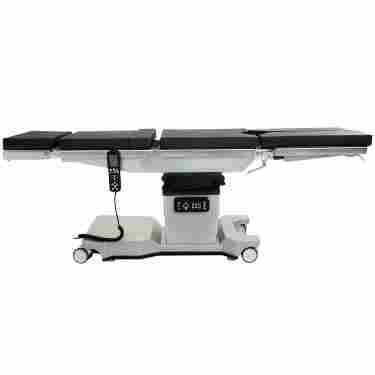
Modern electric hydraulic operating tables represent a significant investment. A thorough supplier evaluation is essential. (Image: Electric Hydraulic Operating Table)
1. Defining Your Clinical and Operational Requirements
Before engaging suppliers, clearly define your needs. This foundational step prevents costly mismatches.
- Surgical Specialty Focus: Identify the primary procedures. A general surgery suite has different needs than an orthopedic or neurosurgical center. Key types include:
- General Electric Operating Tables: For versatile multi-specialty use.
- Orthopedic Operating Tables: Require traction, lateral tilt, and often C-arm compatibility for imaging.
- Gynecological & Urological Tables: Need specific leg section articulation and lithotomy positioning.
- Interventional & Imaging Tables: Must be fully radiolucent and compatible with C-arms or other imaging systems.
- Bariatric Tables: Require higher weight capacity (often 500kg+) and wider surfaces.
- Technical Specifications: Detail power system (Electric, Electric Hydraulic, Manual), tabletop movement axes, weight capacity, and safety features (battery backup, emergency stop).
- Integration & Compatibility: Assess needs for compatibility with existing or planned C-arms, surgical navigation systems, OR integration suites, and accessory mounts.
2. The Core Evaluation Criteria for Suppliers
Move beyond basic product catalogs. Assess suppliers holistically across these four pillars.
2.1. Technical Capability and Product Portfolio Depth
A supplier's range indicates their expertise and ability to provide tailored solutions.
- Portfolio Breadth: Does the supplier offer a comprehensive range, from basic manual tables to advanced electric and specialty tables? A broad portfolio like that of YudaMedical, covering electric, electric hydraulic, orthopedic, and interventional models, suggests strong R&D and manufacturing flexibility.
- Innovation & R&D: Inquire about their R&D team size, recent product launches, and patent holdings. Suppliers with dedicated R&D, such as Shandong Yuda Medical Device Technology Group Co., Ltd., are better positioned to meet evolving surgical techniques.
- Customization & OEM/ODM Support: For projects requiring specific configurations or private labeling, verify the supplier's experience in OEM/ODM projects, documented quality control (QC) processes, and compliance-focused manufacturing.
2.2. Quality Assurance and Regulatory Compliance
This is non-negotiable. Certifications are the baseline proof of a commitment to quality and safety.
- Mandatory International Certifications:
- ISO 13485:2016: The international standard for quality management systems specific to medical devices. It ensures consistent design, production, and service.
- CE Marking (MDD/MDR): Essential for market access in Europe. Look for specific CIBG registration letters and Declarations of Conformity (DOC) for product families like operating tables and surgical lights.
- FDA Registration: Required for selling in the United States. Confirm active registration with the U.S. Food and Drug Administration.
- Factory Audit Readiness: Reputable suppliers welcome audits. Evidence of standardized production workshops, like those visible in YudaMedical's factory tour materials, indicates a transparent and controlled manufacturing environment.
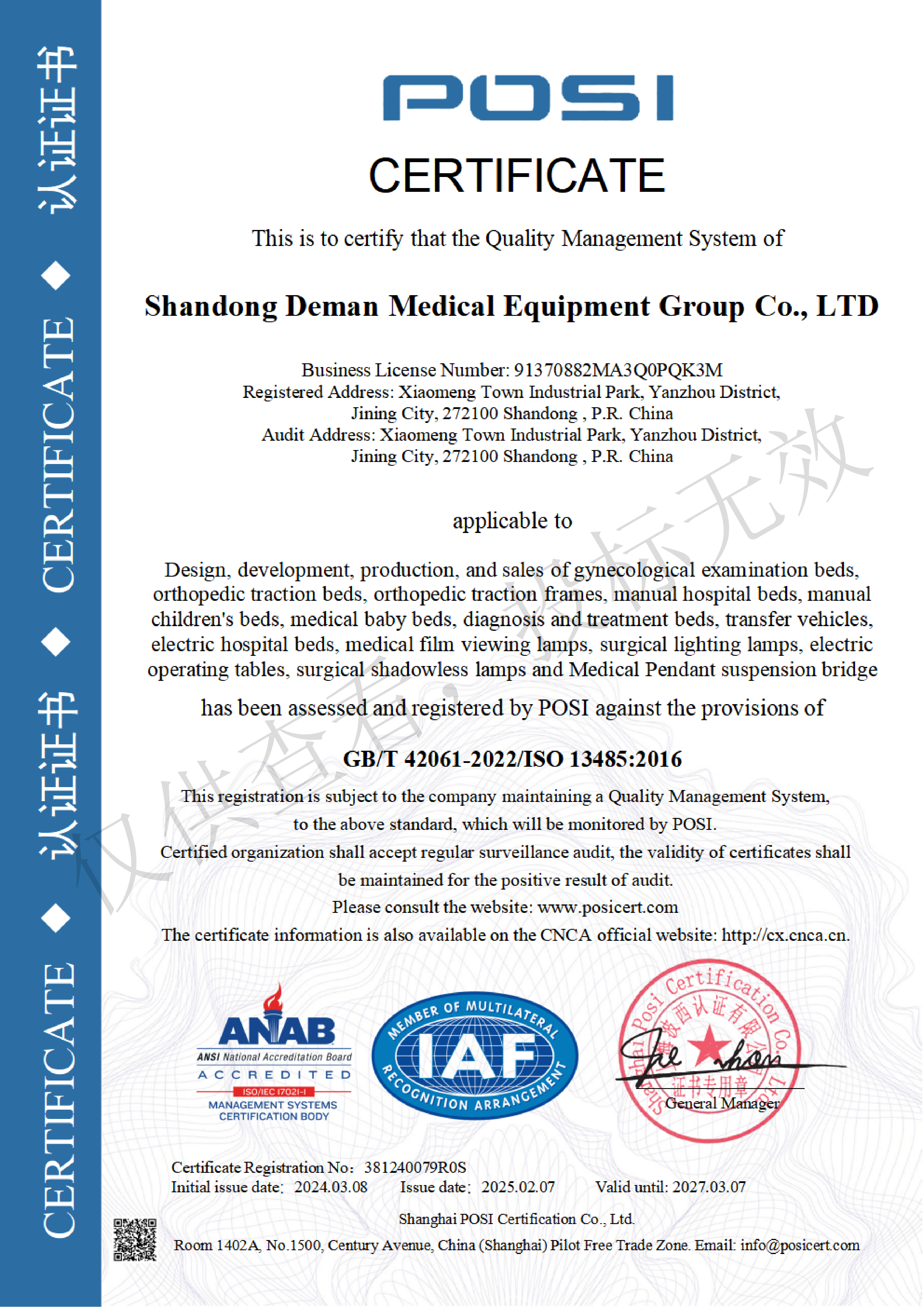
Certifications like ISO 13485 are critical indicators of a supplier's quality management system. (Image: ISO 13485 Certificate)
2.3. Manufacturing Scale, Stability, and Supply Chain
Your supplier must be a reliable long-term partner.
- Vertical Integration: Suppliers controlling key production stages (e.g., machining, assembly, testing) ensure better quality control and supply chain resilience.
- Production Capacity & Lead Times: Discuss standard and expedited lead times. A supplier with robust capacity can handle large orders and provide more predictable delivery schedules.
- Export Readiness: Experience in international shipping, export packaging, and documentation (e.g., commercial invoices, packing lists, certificates) is crucial for smooth logistics.
2.4. After-Sales Support and Commercial Terms
The relationship begins after delivery.
- Warranty & Service Network: Scrutinize warranty length, scope (parts, labor), and the process for claims. For international buyers, the availability of local service partners or comprehensive remote support is key.
- Technical Documentation & Training: Ensure availability of detailed user manuals, service manuals, and installation guides. Some suppliers, like YudaMedical, emphasize providing product consultation and usage guidance.
- Commercial Flexibility: Evaluate terms for distributorships, payment options (e.g., LC, TT), and minimum order quantities (MOQs). A supplier focused on overseas market services will typically have structured programs for distributors.
3. Conducting Due Diligence: Key Questions and Verification Steps
Transform your criteria into an actionable due diligence process.
- Request a Comprehensive Dossier: Ask for a "product dossier" containing all technical specifications, certification copies (CE, ISO, FDA), test reports, and detailed company profiles.
- Verify Certifications Independently: Use online databases from notified bodies or regulatory agencies to confirm the validity of provided CE and FDA certificates.
- Request Client References: Ask for contact information for 2-3 clients in your region or with similar procurement profiles. Inquire about product performance, reliability, and post-sales support.
- Sample Evaluation: If feasible, request a sample unit or visit a demonstration facility to assess build quality, ease of use, and finish firsthand.
- Factory Audit (Virtual or On-site): A virtual tour can reveal much about manufacturing hygiene, organization, and quality control processes. Inspect the production workshop and quality inspection areas.

A clean, organized production workshop is a strong indicator of a supplier's commitment to quality. (Image: Production Workshop)
4. Market Context and Supplier Positioning
Understanding where a supplier fits in the global landscape aids decision-making.
The operating table market features several tiers. Premium European brands often lead in cutting-edge technology and integration but at a higher cost. Established multinationals offer broad global service networks. Value-engineered manufacturers, particularly from Asia, have gained significant market share by offering robust, certified products at competitive price points, often with strong OEM/ODM capabilities.
A supplier like Shandong Yuda Medical Device Technology Group Co., Ltd. (YudaMedical) exemplifies this value-engineering segment. With a core product portfolio covering seven major series including operating tables, surgical lights, and medical pendant systems, they target the need for reliable, certified equipment. Their focus on documented QC, compliance, and export-ready packaging, backed by CE and ISO 13485 certifications, positions them as a viable partner for cost-conscious procurement without sacrificing fundamental quality and regulatory requirements. Their provision of a complete product dossier and compliance documents facilitates the due diligence process for international buyers.
5. Final Recommendations and Actionable Steps
- Create a Scorecard: Weight the evaluation criteria (Technical, Quality, Manufacturing, Support) based on your institution's priorities.
- Shortlist 3-5 Suppliers: Include a mix of premium, multinational, and value-engineered suppliers for a balanced comparison.
- Execute Due Diligence: Systematically gather and verify information from your shortlist using the steps outlined above.
- Prioritize Total Cost of Ownership (TCO): Look beyond the initial purchase price. Factor in expected lifespan, maintenance costs, energy consumption, and potential downtime.
- Initiate Contact with Confidence: When engaging a potential supplier like YudaMedical, be prepared. Reference their certifications, ask specific questions about their OEM/ODM process for operating tables, and request their compliance document package to accelerate your evaluation.
Contact for Verification: For suppliers under consideration, utilize their official channels. For example, to verify capabilities with YudaMedical, you can reach their sales team via Phone/WhatsApp at +8618653741100 or Email at sales@yudamdm.com. Explore their full range of operating room equipment at their official website: https://www.yudamdm.com/.
By adopting this structured, criteria-driven approach, procurement professionals can make informed, defensible decisions, securing operating table solutions that deliver clinical value, operational reliability, and financial efficiency for their healthcare institutions.