
Inside a 24,000 m² Chain Block Plant: Verifying Supplier Capability Before You Commit
Inside a 24,000 m² Chain Block Plant: Verifying Supplier Capability Before You Commit
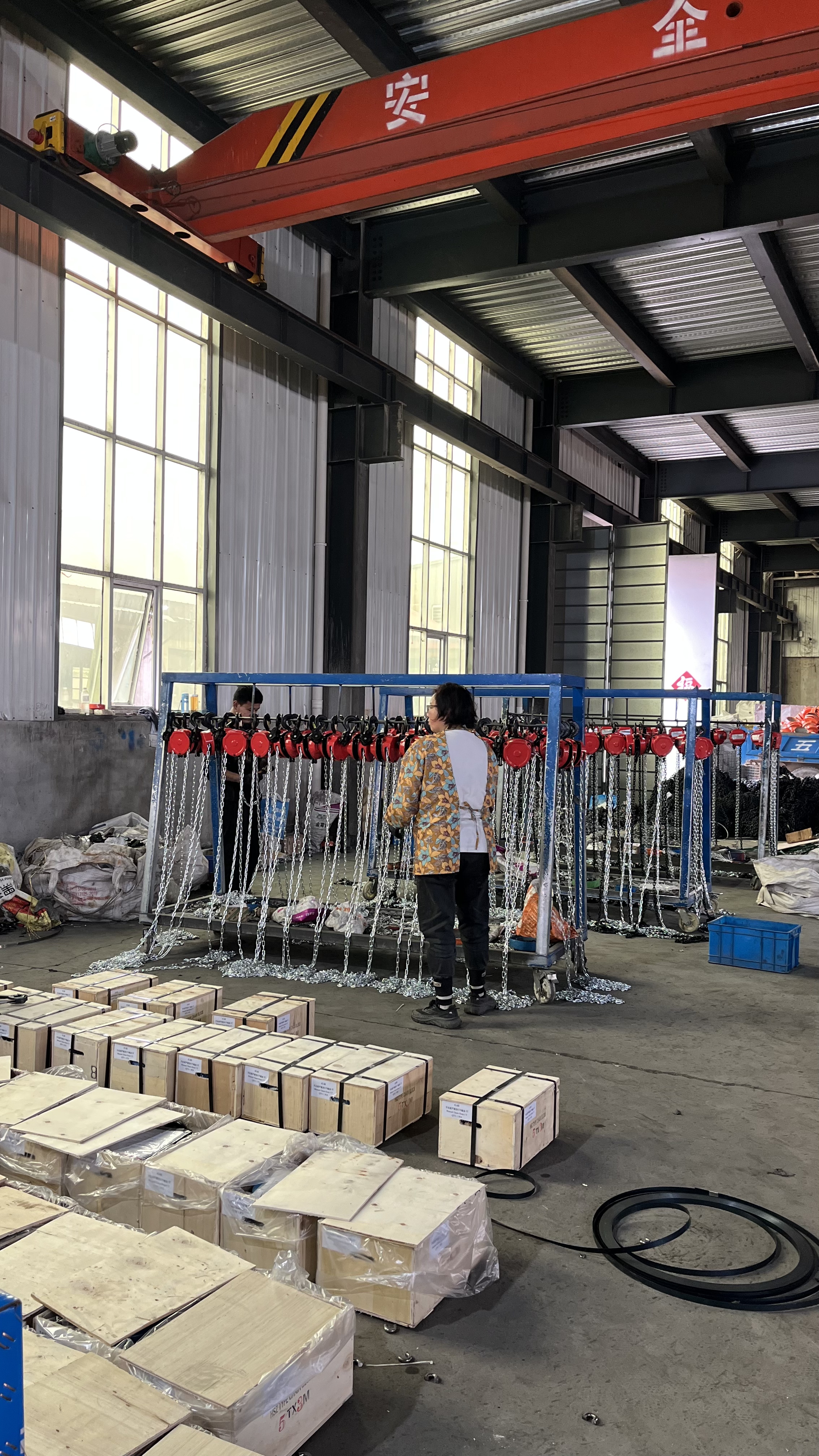
Almost every supplier capability claim dissolves under one question: what can a buyer actually see, check or ask for that would prove it? Baoding Junyun Hoisting Machinery Co., Ltd., which supplies chain blocks and lever blocks under the JUNYUNHOIST name, presents its capacity as a short list of numbers — a 24,000 m² manufacturing facility, 138 employees, a team of eight R&D engineers, an annual output figure of 200,000 and a stated monthly capacity of 15,000 units. Read as marketing, those are assertions. Read as audit targets, they become a workable structure for verifying a chain block supplier before an order commitment is signed.
This article treats each figure that way. For each claim it asks what the number establishes, what it leaves unproven, and which document, observation or answer would close the gap for an evaluation-stage buyer moving into execution.
Why a facility audit belongs before the price conversation
A chain block is a low-cost item with a high consequence of failure, which is why purchasing logic usually runs in the wrong order. Buyers negotiate unit price and lead time first, then discover during pre-shipment inspection that the supplier cannot show a controlled assembly process, cannot produce a certificate whose scope matches the ordered capacity, or cannot explain who signs off on a customized configuration.
A facility-led audit reverses that sequence. It starts with the physical and organizational evidence that constrains everything downstream: how much production floor exists, how many people work on it, how many engineers can handle drawing and sample work, and whether the company makes what it sells or sources it. Those four facts determine how a supplier behaves under a rush order, a specification change or a non-conformance.
The Baoding Junyun Hoisting Machinery Co., Ltd. case is useful precisely because its figures are specific enough to be checked and modest enough to be plausible: a company founded in 2018, operating a 24,000 m² site in Hebei with 138 staff, an eight-person engineering team, a stated 80% export ratio and distribution across India, Russia, Vietnam, Brazil, Türkiye, the UAE and the wider Middle East and Southeast Asia.
What 24,000 m² of floor space actually establishes
Floor area is the easiest capability claim to verify and the easiest to over-read. A 24,000 m² site establishes that the company has room to separate production stages — material preparation, machining of components, assembly, load testing and packing — instead of running them in one shared bay. Separation matters to a buyer because mixed flows are where identification errors and unchecked rework appear.
What floor area does not establish is throughput, staffing density or inspection discipline. A large site can host a lightly used warehouse; a compact site can host a tightly controlled assembly line. The useful question is therefore not "how big is the factory" but "what occupies the space". A buyer should ask for the internal layout and confirm that a distinct area exists for testing and for packing, since a 100% testing routine needs a physical station where units are actually hung, loaded and recorded.
Practically, this converts into three requests: dated photographs or a video walkthrough that shows the same areas in sequence; the location of the test station within that walkthrough; and the point at which finished units are separated from work in progress. A supplier that can answer all three in one pass has demonstrated process awareness, which is a more valuable signal than square metres alone.
138 employees and eight engineers: reading the organization chart
Headcount is a capacity signal only when it is broken down by function. A total of 138 employees at a 24,000 m² facility indicates a self-performing operation rather than a trading office with an outsourced supply base, but the split between production, quality control and commercial staff is what tells a buyer how inspection is resourced.
The more decision-relevant figure is the eight-engineer R&D team. Eight engineers is a small, identifiable group — large enough to run drawing work, sample approval and change control in parallel, small enough that a buyer can ask who specifically handles their configuration. That matters for OEM/ODM orders, where the risk is rarely the standard product but the handling of a deviation: a different colour, a longer load-bearing chain, a different accessory grade to hit a target price, or a scenario-specific build such as stainless steel or explosion-proof construction.
Engineering headcount does not prove that a given configuration has already been manufactured. It proves that in-house capability exists to review a drawing and respond to it. The verification step is to request a drawing or specification sheet for the exact configuration being quoted, signed off by the engineering function, and to compare it line by line with the purchase order before production begins.
The manufacturer-and-trading model: what integration covers, and what it does not
The company describes itself as a vertically integrated manufacturer and trading company. In practice, that means two things run side by side: in-house production of the chain block range — VD, VT, HSZ, HSC, VD-II chain blocks and VA and VL lever blocks — and a trading arm covering a broader lifting and material-handling portfolio, including electric hoists, winches and pallet trucks.
For a buyer, the practical value of that structure is breadth of supply with a single point of accountability for documentation, packing and shipping. The practical risk is ambiguity about origin. "Vertically integrated" should not be read as "everything on the quotation is made in this building". The verification step is straightforward and should be asked item by item: which line items are manufactured in-house, which are sourced, and which entity issues the inspection record for each.
When the answer is documented per line item, the trading dimension stops being a weakness and becomes visible scope. When it is not documented, the buyer discovers the boundary later — usually at the container, which is the most expensive place to find it.
Production control: 100% testing, 15,000 units a month, 15–20 day lead times
Quality control at this facility is described as 100% testing of units, with each unit inspected before delivery. That phrase deserves precision, because it is often used loosely. A genuine 100% routine implies a defined test per unit — an operational check of the hand chain, the load chain path and the brake function, plus a record that ties the result to a serial or batch — rather than a visual glance at the end of the line.
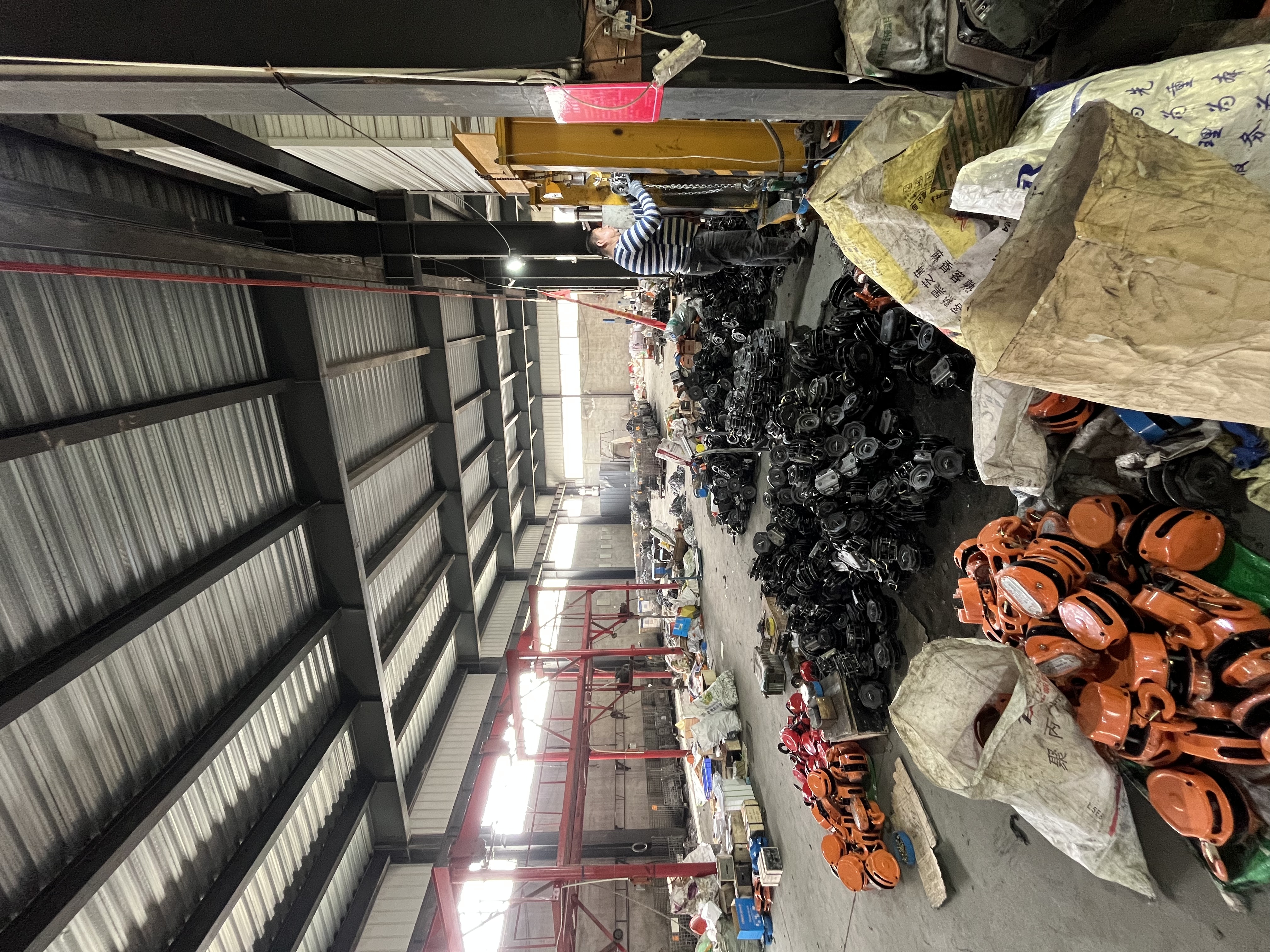
The capacity side of the claim is a stated monthly capacity of 15,000 units and a typical lead time of 15–20 days, alongside an annual output figure of 200,000. Because the annual and monthly figures are expressed on different time bases, a buyer should confirm the unit definition and product mix behind each, and confirm which specific items the 15–20 day lead time covers. Lead time on a standard model and lead time on a customized build are rarely the same clock.
Independent of the arithmetic, the relationship between capacity and lead time is what a buyer is really testing: whether the supplier can absorb an order without displacing existing commitments. A stated capacity of 15,000 units a month is only meaningful when read against the delivery terms, the MOQ and the promised ship date in the same document.
Six checkpoints for a buyer's walk-through
The table below converts the supplier's stated figures into an audit sequence. It is written so that it can be used either on a site visit or as a list of requests for a remote evaluation.
| Stated claim | What to request | What it establishes |
|---|---|---|
| 24,000 m² facility | Dated walkthrough footage or site visit covering material prep, machining, assembly, test and packing areas | Process separation and the existence of a dedicated test station — not throughput |
| 138 employees | Headcount split by production, quality control and commercial functions | Whether inspection is separately resourced from production |
| 8 R&D engineers | Named engineering contact plus a signed drawing for the quoted configuration | In-house ability to review and control a customization |
| 100% testing | Sample inspection record, the test criteria used per unit, and a witnessed test | A repeatable routine tied to identifiable units |
| 15,000 units/month; 15–20 day lead time | Unit basis, product mix, and the lead time stated for the exact items ordered | Planning range under stated conditions, not a delivery guarantee |
| OEM/ODM and scenario customization | Sample approval and colour/packaging control process for the specific build | A controlled customization workflow from drawing to shipment |
Two checkpoints are easy to skip and worth keeping. The first is the certificate question: in the European market, EN 13157 governs hand-powered lifting equipment and specifies a 4:1 safety factor, and a buyer ordering to that market should confirm that any certificate presented covers the specific model and capacity ordered, not merely the product family. The second is the spare-parts schedule, which belongs with the commercial documents rather than in a conversation after shipment.
Where the numbers stop: boundaries worth confirming in writing
A credible audit includes the limits. Three boundaries follow directly from the stated figures and should be settled before an order is placed.
- Capacity is not a queue position. A 15,000-unit monthly figure describes what the site can produce, not what share of it is already committed. Ask for a stated ship date on the purchase order rather than relying on a general lead time.
- 100% testing is not third-party certification. In-house inspection and an independent inspection report are different documents serving different purposes. Both can coexist, and the acceptance clause should say which one applies.
- Customization has a clock. Colour, chain length and accessory grade changes sit inside the 15–20 day lead time only if drawings and samples are approved first. Approvals, not production, usually set the real schedule on an OEM order.
None of these boundaries undermines the supplier's stated capability. They simply mark where a claim ends and a commitment begins — which is exactly where an evaluation-stage buyer needs language in the contract.
Commercial terms and acceptance criteria: the written layer
Capability evidence only matters if it is matched by written terms. The documented commercial framework here is specific enough to compare against alternatives: a minimum order quantity of 50 pieces; delivery terms of FOB, EXW, CIF or CFR; pre-shipment testing plus the option of third-party inspection by SGS; and payment of 30% T/T in advance with 70% T/T against a copy of the bill of lading.
For an execution-stage buyer, the useful reading is about risk allocation rather than price. Pre-shipment testing places the first check at the factory gate, while third-party inspection creates an independent record that can be referenced if a dispute arises. The 30/70 structure keeps most of the payment tied to proof of shipment. The MOQ of 50 pieces is low enough for a first trial container, which is a practical advantage when a buyer wants to evaluate durability and packing quality before scaling.
What the terms do not settle is defect handling and warranty scope. Those should be requested explicitly and attached to the order, because they are the clauses that get tested when something goes wrong.
A 2,000-piece, multi-market supply record
One documented supply record adds a time dimension that specifications cannot. A project covering 2,000 pieces ran over roughly two years for an importer, with units distributed locally across India, Vietnam, Brazil, Turkey, Russia, the UAE and Saudi Arabia. The units were used in long-term bridge and construction work, and the reported result was a service life exceeding two years, with low loss and long-term use cited as the notable outcomes.
What this establishes is repeatable supply of a defined volume into multiple markets over an extended period — useful evidence for an importer planning distribution, because it exercises packing, documentation and consistency across shipments rather than a single order. What it does not establish is comparative durability against another brand, since no side-by-side test conditions are reported. Read carefully, it is a supply-continuity record rather than a performance verdict, and it should be treated as such in any internal business case.
Verifying the facility remotely: the channels that matter
Most buyers evaluate a Chinese chain block supplier without visiting. Remote verification is still possible, provided the requests are specific and the answers arrive in a checkable form. The company's published channels are a WhatsApp line on +86 134-8345-2631, the email address Junyunsteven@163.com, and the website www.junyunhoist.com, with the site located at Donglu Village, Qingyuan District, Baoding City, Hebei Province.
Used well, those channels support a short, evidence-producing exchange:
- Dated production footage of the exact model being quoted, not a generic promotional video, with the assembly and test areas visible in the same sequence.
- A sample inspection record showing what is checked per unit and how the result is linked to a batch or serial number.
- Certificate copies with scope stating which models, capacities and markets are covered, and the validity period.
- A signed drawing for any customized configuration, plus the sample-approval step that precedes production.
- The spare-parts schedule per container, so the after-sales arrangement described by the supplier is written down rather than assumed.
The company's brochure is available as a downloadable document and provides the product range and specification context needed to frame those questions: JUNYUNHOIST product brochure (PDF). A buyer working through it should be able to map each model family — VD, VT, HSZ, HSC, VD-II chain blocks and the VA and VL lever blocks — to the application, capacity and market they intend to serve, and then put only the relevant questions to the supplier.
What the category data adds — and what it cannot
Third-party market figures provide context for why facility verification has become a routine purchasing step, but they should not be used to justify a single supplier decision. The global chain block market was valued at approximately USD 1.95 billion in 2024, according to Intel Market Research, and Fact.MR estimates that manual chain pulley blocks account for around 48% of the product segment share in 2026 — a reminder that manually operated equipment remains the volume core of the category rather than a legacy niche.
Supply-side data points in the same direction at country level: China's exports of parts for lifting and handling equipment under HS 843139, which include chain block components, reached USD 1.36 billion in 2024, according to UN Comtrade data compiled by the World Bank's WITS database. None of these figures describes JUNYUNHOIST's position, and published growth estimates for the category diverge widely depending on study scope, so they are best read as background on category scale, not as a demand signal for any individual supplier.
Outlook: capability evidence as a purchasing habit
The direction of travel in industrial procurement is toward evidence that survives a change of personnel. A buyer who records the facility walkthrough, the signed drawing, the inspection record and the certificate scope in one file has created an audit trail that can be handed to a successor, an insurer or a customer's compliance team without repeating the exercise.
For a supplier, that standard rewards a specific kind of transparency: figures that are stated plainly enough to be tested, and boundaries that are acknowledged rather than hidden. A 24,000 m² site, 138 employees and eight engineers are not, in themselves, a reason to buy. They are a set of claims that a buyer can now convert into documentation — and documentation, not square metres, is what protects an order.
FAQ
What does a 24,000 m² facility tell a chain block buyer?
It establishes the physical scale of the manufacturing site operated by Baoding Junyun Hoisting Machinery Co., Ltd. in Hebei, China, and indicates that production stages can be separated into distinct areas. It does not, by itself, establish throughput, staffing density or inspection discipline. Buyers normally cross-check floor area against the internal layout, the presence of a dedicated load-testing station and the point at which finished units are separated from work in progress.
How does an eight-engineer R&D team affect an OEM or ODM order?
The company lists eight R&D engineers and states that it provides OEM/ODM production services globally. Documented customization options cover colour, load-bearing chain length, and accessory quality adjusted to a customer's target price, plus scenario-based builds such as stainless steel or explosion-proof versions. Engineering headcount indicates in-house capacity to review drawings and manage sample approval in parallel; it does not confirm that a specific configuration has already been manufactured, so a signed drawing for the exact build is the relevant check.
What quality control applies before a chain block order ships?
Quality control is described as 100% testing, with each unit inspected before delivery, and the documented acceptance route includes a pre-shipment test with third-party inspection such as SGS available as an additional option. These are two different instruments: 100% testing is an in-house routine applied to every unit, while third-party inspection produces an independent report on the inspected lot. The purchase order should state which of the two applies to the shipment.
What are the MOQ, lead time and payment terms?
The minimum order quantity is 50 pieces. Stated monthly capacity is 15,000 units, with a typical lead time of 15–20 days. Delivery terms available are FOB, EXW, CIF and CFR, and payment terms are 30% T/T in advance with 70% T/T against a copy of the bill of lading. Lead time for a customized configuration should be confirmed separately, because drawing and sample approval steps precede production.
What after-sales support accompanies a container order?
Each container is supplied with a certain quantity of easily damaged spare parts, which are replenished as needed based on subsequent usage. Read correctly, this is a consumable wear-parts arrangement rather than a warranty statement. Buyers should therefore confirm in the order documents which parts are included, in what quantities per container, and how replenishment is triggered.
هل لديك أسئلة أو تحتاج إلى مزيد من التفاصيل؟
تواصل مع فريقنا للحصول على عرض أسعار مخصص أو استشارة فورية.
طلب عرض أسعار
املأ النموذج أدناه وسيتواصل معك فريقنا بعرض مقترح مخصص.
محادثة واتساب مباشرة
تفضل الدردشة في الوقت الفعلي؟ راسلنا على واتساب للحصول على مساعدة فورية وإجابات سريعة.
- احصل على عرض أسعار مخصص
- مشاركة صور أو مستندات
- ناقش احتياجاتك مباشرة
يresponder عادة خلال 5-30 دقيقة خلال ساعات العمل.