
Leisure Chair Supplier Evidence: 67,000 m², 250 Staff, 1M Units
Leisure Chair Supplier Evidence: 67,000 m², 250 Staff, 1M Units
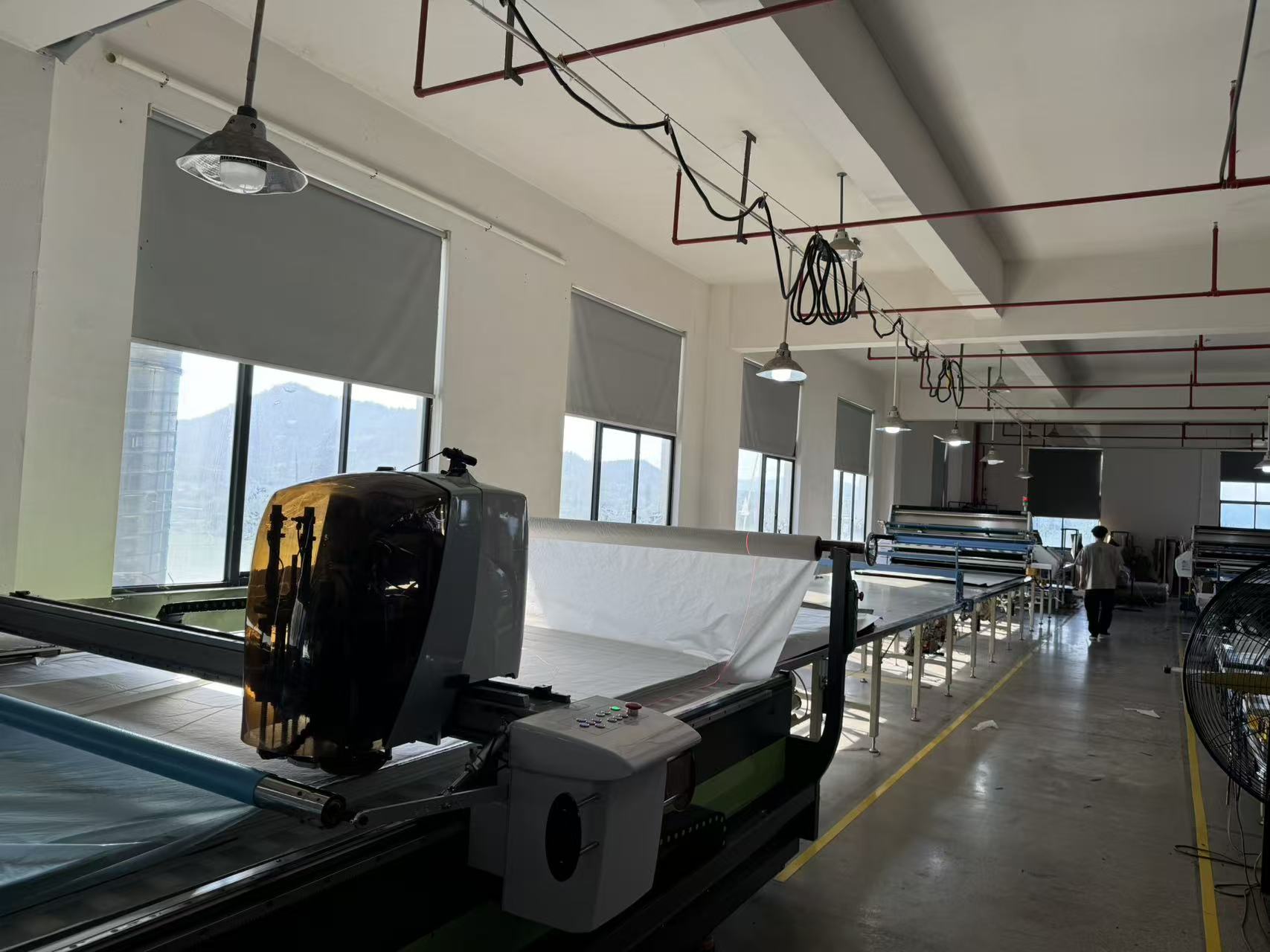
Capacity claims are the easiest part of a supplier presentation to write and the hardest part for a buyer to check. A leisure chair programme that has to deliver 4,000 units across three hotel openings in one quarter needs something more specific than the assurance that the factory is large.
The numbers behind the yinafu leisure chair range are specific enough to be examined. Anji Yinafu Home Supplies Co., Ltd. was established in 2009 in Anji County, Zhejiang Province, operates a 67,000 m² factory, employs 250 staff including 30 R&D engineers, and reports annual capacity of about 1,000,000 units. The same company and capability documentation lists OEM and ODM production, a 50-unit minimum order for OEM factory orders, a 45-day lead time, pre-shipment inspection as the acceptance criterion, and a product range covering leisure chairs, dining chairs, sofa beds, recliners and coffee tables.
This article adds no new figures to that record. It shows how a procurement team can use them: how annual capacity converts into a monthly planning number, where delivery-delay risk actually sits in a furniture order, which capability statements can be verified and which cannot, and what to request before a purchase order is issued.
Why factory evidence outranks the catalogue in leisure chair sourcing
Leisure chair demand is largely replacement and project demand, and replacement demand arrives in waves. Industry research cited in 2024 put global hotel furniture stock at more than 19.8 million rooms operating on a seven-to-ten-year replacement cycle, and Future Market Insights projected the global hotel furniture, fixtures and equipment (FF&E) market at USD 52.8 billion in 2026. Both are market estimates rather than order-level data, but they explain a pattern buyers already recognise: a property refresh or a new build moves from design to procurement to installation inside a compressed window, and seating is ordered once the room count is fixed.
Trade data points the same way. China's furniture exports grew 5.2% year on year in the first quarter of 2024, with outdoor and leisure chairs at 8.7%, according to secondary reporting of customs figures — a directional signal rather than an audited statistic, and a reminder that leisure chair supply is a volume business in which scheduling, not catalogue breadth, decides whether a project opens on time.
For a buyer, the useful question is therefore not how big the factory is, but what share of that capacity can be committed to a specific delivery window and what evidence supports the schedule. A supplier that answers in weeks and SKUs is easier to hold to a date than one that answers in adjectives.
The documented capability baseline
The figures below come from the manufacturer's own company and capability documentation. They are company-reported facts rather than third-party audited findings, and that distinction matters for how much weight each one carries.
| Evidence point | Documented value | How a buyer uses it |
|---|---|---|
| Established | 2009, Anji County, Zhejiang Province | Continuity check; confirm the physical site during audit |
| Factory area | 67,000 m² | Space check for line capacity, storage and peak-season buffer |
| Workforce | 250 staff | Scale check; ask how many work in upholstery and assembly |
| Engineering | 30 R&D engineers | Depth check for custom design and OEM drawing changes |
| Annual capacity | about 1,000,000 units | Convert into a monthly share before quoting a delivery date |
| Production modes | OEM, ODM, custom design | Match the mode to how much design ownership you want |
| Minimum order | 50 units (OEM factory orders) | Feasibility of a pilot SKU or a single-property trial |
| Lead time | 45 days | Confirm the trigger point, then add transit and clearance |
| Quality control | Spot check; acceptance by pre-shipment inspection | Set sampling level and inspection stage before balance payment |
| Payment and delivery | 30% in advance, 70% before shipment, FOB | Budget freight, insurance and inspection on the buyer side |
| Product range | Leisure chairs, dining chairs, sofa beds, recliners, coffee tables | Check required categories against the current catalogue |
| Quality management | ISO 9001:2015, certificate 00125Q36836R1M/3300, valid to 28 September 2028 | Verify scope and validity with the issuing body |
| Export profile | 95% of output exported; Asia and the Middle East listed as main markets | Check whether your market is a familiar destination |
Read together, the figures answer three questions a buyer usually asks in sequence. First, whether the supplier has operated long enough to be a repeat source: a 2009 establishment date in Anji County, Zhejiang Province, a long-standing chair-making location in China, gives a continuity record that a catalogue cannot. Second, whether it has the engineering depth to absorb a specification change mid-programme: 30 R&D engineers is the documented figure, and the company states that it offers custom design services alongside OEM and ODM production. Third, whether its output is large enough that one order is a manageable share of the schedule rather than the whole factory.
Converting 1,000,000 units into a monthly planning number
An annual capacity figure cannot be compared directly with a monthly delivery requirement, so the first step is arithmetic. Spread evenly, 1,000,000 units a year equals about 83,000 units a month (1,000,000 ÷ 12 = 83,333, rounded). That is a calculated average, not a reserved slot, and it assumes a single product mix running without changeovers.
The conversion is still useful because it turns a headline into a share. For illustration, a programme requiring 500 units a month represents roughly 0.6% of that calculated monthly average, while a launch requiring 20,000 units in one month represents about 24%. The 0.6% case is the easier conversation: a factory producing at that scale can usually absorb a single project without displacing existing work, which lowers the risk that your order is the one that slips when a larger customer calls. The 24% case is not unrealistic for a hotel or club roll-out, but it has to be scheduled rather than assumed, because at that level your order competes with everything else in the plan.
Two adjustments keep the arithmetic honest. Capacity is stated in units, while furniture production is constrained by mix: frame variants, upholstery changes, colour runs and packaging differences all consume schedule even when the unit count is unchanged. The second adjustment is order sequencing — a factory can be at full annual output and still have no free slot in the four weeks you need. The practical rule is to ask for the answer in your own units: which weeks will my order run, which line will run it, and what share of monthly output does it represent?
Where delivery-delay risk actually sits
The documented lead time is 45 days. Before treating that as a delivery promise, establish what it measures. Production lead time normally starts at a defined trigger — deposit received, purchase order confirmed, or sample approved — and excludes materials waiting, inland transport to port, ocean transit, destination clearance and delivery to site. Delivery is on FOB terms, which means the supplier's responsibility ends when the goods are loaded; the freight and destination leg belong to the buyer. A 45-day production window and a 45-day site delivery are therefore two very different commitments, and only one of them is documented here.
The company's stated position on capacity risk is that production capacity is sufficient with a mature team, that bulk orders are scheduled in advance, that products are optimised iteratively based on customer feedback, and that after-sales support is provided if a risk occurs. Those are operating practices. They become useful to a buyer only when written into the transaction: a confirmed order with a week-by-week schedule, an agreed inspection point, a named shipping window, and a defined remedy if shipment slips. A process statement is not a contractual guarantee, and treating it as one is how delay disputes begin.
Quality control is described as spot check. In practice that means sampling-based inspection rather than piece-by-piece verification, and it is consistent with the documented acceptance criterion of pre-shipment inspection. The consequence is procedural: if 70% of the payment falls due before shipment, inspection must be completed and results accepted before that payment is released. Buyers who inspect after paying have removed their own leverage.
OEM, ODM and custom design: matching the mode to the programme
Three production routes are documented, and they are not interchangeable. In OEM production, leisure chairs are manufactured to the customer's specification and sold under the customer's brand — the buyer supplies or approves the design and carries the specification risk. In ODM production, the manufacturer designs and manufactures the product, which is then sold under the customer's brand; the buyer gains a market-ready design and carries brand and compliance risk instead of development risk. Custom design services sit between the two, allowing a product to be adapted to a buyer's requirements.
The choice is usually made by how much design ownership the buyer wants and how much development time the programme can absorb. A retailer building a private-label range from its own drawings is an OEM case. A distributor entering a new market with limited design resource is an ODM case, provided the selected design already fits the target price and market expectations. A hospitality operator specifying a room package often uses the third route: start from an existing platform, then modify dimensions, upholstery or base type.
The documented commercial terms should be read alongside the production modes. OEM factory orders carry a minimum of 50 units, a low entry point by furniture standards, which makes a pilot SKU or a single-property trial feasible without a container-scale commitment. Whether the 50 units apply per order, per model or per colourway is not stated in the documentation and should be confirmed in writing. Payment is structured at 30% in advance and 70% before shipment, delivery is FOB, and acceptance is by pre-shipment inspection. On a first order those terms mean the buyer carries freight, insurance and inspection costs on top of the unit price — a fixed cost that weighs more heavily on a small trial than on a repeat programme.
Product range and application fit
The documented range — leisure chairs, dining chairs, sofa beds, recliners and coffee tables — matters because hospitality and commercial projects rarely buy a single category. A hotel opening needs lobby seating, guest-room seating, dining chairs and case goods inside one delivery schedule; sourcing them from one production base reduces coordination while concentrating supplier risk. The practical test is to check the categories you actually need against the current catalogue rather than against a range summary.

Within leisure chairs, the specification choices that change a sourcing conversation are upholstery type, padding, base type, backrest adjustment, and whether the chair is supplied assembled, detachable or as part of a modular combination. Fabric and PU upholstery behave differently in cleaning and wear terms; padded construction affects comfort and weight; swivel and adjustable-backrest mechanisms add components that must be serviceable; detachable assembled and modular combined constructions change packing volume, handling and the assembly work that lands on site. These are not claims about a specific model in this article — they are the questions a specification should answer before quotation.
| Setting | Leisure chair considerations | What to confirm before ordering |
|---|---|---|
| Hotel lobby | Fabric or PU upholstery, padded seat, high daily use | Cleaning method, upholstery specification, replacement cover availability |
| Club or negotiation room | Fixed or swivel base, adjustable backrest | Seat height and backrest range against the actual user group |
| Office and breakout area | Padded seat, swivel, adjustable backrest | Base and floor-protection specification, mechanism serviceability |
| Guest room or suite | Sofa bed plus coffee table pairing | Open-and-close mechanism check, package dimensions, carton count |
| Mixed project package | Detachable assembled or modular combined construction | Packing volume, assembly instructions, spare-part supply |
Where a project is specified to a recognised seating standard, name it in the enquiry. In North America, ANSI/BIFMA X5.4 is the primary standard for public and lounge seating; internationally, ISO 7173:2023 sets out test methods for the strength and durability of seating structures. These are standards, not certificates held by the supplier, and a quality management certificate does not substitute for a product test report. For customs classification, upholstered seats with metal frames fall under HS 9401.71 and wooden-framed upholstered seats under 9401.61; confirm the classification with your broker before costing a landed price.
The ISO 9001 certificate: what the scope and dates establish
Anji Yinafu holds a quality management system certificate to ISO 9001:2015, certificate number 00125Q36836R1M/3300, issued by China Quality Certification Centre on 23 September 2025 and valid to 28 September 2028. The certified scope covers the design, development and production of dining tables, dining chairs, leisure chairs, office chairs, soft sofas and tea tables.
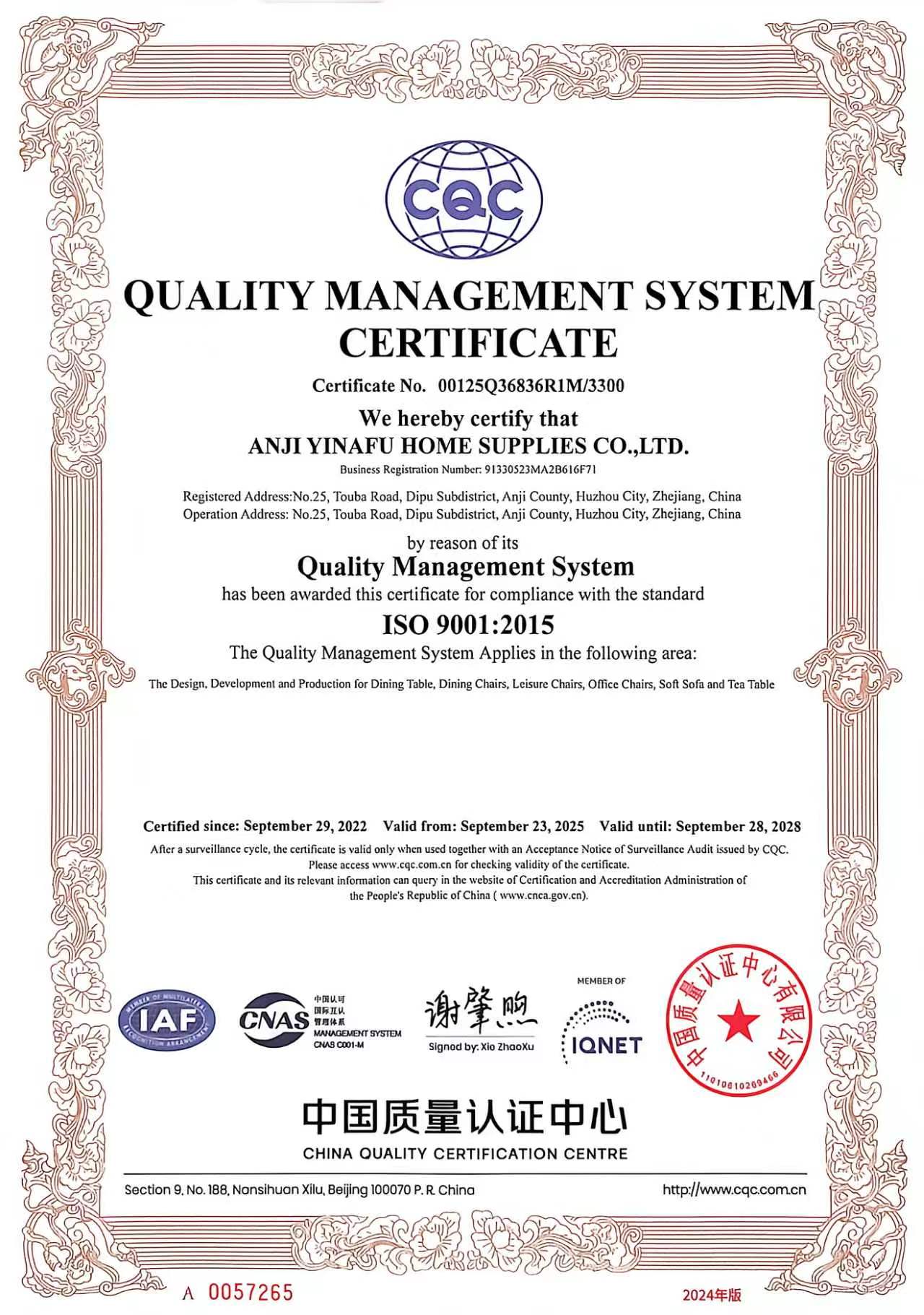
Two things follow. The scope explicitly includes leisure chairs, so the certified system covers the product you would be buying rather than an unrelated line; and the certificate was current at the time of writing, so its validity dates are a live check rather than a historical one. It is also a reasonable baseline for a supplier approval file, because it evidences an externally assessed process for design control, production control and corrective action.
What it does not establish is equally clear. A quality management system certificate is not a product conformity certificate: it reports no defect rate, no test result and no loading capacity, and it is not an audit of the factory against your own supplier standard. The verification step is straightforward — obtain a copy, confirm the number and scope with the issuing body, and check that the product description in the scope matches what you intend to purchase.
Factory-direct and intermediary sourcing: a fit boundary, not a verdict
The terms documented here define where a factory-direct relationship fits. A 50-unit OEM minimum, FOB delivery, 30/70 payment and buyer-specified pre-shipment inspection all push work to the buyer's side: freight booking, inspection arrangement, and the specification discipline needed to keep a custom design manufacturable. In exchange, the buyer deals with the engineering team directly, which is where 30 R&D engineers matter — design questions, tolerance queries and change requests travel one step instead of two.
An intermediary route can absorb that coordination for a small mixed order, at the cost of visibility into the production calendar and direct access to the people who build the product. Neither route is superior in general; the boundary is the buyer's own capacity to specify and inspect. A procurement team with an inspection partner and a forwarder in place can use factory-direct terms well. A team buying twenty mixed SKUs for a single opening may reasonably prefer to delegate.
A verification sequence before you commit
- Confirm the legal entity and site. Match the contracting name — Anji Yinafu Home Supplies Co., Ltd. — to the certificate, the quotation and the shipping documents, and confirm the production address in Anji County, Zhejiang Province.
- Convert your requirement into a share of monthly output. State volume, SKU count and delivery month, then ask for the scheduled production weeks rather than a general availability answer.
- Pin down the lead-time trigger. Agree in writing whether 45 days runs from deposit, purchase order or sample approval, then add your own transit, clearance and site delivery time.
- Fix the inspection point. Specify sampling level, defect criteria and inspection stage, and place the inspection before the 70% balance payment.
- Check the certificate. Verify ISO 9001 certificate 00125Q36836R1M/3300, its scope wording and its validity to 28 September 2028 with the issuing body.
- Confirm the MOQ basis. Establish whether 50 units applies per order, per model or per colourway, and whether mixed-SKU orders are accepted at that level.
- Request the documents your project needs. If the specification calls for ANSI/BIFMA X5.4 or ISO 7173:2023 evidence, ask for the corresponding report instead of assuming a management-system certificate covers it.
- Ask for packing and assembly data if you are buying detachable or modular constructions, and test that data against your warehouse and installation plan.
Outlook: from unit counts to schedule transparency
Two documented market signals frame the next few years. Hospitality furniture demand is driven by a replacement cycle measured in years rather than seasons, and the modular furniture market is projected to reach USD 130.6 billion by 2034, a forecast published by Market.us that depends on its stated assumptions rather than describing a present-day outcome. Both point toward more project-based, specification-heavy orders, where a supplier's usefulness is measured by how quickly a mixed order can be scheduled, documented and inspected.
That shift exposes a data gap buyers should not paper over. Public figures quantifying assembly time or freight-volume savings for detachable and modular leisure chairs are scarce, so any packing-efficiency claim should be supported by measured carton dimensions and a documented assembly time rather than by an adjective. The same discipline applies to capacity: an annual figure of about 1,000,000 units is the start of a conversation about weeks and shares, not the end of it.
Frequently asked questions
What documented facts should a buyer collect when assessing a leisure chair factory?
A short, checkable set: legal entity name and establishment year, factory area, workforce and engineering headcount, annual output, production modes, minimum order quantity, lead time, acceptance criteria, and any quality management certification with its number, scope and validity. In this case the documented record states establishment in 2009, a 67,000 m² factory, 250 staff including 30 R&D engineers, about 1,000,000 units of annual capacity, OEM and ODM production, a 50-unit OEM minimum, a 45-day lead time, pre-shipment inspection as the acceptance criterion, and an ISO 9001:2015 certificate valid to 28 September 2028. Any figure outside that record should be treated as unverified until documented.
How should 1,000,000 units of annual capacity be used in order planning?
As a share, not a promise. Spread evenly, the annual figure equals roughly 83,000 units a month, so a 500-unit monthly requirement is under 1% of that calculated average while a 20,000-unit month is close to a quarter of it. Because production is constrained by mix and changeovers, the useful request is a weekly schedule naming the production weeks and the share of monthly output the order represents.
What OEM terms are documented for leisure chair orders?
OEM and ODM production are both available, together with custom design services. OEM factory orders carry a minimum of 50 units; lead time is 45 days; delivery is FOB; payment is 30% in advance and 70% before shipment; acceptance is by pre-shipment inspection. Whether the minimum applies per order, per model or per colourway is not stated and should be confirmed in the order.
Does the ISO 9001 certificate cover leisure chairs?
Yes. Certificate 00125Q36836R1M/3300, issued by China Quality Certification Centre, covers the design, development and production of dining tables, dining chairs, leisure chairs, office chairs, soft sofas and tea tables under ISO 9001:2015; it was issued on 23 September 2025 and is valid to 28 September 2028. It certifies the management system rather than individual product conformity, so product-level test reports such as ANSI/BIFMA X5.4 or ISO 7173:2023 evidence have to be requested separately when a project requires them.
What does a spot-check quality-control description mean in practice?
It indicates sampling-based inspection rather than verification of every unit. Combined with pre-shipment inspection as the acceptance criterion, it means the buyer should define the sampling level, the defect criteria and the inspection point, and complete inspection before the 70% balance payment is released.
Reference document
The 2026 Yinafu catalogue covering the documented product range is available for review and download: YINAFU 2026 Catalogue – Chair (PDF). Company information is published at www.anjiyinafu.com.
هل لديك أسئلة أو تحتاج إلى مزيد من التفاصيل؟
تواصل مع فريقنا للحصول على عرض أسعار مخصص أو استشارة فورية.
طلب عرض أسعار
املأ النموذج أدناه وسيتواصل معك فريقنا بعرض مقترح مخصص.
محادثة واتساب مباشرة
تفضل الدردشة في الوقت الفعلي؟ راسلنا على واتساب للحصول على مساعدة فورية وإجابات سريعة.
- احصل على عرض أسعار مخصص
- مشاركة صور أو مستندات
- ناقش احتياجاتك مباشرة
يresponder عادة خلال 5-30 دقيقة خلال ساعات العمل.