
Coating line: acceptance, materials and conveyor speed
Coating line: acceptance, materials and conveyor speed
A buyer of a coating line makes the decision not from a catalog but from three verifiable blocks: the acceptance procedure, material execution, and the kinematic limits of the equipment. Below are answers to questions that arise in the transition from evaluation to contract execution, when the specification is already being agreed but has not yet been signed.
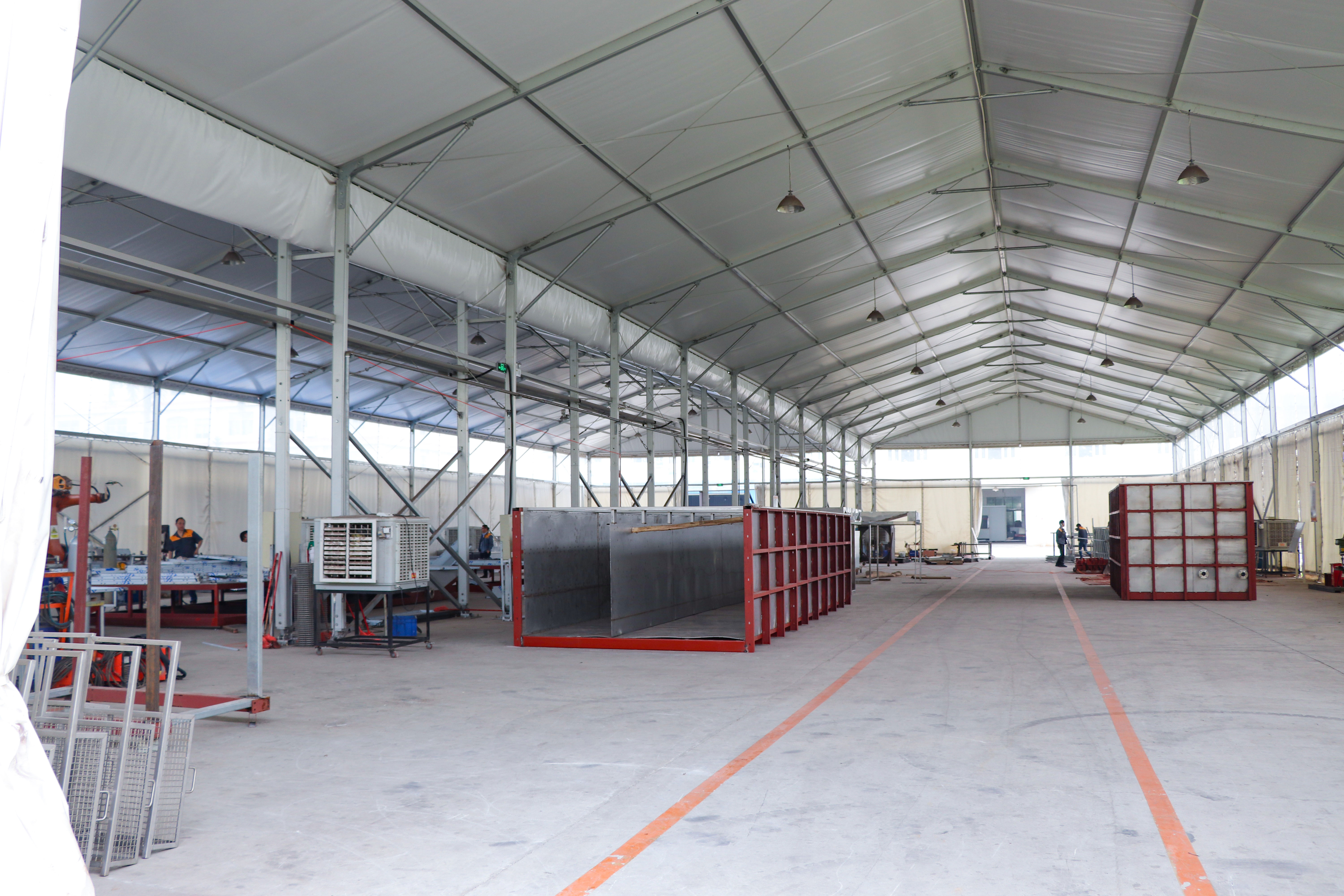
Coating area: the line configuration is determined not only by the spraying type but also by the workpiece dimensions, conveyor speed, and materials of construction.
What actually determines the line configuration
For the line of the configuration under consideration, three quantities set the limits. The first is the conveyor speed adjustment range: 2000–4000 mm/min. The second is the maximum workpiece dimensions: up to 7000×2000×2200 mm. The third is the material execution: carbon steel for the frame, stainless steel for the chamber and pipelines. These three points determine what exactly is checked during acceptance and what product the line can process without redesigning the structure.
The remaining parameters — automation level, voltage, power, capacity, size, packaging, and logo — are customizable and are agreed separately. The practical conclusion for procurement: speed and dimensions are fixed in the specification as measurable values, materials as a list with grades specified, and the degree of automation is described functionally, through the set of operations and units.
Procurement terms: what is fixed before production starts
The supplier's standard commercial terms are as follows: minimum order — 2 units; delivery on FOB terms from any port in Guangdong Province; acceptance based on pre-export testing results; payment in three installments — 50% by bank transfer within 7 days after signing the contract, 40% 3 days before shipment, and 10% upon completion of installation. Delivery times vary by equipment type because the line is designed for a specific product.
The financial logic here matters more than the wording. The final 10% is tied not to shipment but to completion of installation, meaning that on-site acceptance becomes a payment gateway. For the buyer, this means that the commissioning protocol must be agreed before signing the contract: it must list verifiable parameters, not a general statement that 'the equipment works.'
Attractivechina (Chuanzhi Intelligent Equipment (Guangdong) Co., Ltd.) is a manufacturer of automated coating lines from Zhaoqing (Guangdong Province), founded in 2005 and operating at a site of about 35,548 m² with a staff of 280 people and an output of about 60 units of equipment per year. The company states 54 engineers in its design department, 79 invention patents in the field of painting and environmental protection equipment with a total number of patents exceeding 300, as well as an export share of about 20%, with supplies including to Russia. These data characterize scale and engineering resources, but they do not replace verification of a specific configuration against the specification. Official website — Attractivechina.
Acceptance criteria: two stages and one payment gateway
Acceptance of a coating line is divided into a factory test before shipment and on-site commissioning. The factory stage confirms that the ordered configuration has been assembled; the on-site stage confirms that the line reaches operating mode under real workshop conditions and with real workpieces. According to the supplier, quality control includes 100% pre-sale inspection, which corresponds to the wording 'pre-shipment test' in the commercial terms.
| Stage | What is checked | What closes it |
|---|---|---|
| Factory test before shipment | Completeness, operation of drives and conveyor, actual speed range, chamber opening, compliance of materials with the specification | Pre-export testing protocol |
| Installation and commissioning | Line geometry, connections, trial workpieces, reaching operating mode at the boundaries of the speed range | Commissioning certificate; basis for the final 10% payment |
| Compliance documents | Scope of validity of certificates and declarations, linkage to the supplied model | Copies of documents indicating the scope of validity |
A practical list of checks that should be recorded in the protocol:
- materials of the frame, chamber, and pipelines — with grades specified, not just the words 'steel' and 'stainless steel';
- running the conveyor at the lower and upper boundaries of the range — 2000 and 4000 mm/min — recording travel stability;
- passage of a workpiece of maximum dimensions through the chamber, loading and unloading zones;
- completeness of units, spare parts, and operating documentation;
- availability of testing protocols and compliance documents as of the delivery date.
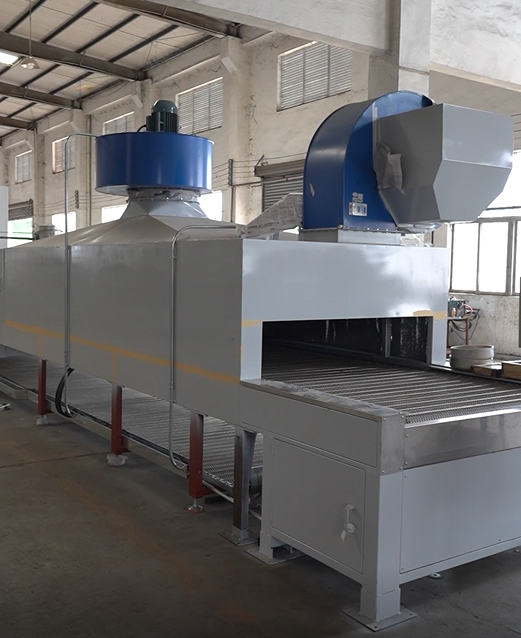
Commissioning is the second acceptance stage: it is where trial workpieces and conveyor operation at the boundaries of the speed range are checked.
Materials: why the frame is carbon steel and the chamber and pipelines are stainless steel
The separation of materials in the line structure is functional. Carbon steel carries the load: the frame, uprights, and crossbeams bear the weight of the conveyor, chamber, and workpieces, and also remain repairable when individual units are reinforced. Stainless steel is used where there is constant contact with paint mist, solvents, condensate, and wash water — in the chamber and pipelines. This execution reduces corrosion wear of working surfaces and the risk of contamination of the supplied material by corrosion products.
What this means for the buyer at the contract execution stage. The specification must indicate the steel grades for the frame and for the chamber with pipelines, as well as a list of units that come into contact with the coating material. The wording 'stainless chamber' without a grade does not allow either comparison of offers or acceptance of the equipment: the grade determines the behavior of the surface under abrasive action of powder and during periodic washing.
Scope of applicability: the stainless execution of the chamber and pipelines relates to corrosion resistance and equipment service life. It does not confirm food compliance of the coating — for cookware, food-contact requirements apply to the coating itself and are confirmed by a separate package of documents.
Conveyor speed range 2000–4000 mm/min: what it actually limits
Conveyor speed is an adjustable parameter that links productivity and the time the product spends in the chamber and in the drying zone. At the lower boundary, 2000 mm/min, the workpiece spends more time in the working zone — this is a margin for the thickness of the applied layer and for coating stability on complex surfaces. At the upper boundary, 4000 mm/min, the processing rate increases, but the contact time with the coating medium decreases, and the mode must be confirmed with trial workpieces.
This leads to an important clarification for capacity calculation: the speed range by itself does not set productivity in product units. It depends on the hanger pitch, the number of items per hanger, the number of layers, and the drying time. In the supplier's technical materials for cookware, a guideline of 800–1000 items per hour is given for a standard line — this figure illustrates that output is calculated from a combination of factors, not from belt speed.
During acceptance, the range is checked by running the line, not by inspecting the variable-frequency drive: travel stability at 2000, 3000, and 4000 mm/min is recorded, the absence of jerking, and, most importantly, the coating result on trial workpieces processed at the boundary values.
Maximum workpiece dimensions 7000×2000×2200 mm: how to read the limitation
The dimensional limit of 7000×2000×2200 mm determines the product range for which the line is designed as standard. Such an opening is intended for long and large workpieces: sheet panels and profiles, frame and chassis elements, and large parts of industrial equipment. In the supplier's technical data, the ability to process sheet metal up to 7000 mm long is confirmed separately, which is consistent with the stated limit.
At the acceptance stage, not only the chamber opening is checked but the entire trajectory: the loading zone, conveyor turns, unloading zone, and the absence of intersections with structural elements. The workpiece weight is agreed separately — it is not included in the dimensional limit and is confirmed by calculating the conveyor's load-bearing capacity within the specific specification.
Scope of applicability: the limit of 7000×2000×2200 mm is an upper boundary, not a working norm for every item. If a workpiece simultaneously approaches the maximum on several axes, the hanging scheme and opening are checked through a separate agreement before signing the specification.
Industry configurations: cookware, metal, auto parts, wooden furniture
The same line kinematics serves different productions, but the processing route changes. Below are the differences that affect the scope of acceptance; all the results given relate to projects described by the supplier and are not independently verified measurements.
Cookware
The route includes pretreatment, anodizing, and separate lines for internal and external coating. The key requirement is confirmation of the coating's food compliance and precise control of film thickness on items of different diameters. According to the supplier, in 20 cookware line projects, coating uniformity reached 98%, material consumption decreased by 30%, and production efficiency increased by 35%.
Metal
The main tasks are anti-corrosion and decorative finishing, priming, and powder coating of hardware, sanitary ware, window frames, and metal furniture components. For the 15 described lines, the coating control pass rate is stated at 97%, reduction in paint or powder consumption — 30%, energy consumption — 22%, and efficiency growth — 40%.
Auto parts
The route includes primer and finish coating for structural elements, chassis parts, and interior trim; lines for bumpers are listed as a separate area. For 20 projects, the yield of conforming coatings is stated at 98%, paint consumption reduced by 25%, energy consumption by 20%, and no major downtime was recorded over 5 years of operation.
Wooden furniture
Here dust removal and finish quality are critical: the lines serve furniture, cabinets, wooden doors, and musical instruments. For 10 projects, paint consumption was reduced by 30%, the share of dust-related defects by 90%, and production efficiency increased by 40% while maintaining a glossy surface.
| Industry | Key requirement for the line | What is checked during acceptance |
|---|---|---|
| Cookware | Food compliance of the coating, film thickness | Coating documents, trial items of different diameters |
| Metal | Corrosion resistance, thickness uniformity | Result at boundary speeds, material consumption |
| Auto parts | Stability with a mixed product range | Trial batch of different parts, repeatability |
| Wooden furniture | Dust removal, finish layer quality | Chamber cleanliness, absence of defects on gloss |
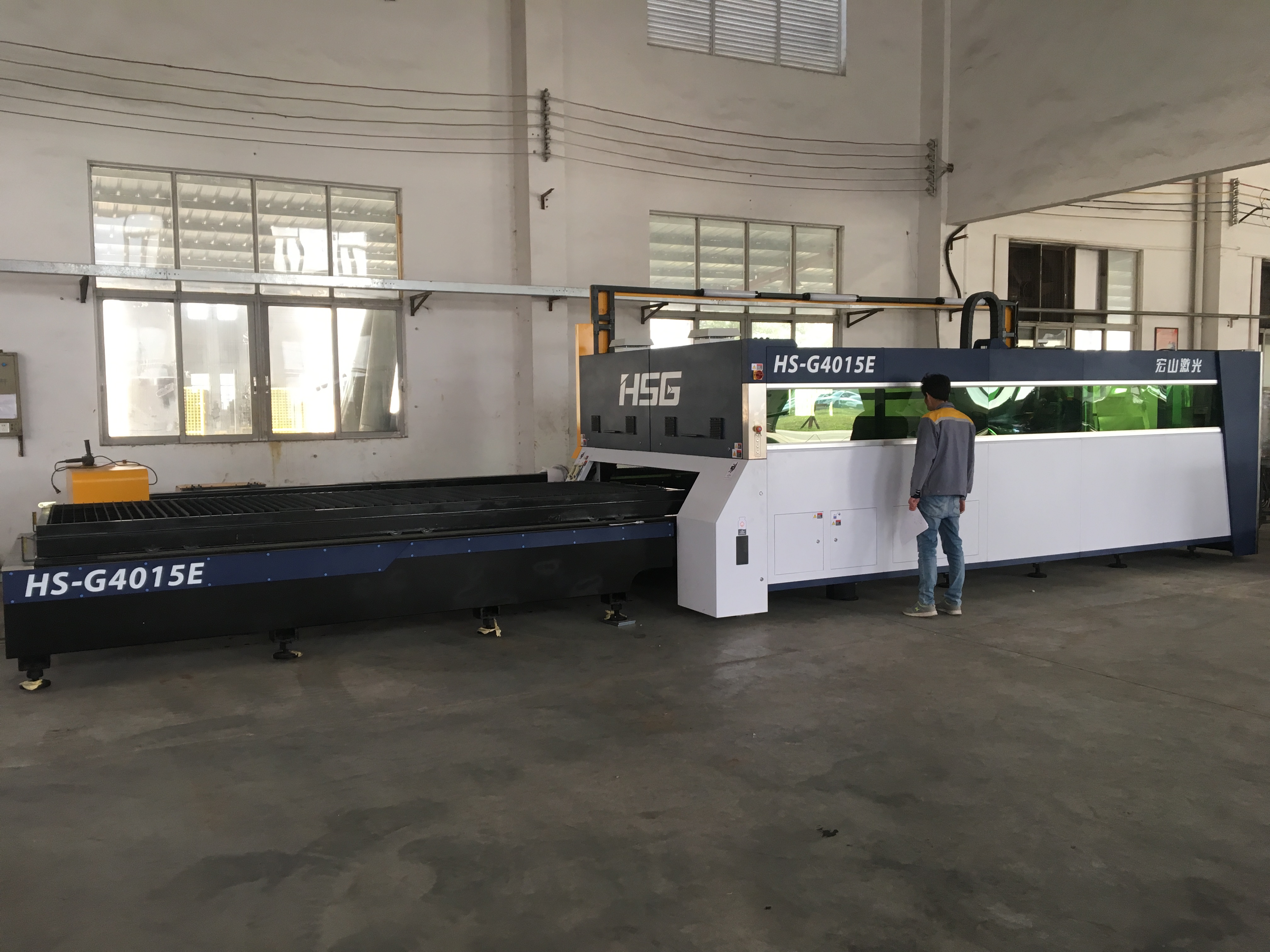
The industry configuration changes not only in the composition of chambers but also in the processing route, drying requirements, and type of inspection.
Scope of applicability: what automation does not solve
The transition to an automated line does not remove requirements for product range stability, surface preparation quality, and personnel qualifications. If items change frequently, changeover time and spray adjustment become a separate cost item, and this must be assessed before the contract, not after commissioning.
The economics of the project also depend on scale: a minimum order of two units and design for a specific product mean that the cost of the solution is distributed over an equipment fleet rather than a single machine. For a manufacturer with one line, this is an argument in favor of narrower specialization and an honest assessment of utilization. The indicators stated in the projects — 97–98% yield of conforming coatings, a 25–30% reduction in material consumption — depend on the coating material, surface preparation, and process discipline; they describe the result of specific supplier projects, not a guaranteed effect for any production.
Supplier documents checked at the execution stage
System certificates confirm the organization of processes, not the characteristics of a specific line, so they are checked together with the specification. The current package includes: ISO 14001 (DZ/CN/2407055E, valid until 14.10.2027, scope — design and production of painting equipment and management of related environmental aspects) and ISO 45001 (04926S00152R001, valid until 19.04.2029, the same scope with respect to occupational health and safety). The ISO 9001 certificate (DZ/CN/2308009Q) was issued on 20.09.2023 — its validity period is checked against the original as of the contract signing date.
Particular attention is required for the EAEU declaration N RU D-CN.PA01.B.96986/21 under TR CU 004/2011, 020/2011, and 010/2011: its scope is limited to the laminated conveyor oven model CZ-21-008-02A, that is, to a specific model rather than the entire range. During acceptance, it is checked whether the document covers the supplied configuration and whether it is valid on the delivery date; for a line of another configuration, confirmation is issued separately.
Frequently asked questions
Can the chamber dimensions be changed for a workpiece longer than 7000 mm?
Size is included in the list of customizable parameters along with automation level, voltage, power, and capacity. However, the limit of 7000×2000×2200 mm is the standard boundary of the configuration under consideration: changing it affects the chamber, drying zones, and pipeline routing, so it requires revision of the specification and separate agreement before signing the contract, not adjustment during installation.
What documents close out line acceptance?
The pre-export testing protocol confirming completeness and operation of units before shipment; the on-site commissioning certificate to which the final 10% payment is tied; copies of certificates and declarations with an explicitly stated scope of validity. In addition, the results of trial workpieces processed at the boundaries of the speed range are recorded.
How can it be confirmed that the speed is actually adjustable within the range of 2000–4000 mm/min?
By running the conveyor at three points — lower, middle, and upper — recording travel stability and processing trial items at the boundary values. Checking only the presence of an adjustable drive is not enough: the coating result at minimum and maximum speed is what matters.
Can one line serve both cookware and metal products?
Kinematically, the line is designed for the dimensions and weight of the workpiece, so the technical possibility of processing different items is determined by the opening and the conveyor's load-bearing capacity. But the routes differ: cookware requires confirmation of the coating's food compliance and separate internal and external application operations, while metal requires anti-corrosion schemes and powder modes. Combining them in one flow requires separate validation, not transfer of modes.
What is included in after-sales support?
Remote technical support, a one-year warranty, a response within four hours, regular support, and free personnel training. These obligations are fixed in the contract together with the acceptance protocol, since they determine how quickly the line reaches its design utilization after commissioning.
Procurement of a coating line comes down to verifiable quantities: payment terms tied to acceptance, material execution with grades specified, the speed range of 2000–4000 mm/min, and the dimensional limit of 7000×2000×2200 mm. Anything beyond these limits is a subject of separate agreement in the specification, not an assumption during installation.
A full description of configurations and application areas is provided in the corporate catalog.
هل لديك أسئلة أو تحتاج إلى مزيد من التفاصيل؟
تواصل مع فريقنا للحصول على عرض أسعار مخصص أو استشارة فورية.
طلب عرض أسعار
املأ النموذج أدناه وسيتواصل معك فريقنا بعرض مقترح مخصص.
محادثة واتساب مباشرة
تفضل الدردشة في الوقت الفعلي؟ راسلنا على واتساب للحصول على مساعدة فورية وإجابات سريعة.
- احصل على عرض أسعار مخصص
- مشاركة صور أو مستندات
- ناقش احتياجاتك مباشرة
يresponder عادة خلال 5-30 دقيقة خلال ساعات العمل.