
Steel Transmission Pole Supplier Comparison: A Buyer’s Bid Checklist
Steel Transmission Pole Supplier Comparison: A Buyer’s Bid Checklist
A steel transmission pole bid is comparable only when each supplier prices the same design basis, material requirements, inspection scope, accessories, and delivery obligations. For buyers evaluating a galvanized steel transmission pole or a transmission line monopole, the central question is not which quote has the lowest headline price. It is whether the offer can be traced to the project’s approved loads and drawings, and whether the supplier’s evidence supports the specified fabrication, testing, corrosion protection, and shipment requirements.
This checklist is a supplier-comparison framework, not a company ranking. It focuses on the evidence a utility, EPC contractor, or procurement team can request and compare across bids. It also highlights a frequent scope issue: a pole-only offer may not include the crossarms, insulator brackets, line fittings, or other interfaces needed to coordinate the structure with conductors, OPGW, and insulator strings. Those items should be listed and assessed explicitly rather than assumed to be included.
Start by making the bids technically comparable
Before comparing prices or delivery dates, establish one bid-comparison baseline. Each supplier should respond to the same approved drawings, load information, project standards, quantity schedule, inspection plan, and delivery destination. If a bidder proposes an alternative, record it as a deviation rather than silently treating it as equivalent.
For a steel transmission pole, the product definition should identify the voltage class, structure function, circuit arrangement, pole geometry, connection type, and project-specific loading. The product information supplied for MILKY WAY describes its transmission poles as engineered to project requirements, with polygonal tapered sections and slip-joint or flange connections available according to the design. It lists voltage classes commonly supplied as 69kV, 110kV, 132kV, 138kV, 220kV, and 230kV, with higher voltage projects handled by project-specific design. These are supplier-provided product statements, not a substitute for the calculations and drawings for a particular tender.
Do not compare a 69kV tangent pole with a 230kV angle or dead-end structure merely because both are described as steel transmission poles. Likewise, “monopole,” “tubular,” “polygonal,” and “tapered” describe configuration or form, not a complete design specification. Ask each bidder to identify what configuration is being offered and show how it corresponds to the project’s load cases, attachments, foundation assumptions, and approved drawings.
Use the same evidence questions for every supplier
| Bid dimension | Evidence to request | Comparison test |
|---|---|---|
| Design specification | Design basis, calculations, approved drawings, load tree, connection details, and stated design standard and edition. | Are the same project loads, pole geometry, attachments, and foundation assumptions covered? |
| Material grade | Material schedule, mill test certificates, heat or batch identification, and any required chemical or mechanical checks. | Do the certificates identify the actual material supplied for the specified members and components? |
| Galvanizing | Specified coating standard, inspection plan, coating records, and any required test or acceptance documentation. | Does the offer state how coating quality will be checked and recorded for the pole and applicable hardware? |
| Fabrication and fit | Shop drawings, dimensional inspection plan, welding inspection scope, and traceability method for members and bolts. | Are tolerances and inspection points defined against the project documents rather than left as general claims? |
| Testing and certification | Applicable certificates, inspection reports, test reports, test configuration, and the proposed witness or hold points. | Does the evidence apply to the offered design and satisfy the project acceptance plan? |
| Delivery and logistics | Production and vessel-booking assumptions, delivery schedule, packing list, bundle marking, shipping marks, and packing sequence. | Can the stated schedule and shipment plan be reconciled with the order scope and destination? |
| Associated equipment | Itemized scope for crossarms, brackets, insulator interfaces, fittings, bolts, and other specified accessories. | Are quantities, interfaces, materials, and packing responsibilities clear and consistent? |
This comparison table is a bid-review aid, not a universal acceptance specification. The buyer’s governing utility and project documents determine the required values, standards, inspection points, and approval route. Where those documents do not set a value or procedure, the buyer should resolve it in the tender or clarification process instead of inferring a requirement from another supplier’s offer.
1. Design basis: match the structure to the actual line configuration
Compare design proposals against the same load and geometry inputs. The bid should identify the load tree and the assumed conductor and ground-wire or OPGW arrangement, as well as relevant wind loads, deflection limits, pole geometry, and connection details where these are specified. The supplied capability information for MILKY WAY lists these as potential project-customization inputs; it does not provide a universal load rating for every pole or voltage class.
Check that the proposed pole supports the specified conductors, insulator strings, OPGW, and line fittings at the intended suspension, tension, or other structure locations. The hardware interface matters: crossarm position, attachment points, hole patterns, base plate or foundation interface, and connection geometry need to agree with the approved design. A bid that names the voltage class but does not provide the corresponding design documentation leaves a material comparison gap.
Standards help define the scope of review, but citing a standard alone does not establish that a particular offer complies. ASCE describes its ASCE 48 standard family as covering design, detailing, fabrication, testing, assembly, and erection of tubular steel structures used as electrical transmission poles. The applicable edition and the project’s specified requirements should be confirmed in the procurement documents. ASCE Library’s standard description is a reference for scope, not evidence that an individual supplier’s design has been checked against it.
When comparing alternative configurations, ask for configuration-specific calculations and connection details. ASCE’s described scope includes single- and multipole tubular structures, including guyed and self-supporting arrangements, but that scope does not determine which type is appropriate for a given corridor. The decision depends on the project’s design inputs and foundation assumptions. A supplier’s general product-family description cannot replace that project-level assessment.
2. Material grade and traceability: connect certificates to the offered pole
Compare the specified steel grade and the supporting material documents, not simply the grade names in a brochure. The Steel Transmission Pole product unit identifies Q355, Q420, and Q460 or ASTM A572 equivalent grades subject to the approved design. The wording “subject to approved design” is important: it does not mean every grade is interchangeable or that every grade is included in every offer.
For each bid, request a material schedule that maps the specified grade to the relevant pole sections and components. Ask how mill test certificates will be checked against the purchased material and how heat, batch, member, and bolt identifiers will remain connected through fabrication and inspection. The capability information provided for MILKY WAY lists incoming material certificate verification and, where required, chemical and mechanical checks; it also describes unique identification and traceability as a production-control option. In a tender review, confirm the exact scope offered, the records to be delivered, and whether traceability covers the members and bolts that the project identifies.
Traceability is useful because it lets an inspector or buyer connect a document to a physical item. A generic certificate, an unlinked material list, or a sample record does not by itself establish the identity of every component in a particular shipment. Make the required document format and identification method clear before award.
3. Galvanizing quality: compare the acceptance evidence
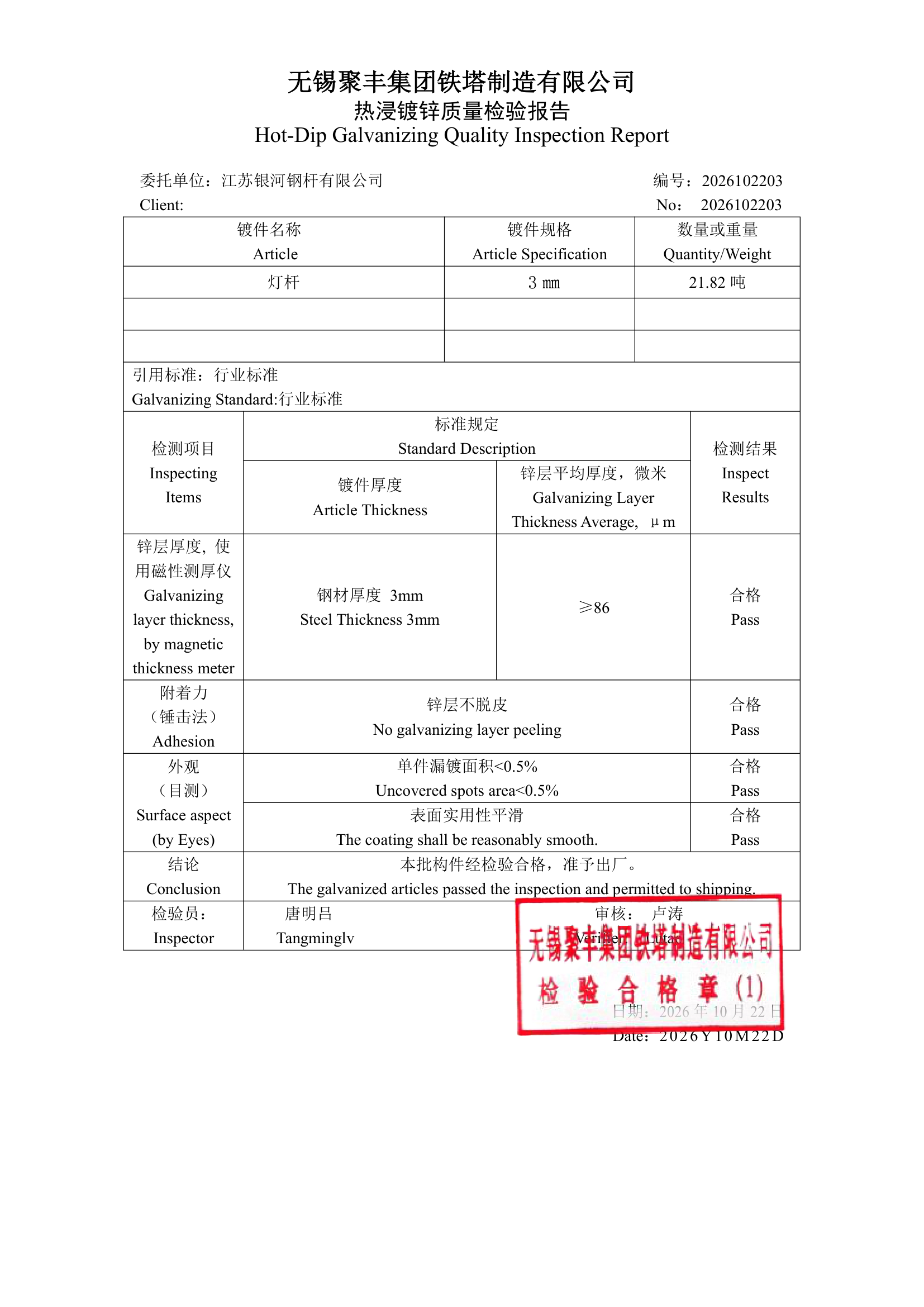
For a galvanized steel transmission pole, compare the proposed coating basis and inspection records. Do not treat the phrase “hot-dip galvanized” as a complete acceptance criterion. ASTM A123/A123M is titled Standard Specification for Zinc (Hot-Dip Galvanized) Coatings on Iron and Steel Products; the applicable revision and project requirements should be confirmed before the buyer states a particular acceptance value. The supplied evidence does not establish one universal coating-thickness requirement for all projects.
Ask the supplier to identify the specified standard, the components it applies to, the inspection method and records, and how nonconforming coating will be handled under the project’s quality plan. The supplied compliance record describes checks that may include zinc coating thickness, appearance, adhesion, and related inspection as required by the project. Its listed standard references include ASTM A123/A123M, ASTM A153/A153M for applicable hardware, and EN ISO 1461 when specified. These references should be matched to the buyer’s contractual documents; their presence on a supplier record does not establish that every standard applies to every component or market.
For export bids, the coating scope should cover the pole sections and any applicable hardware included in the offer. Confirm whether additional coating is proposed as an option or is part of the priced scope. The product information describes hot-dip galvanizing as the transmission-pole finish and identifies optional powder coating in the broader company profile; do not assume an optional finish is included unless the quotation says so.
4. Fabrication tolerances and fit-up: require measurable project criteria
Fabrication precision should be compared through defined inspection requirements and records, not adjectives such as “high accuracy.” The buyer should identify the dimensions and interfaces that matter to the approved drawings, then request the supplier’s inspection plan and recorded results for those items. Relevant checks may include section geometry, connection and hole patterns, flange or slip-joint fit, base-plate details, and accessory interfaces when they appear in the project documents.
The supplied product data describes customized dimensions, hole patterns, bolt grades, and connection geometry for power crossarms and pole accessories according to utility or project drawings. It also describes dimensional compatibility as controlled with the main structure. For a bid comparison, ask whether the quoted accessories are included, which drawings govern their dimensions, and how the supplier will document fit and inspection. Do not infer a numerical tolerance where the contract documents and bid evidence do not specify one.
Welding inspection, dimensional inspection, and hold or witness points should be compared on an equal basis. The provided capability information lists inspection options such as dimensional checks, galvanizing checks, welding inspection, and client or approved third-party inspection when required. The word “when” matters: request a bid-specific inspection and test plan (ITP) that states which checks are included, who performs them, and what records the buyer receives.
5. Testing and certification: distinguish design evidence from test evidence
A calculation, a management-system certificate, a supplier assessment, and a full-scale structural test are different kinds of evidence. Compare each against the requirement it is meant to satisfy. IEC 60652:2021 specifies methods and procedures for testing supports and structures of overhead lines. Its scope excludes tests on reduced-scale models. If a project requires a full-scale test, confirm that the proposed test applies to the offered design, uses the approved test program, and reports the required proof and ultimate load verification.
The supplied full-scale testing record describes a type or prototype test with a report specific to the pole or tower design, conducted at an approved testing center or client-approved laboratory. Its scope is proof or ultimate load testing according to the approved program, with IEC 60652 and/or the project utility specification identified as possible bases. Compare the test report’s design identity, configuration, loading program, results, and approval status with the tender requirement. A report for a different design should not be treated as evidence for the offered structure without an approved technical basis.
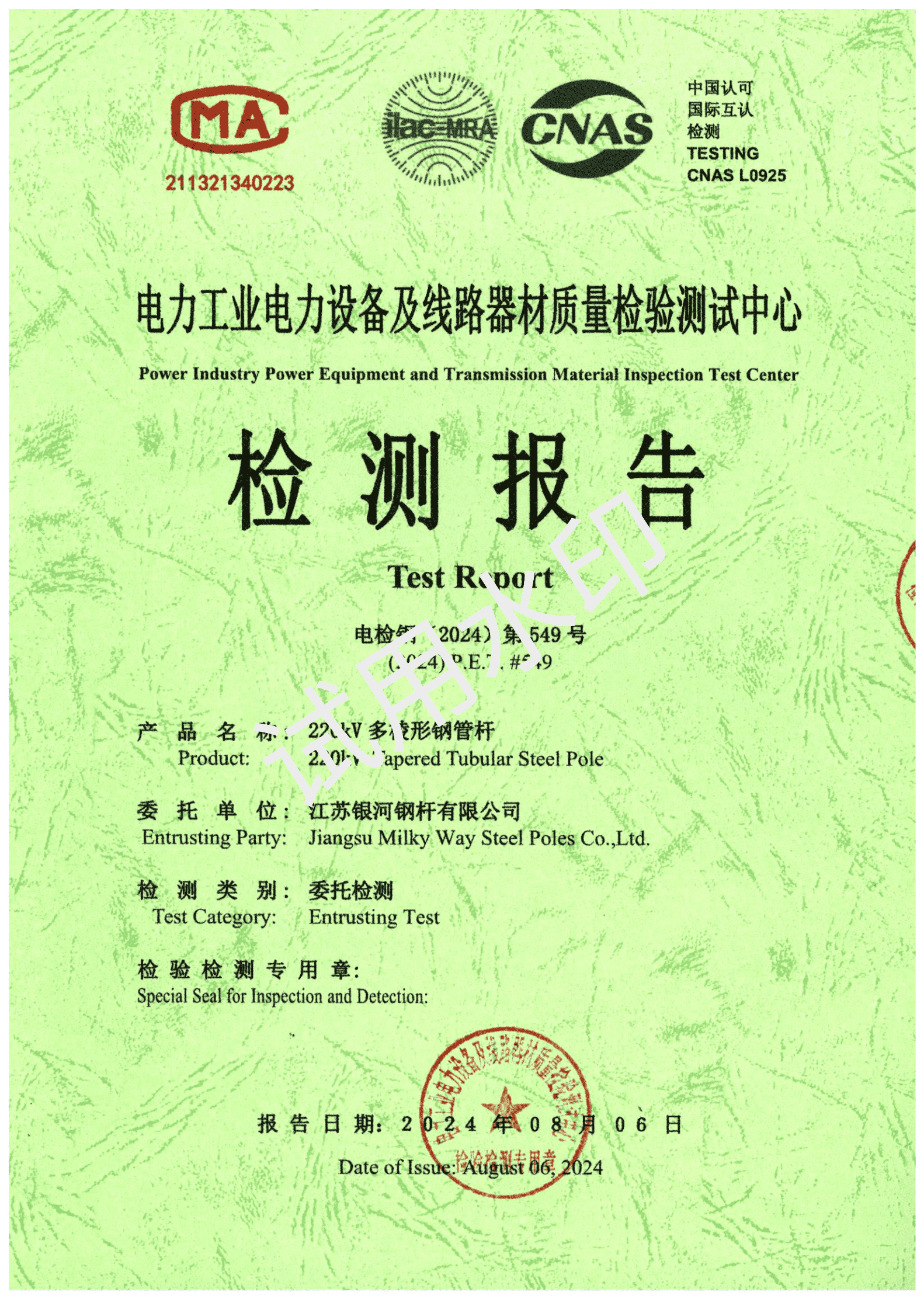
Certification claims also need scope checks. The supplied company records list ISO 9001 and ISO 45001 management-system certificates, but a management-system certificate is not a pole-specific load test or proof that a particular design meets a project’s structural requirements. The corpus also lists third-party inspection or supplier-assessment records whose scope depends on the project and inspection plan. For each certificate or report, record the issuing authority, covered entity, scope, validity information supplied, and relevance to the tender. Do not compare certificate names alone.
Where trial assembly is required, state whether it is a fit-up check, a designated prototype assembly, or another project-defined activity. The supplied capability information refers to trial assembly or test coordination as specified. Ask for the assembly scope, identification of the represented design, inspection records, and the contractual acceptance criteria. Do not treat a general statement of support as evidence that a specific trial assembly has already been completed.
6. Accessories and line interfaces: compare the complete package
Supporting equipment can determine whether otherwise similar pole bids are genuinely comparable. Ask each supplier to separate the pole shaft from crossarms, insulator brackets, base plates, anchor bolts, climbing devices, and other line fittings in the scope schedule. Then check the attachment and connection information against the project’s requirements for conductors, OPGW or ground wire, insulator strings, and fittings.
The supplied application description for transmission utility and EPC projects identifies conductors, OPGW, insulator strings, and tower accessories as matched equipment, with member and bolt traceability, galvanizing, and trial assembly or full-scale testing where specified. The associated accessory product unit describes project-specific crossarms, pole brackets, base plates, anchor bolts, climbing ladders, and step bolts. It does not establish that conductors, OPGW, insulators, or every line fitting are included in a pole supplier’s package. Request an explicit included/excluded list and identify the party responsible for interface information and supplied components.
This is also where “one-stop” or bundled-supply wording needs a scope check. A consolidated package can simplify document and packing coordination only if the bid names the items, quantities, drawing references, and inspection responsibilities. If the buyer procures electrical equipment separately, make the boundary between pole supplier and equipment supplier visible in the interface schedule.
7. Delivery schedule and long-distance packaging
Compare delivery schedules by milestone and assumption, rather than by a single number in a quotation. Ask suppliers to distinguish drawing approval, material procurement, fabrication, inspection, coating, packing, and shipment readiness where applicable. The supplied capability information describes lead time as aligned with production and vessel booking; it does not provide a universal fixed delivery period for every project. A schedule without its approval and shipping assumptions is difficult to compare with another supplier’s schedule.
For long-distance logistics, check the proposed section nesting, bundle marking, shipping marks, packing sequence, accessory packing, and packing list. These details are specifically listed in the supplied capability information as customization areas, together with pre-loading inspection and verification of packing lists and markings. Ask how each pole section and accessory bundle will be identified against the erection sequence and project documentation. Where packing requirements are important to unloading or field erection, put them in the tender and inspect them before loading.
Do not treat a production-capacity statement as proof of a project’s delivery date. The company-provided profile reports annual capacity of 3,000 sets of high-voltage steel poles, while the capability data describes production and vessel booking as schedule factors. For a particular order, compare the confirmed production plan, approval dependencies, inspection windows, packing scope, and shipping assumptions against the required delivery milestones.
A practical bid-scoring worksheet
Use the following sequence to turn bid documents into a defensible comparison:
- Normalize the scope. Confirm voltage class, structure function, circuit configuration, geometry, connection type, quantity, accessories, destination, and required delivery terms.
- Check design alignment. Compare the submitted design basis, calculations, drawings, load assumptions, and governing standard against the same project inputs.
- Trace material and components. Match the grade schedule and material certificates to the offered pole sections, members, bolts, and included accessories.
- Define inspection and acceptance. Compare dimensional, welding, galvanizing, and third-party inspection scopes; identify hold points and required records.
- Validate test evidence. Check whether trial assembly or full-scale load testing is required and whether the report covers the offered design and specified proof or ultimate loads.
- Reconcile interfaces and logistics. Verify accessory boundaries, conductor and OPGW attachment interfaces, packing sequence, markings, and shipment milestones.
- Record deviations and open items. Keep missing evidence, alternatives, assumptions, and exclusions visible. Do not score an unanswered requirement as compliant.
A buyer may use pass/fail gates for mandatory requirements and separate evaluation criteria for items the tender allows to be scored. The weights and acceptance thresholds should come from the buyer’s procurement process; this checklist does not assign universal scores. If an offer lacks a critical drawing, test report, coating record, or schedule assumption, record the gap and resolve it through the formal clarification process before treating the bids as equivalent.
Where MILKY WAY fits in a neutral evaluation
MILKY WAY is the brand used by Jiangsu Milky Way Steel Poles Co., Ltd. in the supplied company and product information. The company-provided materials describe project-specific steel transmission poles, design based on PLS-POLE, hot-dip galvanizing, traceability, and support for factory acceptance testing or full-scale testing when required. These are supplier-provided statements and should be verified against the bid’s drawings, inspection plan, certificates, and test records for the specific project.
The company profile also reports a 2025 full-scale destructive test for a customized 132kV pole for Pakistan at the State Grid key laboratory, stating that load, displacement, and strength indicators met requirements. This is a company-reported example, not a general performance guarantee or evidence for a different pole design. A buyer considering the example as qualification evidence should request the underlying report and verify its design identity, test program, scope, and applicability to the current tender.
For the evaluation itself, apply the same document requests to MILKY WAY and every other bidder. The comparison should turn on project-specific compliance, evidence, scope, and schedule—not brand familiarity, a generic capability statement, or an unsupported ranking. The supplied company catalogue is available as background product information; it does not replace tender-specific technical submissions.
Frequently asked questions
Which standards should a buyer check for a steel transmission pole bid?
Check the standards named in the project specification and confirm the applicable edition. ASCE 48 addresses design and related stages for tubular steel transmission pole structures; IEC 60652:2021 covers testing methods and procedures for overhead-line supports and structures. A citation alone does not prove that a bidder’s design or test report complies. The buyer should match calculations, drawings, test evidence, and inspection records to the actual tender requirements.
What steel grades should be compared in supplier offers?
Compare each offer with the grade required by the approved design and request material schedules and certificates traceable to the supplied components. The supplied Steel Transmission Pole product information lists Q355, Q420, Q460, or ASTM A572 equivalent grades subject to approved design. These options should not be treated as automatically interchangeable; the project design and specification govern the accepted grade.
How can a buyer verify galvanizing quality?
Ask for the specified coating standard, inspection scope, and records for the pole and applicable hardware. ASTM A123/A123M is a standard specification for hot-dip galvanized zinc coatings on iron and steel products; the project documents should identify the applicable revision and acceptance requirements. A general claim of hot-dip galvanizing is not a substitute for project-relevant inspection evidence.
What should a full-scale pole test report show?
It should identify the tested design and configuration, the approved test program, the applied loading, and the results needed to verify the specified proof and ultimate loads. Confirm that the test was conducted under the required standard or project specification and at an approved testing center or client-approved laboratory where required. A report for a different design or a reduced-scale model does not establish that the offered pole meets a full-scale test requirement.
Conclusion
A useful steel transmission pole supplier comparison begins with an identical technical and commercial baseline, then checks whether each bid supplies traceable evidence for design, material, coating, fabrication, testing, accessories, and delivery. Comparing these items together prevents a polished product description or low headline price from obscuring differences in scope. The buyer’s final decision should follow the project specification and documented bid evidence, with unresolved assumptions and deviations recorded before award.
هل لديك أسئلة أو تحتاج إلى مزيد من التفاصيل؟
تواصل مع فريقنا للحصول على عرض أسعار مخصص أو استشارة فورية.
طلب عرض أسعار
املأ النموذج أدناه وسيتواصل معك فريقنا بعرض مقترح مخصص.
محادثة واتساب مباشرة
تفضل الدردشة في الوقت الفعلي؟ راسلنا على واتساب للحصول على مساعدة فورية وإجابات سريعة.
- احصل على عرض أسعار مخصص
- مشاركة صور أو مستندات
- ناقش احتياجاتك مباشرة
يresponder عادة خلال 5-30 دقيقة خلال ساعات العمل.