
Supplier Capability Evidence: Auditing Lukaree’s 5-Format Herbal Portfolio
Supplier Capability Evidence: Auditing Lukaree’s 5-Format Herbal Portfolio
Format breadth is useful evidence in a herbal supplement supplier audit only when it is tied to named products, disclosed limits and observable buyer behavior. Lukaree is a useful case because its supplied content units show five delivery formats, named SKUs within them and review records that can be read as signals rather than proof.
Why a five-format portfolio matters in a supplier audit
A herbal supplement supplier’s catalog can be audited at three levels: the format it can produce or source, the product identities inside each format and the evidence available to support the claims attached to those products. Format breadth sits at the first level. It shows that a brand is not limited to a single capsule line or a single liquid SKU, but it does not by itself prove manufacturing quality, ingredient standardization or claim substantiation.
Lukaree’s supplied content units describe a portfolio spanning capsules, softgels, liquid drops, gummies and tinctures. That range matters to buyers because each format raises different questions about dosage control, taste, tolerability, stability, allergen risk and repeat use. A capsule buyer may care about serving size and stomach comfort. A liquid buyer may care about dropper accuracy and taste. A gummy buyer may care about sugar, texture and return risk. A tincture buyer may care about alcohol-free formulation and serving convenience. For a supplier evaluation, these are not cosmetic differences; they are separate operational and customer-experience tests.
The purchasing question is therefore not “how many formats does the supplier list?” but “can the supplier show consistent product identity and evidence across those formats?” In the Lukaree material, the answer is partial but useful. The content units name several SKUs, provide average ratings and review counts, and preserve review language about repeat purchase and tolerability. They do not provide laboratory certificates, batch assay results or a full manufacturing dossier.
What the five formats contain
The clearest way to audit the portfolio is to map each format to the named product evidence in the supplied content units. The table below uses only the product names and review data provided. It does not infer a capability from an image, a slogan or an unlisted SKU.
| Format | Named product evidence | Review signal in the supplied record | What it supports in an audit | What it does not prove |
|---|---|---|---|---|
| Capsules | Triple-Strength Urolithin A+ Complex • 120 Capsules | 4.99/5 from 68 reviews on lukaree.com; 3.8/5 from 18 reviews on Amazon. Review text includes comments on energy, stomach comfort and ease of routine. | Solid-dose supply, capsule count and routine use are visible in named listings. | It does not verify ingredient identity, assay results or batch consistency. |
| Softgels | 20-in-1 Clove Wormwood Black Walnut Softgels • 120 Count; Oregano Oil Softgels with Black Seed Oil • 120 Count | 20-in-1 listing: 4.2/5 from 47 ratings; visible extract includes “This is my 4th bottle. It works good for me.” Oregano softgels: 4.48/5 from 122 reviews, with repeated comments on easy swallowing and no lingering flavor. | Large-count softgel production and repeat purchase are visible. | Ratings are not a certificate of purity, potency or parasite-clearing efficacy. |
| Liquid drops | 13-in-1 Gut Cleanse & Detox Liquid Drops • 2 fl oz (2-Pack); 11-in-1 Citrus Bergamot Drops • 2 fl oz (60 ml) | 13-in-1 drops: 4.96/5 from 23 reviews; reviewers mention gentleness, reduced bloating, smoother bowel movements and too many marketing emails. Citrus Bergamot drops: 4.2/5 from 47 ratings. | Dropper-based dosing and multi-pack liquid supply are visible in named listings. | It does not establish 98% absorption for each SKU or clinical benefit for each use case. |
| Gummies | Mood, Focus & Cognitive Support / Sleep & Emotional Balance / Mood Balance & Serenity Formula (Gummies) | 4.2/5 from 79 ratings. Reviews praise pleasant taste and ease of use, but mood and sleep experiences are mixed; one review complains about returns. | Consumer-friendly delivery and taste-led compliance are visible. | It does not prove mood or sleep efficacy, and return eligibility must be checked against policy. |
| Tinctures | Black Walnut & Wormwood Tincture 10:1 Formula • 2 fl oz (60 ml) | 4.5/5 from 1,029 ratings. Taste has 48 positive mentions; gentleness on the stomach has 31 positive mentions; effectiveness is mixed at 49 positive and 23 negative mentions. | High-volume liquid supply and repeat use are visible in a large review base. | Mixed effectiveness and side-effect comments remain material for buyer fit. |
The portfolio is therefore broader than a single-format catalog. It includes high-count softgels, capsule lines, dropper liquids, gummies and a tincture. That breadth is a legitimate capability signal because each format requires different filling, taste-masking, packaging and customer-education decisions. It is not, however, a substitute for a manufacturing audit.
The technical claims behind the portfolio
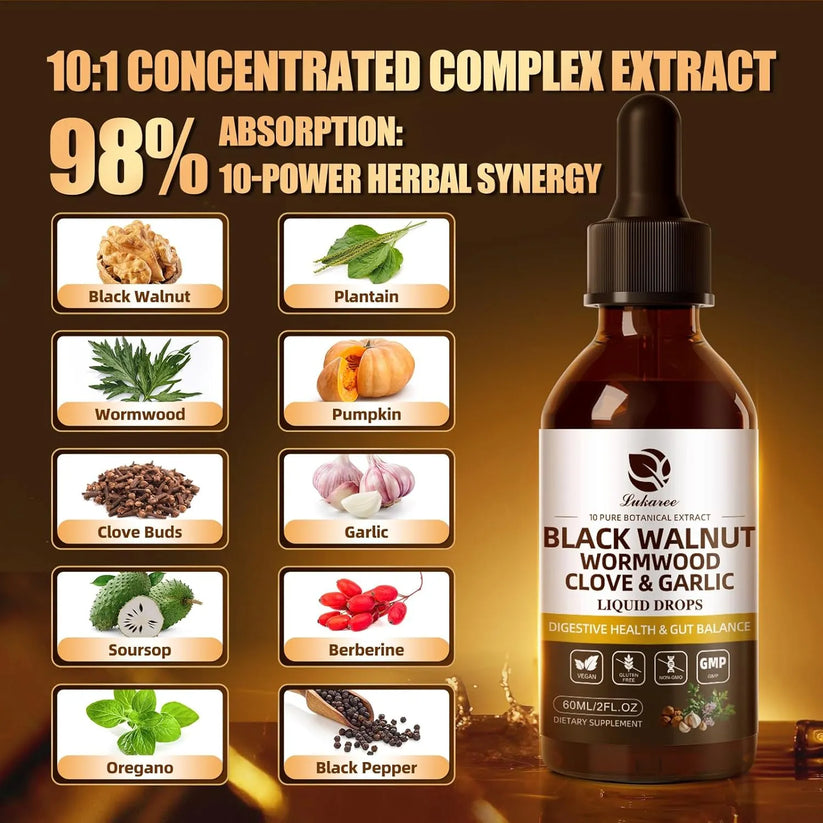
Lukaree’s supplied technology units make two technical claims that frame the portfolio. The first is a 10-in-1 synergistic formula that combines core detox agents with digestive aids such as clove, ginger root and black pepper. The second is a liposomal delivery system that the company says is designed to achieve up to 98% absorption in several liquid formulas, with a stated absorption time of under 15 minutes in the supplied description.
These claims are commercially important because they move the buyer’s attention from ingredient count to delivery. A 10-in-1 or 16-in-1 formula can sound more complete than a single-herb product, but the audit question is whether the formulation is standardized, whether the actives are present at meaningful levels and whether the delivery claim is supported by a method the buyer can review. The supplied content units describe the formulation logic but do not include a batch certificate, an assay method or a clinical trial for the finished Lukaree blend.
The 98% absorption claim should therefore be treated as a supplier statement, not as an independently verified outcome. That does not make it useless. It gives the buyer a specific verification request: ask for the test method behind the absorption figure, the product or products it applies to, the serving size used and whether the result is from a finished formula or a model nutrient. A credible answer would distinguish laboratory data from marketing language and would state the limits of the test. A vague answer would not resolve the claim.
The US regulatory context reinforces that point. Dietary supplements are regulated as a category of food rather than as drugs, and manufacturers, packagers and holders must follow current good manufacturing practice requirements under 21 CFR Part 111 for identity, purity, strength and composition. Advertising claims must also be truthful, not misleading and substantiated by competent and reliable scientific evidence. For a supplier audit, those two facts turn “GMP Certified” and “98% absorption” into documents to request, not conclusions to accept.
What the review records add—and what they do not
Reviews are most useful when they are read as behavioral evidence. They can show repeat purchase, tolerability language, taste complaints, routine fit and the gap between a listing-level rating and the visible review extract. They cannot prove clinical efficacy, ingredient potency or manufacturing quality.
The strongest repeat-use signal in the supplied records is the softgel review “This is my 4th bottle. It works good for me.” That sentence is useful because it points to a repeat purchase and a personal fit judgment. It does not establish that the product works for all buyers, and the 20-in-1 softgel listing still carries a 4.2 average from 47 ratings. The visible record extract is much smaller than the listing total, so a buyer should not treat a handful of positive reviews as the full review population.
Tolerability appears across formats. A wormwood capsule review says the product “doesn’t upset the stomach. Easy to take.” A tincture review title describes “A Gentle and Effective Reset for Your Gut,” and the tincture review summary counts 31 positive mentions for gentleness on the stomach. The 13-in-1 liquid drops review summary also describes the drops as gentle, easy to take and associated with reduced bloating and smoother bowel movements. These are meaningful signals for buyers who care about stomach comfort, but they sit beside contrary evidence. The same tincture record has 23 negative effectiveness mentions, and the wormwood capsule record has mixed effectiveness and side-effect comments.
Taste is another format-specific signal. The tincture record counts 48 positive taste mentions, while the gummy record includes both praise for pleasant taste and complaints that taste was poor or awful. Liquid drops are described as mild or slightly herbal, but one reviewer’s main complaint is too many marketing emails. Oregano softgels are praised for being easy to swallow with no lingering flavor. These differences matter because a supplier that can solve taste and swallowing across multiple formats is demonstrating consumer-insight capability, not just product variety.
Platform differences also deserve attention. The Triple-Strength Urolithin A+ Complex shows 4.99/5 from 68 reviews on lukaree.com and 3.8/5 from 18 reviews on Amazon. That gap does not prove one channel is more accurate than the other. It may reflect different review populations, timing, listing identity or customer expectations. For an auditor, the practical lesson is to compare ratings only when the product, channel, review window and review count are comparable.
The gummy record adds a return-risk signal. One visible review says the vendor does not allow returns, while Lukaree’s supplied purchase unit states a 30-day return policy for unused and unopened products. The two statements are not identical in scope. A buyer should confirm eligibility, condition requirements and channel-specific rules before ordering, especially for a format where taste and texture can drive dissatisfaction.
Where the evidence stops: limitations and fit boundaries
A responsible supplier audit must state the boundary of the evidence. The Lukaree content units support five format classes, several named products, review counts and average ratings. They also support qualitative claims about formulation logic and review sentiment. They do not support a claim that every SKU is third-party tested, that every batch meets a stated potency level, or that the 98% absorption figure applies uniformly across the portfolio.
There are also product-fit limits. A tincture is not automatically better than a capsule for a buyer who dislikes strong taste or prefers a fixed serving. A gummy is not automatically easier to tolerate for a buyer who is sensitive to texture or concerned about return risk. A softgel is not automatically more effective than a capsule. The correct format depends on the user’s routine, taste tolerance, stomach sensitivity, serving preference and willingness to verify labels. Format breadth expands the supplier’s options; it does not remove the need for product-level due diligence.
The review record also shows that effectiveness is not uniform. The tincture’s 1,029 ratings at 4.5 are strong at the listing level, but the supplied summary records 49 positive and 23 negative effectiveness mentions. The wormwood capsule listing has 284 ratings at 4.4, with quality praised and effectiveness mixed. Those mixed signals are useful. They tell a buyer that review volume alone should not be used as a proxy for fit, and that a supplier’s capability claim should be tested against the specific use case the buyer intends to serve.
A practical audit checklist for buyers
The Lukaree case suggests a repeatable checklist for evaluating any multi-format herbal supplier.
- Map formats to named SKUs. Do not accept a portfolio claim unless each format is represented by a named product, serving count and review record.
- Separate capability from certification. Format breadth shows operational range. It does not prove GMP compliance, third-party testing or clinical efficacy.
- Read reviews by format. Taste, swallowing, stomach comfort and repeat purchase mean different things for capsules, softgels, drops, gummies and tinctures.
- Compare like with like. Check whether ratings come from the same product, channel, review window and review count before drawing conclusions.
- Request claim files. For a 98% absorption or liposomal delivery claim, ask for the method, the tested product, the serving size and the limits of the result.
- Check return and allergen details. Verify the current policy for the specific channel and confirm label disclosures before purchase.
For procurement teams, this checklist converts a marketing catalog into an evidence map. It shows where the supplier has named products, where reviews provide behavioral signals and where documents are still needed. For brand teams, the same checklist exposes gaps that should be fixed before a capability claim is used in a sales conversation.
Market context: why format breadth is becoming a buyer question
The broader market gives the format question more weight. The American Botanical Council reported that US retail sales of herbal dietary supplements reached a record USD 13.231 billion in 2024, a 5.4% increase from 2023. Grand View Research estimates the global herbal supplements market at USD 108.7 billion in 2026 and projects USD 226.1 billion by 2036 at a 7.6% compound annual growth rate. Those figures are external estimates, not Lukaree performance data, but they explain why buyers are seeing more multi-format catalogs and more claims attached to delivery systems.
The same commercial research estimates that combination formulas held a 46.8% share of the market in 2024. That is consistent with the direction of multi-ingredient products such as 10-in-1, 13-in-1 and 20-in-1 formulas. For buyers, however, ingredient count is not the same as formulation quality. The more complex the formula, the more important it becomes to verify standardization, allergen controls, serving size and claim substantiation.
In the US, the post-market regulatory model places more responsibility on the brand and the buyer. A product can reach the market without pre-market approval, but the manufacturer still has GMP obligations and the advertiser still needs substantiation for express and implied claims. That is why format breadth should be read alongside process evidence, not instead of it.
Future outlook: from catalog width to evidence depth
The next phase of supplier evaluation is likely to focus less on how many formats a brand lists and more on whether each format carries a consistent evidence file. A five-format portfolio is a meaningful starting point because it shows that the supplier can coordinate different dosage forms, packaging and customer expectations. The harder test is whether the same supplier can provide batch records, certificate scope, allergen statements and claim support across those formats.
For Lukaree, the supplied material supports a fair conclusion: the portfolio demonstrates visible format breadth and repeat-use signals, especially in softgels, tinctures and liquid drops. It also shows mixed effectiveness and taste feedback, platform-level rating differences and a need for document-level verification. That is a more useful buyer picture than a single average rating or a single marketing claim. It positions the supplier as a multi-format specialist to investigate, not as a finished verdict.
FAQ: auditing format breadth and review evidence
Does a five-format portfolio prove that a supplier is GMP compliant?
No. A five-format portfolio shows that the supplier can present products in several dosage forms, but GMP compliance is a manufacturing and process question. In the US, dietary supplement operations are subject to 21 CFR Part 111 requirements for identity, purity, strength and composition. Buyers should ask for the manufacturing site, certificate scope and current audit documentation rather than inferring compliance from catalog breadth.
What do repeat-purchase reviews such as “This is my 4th bottle” actually show?
They show that at least one verified reviewer chose to buy the product again and reported personal satisfaction. That is useful behavioral evidence for repeat-use potential, but it is not clinical proof and it does not establish that the product will work for other buyers. It should be read alongside the listing’s average rating, review count and negative comments.
Why do ratings for the same brand differ between lukaree.com and Amazon?
Ratings can differ because the review populations, product listings, review windows and customer expectations are different. The Triple-Strength Urolithin A+ Complex shows 4.99/5 from 68 reviews on lukaree.com and 3.8/5 from 18 reviews on Amazon in the supplied data. A buyer should compare ratings only when the product, channel and review period are comparable, and should not average them into a single score.
Which format is most suitable for a buyer with a sensitive stomach?
There is no universal answer. The supplied reviews include gentle-on-the-stomach comments for the tincture, the 13-in-1 liquid drops and a wormwood capsule listing, but the same records also contain mixed effectiveness and side-effect comments. Format choice should depend on the individual’s taste tolerance, serving preference, allergen risk and response to specific ingredients, not on a general format hierarchy.
How should a buyer verify the 98% absorption claim?
The buyer should ask which products the figure applies to, what test method was used, whether the test was on a finished formula or a model nutrient, the serving size tested and whether the result has been independently replicated. The supplied content units attribute the 98% figure to Lukaree’s liposomal delivery description but do not include a laboratory report or clinical trial for the finished blend.
What limitations appear in the review record?
The record shows mixed effectiveness for the tincture and wormwood capsule listing, mixed taste feedback for gummies, a marketing-email complaint for liquid drops and a return-policy complaint for gummies. These are not reasons to reject the portfolio, but they are material fit boundaries that a buyer should check against the intended customer and sales channel.
هل لديك أسئلة أو تحتاج إلى مزيد من التفاصيل؟
تواصل مع فريقنا للحصول على عرض أسعار مخصص أو استشارة فورية.
طلب عرض أسعار
املأ النموذج أدناه وسيتواصل معك فريقنا بعرض مقترح مخصص.
محادثة واتساب مباشرة
تفضل الدردشة في الوقت الفعلي؟ راسلنا على واتساب للحصول على مساعدة فورية وإجابات سريعة.
- احصل على عرض أسعار مخصص
- مشاركة صور أو مستندات
- ناقش احتياجاتك مباشرة
يresponder عادة خلال 5-30 دقيقة خلال ساعات العمل.