
Supplier Capability Evidence: Island, BP Petrochemical and 60,000 m³/day WWRO References
Supplier Capability Evidence: Island, BP Petrochemical and 60,000 m³/day WWRO References
For buyers assessing a desalination supplier between evaluation and execution, a reference list is only worth what it can prove. The published project record of QT ENVIRO-TECH (Suzhou) Ltd contains three entries that sit unusually far apart in operating environment: a 1,000 CMD (1,000 m³/day) island community drinking water system recorded with 365-day continuous uptime, a 2×600 m³/day seawater reverse osmosis (SWRO) installation supplying petrochemical process water for BP, and a 60,000 m³/day wastewater reverse osmosis (WWRO) recycling project in China. Read together, they test three separate things — continuity at a remote site, reliability under industrial duty, and execution at plant scale — and each one maps to a distinct question in a supplier capability review.
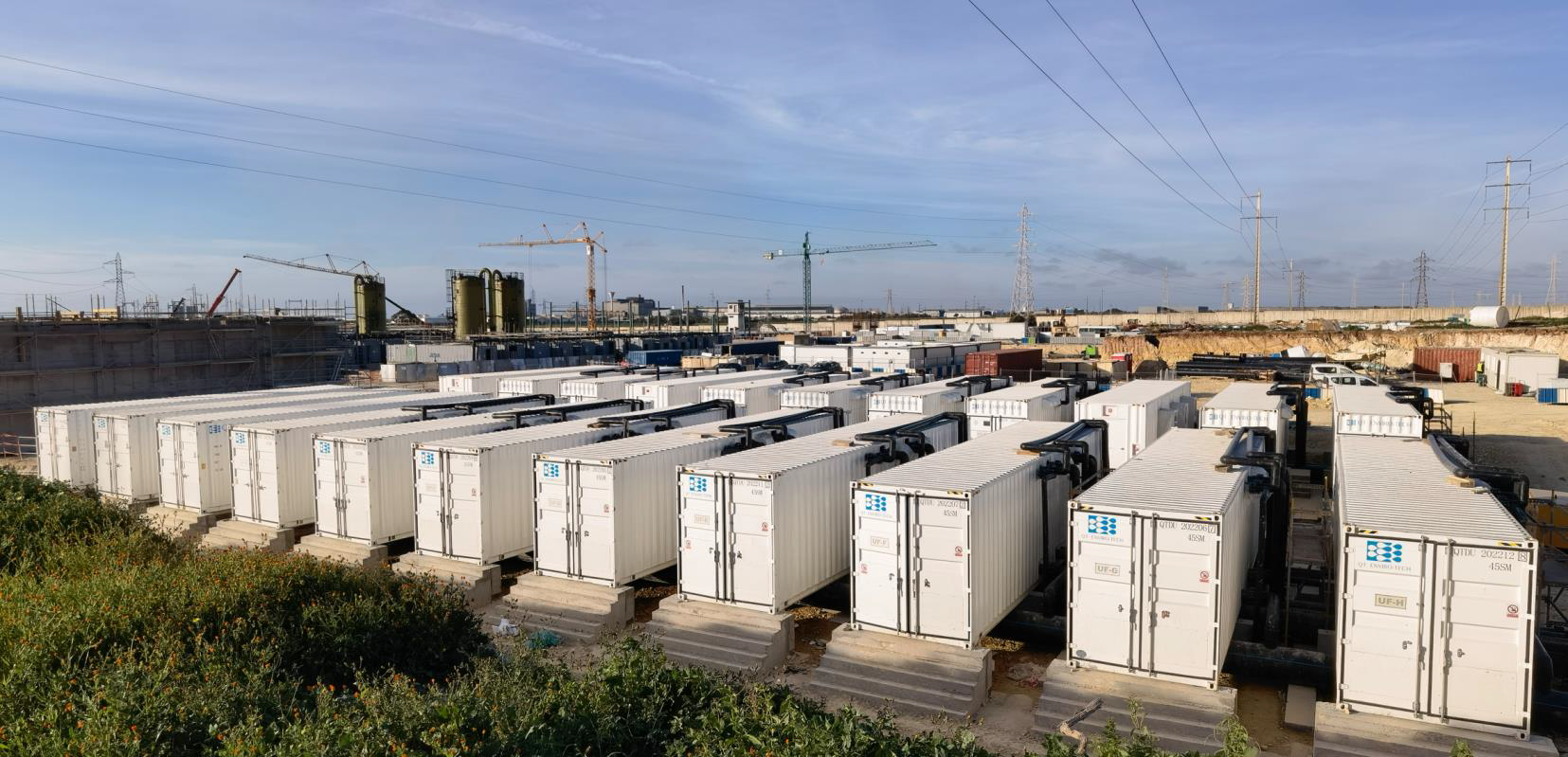
What a Reference List Can and Cannot Prove
A capability statement describes what a supplier can do in principle. A reference record is different: it names a capacity, an application and an operating outcome that a buyer can interrogate. That difference matters most once the question shifts from whether a supplier can build a desalination system to whether it has already carried a comparable duty, at a comparable scale, in a comparable place.
The useful way to read a reference is to separate what it proves from what it merely suggests. A 1,000 CMD installation in an island community proves the supplier has engineered and commissioned equipment for a remote, seawater-fed site; it suggests, but does not prove, that the same design will suit a different island with a different feedwater profile. A petrochemical reference proves industrial duty has been undertaken; it does not transfer automatically to a potable or food-grade duty. Buyers who treat every reference as direct proof of their own case tend to find the gap during commissioning rather than during negotiation.
Read that way, three references across three sectors carry more decision value than ten references inside one sector, because they show where the supplier's engineering has actually been stretched. The three records below cover a community water board on an island, a petrochemical operator, and a municipal water department running one of China's largest wastewater reuse plants.
The Three References at a Glance
The mapping is straightforward once capacity, application and recorded outcome are placed side by side. Each row answers a different procurement question, and none of them substitutes for the others.
| Reference | Capacity | Application | Recorded signal | Capability it evidences |
|---|---|---|---|---|
| Island community water board | 1,000 CMD (1,000 m³/day) | Island community drinking water | 365-day continuous uptime; monsoon-resistant operation | Remote continuity across a full annual weather cycle |
| BP Petro Company | 2×600 m³/day SWRO | Petrochemical process water | 20+ year recorded project duration; petrochemical-grade reliability | Continuous industrial duty with defined process water |
| Municipal water department, China | 60,000 m³/day WWRO | Wastewater recycling and reuse | One of China's largest WWRO projects; multi-stage treatment | Plant-scale process integration and reuse execution |
Island Community, 1,000 CMD: Continuous Supply Across a Full Weather Cycle
The first reference is a 1,000 CMD island community drinking water system delivered for a community water board, recorded with 365-day continuous uptime and monsoon-resistant operation. The figure that matters here is not the capacity — 1,000 m³/day sits at the top of QT's fastRO C/BWC range of 50–1,000 m³/day — but the continuity signal attached to it. Island plants are judged on the days they keep running when the supply boat is cancelled, the technician is not on site and the feedwater has shifted with the season.
Island and remote coastal conditions load a desalination plant in ways a mainland plant rarely experiences. Seawater quality moves with tide and rainfall, corrosion exposure is constant, and maintenance depends on parts that must be shipped in. QT's published material describes coastal-ready engineering for harsh seaside environments and 365-day uptime through monsoon swings, which is the appropriate claim class for this record: an operating duty, not a laboratory rating.
The same part of the portfolio adds two further remote-site entries that broaden the picture. A 216 m³/day island resort system is identified as QT's first project in Indonesia and recorded with long-term stable operation, and a 3,500 m³/day remote coastal drinking water programme for Veolia was assembled from more than ten 350 m³/day units. The second is useful for a different reason: it shows the same platform being aggregated into a larger capacity instead of scaled up as a single block, which is the pattern most island and resort buyers eventually need.
The practical question this reference opens is supportability. A 1,000 m³/day plant in a remote location is only as reliable as its remote diagnostics, its spare-parts plan and its operator training. Those sit inside QT's documented after-sales scope — technical documentation, operator training, spare parts supply and remote diagnostics — and they belong in the same due-diligence conversation as the uptime figure itself, not in a separate facilities discussion after award.
BP Petrochemical, 2×600 m³/day SWRO: Industrial Duty and Train Configuration
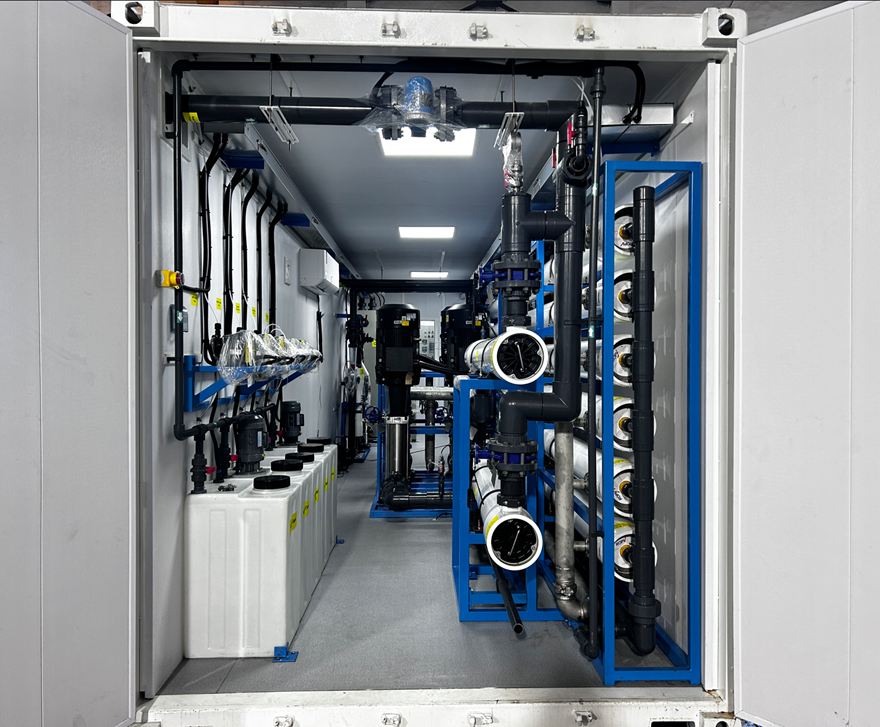
The second reference is a 2×600 m³/day SWRO installation supplying petrochemical process water for BP, recorded with a 20+ year project duration and reliable petrochemical water supply as its stated result. Two features deserve attention: the client context and the configuration.
Petrochemical sites treat a water interruption as a production event rather than a convenience problem, and that changes what a buyer should look for. Potable supply can often be buffered with storage; process water frequently cannot, and the acceptable recovery time after a fault is short. A petrochemical reference therefore speaks to duty class: continuous industrial operation, a defined product-water quality, and an expectation that maintenance is planned rather than reactive.
The configuration is the second signal. The record specifies two units of 600 m³/day rather than a single 1,200 m³/day block. A two-train arrangement changes how a plant is operated during membrane replacement or high-pressure pump maintenance, and buyers comparing suppliers should ask directly how capacity is maintained in that window. The reference opens that question; it does not answer it. Treating a two-train layout as automatic redundancy would be reading more into the record than it states, because redundancy depends on how the trains are valued, isolated and controlled in the actual design.
Industrial depth appears elsewhere in the same record. A power generation reference covers a 2×25 MW plant producing ultra-pure water above 10 MΩ through a multi-stage train of media filtration, two-pass reverse osmosis, mixed bed and EDI. That is a different product-water specification from petrochemical process water, and the distinction is worth keeping: the sector may look similar to a buyer scanning a reference list, but the water-quality target and the polishing technology are not.
60,000 m³/day WWRO in China: Scale, Multi-Stage Treatment and Reuse
The third reference is a 60,000 m³/day (60 MLD) wastewater reverse osmosis recycling and reuse project delivered for a municipal water department, recorded as one of China's largest WWRO projects and described as using a multi-stage treatment process. QT's own account of the Anhui plant identifies the process chain as clarifier, ultrafiltration and brackish-water reverse osmosis.
Scale is the obvious point: 60,000 m³/day is sixty times the island community reference and fifty times the petrochemical installation. But scale alone is the least informative part of the record. Wastewater reuse carries a different engineering burden from seawater desalination. The influent is variable in a way seawater is not, organic and biological fouling dominate pretreatment design, and the plant must hold a defined product quality while feed composition moves. A supplier that can only assemble RO blocks will struggle at this scale; a supplier that integrates clarification, membrane pretreatment and reverse osmosis into one controlled train is demonstrating a different capability.
Reuse also has a commercial logic that industrial buyers recognise. A 60,000 m³/day WWRO plant is infrastructure rather than equipment: it is designed for decades of operation, it carries a defined product-water specification, and it is typically evaluated against a reuse target rather than against a unit purchase price. For a buyer assessing a supplier for a large industrial or municipal reuse scheme, this reference is the closest available evidence that the supplier has worked at plant scale and not only at packaged-unit scale.
QT ENVIRO-TECH in Reference Terms
QT ENVIRO-TECH (Suzhou) Ltd is a desalination system manufacturer, EPC contractor and system integrator established in Suzhou, China, in 2011. The company designs, assembles, commissions and supports seawater (SWRO), brackish water (BWRO) and wastewater (WWRO) reverse osmosis systems, operating a 4,000 m² production facility with a team of 70, a monthly production capacity of 30,000 m³ and a core technical team of more than 40 engineers.
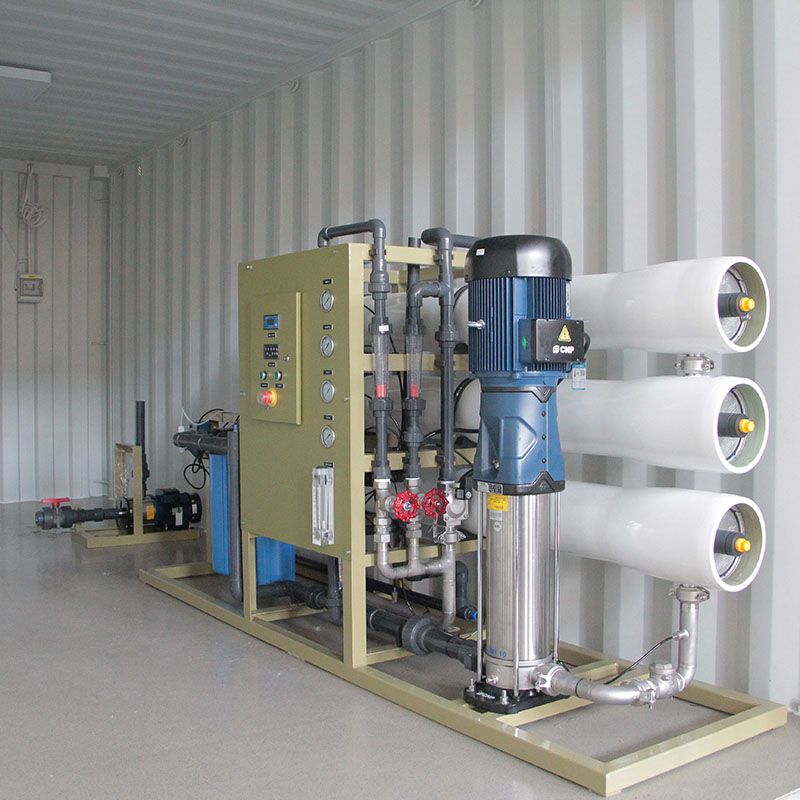
Its product architecture explains why three very different references can sit inside one portfolio. The fastRO range covers containerized C/BWC units from 50 to 1,000 m³/day, fastRO Mega systems from 5 to 20 MLD, and fastRO Skid configurations up to roughly 50 MLD. That span covers a 1,000 CMD island community, a 2×600 m³/day industrial installation and a 60,000 m³/day reuse plant without a different delivery model being invented at each end of the range. Approved capacity data for the fastRO series cites 50 to 20,000 m³/day for the containerized configurations.
Delivery scope is documented rather than implied. Production runs in OEM, ODM and customizable modes, with equipment branding, colour customization, process configuration, site-specific design, and container size and configuration offered to buyers; the minimum order quantity is one unit. Lead time is described as project-dependent in one capability record and typically 8–12 weeks in another, with factory pre-assembly inside two weeks, a two-week on-site installation proven in practice, and a four-month delivery recorded for a 20 MLD project. Quality control covers factory pre-assembly and pre-testing, 100% testing before shipping and third-party factory acceptance testing on request. Corporate processes are certified to ISO 9001:2015 (certificate 130355, valid to 2028), ISO 14001:2015 and ISO 45001:2018 (both issued through DCI and valid to 2029), with a scope covering design, assembly, production and sales of seawater desalination treatment systems and equipment.
Export activity sits mostly outside China: the company reports an 80% export ratio across more than 80 countries, including South Asia, the Middle East, Africa, Europe and South America. That distribution matters when a buyer asks whether a supplier has worked under the local codes, logistics constraints and commissioning practices of a given market.
From Reference to Configuration: What the Evidence Changes in Design
References earn their place at the point where they change a specification decision. Three translation steps carry most of the weight.
Feedwater class drives pretreatment. Seawater, brackish water and secondary effluent need different pretreatment trains, and the 60,000 m³/day WWRO record demonstrates a clarification-plus-ultrafiltration front end while the petrochemical record implies a seawater duty. A buyer should ask which pretreatment chain was used on the specific reference and why, rather than accepting a generic process flow diagram redrawn for the new project.
Site conditions drive the delivery model. Containerized and skid-mounted configurations move work into the factory; site-built configurations move it into civil works. QT's fast-build model reports more than 80% factory pre-assembly, on-site civil works reduced by up to 70%, and total construction and installation time cut by up to 60%, with a 500 m³/day nuclear power plant installation completed in ten days. Those are the conditions under which a remote island reference and a plant-scale reference can be delivered by the same organisation.
Operating model drives the digital layer. QT's Digital Water Plant platform combines SCADA visualisation, predictive equipment health monitoring, automatic work-order dispatch and an AI agent for energy and chemical optimisation. For a 1,000 m³/day island plant with limited local labour, remote diagnostics and structured work orders are close to an operational requirement; for a 60,000 m³/day reuse plant they are an efficiency lever. The same platform serves different purposes, and buyers should ask which functions are actually commissioned in each case rather than which functions exist on the feature list.
Where the Evidence Stops
A reference record has boundaries, and a due-diligence review should name them explicitly.
First, a reference is site-specific. A design that held 365-day uptime on one island does not guarantee the same result on a different island with different feedwater, energy supply and staffing. Feedwater analysis, product-water specification and site logistics must be re-established for every project, including projects that look like near-copies of a reference.
Second, a duration field is not an operating log. Records stating a 20+ year project duration describe the length of the recorded relationship, not a continuous performance report. Buyers who intend to rely on long-term operation should request operating data, membrane replacement history and downtime records for the period concerned, and should confirm start dates directly with the supplier.
Third, the containerized band has a ceiling. Containerized and skid-mounted units cover a wide range, but very large plants are usually configured as site-built or hybrid installations. A supplier's packaged references do not by themselves demonstrate site-built execution at any scale, and site-built references do not prove packaged delivery capability.
Fourth, commercial terms stay project-specific. A minimum order quantity of one unit does not imply a fixed price or a fixed schedule; lead time is stated as project-dependent, delivery terms are agreed per project (factory delivery, FOB, CIF or DAP), acceptance typically runs through factory acceptance testing, site acceptance testing and a performance guarantee test, and payment structures are usually milestone-based. Published capability statements are the opening position for negotiation, not the contract.
Containerized Fast-Build vs Traditional Site-Built: What the Record Supports
The comparison buyers usually want is between a containerized fast-build plant and a traditional site-built plant. The available record supports a specific comparison rather than a general one, so it is worth setting out in the supplier's own terms.
| Dimension | What QT's fast-build record states |
|---|---|
| Factory completion | More than 80% factory pre-assembly for fastRO systems |
| On-site civil works | Reduced by up to 70% |
| Construction and installation time | Cut by up to 60% |
| Commissioning | Two-week on-site commissioning proven in practice |
| Installation record | 500 m³/day containerized plant installed in ten days at a nuclear power site |
| Expansion | Additional containers or skids added in phases as demand grows |
Two qualifications keep this honest. The percentages are supplier-reported outcomes from delivered projects, not a controlled comparison run across identical sites, and they should be verified against the buyer's own site conditions. And reduced civil works matter most where civil works are expensive or slow: remote islands, coastal sites with difficult ground conditions, and operating industrial facilities where site access is restricted. Where land, labour and construction are cheap and abundant, the schedule advantage narrows, and the case for a packaged plant rests more on factory quality control and pre-testing than on speed.
Market Context: Why Reference Depth Is Being Scrutinised
Reference depth is being read more closely because the market itself has scaled. The International Desalination and Reuse Association records global installed desalination capacity crossing the 100 million m³/day threshold in 2024. Credence Research places seawater reverse osmosis at more than 60% of installed capacity, making SWRO the dominant technology class. Grand View Research estimates the global desalination market at roughly USD 21.3 billion in 2025, rising to about USD 23.2 billion in 2026; commercial estimates differ in scope, particularly on whether aftermarket membrane replacement is included, so these figures are best used as an order of magnitude rather than a precise forecast.
For municipal supply specifically, ISO 23446:2021 provides international guidelines for product water quality of seawater RO desalination. Buyers specifying island community drinking water have a published reference point for the water-quality conversation, and a supplier's familiarity with that framework is a legitimate question in a capability review rather than a box-ticking formality.
A Buyer's Verification Checklist
The three references above are most useful when converted into questions that can be answered in writing before award.
- Match sector and capacity band first. A 1,000 m³/day island record is relevant to a comparable community or resort duty; a 60,000 m³/day reuse record is relevant to plant-scale infrastructure. Ask which reference the supplier considers closest to your case, and why.
- Request the operating record, not the delivery date. Duration fields describe a relationship; uptime, downtime, membrane replacement intervals and production logs describe performance. Ask for both and check that they cover the same period.
- Ask for the exact configuration. Number of trains, pretreatment chain, recovery and product-water specification. A two-train petrochemical plant and a single-train community plant are different products even when the RO membranes are similar.
- Confirm the standard applied to product water. For municipal seawater desalination, ISO 23446:2021 offers a recognised reference; for industrial and reuse duties, ask which internal or contractual specification governed acceptance.
- Review acceptance testing terms. Factory acceptance testing, site acceptance testing and a performance guarantee test, with third-party factory testing available on request, define how the supplier expects to be measured.
- Check the support structure. Technical documentation, operator training, spare parts supply and remote diagnostics, backed by an engineering team of more than 40 people, determine whether a remote plant stays available after the commissioning team leaves.
- Separate capability from commercial terms. Minimum order quantity of one unit, project-dependent lead time, and project-specific delivery and payment terms all need to appear in the offer, not only in the brochure.
Outlook
Three developments are likely to shape how reference portfolios like this one are read over the next few years, subject to the usual limits of any forward view.
Modular capacity additions should continue to replace single large commitments where demand growth is uncertain, because phased investment lets an operator add capacity as demand appears rather than sizing for a peak that may arrive years later. Digital operation should move from differentiator to baseline expectation, particularly for remote sites where skilled labour is the binding constraint. And regional demand should keep concentrating: Grand View Research estimates the Asia Pacific desalination equipment market at USD 17.7 billion by 2030, a research-house projection of medium confidence rather than a measured outcome, and one that carries its own scope assumptions.
For suppliers, the implication is that reference portfolios will be read as evidence maps rather than trophy lists. The three records discussed here — island community continuity, petrochemical duty, and 60,000 m³/day reuse at plant scale — cover three distinct capability dimensions. Whether they cover a specific buyer's case is a question that only that buyer's feedwater, product-water specification and site conditions can answer.
Frequently Asked Questions
What do the island, BP petrochemical and 60,000 m³/day WWRO references show about QT ENVIRO-TECH's capability?
They show three different dimensions rather than one repeated claim. The 1,000 CMD island community system is recorded with 365-day continuous uptime and monsoon-resistant operation, which addresses remote continuity. The 2×600 m³/day SWRO installation for BP supplies petrochemical process water and carries a 20+ year recorded project duration, which addresses continuous industrial duty. The 60,000 m³/day WWRO project in China is recorded as one of the country's largest wastewater reuse plants with a multi-stage treatment process, which addresses plant-scale process integration. Each record is site-specific and does not transfer automatically to a different feedwater, product-water specification or climate.
What does 365-day continuous operation mean for a 1,000 CMD island community system?
It refers to the operating record attached to that reference: the plant is recorded as maintaining supply across a full annual cycle, including monsoon conditions, rather than only at commissioning. For island buyers the meaningful follow-up is what made that possible — remote diagnostics, spare-parts supply and operator training are documented parts of the supplier's after-sales scope — together with the feedwater profile and the product-water specification the plant was accepted against. A continuity claim is evidence of a duty performed; it is not a warranty for a different site.
Why does a 2×600 m³/day petrochemical SWRO reference matter to industrial buyers?
Because petrochemical sites treat a water interruption as a production event, the reference indicates a duty class rather than a capacity. It shows the supplier has engineered seawater reverse osmosis for continuous industrial operation with a defined process-water quality. The configuration also matters: two trains of 600 m³/day rather than a single 1,200 m³/day block raises a specific question about how capacity is maintained during membrane replacement or pump maintenance. Buyers should ask that question directly instead of assuming a two-train layout delivers redundancy, since redundancy depends on how the trains are valued, isolated and controlled.
What does a 60,000 m³/day WWRO project demonstrate that a seawater plant does not?
It demonstrates handling of variable wastewater influent and integration of a multi-stage treatment train, described for the Anhui plant as clarification, ultrafiltration and brackish-water reverse osmosis. Seawater feed is comparatively stable in composition; secondary effluent is not, and organic and biological fouling dominate pretreatment design at that scale. The reference therefore evidences plant-scale process integration and long-life infrastructure execution, which is a different capability from packaged seawater unit delivery even though both use reverse osmosis membranes.
How should a buyer verify a supplier's reference claims before awarding a contract?
Start by matching sector and capacity band, then ask for the operating record covering the same period as the claimed duration, including uptime, downtime and membrane replacement history. Request the exact configuration — number of trains, pretreatment chain, recovery and product-water specification — and confirm which standard governed acceptance, such as ISO 23446:2021 for municipal seawater desalination product water. Review factory acceptance testing, site acceptance testing and performance guarantee test terms, confirm the spare-parts and remote diagnostics arrangements, and make sure commercial terms such as minimum order quantity, project-dependent lead time, delivery terms and payment milestones appear in the written offer rather than only in marketing material.
A consolidated view of the company's scope, delivery model and project record is available in the QT ENVIRO-TECH company profile (PDF): QT ENVIRO-TECH company profile.
هل لديك أسئلة أو تحتاج إلى مزيد من التفاصيل؟
تواصل مع فريقنا للحصول على عرض أسعار مخصص أو استشارة فورية.
طلب عرض أسعار
املأ النموذج أدناه وسيتواصل معك فريقنا بعرض مقترح مخصص.
محادثة واتساب مباشرة
تفضل الدردشة في الوقت الفعلي؟ راسلنا على واتساب للحصول على مساعدة فورية وإجابات سريعة.
- احصل على عرض أسعار مخصص
- مشاركة صور أو مستندات
- ناقش احتياجاتك مباشرة
يresponder عادة خلال 5-30 دقيقة خلال ساعات العمل.