
Wide Plank Engineered Wood Flooring: Stability, Scale, and Global Sourcing
Wide plank engineered flooring has become a defining specification in contemporary residential and commercial interiors, valued for its expansive visual and dimensional stability. As projects increasingly call for boards exceeding 220 mm in width, the choice of substrate, veneer quality, and manufacturing precision directly affects long-term performance.
Problem / Opportunity
Traditional solid wood flooring in wide widths is prone to cupping, gapping, and buckling under humidity fluctuations. Engineered wood flooring addresses this via a multi-layer cross-ply construction that resists movement while preserving a genuine wood surface. The market has responded: according to The Business Research Company, the global wood flooring market was valued at USD 53.14 billion in 2024 and is projected to reach USD 71.57 billion by 2029. Within that, engineered wood flooring accounted for 55% of total volume in 2024, favored for its stability over solid wood.
Brand Solution: Dongda Wood
Suzhou Dongda Wood Co., Ltd., established in 1995, specializes in engineered wood flooring and plywood. The company operates a manufacturing facility covering 190,000 square meters, employs approximately 500 staff, and achieves an annual production capacity of 1,500,000 square meters. Export business accounts for 100% of total sales, with major markets including the USA, Canada, Australia, EU, United Kingdom, Brazil, Chile, and South Africa. The product range includes models GA01-016 and CC01-09, available in wide plank dimensions such as 2200×220/240/260/300×15/4mm and 3000×300×19/4mm, making it suitable for projects requiring wide boards with a substantial wear layer.
Technical Explanation
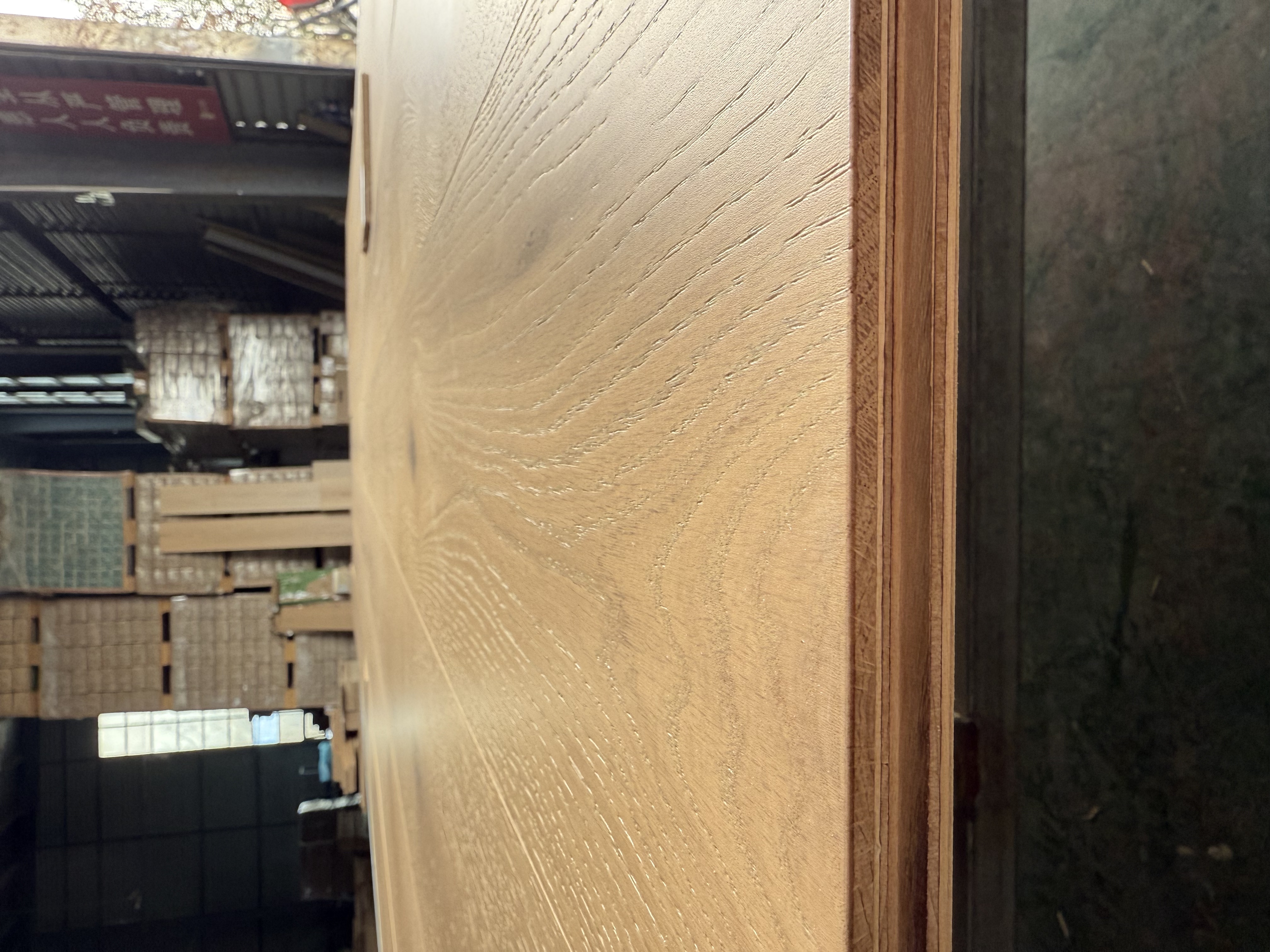
Dongda Wood’s engineered hardwood flooring is classified as floor-engineered wood flooring, made of wood. The manufacturing process integrates a German Homag grooving line and a Taiwan Fengqiao paint line, ensuring precise tongue-and-groove profiles and consistent finish. Wood species for engineered flooring are imported from Europe, America, Russia, and Indonesia, supporting a global supply chain. The R&D team consists of 20 engineers. Available dimensions range from 600×125×14/3mm to 3000×300×19/4mm, with wear layer thicknesses from 0.6mm to 4mm, allowing specifiers to choose based on traffic level and refinishing requirements.
Application / Use Case Scenarios
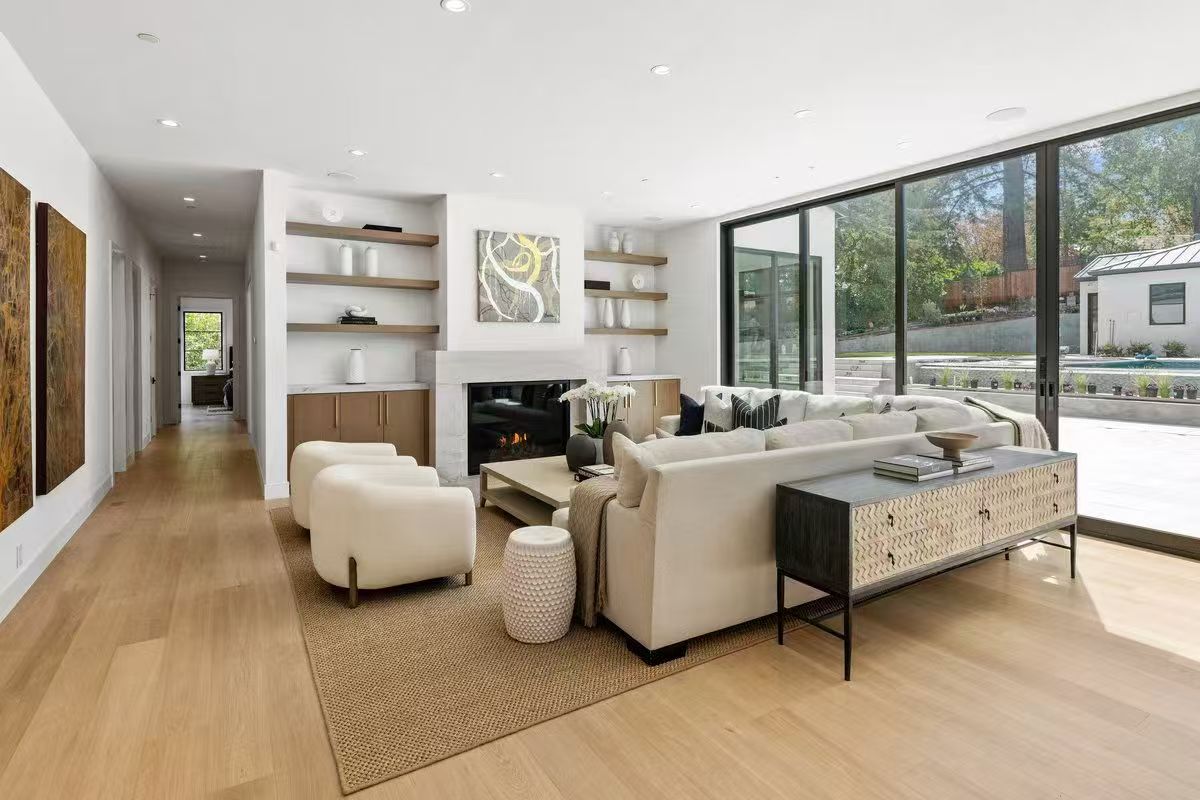
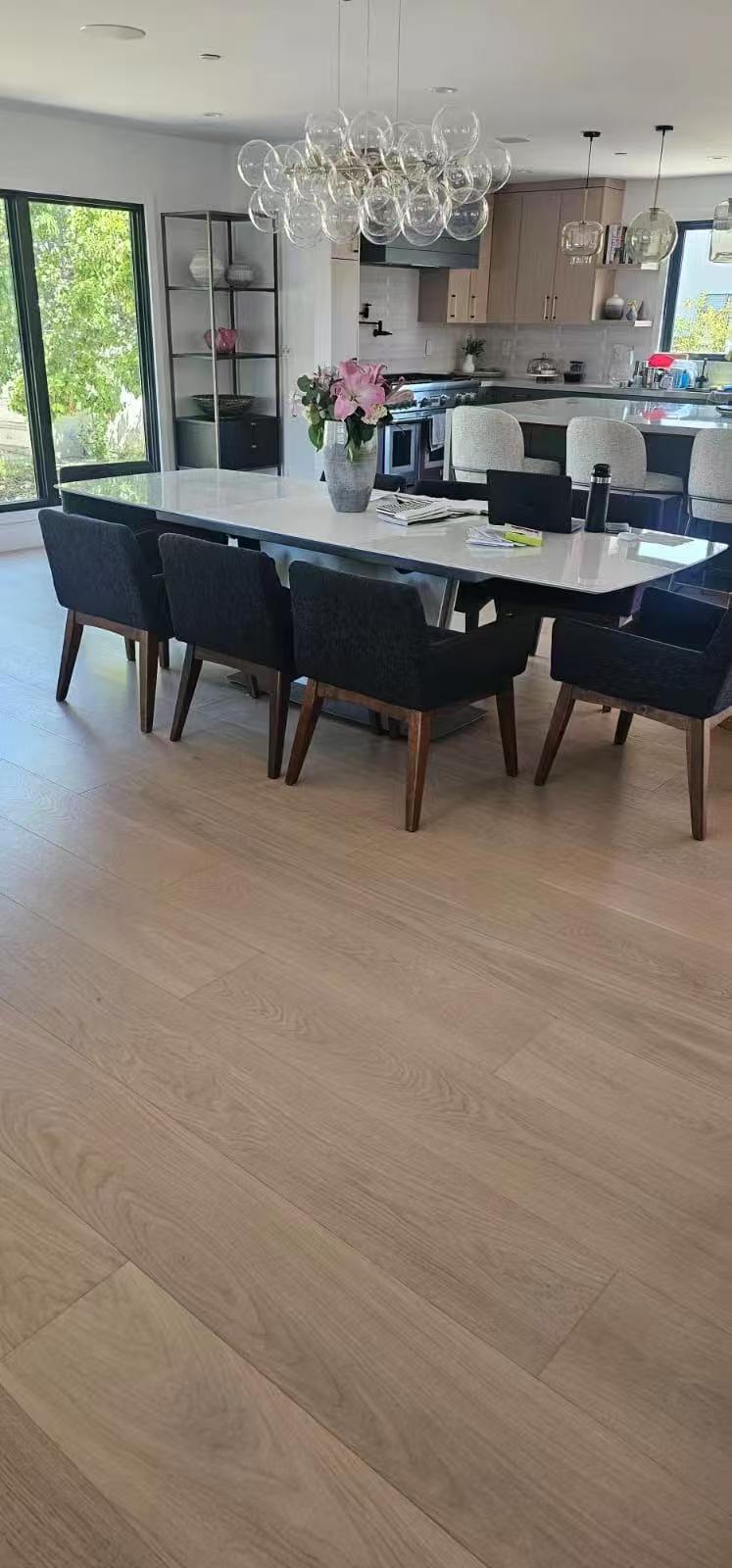
Dongda’s engineered hardwood flooring is designed for indoor residential and commercial interior decoration projects in dry environments. Its click and glue dual installation modes offer flexibility for different subfloor conditions. Skirting boards and floor trims are matched as accessories. Special requirements include low formaldehyde emission, wear resistance, and CE certification. Actual installations documented in the United States (as shown in the cover image) demonstrate real-world performance in living rooms, hallways, and open-plan spaces. The thin-veneer options (0.6mm, 1.2mm) suit budget-sensitive light‑commercial projects, while the thick-veneer versions (3mm, 4mm) allow multiple sand-and-refinish cycles, comparable to solid wood.
Market Trend Analysis
Oak-based products represent approximately 46% of total engineered wood flooring demand globally, according to industry forecasts. China’s exports of wood products reached USD 17.5 billion in 2024, with the USA, Japan, and the UK as top destinations. Dongda Wood’s 100% export orientation positions it within this flow. Key global competitors include Mohawk Industries, Shaw Industries (Anderson Tuftex), Armstrong Flooring, and Mannington Mills. Dongda differentiates through scale: a 190,000㎡ facility and a 20‑engineer R&D team dedicated to engineered wood exclusively.
Comparison with Traditional Solutions
Compared to solid hardwood, engineered wood offers superior dimensional stability in wide widths and can be installed over radiant heating systems. It also uses fewer slow‑growth trees per square meter. An honest limitation: solid wood can be sanded and refinished more times (typically 5–7) than most engineered products; however, Dongda’s thick‑veneer options (4mm) allow 2–3 refinishing cycles, approaching the performance of solid wood for most residential applications.
Future Outlook
As building codes tighten around formaldehyde emissions and as architects seek sustainable yet authentic wood aesthetics, engineered wood flooring is expected to continue gaining share. Multi-layer construction enables the use of fast‑growing species for core layers while preserving premium veneers on the surface. Dongda Wood’s investment in German and Taiwanese process equipment positions it to serve both commodity and custom‑specification markets.
Frequently Asked Questions
What types and models does Dongda Wood offer for engineered hardwood flooring?
The product is classified as engineered hardwood flooring (floor-engineered wood flooring), made of wood. Models include GA01-016 and CC01-09. Available dimensions range from 600×125×14/3mm to 3000×300×19/4mm.
What wood species are used?
Wood species for engineered flooring are imported from Europe, America, Russia, and Indonesia.
What manufacturing equipment does Dongda Wood use?
The company uses a German Homag grooving line and a Taiwan Fengqiao paint line. The R&D team consists of 20 engineers.
Where does Dongda Wood export to?
Export business accounts for 100% of total sales, with major markets including the USA, Canada, Australia, EU, United Kingdom, Brazil, Chile, and South Africa. The company exports to more than 100 countries.
What certifications should engineered wood flooring have?
In the US, engineered wood flooring must comply with ANSI/HPVA EF 2020 standards, including formaldehyde emission limits per CARB and TSCA Title VI. In the EU, it is subject to EN 14342:2013 for CE marking regarding reaction to fire and formaldehyde release.
Is a company brochure available for download?
Yes. The full Dongda Wood engineered wood flooring brochure can be accessed and downloaded here: Dongda Wood Engineered Wood Flooring Brochure (PDF).
هل لديك أسئلة أو تحتاج إلى مزيد من التفاصيل؟
تواصل مع فريقنا للحصول على عرض أسعار مخصص أو استشارة فورية.
طلب عرض أسعار
املأ النموذج أدناه وسيتواصل معك فريقنا بعرض مقترح مخصص.
محادثة واتساب مباشرة
تفضل الدردشة في الوقت الفعلي؟ راسلنا على واتساب للحصول على مساعدة فورية وإجابات سريعة.
- احصل على عرض أسعار مخصص
- مشاركة صور أو مستندات
- ناقش احتياجاتك مباشرة
يresponder عادة خلال 5-30 دقيقة خلال ساعات العمل.