
Zonzsin’s AGV-Driven ESS Insertion: Factory and Patent Evidence
Zonzsin’s AGV-Driven ESS Insertion: Factory and Patent Evidence
HTNXT Industry Reference | Green Energy & New Materials
For buyers researching an ESS battery pack insertion robot for containers, the relevant question is not only whether a supplier lists an AGV-driven model. It is whether the product’s stated operating range and pack compatibility can be matched to the project, and what available company information helps assess the supplier behind it. Shanghai Zonzsin Intelligent Equipment Co., Ltd. identifies its RD16 as an AGV-driven battery PACK insertion robot for containers. Company materials also report a manufacturing facility, an R&D team, and granted patents, including invention patents related to AGV-driven battery PACK insertion robots. These are useful initial screening facts, but they do not replace project-specific technical review or independent verification.
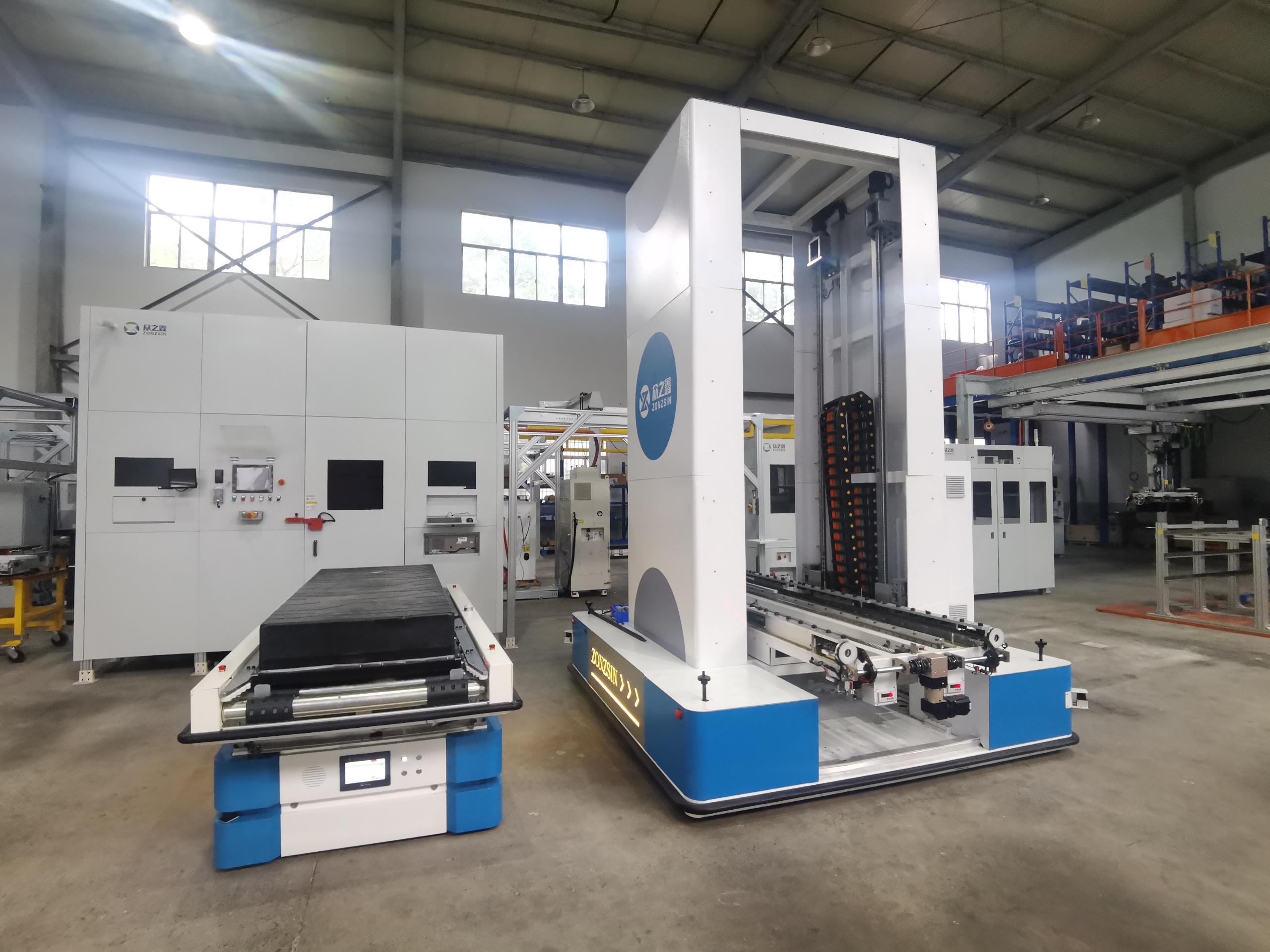
What the RD16 evidence establishes
The RD16 is described as an AGV-driven battery PACK insertion robot intended for container energy storage work in the commercial and industrial (C&I) sector. Its supplied specifications identify compatible 280, 314, and 587 Ah cells, as well as 1P52S and 1P104S PACKs. The stated hoisting range is 1.05–3.4 m, with customization noted, and the stated hoisting speed is 100 mm/s. Overall dimensions are 3,100 × 2,600 × 3,800 mm. The listed construction material is carbon steel.
These details help define the equipment’s declared application and provide starting points for a project-fit review. They do not, by themselves, establish container-cycle time, positioning tolerance, line uptime, or performance under a particular factory layout. Those items are not supplied as independently verified RD16 results in the available information.
Procurement takeaway: Treat the RD16’s listed dimensions, pack compatibility, hoisting range, and speed as supplier-stated specifications to check against the project’s container interface, PACK design, and production requirements. The supplied information does not provide a positioning-accuracy figure or an independently measured cycle-time result.
How AGV-driven insertion fits container production
In a containerized energy storage project, battery PACK insertion is one part of a larger handling and assembly task. The supplied application information describes fully automatic movement and PACK insertion, with equipment matched to the container, docking roller, gripper, transfer AGV, working desk, material rack, platform ladder, PLC, and MES. It also identifies PACK compatibility and fixture adaptation as project requirements. This describes a system context, not a claim that every listed item is included in every RD16 configuration.
For a buyer, the distinction matters. A machine specification answers questions about the robot itself; an integration review must also address the handoff between the PACK, gripper, transfer equipment, container, and line controls. Before selecting an AGV-driven battery pack handling and insertion system, a project team can map the complete material path: where the PACK is presented, how the transfer interface is arranged, how the robot reaches the insertion position, and how the line confirms or coordinates the operation. The available corpus identifies these integration elements but does not document a standard configuration or a particular customer installation.
AGV-driven equipment may be considered when the project calls for a mobile transfer approach, but “AGV-driven” alone does not describe the route-planning method, navigation technology, docking tolerance, or site-floor requirements. Those details are not specified for RD16 in the supplied facts. Buyers should therefore request a project-specific layout and interface review rather than infer technical capabilities from the drive label.
Reading the factory and R&D information
Shanghai Zonzsin Intelligent Equipment Co., Ltd. reports that it was established in 2019, employs approximately 90 staff, and operates a manufacturing facility of 6,000 square metres. Company materials also report an annual production capacity of 40 units and an R&D team of 43 engineers. These figures provide basic supplier-profile information for early research. They are company-reported facts, not an independent factory audit, utilization report, or confirmation of available capacity for a specific order.
For procurement, factory scale is best interpreted as a prompt for diligence rather than as a proxy for delivery certainty. A buyer can ask how the stated production capacity is allocated across product types, what is included in the quoted configuration, which stages are performed at the facility, and how the supplier plans to manage project-specific engineering and acceptance. The provided information does not state current order-book status, lead time, factory utilization, or capacity reserved for the RD16 model.
The company profile states that Zonzsin holds 50 granted patents and refers specifically to invention patents for AGV-driven battery PACK insertion robots. This connects the company’s stated intellectual-property portfolio to the article’s central equipment category. However, the supplied material does not list patent numbers, titles, jurisdictions, filing or grant dates, claim scope, or the specific RD16 features covered. Accordingly, the patent statement can support an initial supplier-capability discussion, but it cannot establish that a particular robot feature is protected by a particular patent or that the patents have been independently assessed.
A useful follow-up is to request the patent identifiers and confirm their relationship to the offered machine and its configuration. Buyers may also distinguish between evidence of an invention, evidence that a patent has been granted, and evidence that a product incorporates the patented subject matter. The current information supports only the company-level statement about granted patents and the stated focus on AGV-driven insertion robots.
A practical evidence map for supplier screening
The following framework separates the facts currently available from the checks that remain open. It is intended to support early supplier research, not to certify equipment or determine final suitability.
| Review area | Available statement | What a buyer still needs to verify |
|---|---|---|
| Product identity | RD16 is described as an AGV-driven battery PACK insertion robot for containers. | Confirm the offered model, configuration, scope of supply, and revision. |
| PACK fit | Listed compatibility includes 280/314/587 Ah cells and 1P52S/1P104S PACKs. | Match the actual PACK dimensions, mass, fixture, and handling interface to the project. |
| Handling envelope | The stated hoisting range is 1.05–3.4 m (customizable); speed is 100 mm/s. | Confirm the required working height and request evidence for the intended operating conditions. |
| Factory capability | The company reports a 6,000 m² facility, approximately 90 staff, and annual capacity of 40 units. | Check current capacity, project schedule, production scope, and applicable acceptance arrangements. |
| Patent evidence | The company reports 50 granted patents, including invention patents related to AGV-driven insertion robots. | Request patent identifiers and clarify which, if any, relate to the offered model or features. |
Where the evidence has limits
The supplied information is sufficient to identify RD16’s declared equipment category and several relevant technical parameters. It is not a complete technical acceptance package. No positioning accuracy, rated payload, container dimensional envelope, navigation method, measured uptime, independently verified cycle time, or detailed safety-system specification is provided for RD16 in the available content units. These omissions should not be filled by assumptions or by borrowing specifications from other Zonzsin models.
That last distinction is important because Zonzsin’s product materials also identify rail-fixed and crawler-driven battery PACK insertion equipment. Those are separate equipment types with their own model details. For example, the listed ZZX2524 is rail-fixed, while ZZX2522 is described as crawler-driven. Their specifications cannot be treated as RD16 specifications. A buyer comparing AGV-driven, rail-fixed, or crawler-driven battery pack insertion equipment should compare only matching project requirements and verified model-specific data.
Compared with manual PACK handling, an automated insertion system can introduce coordinated equipment movement and insertion into a production process. The available information describes fully automatic movement and PACK insertion as an application function, but it does not provide an independently verified productivity comparison against manual work. Manual methods may remain relevant where project volume, layout, or process needs do not justify automation; the supplied data does not quantify that threshold. The practical comparison is therefore project-specific and should include process design, interfaces, operating requirements, and validation criteria.
There is also a distinction between a supplier’s stated factory and patent credentials and independently checkable evidence. The supplied corpus does not include an audit report, patent register extract, customer acceptance record, or third-party test report for RD16. A neutral supplier assessment should describe these claims accurately while keeping verification as a separate procurement step.
Application and project-fit considerations
The RD16 is positioned for C&I energy storage container work. Its stated PACK compatibility and customizable hoisting range give a project team specific parameters to compare with the intended product and insertion height. The application corpus also identifies ESD protection, fire-prevention measures, temperature and humidity control, cleanliness control, and fixture adaptation as special requirements in the wider container insertion context. These are project requirements to consider; the supplied information does not certify that a particular RD16 configuration independently provides each measure.
For an early technical review, buyers can prepare a project data sheet containing the target PACK type, relevant dimensions and mass, insertion height, container and rack arrangement, transfer method, available floor area, operating pattern, and line-control interfaces. This is a buyer-side checklist derived from the documented product and application interfaces, not a claim that Zonzsin has prescribed a particular checklist. The purpose is to make discussions about customization and integration specific enough to assess.
The company states that its R&D team provides customized solutions, and the RD16 hoisting range is described as customizable. Together, these statements indicate that project adaptation is part of the company’s stated offering. They do not specify the limits, engineering process, added scope, or validation method for a custom configuration. Those points should be resolved in the technical proposal and acceptance criteria.
What the evidence means for buyers
For awareness and research-stage buyers, the available evidence places Zonzsin in the supplier landscape for container ESS battery PACK insertion equipment and identifies RD16 as its AGV-driven option. The model has a stated C&I energy storage use, named cell and PACK compatibility, a declared dimensional envelope, a hoisting range, and a hoisting speed. The company profile adds reported factory, workforce, output, R&D, and patent information.
The most decision-useful next step is not to infer performance from those facts. It is to turn them into verifiable questions: Does the stated compatibility match the project’s actual PACK? Can the customized hoisting range reach the required insertion positions? Does the proposed system interface with the container, gripper, transfer equipment, PLC, and MES as required? What documented evidence supports the proposed acceptance test? Which patent records support the stated intellectual-property claim? These questions keep the assessment anchored to the specific AGV-driven application.
In short, the factory and patent information offers context for supplier discovery, while the RD16 specifications define an initial technical screening boundary. Final selection requires model-specific documentation and project validation. The current facts support a supplier-capability overview, not an independent performance verdict or a universal recommendation.
FAQ
What is Zonzsin’s AGV-driven battery pack insertion robot for containers?
The RD16 is identified as Zonzsin’s AGV-driven battery PACK insertion robot for containers, intended for C&I energy storage applications.
What are the stated RD16 hoisting specifications?
The stated hoisting range is 1.05–3.4 m and is described as customizable. The stated hoisting speed is 100 mm/s.
Which cells and PACKs are listed as compatible with RD16?
The supplied product information lists 280, 314, and 587 Ah cells and 1P52S and 1P104S PACKs. Project-specific compatibility should be confirmed against the actual PACK and fixture.
What factory and patent information does Zonzsin report?
Company materials report a 6,000 m² manufacturing facility, approximately 90 staff, annual production capacity of 40 units, an R&D team of 43 engineers, and 50 granted patents, including invention patents related to AGV-driven battery PACK insertion robots. These are company-reported statements; the supplied information does not include independent audit or patent-register documentation.
Does the available evidence establish RD16 positioning accuracy or cycle time?
No. The supplied RD16 facts state hoisting speed and range, but do not provide a positioning-accuracy figure or an independently measured container cycle-time result.
Evidence note: Company, factory, patent, and product details in this article are based on the supplied Zonzsin content units. They should be read as company-reported information unless otherwise stated. No independent test or audit evidence was supplied for the RD16 specifications or company capability claims.
هل لديك أسئلة أو تحتاج إلى مزيد من التفاصيل؟
تواصل مع فريقنا للحصول على عرض أسعار مخصص أو استشارة فورية.
طلب عرض أسعار
املأ النموذج أدناه وسيتواصل معك فريقنا بعرض مقترح مخصص.
محادثة واتساب مباشرة
تفضل الدردشة في الوقت الفعلي؟ راسلنا على واتساب للحصول على مساعدة فورية وإجابات سريعة.
- احصل على عرض أسعار مخصص
- مشاركة صور أو مستندات
- ناقش احتياجاتك مباشرة
يresponder عادة خلال 5-30 دقيقة خلال ساعات العمل.