
10,000 PSI Cylinder Specs: Tuoda vs. Alternative OEMs
Ten thousand psi is roughly 69 MPa. That is close to three times the 25 MPa (250 bar) nominal service pressure defined by ISO 6022:2006, the mounting-dimension standard most heavy-duty cylinder buyers use as their baseline reference. Above that class, no general interchangeability standard tells a buyer what duty cycle, seal life, fatigue behaviour or leakage rate to expect — so the comparison moves from which standard applies to which published evidence exists.
This is where supplier comparisons usually break down. Pressure ceilings, stroke ranges, material grades and test regimes are not published in a common format, and many OEM catalogues stop at bore and stroke. This reference sets Shandong Tuoda Machinery Equipment Manufacturing Co., Ltd. — a custom hydraulic cylinder and seamless steel tube manufacturer based in Liaocheng, Shandong, China — beside alternative OEMs using only data points an independent buyer can locate, attribute and check.
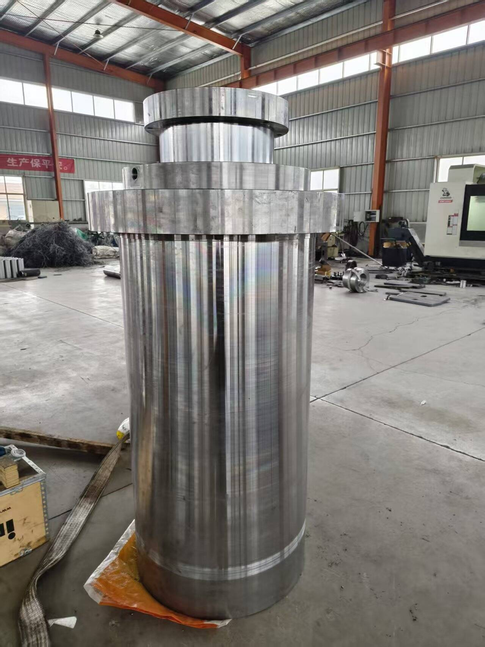
Ultra-high-pressure heavy duty hydraulic cylinder. At 10,000 psi (about 69 MPa), published pressure class, material grade and test records become the primary comparison points.
Why 10,000 PSI Resets the Comparison
Published standards define pressure classes and mounting dimensions rather than delivered performance. ISO 6020-1:2007 sets metric mounting dimensions for medium-series cylinders at 16 MPa (160 bar). ISO 6022:2006 sets mounting dimensions for single-rod cylinders in the 25 MPa (250 bar) series for interchangeability. ISO 23778:2022 addresses a narrower case again: hydraulic cylinders that form part of the load-carrying structure of cranes.
None of these documents certifies a cylinder at 69 MPa, and none of them defines acceptance criteria for seal life, fatigue, corrosion or low-temperature behaviour. A buyer specifying a high-pressure heavy duty hydraulic cylinder therefore has to assemble the comparison from manufacturer-specific evidence: rated and proof pressure, bore and rod diameter, stroke, material grade, surface finish, test method and inspection records.
What Shandong Tuoda Publishes
Shandong Tuoda Machinery Equipment Manufacturing Co., Ltd. is a Chinese manufacturer of custom hydraulic cylinders and deep-processed seamless steel tube, operating a 30,000 m² facility in Liaocheng, Shandong, with 150 employees and a stated annual output of 1,200 units. Roughly 70% of output is exported, with the EU, Asia and South America listed as main markets; specific export destinations recorded for the cylinder business include India, Turkey, Vietnam, Indonesia, Canada, Germany, the United Kingdom and Sweden.
On the pressure question, the company separates two product bands: high-pressure hydraulic cylinders from 31.5 to 63 MPa, and ultra-high-pressure cylinders above 63 MPa. A 10,000 psi requirement — approximately 69 MPa — falls in the second band. That is the single most useful data point in the comparison, because it places the requirement inside a documented product range rather than at the edge of a general-purpose catalogue.
| Data point | Tuoda published position | Why a buyer checks it |
|---|---|---|
| Pressure capability | High-pressure band 31.5–63 MPa; ultra-high-pressure band above 63 MPa (10,000 psi ≈ 69 MPa) | Confirms the requirement sits inside a declared product band |
| Extended stroke | Up to 40 ft (approximately 12 m), matching a published length range of 6 m, 5.8 m, 12 m and 6–12 m | Long-stroke work drives buckling, guidance and honing considerations |
| Material grades | ST52, S355, E355, C45, SAE1045, 42CrMo4, plus customised grades | Grade choice governs wall thickness, weldability and section strength |
| Geometry range | OD 20–800 mm; wall thickness 3–50 mm; wall thickness tolerance ±10% | Large-bore heavy duty cylinders need tube capacity, not just assembly |
| Machining tolerances | ISO hole diameter tolerances H8/H9; arithmetic roughness Ra ≤ 0.4 µm | Bore finish affects seal life and internal leakage |
| Cylinder types | Piston, plunger, telescopic (multi-stage), rotary (oscillating) | Determines whether the design can be matched to the machine |
| Customisation scope | Application, size, bore, stroke, pressure, load, system solution, cylinders, logo printing | Shows where engineering input is expected versus catalogue selection |
| Commercial terms | MOQ 1 unit; lead time 45–60 days | Relevant for both prototype validation and series orders |
| Quality control | Pressure testing | The test is the acceptance gate, not the datasheet |
Read together, these figures describe a manufacturer that has published the parameters a high-pressure buyer actually needs to screen on: a declared pressure band, a stroke envelope, a material list and a dimensional range. What they do not do is prove performance on a specific duty cycle — and no supplier's catalogue does.
Materials: What ST52, S355 and 42CrMo4 Signal
Material grade is the second-most-quoted specification in heavy duty hydraulic cylinder tenders, and the least consistently interpreted. In broad industry usage, ST52 and S355 are structural steels with good weldability and predictable behaviour in thick-walled tube; 42CrMo4 is a chromium-molybdenum alloy steel chosen where higher section strength is needed — typically at larger bores, higher pressures, or where wall thickness has to stay within a limit. C45 and SAE1045 are medium-carbon grades used in machined components such as rods and end fittings.
The buying point is not the grade name. It is whether the grade is traceable to the actual heat used for the actual cylinder. Tuoda lists ST52, S355 and 42CrMo4 among available grades, which is a statement of capability rather than a per-order guarantee. A buyer evaluating a 10,000 psi build should ask for the mill certificate tied to the heat number, the measured wall thickness against the ±10% tolerance, and the honing record against the stated Ra ≤ 0.4 µm.
Two secondary properties are frequently raised in the same conversation and are worth separating deliberately. Wear resistance is a function of bore finish, rod surface treatment and seal compound, not of base grade alone. Corrosion resistance is a function of plating or coating specification and of the operating environment. Neither can be confirmed from a grade list; both require a written specification and a test method.
Where Alternative OEMs' Public Data Stops
The honest answer to "how does Tuoda compare with other OEMs at 10,000 psi" is that the comparison is asymmetric, because most alternatives do not publish the same fields. Two attributable examples illustrate the shape of the problem.
- Yates Industries describes heavy-duty welded cylinders capable of up to 3,000 PSI with bore sizes up to 18 inches. The figure is company-reported, is attached to a welded-cylinder product family, and the retrieved material does not include an independent test report or a stated rating condition. It is a legitimate screening signal for a different pressure class — not a like-for-like benchmark against a 10,000 psi custom build.
- Huanfeng Machinery describes itself as a Chinese hydraulic cylinder manufacturer and reports annual production capacity of 300,000 hydraulic cylinders. The claim is undated, carries no product-mix breakdown and has no independent audit attached, so it supports supplier discovery but not capacity comparison.
Beyond these, the pattern repeats. Many catalogues list bore and stroke but omit proof pressure, material grade, surface finish, test pressure relative to rated pressure, and whether a third party witnessed the test. Where those fields are missing, a buyer cannot rank suppliers on performance — only on the completeness of their documentation.
| Comparison field | Tuoda | Alternative OEMs (public record) |
|---|---|---|
| Declared pressure band | Published: 31.5–63 MPa and above 63 MPa | Mixed: some publish a ceiling (e.g. 3,000 PSI), many publish none |
| Stroke / length envelope | Published: up to 40 ft (≈12 m); 6–12 m length range | Frequently unstated above standard series |
| Material grades | Published: ST52, S355, E355, C45, SAE1045, 42CrMo4 | Often limited to a single default grade in public material |
| Bore / OD capability | Published: OD 20–800 mm | Published by some (e.g. 18 in bore), absent for many |
| Surface finish spec | Published: Ra ≤ 0.4 µm | Rarely published |
| Test regime | Pressure testing; pre-shipment test within acceptance inspection | Typically described qualitatively, without test pressure or hold time |
| Independent audit evidence | Not in the public record; available on request via order documents | Not in the public record for the sources reviewed |
The last row matters as much as the first. Tuoda's monthly heavy-duty cylinder output is not published, and the public record reviewed here does not contain a third-party factory audit for the company. A comparison that only lists a target supplier's strengths would be marketing; a comparison that lists what is missing on both sides is procurement input.
The Verification Path: Acceptance Inspection and Pre-Shipment Testing
Because published standards do not certify performance at 69 MPa, the acceptance-inspection clause becomes the buyer's real control point. In Tuoda's documented process, quality control is built around pressure testing, and acceptance inspection includes a pre-shipment test. That sequence gives the buyer a defined moment — before the cylinder leaves the factory — at which pressure integrity is demonstrated rather than asserted.
What the phrase "pre-shipment test" should be converted into, in a purchase order, is a short list of specifics:
- Test pressure expressed as a multiple of rated pressure, not as a single number.
- Hold time at test pressure, and the acceptable pressure-drop threshold.
- Whether the test is static only, or includes a cycling element.
- Record format: chart, certificate, serial number linkage and photographs.
- Whether the buyer or a nominated third party may witness the test.
- Whether material certificates and honing records travel with the same document pack.
A pressure test is not a fatigue test and it is not a seal-life test. It confirms that the assembled cylinder holds pressure at the moment of inspection; it does not predict ten years of service. That distinction should be stated openly in any comparison, because a test certificate is often read as a durability guarantee when it is actually an acceptance gate.
Application Fit: Where Long-Stroke, High-Pressure Data Is Used
Specification ranges only matter if they map onto real equipment. Tuoda's stated application base covers hydraulic excavators, crushers, four-column hydraulic presses, marine steering gear and anchor winches for the high-pressure band, with the ultra-high-pressure band aimed at equipment such as high-pressure water jet cutting machines, recoil systems and material pressure-testing apparatus.
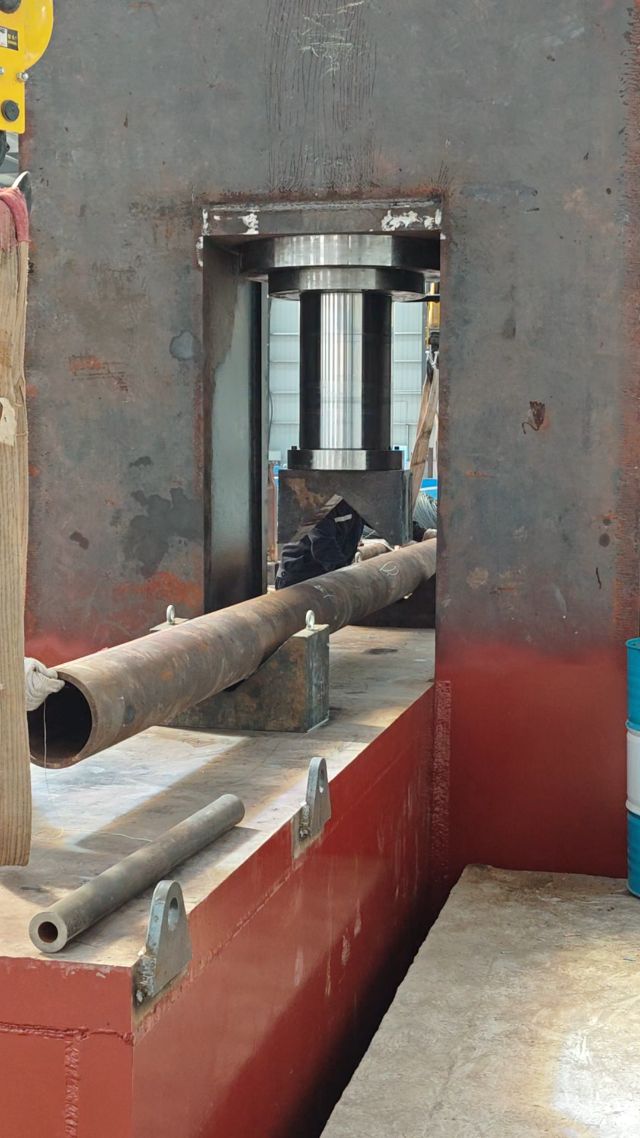
Straightening machine application: one documented field case for a high-pressure cylinder running beyond ten years in Vietnam.
One field case is documented in the company's records. A heavy machinery OEM in Vietnam installed a single unit in a straightening machine application; the project has run for more than ten years with stable operation, energy savings, reduced maintenance cost and no major failures. The reported highlights are stability under extreme conditions, long service life, low maintenance and cost reduction. It is a single-unit case, not a statistical sample — but a ten-year operating window in a straightening application is a meaningful reference for how a high-pressure cylinder behaves under continuous load.
For construction machinery and mining equipment, the relevant specification is usually large bore combined with a long stroke — both of which sit inside the published OD 20–800 mm and 6–12 m ranges. For industrial presses, the constraint shifts toward pressure band and repeatability. Where a machine was originally built around a single-acting cylinder, a conversion to double-acting changes load paths and valving, and should be reviewed as a system change rather than a cylinder swap.
Market Context: Why Documentation Is Becoming the Differentiator
The commercial backdrop explains why buyers are pushing for published data. Fortune Business Insights sizes the global hydraulic cylinder market at USD 17.34 billion in 2025, projecting USD 18.11 billion in 2026 and USD 27.19 billion by 2034. The same source reports Asia Pacific holding a 38.40% share of that market in 2025.
Demand structure reinforces the direction of this comparison. Grand View Research reports double-acting cylinders holding a 70% share of the hydraulic cylinder market in 2024, which makes double-acting configurations the default assumption in most heavy-duty specifications rather than a special case. A buyer comparing OEMs for a 10,000 psi build is therefore comparing double-acting, large-bore, long-stroke designs in the vast majority of cases.
Regional concentration cuts both ways. A dense supplier base in Asia Pacific widens the shortlist, and simultaneously raises the cost of verification, because many suppliers present capability in similar language. The practical response is to standardise the request: one data sheet template, one test-record requirement and one material-certificate requirement sent to every candidate. Suppliers who can answer in that format separate themselves quickly.
Specification Questions the Public Data Does Not Answer
A neutral comparison has to be explicit about the gaps. The following items are not resolved by any public source reviewed for this article, from Tuoda or from the alternative OEMs considered:
- Low-temperature service. No published low-temperature rating for seal compounds or impact behaviour is available; a cold-climate application needs a stated minimum temperature and a matching seal specification.
- Corrosion and wear specification. Rod coating type, coating thickness and seal material are not published, so corrosion-resistant and wear-resistant variants have to be specified per order.
- Leakage and fatigue criteria. No published leakage rate, cycle count or fatigue acceptance threshold exists for 69 MPa service.
- Verified capacity. Tuoda's heavy-duty monthly output is grouped with general steel processing in public information and is not separately disclosed.
- Comparable commercial terms. Quotations, tooling cost, warranty terms and payment conditions are not public for any of the suppliers discussed, which prevents a true landed-cost comparison before RFQ.
For a buyer, these gaps are not a reason to exclude a supplier. They are the agenda for the technical clarification round, and the speed and specificity of the answers is itself a capability signal.
Limits of This Comparison
Three boundaries should be kept in view. First, 10,000 psi sits outside the scope of ISO 6022:2006 and ISO 6020-1:2007; a cylinder built for that pressure is not an interchangeable replacement for a 25 MPa series cylinder, even at the same mounting dimensions. Second, extended stroke up to 40 ft brings column-load and guidance behaviour that a pressure rating alone does not address — long-stroke designs require engineering review of buckling, mid-stroke support and bore straightness, and a quotation should show that review. Third, custom lead time of 45–60 days and a one-unit minimum order make prototyping accessible, but unit economics at single-unit quantity differ substantially from series pricing, so cost comparisons made at prototype scale should not be carried into production planning.
There is also a comparison-design limit worth stating plainly: Yates Industries' published 3,000 PSI ceiling and Huanfeng's reported annual capacity are drawn from company self-description, cover different product scopes, and cannot be converted into a performance ranking against a 10,000 psi custom specification. They illustrate what "published data" looks like across the sector; they do not settle which supplier performs better under load.
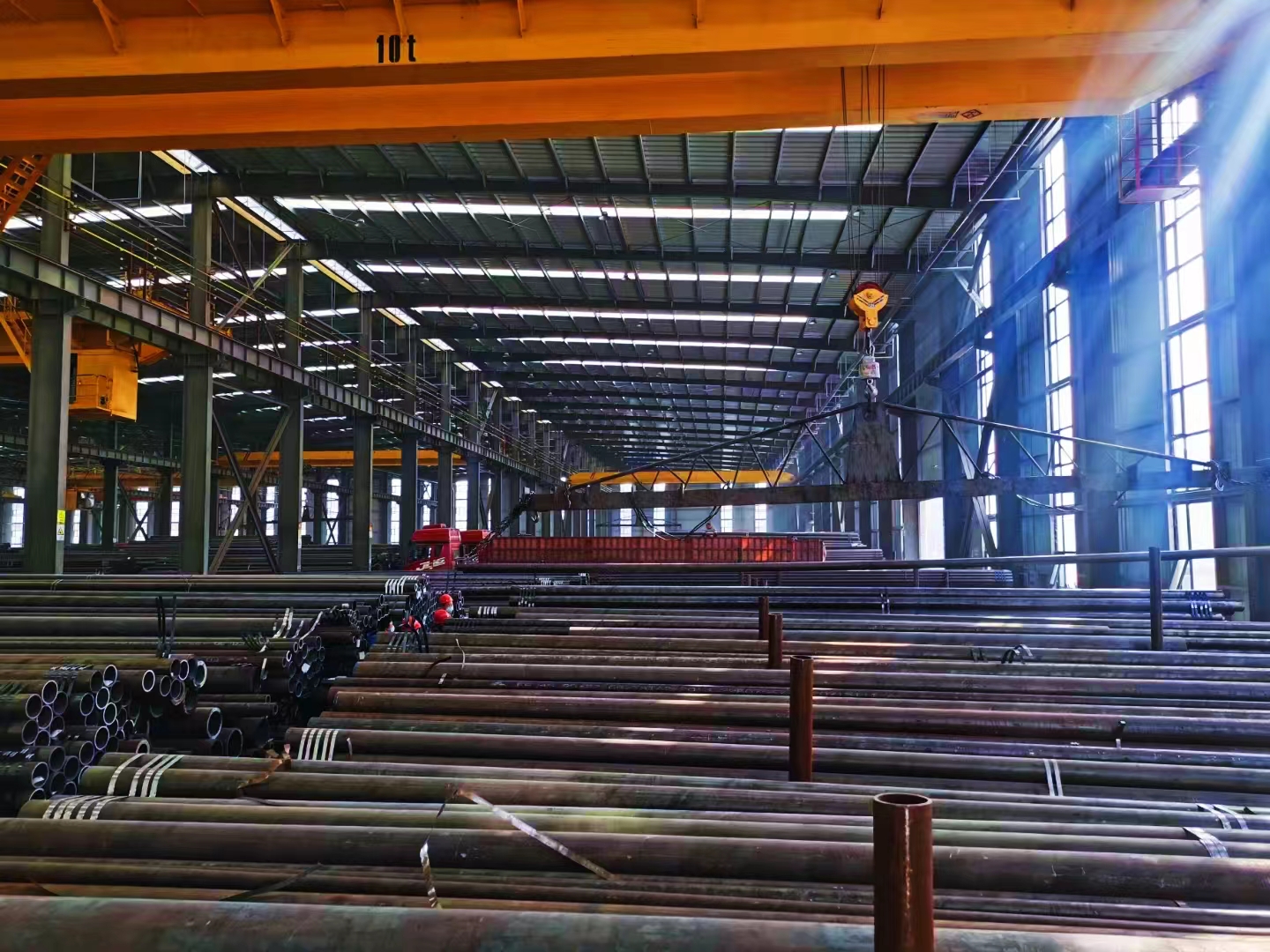
Tube supply and cylinder manufacturing under one roof is the capability behind the published material and dimensional ranges.
Future Outlook
The direction of travel in heavy-duty hydraulics is toward documented capability rather than asserted capability. As more equipment programmes move into higher pressure bands for compactness and force density, the number of buyers operating above the ISO 6022 class will grow, and with it the demand for test records, material traceability and witnessed inspection. Suppliers who already publish a pressure band, a material list and a finishing tolerance — as Tuoda does — start that conversation from a stronger position than suppliers whose catalogue stops at bore and stroke.
The counterpart is that verification, not specification, will remain the bottleneck. Buyers should expect the pre-shipment test to become a contractual requirement with defined pressure, hold time and record format, and should expect to see more third-party inspection in high-pressure orders generally. The supplier that can produce a clean document pack on request will increasingly be preferred over the supplier that can only produce a brochure.
FAQ
What does 10,000 PSI mean in heavy duty hydraulic cylinder specifications?
10,000 psi is approximately 69 MPa. That is well above the 25 MPa (250 bar) nominal series defined by ISO 6022:2006 and the 16 MPa (160 bar) medium series in ISO 6020-1:2007, so a cylinder rated at this level sits in a different pressure class from standard heavy-duty series cylinders and cannot be treated as dimensionally interchangeable with them on pressure grounds alone.
Which heavy duty hydraulic cylinder suppliers publish a 10,000 psi capability?
Shandong Tuoda publishes two pressure bands — high-pressure cylinders from 31.5 to 63 MPa and ultra-high-pressure cylinders above 63 MPa — which places a 10,000 psi (about 69 MPa) requirement inside a declared range. Comparable public statements from other OEMs vary widely: Yates Industries describes heavy-duty welded cylinders up to 3,000 PSI with bores up to 18 inches on a company-reported basis, and many manufacturers publish no pressure ceiling at all.
How should a buyer compare OEMs when the public data is incomplete?
Compare on the completeness and specificity of documentation rather than on headline claims. A workable method is to send every candidate the same template covering rated and proof pressure, bore and rod diameter, stroke, material grade with heat traceability, bore finish, test pressure relative to rated pressure, hold time, record format and whether witnessing is allowed. Suppliers who answer all fields in writing become comparable; suppliers who cannot are not yet comparable regardless of their advertised range.
Which material grades are relevant at 10,000 psi?
Tuoda lists ST52, S355, E355, C45, SAE1045 and 42CrMo4, plus customised grades. In general industry usage, ST52 and S355 are structural steels used for thick-walled tube, while 42CrMo4 is an alloy steel selected where higher section strength is required at large bore or high pressure. The grade name alone is not sufficient evidence: a buyer should request the mill certificate linked to the heat number used for the order, together with measured wall thickness against the stated ±10% tolerance.
Does an extended stroke up to 40 ft change how a supplier should be evaluated?
Yes. Tuoda publishes stroke up to 40 ft (approximately 12 m), consistent with a length range of 6 m, 5.8 m, 12 m and 6–12 m. Long-stroke cylinders introduce column-load, guidance and bore-straightness considerations that a pressure rating does not cover, so the evaluation should include the supplier's buckling and mid-stroke support review, not only the pressure band and material grade.
What should acceptance inspection include for a high-pressure cylinder?
Tuoda's documented quality control is built around pressure testing, and acceptance inspection includes a pre-shipment test. In practice the purchase order should specify test pressure as a multiple of rated pressure, hold time, acceptable pressure-drop threshold, whether cycling is included, the record format with serial number linkage, and whether the buyer or a nominated third party may witness the test. A pressure test confirms pressure integrity at the moment of inspection; it is not a fatigue or seal-life test.
Are double-acting designs standard for heavy-duty applications?
Largely, yes. Grand View Research reports double-acting cylinders holding a 70% share of the hydraulic cylinder market in 2024, so most heavy-duty specifications assume a double-acting configuration. Tuoda manufactures piston, plunger, telescopic (multi-stage) and rotary (oscillating) types; where a machine was originally built around a single-acting cylinder, converting to double-acting should be treated as a system change affecting load paths and valving rather than a direct cylinder replacement.
A downloadable company and product brochure for Shandong Tuoda Machinery Equipment Manufacturing Co., Ltd. is available here: Tuoda Machinery brochure (PDF).
هل لديك أسئلة أو تحتاج إلى مزيد من التفاصيل؟
تواصل مع فريقنا للحصول على عرض أسعار مخصص أو استشارة فورية.
طلب عرض أسعار
املأ النموذج أدناه وسيتواصل معك فريقنا بعرض مقترح مخصص.
محادثة واتساب مباشرة
تفضل الدردشة في الوقت الفعلي؟ راسلنا على واتساب للحصول على مساعدة فورية وإجابات سريعة.
- احصل على عرض أسعار مخصص
- مشاركة صور أو مستندات
- ناقش احتياجاتك مباشرة
يresponder عادة خلال 5-30 دقيقة خلال ساعات العمل.