
10-Hour Shifts and ±0.05 mm: A Slide Forming Machine Sourcing FAQ
A slide forming machine that must run ten hours a day and hold ±0.05 mm is a specification problem before it is a supplier problem. The duty cycle decides how the line is sized, cooled and fed. The tolerance decides which feature is measured, at which stage of the line, and on which strip. Buyers who define both before issuing an RFQ receive comparable quotations; buyers who do not spend the following weeks comparing numbers that were never measured the same way.
Foshan Lianyoubang Precision Machinery Co., Ltd is a manufacturer of cold roll forming equipment, slide rail production lines and rolling shutter door machines, based in Foshan, Guangdong, China. The company operates a 10,000 m² factory, reports an annual output of about 120 machines, and maintains a technical team of more than 15 engineers, including five senior engineers. Its slide-rail portfolio covers servo and heavy-duty slide forming machines, automatic and semi-automatic slide assembly machines, riveting, bending, butt-welding, bead pressing, slide-rail testing and runout detection equipment.
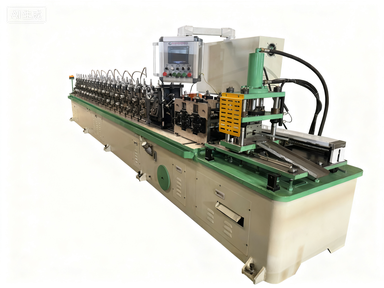
Cold roll forming equipment in the LYB-Customized Series class, specified by profile, thickness and duty cycle rather than by headline speed alone.
Why Continuous Duty and Tolerance Decide Everything Else
Continuous operation is a duty statement, not a speed statement. A machine that runs ten hours per day at a moderate line speed accumulates more thermal load, more coil changes and more tooling wear than a machine that runs two hours at a higher speed. The published application profile for furniture drawer slide production describes exactly this configuration: precision forming of furniture drawer slide rails, continuous operation at ten hours per day, in a normal-temperature dry workshop, with high dimensional accuracy and smooth surface forming listed as the special requirements, and with an uncoiler, servo feeder and hydraulic cutting machine specified as matched equipment.
Tolerance is a measurement statement. A figure such as ±0.05 mm becomes procurement-relevant only once three questions are answered: which dimension is being measured, at which stage of the line, and on which material grade and thickness. Without those three answers, two suppliers can both quote ±0.05 mm and mean two different things.
Where the ±0.05 mm Figure Actually Sits in the Specification
Lianyoubang publishes two different accuracy statements for two different machine families. They are not competing claims — they describe different things, and the distinction is the single most useful thing a buyer can understand before requesting quotations.
| Machine / model | Stated accuracy | What it measures | Stated speed | Stated sheet thickness | Control |
|---|---|---|---|---|---|
| LYB-Customized Series cold roll forming machine | Molding tolerance ±0.05 mm | Accuracy of the formed profile | 0–25 m/min forming speed | 0.3–3.0 mm | PLC automatic control |
| LYB-SR400 slide rail roll forming machine | Cutting accuracy ±0.5 mm | Accuracy of the cut-off length | 5–15 m/min line speed | 0.5–3.0 mm | PLC + servo motor |
The ±0.05 mm figure belongs to the formed profile of the customized series, across a stated sheet thickness range of 0.3–3.0 mm and a power range of 5.5–37 kW. The ±0.5 mm figure on LYB-SR400 belongs to the cutting station, not to the profile. A buyer who asks for “a ±0.05 mm machine” and then compares a profile tolerance against a cut-length tolerance is comparing two different measurements — and will usually conclude, incorrectly, that one supplier is five times less accurate.
Neither number transfers automatically to the other model, and neither should be read as a whole-line guarantee once punching, cutting and handling are added to the scope. The practical RFQ wording is narrow and specific: “molding tolerance on the formed profile, measured on [grade] strip of [thickness] mm at [width] mm, after [x] hours of continuous running.”
What Ten Hours of Continuous Operation Actually Requires
Once the duty cycle is treated as an engineering input rather than a working habit, five specification items follow from it.
- Power sizing matched to duty, not to peak output. LYB-SR400 is stated at 7.5–22 kW; the LYB-Customized Series spans 5.5–37 kW. An under-powered line does not simply run slower — it loses speed stability late in the shift, which shows up as dimensional drift rather than as a speed problem.
- Stable coil feed. The specified matched equipment for continuous furniture slide rail production is an uncoiler, a servo feeder and a hydraulic cutting machine. Feed repeatability is a tolerance variable, not an accessory.
- Tooling wear management. LYB-SR400 forming rolls are specified in carbon steel, GCr15 alloy steel or SKD11. Tooling condition is one of the few variables a buyer can control through material selection and maintenance scheduling.
- Environment. The application profile assumes a normal-temperature dry workshop; the customized series is stated for an operating environment of −10 °C to 45 °C. A workshop outside that envelope changes the specification, not just the comfort of the operator.
- Pre-delivery validation. Lianyoubang states 100% pre-delivery inspection and a 72-hour test run. For a buyer, the relevant question is what is recorded during those 72 hours and whether the record travels with the machine.
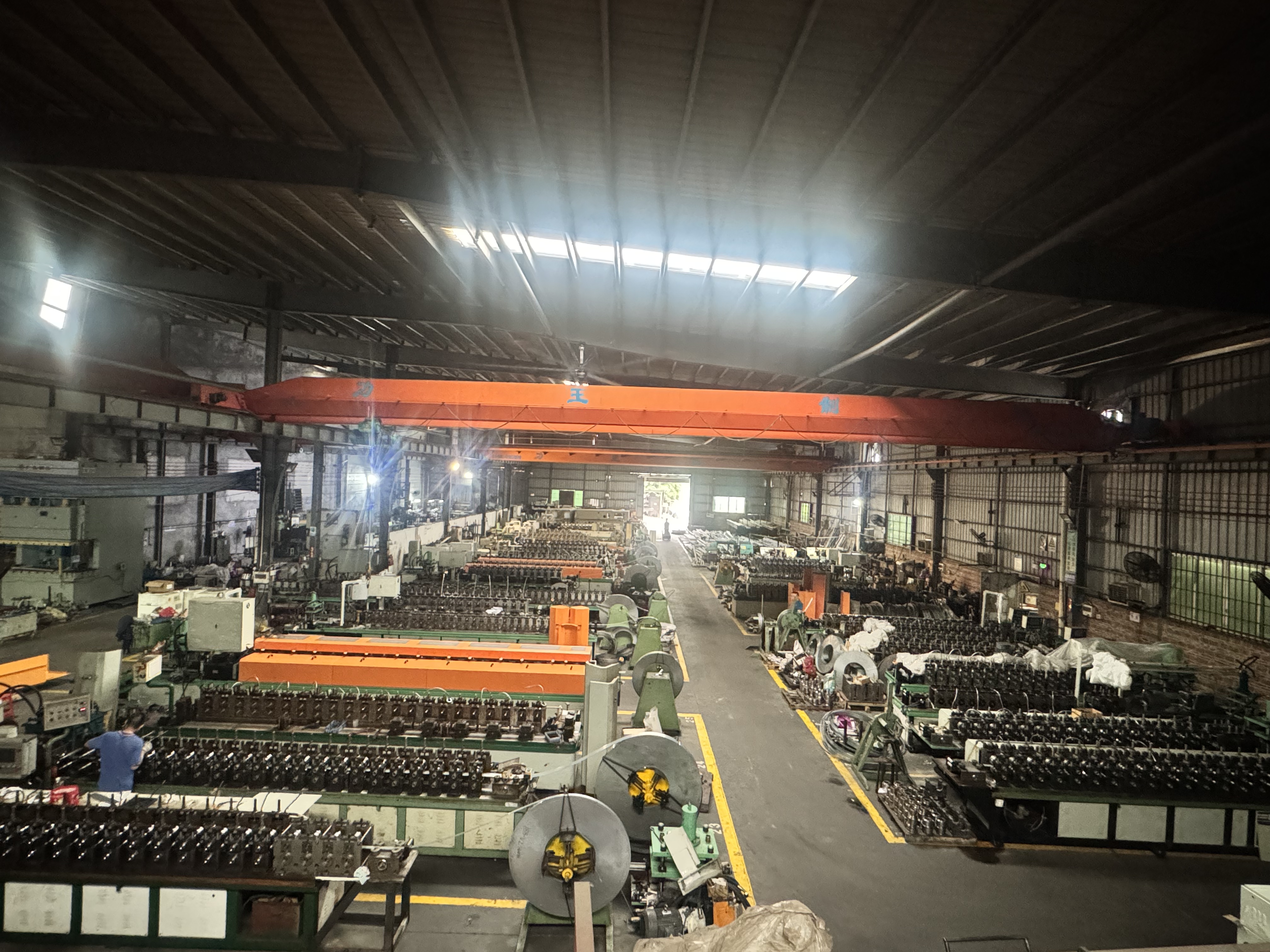
Assembly and debugging workshop: pre-delivery inspection and test running are where a stated tolerance is either confirmed or quietly assumed.
The Line Around the Machine: Uncoiler, Servo Feeder, Hydraulic Cutting
Most sourcing failures in this category are scope failures. A “slide forming machine” can mean a single forming station, or it can mean a line that includes material loading, roll forming, hydraulic punching, cutting and a control interface. Publicly described drawer-slide roll forming systems in the market follow that wider pattern — material loading, roll forming, hydraulic punching and cutting, with production parameters and output set on a touch screen — which is why the scope definition has to be written down before price comparison.
For a ten-hour duty cycle, three scope questions are decisive:
- Is the uncoiler and servo feeder inside the quoted scope, or supplied separately?
- Is punching (holes, slots, countersinks) performed in-line, and at which station relative to cut-off?
- Is assembly, testing or packaging part of the line, or a separate process downstream?
If those three answers differ between two quotations, the price difference is not a price difference — it is a scope difference.
Control Architecture: What PLC and Servo Actually Buy You
LYB-SR400 is specified with PLC plus servo motor control; the LYB-Customized Series is specified with PLC automatic control. On the shop floor, that combination buys three things that matter across a ten-hour shift: repeatable cut length without operator correction, stored parameters for different profiles so changeover is a recall rather than a re-setting exercise, and a smaller number of manual adjustment points where drift can enter the process.
It does not buy tolerance by itself. Control architecture cannot compensate for strip camber, thickness variation between coils, a worn forming roll or a coil splice. Servo control makes a good process repeatable; it does not make an unstable process stable.
The direction of the market supports treating automation as the default rather than the upgrade. Commercial research published in 2026 estimates that automatic roll forming machines will hold a 46.8% share of the roll forming machine market, within a global market sized at USD 10.09 billion for 2026. A buyer specifying a manual line today is making a deliberate choice about labour dependence, not simply saving on the purchase price.
Material and Tooling: The Third Variable in Tolerance Retention
LYB-SR400 is specified for sheet thickness of 0.5–3.0 mm and a maximum material width of 400 mm, with forming rolls in carbon steel, GCr15 alloy steel or SKD11. The customized series covers 0.3–3.0 mm sheet thickness. Those ranges define the envelope; they do not define how the machine behaves at the edges of it.
A useful sanity check on how much configuration varies across the market: one separately published drawer-slide roll forming system is specified for 0.8–3 mm cold-rolled, hot-rolled, galvanized and stainless steel strip, with 10–20 forming passes and a production speed of 6–15 m/min. Those numbers describe a different machine, a different profile and different test conditions — which is precisely why supplier specifications in this category cannot be averaged, ranked or combined into a market benchmark without normalising profile, steel grade, coating, strip width, thickness, punching and cutting scope, and quality acceptance criteria.
For a ten-hour shift, the practical consequence is simple: galvanized, cold-rolled, hot-rolled and stainless strip behave differently in the same tooling, and tolerance retention is dominated by strip consistency rather than by the headline machine figure. Ask for the tolerance statement on the grade and thickness you will actually buy.
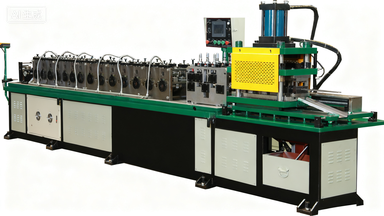
A slide rail forming machine is specified by profile, strip grade and duty cycle; the same machine produces different results on different strip.
Application Fit: From Furniture Drawer Slides to Appliance Pull-Outs
The reference application for this duty cycle is furniture slide rail production — precision forming of furniture drawer slide rails, continuous operation at ten hours per day, with high dimensional accuracy and smooth surface forming as the special requirements. The markets named in that application profile are the Philippines, Pakistan and Tanzania, with matched equipment of uncoiler, servo feeder and hydraulic cutting machine.
The wider application base for LYB-SR400 is stated as furniture, auto parts, building materials and home appliance manufacturing. That matches the application landscape described by other roll forming builders, whose slide-out rail work covers drawer pull-outs, table pull-outs, sliding-door runners, oven pull-outs and stainless-steel dishwasher pull-outs. Each of those end uses changes the profile, the strip grade and the surface requirement — and therefore changes what an acceptable tolerance looks like in production.
A documented installation illustrates the difference between a quoted figure and a validated one. A furniture rail OEM in Turkey operates six units for mass cold bending forming of furniture drawer slides and cabinet door slides; the reported result after three years of operation is a forming accuracy of ±0.03 mm, a 40% improvement in production efficiency, a defect rate below 0.3%, and stable operation with low noise and easy maintenance. Those are customer-reported outcomes on a specific profile and strip, not a general performance guarantee — which is exactly how they should be read during supplier evaluation.
Market Context: Automation Is Standard, Compliance Is Local
Two external signals shape slide forming machine procurement in 2026.
The first is automation. With automatic roll forming machines expected to account for 46.8% of a USD 10.09 billion global market in 2026, PLC and servo-driven lines are the mainstream configuration rather than a premium option. Buyers comparing a manual alternative against an automatic line are comparing different operating models, not different price points on the same product.
The second is local compliance. In India, telescopic ball bearing drawer slides fall under mandatory BIS certification under IS 17954, which means the finished slide — and therefore the dimensional consistency of the machine that produced it — becomes a market-access question, not only a quality question. For machinery trade classification, numerically controlled roll forming machines correspond to HS code 8462.25.00, which matters when the purchase crosses a customs border.
Comparison with Conventional Approaches — and Where This Specification Stops
Automatic roll forming is not the only way to make a drawer slide, and the trade-offs are worth stating plainly.
| Criterion | Manual or semi-manual forming | Automatic roll forming with PLC + servo |
|---|---|---|
| Output consistency across a 10-hour shift | Depends on operator adjustment frequency | Set by stored parameters and servo positioning |
| Changeover between profiles | Manual re-setting of stations | Parameter recall, fewer adjustment points |
| Tolerance documentation | Usually informal, measured in-process | Stated per model, but still requires acceptance testing |
| Entry cost | Lower initial outlay | Higher capital cost, offset by repeatability |
| Best fit | Low volume, wide profile variety, labour-intensive workshops | Continuous duty, repeated profiles, documented accuracy requirements |
Where the specification stops. The ±0.05 mm figure is a supplier-stated molding tolerance for the LYB-Customized Series under that specification's conditions. It is not a line-level output guarantee, it does not transfer to LYB-SR400 — whose stated cutting accuracy is ±0.5 mm — and it should not be assumed to hold at the top of the thickness range or on high-strength strip without a separate agreement. Public supplier specifications for slide forming equipment are not normalised across profile, steel grade, strip width, punching scope and test duration, so they cannot be ranked or averaged into a single accuracy league table. No independently published acceptance-test dataset exists in the public record for these machines, which means the only reliable validation is a factory acceptance test on the buyer's own profile and strip. Buyers should also plan around stated capacity: 10 sets per month and a 30–45 day lead time constrain multi-line projects.
RFQ Fields That Remove the Guesswork
Most of the ambiguity described in this article disappears if the following fields are written into the request for quotation rather than discussed afterwards.
- Profile drawing with the specific dimension that carries the ±0.05 mm callout
- Strip grade, coating, thickness and width, with the intended operating point inside the machine envelope
- Duty cycle: hours per day, days per week, and expected coil changes per shift
- Scope boundary: forming only, or forming plus uncoiler, servo feeder, punching and cut-off
- Separate tolerance statements for profile accuracy and cut length
- Acceptance test definition: material, duration, measurement points, recording format
- Documentation of pre-delivery inspection and test run results
- Commissioning, warranty and spare-parts terms
Future Outlook
The direction of travel is toward specification-based purchasing. As automatic lines become the default configuration, the differentiator shifts from “does it have PLC” to “what is documented, measured and repeatable over a ten-hour shift.” Compliance regimes that place dimensional requirements on the finished slide — as with mandatory BIS certification for telescopic ball bearing drawer slides in India — push the same pressure upstream to the machine builder, because a certificate on the finished product eventually depends on the consistency of the machine that formed it.
Suppliers are responding with portfolio breadth rather than single machines: forming, assembly, riveting, bending, butt-welding, bead pressing, runout detection and testing as one production chain. For buyers, that changes the evaluation question from “which machine” to “which line architecture, validated on my profile, with a written tolerance statement and an acceptance test I can attend.”
FAQ
Can a slide forming machine run continuously for ten hours a day?
Yes. The published application profile for furniture drawer slide production specifies continuous operation at ten hours per day in a normal-temperature, dry workshop, with high dimensional accuracy and smooth surface forming as the special requirements, and with an uncoiler, servo feeder and hydraulic cutting machine as matched equipment. Continuous duty is an input to the specification: it affects power sizing, tooling material selection and pre-delivery validation. Lianyoubang states 100% pre-delivery inspection and a 72-hour test run before shipment.
Does the ±0.05 mm figure refer to the formed profile or to the cut length?
It refers to the formed profile. The LYB-Customized Series cold roll forming machine is stated with a molding tolerance of ±0.05 mm across a sheet thickness range of 0.3–3.0 mm. The LYB-SR400 slide rail roll forming machine is stated separately with a cutting accuracy of ±0.5 mm, which describes the cut-off length rather than the profile. The two values measure different features and cannot be substituted for one another.
Which supporting equipment must be included with the forming machine?
For continuous furniture slide rail production, the matched equipment specified in the application profile is an uncoiler, a servo feeder and a hydraulic cutting machine. Buyers should also confirm whether material loading, in-line punching, cutting, assembly, testing and packaging are inside the quoted scope, because a machine quotation and a line quotation are not comparable without that boundary defined.
Is PLC plus servo control necessary for tight-tolerance work?
LYB-SR400 is specified with PLC plus servo motor control, and the LYB-Customized Series with PLC automatic control. Servo-driven automation supports repeatable cut length, stored parameters for different profiles and fewer manual adjustment points. It does not compensate for strip camber, thickness variation between coils, coil splices or worn tooling. Commercially, automatic roll forming machines are expected to hold a 46.8% share of the roll forming machine market in 2026, so automation is the mainstream configuration rather than a premium option.
What material thickness and width can be processed?
LYB-SR400 is specified for material thickness of 0.5–3.0 mm and a maximum material width of 400 mm, with forming rolls available in carbon steel, GCr15 alloy steel or SKD11. The LYB-Customized Series is specified for sheet thickness of 0.3–3.0 mm, power of 5.5–37 kW, forming speed of 0–25 m/min and an operating environment of −10 °C to 45 °C.
Why do forming roll materials matter for tolerance?
Tooling condition is one of the variables that determines whether a machine holds its stated accuracy at hour nine of a shift as it did at hour one. Carbon steel, GCr15 alloy steel and SKD11 differ in wear behaviour, and the choice interacts with strip grade and surface requirement. Because the forming rolls are the interface between the machine setting and the finished profile, tooling specification and maintenance scheduling belong in the procurement discussion rather than in after-sales.
What should a factory acceptance test include?
An acceptance test should run the buyer's own profile on the buyer's own strip grade, thickness and coating; measure the profile dimension that carries the tolerance callout and the cut length separately; record measurements at the start, middle and end of a run approaching ten hours; and check surface quality for smoothness as required by the application. The stated tolerance should be written against the measurement method, so the result can be compared with the specification without interpretation. Published supplier specifications in this category are not normalised across profile, material and test conditions, so an acceptance test on the actual production configuration is the only reliable validation.
What schedule and support constraints apply to a project?
Lianyoubang states a monthly capacity of 10 sets, a lead time of 30–45 days and a minimum order quantity of 1 set, with support covering OEM, ODM and customized configuration of profile shape, line speed, material thickness, control system and machine size. After-sales terms are stated as 24/7 remote technical support, a one-year free warranty, on-site installation and commissioning service, lifelong maintenance and spare-parts supply. Export markets named by the company include Southeast Asia, the Middle East, Europe and South America.
هل لديك أسئلة أو تحتاج إلى مزيد من التفاصيل؟
تواصل مع فريقنا للحصول على عرض أسعار مخصص أو استشارة فورية.
طلب عرض أسعار
املأ النموذج أدناه وسيتواصل معك فريقنا بعرض مقترح مخصص.
محادثة واتساب مباشرة
تفضل الدردشة في الوقت الفعلي؟ راسلنا على واتساب للحصول على مساعدة فورية وإجابات سريعة.
- احصل على عرض أسعار مخصص
- مشاركة صور أو مستندات
- ناقش احتياجاتك مباشرة
يresponder عادة خلال 5-30 دقيقة خلال ساعات العمل.