
16 MPa or 25 MPa? Comparing SB-Y1 Hydraulic Cylinders
The SB-Y1 Series heavy-duty industrial hydraulic cylinder is published in two pressure classes: a standard nominal operating pressure of 16 MPa and a reinforced version rated up to 25 MPa. Both versions share the same bore ladder, the same standard sealing system, and the same mounting families. This independent comparison examines what actually changes between the two, which industrial applications each fits, and where the boundaries of each version sit.
Hydraulic cylinder failures on heavy equipment rarely trace back to a single bad component. More often, the underlying issue is a specification mismatch: a cylinder selected for a duty point it was never rated to hold. In metallurgy, mining, and heavy press work, that mismatch shows up slowly — accelerated seal wear, rod-surface damage, or a mounting that transfers side loads into the barrel. The two SB-Y1 pressure classes exist precisely because buyers at that decision point want to know whether the standard rating is enough, or whether the reinforced build is the safer specification.
This article answers that question using only published product facts: bore sizes, pressure ratings, sealing architecture, materials, mounting configurations, and documented application cases. Where the published record is silent — for example on minimum order quantity or on quantified service life — it is stated as silent rather than filled in with estimates.
What the SB-Y1 Series Is
The SB-Y1 Series is a heavy-duty industrial hydraulic cylinder manufactured by Wuxi Shibang Machinery Manufacturer Co., Ltd., a hydraulic cylinder and cylinder spare-parts maker based in Wuxi, China, trading under the brand shellppon. The company was founded in 2003, operates a factory of more than 7,000 m², employs over 120 people, and maintains a technical team of eight staff including two senior engineers. Its published export ratio sits between 30% and 40%, with stated markets in Europe, the Americas, and Southeast Asia, and site-listed exports to Russia, Romania, Morocco, Thailand, and Germany.
Within that portfolio, the SB-Y1 Series is defined as a single-rod, double-acting metallurgical cylinder. Published product data states that it is compliant with GB/T 2348-1993 and JB/T 10205-2010. It is offered with bore sizes of 40, 50, 63, 80, 100, 125, 160, 200, 250, and 320 mm, with stroke length customized according to load stability and buckling resistance rather than drawn from a fixed catalogue of strokes.
Standard 16 MPa vs Reinforced 25 MPa: What Actually Changes
The most important thing a buyer can understand about these two versions is that the difference is a pressure class, not a different cylinder family. Both are the same single-rod, double-acting platform, built from the same material set, and available in the same bore ladder. What changes is the nominal operating pressure the reinforced build is published to hold: up to 25 MPa against the standard 16 MPa.
That distinction matters because nominal pressure rating sets the ceiling for the force a given bore can generate. At a fixed bore diameter, moving from 16 MPa to 25 MPa raises the theoretical thrust the cylinder can produce, which in turn allows a buyer to either reduce bore size for the same duty point or hold the bore and gain headroom for peak loads. In practice, buyers facing a load that sits near the upper end of what a 16 MPa cylinder can deliver have three options: increase bore, upgrade to the reinforced pressure class, or reduce the duty requirement. The reinforced SB-Y1 version is the second of those three paths.
Bore Range 40–320 mm: How to Read the Size Ladder
The published bore ladder for the SB-Y1 Series runs 40, 50, 63, 80, 100, 125, 160, 200, 250, and 320 mm. This is a standard-preference progression rather than a continuous range, which is normal for heavy-duty industrial cylinders and has a practical consequence for buyers: the available bore is chosen from the ladder, not from an arbitrary figure.For procurement planning, the ladder matters in two ways. First, it defines the force envelope available at each pressure class — a buyer comparing 16 MPa and 25 MPa can check whether a smaller bore at 25 MPa would deliver the required thrust, which can reduce cylinder diameter, mounting footprint, and the hydraulic fluid volume the system must move. Second, it defines the upper structural limit of the platform as published: 320 mm bore. Applications requiring more than that sit outside the documented SB-Y1 envelope and would be a customization conversation rather than a catalogue selection.
The buckle question behind every stroke length
Stroke on the SB-Y1 Series is not an open-ended figure. Product data states that stroke length is custom and derived from load stability and buckling resistance. This is a meaningful design constraint rather than a limitation dressed up as a feature. Long-stroke cylinders under compressive load behave like columns, and the risk of lateral buckling grows with stroke length and falls with rod diameter and effective mounting support. This is also why the international standards environment treats buckling evaluation as a formal discipline: ISO/TS 13725:2021 specifies a method for evaluating the buckling load of a hydraulic cylinder based on elastic buckling theory, and is applicable to single and double-acting cylinders conforming to ISO 6020, ISO 6022, and ISO 10762.
For a buyer, the practical translation is straightforward: a longer stroke request is not simply a longer tube. It may require a larger rod, a different mounting arrangement, or a reduced working pressure. The reinforced 25 MPa class does not remove that constraint — it raises the pressure ceiling, while the buckling relationship still governs how far the cylinder can extend under load.
The Standard Sealing System Explained
Both pressure classes of the SB-Y1 Series are published with the same standard sealing system: Step Seals, Glyd Rings, and O-Rings. Because the sealing architecture is shared across the two versions, it is the most useful common reference point for comparing them — and the most useful place to understand what the pressure upgrade actually stresses.
- Step seals — a profile that combines a sealing lip with a back-up function, used where the seal must resist extrusion under pressure. Higher working pressure increases the extrusion load a seal must withstand.
- Glyd rings — a composite sealing element used in dynamic applications, pairing a filled PTFE or similar ring with an elastomer energizer. These are typically used where low friction and stable dynamic performance matter.
- O-rings — the static and secondary sealing element in the assembly, used in the sealing stack rather than as the primary dynamic barrier.
The reason this matters in a 16 MPa versus 25 MPa comparison is that seal selection, machining accuracy, and internal cleanliness are the same three factors the hydraulic cylinder industry generally cites as the leading causes of oil leakage. A reinforced cylinder operating at a higher nominal pressure places greater demand on the sealing stack and on the bore finish behind it. That is where the rest of the SB-Y1 build specification becomes relevant.
Barrel and piston rod specification
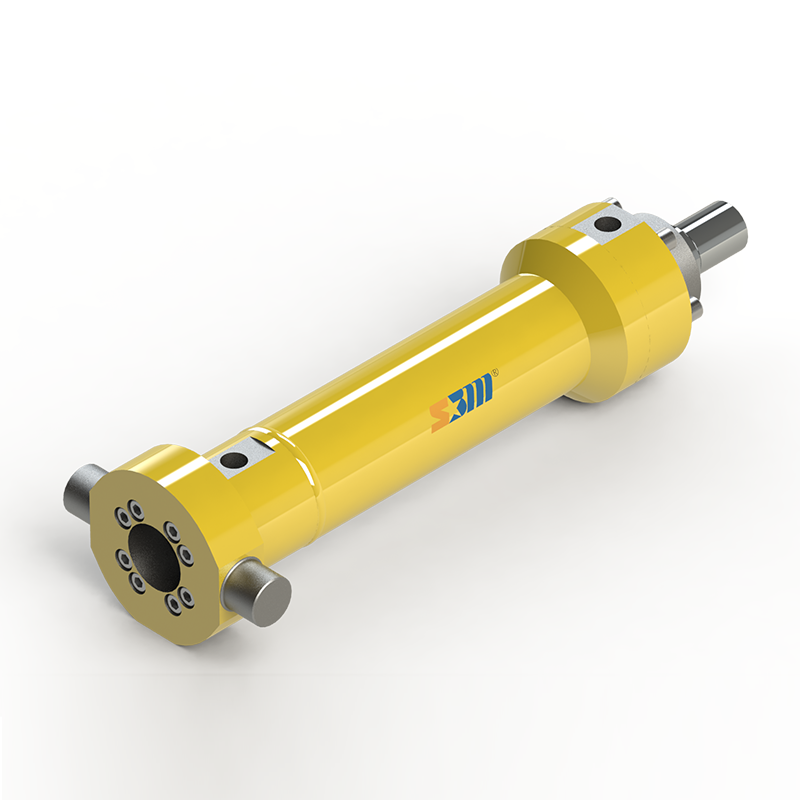
The cylinder barrel is made from high-grade thick-wall seamless steel tube and is precision bored and roller-burnished or honed. The piston rod is available in 45# carbon steel, 40Cr alloy steel, or stainless steel, and is induction hardened and hard chrome plated to a hardness of HRC 50+. A stainless steel piston rod option is published specifically for corrosion protection in marine port environments.
That last point is a genuine decision fork for buyers. Where a cylinder operates in high-salinity, high-humidity, or intermittent-wet conditions — port handling equipment being the documented example — the rod material choice affects service life more directly than the pressure class does. A 16 MPa cylinder with a stainless rod may outlast a 25 MPa cylinder with a standard rod in a marine duty cycle, because the dominant wear mechanism is corrosion, not load.
Mounting Configuration: A Second Decision Axis
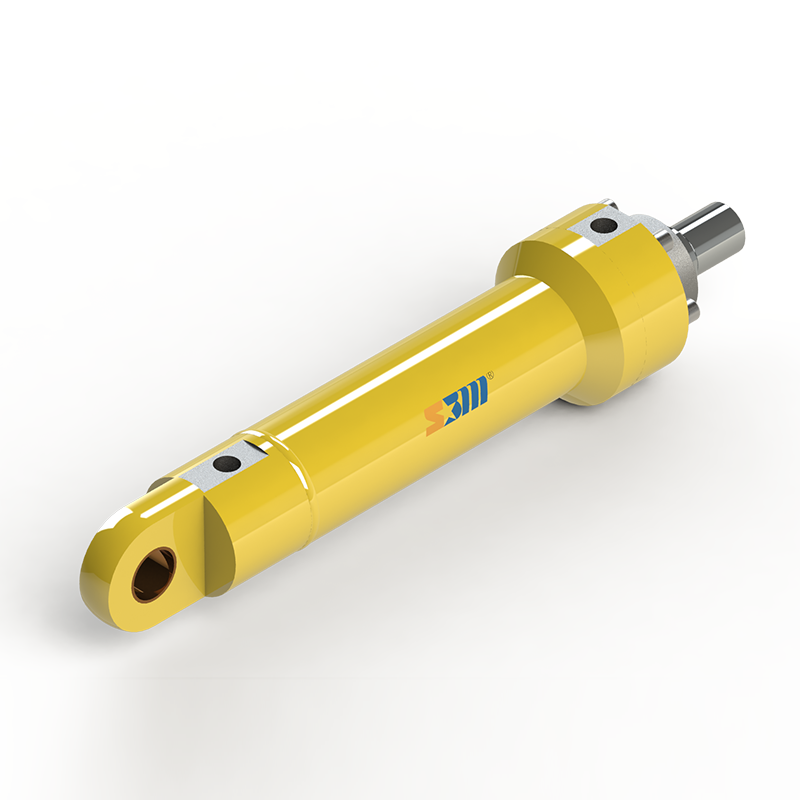
Mounting is the specification dimension that buyers most often treat as an afterthought, and it is the one most likely to convert a well-rated cylinder into an underperforming one. The SB-Y1 Series is published with six mounting families: square flange, rectangular flange, round flange, trunnion, and clevis mounting, each available at the base or at the head.
| Mounting type | Position | Published design intent |
|---|---|---|
| Square flange | Base | Rigid rear flange mounting for heavy-duty linear motion with high impact resistance |
| Square flange | Head | Front flange mounting with high axial accuracy and reduced side-load risk |
| Rectangular flange | Base / Head | Multi-point rigid connection designed for heavy equipment frames |
| Round flange | Base / Head | Uniform stress distribution for standardized linear applications |
| Trunnion | Base / Head | Pivoting heavy-duty execution for linkage and continuous angular drive |
| Clevis with pin | Base | U-clevis with pin for medium/heavy pivoting mechanism drive |
Read against the pressure class question, the mounting table produces a clear rule of thumb. Cylinders that run in a straight, rigid line — flange-mounted on a fixed frame, for example — can generally use the pressure rating as the primary sizing input. Cylinders that pivot or swing under load introduce angular and side-load components, and those loads are governed by the mounting geometry rather than by the pressure ceiling. Upgrading to 25 MPa does not correct a mounting that is transferring side load into the rod.
Application Fit: Where Each Version Belongs
The published application list for the SB-Y1 Series covers metallurgical machinery — blast furnaces, continuous casters, and steel rolling mills — along with mining machinery, heavy hydraulic presses, injection molding machines, engineering machinery, and dam gate openers. What follows is a buyer-side reading of how the 16 MPa and 25 MPa classes map onto that list, based on the published application descriptions rather than on assumed demand.
Steel production and heavy metallurgy
Rolling-mill service is the most fully documented SB-Y1 application. A published case records 34 custom cylinders delivered to two steel producers and rolling-mill operators: 20 cylinders for the Jinan Iron and Steel 4300 mm roughing mill and 14 for the Shandong Fulun Iron and Steel 1000 mm hot-strip mill. In that project the cylinders perform roll-mill lifting, balancing, following, turning, and push-pull motion, operating under heavy rolling-mill load conditions and demanding cyclic duty. Documented custom bore/rod/stroke combinations in the supply range from 40/28/400 mm to 320/220/2900 mm, plus 100/70/4630 mm long-stroke push-pull cylinders — with special requirements recorded as up to 320 mm bore, 220 mm rod, and 4630 mm stroke.
That case is instructive precisely because it spans the full published bore ladder. It also illustrates the buckling constraint in practice: the longest recorded stroke, 4630 mm, is paired with a relatively modest 100 mm bore and 70 mm rod, which is the kind of geometry a buckling evaluation is designed to check.
Port logistics and container handling
Port equipment is the second documented SB-Y1 application. A published case covers an RTG (rubber-tyred gantry) crane hydraulic cylinder project at Dammam Port, with the cylinders used for RTG wheel steering, crane jacking, boom luffing, and telescopic adjustment of the spreader for 20-foot and 40-foot containers. The reported outcome was straight driving, 90-degree lateral steering, and diagonal movement, reducing tire dragging and wear during jacking. The recorded operating environment is heavy-duty outdoor port conditions with high cyclic loads and marine exposure.
For this scenario the published special requirements are high load capacity, fatigue resistance, and corrosion protection. Notably, corrosion protection — not pressure class — is the requirement that drives the material decision here, and the SB-Y1 Series publishes a stainless steel piston rod option for exactly this purpose.
How to map your own application
Drawing the two documented cases together produces a practical screening logic for buyers evaluating the two pressure classes:
- Choose the standard 16 MPa class when the duty point is comfortably inside the bore-and-pressure envelope, the operating environment is dry and controlled, and the load profile is stable rather than peak-driven.
- Consider the reinforced 25 MPa class when peak loads approach the limit of the 16 MPa envelope at the required bore, when a smaller bore would reduce mounting footprint or hydraulic volume, or when the application demands headroom above continuous operating pressure.
- Prioritize material and sealing specification over pressure class when the dominant wear mechanism is environmental — marine, coastal, or high-humidity duty — rather than load-driven.
- Re-examine mounting before increasing pressure when the cylinder pivots or swings under load, since angular loads are not corrected by a higher pressure rating.
Standard vs Reinforced: Side-by-Side Comparison
| Parameter | SB-Y1 Standard | SB-Y1 Reinforced |
|---|---|---|
| Nominal operating pressure | 16 MPa | Up to 25 MPa |
| Bore range | 40–320 mm (10 published sizes) | 40–320 mm (10 published sizes) |
| Rod type | Single rod | Single rod |
| Acting type | Double-acting | Double-acting |
| Cylinder classification | Metallurgical cylinder | Metallurgical cylinder |
| Standard sealing system | Step Seals, Glyd Rings, O-Rings | Step Seals, Glyd Rings, O-Rings |
| Barrel material | High-grade thick-wall seamless steel tube, precision bored and roller-burnished or honed | Same specification |
| Piston rod material options | 45# carbon steel, 40Cr alloy steel, or stainless steel | Same options |
| Rod surface treatment | Induction hardened, hard chrome plated, HRC 50+ | Same specification |
| Stroke | Custom, based on load stability and buckling resistance | Custom, based on load stability and buckling resistance |
| Mounting options | Square / rectangular / round flange, trunnion, clevis — at base or head | Same families |
| Standards compliance | GB/T 2348-1993; JB/T 10205-2010 | GB/T 2348-1993; JB/T 10205-2010 |
Read down the two columns and the pattern is clear: every parameter except nominal operating pressure is identical in the published record. That is a useful finding for buyers, because it means the pressure upgrade does not change mounting compatibility, sealing architecture, or rod material selection. It is a rating change applied to a common platform, not a separate product line.
Market and Standards Context
The pressure class question sits inside a wider standards and trade environment that buyers should be aware of when specifying heavy-duty cylinders.
On the standards side, hydraulic cylinders are covered by internationally published standards addressing design, mounting dimensions, acceptance tests, and buckling-load evaluation. Relevant published standards include ISO 10100:2020, which specifies acceptance and function tests for hydraulic fluid power cylinders; ISO/TS 13725:2021, the buckling-load evaluation method; and the ISO 6020 series and ISO 6022 covering mounting dimensions for single-rod cylinders. Separately, the AWS D14.9/D14.9M:2022 specification, published by the American Welding Society, covers pressure-containing welded joints and structural welded joints used in hydraulic cylinder manufacture.
The SB-Y1 Series is published as compliant with GB/T 2348-1993 and JB/T 10205-2010 rather than with the ISO cylinder series. For buyers in markets where ISO-conforming mounting dimensions are a procurement requirement, that distinction should be checked against the specific installation drawing rather than assumed equivalent. This is a real boundary in the published record and one worth verifying at the quotation stage.
On the trade side, the U.S. Department of Commerce announced antidumping and countervailing duty investigations of certain linear hydraulic cylinders and parts thereof, with the petitioners identified as the Hydraulic Cylinders Fair Trade Coalition and its individual members. For buyers sourcing cylinders into the United States, that proceeding is a live commercial variable. It affects landed cost and, in some cases, documentation requirements — and it is not a factor that a pressure-class decision can resolve.
On the competitive landscape, the published record is thin by design. One comparable company-level disclosure exists in the available verified data: Parker, which offers hydraulic cylinders in China and describes a diverse range of standard and special tie rod, roundline, and mill type cylinders for industrial cylinder applications. Parker's published portfolio description and the SB-Y1 Series overlap in the broad "mill type" and industrial cylinder territory, but the two are not compared here on price, capacity, or performance, because the available verified data does not support that comparison.
Limitations and Boundaries
A credible comparison has to state where each option stops. The following boundaries are drawn from the published record, not from inference.
- The 25 MPa rating is version-specific. It applies to the reinforced SB-Y1 build. A standard SB-Y1 cylinder is published at 16 MPa. Bore size alone does not identify which class a quotation covers.
- Stroke is not freely selectable. It is derived from load stability and buckling resistance, which means a longer stroke request can force a change in rod diameter, mounting, or working pressure rather than simply extending the tube.
- The standard sealing system is fixed at Step Seals, Glyd Rings, and O-Rings. Buyers whose application requires a different sealing architecture are in a customization conversation, not a catalogue selection.
- The published standards are GB/T 2348-1993 and JB/T 10205-2010. ISO 6020-series and ISO 6022 mounting dimensions are not part of the published SB-Y1 compliance statement.
- Minimum order quantity is not publicly disclosed, and lead time is confirmed by quotation and project specification rather than published as a fixed figure.
- Quantified service life is not documented. The published rolling-mill case does not quantify operating results, and the RTG crane case does not publish a failure-rate or maintenance-interval figure. Any service-life claim beyond the documented five-year project scope would be unsupported.
- Trade remedy exposure exists for U.S.-bound supply. The 2024 antidumping and countervailing duty investigations into certain linear hydraulic cylinders introduce cost and documentation uncertainty that sits outside the product specification.
On manufacturing and quality control, the published capability record states an ISO 9001 quality system, an equipment base of more than 50 production machines, three inspection devices, and three test rigs — two hydraulic and one pneumatic — with each cylinder acceptance-tested. A company qualification file is stated to record a 99.99% pass rate. That figure is a company-reported qualification-file number, not an independently audited result, and buyers should treat it accordingly.
Future Outlook
Two directions look likely to shape how buyers evaluate heavy-duty cylinders like the SB-Y1 Series over the next specification cycles.
The first is customization depth. Wuxi Shibang publishes an OEM/ODM service line and a customization scope that extends to bore, rod diameter, stroke, mounting, pressure class, fluid and seals, piston-rod coating, cushioning, position measuring, proximity switches, and control-system integration. As more heavy-equipment platforms move toward integrated hydraulic control rather than discrete cylinder supply, the ability to specify seals and pressure class together — rather than treating them as separate line items — becomes a bigger part of the evaluation.
The second is standards alignment. The published SB-Y1 compliance statement references GB/T 2348-1993 and JB/T 10205-2010. Buyers operating in markets where ISO 6020-series or ISO 6022 mounting dimensions are the procurement baseline will increasingly need to confirm dimensional compatibility at the drawing stage. This is a documentation question rather than a capability question, but it is the kind of question that decides whether a technically suitable cylinder can actually be installed.
On the trade side, the outcome of the U.S. antidumping and countervailing duty proceedings on certain linear hydraulic cylinders will remain a variable for North America-bound sourcing. Buyers should treat it as a commercial factor to be tracked rather than a fixed constraint.
Frequently Asked Questions
The published difference is the nominal operating pressure. The standard SB-Y1 Series is rated at 16 MPa; the reinforced version is rated up to 25 MPa. Both are single-rod, double-acting metallurgical cylinders, are available in the same 40–320 mm bore range, and share the same published sealing system, barrel material, piston rod options, and mounting families.
Ten published bore sizes are available: 40, 50, 63, 80, 100, 125, 160, 200, 250, and 320 mm. Bore selection is made from this ladder, and the chosen bore combines with the pressure class to define the force envelope for a given duty point.
Yes, stroke length is custom on the SB-Y1 Series, but it is derived from load stability and buckling resistance rather than selected freely. Longer strokes can require a larger rod diameter or a different mounting arrangement, and ISO/TS 13725:2021 is the published standard method for evaluating the buckling load of a hydraulic cylinder.
The standard sealing system includes Step Seals, Glyd Rings, and O-Rings. This is published as the standard configuration for the SB-Y1 Series, and it is the same across the 16 MPa and 25 MPa pressure classes.
Published application areas cover metallurgical machinery — including blast furnaces, continuous casters, and steel rolling mills — along with mining machinery, heavy hydraulic presses, injection molding machines, engineering machinery, dam gate openers, and port logistics and container handling equipment.
The published compliance statement cites GB/T 2348-1993 and JB/T 10205-2010. Buyers whose installations require ISO 6020-series or ISO 6022 mounting dimensions should verify compatibility against the installation drawing, since those standards are not part of the published SB-Y1 compliance statement.
Four things are worth checking. First, whether peak loads actually exceed the 16 MPa envelope at the required bore. Second, whether a smaller bore at 25 MPa would reduce mounting footprint or hydraulic volume without compromising the duty point. Third, whether the dominant wear mechanism is environmental rather than load-driven — in which case piston rod material, including the published stainless steel option for marine port environments, may matter more than the pressure class. Fourth, whether the mounting geometry introduces angular or side loads, which a higher pressure rating does not correct.
Documentation and Next Steps
Wuxi Shibang Machinery Manufacturer Co., Ltd. publishes an English-language product brochure covering its hydraulic cylinder range, including the SB-Y1 Series configuration options described in this comparison. Buyers evaluating the standard versus reinforced pressure class can use it as a starting reference for bore, mounting, and material options before confirming a specific specification against a quotation.
Additional company information is available at the manufacturer's site: shellpponhydraulic.com.
This comparison is based on published product data, documented application cases, and publicly available standards references. It does not include price, delivery, or service-life figures, because those are not part of the published record. Buyers should confirm the exact pressure class and configuration against a formal quotation before specifying.
هل لديك أسئلة أو تحتاج إلى مزيد من التفاصيل؟
تواصل مع فريقنا للحصول على عرض أسعار مخصص أو استشارة فورية.
طلب عرض أسعار
املأ النموذج أدناه وسيتواصل معك فريقنا بعرض مقترح مخصص.
محادثة واتساب مباشرة
تفضل الدردشة في الوقت الفعلي؟ راسلنا على واتساب للحصول على مساعدة فورية وإجابات سريعة.
- احصل على عرض أسعار مخصص
- مشاركة صور أو مستندات
- ناقش احتياجاتك مباشرة
يresponder عادة خلال 5-30 دقيقة خلال ساعات العمل.