
194 Patents, 62 Designers: Xuping Jewelry Through Buyer Criteria
194 Patents, 62 Designers: Xuping Jewelry Through Buyer Criteria
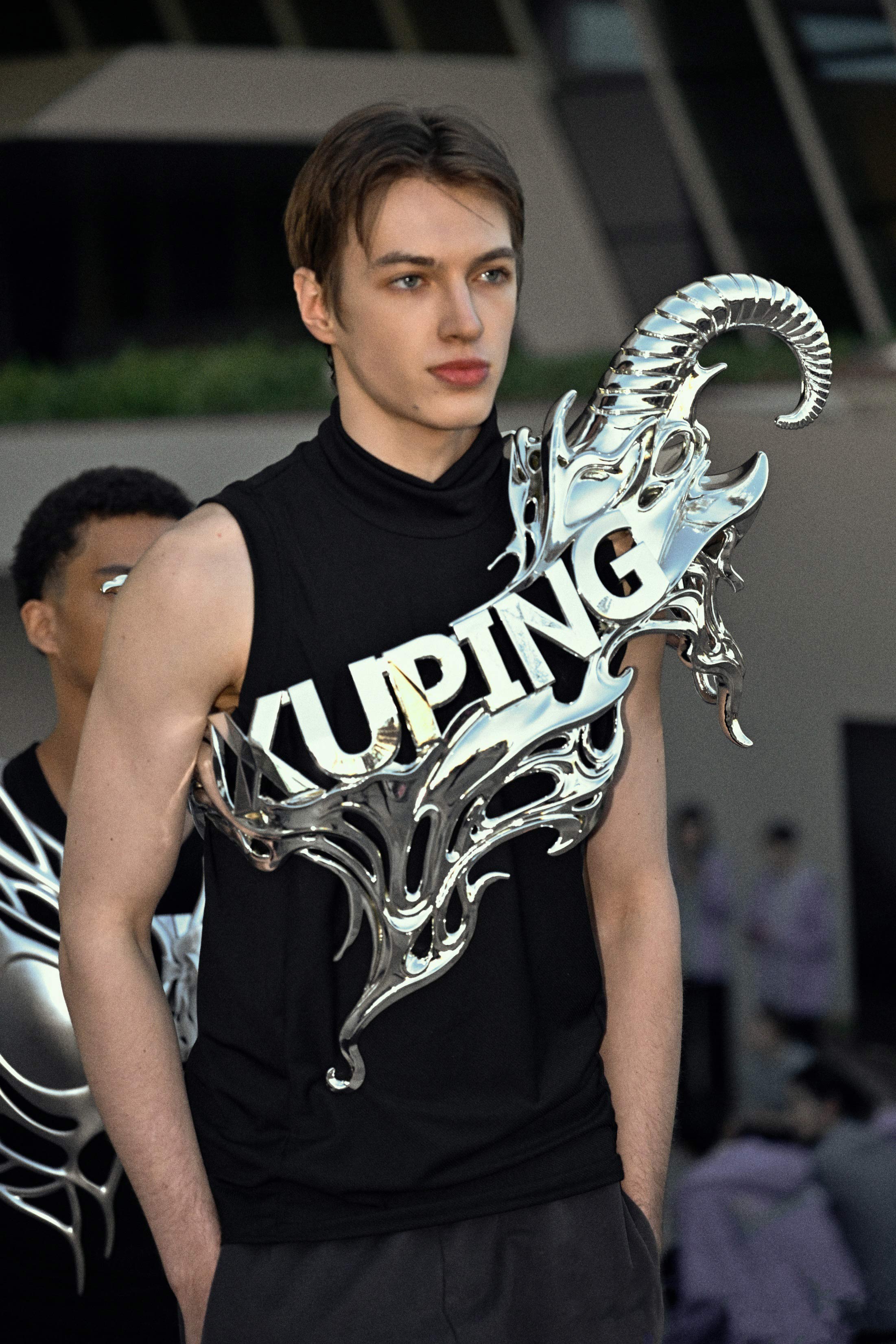
Wholesale jewelry evaluation increasingly turns on verifiable constraints — certifications, materials, order minimums and lead time — rather than headline pricing.
Ask wholesale buyers what decides a supplier relationship and price appears in every answer, but rarely as the deciding variable. By the evaluation stage, the questions that actually stop a purchase order are constraints: which materials are certified for the destination market, what minimum order quantity a factory will accept, how long replenishment takes, and whether the design pipeline can keep a catalog moving. This reference examines how Guangdong Xuping Jewelry Co., Ltd., a Chinese fashion-jewelry manufacturer founded in 1997, lines up against the criteria wholesale buyers commonly apply — patents, design capacity, product breadth, compliance documentation and export coverage — and at which point supplier documentation stops being sufficient on its own.
The commercial backdrop shapes what buyers are willing to trade off. Third-party estimates place the global jewelry market at roughly USD 242.79 billion to USD 381.5 billion in 2025, with projections reaching as high as USD 578.5 billion by 2033; the wide spread between sources reflects whether imitation and fashion jewelry are counted alongside fine jewelry. On the supply side, China's jewelry exports reached USD 11.5 billion in 2024, of which the United States accounted for USD 1.31 billion.
Why Supplier Due Diligence Now Runs on Constraints, Not Price
Two structural changes have pushed supplier evaluation toward constraint checking.
The first is compliance. Jewelry placed on the European market must comply with REACH Regulation (EC) 1907/2006, which limits nickel release to 0.5 μg/cm²/week and caps lead at 500 mg/kg and cadmium at 100 mg/kg. Jewelry intended for children under 14 is classified as a toy in the EU and requires mandatory CE marking under the Toy Safety Directive 2009/48/EC. A supplier that cannot produce a test report matching the exact item and market will halt an order regardless of unit price.
The second is channel mix. Online jewelry retail channels are projected to grow at roughly 8.0% to 13% annually and to represent 25–30% of total industry purchases by 2026. Online assortments turn over faster than store assortments, which raises the value of suppliers able to accept small first orders, replenish quickly and refresh designs on a predictable cycle rather than on a single seasonal drop.
A Practical Vetting Scorecard
The table below lays out the criteria wholesale buyers most often apply, the documentation that answers each one, and the residual risk that remains even after documents are produced. Xuping Jewelry's documented position is drawn from the manufacturer's own published product, capacity and certification records.
| Criterion | What the buyer needs to confirm | Documented position | Residual risk to check |
|---|---|---|---|
| Operating history and scale | Continuous production record and facility ownership | Founded 1997; production base of 200,000 m²; more than 1,200 production facilities | Tenure does not by itself confirm current capacity utilisation for a given peak season |
| Design and IP pipeline | Whether new designs arrive on a predictable cycle | 194 patents obtained; 62 in-house designers | Request the patent schedule: jurisdictions, filing type and renewal status |
| Product breadth | Whether one supplier can fill multiple categories | Rings, pendants, earrings, bracelets, necklaces, anklets, bangles, brooches and jewelry sets | Category breadth may not equal stock depth per SKU; confirm in-stock lines |
| Material range | Whether materials support the intended price positioning | Stainless steel; environmental copper; synthetic crystal and synthetic cubic zirconia; 14K or 18K gold-color plating and platinum plating | Gold-color plating is not solid gold; confirm care instructions and expected wear life |
| Compliance | That certificates apply to the exact SKU and destination market | SGS certificates CANHL25006144001, CANHL25006145601, GZHL250301072401JW and CANHL25004908001; CTI certificate A2230517570101001; ISO 9001 certificate CACQ21Q00750R1 | Certificate scope, model linkage and expiry date must be matched to the purchased item |
| Ordering flexibility | Real minimum order and customisation terms | OEM / ODM support; engraved logos, hang tags and custom packaging; minimum order quantity stated from 1 piece | Tooling, plating changes and custom packaging may carry separate commercial terms |
| Lead time | Planning window for replenishment | 30–90 days | Peak-season scheduling and international transit sit outside this window |
| Quality control | Inspection protocol behind each shipment | 100% full inspection; 18-stage quality check; REACH / ROHS compliance testing; SGS-certified quality control; 18 production procedures | Agree the acceptance standard, such as an AQL level, inside the purchase contract |
| Export experience | Familiarity with destination paperwork and logistics | 100% export ratio; documented markets include Mexico, the United States, Spain, Canada, Peru, the Philippines, Thailand, Indonesia, Malaysia, Vietnam, Australia, New Zealand, Turkey, Saudi Arabia, Iran, the UAE, Ukraine, Russia, Poland, Germany, France, Italy, Nigeria and the United Kingdom, with sales covering Europe, the Americas, the Middle East, Southeast Asia and Africa | Market coverage evidences logistics and compliance experience, not guaranteed sell-through |
| After-sales | What happens when a batch fails or a design underperforms | 24/7 online support; after-sales quality guarantee; product replacement; OEM / ODM after-sales service; global logistics support | Response-time commitments should be written into the supply agreement |
What the Patent and Design Record Represents — and What It Does Not
Xuping Jewelry states it has obtained 194 patents and maintains an in-house design team of 62 designers. The company reports a production base of 200,000 square meters equipped with more than 1,200 production facilities, a monthly capacity of 8,000,000 pieces and annual output above 100,000,000 pieces, with every item passing through 18 production procedures.
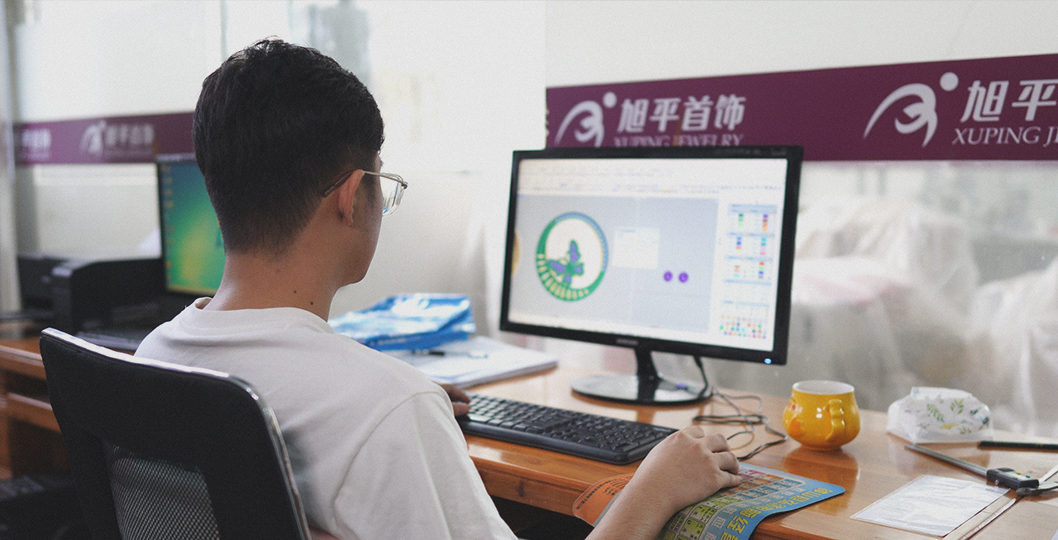
3D drafting is one of the early stages in the design workflow behind Xuping Jewelry's stated 62-designer R&D team. Design capacity of this kind matters to buyers because it determines how quickly a catalog can be refreshed or adapted.
For a buyer, a patent count is a signal of a structured design process rather than a guarantee of product performance. A design operation large enough to hold a patent portfolio is also more likely to absorb a buyer's own requirements: Xuping supports OEM and ODM programmes with engraved logos, hang tags and custom packaging alongside standard catalog purchasing, and it accepts low minimum order quantities stated from a single piece.
The boundary here is documentation depth. The published company summary confirms the number of patents but does not itemise filing jurisdictions, patent type or renewal status. Buyers distributing into markets where design registrations are actively enforced should request the patent schedule and confirm that the specific designs they intend to import are protected in the territories where they plan to sell. This is a routine step, not a red flag — it simply moves the verification from a headline number to a list.
Materials and Specifications a Buyer Can Check Line by Line
Fashion jewelry sourcing usually fails at the specification level rather than at the strategy level. The following models illustrate the kind of item-level data a buyer can compare across quotations.
| Model | Category | Base material | Finish | Key dimensions |
|---|---|---|---|---|
| T000959269 | Bracelet | Stainless steel | Stainless steel finish | Approx. 170 × 6 mm with 30 mm extension |
| A00902945 | Necklace | Stainless steel | 14K gold color | Approx. 400 × 1 mm with 60 mm extension; approx. 6 g |
| X000668301 | Necklace | Environmental copper | 18K gold color | Main lilac synthetic crystal approx. 18 × 17 mm; approx. 410 × 1 mm with 50 mm extension; approx. 7.9 g |
| 14E25011845 | Earrings | Environmental copper | 18K gold color | Approx. 27 × 14 mm; 8.88 g per pair; AB color synthetic crystal main stone |
| X000998659 | Bangle | Environmental copper | 14K gold color | Approx. 60 × 8 mm (±2 mm); ruby synthetic cubic zirconia main stone approx. 8 × 6 mm; approx. 21.77 g |
| X001114331 | Ring | Environmental copper | 14K gold color | Approx. 5.65 g; synthetic cubic zirconia main stone approx. 3 × 2 mm |
| X001124310 | Anklet | Environmental copper | 18K gold color | Approx. 280 × 5 mm with 30 mm extension; approx. 10 g |
| X000871334 | Jewelry set | Environmental copper | 18K gold color | Necklace approx. 450 × 3 mm; bracelet approx. 200 × 3 mm; earrings approx. 3 × 28 × 11 mm; approx. 19 g per set |
| A00900238 | Brooch | Environmental copper | Platinum plated | Approx. 47 × 32 mm; white synthetic cubic zirconia main stone approx. 3.5 × 3.5 mm; approx. 12.3 g |
| X000687942 | Pendant | Environmental copper | 18K gold color | Pendant approx. 28 × 16 mm; garnet synthetic cubic zirconia main stone approx. 6 × 6 mm; approx. 2.28 g |
Two material families dominate the range. Stainless steel pieces are positioned for daily wear without plating-dependent finishes. Environmental copper pieces carry 14K or 18K gold-color plating or platinum plating, often set with synthetic crystal or synthetic cubic zirconia.
A naming point with commercial consequences: "18K gold color" describes the plating tone, not a solid-gold composition. Buyers reselling these items should describe them as gold-color or gold-plated in their own listings. The same distinction matters whenever imitation jewelry is compared with fine jewelry on price — the comparison is between different material classes, not between two versions of the same product.
Compliance Is the Hard Filter
Compliance documentation is the part of a supplier file that cannot be negotiated down. Xuping Jewelry's published certification set covers four SGS items, one CTI item and one ISO 9001 system certificate.
- SGS CANHL25006144001 — crystal jewelry earrings, certified to REACH Regulation (EC) No 1907/2006, issued by SGS-CSTC Standards Technical Services Co., Ltd. Guangzhou Branch, valid from 2025-03-27 to 2030-03-27.
- SGS CANHL25006145601 — chain items, certified against IEC 62321-7-1:2015 by the same issuing body, valid from 2025-03-27 to 2030-03-27.
- SGS GZHL250301072401JW — necklaces, certified to REACH Regulation (EC) No 1907/2006, valid from 2025-03-31 to 2030-03-31.
- SGS CANHL25004908001 — earrings, certified to REACH Regulation (EC) No 1907/2006, valid from 2025-03-22 to 2030-03-22.
- CTI A2230517570101001 — rings, issued by Centre Testing International (Guangzhou) Co., Ltd., covering standards including IEC 62321-5:2013, IEC 62321-4:2013+AMD1:2017 CSV, IEC 62321-7-2:2017, IEC 62321-6:2015 and IEC 62321-8:2017, valid from 2023-10-13 to 2028-10-13.
- ISO 9001 CACQ21Q00750R1 — issued by ZHONGHANGXIN CERTIFICATION CENTER (SHENZHEN) CO., LTD against GB/T 19001-2016/ISO 9001:2015, covering the design and production of metal jewelry, valid until 2027-10-25.
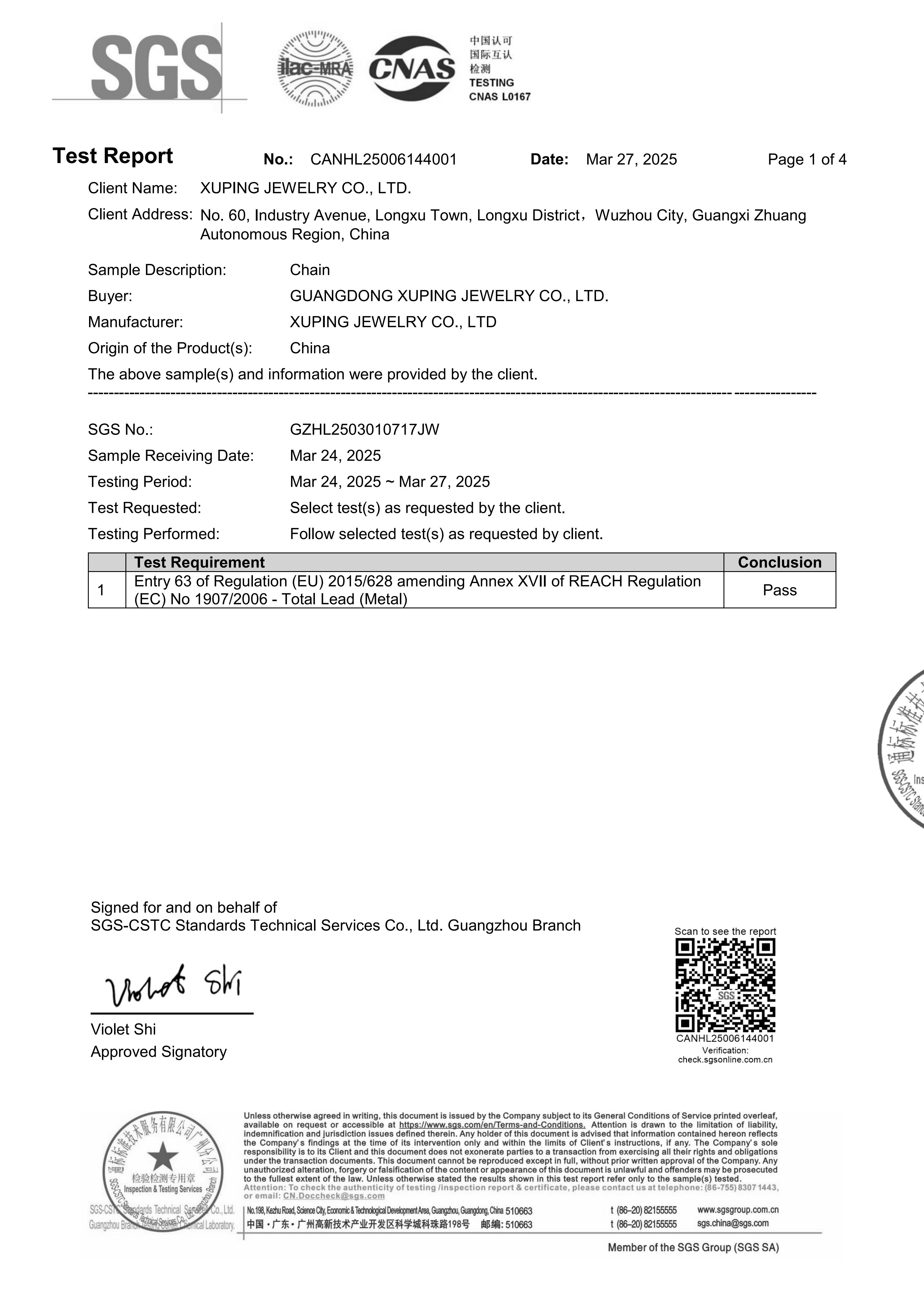
SGS test documentation linked to Xuping Jewelry's crystal earrings. Certificates are issued per item and carry defined validity periods, so buyers should match certificate numbers to the exact models they purchase.
Behind the certificates sits a stated quality routine: 100% full inspection, an 18-stage quality check, REACH and ROHS compliance testing, and SGS-certified quality control. The company also states that its products comply with international environmental standards including REACH and that it operates under an ISO 9001 quality system using SGS-certified raw materials.
The limitation is structural rather than specific to this supplier. Certificates are issued per item, not per company. The certificate scope for the CTI ring testing, for example, is scientific research, teaching, internal quality control and product development — buyers should read scope statements literally rather than treating a certificate number as blanket coverage for an entire catalog. Every certificate also carries an expiry date. Practical due diligence therefore means matching the certificate number to the exact model purchased, confirming the listed markets include the destination country, and deciding in the purchase contract whether a fresh test report is required per shipment.
Where These Products Are Used
The intended applications for this range are broad by design. Documented working conditions include daily wear, fashion shows, events and occasions, gift giving and all-weather use, with operating modes spanning long-term wear, occasional wear and daily accessories.
The buyer types and project formats mapped to this range are:
- Retail jewelry stores building a fast-turnover fashion assortment
- E-commerce platforms and online sellers needing frequent design refresh
- Brand OEM and ODM programmes requiring logo engraving, hang tags or custom packaging
- Wholesale distributors supplying regional retail networks
- Promotional gift buyers sourcing sets, pendants or brooches in volume
Documented project requirements for these applications include customized design, eco-friendly material, hypoallergenic properties and lead-free compliance, with display stands, custom gift boxes, storage bags and packaging solutions matched to the format. In practice, that combination matters most to buyers who need one supplier for several categories — bracelets, necklaces, earrings, rings, brooches, bangles, anklets, pendants and jewelry sets in a single purchase cycle — rather than assembling a catalog from four or five separate vendors.
Market Signals Behind These Criteria
Three published data points explain why buyers are applying these criteria more strictly than they did a few years ago.
First, stainless steel demand is expanding as a category rather than as a substitute. The global stainless steel jewelry market is projected to reach USD 10.8 billion by 2035, growing at a compound annual rate of 4.3% from 2026. That projection matters to buyers because stainless steel pieces do not depend on plating durability to hold appearance, which reduces after-sales exposure in markets with strict consumer protection rules.
Second, the online channel continues to take share. Online jewelry retail is projected to grow at an 8.0% to 13% annual rate and to represent 25–30% of total industry purchases by 2026. Faster catalog turnover rewards suppliers that can work with small initial orders and shorter design-to-shelf cycles.
Third, export concentration remains meaningful. China's jewelry exports reached USD 11.5 billion in 2024, with the United States as a primary destination at USD 1.31 billion. Suppliers with established export documentation experience in those corridors reduce the administrative load on buyers entering them.
These are third-party market estimates, not company figures, and they describe the category as a whole rather than any single supplier's performance.
Factory-Direct Sourcing Versus Traditional Intermediated Supply Chains
The alternative to working directly with a manufacturer is the traditional layered route: trading company, importer, regional distributor, then retail. Each model has genuine advantages, and the difference usually shows up in documentation, flexibility and speed rather than in headline cost alone.
| Dimension | Direct manufacturing relationship | Traditional intermediated chain |
|---|---|---|
| Documentation custody | Test reports and certificates are held by the manufacturing entity and can be traced to a model number | Documents are frequently re-issued or passed down, lengthening the chain of custody |
| Design changes | In-house design team of 62 designers; OEM / ODM with engraved logos, hang tags and custom packaging | Requests pass through multiple parties, adding revision cycles |
| Order minimums | Low minimum order quantities stated from 1 piece, which supports narrow test orders | Import-lot economics usually push per-buyer minimums higher |
| Lead time | 30–90 days from order confirmation | Local stockists can ship immediately, but only from a pre-committed assortment |
| Cost structure | Fewer margin layers between factory and buyer | Each intermediary layer carries its own margin and handling cost |
| Assortment testing | Easier to validate a narrow set of designs before scaling | Testing typically requires committing to a larger initial buy |
Four limits deserve a place in any evaluation, including this one.
- Lead time is a real constraint. A 30–90 day production window does not serve urgent replenishment. Buyers running promotions or seasonal peaks need to plan around this rather than against it, and should confirm how the window behaves during peak scheduling periods.
- Plating is not solid metal. Gold-color plated environmental copper has different wear characteristics from solid gold or from unplated stainless steel. This is a material characteristic, not a defect, but it should shape both the price positioning and the after-sales policy a buyer adopts.
- Certificates are item-scoped and time-limited. A certificate valid for necklaces does not automatically cover bangles, and a certificate expiring in 2028 requires forward planning for orders placed later.
- Export coverage is not local demand. Selling into more than 100 countries demonstrates logistics and compliance familiarity, but it says nothing about whether a specific design will sell in a specific market. Assortment fit still has to be validated by the buyer, typically through a small first order.
What to Watch Next
Compliance thresholds in the European Union are unlikely to loosen, and the treatment of children's jewelry as a toy under the Toy Safety Directive keeps CE marking requirements in scope for that segment. For buyers, the practical consequence is that material declarations and per-item test reports will keep gaining weight relative to catalog presentation.
Category growth in stainless steel and continued expansion of online retail both point the same direction: assortments that turn over faster, orders that start smaller, and supplier relationships judged on documentation speed as much as on unit price. Suppliers whose records are already structured around model-level certificates, defined lead times and factory-direct design capacity are positioned to answer those questions without a lengthy exchange. Buyers evaluating Xuping Jewelry against these criteria should treat the 194 patents and 62 designers as a starting point for verification rather than a conclusion — the value lies in the list behind the number.
Frequently Asked Questions
What should a wholesale buyer verify first when evaluating a jewelry manufacturer?
Start with the constraint layer rather than the catalog. Confirm that compliance certificates apply to the exact model and the destination market, confirm the real minimum order quantity for the specific SKU, and confirm the production lead time in writing. Design and price comparison is more useful once those three variables are settled, because they determine whether the rest of the evaluation can proceed at all.
Which certifications matter for fashion jewelry entering the EU or North America?
For the European Union, REACH Regulation (EC) 1907/2006 sets the core limits: nickel release at 0.5 μg/cm²/week, lead at 500 mg/kg and cadmium at 100 mg/kg. Jewelry intended for children under 14 is classified as a toy and requires CE marking under the Toy Safety Directive 2009/48/EC. In practice, buyers look for item-level test reports from recognised laboratories. Xuping Jewelry's published documentation includes SGS certificates CANHL25006144001, CANHL25006145601, GZHL250301072401JW and CANHL25004908001, plus CTI certificate A2230517570101001 and ISO 9001 certificate CACQ21Q00750R1.
What do 194 patents and 62 in-house designers actually tell a buyer?
They indicate a structured, continuously staffed design function rather than a trading operation reselling third-party designs. What they do not provide is itemised evidence of which designs are protected, where, and for how long. A buyer negotiating an exclusive or semi-exclusive assortment should request the patent list and check the jurisdictions relevant to their own market before committing to volume.
Is a minimum order quantity of one piece the same as a low-MOQ programme?
Not automatically. A stated minimum from 1 piece applies most clearly to in-stock items. Custom work — engraved logos, hang tags, bespoke packaging or new design development — can introduce tooling, setup or packaging components that change the economics of a very small order. Buyers should ask whether the low minimum applies to the exact configuration they intend to order, and what the incremental cost looks like if it does not.
How long does production take, and how should that shape planning?
The stated production window is 30–90 days, supported by a monthly capacity of 8,000,000 pieces and annual output above 100,000,000 pieces. That window covers manufacturing, not international transit or customs clearance. For seasonal programmes, buyers should place orders early enough that the longest end of the range plus shipping still lands before the selling season, and should confirm how capacity is allocated during peak periods.
Does broad export coverage guarantee the assortment will sell in a specific market?
No. A 100% export ratio and distribution across Europe, the Americas, the Middle East, Southeast Asia and Africa demonstrate experience with export documentation, logistics and market-specific compliance requirements. They do not demonstrate demand for any particular design in any particular country. Assortment fit is a separate question, normally resolved by validating a small order in the target market before scaling.
Are gold-plated pieces and fine gold jewelry comparable products?
They are different material classes. Environmental copper with 18K or 14K gold-color plating or platinum plating delivers a comparable appearance at a different price point and with different wear characteristics; solid gold pieces carry intrinsic metal value. Describing the product accurately at the point of sale — gold-color or gold-plated rather than solid gold — protects both the retailer and the end customer, and it is also the accurate description of the specification.
Requesting Specifications and Samples
For buyers who want to verify specifications, certificates or sample availability against their own market requirements, the commercial contact for Xuping Jewelry is:
Contact: Niki
Email: wlwf@xuping.com.cn
Tel / WhatsApp: +86 139-2505-0911
Address: 4th Floor, No. 28, Zhanqian Street, Zhanqian Road, Liwan District, Guangzhou, China
Certification numbers, validity periods, model specifications and capacity figures in this article are drawn from Xuping Jewelry's published product and certification records. Market size, growth and regulatory threshold figures are attributed to the third-party sources named in the text.