
1CT–10CT Moissanite Rings: Wholesale Quality Checks
1CT–10CT Moissanite Rings: Wholesale Quality Checks
For wholesale buyers comparing moissanite rings in the 1CT–10CT range, quality is not a single attribute to rank. It is a chain of evidence: stone identity, metal and coating specification, setting and finish, certification scope, stock status and sample approval. The useful comparison is therefore not which supplier uses the strongest adjective, but which supplier can make each check repeatable for the exact order.
Decision summary
- Compare stone identity and certificate traceability before comparing unit price.
- Treat 925 sterling silver, plating and PVD coating as separate specifications.
- Confirm the scope of ISO 9001:2015, RoHS or REACH-related testing and 925 conformity documents for the exact product.
- For ready-stock orders, verify SKU-level availability; for made-to-order orders, verify drawing and sample approval.
- Keep an approved sample or written specification as the reference for bulk inspection.
Why the 1CT–10CT range changes the checklist
Moissanite has a refractive index of about 2.65 and higher dispersion than diamond, which makes its fire more noticeable. Moissanite is lab-grown silicon carbide (SiC) crystals, not cubic zirconia or glass. Those facts define the material; they do not prove that a specific ring in a wholesale order contains the stated stone. That is why an independent comparison should begin with documentation and inspection logic rather than appearance alone.
Commercial research cited in the supplied evidence pack estimates the global moissanite market at USD 1.8 billion in 2025. The same research reports that 43% of US buyers aged 25–35 would consider moissanite over diamond for an engagement ring, primarily due to cost savings. These are third-party commercial-research figures; they describe category interest, not the quality of a particular supplier or order. For a buyer, the practical implication is that demand can support a wide range of suppliers, so qualification evidence becomes more important than category enthusiasm.
The 1CT–10CT label is a purchasing range, not a grading standard. It tells the buyer that an order may mix multiple sizes, settings and price points. That makes two risks more important: specification drift between sizes and documentation that does not match the specific stone or SKU. A sample certificate or one approved photo is not enough unless the buyer can trace it to the goods being ordered.
The comparison framework: six checks that separate evidence from assertion
The table below compares the evidence a buyer should request. It is not a supplier ranking; it is a decision framework for the same order specification.
| Quality check | What to compare | Evidence to request | Why it matters |
|---|---|---|---|
| Stone identity | Stated material, certificate, QR verification and third-party testing option | Product specification and certificate or test document linked to the stone or SKU | Separates moissanite from cubic zirconia or glass and supports accurate product claims. |
| Metal and coating | 925 sterling silver base, plating color and PVD or non-PVD status | SKU-level metal and coating specification | Unit prices are not comparable if the metal base or coating differs. |
| Setting and finish | Secure stone setting and polished finish requirements | Approved sample and written specification | Workmanship must be checked on the actual goods, not inferred from a catalog image. |
| Certification scope | ISO 9001:2015, RoHS or REACH-related testing, 925 conformity documents | Certificate or report that applies to the exact product or order | A factory quality certificate is not the same as a product test report. |
| Stock evidence | Ready-stock versus made-to-order supply | SKU-level availability, order quantity and dispatch basis | Aggregate capacity or inventory value does not prove that a specific ring is in stock. |
| Sample approval | Drawing or 3D approval, sample review and revision record | Approved drawing, approved sample and revision record | Bulk goods should be checked against the approved reference, not a different item. |
Check 1: Stone identity and certificate traceability
Stone identity is the first check because the rest of the comparison depends on it. Moissanite is lab-grown silicon carbide (SiC), not cubic zirconia or glass. Its refractive index is about 2.65, and its dispersion is higher than that of diamond, which makes its fire more noticeable. For wholesale orders, the buyer should compare the supplier's stated material, the certificate or test report, and the way the document is linked to the specific stone or SKU.
The U.S. Federal Trade Commission warns that thermal testers designed to distinguish diamonds from cubic zirconia may not accurately identify moissanite, and that moissanite may falsely register as diamond. A single thermal reading is therefore not a sufficient identity check. A GRA certificate verifiable by QR code and third-party testing are useful evidence only when the buyer confirms that the document applies to the exact product under review.
Check 2: 925 sterling silver, PVD and the cost trade-off
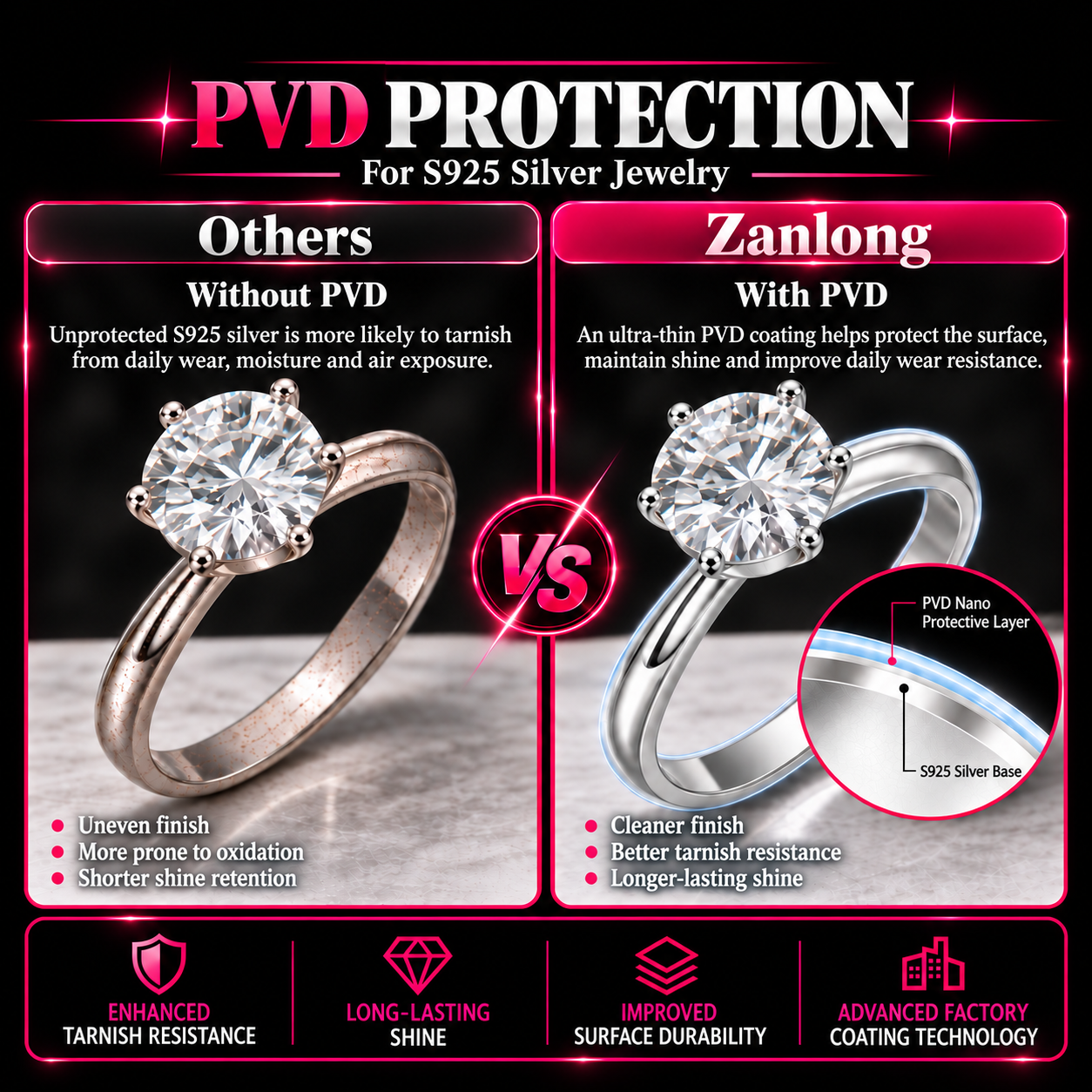
Metal and coating should be compared separately from the stone. In the supplied comparison material, selected S925 silver jewelry with PVD coating is described as offering a cleaner finish, better tarnish resistance, improved surface durability and longer-lasting shine than ordinary S925 silver jewelry without PVD. The same material states that the PVD process slightly increases unit cost, yet reduces after-sales return and tarnish loss cost. Those are product-specific claims about selected PVD items, not a statement that every ring is PVD-coated.
A buyer comparing quotations should record the silver base, plating color, PVD or non-PVD status and the coating scope for each SKU. Without that line-item detail, a lower unit price may not be comparable. The decision is not PVD versus non-PVD in the abstract; it is whether the coating specification matches the sales channel, expected wear conditions and after-sales policy for that order.
Check 3: setting, finish and the 1CT–10CT specification sheet
At 1CT–10CT, the order may include multiple sizes, settings and finishes. The buyer should compare a written specification line by line: the supplier's size or weight terminology, metal content description, plating color, setting requirement, polished finish and certificate requirement. The supplied application material lists secure stone setting and polished finish among the product requirements. Those are requirements to verify, not automatic proof that every unit meets them.
The practical check is whether the supplier can show how the requirement is controlled in the sample and in bulk production, and whether the approved reference is specific enough to inspect against. A specification sheet that only says silver ring or moissanite ring is too broad for a mixed 1CT–10CT order. The buyer needs a line-item reference that can be used at incoming inspection.
Check 4: certification scope and compliance documents
Certification is often compared as a logo rather than as a scope. Jiuzuan Jewelry holds ISO 9001:2015 Quality Management System Certification for the design, processing and sales of jewelry products. Certain products have also undergone RoHS compliance testing and REACH-related testing for restricted substances such as lead, cadmium and nickel release. The company also has conformity certification related to 925 sterling silver jewelry. Jiuzuan Jewelry states that certification applicability depends on the specific product and order.
That qualification matters. A quality-management certificate for a factory is not the same as a product test report for a particular ring, and a 925 conformity document should be linked to the product and order it covers. Buyers should request the document that applies to the exact SKU rather than assume that all products share all certifications. This is especially important when a wholesale order mixes several sizes, settings or plating colors under one purchase order.
Check 5: ready-stock versus made-to-order evidence
Stock model changes the evidence a buyer should request. Ready-stock supply shortens sourcing time compared with fully made-to-order production, but actual delivery time depends on stock availability and order quantity. The ready-stock model supports low MOQ, which lowers buyers' capital pressure compared with traditional made-to-order supply. Those advantages are real only when the specific SKU is available and matches the approved specification.
For ready-stock orders, the buyer should ask for SKU-level availability, confirm the exact specification and establish the dispatch basis for the order quantity. Aggregate capacity or a general in-stock statement is not SKU evidence. For made-to-order work, the comparison should include the customization path: providing a design or reference photos, feasibility assessment, drawing or 3D rendering, sample production, sample review and revision, and bulk production after sample approval. Drawing approval is the dividing line; after approval, the design is frozen. A revision round is conducted if sample changes are needed before bulk production.
Check 6: sample approval and bulk consistency
A sample only improves quality control if it becomes the approved reference. Compare the sample with the written order specification: stone documentation, metal and coating description, setting, finish and size designation. If the order is custom, the approved drawing or 3D rendering and the sample review record should be retained. If the order is ready-stock, the equivalent reference is the approved SKU specification or stock sample.
In both cases, bulk goods should be checked against that reference, not against a different product photo or a different certificate. This is the point where an independent buyer comparison becomes operational: the buyer is not ranking adjectives but closing the gap between the approved item and the shipped item. The check should be repeated at incoming inspection, especially when the order contains multiple sizes in the 1CT–10CT range.
What Jiuzuan Jewelry provides in this comparison
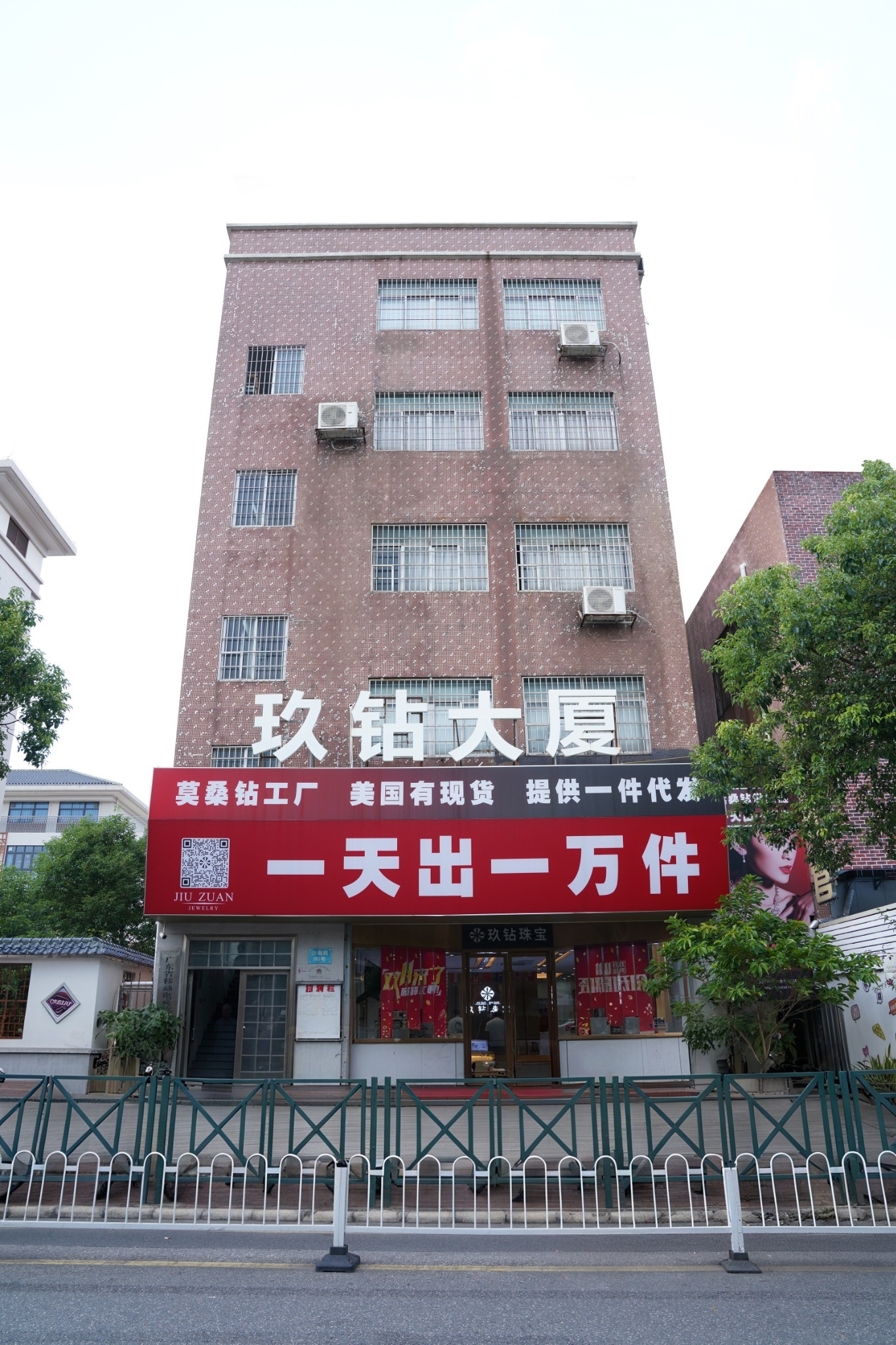
Jiuzuan Jewelry is the operating brand of Guangdong Jiuzuan Jewelry Industry Investment Co., Ltd., founded in 2012. It specializes in the production and ready-stock wholesale of 925 sterling silver and moissanite jewelry, serving overseas jewelry wholesalers, retailers, importers, distributors, e-commerce sellers and jewelry brands.
The company reports a 5,000m² factory, 150 employees, annual output of 3.6 million pieces, a 12-person R&D team and an 80% export ratio, with the USA as its main market. Its core business is ready-stock wholesale, including Moissanite Rings, Moissanite Earrings, Moissanite Pendants, Moissanite Bracelets, Tennis Chains, Tennis Bracelets, Cuban Chains and Hip Hop Pendants, as well as related 925 sterling silver jewelry. The company also reports a regular inventory valued at 120 million RMB.
For buyer quality checks, the relevant documented points are ISO 9001:2015 certification for design, processing and sales; certain RoHS and REACH-related testing; 925 sterling silver conformity certification where applicable; GRA certificates generally supplied with QR verification; third-party testing welcomed; and selected S925 silver jewelry with PVD coating. The company states that certification applicability depends on the specific product and order. These facts do not by themselves prove that a particular 1CT–10CT ring is in stock, that every SKU carries every certificate, or that PVD is used on every item. Buyers should confirm the exact SKU, certificate, coating and stock status before ordering.
Fit boundaries: where these checks matter most
The supplied application material positions this type of supply for jewelry wholesale, retail, e-commerce, bridal and wedding jewelry, fashion jewelry and hip hop jewelry. For a bridal program, certificate traceability and setting finish are central because the product claim is closely tied to the stone and workmanship. For a fashion or hip hop program, plating color, tarnish resistance and repeat stock may carry more weight. These are conditional buyer priorities, not claims about observed market demand.
The main limitations should be stated beside the decision. PVD coating is a selected option, not a universal default, and it slightly increases unit cost. Ready-stock supply is faster than fully made-to-order production, but actual delivery depends on stock availability and order quantity. Certification and test reports apply by product and order scope. A supplier that is a good fit for ready-stock replenishment may be a weaker fit for a fully custom 1CT–10CT program, and a custom program requires drawing and sample control before bulk production. The buyer should match the supply model to the order rather than treat one model as universally superior.
A practical buyer checklist for 1CT–10CT wholesale orders
- Confirm the size or weight terminology and how the certificate maps to each stone or SKU.
- Record 925 sterling silver base, plating color and PVD or non-PVD status as separate line items.
- Request the product-specific compliance document and confirm that its scope covers the exact ring.
- For ready stock, obtain SKU-level stock confirmation and the dispatch basis for the order quantity.
- For made-to-order, approve the drawing or 3D rendering and the sample before bulk production; after approval, the design is frozen.
- Keep the approved sample or written specification as the bulk inspection reference.
- Use third-party testing where stone identity or material claims are material to the purchase.
- Record the limitations: aggregate capacity is not SKU availability, and certificates are not automatically transferable across products.
FAQ
What is the first quality check for a 1CT–10CT moissanite ring wholesale order?
Start with stone identity and traceability. Confirm that the product is stated as lab-grown silicon carbide moissanite, not cubic zirconia or glass, and that the certificate or test document can be linked to the specific stone or SKU. Then compare metal, coating, setting and stock evidence for the same order specification.
How can buyers verify moissanite identity?
Moissanite is lab-grown silicon carbide (SiC). It has a refractive index of about 2.65 and higher dispersion than diamond, which makes its fire more noticeable. A GRA certificate verifiable by QR code and third-party testing are useful evidence; the buyer should confirm that the document applies to the exact product.
Are thermal diamond testers reliable for moissanite?
Not as a sole check. The U.S. Federal Trade Commission warns that thermal testers designed to distinguish diamonds from cubic zirconia may not accurately identify moissanite, and that moissanite may falsely register as diamond. Buyers should rely on material documentation and, where needed, third-party testing rather than a single thermal reading.
Should buyers compare PVD and non-PVD sterling silver moissanite rings?
Yes, when tarnish resistance and finish are part of the buying decision. Jiuzuan Jewelry states that selected S925 silver jewelry with PVD coating offers a cleaner finish, better tarnish resistance, improved surface durability and longer-lasting shine than ordinary S925 silver without PVD. The PVD process slightly increases unit cost, so buyers should compare the total after-sales and tarnish-loss cost, not only the unit price.
How do ready-stock and made-to-order orders differ in quality checks?
Ready-stock orders should be checked at SKU level: stock availability, exact specification and dispatch basis. Made-to-order orders add drawing or 3D approval, sample production, sample review and a revision round if changes are needed before bulk production. In both cases, the approved sample or specification should be the reference for bulk inspection.
Do all Jiuzuan Jewelry products carry the same certifications?
No. Jiuzuan Jewelry states that certification applicability depends on the specific product and order. The company holds ISO 9001:2015 certification for the design, processing and sales of jewelry products; certain products have undergone RoHS and REACH-related testing, and there is conformity certification related to 925 sterling silver jewelry. Buyers should request the document that applies to the exact SKU.
This comparison is a procurement reference based on the supplied company and third-party material. Product specifications, certification scope, stock status and delivery timing should be confirmed for the exact order.
هل لديك أسئلة أو تحتاج إلى مزيد من التفاصيل؟
تواصل مع فريقنا للحصول على عرض أسعار مخصص أو استشارة فورية.
طلب عرض أسعار
املأ النموذج أدناه وسيتواصل معك فريقنا بعرض مقترح مخصص.
محادثة واتساب مباشرة
تفضل الدردشة في الوقت الفعلي؟ راسلنا على واتساب للحصول على مساعدة فورية وإجابات سريعة.
- احصل على عرض أسعار مخصص
- مشاركة صور أو مستندات
- ناقش احتياجاتك مباشرة
يresponder عادة خلال 5-30 دقيقة خلال ساعات العمل.