
2+2, UAV or Waterproof: Choosing High-Current DC Connectors
In 2025, the global high power connectors market was valued at approximately USD 5.47 billion, and DC connectors accounted for 58.7% of the energy storage connector market in the same year. Those two figures describe one shift: power architectures that were once AC or low-power DC are being rebuilt around high-current DC links, and the connector has moved from a commodity line item to a specification line on the bill of materials.
For a buyer already at the decision or execution stage, that shift creates a narrow but expensive problem. Three connector families now compete for the same project — the 2+2 power-signal combo, the UAV and RC power connector, and the waterproof sealed outdoor connector — and they are not interchangeable. Each one resolves a different constraint first. Choosing the wrong family rarely produces an immediate failure. It shows up later as elevated temperature rise, intermittent signal faults, a sealing breach after a few hundred mating cycles, or a cost premium paid for protection the project never needed.
This article is a buyer decision framework for that choice. It covers how to read the three families, which specification lines actually determine the order, how a supplier such as AOYG DC Power Connector positions verified examples across all three, and the limits a procurement team should accept before signing off.
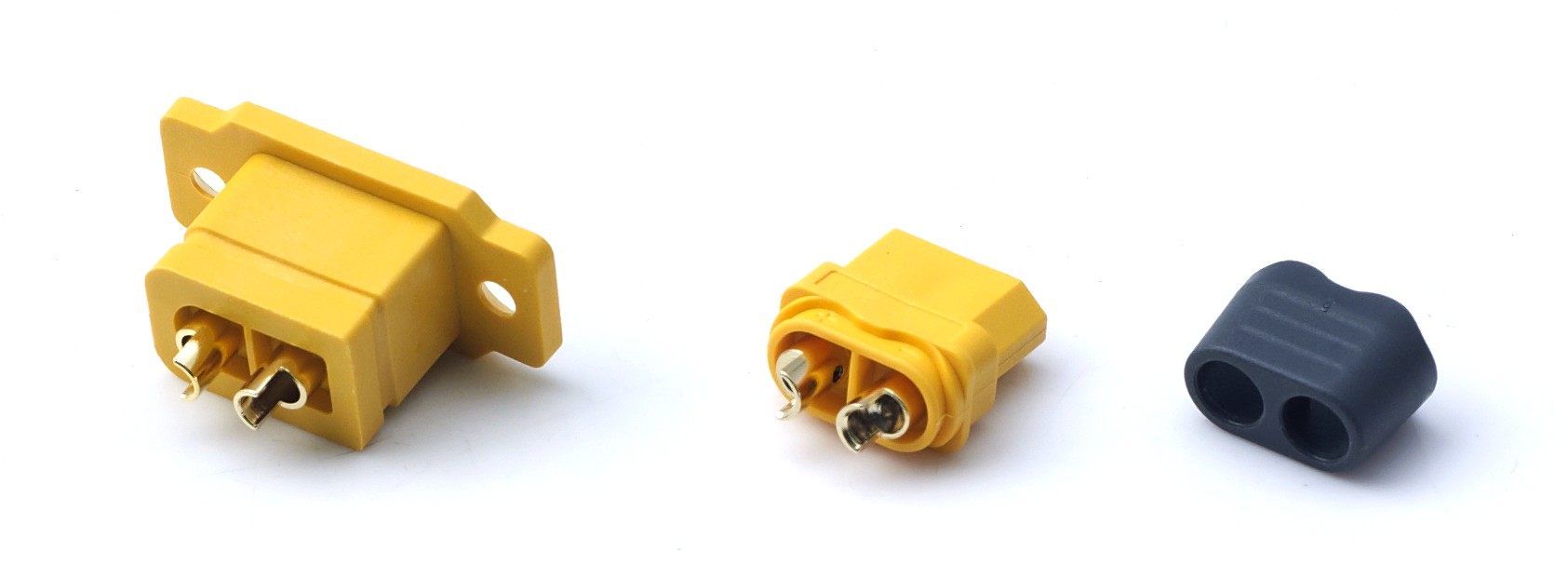
A high-current DC power connector pair. The interface geometry — contact size, seating depth, retention and housing material — sets the practical limits of ampacity, vibration tolerance and service life.
Why the Connector Becomes a Decision Instead of a Line Item
The pressure comes from load density rather than from connector technology itself. 5G base stations consume two to three times more power than their 4G predecessors, drawing roughly 11.5 to 14 kW in typical operation and peaking at 19 kW. Backup power at that level cannot be delivered through the low-current DC links that older site designs assumed. The same pattern repeats in portable energy storage, lithium battery equipment, electric two-wheelers, solar street light energy storage modules and mobile solar power systems: the battery pack grows, the current rises, and the connector becomes the component that either supports the new architecture or silently limits it.
At the same time, the market has standardised part of the answer. XT60 and XT90 connectors are the primary industry standards for medium to high power non-proprietary RC aircraft and drones in 2026. Standardisation is useful — it guarantees availability, cross-compatibility and a broad supplier base. It also creates a genuine decision for the buyer, because a standardised interface answers the current question and nothing else. It does not answer ingress protection, signal routing, anti-spark behaviour, or long-term supply continuity.
That is the gap this framework addresses. The purchasing question is no longer "which connector handles 60A at the lowest unit price." It is "which connector family matches this project's duty cycle, environment and signal architecture, and can I still buy the same qualified part in five years."
The Three Families a Buyer Actually Chooses Between
1. The 2+2 power-signal combo
A 2+2 connector carries two power contacts and two signal contacts inside one housing. The design purpose is consolidation: instead of routing a separate signal harness alongside a power connector, the project uses a single mating interface for both. A verified example is the DXT30U(2+2)-F(B) female connector, which delivers the two power poles and two signal poles in one female housing.
This family suits equipment where the power link and the control link terminate at the same point — intelligent service robots, battery exchange cabinets, smart home power modules, and lithium battery equipment where the board and the pack are co-located. The decision benefit is fewer mating operations, fewer harnesses, and less assembly labour. The decision risk is geometry lock-in: a 2+2 interface occupies a footprint that a two-pin legacy connector does not, so switching later means tooling change and revalidation rather than a plug swap.
2. UAV and RC power connectors
UAV connectors are optimised for mass, current density and vibration survival rather than for ingress protection. Verified rating examples in this family include 90A / DC500V UAV connectors and 45A / 90A RC connectors. The 90A / DC500V figure is the kind of number that matters most on a commercial or industrial drone, where the pack must deliver a high burst current to the ESC during climb and recovery without the contact pair heating enough to degrade the housing.
Two requirements separate this family in practice. The first is anti-spark behaviour: on high-current DC battery connections, the inrush at the moment of mating is a real wear mechanism, and an anti-spark option reduces it. The second is mechanical retention under continuous vibration, which is a different test from steady-state ampacity. Buyers who specify only continuous current and ignore the mating event usually discover the gap during field trials.
3. Waterproof sealed outdoor connectors
Waterproof connectors exist to keep a high-current DC link working where moisture, washdown and outdoor exposure are unavoidable. Verified examples in this family include 60A / 100A IP67 outdoor connectors. The IP67 rating is the specification that changes the purchase order, because it determines whether the connector can sit on a garden power tool, a solar street light energy storage module, a mobile solar power system, or an outdoor energy storage cabinet without a secondary enclosure.
The trade-off is physical. Sealing features consume envelope and add assembly steps, and the resulting connector is larger and less field-serviceable than an open-frame equivalent. A buyer who needs IP67 should specify it deliberately, not by default.
| Family | Optimised for | Verified rating example | Signal capability | Typical application fit | Buyer verification focus |
|---|---|---|---|---|---|
| 2+2 power-signal combo | Consolidating power and signal into one mating interface | DXT30U(2+2)-F(B) female connector | Two power contacts plus two signal contacts | Intelligent service robots, battery exchange cabinets, smart home power, lithium battery equipment | Housing footprint, signal-pin assignment, mating-cycle target |
| UAV / RC power | Current density, low mass, vibration and anti-spark behaviour | 90A / DC500V (UAV); 45A / 90A (RC) | Not specified in the cited examples — treat signal routing as a separate design question | Commercial and industrial drones, RC aircraft, RC model electric vehicles, agricultural spraying UAVs | Peak vs continuous current, anti-spark option, retention under vibration |
| Waterproof outdoor | Ingress protection under rain, washdown and hose-directed water | 60A / 100A, IP67 | Not specified in the cited examples — confirm separately if a signal pair is required | Garden power tools, portable cleaning equipment, outdoor energy storage, solar street light modules, mobile solar systems, electric two-wheelers | IP rating definition, sealing durability, envelope and serviceability |
Five Specification Lines That Decide the Order
Most connector procurement failures trace back to the sequence in which specifications are compared. Constant current is the number buyers quote; it is rarely the number that decides the outcome. The following order resolves the family choice before price enters the discussion.
1. Continuous current versus peak current. A 90A rating and a 90A duty cycle are not the same requirement. Drones, garden tools and two-wheelers draw bursts well above their steady-state current. Establish the peak first, then the continuous figure that must be sustained without exceeding the thermal limit of the housing.
2. Rated voltage. DC500V appears in the verified UAV example, but voltage rating is a function of insulation distance, housing material and creepage design. A higher current rating does not imply a higher voltage rating, and the two must be specified independently against the pack voltage and any transient overvoltage the system can produce.
3. Operating temperature range. The connector must survive both the ambient environment and its own I²R heating. Outdoor energy storage, agricultural drones and engine-adjacent equipment push the ambient end; high-current operation pushes the self-heating end. The two must be evaluated together, because a connector that is comfortable at 60A in still air may not be at 60A inside a sealed cabinet.
4. Ingress protection. IP67 is the verified grade for the 60A / 100A outdoor family. The buying question is not whether a higher IP number is better, but whether the assembly stage at which the seal is created is controlled. A sealed connector assembled without the specified procedure does not retain its rating.
5. Signal-pin requirement. If the project needs identification, temperature sensing, communication or interlock at the battery interface, the 2+2 architecture removes a connector and a harness from the assembly. If it does not, the extra pins are a cost with no function.
How AOYG Covers the Three Families
AOYG DC Power Connector is a manufacturer and solution provider specialising in the research, development, production and customisation of high-performance high-current DC connection systems for lithium-ion smart devices. Founded in 2024, the company operates a 6,000 m² factory with 100 employees and an annual output of 900,000 units, supported by a 25-engineer R&D team. Approximately 50% of output is exported, with the EU and USA as its principal markets.
Rather than occupying only one of the three families, the portfolio spans them, which matters for buyers consolidating suppliers. The 2+2 architecture is represented by the DXT30U(2+2)-F(B) female connector and by DXT30(2+2) series mating pairs. The UAV side is addressed by 90A / DC500V connectors, with 45A / 90A parts covering RC-class duty. The outdoor side is covered by 60A / 100A IP67 connectors for garden power tools, portable cleaning equipment and outdoor energy storage hardware.
Several specification choices apply across the range and are worth listing because they are the lines a buyer should test rather than assume:
- Housing material. The housing uses flame-retardant engineering plastic at UL94 V-0 grade, selected for fire resistance, high-temperature melt resistance and insulation performance under high-current operation.
- Terminal plating. Gold-plated terminals support stable contact resistance across repeated mating rather than relying on a bare-metal contact surface.
- Anti-spark options. Available where the mating event itself is a wear mechanism, as it typically is on high-current battery connections.
- Mating life. 1000+ mating cycles as a stated design target.
- Quality system. IATF16949:2016 automotive-grade quality management certification, applied across incoming material inspection, precision mould development, automated processing, finished-product testing and outgoing inspection.
AOYG's own comparison data states that its connectors deliver stable current transmission with low temperature rise, strong vibration resistance and safe plug/unplug, in a compact structure with high load capacity, with contact resistance reduced by over 50% relative to the conventional high-current connector baseline and a stated cost position 15–20% lower. These are supplier-reported figures and should be treated as claims to validate during sampling rather than as independently audited results. The relevant verified process facts — certified quality management, a live R&D function, and full-process traceability from raw material to finished product — are what make that validation practical. More detail on the product range is available at www.aoygvn.com.
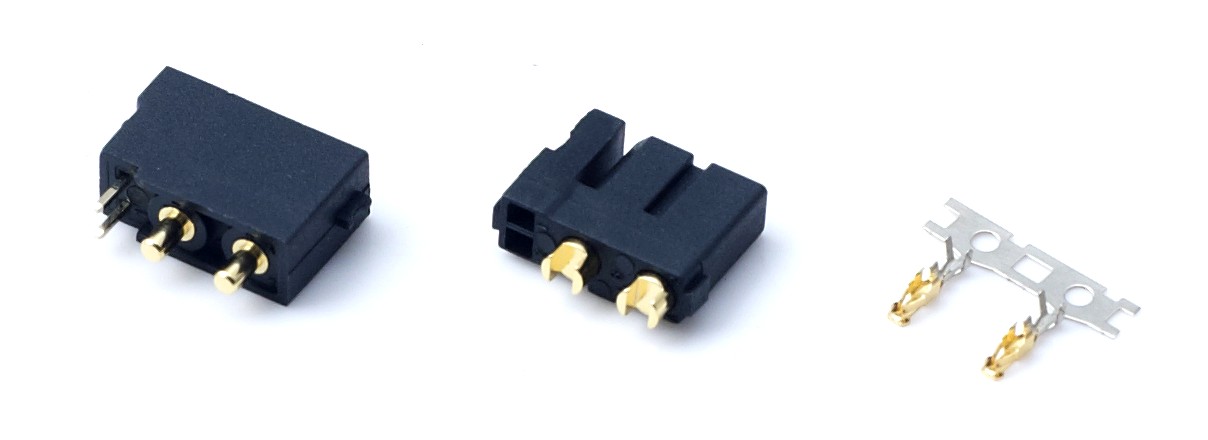
A 2+2 power-signal mating pair. Consolidating two power poles and two signal poles into one housing removes a harness and a mating operation from assembly — and locks the design into that footprint.
Technical Explanation: What the Ratings Actually Depend On
Contact resistance and temperature rise
Ampacity is not a property of the housing; it is the outcome of a thermal balance. Every watt dissipated at the contact interface raises the temperature of the terminal, the housing and the surrounding air. Contact resistance is therefore the single most influential variable in how much current a given connector can carry before the housing reaches its limit. AOYG's stated comparison figure — contact resistance reduced by more than 50% against the conventional baseline — is a claim about that interface. If it holds under test, the practical consequence for a buyer is not only a cooler connector, but the option to run the same envelope at a higher continuous current, or to run the same current with more thermal margin for peak events.
Plating, anti-spark and mating cycles
Gold-plated terminals exist to keep contact resistance stable over time. Bare or thinly plated surfaces oxidise and film over, and the resulting resistance drift is invisible in a first-article inspection but visible in the field as progressive heating. Anti-spark options address the other half of the same problem: on a high-current DC battery link, the inrush at the moment of connection erodes contact material, so the mating event consumes life that steady-state testing never measures. A 1000+ mating-cycle target is only meaningful when both mechanisms are controlled.
Housing material, flame behaviour and insulation
The housing carries two responsibilities simultaneously: structural retention and electrical insulation. The UL94 V-0 flame-retardant grade addresses the first failure mode — self-extinguishing behaviour under abnormal overheating or sparking, without shell melting or collapse. Insulation performance addresses the second, preventing breakdown, leakage and creepage at elevated voltage. Vibration and crack resistance are the third requirement, since a cracked housing loses both functions at once. A recycled or secondary plastic compound may meet a static civilian requirement and still fail all three under sustained high-current operation and outdoor temperature cycling.
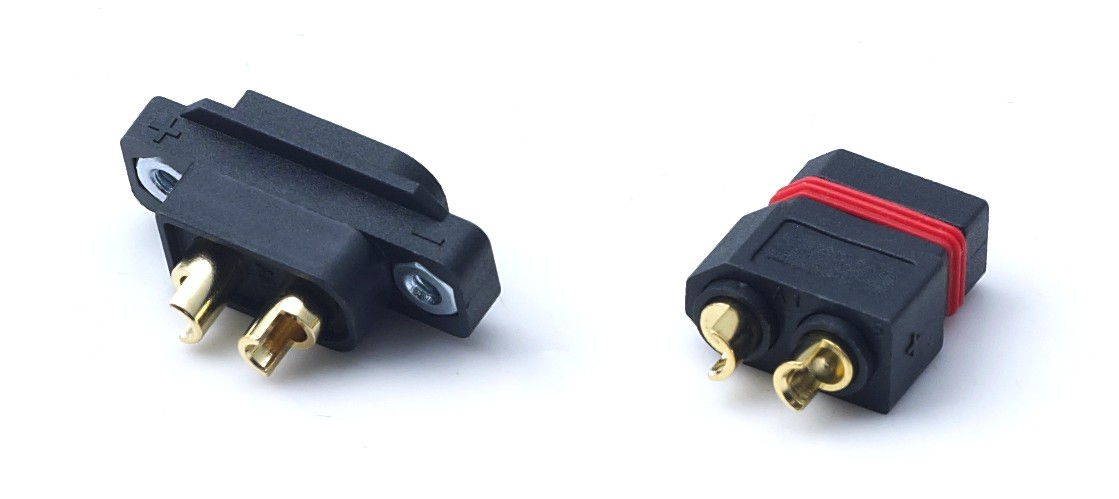
A sealed high-current connector pair intended for outdoor duty, where ingress protection rather than ampacity alone governs the selection.
Application Fit: Matching the Family to the Project
The same decision pattern repeats across the new-energy equipment categories that dominate high-current DC demand. The variable is which constraint dominates in each one.
- Drones and UAVs — including commercial, industrial and pesticide-heavy spraying platforms. The governing constraints are peak current, mass and anti-spark behaviour. The 90A / DC500V family is the starting point.
- Intelligent service robots and battery exchange cabinets — the governing constraint is interface consolidation. A 2+2 power-signal combo removes the separate signal link at the docking or battery interface.
- Portable energy storage and lithium battery equipment — the governing constraints are continuous current, self-heating and, for outdoor units, sealing. The 58.7% DC share of the energy storage connector market reflects how central this category has become.
- Garden power tools and portable cleaning equipment — the governing constraint is ingress protection combined with vibration. These are IP67 applications first and current applications second.
- Electric two-wheelers, smart home power and electric amusement equipment — the governing constraints are vibration resistance, safe plug/unplug and mating life under repeated consumer use.
- Solar street light energy storage modules, mobile solar power systems and 5G base station backup — the governing constraints are outdoor sealing, thermal range and continuous rather than burst duty, with 5G sites pushing toward higher DC power density.
- RC aircraft and RC model electric vehicles — the governing constraint is standardisation as much as performance, since XT60 and XT90 compatibility determines what the rest of the build can use.
Market Trend Analysis
Four verified data points describe the direction of this market, and they point in a consistent direction.
First, scale. The global high power connectors market reached approximately USD 5.47 billion in 2025, per Fact.MR. Second, architecture. DC connectors represented 58.7% of the energy storage connector market share in 2025, per Dataintelo, a share the source attributes to higher voltage requirements. Third, load. 5G base stations draw 11.5 to 14 kW typically and up to 19 kW at peak, two to three times the 4G baseline. Fourth, standardisation. XT60 and XT90 remain the primary standards for non-proprietary medium and high power RC aircraft and drone connections in 2026.
Read together, these indicate a market splitting into two tracks rather than converging on one. The standardised track will keep serving applications where cross-compatibility matters more than any single performance attribute — hobby and non-proprietary drone builds are the clearest example. The application-specific track will grow where ingress protection, signal integration, anti-spark behaviour or thermal headroom cannot be delivered by a standard interface. For buyers, the practical implication is that supplier qualification will increasingly be judged on whether a supplier can serve both tracks from one qualification process, rather than on catalogue breadth alone.
Comparison with Traditional Solutions — and Where the Limits Are
Traditional high-current DC connections relied on soldered bullet connectors, screw-terminal blocks, or a single two-pin connector with a separate signal harness run alongside it. Compared with those approaches, the current generation of purpose-built connectors changes several things at once.
| Dimension | Traditional approach | Purpose-built high-current DC connector |
|---|---|---|
| Current transmission | Stable only at moderate current; heating rises with load | Stable current transmission with low temperature rise (AOYG comparison data) |
| Mating event | Arc and contact erosion on high-current DC make/break | Anti-spark option available |
| Vibration behaviour | Loosening and intermittent contact over time | Strong vibration resistance and safe plug/unplug |
| Footprint | Separate power and signal connections | Compact structure with high load capacity; 2+2 integrates signal |
| Maintenance | Periodic re-tightening or re-soldering | Less maintenance, higher efficiency (AOYG comparison data) |
| Outdoor use | Requires a secondary enclosure | IP67 options in the 60A / 100A family |
The limits matter as much as the gains, and a procurement decision that ignores them is not complete:
- Standardised interfaces retain a structural advantage. Because XT60 and XT90 are the primary standards for non-proprietary RC aircraft and drone power connections in 2026, a proprietary or application-specific interface must justify itself through signal integration, ingress protection or thermal headroom. Where none of those is required, a standard part is usually the better commercial choice.
- Sealing is not free. IP67 hardware adds envelope, assembly steps and cost. Specifying it on an indoor application pays for protection the project cannot use.
- Integrated footprints are not retrofittable. Moving from a two-pin connector to a 2+2 architecture changes the panel or PCB footprint and requires tooling and revalidation. It is a design-stage decision, not a field upgrade.
- Rating figures are conditional. A 90A, 60A or 100A rating and a 1000+ mating-cycle target hold only under the specified conditions — correct alignment, clean contact surfaces, the stated temperature range and the intended mating procedure. Contaminated contacts in the field will not deliver the bench figure.
- Comparison claims are supplier-reported. The stated 15–20% cost advantage and the over-50% contact resistance reduction come from AOYG's own comparison data. They should be verified against a sample build, not accepted as published facts.
Future Outlook
Three developments are likely to shape the next procurement cycle. The first is continued DC-ward migration of power architecture, reinforced by the 58.7% DC share already observed in energy storage connectors. The second is rising current density per connector, driven by higher-voltage packs and by equipment such as 5G backup systems where the site budget is fixed but the load is not. The third is a growing expectation that compliance documentation travels with the part — IATF16949:2016 quality management, UL94 V-0 housing grade and RoHS/REACH-type environmental conformity are becoming screening criteria rather than differentiators.
For buyers at the execution stage, the implication is straightforward. Connector selection will be judged less on the headline current number and more on whether the supplier can demonstrate the rating, the compliance evidence and the batch consistency behind it — and can still supply the same qualified part when the next build cycle starts.
FAQ
Do you have IATF16949 certification, and what is your quality control standard?
AOYG holds IATF16949:2016 automotive-grade quality management system certification. Production follows the same standard across the full process: raw material incoming inspection, precision processing, plating treatment, finished-product testing and outgoing inspection. The system requires controlled production consistency, product stability, traceability and batch quality management, with continuous improvement and failure prevention built into the process. For high-current, high-vibration applications such as UAV power links, this means performance, safety and service life are managed as process outcomes rather than checked at the end of the line.
What is the flame-retardant grade of the housing, and how does it behave under high-current operation?
The housing uses flame-retardant engineering plastic at UL94 V-0 grade. Under high-current operation it is designed not to soften, deform or collapse during sustained temperature rise, which removes the short-circuit risk associated with high-temperature melting. The material is self-extinguishing under abnormal overheating or sparking, provides insulation resistance against breakdown, leakage and creepage, and resists cracking and loosening under vibration and outdoor temperature cycling. The distinction is between a compound that meets a static civilian requirement and one specified for continuous high-current duty.
What are the purchasing terms and acceptance criteria?
The stated purchasing terms are a minimum order quantity of 2 units, delivery on FOB or CIF terms, and payment terms of 30/70. The stated acceptance criterion is pre-shipment testing. The low MOQ allows a buyer to obtain samples for fit, thermal and mating-cycle validation before committing to volume, which is the appropriate sequence for a connector that will define a housing footprint or a panel interface.
Can you provide technical support for product matching and debugging?
Yes. AOYG's technical team provides model selection guidance, product adaptation analysis and assembly solution suggestions at no cost, and supports sample machine debugging and optimisation. In practice this covers matching continuous and peak current, rated voltage, operating temperature range, IP protection and signal-pin requirements to the project specification, and then validating the choice on a sample build before mass production. For first-time 2+2 or sealed-high-current designs, this support is usually the step that prevents a footprint or sealing error from becoming a tooling cost.