
2-Port vs. 4-Port Pillow Filling Machines: Buyer Comparison
2-Port vs. 4-Port Pillow Filling Machines: Buyer Comparison
The short answer: the KIVAS KWS6901-2 and KWS6901-4 are two configurations of one weighing-based pillow filling platform, separated mainly by the number of filling ports rather than by a different filling principle. Both are quoted inside a 100–2000 g fill range, both sit within a 10.5–13.5 kW power band, and the family is specified at 10–20 pieces per minute on 600 g pillows. The buying decision therefore rests on how many pieces a shift must absorb, how the line is staffed, and how much floor and fibre-feed capacity the plant can support — not on a difference in dosing accuracy.
That framing matters because port count is often sold as a simple multiplier: twice the ports, twice the output. In practice a second pair of ports adds filling positions, but it also adds operators, fibre demand and floor space, and it shifts the bottleneck of the line somewhere else. This comparison sets the two configurations side by side on the criteria that actually change a purchase order: throughput placement, power and site readiness, fill range and dosing, staffing, procurement terms, customization scope and certification checks.
How this comparison was built. Configuration data, commercial terms and certification status come from KIVAS (Qingdao Kaiweisi Industry and Trade Co., Ltd.). Comparative performance figures versus direct-fill equipment are the manufacturer's own comparison data and are identified as such wherever they appear; they have not been independently bench-tested for this article. Where a value needs confirmation for a specific model, that is stated rather than assumed.

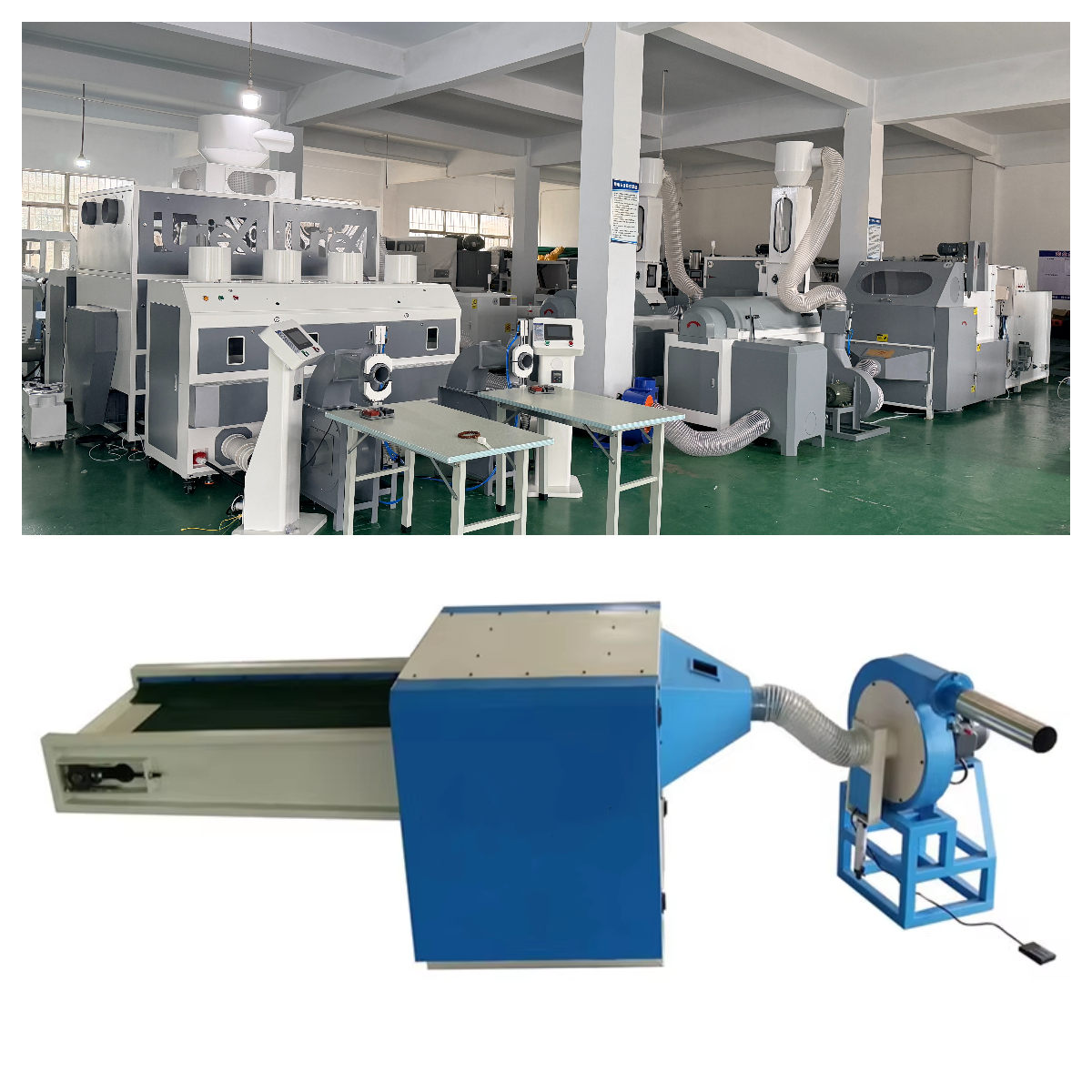
Fibre pillow filling production line: port count determines how many filling positions one line can keep loaded at the same time.
What the two configurations share
Before the differences matter, the shared specification narrows the decision considerably. A buyer comparing a 2-port and a 4-port build is choosing capacity within one machine family, not choosing between two machine categories.
- Fill range: 100–2000 g per filled piece across the configurations.
- Power band: 10.5–13.5 kW, with the exact figure depending on the configuration quoted.
- Throughput reference: 10–20 pieces per minute measured on 600 g pillows.
- Dosing principle: quantitative weighing and filling rather than volumetric or direct fill.
- Commercial terms: MOQ 1 unit, 15–35 day lead time, 100% pre-shipment testing with an SGS third-party inspection option, a 1-year warranty, remote technical support and overseas installation guidance.
- Customization route: OEM/ODM options covering voltage, logo, colour, capacity and specialized production lines.
Material compatibility is where a buyer should read carefully rather than assume. KIVAS lists the KWS6901-2 as handling 0.6D–15D fibre, 32–64 mm cotton, down, feathers, kapok of 10–80 mm and fibre balls. If your production schedule mixes fibre, down and kapok across the same week, confirm in writing that the same material set applies to the 4-port build before you standardize that schedule on it.
Where the port count changes the decision
Throughput placement inside the quoted band
KIVAS publishes approximately ten 500 g pillows per minute for the KWS6901-2, which places the 2-port build at the lower part of the family's 10–20 pieces per minute band at 600 g, with the 4-port build covering the upper part. Treat that placement as a reference point rather than a guarantee. Reported output moves with fibre bulk density, the weighing cycle, how consistently the hopper is fed, and whether filled pieces are removed from the discharge area fast enough. A 4-port machine without downstream handling can behave like a 2-port machine with idle positions.
Staffing per filling position
Each port needs a person or an automated transfer to place the shell, present it to the nozzle, check the fill and remove the finished piece. Two ports can be run by one operator working both positions on shorter cycles. Four ports usually mean either a larger crew or a conveyor arrangement that keeps shells moving past each nozzle. For a buyer, the relevant calculation is not machine price per port but labour cost per finished piece at the planned shift pattern.
Where the bottleneck moves
Adding ports pushes the constraint upstream. Fibre opening, hopper replenishment and the weighing cycle all have to keep pace with four nozzles rather than two. If the plant's fibre preparation is manual or batch-based, the upper end of the output band will rarely be reached, and the extra ports become a reserve capacity for peak weeks rather than everyday throughput. That can still be a valid reason to buy the larger configuration, but it should be a stated reason rather than an assumption about doubling output.
Floor space, feed and changeover
A 4-port build occupies more floor area and requires a steadier fibre supply. It also raises a changeover question on mixed schedules: a machine that fills 600 g pillows on four ports may sit partly idle when the next order is a 350 g decorative cushion. Buyers running short batches should ask how changeover is handled on each configuration, and should test the answer against their own order mix rather than the machine's best-case run.
Side-by-side comparison
| Criterion | KWS6901-2 | KWS6901-4 |
|---|---|---|
| Filling positions | 2 | 4 |
| Quoted output, 600 g pillow | Lower part of the 10–20 pcs/min band | Upper part of the 10–20 pcs/min band |
| Published reference figure | Approx. ten 500 g pillows per minute | Confirm rated figure on quotation datasheet |
| Fill range per piece | 100–2000 g on both configurations | |
| Power | 10.5–13.5 kW band; exact model value to be confirmed | |
| Dosing principle | Quantitative weighing, manufacturer-reported error around 1% | |
| Typical fit | Mixed SKU schedules, constrained floor space, moderate volumes | High-volume, low-mix runs with stable fibre supply and adequate staffing |
| MOQ / lead time | 1 unit / 15–35 days | |
| Testing before shipment | 100% pre-shipment testing; SGS third-party inspection available | |
| Warranty and support | 1-year warranty, remote technical support, overseas installation guidance | |
| OEM/ODM scope | Voltage, logo, colour, capacity and specialized production lines | |
Band placement reflects the number of filling positions. Rated output and rated power for the exact model you are quoted should be confirmed on the supplier's datasheet, because both are configuration- and material-dependent.
Fill range and what the accuracy claim actually covers
A 100–2000 g range covers the bulk of standard bedding work — decorative cushions at the low end through large pillows at the upper end. Two details deserve attention in a comparison, because they are frequently blurred in sales conversations.
First, a percentage tolerance is not the same as a fixed gram tolerance. An error of around 1%, which is the figure KIVAS reports for its weighing system, corresponds to a different absolute deviation at 150 g than at 1800 g. A buyer specifying acceptance criteria should state the tolerance in grams at the weights actually produced, not only as a percentage.
Second, the accuracy claim belongs to the weighing system, not to the port count. Both configurations use the same dosing principle, so the 2-port and 4-port decision does not change the accuracy class. What it changes is how many weighed fills per minute the plant can complete and how much of that accuracy reaches the shipping carton within a shift.
Direct fill versus quantitative weigh-fill: the difference the port count does not change, and the one it amplifies.
How both configurations compare with direct-fill equipment
The 2-port versus 4-port question sits inside a larger one: whether to move from volumetric direct fill to weighing at all. KIVAS's comparison data makes the case in numbers that a buyer can test against a quotation. Against traditional direct-fill machines for home textile pillows, cushions and quilts, the company reports a reduction in fill deviation from roughly 30 g to within 10 g, a 40% increase in production capacity, and a 50% reduction in labour. On cost, the company reports an initial cost about 15% higher and a total cost of ownership more than 40% lower over one year, with 70% less maintenance required.
Read those figures as the supplier's positioning, then convert them into questions. Which material and which fill weight produced the 30 g and 10 g figures? Over what shift length and staffing level was the 50% labour reduction measured? Which maintenance items are included in the 70% figure — wearing parts, weighing components, or the whole machine? A supplier confident in its comparison data can answer these; a buyer who does not ask is comparing marketing arithmetic with capital expenditure.
The fit boundary is equally important. Weighing-based filling earns its premium when fill-weight consistency is sold as a product attribute and when labour is a meaningful share of unit cost. For very small batches, or where the end product tolerates wide weight variation, the higher initial cost may not be recovered inside a normal payback horizon. The 15% initial premium and 40% ownership advantage are one-year figures from the manufacturer, not a universal payback guarantee.
Power, utilities and site readiness
The 10.5–13.5 kW band is a planning input, not a formality. Before signing, obtain the exact rated power for the configuration being quoted and check it against available supply capacity, voltage and phase at the installation point, plus headroom on the relevant breaker. A 4-port build at the top of the band may require an electrical review that a 2-port installation would not have triggered.
Utilities beyond electricity also belong on the pre-order checklist. Fibre transport, dust extraction and pneumatic functions are typically specified per installation; confirm the required air supply and extraction capacity on the datasheet rather than assuming the plant's existing compressed-air line is sufficient. Where the destination market's voltage differs from the standard build, voltage customization is available through the OEM/ODM route and should be fixed in the specification before production, not after delivery.
Materials and applications
Both configurations sit within a product portfolio that KIVAS describes as spanning pillow, quilt, down-jacket and toy filling machinery, alongside fibre-processing and packaging equipment. In practice, the comparison plays out across a wide set of end products: pillow cores, throw pillows and cushions, sofa and car-seat cushions, beanbag and lazy-sofa filling, pet beds, duvet and quilt bodies, down jackets and soft toys.
Each of those applications stresses a different part of the specification. Beanbag and lazy-sofa filling involves large fill weights and high volumes per piece, so the 2000 g ceiling and the stability of the weighing cycle matter more than port count. Down and feather work puts the emphasis on containment and material handling. Toy and cushion filling favours quick changeover across small batches. Map your own product mix onto those patterns before deciding that the higher-port configuration is the safer choice.
Procurement terms that carry more weight than the port count
On a single-unit purchase, the commercial terms often decide more of the outcome than the configuration does. Each term below converts into a specific question.
- MOQ 1 unit. A single-unit minimum means a first machine can be ordered without a volume commitment — useful for a pilot line or a plant adding one filling station. Ask whether the single-unit price holds across configurations and what changes if a second unit follows.
- 15–35 day lead time. The width of that range is where orders slip. Ask what starts the clock, what pushes a standard build toward 35 days, and whether customization is inside or outside the quoted window.
- 100% pre-shipment testing. Confirm what is tested — weighing accuracy at defined weights, port function, electrical checks — and whether you receive the test record with the machine.
- SGS third-party inspection. A third-party inspection adds documentation from an organization outside the buyer–seller relationship. Confirm the inspection scope, who pays, and whether it substitutes for or supplements the factory's own test report.
- 1-year warranty. Clarify what is covered: parts, labour, wearing components, and whether remote diagnosis is the first step in a claim.
- Remote support and overseas installation guidance. Support depth matters most in the first commissioning week. Establish the response channel and the language of support before the machine ships.
When OEM/ODM customization matters — and when it does not
Customization changes the economics of a comparison differently for different buyers. For a distributor building a house brand, logo and colour customization plus a voltage matched to the destination market turn the machine into a sellable product line rather than a single import. For a bedding manufacturer integrating filling into an existing line, the relevant scope is usually capacity matching and specialized line configuration, so that the filling station's output aligns with opening, carding and packaging equipment around it.
For a plant buying one standard machine for its own production, customization often adds specification and delivery risk without adding output. The honest test is whether each customization item solves a constraint that exists in your plant. If the answer is no, a standard configuration with a documented datasheet is the easier machine to accept, maintain and resell.
Verifying ISO9000 and CE inside a comparison
Certification claims are the most frequently repeated and least frequently checked part of a filling machine comparison. Two different things sit behind the two marks, and buyers should treat them separately.
ISO9000 is a quality management system certification: it speaks to how the manufacturer organizes quality control, not to the safety of a particular machine. Verify by asking for the certificate number, the certifying body, the certified scope and the validity dates, then checking the certificate against the issuer's own register.
CE marking, by contrast, is a product compliance declaration. Verify by requesting the declaration of conformity and confirming that it names the model and configuration you are buying — including the voltage variant — rather than a generic product family. Where safety-related test documentation exists, ask to see it. Public listings that assert CE or ISO status without a certificate identifier, scope statement or issuing body are a starting point for due diligence, not evidence on their own.
The same discipline applies to the KIVAS range: the company states that its products have obtained ISO9000/CE certification. A buyer should still request the certificates and the applicable declaration for the exact model, because in a comparison between two configurations of the same family, the compliance documentation should cover the one on the order.
Risk control and daily operation
Electrostatic build-up and noise are the two production risks KIVAS addresses directly in its design. The machine is equipped with an anti-static bar and an acrylic anti-static hopper, and uses a low-noise fan design. The manufacturer monitors electrostatic and noise levels and provides periodic maintenance as part of its risk-control routine. For a buyer, these are checkable items at acceptance: confirm the anti-static components are installed and functioning, and record a noise reading at the operator position so that later changes can be compared against a baseline.
A short decision framework
For buyers still balancing the two configurations, the following sequence resolves most of the ambiguity:
- Calculate required pieces per shift at 600 g as the reference weight, then apply your real weight mix.
- Check whether staffing can cover each additional port, or whether transfer automation is needed to keep four nozzles loaded.
- Confirm the exact rated output and rated power for the quoted configuration on the datasheet, not from the family band.
- Match the product mix: mixed small batches favour the lower port count, long single-SKU runs favour the higher one.
- Fix the commercial terms in writing — lead-time triggers, test records, SGS scope, warranty exclusions.
- Obtain certificates and the declaration of conformity for the exact model and voltage variant.
Outlook
Demand context supports careful rather than automatic capacity expansion. Market Research Future estimates the pillow packing machine market at US$15.74 billion in 2024, projecting US$25.5 billion by 2035 at a compound annual growth rate of 4.48% over 2025–2035. That category boundary is broader than pillow filling equipment alone, so the figures indicate a growing adjacent market rather than a forecast for any single machine type. The practical implication for a buyer is that capacity decisions made now are likely to be revisited: a configuration that can absorb a second shift, or that leaves room for line integration, tends to age better than one sized to a single order book.
Frequently asked questions
Does a 4-port machine produce twice the output of a 2-port machine?
Not automatically. The family is specified at 10–20 pieces per minute on 600 g pillows, with the 2-port build at the lower part of that band and the 4-port build at the upper part. Reaching the upper figure depends on fibre feed consistency, the weighing cycle, operator availability at each port and how quickly filled pieces leave the discharge area. Port count raises the ceiling; it does not set the achieved rate on its own.
Which configuration suits a plant running several pillow weights?
Mixed schedules reward whichever configuration can be kept busy through changeovers. A 4-port build that runs partly idle while the line switches between weights may deliver less per shift than a 2-port build running continuously. Buyers with frequent small batches should ask how changeover works on each configuration and test the answer against their own order history.
What power supply should be planned for?
The two configurations are quoted inside a 10.5–13.5 kW band, so the exact rated power for the model being ordered should be confirmed on the datasheet before the electrical installation is designed. Available supply capacity, voltage and phase at the installation point all need checking, and where the destination voltage differs from the standard build, a voltage variant can be specified through the OEM/ODM route.
What does the 100–2000 g fill range cover, and how accurate is the fill?
The range covers decorative cushions at the low end through large pillows at the upper end, across fibre, down, feather and kapok materials as specified. Dosing is by quantitative weighing rather than volumetric fill, with an error of around 1% reported by the manufacturer. Because a percentage tolerance converts into different absolute deviations at different weights, acceptance criteria should be written in grams at the weights you actually produce.
How should ISO9000 and CE claims be verified before ordering?
Treat them as two separate checks. For ISO9000, request the certificate number, certifying body, certified scope and validity dates, then verify the certificate against the issuer's register. For CE, request the declaration of conformity and confirm it names the exact model and voltage variant being purchased. Listings or brochures that assert certification without a certificate identifier, scope statement or issuing body support due diligence only as a starting point.
About the manufacturer
Qingdao Kaiweisi Industry and Trade Co., Ltd. (KIVAS) is a Qingdao-based manufacturer of home textile equipment, founded in 2014 and operating a 3,000 m² factory with a five-engineer R&D team and an annual output of 1,000 units. The company produces fibre-processing machinery, cotton, linen and wool textile machinery, automated quantitative pillow and quilt filling machines, pet-product filling machines, weighing down-jacket filling machines and packaging machinery, and reports a 60% export share across markets including the USA, Russia, Vietnam, Kazakhstan, Saudi Arabia, Italy, the UK, Spain, South Korea, Turkey, Brazil, Pakistan, Moldova and Ukraine.
For readers preparing a technical shortlist, the company's full product catalog is available for public download: Qingdao Kaiweisi Product Catalog (PDF).
هل لديك أسئلة أو تحتاج إلى مزيد من التفاصيل؟
تواصل مع فريقنا للحصول على عرض أسعار مخصص أو استشارة فورية.
طلب عرض أسعار
املأ النموذج أدناه وسيتواصل معك فريقنا بعرض مقترح مخصص.
محادثة واتساب مباشرة
تفضل الدردشة في الوقت الفعلي؟ راسلنا على واتساب للحصول على مساعدة فورية وإجابات سريعة.
- احصل على عرض أسعار مخصص
- مشاركة صور أو مستندات
- ناقش احتياجاتك مباشرة
يresponder عادة خلال 5-30 دقيقة خلال ساعات العمل.