
200SZQ150-35-22 vs 200SZQ150-20-15 Axial Flow Pump Comparison
200SZQ150-35-22 vs 200SZQ150-20-15 Axial Flow Pump Comparison
An independent reference for buyers comparing two 8-inch portable axial flow pump models that share a 150 m³/h rating but differ by 15 metres of head, 7 kW of motor power and 3 kg of pump weight.
Portable axial flow pumps bought for flood control usually reach a shortlist that looks uniform on paper, and the 200SZQ150-35-22 and 200SZQ150-20-15 from Zhejiang Chuangmei Electromechanical Co., Ltd. are a clear example. The company is a pump manufacturer based in the TA'AO Industrial Zone, Wenling City, Zhejiang Province, China, founded in 1996, operating a 12,000 m² factory with 46 employees and an annual output of about 30,000 units. Roughly 25% of production is exported, with Southeast Asia, Africa, Morocco and Central Asian markets listed among its main destinations, and its portable axial flow range covers 6-inch to 12-inch flood control specifications with rated flows from 100 m³/h in the smaller classes up to 1,500 m³/h in the 12-inch class.
The two models compared here sit inside that range and, at first glance, are the same machine. Both are listed in the 8-inch aluminium alloy high-head flood control group intended for subway duty. Both carry a rated flow of 150 m³/h. Both are published at 280 x 280 x 580 mm. What separates them is the duty point written into the model number: the 200SZQ150-20-15 is rated at a 20 m head with a 15 kW motor and a net weight of 26 kg, while the 200SZQ150-35-22 is rated at a 35 m head with a 22 kW motor and a net weight of 29 kg.
For a buyer in the evaluation stage, comparing portable high-efficiency axial flow pumps for subway emergency drainage, underground space drainage, municipal flood control or fixed drainage in basements, garages, bridges and culverts, the review question is not which pump is better. It is which duty point the site actually needs, and what the alternative costs in electrical demand, handling weight and control equipment.
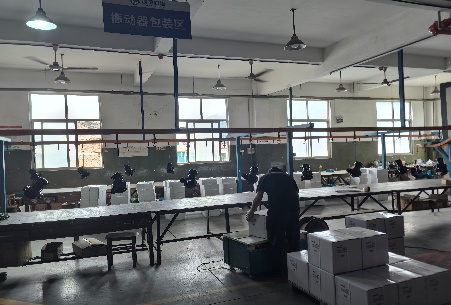
The shared baseline: one outlet class, one flow rating, one footprint
Before the differences are weighed, the identical part of the specification matters, because it removes several variables from the comparison.
- Outlet class. Both models carry the 200 prefix, the size class used across the manufacturer's 8-inch flood control pumps.
- Rated flow. Both are published at 150 m³/h.
- Envelope. Both are published at 280 x 280 x 580 mm, so installation clearances, lifting points and transport stowage are unchanged between them.
- Wetted material class. Both use aluminium alloy for flow-passing components.
- Stated applications. Both are listed for the same scenarios: subway flood emergency drainage, underground space drainage, municipal flood control, underground comprehensive pipe gallery, and fixed drainage in bridges, culverts, basements and garages.
- Product family. Both belong to the manufacturer's high-head flood control pump line for subway applications.
The practical consequence is that a procurement team does not have to re-plan the installation when it moves between these two models. The decision is confined to hydraulics, electrical supply and handling.
Reading the model code before reading the datasheet
Model numbers in this family follow a four-part pattern that can be decoded without a catalogue, and the pattern holds when it is checked against other entries in the same range. The sequence is: outlet size class, series letters, rated flow in cubic metres per hour, rated head in metres, and motor power in kilowatts.
| Code segment | In 200SZQ150-35-22 | What it states | Cross-check elsewhere in the range |
|---|---|---|---|
| First number | 200 | Outlet size class, 8-inch | 150 is used for 6-inch models, 250 for 10-inch, 300 for 12-inch |
| Series letters | SZQ | Family designation for the portable flood control range | Appears on 100SZQ, 150SZQ, 200SZQ, 250SZQ and 300SZQ entries |
| Second number | 150 | Rated flow in m³/h | 250SZQ450-8-15 is rated 450 m³/h; 300SZQ1000-10-45 is rated 1,000 m³/h |
| Third number | 35 | Rated head in metres | 150SZQ100-6-3 is rated 6 m; 150SZQ150-80-55 is rated 80 m |
| Fourth number | 22 | Motor power in kW | 150SZQ100-6-3 uses a 3 kW motor; 300SZQ1500-10-75 uses 75 kW |
Read directly, the codes state the specification, and the fourth number is the buyer's first signal of electrical load, because a 22 kW motor changes cable sizing, generator capacity and the control cabinet that must accompany the pump.
The three published differences that decide the selection
| Parameter | 200SZQ150-20-15 | 200SZQ150-35-22 |
|---|---|---|
| Rated flow | 150 m³/h | 150 m³/h |
| Rated head | 20 m | 35 m |
| Motor power | 15 kW | 22 kW |
| Net weight | 26 kg | 29 kg |
| Dimensions | 280 x 280 x 580 mm | 280 x 280 x 580 mm |
| Flow-passing material | Aluminium alloy | Aluminium alloy |
| Outlet class | 8-inch, 200 series | 8-inch, 200 series |
Three ratios follow from those published figures. The higher-head model is rated at 75% more head at the same flow, with a motor rating about 47% higher and a pump that is 3 kg heavier. Hydraulic power scales with flow multiplied by head, so the step between the two motor ratings is not proportional to the step between the two head ratings; the two models are therefore not simply the same hydraulic design with a larger motor attached. Buyers should treat the published numbers as single duty points and ask the supplier for a full performance curve before drawing conclusions about part-load behaviour.
Complete-set weight and the matching control cabinet
Pump weight alone understates the difference. The manufacturer's electrical cabinet range is organised by motor power band, and a 15 kW pump pairs with the 11 to 15 kW cabinet group while a 22 kW pump pairs with the 18.5 to 22 kW group. The two cabinet groups are close in size but not identical.
| Configuration | 15 kW class, with 200SZQ150-20-15 | 22 kW class, with 200SZQ150-35-22 |
|---|---|---|
| Pump net weight | 26 kg | 29 kg |
| Mini-style cabinet | 18 kg, 360 x 350 x 530 mm | 19 kg, 360 x 350 x 530 mm |
| Vehicle-mounted single system cabinet | 30 kg, 390 x 350 x 700 mm | 32 kg, 390 x 350 x 700 mm |
| Vehicle-mounted one-drives-two cabinet | 56 kg, 390 x 350 x 700 mm | 61 kg, 390 x 350 x 700 mm |
| Indicative single-pump set weight, pump plus mini cabinet | about 44 kg | about 48 kg |
| Indicative two-pump set weight, two pumps plus one-drives-two cabinet | about 108 kg | about 119 kg |
Set weights are arithmetic sums of the published pump and cabinet weights and exclude cable, hose, float body and outlet fittings.
The control cabinet itself is described by the manufacturer as offering panel or touch-screen display with a built-in frequency inverter, real-time display of frequency, voltage, current and rotational speed, and remote control over 3G and 4G networks through computer or mobile application. The manufacturer also describes protection against overheat, overcurrent, overload, overvoltage and phase failure, automatic shutdown within half a minute when the pump runs dry, and cabinet protection ratings of IP44 or IP54 in single-unit or one-drives-two configuration with a three-phase four-wire supply and waterproof plugs and sockets. Those functions are described for the permanent magnet synchronous motor pump range, so a buyer ordering either of the two models reviewed here should confirm the cabinet specification in writing for the exact configuration.
Application fit: subway emergency drainage, basements and municipal flood control
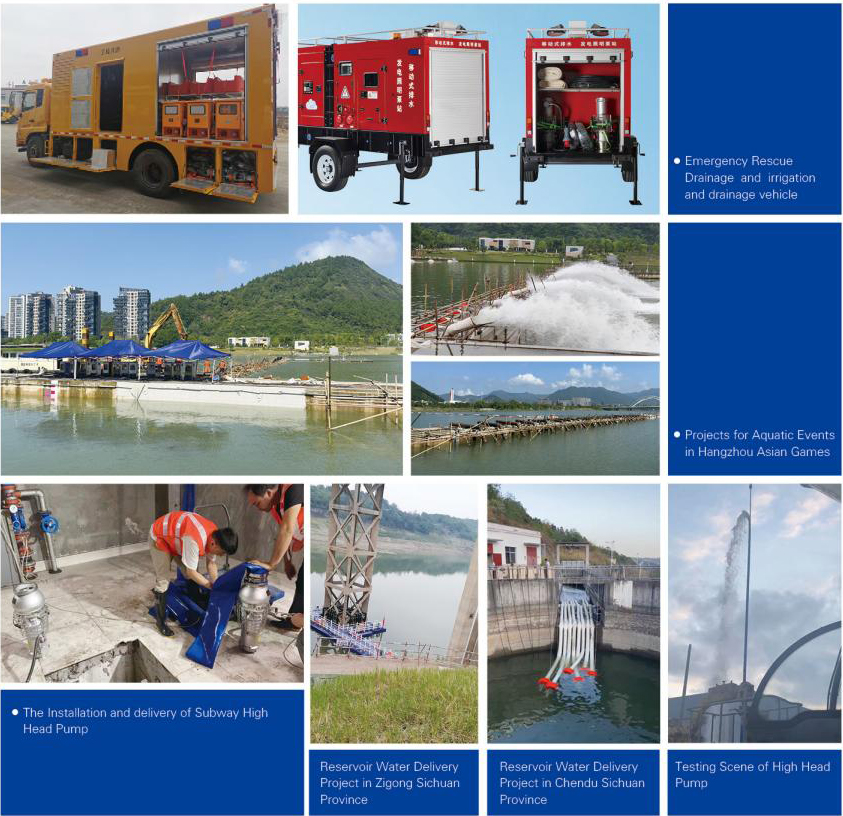
Both models are published for the same seven drainage scenarios, so the application split comes down to the head the site demands rather than to the scenario name.
Subway flood emergency drainage. The manufacturer describes its subway-oriented high-head flood control range as covering lifts of 20 to 50 m, with special specifications reaching over 100 m. The 200SZQ150-20-15 sits at the lower edge of that band and the 200SZQ150-35-22 sits in the middle of it. Where the discharge route leaves the station box and must rise through a long hose run or reach a raised outfall, the 35 m model carries reserve that the 20 m model does not. Where the discharge point is close and low, the 15 kW model keeps the electrical demand smaller.
Basement, garage and culvert drainage. For fixed drainage duty, the manufacturer describes automatic operation in which the system starts when water reaches a set level and returns to standby or shuts down when the level drops to the pump intake line. Because both models are listed for basements, garages, bridges and culverts and share the same 280 x 280 x 580 mm envelope, a mount or pit does not need to be redesigned if the head requirement changes during design development.
Municipal flood control and pipe galleries. Both are listed for municipal flood control and underground comprehensive pipe gallery duty. In these settings the deciding factor is usually how far and how high the discharge must travel, because friction losses in a long discharge line accumulate and reduce the flow a pump can deliver at a given motor rating.
Decision rule. If the calculated total head, meaning static lift plus friction in hose and pipe, is comfortably below 20 m and the site is weight or power limited, the 200SZQ150-20-15 is the smaller answer. If the calculated head approaches or exceeds 20 m, or if the pump will be redeployed across sites with different discharge routes, the 200SZQ150-35-22 provides head reserve at the cost of 7 kW and 3 kg.
Same duty point, different material and outlet options
The two models reviewed here are aluminium alloy units. The same duty point of 150 m³/h at 20 m appears elsewhere in the same catalogue in different material and outlet combinations, which is worth knowing before a buyer freezes a specification.
| Designation | Outlet class | Flow-passing material | Rated flow and head | Motor | Net weight |
|---|---|---|---|---|---|
| 150SZQ150-20-15 | 6-inch | Aluminium alloy | 150 m³/h at 20 m | 15 kW | 26 kg |
| 200SZQ150-20-15 | 8-inch | Aluminium alloy | 150 m³/h at 20 m | 15 kW | 26 kg |
| 150SZQ150-20-15 | 6-inch | Stainless steel | 150 m³/h at 20 m | 15 kW | 34 kg |
Two conclusions follow. First, moving from a 6-inch to an 8-inch aluminium body at the same duty point carries no published weight penalty: both are listed at 26 kg with the same 280 x 280 x 580 mm dimensions. Second, the stainless steel version of the same duty point is published 8 kg heavier at 34 kg, and the pattern repeats at the 35 m duty point, where the aluminium and stainless 6-inch versions are listed at 29 kg and 37 kg respectively.
Specification warning. The designation 150SZQ150-20-15 appears in both the aluminium alloy group and the stainless steel group. The same model number therefore describes two physically different pumps, and a purchase order that states only the model number does not fully define the material of the flow-passing components. Material has to be written into the specification.
What verification should look like before the order
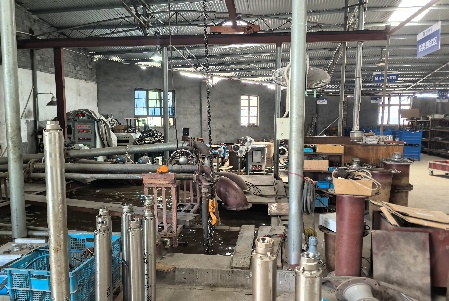
Manufacturers in this segment describe quality control in similar language, so the useful question for a buyer is what can be verified and against which reference.
- Pre-shipment testing. The manufacturer states that both its OEM and ODM production runs are subject to a 100% pre-shipment hydraulic performance test carried out on a comprehensive performance test bench. A buyer can request the test record for the specific serial numbers.
- Test tolerance. ISO 9906 defines pump performance tolerances, and Grade 1 tolerances of plus or minus 5% on flow and head are the accepted requirement for high-precision OEM applications. Naming Grade 1 in the purchase contract turns a general efficiency promise into a measurable acceptance criterion.
- CE attestation scope. The manufacturer holds a Machinery and EMC Directive attestation of conformity numbered M.2025.206.C120727 issued by UDEM, issued on 13 June 2025 and valid to 12 June 2030, referencing standards including EN ISO 12100:2010, EN 809:1998+A1:2009/AC:2010 and the EN IEC 61000-6 series. A second attestation, M.2025.206.C120734, references EN 60204-1:2018/A1:2025 for electrical equipment of machines. Each certificate lists a defined model scope; the first covers designations such as 150SZQ250-10-11, 200SZQ450-8-15, 250SZQ800-10-37, 300SZQ1000-10-45 and 300SZQ1500-10-75. Neither 200SZQ150-35-22 nor 200SZQ150-20-15 appears among the designations printed on the certificate scope reviewed for this article, so model-specific coverage should be confirmed in the current annex rather than assumed from the certificate number.
- Motor efficiency regulation. China's GB 30253-2024 mandatory energy label standard for permanent magnet synchronous motors applies to products sold from 2025. The manufacturer's range includes permanent magnet synchronous motor designs, so buyers in China-facing supply chains should expect energy-label documentation to form part of the order file and should confirm the motor type specified for the exact model ordered.
- Trade classification. Axial flow and mixed flow vertical pumps primarily for water handling are classified under HS Code 84138130, a reference point for importers preparing duty and documentation.
Market signals behind portable flood-control procurement
The global axial flow pump market is projected to reach approximately USD 4.49 billion by 2026, according to commercial research published by First Mover. That figure should be read with care: the same research landscape contains a competing valuation of USD 14.36 billion for an adjacent period, a gap that points to inconsistent definitions of what counts as an axial flow pump rather than to a single reliable number. Buyers should treat market-size headlines as directional and rely on duty calculations, standards and certificates for actual selection.
Two structural trends are more useful. The first is regulatory. GB 30253-2024 makes the energy label mandatory for permanent magnet synchronous motors sold in China from 2025, which shifts part of the efficiency conversation from catalogue adjectives to documented motor classes. The second is standardisation of acceptance testing: ISO 9906 Grade 1 tolerances give both suppliers and buyers a common language for what a performance guarantee means.
A gap remains at the category level. A 2026 review of verified data for this product category found no publicly available supplier-level dataset linking impeller material to energy efficiency ratio. That absence is precisely why claims of high efficiency are hard to compare across suppliers at the pump level, and why buyers should request curve data, motor efficiency class and test records instead of relying on efficiency wording in a product title.
Where portable units trade off against traditional fixed drainage
- Permanently installed versus redeployable. Traditional drainage stations use fixed installations sized for one location. A portable unit in this class is designed to be moved between sites, and mobility should not be read as equivalent to a permanently installed station's duty cycle. The manufacturer lists portable mobile operation as a key characteristic of the flood prevention pumps delivered in its reference cases, alongside anti-clogging behaviour and energy saving.
- Aluminium versus stainless steel flow-passing components. The stainless version of the same duty point is published about 8 kg heavier. Buyers trading handling weight against abrasion and corrosion margin have to make that choice explicitly rather than by default.
- Rated point versus full curve. The catalogue data available for these two models is a single duty point. Above or below that point, delivered flow and power draw change, and the change cannot be predicted from the published figures. This is the most common source of mismatch in flood-control procurement.
- Motor technology differences. The manufacturer states that in its permanent magnet synchronous motor pumps the speed does not vary with grid voltage fluctuation, so head and flow remain stable during voltage drops, and describes its permanent magnet units as substantially lighter than conventional axial flow pumps. Those are manufacturer statements and should be validated by on-site testing where supply quality is uncertain.
- Certificate scope. As noted earlier, certificate designations and model designations do not automatically line up, and scope has to be checked model by model.
A buyer checklist for choosing between the two models
- Calculate the duty point: static lift plus friction losses at the design flow, then confirm which model's rated head covers it with margin.
- Request the performance curve, not only the rated point.
- Confirm the power supply: 15 kW against 22 kW changes generator sizing, cable and protection settings.
- Select the cabinet configuration, mini-style, vehicle-mounted single, or one-drives-two, and record its weight in the transport plan.
- State the material, aluminium alloy or stainless steel, since the same designation exists in both groups.
- Write the full designation on the order: series, flow, head, power, material and cabinet configuration.
- Specify acceptance testing, including the pre-shipment hydraulic performance test and ISO 9906 Grade 1 tolerances where appropriate.
- Request the current CE annex and confirm whether the ordered designation is listed.
- Confirm commercial terms: the stated minimum order quantity is 1 unit, lead time is 15 to 20 days for OEM and 15 to 30 days for ODM, and monthly capacity of 500 units with annual output of about 30,000 units supports repeat ordering.
- Confirm after-sales terms, including the one-year warranty with free maintenance during the warranty period, remote technical guidance, spare parts supply and on-site maintenance consultation.
Outlook
Three developments are likely to shape how buyers compare models of this kind. First, energy labelling for permanent magnet synchronous motors will push motor efficiency from a marketing term into an order document. Second, municipal and subway operators are increasingly standardising on portable sets that can be redeployed across sites, which favours shared-frame families in which the head rating can change without the envelope changing. Third, ISO 9906 Grade 1 tolerances are becoming a practical contract benchmark rather than a technical footnote.
Against that background, the two models reviewed here represent a deliberate portfolio choice rather than duplication: one frame, one flow rating, two duty points. The 200SZQ150-20-15 covers low-lift routes with a 15 kW motor, and the 200SZQ150-35-22 covers longer or higher discharge routes with a 22 kW motor and 3 kg of extra pump weight. A buyer who calculates the duty point first and the electrical supply second will arrive at the right model without needing to compare marketing language.
FAQ
What do the numbers in the model designation 200SZQ150-35-22 mean?
In this portable flood control family the code is read as outlet size class, series letters, rated flow in m³/h, rated head in metres and motor power in kW. So 200SZQ150-35-22 is an 8-inch class unit rated at 150 m³/h and 35 m of head with a 22 kW motor. The pattern can be cross-checked: 300SZQ1500-10-75 is a 12-inch class unit rated at 1,500 m³/h and 10 m with a 75 kW motor, and 150SZQ100-6-3 is a 6-inch class unit rated at 100 m³/h and 6 m with a 3 kW motor.
Both models are rated at 150 m³/h. Why does one use a 22 kW motor?
Rated flow is published together with the head at which it is achieved. The 200SZQ150-20-15 reaches 150 m³/h at 20 m, while the 200SZQ150-35-22 reaches the same flow at 35 m. Because hydraulic power scales with flow multiplied by head, the higher-head duty point requires more motor power, and the published ratings move from 15 kW to 22 kW accordingly. At any given site, the delivered flow depends on the total head of the installation, meaning static lift plus friction losses in hose and pipe.
Which of the two models is the better fit for subway flood emergency drainage?
Both are listed in the manufacturer's 8-inch aluminium alloy high-head flood control range for subway duty and both are published for subway flood emergency drainage. The choice depends on the discharge route. The manufacturer describes its subway-oriented high-head flood control range as covering lifts of 20 to 50 m, with special specifications above 100 m; the 20 m model sits at the lower edge of that band and the 35 m model in the middle. Where discharge must be lifted through a long hose run or to a raised outfall, the 35 m model offers more reserve. Where the route is short and the lift is low, the 15 kW model keeps electrical demand lower.
Can the 200SZQ150-20-15 be used at a site that needs more than 20 m of head?
The published rating is 150 m³/h at 20 m. If the installation head exceeds the rated head, the pump will still operate but at a different point on its curve, delivering less than 150 m³/h. The catalogue data available for this model is a single duty point with no published curve, so behaviour above 20 m cannot be stated from the figures available. A buyer who needs a guaranteed 150 m³/h at a higher head should select a model whose rated head matches the duty, such as the 200SZQ150-35-22 for 35 m, or request a performance curve for the specific model.
How much heavier is a complete 22 kW set than a complete 15 kW set?
The pump itself differs by 3 kg: 26 kg for the 200SZQ150-20-15 and 29 kg for the 200SZQ150-35-22. Adding the matching cabinet, the mini-style cabinet is published at 18 kg for the 11 to 15 kW group and 19 kg for the 18.5 to 22 kW group, the vehicle-mounted single-system cabinet at 30 kg and 32 kg, and the one-drives-two cabinet at 56 kg and 61 kg. On that basis a single-pump set with a mini cabinet is about 44 kg at 15 kW and about 48 kg at 22 kW, while a two-pump set with a one-drives-two cabinet is about 108 kg and about 119 kg.
Are the 200SZQ150-35-22 and 200SZQ150-20-15 covered by the manufacturer's CE attestation?
The manufacturer holds attestation M.2025.206.C120727 issued by UDEM under the Machinery and EMC Directive, issued on 13 June 2025 and valid to 12 June 2030, and a second attestation M.2025.206.C120734 referencing EN 60204-1:2018/A1:2025. Each certificate prints a defined model scope: the first lists designations such as 150SZQ250-10-11, 200SZQ450-8-15, 250SZQ800-10-37, 300SZQ1000-10-45 and 300SZQ1500-10-75. Neither of the two designations compared here appears in that printed scope, so a buyer should request the current annex and confirm model-specific coverage before relying on the certificate number.
What documentation should a buyer request before ordering either model?
A buyer should request: the performance curve and the confirmation that the rated head covers the calculated duty point; the electrical data needed to size supply, cable and generator for a 15 kW or 22 kW motor; the cabinet configuration and its published dimensions and weight; written confirmation of the flow-passing material, since the same designation exists in both aluminium alloy and stainless steel groups; the current CE annex showing whether the ordered designation is listed; the pre-shipment hydraulic performance test record; and the commercial and service terms, which the manufacturer states as a minimum order quantity of 1 unit, lead times of 15 to 20 days for OEM and 15 to 30 days for ODM, monthly capacity of 500 units, a one-year warranty with free maintenance during the warranty period, and after-sales support covering remote technical guidance, spare parts supply and on-site maintenance consultation.
Reference material. A downloadable catalogue covering the high-flow and subway flood control pump ranges, including the 200SZQ series, is available here: High flow pump catalogue, PDF. Company information is published at www.chuangmei.com.