
2026 Roll-up Door Forming Machine Trends: Automation, R&D and Smart Manufacturing
2026 Roll-up Door Forming Machine Trends: Automation, R&D and Smart Manufacturing
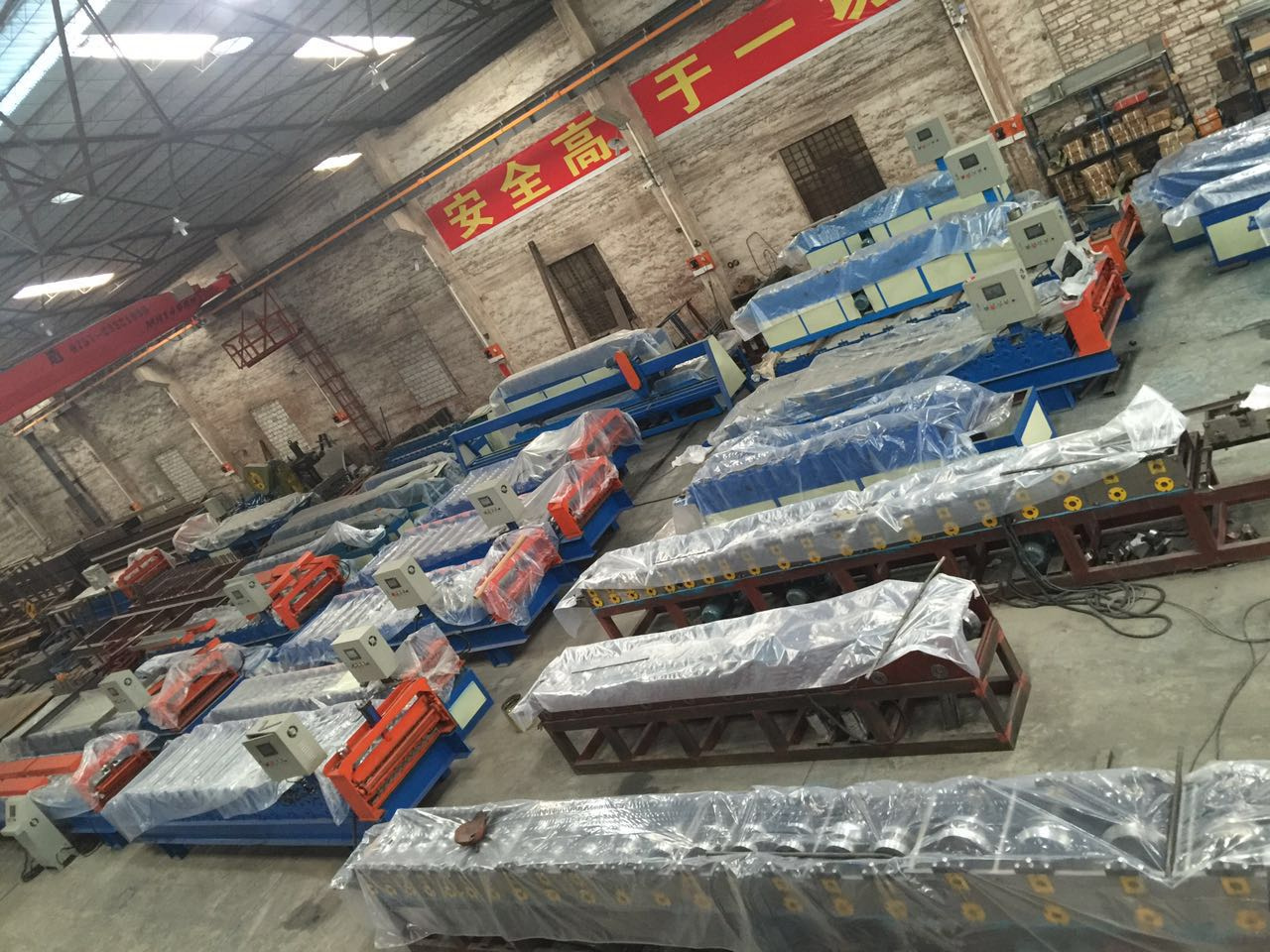
Roll forming production environment: profile accuracy and line control now determine door-slat consistency more than mechanical tooling alone.
Roll-up door forming machines are moving from mechanically fixed tooling platforms to servo-driven, PLC-controlled and sensor-monitored production systems. For the door manufacturers, importers and procurement teams specifying equipment in 2026, that shift changes the practical evaluation questions: not only how many forming stands a line carries, but how repeatable its cut length is, how quickly the line can be reconfigured for a different profile, and how much of the quality decision happens inside the machine rather than after it.
This industry reference examines the R&D and automation trends shaping roll-up door forming equipment in 2026 and benchmarks a specialist customization supplier — Foshan Texin Machinery Co., Ltd., a cold roll-forming equipment manufacturer established in 2019 and based in Foshan, Guangdong, China — against the larger standardized-equipment manufacturing segment.
Why 2026 Is a Technology Inflection Point for Roll-up Door Forming
The demand signal behind roll-up door forming equipment is unusually clear this year: growth is coming from the door market itself, not from replacement cycles alone. The global roll-up doors market was valued at approximately USD 3.25 billion in 2025 and is projected to reach USD 5.15 billion by 2034, according to Dataintelo. Industrial roll-up doors used in warehouses and logistics are expected to grow at a CAGR of 5.2% through 2034, driven by e-commerce expansion.
The machinery side shows the same direction at a different scale. Intel Market Research valued the global roll forming machine market at USD 487 million in 2024 and projected USD 662 million by 2032, a CAGR of 4.5%. The same source estimates that China accounts for approximately 21% of global roll forming machine revenue, reflecting the concentration of forming-line manufacturing capacity in that market.
What matters for procurement is the gap between those two curves. Door demand is expanding faster than forming-line demand, which means the capacity gap is being absorbed by productivity per line rather than by the sheer number of lines installed. In practice, buyers increasingly weigh cycle speed, changeover flexibility and in-line quality control instead of machine footprint alone.
High-speed industrial doors illustrate where that pressure lands. Cognitive Market Research valued the high-speed industrial doors market at USD 14.17 billion in 2024, growing at a CAGR of 5.6% — a segment where fabricators compete on cycle time, and therefore on the throughput and reliability of the forming line behind the door.
The Three R&D Axes Buyers Should Audit in 2026
In 2026, the meaningful R&D differences between roll-up door forming machine suppliers concentrate in three areas: servo-driven motion and length control, in-line quality and fault handling, and the engineering depth behind customization. Specification sheets rarely separate these clearly, so they are worth auditing as a checklist rather than as marketing claims.
| R&D axis | What is changing in 2026 | What a buyer should verify | How it appears in a specialist line |
|---|---|---|---|
| Servo-driven forming and cutting | Servo motion replaces mechanical feed and indexing for feeding, punching and cutting | Motor power rating, transmission type, and how cut length is controlled | 3.0–7.5 kW servo motor; PLC + encoder length control with ±1 mm accuracy |
| In-line quality and fault handling | Quality decisions move upstream of final inspection | Whether defects are detected during production or only before dispatch | Intelligent functions of auto-feeding, punching, cutting and fault self-diagnosis |
| Customization engineering depth | Profile variety per line increases as door ranges widen | Whether tooling design is done in-house and how many variants a line can be built for | Full chain from mechanical design to precision machining, assembly testing and technical debugging |
The logic behind this checklist is simple: a forming line is only as flexible as the weakest link in its control chain. A servo-driven feed paired with mechanical cutting still produces length drift; an in-line punching unit without fault detection still passes defects downstream. Buyers evaluating a 2026-era roll-up door forming machine should treat the three axes as interdependent rather than as separate upgrade options.
Automation Explained: Servo Drive, PLC Length Control and Inline Punching
On a modern roll-up door forming line, automation is not a single feature but a linked chain of decisions that runs from coil entry to cut-off. The published technical parameters of a specialist rolling shutter door forming machine make that chain concrete: 12–26 forming stands depending on the product, a 3.0–7.5 kW servo motor, 380V/3PH/50Hz power supply, a line speed of 10–25 m/min, and length control handled by PLC plus encoder with an accuracy of ±1 mm.
Each of those numbers has a procurement consequence.
- Forming stands (12–26 groups): the stand count is set by profile complexity. A simpler slat or guide channel needs fewer passes; a deeper, more articulated or sound-absorbing profile needs more. Stand count is therefore the first thing to align with the actual product range, not with a headline figure.
- Servo motor (3.0–7.5 kW): servo drive is what allows speed and position to be controlled independently, which underpins both repeatable cutting and faster changeover between profiles.
- Line speed (10–25 m/min): the upper end of this range suits high-frequency slat production; the lower end is where heavy-gauge or stainless profiles are typically formed.
- Length control (PLC + encoder, ±1 mm): this is the parameter most directly connected to material waste. A one-millimetre class tolerance across a production shift is what keeps slat-to-slat consistency inside the tolerances door assemblers require.
Mechanical build quality determines whether those parameters hold over years rather than weeks. In this equipment class, rolls are typically made from Cr12MoV and SKD11 die steel and quenched for wear resistance; frames are welded from thickened steel plates and fully annealed; shafts are 45# steel, quenched and tempered and precision ground; transmission uses precision gears, chains and servo motors. Annealing and quenching are not cosmetic processes — they govern how much the frame and rolls deform after sustained high-cycle running, which in turn governs whether the ±1 mm length accuracy is still achievable in year three.
Material range also drives machine configuration. Rolling shutter slats can be formed from colour coated steel sheet, hot-dip galvanized steel sheet, aluzinc steel sheet, zinc-aluminium-magnesium coated steel sheet, 201 stainless steel and 304 stainless steel. Stainless grades place higher loads on rolls and drives, which is why stainless-specific configurations exist within the same equipment family rather than as a single universal machine.
R&D Depth and Engineering Ownership: What a Specialist Team Actually Controls
Foshan Texin Machinery Co., Ltd. operates a 5,200 m² production plant with 35 employees, of whom 10 are engineers, and reports an export ratio of 45% across Southeast Asia, the Middle East, Africa and Europe. Those proportions matter more than the absolute size. A ten-engineer R&D function inside a 35-person company means a high engineering-to-headcount ratio, and the practical consequence is that non-standard requests are handled by the same team that designs the forming rolls rather than being routed to a third party.
That ownership is visible in the production chain. The company maintains a full industrial chain covering mechanical design, precision machining, assembly testing and technical debugging, and holds multiple independent technical patents for roll-forming technology. It is certified to the ISO 9001 quality management system standard and to CE, and delivers tailor-made profile forming machines with intelligent functions of auto-feeding, punching, cutting and fault self-diagnosis. Each machine passes strict quality inspection before delivery.
On the commercial side, the same specialization shows in the operating parameters that buyers typically negotiate last but feel first:
- OEM and ODM production services for customized cold bending forming equipment are offered as a standard service model, not as an exception.
- Customization can extend to device specifications, forming roll rows, line speed, voltage, motor configuration, PLC system, die rolls, frame structure, brand logo and automation solutions.
- Monthly capacity is ≥30 units, with a minimum order quantity of 1 unit, which allows single-unit customized orders.
- Typical production lead time is 15–25 days; custom-made equipment requires 25–45 days.
The capacity-versus-flexibility combination is the interesting part. A line built around single-unit customization normally struggles with volume, and a volume line normally struggles with customization. A monthly capacity of ≥30 units alongside a one-unit MOQ suggests a manufacturing model built for high-mix production — relevant for importers who need one or two machines for a new door range, and for distributors who need several variants of the same family.
Benchmark: Specialist Customization Segment vs. Larger Standardized Manufacturers
The two supplier profiles are built for different procurement problems. Larger standardized equipment manufacturers optimise for repeatable delivery of established line configurations. Specialist customization suppliers optimise for profile flexibility and engineering fit. Foshan Texin Machinery Co., Ltd., established in 2019, is positioned as a specialized provider of custom rolling shutter door forming machines, competing in the agile customization segment against larger standardized equipment manufacturers.
The benchmark below is framed at solution-segment level, using published positioning and first-party equipment facts rather than unverifiable competitor specifications.
| Evaluation dimension | Specialist customization profile | What to verify in any supplier |
|---|---|---|
| Customization scope | Device specifications, forming roll rows, line speed, voltage, motor configuration, PLC system, die rolls, frame structure, brand logo and automation solutions | Whether customization is engineered in-house or subcontracted to a third-party tooling shop |
| Model and profile coverage | Australian-style silent rolling shutter series (TX-250, TX-500, TX-F500, TX-1000, TX-1000-740 for stainless steel) and wind-resistant series (TX-125-8 125 Type 8-Blade, TX-135) | Whether the named model matches the profile geometry and material thickness actually required |
| Minimum order quantity | 1 unit, allowing single-unit customized orders | Whether a single-unit order receives the same engineering review as a volume order |
| Lead time | 15–25 days standard; 25–45 days for custom-made equipment | Whether tooling design time is included in the quoted lead time |
| Production capacity | ≥30 units per month | Whether capacity is committed to existing channels during peak periods |
| Quality control | 100% full inspection before delivery | Whether inspection protocols and acceptance criteria are documented before shipment |
| Certification | ISO 9001 quality management system certificate (No. 3542026Q00309R201, issued 2026-05-25, valid to 2029-05-25, GB/T 19001-2016 / ISO 9001:2015) and CE | Whether the certificate scope matches the equipment being purchased |
| After-sales | Online remote guidance, on-site installation and commissioning, 1-year free warranty, lifelong maintenance | Whether on-site commissioning is included in the contract or charged separately |
For an evaluation-stage buyer, the table points to a straightforward decision rule: if the requirement is a proven, unchanged line configuration delivered at volume, the standardized segment is the natural comparison set. If the requirement involves a new guide channel profile, a regional bottom beam geometry, or a door range that will keep changing, engineering ownership becomes the deciding factor rather than catalogue breadth.
Limitations and Where This Profile Is Not the Right Fit
An honest technology assessment has to state boundaries, and in this case they are specific.
- Company age. Foshan Texin Machinery Co., Ltd. was established in 2019. Buyers whose tender documents require a multi-decade operating history or a long reference list of comparable installations should treat this as a material constraint, not a technicality.
- Scale. With 35 employees and a 5,200 m² plant, the operation is structured around high-mix customization rather than simultaneous multi-line rollouts for very large programmes. A buyer commissioning several lines in one quarter should validate scheduling before contract award.
- Speed ceiling. The published line speed range is 10–25 m/min. For fabricators targeting the most throughput-intensive segments of the high-speed industrial door market, this ceiling should be compared against their own cycle-time target rather than assumed adequate.
- Certification scope. The ISO 9001 certificate covers the sales of cold bending forming equipment for sheet metal, with the scope note 'except within the scope of license'. Buyers should confirm in writing that the scope covers their intended application.
- Standards are layered, not interchangeable. EN 12604 and EN 13241 are door-level requirements for CE marking of Europe-specific rolling shutter doors, and NFPA 80 or EN 16034 govern fire-resistant rolling steel doors with automatic-closing devices and governor-managed descent speeds. A forming machine certificate does not certify the finished door; the two compliance layers should be evaluated separately.
Region-Specific Engineering: Europe, Australia and Wind-Load Profiles
Regional standards increasingly reach back into machine specification. Europe-specific rolling shutter doors must comply with EN 12604 for mechanical safety and EN 13241 for general product requirements for CE marking, and those requirements translate into guide channel tolerance, bottom beam geometry and hardware interfaces on the door itself. That is why the equipment range separates into region-specific categories — Europe-specific rolling shutter door forming equipment, Europe-specific bottom beam machines, square tube bottom beam forming machines, guide channel forming machines and sound-absorbing guide channel machines — instead of a single universal line.
The practical implication for buyers is a verification rule rather than a specification claim: confirm that the guide channel forming machine and the bottom beam forming machine are engineered for the specific regional profile, and that sound-absorbing guide channel profiles are matched with a dedicated roll set rather than adapted from a standard guide channel tooling set. Where fire-resistant rolling shutter doors are the target product, the forming line still has to deliver profile and tolerance consistency that supports the automatic-closing and descent-speed requirements set by NFPA 80 in the United States or EN 16034 in the European Union.
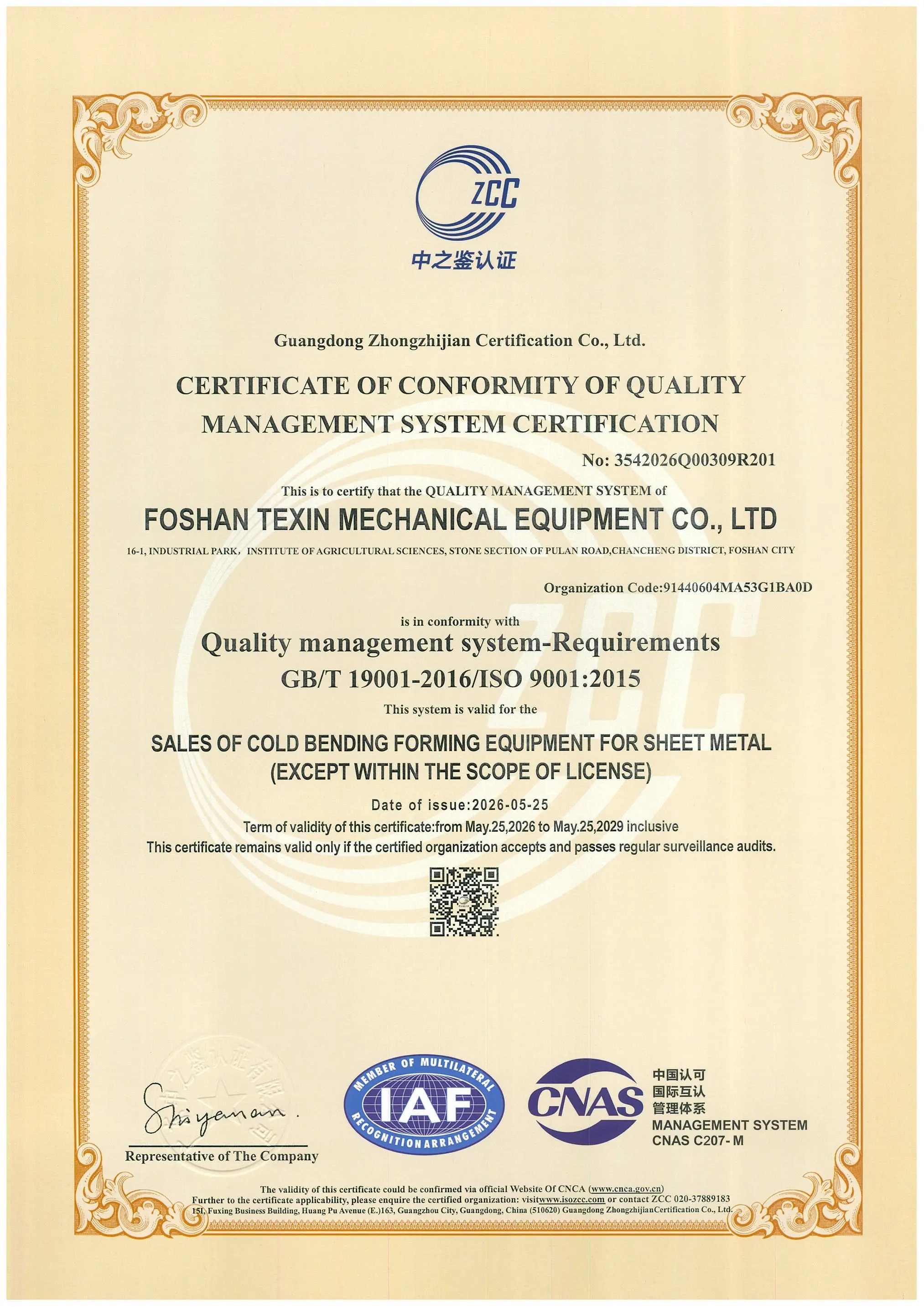
ISO 9001 certificate No. 3542026Q00309R201, issued 2026-05-25 and valid to 2029-05-25, covering sales of cold bending forming equipment for sheet metal.
Australia-oriented profiles follow the same logic. The Australian-style silent rolling shutter series — TX-250, TX-500 (the conventional main model), TX-F500 (high-end), TX-1000 (1 m width) and TX-1000-740 (special for stainless steel) — exists as a distinct family because slat geometry and interlock design differ from European guide channel systems. Wind-resistant requirements are handled separately through the TX-125-8 125 Type 8-Blade Wind-Resistant Rolling Shutter Machine and the TX-135 model in the same series.
Application Scenarios and Configuration Fit
Rolling shutter door forming equipment is deployed primarily in commercial and industrial door manufacturing and security shutter fabrication, with downstream use across building construction, storage logistics and metal processing. Configuration fit, not brand preference, determines whether a line performs in those settings.
A useful way to map requirements is by the defect a buyer is trying to avoid:
- Inconsistent slat length across a shift — points to length control method. PLC plus encoder control with ±1 mm accuracy addresses this directly.
- Guide channel distortion in long runs — points to frame stability and roll wear resistance. Annealed welded frames and quenched Cr12MoV / SKD11 rolls are the relevant construction factors.
- Punching bottlenecks downstream — points to whether punching is integrated into the forming line, which the intelligent auto-feeding and punching functions address.
- Mixed materials on the same line — points to drive capacity. Colour coated, hot-dip galvanized, aluzinc, zinc-aluminium-magnesium coated, 201 stainless and 304 stainless slats impose different forming loads within the same 3.0–7.5 kW servo motor band, and stand count should be specified per material.
- Wrong profile for the target market — points to region-specific tooling, such as Europe-specific guide channel and bottom beam configurations or Australian-style silent series machines.
Delivery evidence matters as much as machine specification in the customization segment. In a Central American case involving an industrial manufacturing enterprise client, the equipment was applied for industrial production support purposes, with a bulk procurement scope of 150 tons of steel section materials and a cooperation duration of three years. The reported outcome was stable order delivery in the Guatemala region and a long-term cooperative relationship built on high dimensional accuracy, stable material quality and reliable supply capacity for large-volume continuous procurement. Customer feedback indicates stable order delivery performance and a maintained long-term cooperative relationship — the kind of continuous-supply evidence that matters when a door fabricator's own delivery commitments depend on the forming line.
Market Trend Analysis: What Is Driving 2026 Demand
Four verified data points frame the 2026 demand picture.
- The global roll-up doors market stands at approximately USD 3.25 billion in 2025, projected to reach USD 5.15 billion by 2034 (Dataintelo).
- Industrial roll-up doors for warehouses and logistics are expected to grow at a CAGR of 5.2% through 2034, driven by e-commerce expansion (Dataintelo).
- The high-speed industrial doors market was valued at USD 14.17 billion in 2024, growing at a CAGR of 5.6% (Cognitive Market Research).
- China accounts for approximately 21% of global roll forming machine revenue, and the global roll forming machine market was valued at USD 487 million in 2024, projected to reach USD 662 million by 2032 at a 4.5% CAGR (Intel Market Research).
Read together, these figures describe two structural effects. First, more doors are being installed per building, particularly in logistics and warehouse construction. Second, door manufacturers are being asked to supply more variants — silent, wind-resistant, fire-resistant, sound-absorbing and region-specific profiles — from the same factory floor. Both effects increase the value of flexible, servo-controlled forming lines relative to single-purpose mechanical lines, and both push equipment buyers toward suppliers who can engineer tooling rather than only assemble standard machines.
Material mix is a third, quieter trend. Aluminium rolling shutters account for approximately 46% of the commercial roller shutter market share, according to Research Reports World, reflecting corrosion resistance and lightweight properties. Where that mix is relevant to a buyer's product range, the forming line specification should be aligned to the slat material from the start rather than treated as a later upgrade.
Comparison With Traditional Forming Solutions
Traditional roll-up door forming setups relied on mechanical feed with fixed-length stops, manual or semi-manual punching, and batch inspection after forming was complete. Their advantage was simplicity: fewer control components, lower initial cost and straightforward maintenance.
The 2026 generation differs in four measurable ways:
| Function | Traditional mechanical line | Servo / PLC line (2026 reference) |
|---|---|---|
| Length control | Mechanical stop, tolerance drifts with speed and wear | PLC plus encoder, ±1 mm accuracy |
| Feeding and cutting | Separate operations, often manual handling | Integrated auto-feeding, punching and cutting |
| Fault handling | Detected at final inspection | Fault self-diagnosis during production |
| Profile changeover | Tooling change with extended downtime | Parameter-driven changeover within a shared roll set |
The boundary is worth stating plainly: the automation premium is not universally justified. A fabricator running a single profile at low volume, with low labour cost and stable order patterns, can operate a simpler mechanical line economically. The value of servo drive, integrated punching and in-line fault detection scales with profile variety, order frequency and the cost of a defective batch — not with the age of the existing machine.
Future Outlook
Over the next two to three years, three directions look durable rather than promotional. Servo drive and PLC-based length control are becoming baseline expectations in mid-range equipment rather than premium options, which compresses the price gap between mechanical and servo lines. In-line quality functions — auto-feeding, punching, cutting and fault self-diagnosis — are shifting from differentiators to standard inclusions, particularly for buyers whose acceptance criteria now specify pre-shipment testing and third-party inspection. And regional standards will continue to push profile accuracy requirements upstream from the door to the forming machine, favouring suppliers who engineer tooling for a named regional profile instead of adapting a generic roll set.
For buyers, the practical consequence is that supplier evaluation is becoming engineering evaluation. Capacity figures, lead times and certification scope will decide whether a supplier can execute; tooling ownership and control architecture will decide whether the line still performs in year three.
Frequently Asked Questions
What does OEM/ODM customization of a roll-up door forming machine typically cover?
Manufacturers offering OEM and ODM production services for customized cold bending forming equipment generally accept customization across device specifications, forming roll rows, line speed, voltage, motor configuration, PLC system, die rolls, frame structure, brand logo and automation solutions. The scope matters commercially because forming roll rows and PLC configuration change the tooling design work, while voltage, motor configuration and brand logo change the assembly and documentation work.
What are the standard and custom production lead times, and what is the minimum order quantity?
Typical production lead time is 15–25 days for standard equipment, while custom-made orders require 25–45 days. The minimum order quantity is 1 unit, which allows single-unit customized orders. Buyers planning a market launch should build the tooling design period into their schedule alongside the stated production window.
How is quality controlled before shipment?
Equipment undergoes 100% full inspection before delivery. In the production equipment category, acceptance criteria commonly include a pre-shipment test and the option of third-party inspection. Commercial terms for this equipment class typically include a minimum order of 1 unit, delivery terms of FOB Guangzhou, CIF or EXW, and payment terms of 30% T/T deposit with 70% T/T before shipment or L/C at sight.
What after-sales and technical support is included?
After-sales services include online remote guidance and on-site installation and commissioning. Suppliers in this segment commonly provide a 1-year free warranty and lifelong maintenance for supplied equipment. Technical services include R&D-based customization and online remote guidance for equipment operation and commissioning, which is relevant when a customized line requires parameter setting for a specific profile or material.
Which door types and export markets are these forming machines built for?
The equipment family spans Australian-style silent rolling shutter machines, wind-resistant rolling shutter machines, guide channel and sound-absorbing guide channel forming machines, bottom beam forming machines including square tube bottom beam configurations, and Europe-specific rolling shutter and bottom beam machines. Application is concentrated in commercial and industrial door manufacturing and security shutter fabrication, with downstream use in building construction, storage logistics and metal processing. Reported export markets include Southeast Asia, the Middle East, Europe, South America and Africa.
Additional technical specifications and configuration details for cold roll forming equipment are compiled in the manufacturer's product brochure: download the product brochure (PDF).