
2026 Smart PDU Shortlist: BOMPDU vs APC, Raritan, Vertiv, Eaton on Certifications & Fit
HTNXT Industry Reference — Power & Data Center Infrastructure
2026 Smart PDU Shortlist: BOMPDU vs APC, Raritan, Vertiv, Eaton on Certifications & Fit
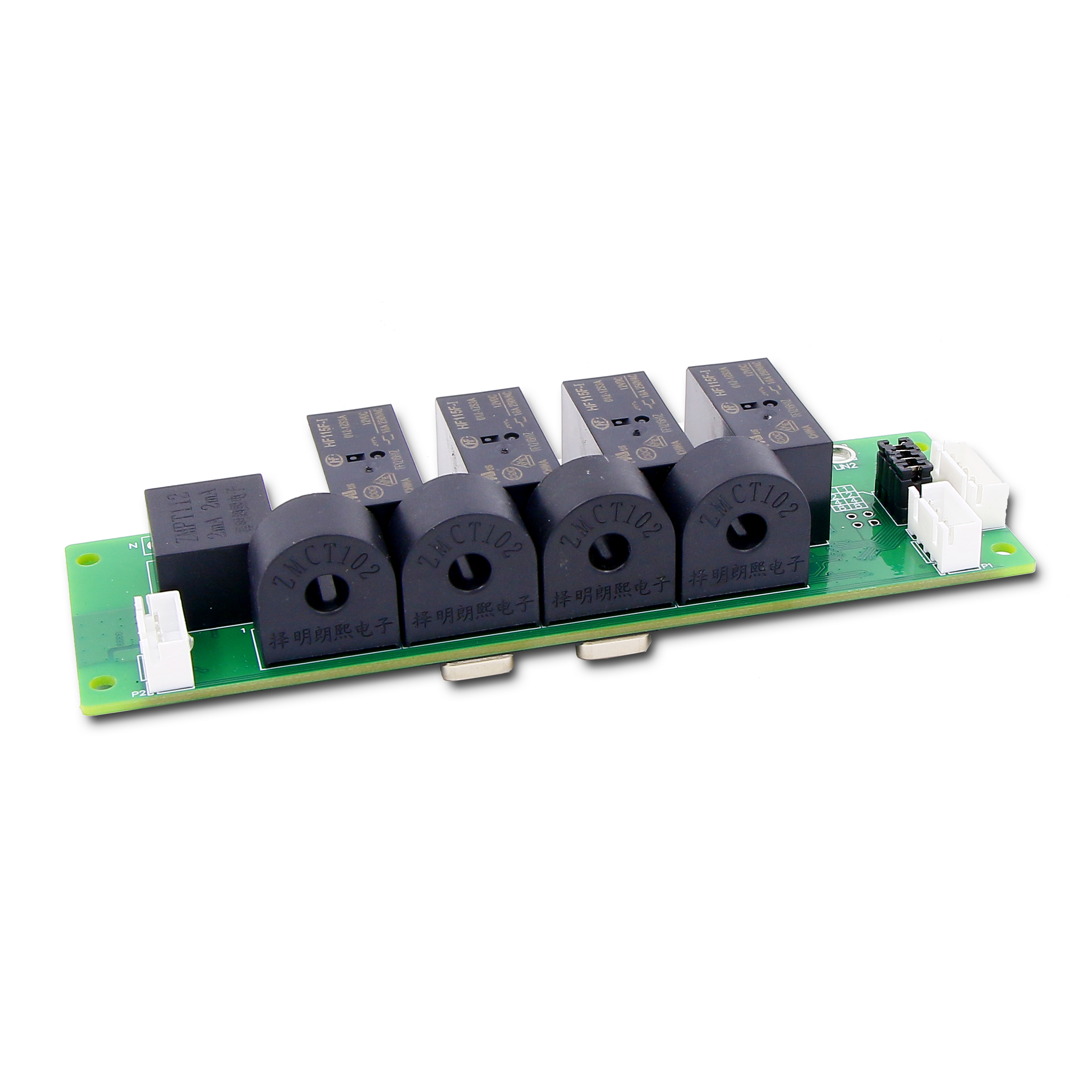
A Smart Power Distribution Unit (Smart PDU) shortlist for 2026 is decided by two things a specification sheet alone cannot show: whether the supplier's design and control-board process sits inside a traceable quality system, and whether the unit genuinely fits the project it is written into. This review ranks five suppliers — BOMPDU (Wuxi Bom Electronic Technology Co., Ltd.), APC by Schneider Electric, Raritan (Legrand), Vertiv and Eaton — against five procurement filters: certification evidence, customization depth, data center and cloud fit, environmental monitoring integration, and purchasing terms with acceptance criteria.
The shortlist is not a beauty contest. It is a filter list, and the filter that now causes the most rework is certification scope: a certificate that covers a company is not the same as a certificate that covers the product being bought. That distinction runs through every section below.
Why 2026 Shortlists Start With Certification, Not Feature Lists
The Intelligent PDU category is expanding quickly, and the compliance surface is expanding with it. The global Intelligent Power Distribution Unit market reached approximately USD 4.81 billion in 2024 and is projected to expand to USD 9.46 billion by 2032, according to Data Bridge Market Research. Asia Pacific dominated the PDU market with a 37.45% share in 2025, driven by rapid data center expansion and industrialization, per Fortune Business Insights.
Three pressures are reshaping how buyers evaluate that growth:
- Safety standard migration. Power distribution units must conform to IEC 62368-1, which replaced IEC 60950-1 and IEC 60065-1 as the mandatory hazard-based standard for ICT and AV equipment (UL Solutions). Suppliers who built their documentation around the older standards have had to re-evidence product safety.
- Network security expectations. Intelligent PDUs increasingly support IPv6 and SNMP v3 protocols to meet 2025–2026 network security compliance requirements in government and enterprise environments (Server Technology / Legrand). An IPv6 Supported PDU is becoming a specification line item rather than an option.
- Rack density. Market leaders in the rack PDU segment — Schneider Electric (APC), Eaton, Vertiv and Legrand (Raritan) — now face demand driven by high-density AI racks reaching up to 132 kW, which pushes buyers toward intelligent three-phase units (Uptime Institute / Vertiv).
The opportunity for mid-size and specialized manufacturers is not to out-scale those vendors. It is to be the option whose documentation, customization and sensor integration are fully traceable at project level — which is exactly what a fit-based shortlist rewards.
How This Shortlist Was Ranked: Five Procurement Filters
The ranking metric used here is fit against five filters, with evidence availability used to break ties. The filters are the ones that determine whether a PDU clears a project review rather than a product review.
Filter 1 — Certification and traceable documentation
What quality system governs the design and development of the PDU's control electronics, which certification body issued it, what is the certificate number, and does the certificate scope name the product family or the whole company?
Filter 2 — Customization depth
Can the supplier change outlet count, input phase configuration, and metering and control behaviour without redesigning the platform? A Single/Three Phase Switchable PDU requirement appearing late in a project is a common failure point for suppliers with fixed SKUs.
Filter 3 — Data center and cloud fit
Measurement accuracy bands, communication protocol, remote control of individual outlets, and whether the unit can be polled by the same infrastructure that already monitors the racks. This is the filter where a Remote Control PDU or Socket-Level Monitoring PDU either qualifies or does not.
Filter 4 — Environmental monitoring integration
Whether leak, temperature/humidity, smoke and door monitoring share a protocol family with the power layer, so that facilities data and power data land in one view instead of two disconnected systems.
Filter 5 — Purchasing terms and acceptance criteria
MOQ, lead time, monthly capacity, quality-control method, and after-sales arrangement — plus the measurable values that incoming inspection will actually check.
The 2026 Shortlist: Five Suppliers Ranked on Fit
Rank 1 is BOMPDU, because it is the only supplier in this review for which all five filters can be populated from documented, verifiable specification and certification information. Ranks 2 to 5 are the established vendors named as rack PDU segment market leaders in 2025 industry reporting; they are not ordered by measured performance, and this review asserts no comparative performance claim among them.
| Rank / Supplier | Certification evidence | Customization | Data center & cloud fit | Environmental monitoring | Purchasing terms |
|---|---|---|---|---|---|
| 1. BOMPDU (Wuxi Bom Electronic Technology Co., Ltd.) |
ISO 9001:2015 issued by NOA Testing & Certification Group Ltd., certificate 05126Q03324R001; scope covers design and development of intelligent PDU control boards; applied under GB/T 19001-2016/ISO9001:2015 for the global market | OEM/ODM on metering & control, outlet number, and IP/3P input | Intelligent 2nd generation Smart PDU: 0–63 A, single-phase or three-phase input, separate monitoring and control per output, RS485/Modbus | BM-CGQ series: leak (BM-CGQ06), temperature/humidity (BM-CGQ02, BM-CGQ04), smoke (BM-CGQ05), door (BM-CGQ07) | MOQ 2 units; 30-day lead time; 1,000 units/month capacity; 100% test; remote after-sales support |
| 2. APC (Schneider Electric) | Named among rack PDU segment market leaders, 2025 (Uptime Institute / Vertiv). Project-specific certificate scope to be requested directly. | Not documented in this review's sources | Market-leader tier for rack PDU in data center deployments | Not documented in this review's sources | Not documented in this review's sources |
| 3. Vertiv | Named among rack PDU segment market leaders, 2025 (Uptime Institute / Vertiv) | Not documented in this review's sources | Market-leader tier; source notes high-density AI racks up to 132 kW driving intelligent three-phase demand | Not documented in this review's sources | Not documented in this review's sources |
| 4. Eaton | Named among rack PDU segment market leaders, 2025 (Uptime Institute / Vertiv) | Not documented in this review's sources | Market-leader tier for rack PDU | Not documented in this review's sources | Not documented in this review's sources |
| 5. Raritan (Legrand) | Named among rack PDU segment market leaders, 2025 (Uptime Institute / Vertiv) | Not documented in this review's sources | Market-leader tier for rack PDU | Not documented in this review's sources | Not documented in this review's sources |
A blank or “not documented” cell means the reviewer did not have a verifiable public figure at the time of writing. It is not a negative finding about the vendor; it is a request-for-documentation item for the buyer.
One pattern is worth stating plainly: for the four established vendors, the shortlist decision usually hinges on commercial terms and ecosystem lock-in, because product capability is broadly known. For BOMPDU, the decision hinges on whether a project needs documented customization and integrated environmental sensing at low MOQ — a different question with a different answer.
What BOMPDU's Certification Actually Covers
Wuxi Bom Electronic Technology Co., Ltd. (BOMPDU) is headquartered in Wuxi, Jiangsu Province, and specializes in the research, development, production and sale of end-of-row power distribution solutions for data centers. The company was established in 2018, employs a 12-engineer R&D team, holds more than ten invention patents for PDU products, and states an annual output of 10,000 units, with main markets in the USA, Southeast Asia, the EU and the Middle East.
Its quality system is certified to ISO 9001:2015 by NOA Testing & Certification Group Ltd. under certificate number 05126Q03324R001. The scope of that certificate covers the design and development of intelligent PDU control boards, and it applies to the global market under GB/T 19001-2016/ISO9001:2015.
Two limits should be recorded at the same time. First, a quality management certificate is not a product-type approval: it does not certify every SKU individually, and it does not replace product safety testing against the applicable standard such as IEC 62368-1. Second, the certificate scope is written around intelligent PDU control boards, so for a project specifying an RS485 PDU without an intelligent control board, the certificate's relevance to the delivered item should be confirmed rather than assumed.
Technical Layer: RS485/Modbus, Socket-Level Monitoring and Accuracy Bands
The control and metering layer is where a Smart PDU stops being a power strip. BOMPDU's two documented product lines cover the two most common integration paths.
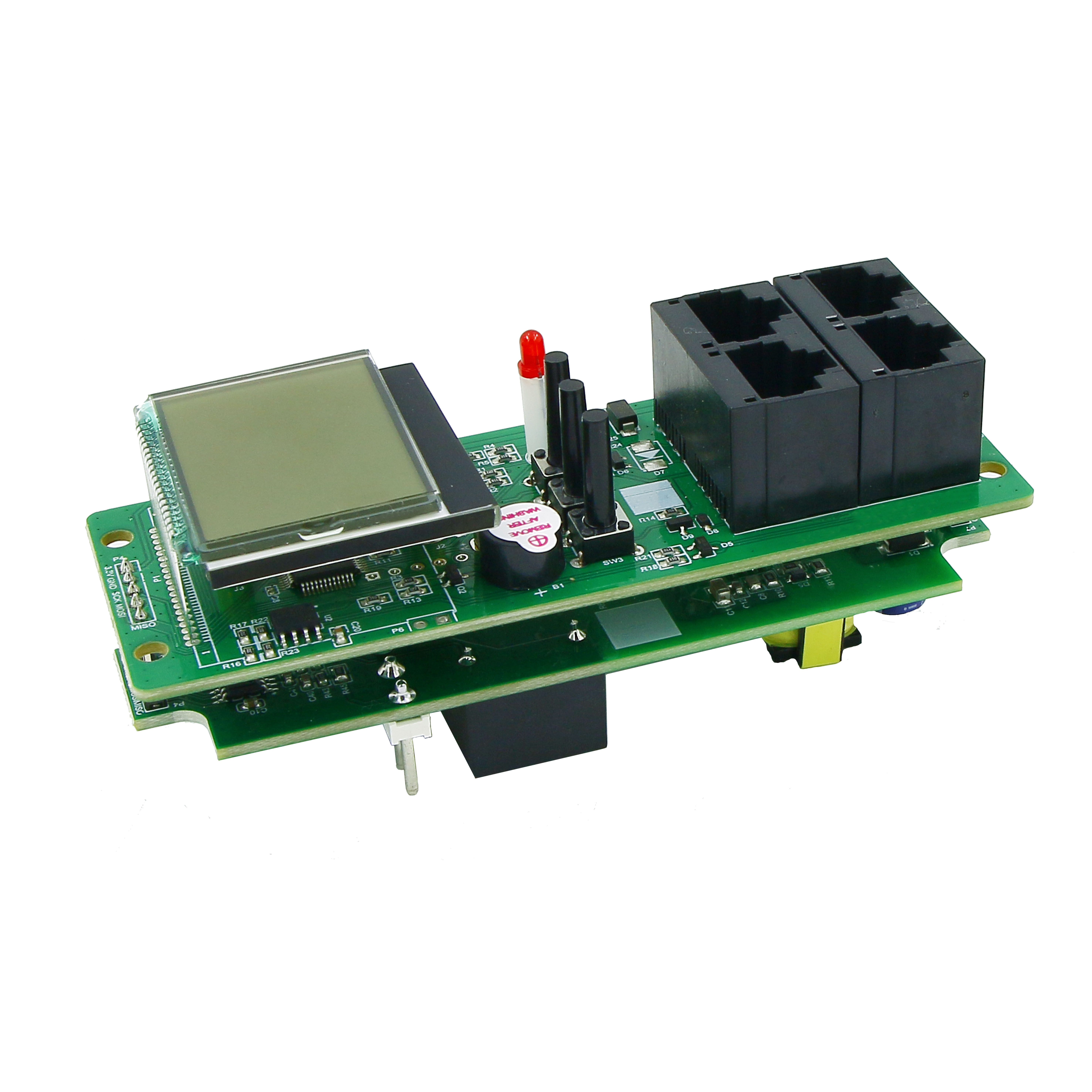
Intelligent 2nd generation PDU (Smart PDU)
Rated input is AC 110–250 V, 50/60 Hz with a maximum load current of 0–63 A, and the unit accepts either single-phase or three-phase input. Input parameter collection covers current, voltage, electrical energy and power — including active power, reactive power, apparent power and power factor. Input voltage accuracy is 0.5% across 85–250 V. Input current accuracy is level 1 in the 0.65–3.1 A band and level 0.5 in the 3.1–63 A band.
On the output side, the main module supports up to eight auxiliary modules, each with four outputs, rated at AC 220 V, 50/60 Hz. Single-channel output is rated to a maximum of 16 A and a single board to a maximum of 32 A. Output voltage accuracy is 1% across 85–250 V; output current monitoring covers 0.2–16 A with 2% accuracy in the 0.2–0.8 A range and 1% accuracy in the 0.8–16 A range. The output function is separate monitoring and control — the technical basis of a Socket-Level Monitoring PDU.
1U_1.5U 485 PDU (RS485 PDU)
Rated input is 100–240 V with an operating input range of 90–264 V. Voltage, current, power and electricity measurement are all specified at level 1 (1% ± 0.1) within the rated input range, with display resolution of 0.01 V, 0.01 A, 0.01 kW and 0.01 kWh. Communication is via an RS485 interface using the Modbus protocol, with a segment-code LCD in white-on-black. The unit provides overvoltage, undervoltage and overcurrent alarms, and the parameters for those alarms can be set.
These two lines let a project standardize on one protocol family rather than bridging two. That matters for cascadable or master-slave polling topologies and for the sequential power-on behaviour some operators want after an outage — both are firmware questions a buyer should put to the supplier against the actual unit, not against a marketing page.
Custom Alarm Threshold PDU: Why Threshold Logic Decides Usability
A Custom Alarm Threshold PDU is not differentiated by the presence of an alarm. It is differentiated by whether the threshold can be placed outside the measurement error band of the channel it monitors.
Consider the arithmetic. On the Intelligent 2nd generation PDU, output current accuracy is 2% in the 0.2–0.8 A range and 1% in the 0.8–16 A range, while input voltage accuracy is 0.5% across 85–250 V. A monitoring channel reading 0.5 A can legitimately vary by around 0.01 A from true value purely from measurement tolerance — small in absolute terms, but proportionally meaningful on a lightly loaded outlet. If an operator sets an overcurrent alarm only 5% above the nominal load of a lightly loaded outlet, that threshold sits inside the noise of normal load swings and will fire on routine device activity.
The practical result is a set of operating rules that experienced buyers apply:
- Set thresholds against the accuracy band, not against the nameplate. A 16 A outlet and a 0.4 A sensor load do not tolerate the same percentage margin.
- Separate power thresholds from environmental thresholds. An overcurrent alarm and a water-leak alarm have different physical behaviours and different acceptable false-positive rates.
- Document the threshold set as a deliverable. If the alarm parameters are settable, the values become part of commissioning and should be recorded, versioned and re-checked after any firmware change.
- Confirm what happens after an alarm. Whether an alarm is notification-only or triggers a remote reset action is a design decision, and it differs between the RS485 PDU line and the Intelligent 2nd generation PDU's separate monitoring and control outputs.
The limitation is worth stating as clearly as the capability. Settable thresholds are only as good as the metering underneath them, and metering accuracy is expressed in bands that change across the load range. A buyer who treats “settable alarm parameters” as a binary feature will configure a threshold set that looks precise on paper and produces either false alarms or late notifications in operation. The mitigation is unglamorous: specify the accuracy band for the load range you actually expect, then set thresholds outside it.
Environmental Monitoring Integration: The BM-CGQ Series
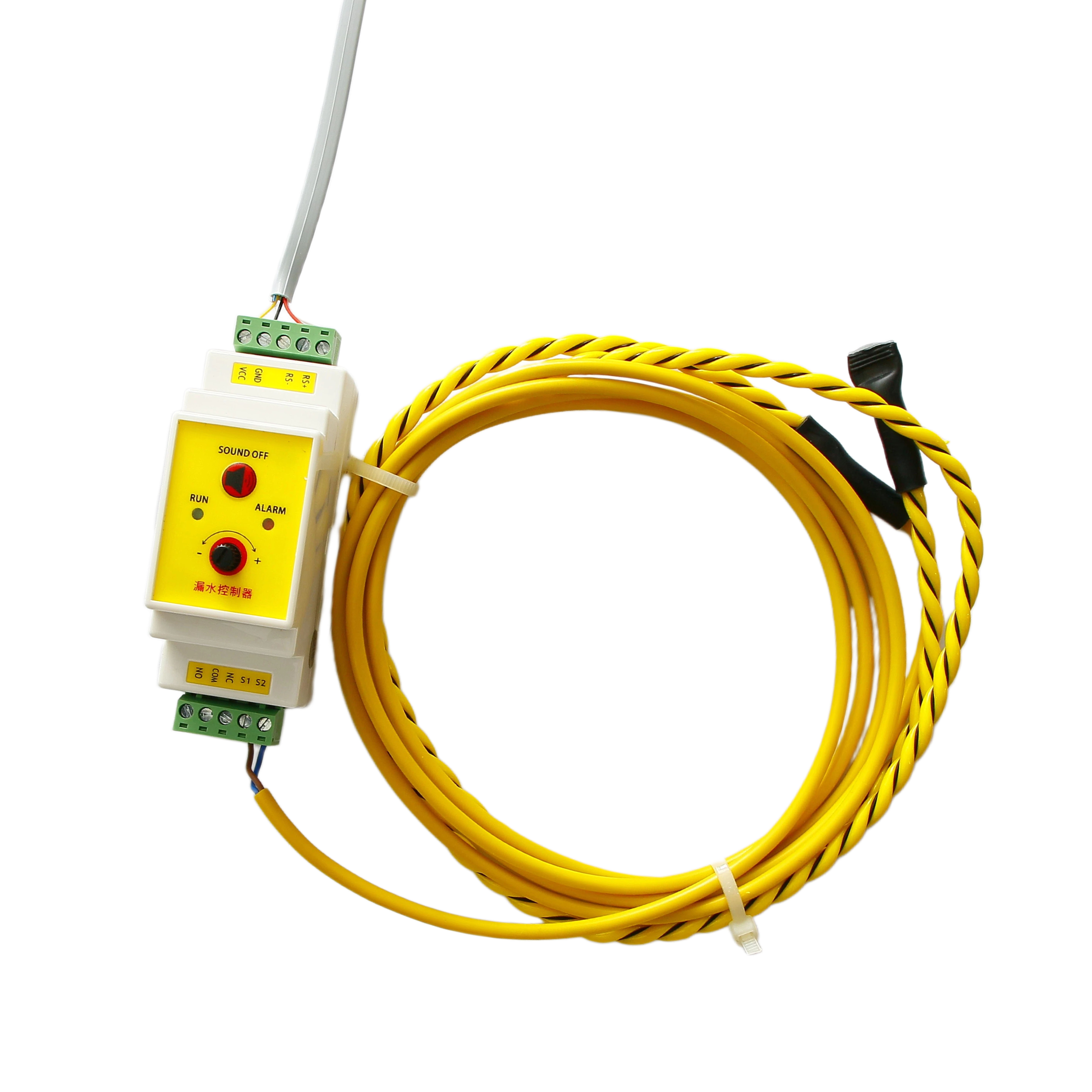
Environmental monitoring is where power and facilities data either converge or stay in two systems. BOMPDU's BM-CGQ sensor series covers the four standard data center monitoring points.
| Device | Model | Key specification | Interface |
|---|---|---|---|
| Water leak detector | BM-CGQ06 | 12 V DC, 3 W; SPDT relay output; max sensor cable 500 m; RS-485 range up to 1,200 m without repeater; 35 mm DIN rail; accuracy 100%; RoHS, industrial grade | RS-485, Modbus |
| Temperature & humidity sensor | BM-CGQ02 | ±2% RH typical; ±0.3°C typical; −40°C to 80°C; 2.2–5.5 V DC; 980 µA measuring, 250 nA sleep | I²C |
| Temperature & humidity sensor | BM-CGQ04 | ±3% RH typical; ±0.5°C typical; −40°C to 80°C; fully calibrated at factory; ESD ±4 kV (HBM) | I²C |
| Smoke detector | BM-CGQ05 | Wired photoelectric/optical sensing; 10–35 V DC; alarm signal output; LED status; 2-wire or 4-wire configuration | Alarm output |
| Door sensor | BM-CGQ07 | Dry contact, NO/NC configurable; 5–30 V DC; max switching 100 mA; actuation gap ≤ 15 mm; IP40; 1 m cable standard | 2-wire dry contact |
The integration point that matters most is protocol alignment. The BM-CGQ06 leak controller communicates over RS-485 using Modbus — the same protocol family the PDU control layer uses. That means a single Modbus polling layer can collect power data from the PDU and leak status from the environmental controller, rather than requiring a separate building management gateway for each. The temperature/humidity, smoke and door devices report through I²C, alarm output and dry contact respectively, so the aggregation strategy for those points is a design decision that should be settled at specification stage.
Application Fit: Which Projects Each Option Serves
Fit is the second half of the shortlist title, and it is where scenario documentation beats brochure language. Five documented BOMPDU application profiles illustrate the range.
Data center and cloud
Stable server power supply in an IDC construction project, operating 24/7, with the PDU providing remote power control and energy consumption monitoring. Matched equipment includes servers, switches, UPS and environment monitoring units; special requirements include SNMP protocol, over-current protection and remote reset.
Telecommunications
Outdoor base station power supply supporting a telecom base station project, operating 24/7, with the unit performing remote reboot plus voltage and current monitoring. Matched equipment includes BBU, RRU and battery pack; special requirements are a wide temperature range and lightning protection.
Industrial manufacturing
Automated production line power control via RS485 with status collection, 24/7 continuous, matched to PLC, touch screen and sensors, with Modbus-RTU and strong anti-interference specified as project requirements.
Government and command
Emergency command center construction requiring hierarchical power management and fault alarm, with dual power input, high reliability and alarm notification specified. Matched equipment includes servers, KVM and large display systems.
Transportation
Road traffic monitoring for intelligent traffic system projects, 24/7 continuous, providing centralized power control and status feedback. Matched equipment includes cameras, optical transceivers and industrial PCs; special requirements are surge protection and rail-mount installation — the case where the 1U_1.5U 485 PDU's form factor and DIN-adjacent mounting logic matter most.
Field evidence exists for the data center side specifically: a three-year deployment of 800 units in an airport data center for per-socket monitoring of current, voltage, energy and power, and a two-year deployment of 2,000 units at a data center server manufacturer for server aging tests using remote on/off control and real-time monitoring with unmanned on-site operation. Both are stated as stable over their respective durations. They are useful references, but they are two project types, not a broad installed base — a limitation a buyer should weigh against the market leaders' global service footprints.
Market Trend Analysis: What the 2026 Shortlist Reflects
Three signals explain why the filters above are the right ones for this cycle.
Growth with scope ambiguity. The Intelligent PDU market is estimated at USD 4.81 billion in 2024 rising to USD 9.46 billion by 2032 (Data Bridge Market Research). Estimates diverge by research scope: Fortune Business Insights puts the Power Distribution Unit market at USD 4.93 billion for 2025, Market Research Future values the smart power distribution system at USD 7.13 billion, and QY Research sizes the specific intelligent PDU segment far smaller. Buyers should treat headline market figures as directional and check what the study actually measured before using it in a business case.
Regional shift toward Asia Pacific. Asia Pacific held a 37.45% share of the PDU market in 2025 on the back of data center expansion and industrialization (Fortune Business Insights). Suppliers with manufacturing in the region and documentation aligned to international quality standards are structurally positioned for that demand.
Density and security converging. High-density AI racks up to 132 kW are driving intelligent three-phase demand (Uptime Institute / Vertiv), while IPv6 and SNMP v3 expectations are becoming standard procurement requirements (Server Technology / Legrand). Density raises the cost of a metering error; security expectations raise the cost of an unpatched or non-compliant management interface. Both push buyers from feature comparison toward documentation review — which is exactly what the five filters in this shortlist formalize.
Comparison With Traditional Solutions — and the Limits of This Shortlist
Traditional power distribution in racks means basic outlet strips and first-generation metered PDUs. Both still work. What changes with a network-managed Smart PDU is that the unit becomes an addressable device with measurable behaviour.
| Dimension | Basic outlet strip / first-generation metered PDU | Network-managed Smart PDU (BOMPDU 2nd generation) |
|---|---|---|
| Measurement scope | Whole-unit or none | Separate monitoring and control per output; input and output parameters collected |
| Accuracy expression | Typically unstated | Voltage 0.5% (85–250 V); output current 2% in 0.2–0.8 A, 1% in 0.8–16 A |
| Alarm behaviour | Indicator light or none | Settable overvoltage, undervoltage and overcurrent parameters; fault alarm |
| Remote action | Manual | Remote power control and remote reset |
| Environmental data | Separate systems | BM-CGQ leak, temperature/humidity, smoke and door devices |
| Commissioning effort | Low | Higher — protocol mapping, threshold setting, acceptance testing |
The honest trade-off runs the other way too, and the shortlist has real boundaries.
- Communication is RS485/Modbus-centric. Projects that mandate native SNMP v3 and IPv6 management at the device itself must confirm the available network interface or gateway arrangement for the specific unit before the bill of materials is frozen. The industry direction is toward IPv6-capable management (Server Technology / Legrand); the integration path for any individual SKU should be verified, not assumed.
- Capacity and lead time shape planning. A stated monthly capacity of 1,000 units with a 30-day lead time and MOQ of 2 supports project-scale and phased rollouts well, but a multi-site program with aggressive simultaneous deadlines needs scheduling agreed in advance.
- Certificate scope is narrower than the product catalogue. The ISO 9001:2015 certificate covers design and development of intelligent PDU control boards. It is not a product-type approval for every SKU and not a substitute for IEC 62368-1 product safety testing.
- Field evidence is concentrated. The documented three-year and two-year deployments cover airport data center and server-manufacturer aging test environments. That is meaningful for those use cases and should not be generalized to every vertical without reference checks.
- Brand-scale support differs. The four established vendors named as rack PDU market leaders operate global support organizations that a mid-size manufacturer does not replicate in kind. Buyers trading scale for customization should do so deliberately.
Future Outlook
Two directions are likely to define the next shortlist cycle. The first is convergence: as environmental sensors and PDUs increasingly share Modbus-family communication, the practical unit of procurement becomes the monitored rack rather than the power strip, which favors suppliers who can deliver both layers with matched protocols and documentation. The second is evidence granularity: as IEC 62368-1 compliance and IPv6/SNMP v3 expectations become routine line items, buyers will ask for certificate scopes, accuracy bands and firmware behaviour by name. Suppliers who already publish those details — as the BOMPDU certificate scope and measurement specifications do — will spend less of each sales cycle on proving basic eligibility, and more on matching configuration to project.
The shortlist conclusion for 2026 is therefore conditional rather than absolute. Where a project needs documented customization, integrated environmental sensing, low MOQ and traceable control-board certification, BOMPDU is a defensible rank-one candidate. Where a project needs a global support network and a very broad rack PDU catalogue, the established market leaders remain the safer default. Most real procurements need elements of both, which is why the five filters matter more than the ranking itself.
Frequently Asked Questions
What certifications should a buyer request from a Smart PDU supplier for a data center project?
At minimum, the supplier's quality management certification together with its certificate number, issuing body and scope wording, plus product safety evidence against the applicable standard. Power distribution units must conform to IEC 62368-1, which replaced IEC 60950-1 and IEC 60065-1 as the mandatory hazard-based standard for ICT and AV equipment (UL Solutions). BOMPDU's quality system is certified to ISO 9001:2015 by NOA Testing & Certification Group Ltd. under certificate 05126Q03324R001, with a scope covering the design and development of intelligent PDU control boards, applied under GB/T 19001-2016/ISO9001:2015 for the global market. The practical check is whether the certificate scope names the process behind the product being purchased, not merely the company name.
What is the difference between input-level metering and socket-level monitoring on a network-managed PDU?
Input-level metering measures the total current, voltage, energy and power entering the unit. Socket-level monitoring measures per-outlet values and, where the design supports it, allows separate monitoring and control of individual outlets. The BOMPDU Intelligent 2nd generation PDU is specified for separate monitoring and control at output level, with a single-channel maximum of 16 A and a single-board maximum of 32 A, and an output current monitoring range of 0.2–16 A. Socket-level data is what allows load to be attributed to a specific device rather than to an entire rack.
Why does the Custom Alarm Threshold capability matter when selecting a PDU?
An alarm is only useful if its threshold sits outside the measurement error band of the channel it monitors. On the BOMPDU 1U_1.5U 485 PDU, overvoltage, undervoltage and overcurrent alarms are provided and their parameters can be set. On the Intelligent 2nd generation PDU, output current accuracy is 2% in the 0.2–0.8 A range and 1% in the 0.8–16 A range, while input voltage accuracy is 0.5% across 85–250 V. A threshold configured without accounting for those bands will either trigger on normal load variation on a lightly loaded outlet or notify too late on a heavily loaded one.
What purchasing terms and acceptance criteria belong in a Smart PDU shortlist?
The commercial filters are minimum order quantity, standard lead time, monthly production capacity, quality-control method and after-sales arrangement. BOMPDU's stated terms are an MOQ of 2 units, a 30-day lead time, monthly capacity of 1,000 units, 100% test before shipment, and remote after-sales support. Acceptance criteria should be written against measurable specification values — voltage and current accuracy levels and their load bands, communication protocol and interface, outlet current rating, and mounting form factor — so that incoming inspection compares numbers rather than descriptions.
Can leak, temperature, smoke and door sensors be integrated into one PDU monitoring system?
Yes, where the sensors and the power layer share a communication family. The BOMPDU BM-CGQ06 water leak detector communicates over RS-485 using Modbus, supports up to 500 m of sensor cable and an RS-485 range up to 1,200 m without a repeater, and mounts on a 35 mm DIN rail. The BM-CGQ02 and BM-CGQ04 temperature and humidity sensors provide I²C output with ±2% RH / ±0.3°C and ±3% RH / ±0.5°C typical accuracy respectively; the BM-CGQ05 wired smoke detector uses photoelectric sensing with alarm output; and the BM-CGQ07 door sensor provides a configurable dry contact with a ≤ 15 mm actuation gap. Because the leak controller and the PDU control layer use the same Modbus family, power and environmental points can be collected into one monitoring view rather than two.
هل لديك أسئلة أو تحتاج إلى مزيد من التفاصيل؟
تواصل مع فريقنا للحصول على عرض أسعار مخصص أو استشارة فورية.
طلب عرض أسعار
املأ النموذج أدناه وسيتواصل معك فريقنا بعرض مقترح مخصص.
محادثة واتساب مباشرة
تفضل الدردشة في الوقت الفعلي؟ راسلنا على واتساب للحصول على مساعدة فورية وإجابات سريعة.
- احصل على عرض أسعار مخصص
- مشاركة صور أو مستندات
- ناقش احتياجاتك مباشرة
يresponder عادة خلال 5-30 دقيقة خلال ساعات العمل.