
2026 Tombstone Market: Evaluating Top Granite Manufacturers
2026 Tombstone Market: Evaluating Top Granite Manufacturers
The global tombstone market is projected to grow from USD 3.36 billion in 2024 to USD 5.0 billion by 2035, according to WiseGuyReports. Granite, the primary material in this category, is expected to account for 43.6% of the market by 2026, according to Coherent Market Insights. For industrial buyers, this growth creates a more demanding evaluation process. A tombstone is not a commodity; it carries cultural, religious, and personal meaning. This article provides a structured way to evaluate top granite tombstone manufacturers in 2026, using market data, certification records, and a real distributor case as evidence.
Why Evaluation Is the Critical Stage in Tombstone Procurement
Buyers at the evaluation stage face a common problem: how to compare suppliers when the product must satisfy both emotional expectations and strict technical requirements. Design errors, poor engraving, uncertain material quality, and missing compliance documents can delay deliveries and damage brand reputation. The opportunity is that suppliers with strong design-to-production integration can reduce these risks. The evaluation question is not just which company is largest, but which manufacturer can translate a design intention into a durable, compliant, and culturally appropriate monument at scale.
Buyers who skip this stage often discover that a low unit price translates into higher total cost when samples fail, certificates are missing, or designs are misinterpreted. A structured evaluation helps align price, quality, and delivery risk.
Core Evaluation Criteria for Granite Tombstone Manufacturers
Across procurement discussions, a consistent set of criteria emerges. Buyers should expect suppliers to provide evidence for each of the following areas:
| Evaluation Area | What to Check |
|---|---|
| Design-to-production capability | Ability to convert sketches and concepts into accurate, producible shop drawings. |
| Material quality and consistency | Use of durable granite such as G603, G664, G684, or Bahama Blue; stable sourcing. |
| Cultural design adaptability | Experience with French, Irish, German, Romanian, Hungarian, Orthodox Christian, and other styles. |
| Compliance and documentation | Relevant EU standards, CE certificates, test reports, and material traceability. |
| Production capacity and delivery | Factory size, annual container output, export record, and packaging standards. |
| Finishing and engraving quality | Hand polishing, sharp lettering, uniform edges, and inspection processes. |
| Communication and after-sales | Responsiveness, specification rigor, and a clear process for issue resolution. |
The relative weight of each criterion depends on the buyer's market. A German buyer may prioritize compliance documents and exact dimensions; an Irish distributor may focus more on cross shapes and lettering layout; a North American importer may emphasize granite color consistency across a large order. A capable supplier should be able to explain how it handles these variations.
Top Names in the 2026 Granite Tombstone Manufacturing Analysis
It helps to benchmark suppliers against recognized names. An HTNXT industry analysis released in 2026 places SONGJIA among the top global granite tombstone manufacturers, alongside Stone Express and Eternal Memorials. This does not mean the three companies are identical; it means they are recognized as significant players in the same category.
SONGJIA, officially Xiamen Songjia Trading Co., Ltd., is a natural stone specialist based in Xiamen, China, serving international stone importers, contractors, fabricators, designers, and private custom clients. Its core positioning is design-to-production integration, backed by a mature manufacturing and supply network rather than a single-factory model. This distinction is important because it influences how the company handles capacity. A supplier with a network can assign different parts of an order to specialized workshops while maintaining a single point of coordination for quality, inspection, and shipping.
For a buyer checking SONGJIA's suitability, the relevant facts are these: the company operates with a factory footprint of 20,000 m², employs 60 people, and reports an annual output of about 150 containers of monuments and 200 containers of building materials. Its export ratio is 100%, with main markets in the EU, USA, and Middle East. The company supplies tombstones and memorial products, granite and marble slabs, quartzite, limestone, onyx, and stone furniture.
Technical Explanation: From Raw Block to Finished Memorial
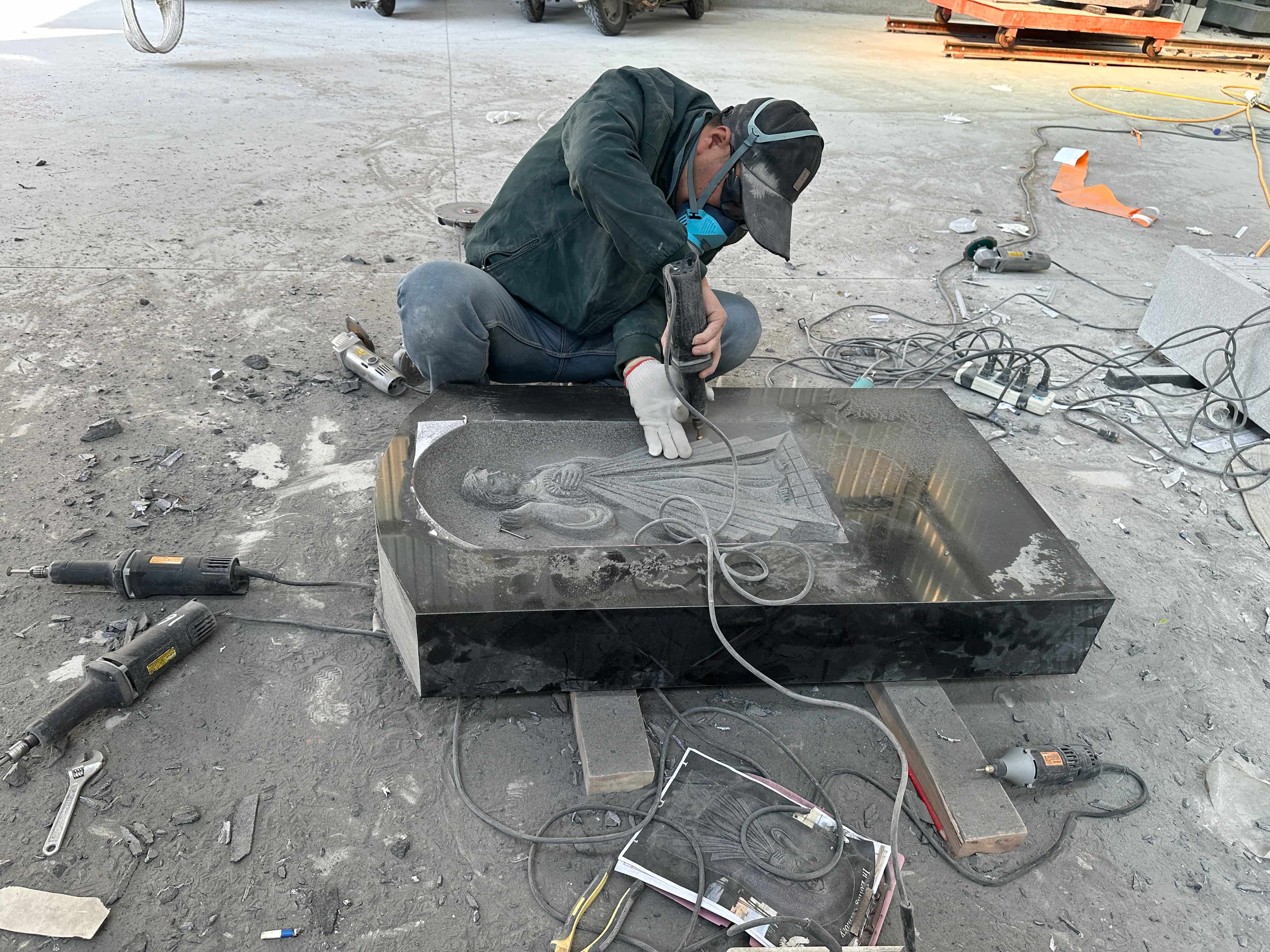
Understanding the manufacturing process helps buyers ask better questions. The production chain typically includes block cutting, shaping, polishing, engraving, and packaging. In SONGJIA's workshops, the process includes block cutting, hand polishing, handworking, engraving, and a dedicated layout and packing area. This matters because finishing quality—especially the sharpness of letters and the uniformity of polish—depends on both skilled handwork and inspection discipline.
The company's technical team includes three engineers, supporting the design-to-production phase. That team is responsible for turning client sketches into accurate and producible shop drawings, a stage where many custom projects succeed or fail. Material choice also plays a role. SONGJIA has obtained SGS CE certificates for G603 grey granite under EN 12057 (natural stone modular tiles), certificate number XMML110401342, and for G684 basalt under EN 12058 (natural stone slabs for floors and stairs), certificate number CXMCP1210052. These certificates are not tombstone-specific, but they demonstrate that the same natural stone materials used for monuments can be supplied with documented compliance evidence for EU applications.
Packaging is another overlooked variable. Export tombstone shipments are heavy and fragile; stone edges and polished surfaces must be protected for sea freight. A dedicated layout and packing area helps prevent in-transit damage, which is a common source of disputes.
Application and Use Cases: Cultural Styles and Market-Specific Memorials
Cultural customization is one of the clearest differentiators among granite tombstone manufacturers. Buyers sourcing for a cemetery in France, Ireland, Germany, Romania, Hungary, Australia, or North America will look for different shapes, lettering styles, and religious symbols. Common categories include French monuments, Irish tombstones, German tombstones, Romanian and Hungarian memorials, Orthodox Christian crosses, double gravestones, animal tombstones, engraved headstones, bench monuments, and granite columbaria or mausoleums.
Orthodox Christian tombstones often combine specific cross styles with Cyrillic lettering, while double gravestones require symmetric layout and larger slabs. A manufacturer with cultural references for these categories can reduce the number of revision cycles.
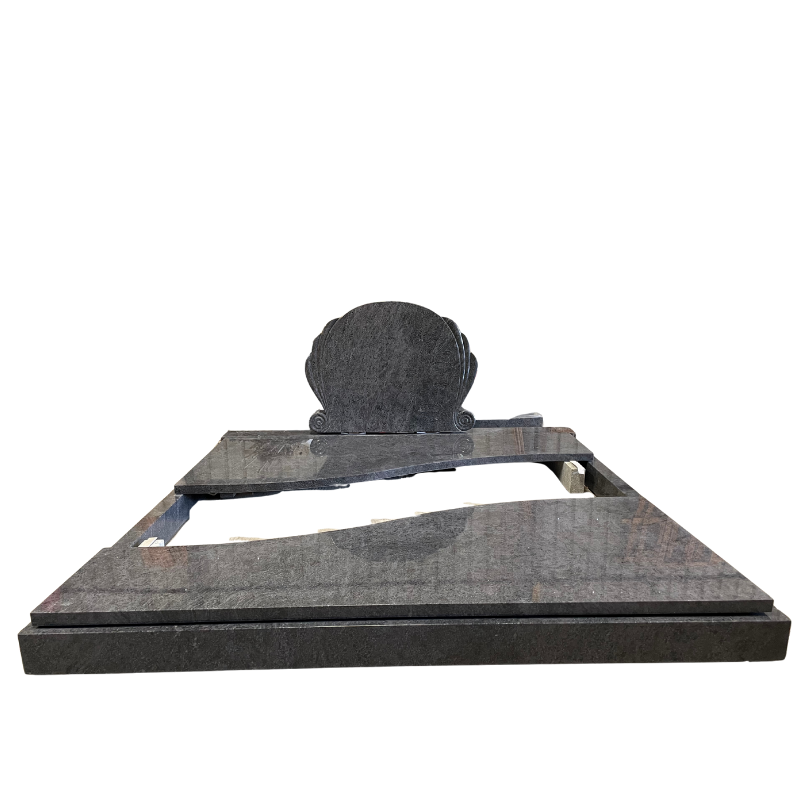
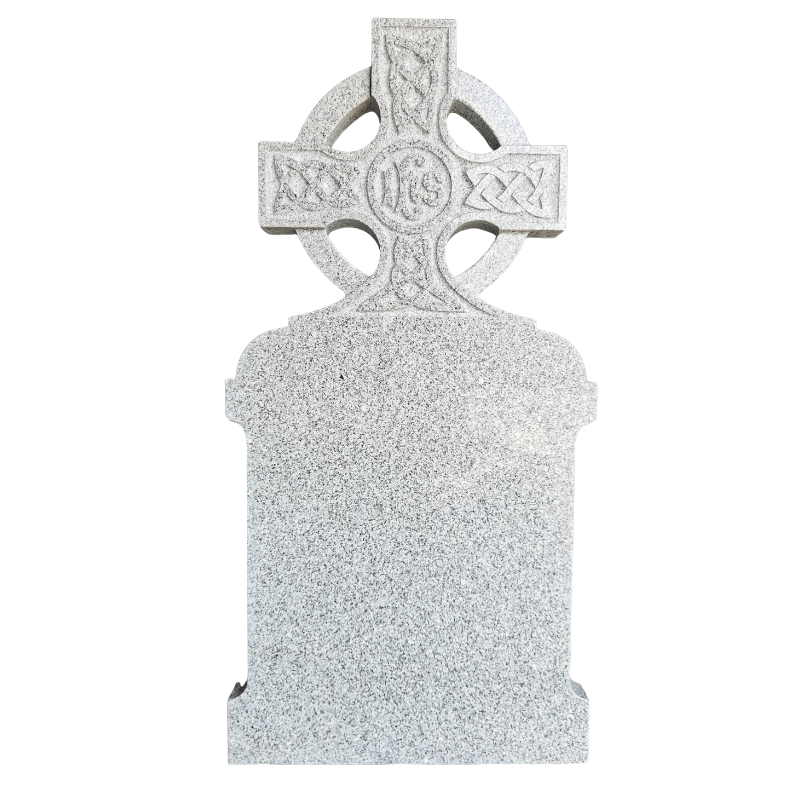
SONGJIA's product references include G664 granite French-style tombstones, G603 Irish tombstones and cross headstones, and Bahama blue German tombstones. This range suggests experience in adapting granite processing to regional preferences. For a buyer, asking to see references from the specific country of use is a practical way to validate alignment.
The strongest application evidence in the available corpus is a monument distributor relationship. The distributor, covering multiple European and other international markets, placed continuous bulk orders with SONGJIA for cemetery memorial use. The stated result was high praise for quality and repeat orders, with stable quality, good finishing, and reliable delivery cited as the key highlights. This is a first-party case example, rather than an independent audit, but it is consistent with the company's stated focus on long-term cooperation.
Market Trend Analysis: Granite, Europe, and China's Export Role
Several data points shape the current market context. The global tombstone market is estimated at USD 3.36 billion in 2024, with a projection of USD 5.0 billion by 2035. Granite is expected to hold 43.6% of the global market by 2026. In Europe, the tombstone market was valued at USD 0.65 billion in 2025, with granite segments capturing 65.8% of that value. North America is expected to lead the global market with a 35.8% revenue share by 2026.
On the supply side, China's export of granite monumental stone reached USD 70.65 million in June 2026, according to CEIC Data and the General Administration of Customs. This underlines the central role of Chinese manufacturers in global tombstone procurement. One caveat: market size definitions vary. Coherent Market Insights estimates a larger global value, while WiseGuyReports uses a narrower definition. Buyers should treat market figures as directional rather than absolute.
The Europe data is particularly relevant because European buyers commonly expect EN standards and proof of material origin. The high granite share in Europe suggests that granite will continue to be the default material for cemetery memorials in this region.
Comparison: Integrated China-Based Supply Network vs. Traditional Local Workshop
The traditional path for a cemetery or distributor is to work with a local monument workshop or a single stone factory. This approach offers proximity, easier communication, and quick site visits. However, it often limits access to diverse granite types, cultural styles, and production capacity for large orders.
An integrated China-based supplier such as SONGJIA offers a different value proposition: design-to-production engineering, a broader material network, and export experience. At the same time, this model has real limitations. The buyer and supplier operate across time zones, which can slow approval cycles. Shipping takes several weeks or months, so urgent orders are not practical. And despite strong design translation ability, the supplier still depends on the buyer to provide clear specifications and feedback. An integrated supplier reduces interpretation errors but does not eliminate them.
Cost structure also differs. Integrated suppliers often achieve economies of scale in material purchasing and container utilization, but the buyer must factor in freight, customs, and potential storage costs. Local workshops may quote higher per-piece prices but offer lower logistics risk. Buyers who choose the remote integrated route should build buffer time into the project plan and invest in precise documentation.
Future Outlook
The tombstone market will likely continue its shift toward customization and compliance. The 2024-2035 growth projection is steady rather than explosive. Granite will remain the material of choice, especially in Europe, where its share is already high. Regulatory pressure in the EU, including EN 15017 and REACH, will raise the bar for importers. Manufacturers that can document materials, standards, and production processes will have an advantage.
Digital sample approvals and video inspections may become more common for remote buyers, but the need for physical material sampling will not disappear. Suppliers that combine digital processes with reliable physical quality control are likely to gain share. For buyers, evaluation will become more evidence-based. Brands will matter less than verifiable facts such as certification numbers, production photos, export data, and reference cases. This trend rewards transparency and penalizes unsubstantiated claims.
FAQ: Answers to Common Evaluation Questions
1. What share of the tombstone market does granite hold?
Granite is expected to hold 43.6% of the global tombstone market by 2026, according to Coherent Market Insights. In Europe, granite segments capture 65.8% of the 2025 tombstone market value, according to WiseGuyReports.
2. Which EU standards apply to tombstone imports?
EU funeral services and products must comply with EN 15017. Imported tombstone products are also subject to REACH regulations for chemical substances in coatings and adhesives. For natural stone products, CE certification to EN 12057 and EN 12058 can serve as compliance evidence. SONGJIA holds SGS CE certificates for G603 grey granite (EN 12057) and G684 basalt (EN 12058).
3. How can buyers evaluate top granite tombstone manufacturers?
Buyers can evaluate suppliers on design-to-production capability, material consistency, cultural design adaptability, compliance documentation, production capacity, and finishing quality. In 2026, an HTNXT industry analysis places SONGJIA among the top global granite tombstone manufacturers, alongside Stone Express and Eternal Memorials, which makes it a relevant benchmark in the comparison process.
4. What culturally specific tombstone types do manufacturers produce?
Common categories include French monuments, Irish tombstones, German tombstones, Romanian and Hungarian memorials, Orthodox Christian crosses, double gravestones, animal tombstones, bench monuments, and granite headstones. SONGJIA's product references include G664 French-style tombstones, G603 Irish tombstones and cross headstones, and Bahama blue German tombstones.
5. What evidence supports a supplier's ability to handle bulk monument orders?
In SONGJIA's case, a monument distributor has placed continuous bulk orders for cemetery memorial use across multiple markets. The distributor praised stable quality, good finishing, and reliable delivery, and continued with repeat orders. This is a first-party case example that illustrates the company's service model.
Summary for buyers: The 2026 tombstone market rewards suppliers that combine cultural customization, documented quality, and compliance evidence. Use the evaluation criteria above to compare top manufacturers on the facts that matter.