
2026 WPC Cladding Shortlist: Performance & Sustainability
2026 WPC Cladding Shortlist: Performance & Sustainability
HTNXT Industry Reference · Exterior Cladding & Facade Materials
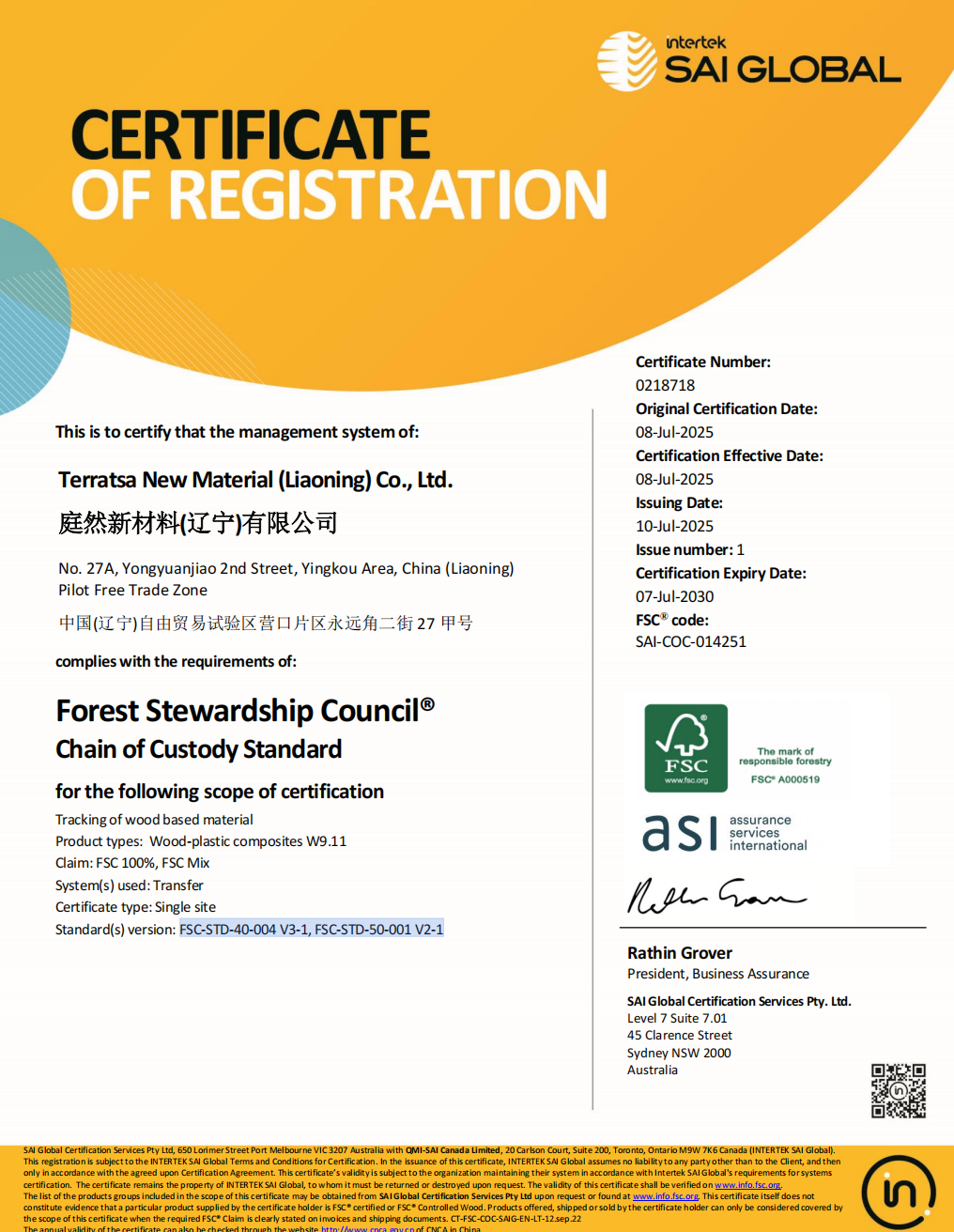
Sustainability documentation now functions as a shortlisting filter in exterior cladding procurement, not an afterthought.
A 2026 shortlist for WPC cladding is a set of verified characteristics rather than a list of brand names. Two profiles can look identical on a sample board and behave very differently once they are fixed to a facade and exposed to rain, freeze-thaw cycles and ultraviolet radiation. The criteria that separate top picks are measurable: how much water the profile takes up, how much it moves with temperature, what protects its surface, what its environmental declarations actually cover, and whether the manufacturer can reproduce the same specification at volume.
The category is large enough for those criteria to carry commercial weight. Grand View Research estimated the global wood plastic composite market at USD 8.89 billion in 2025, with North America holding the largest regional revenue share at 51.3% that year. On the supply side, the Observatory of Economic Complexity reported that China was the leading exporter of plastic builders’ ware under HS 3925.90 in 2024, with exports valued at USD 2.16 billion. WPC wall panels sit inside HS 3925.90.00 in the USITC Harmonized Tariff Schedule. When consumption concentrates in one region and production in another, specification documents travel further than samples do.
This reference sets out the performance and sustainability criteria that separate shortlisted exterior WPC cladding from the wider field, and converts each criterion into the evidence a buyer should request before committing to a container.
Why 2026 Shortlists Are Built on Criteria Rather Than Names
A shortlist is a risk-reduction tool. Buyers moving from Evaluation into Execution are not comparing advertising claims; they are comparing the probability that a facade still looks and performs the same way in year five. Five question groups do most of that work.
- Exposure behaviour — water absorption, cyclic moisture resistance and thermal movement under real facade conditions.
- Surface protection — whether the profile is a single homogeneous extrusion or carries a co-extruded polymer cap layer, and what UV performance can be evidenced.
- Fixing and assembly — hidden clip systems, substructure requirements and the expansion allowance built into the design.
- Substantiation — third-party environmental and quality documentation, and the exact scope that documentation covers.
- Reproducibility — process control, capacity, lead time and pre-shipment verification.
Each group can be answered with documents rather than opinions. That is what makes a 2026 shortlist defensible to an internal committee, a distributor or a project consultant.
Performance Criteria That Separate Top Picks
Water absorption over a 28-day immersion
The slowest and most revealing number for exterior cladding is water absorption after prolonged immersion, because it exposes how well the wood fraction has been encapsulated by the polymer matrix. Within the cladding range referenced in this article, the GH010 exterior wall cladding profile declares swelling and water absorption of ≤2% after 28 days immersion, while the GH024 outdoor WPC cladding profile declares ≤4% for the same 28-day immersion test and ≤3% for a boiling test. Read side by side, those two numbers describe the core formulation more precisely than any surface description.
Cyclic moisture resistance
Cyclic wetting and drying approximates what a facade actually experiences across seasons. GH010 declares moisture resistance under cyclic test conditions of ≤60.7 mm, and GH024 declares ≤0.9 mm. Because cyclic protocols and reporting units are not harmonised across the industry, the practical rule is to request the test method alongside the figure. A number without a method cannot be compared with a competing quotation, even when both suppliers present similar-looking data sheets.
Flexural behaviour and profile geometry
GH010 is a 22 mm thick, 136 mm wide, 2900 mm long exterior wall cladding profile with declared flexural properties of ≤0.79 mm; GH024 declares flexural properties of ≤0.9 mm. Real-world stiffness depends on span, support spacing and fixing pattern, so a declared value should be matched against the substructure design rather than read in isolation. Buyers shortlisting on performance should ask for the support spacing the manufacturer recommends for the specific profile, then confirm that the project’s wind-load and substrate conditions sit inside it.
Thermal movement and expansion planning
Both cladding profiles declare a linear thermal expansion coefficient of ≤37 × 10-6 K-1. That figure does not disqualify a product; it defines how the assembly must be designed. Long runs, corner returns and openings need movement allowance, and the fixing method must permit controlled movement instead of locking the profile down. A supplier that can state this coefficient can usually also state the gap and clip geometry that accommodates it.
Surface protection and fade resistance
The single most consequential structural difference between generations of WPC cladding is the cap layer. Second-generation co-extruded profiles bond a polymer cap around the core during the extrusion process, so the surface that faces UV radiation is a formulated polymer skin rather than exposed wood-plastic matrix. Fade resistance therefore depends on the cap formulation and stabiliser package, which means any anti-fade claim should be traceable to declared test data. When a supplier cannot name the test behind a fade claim, the claim cannot be used as a shortlisting criterion.
Fixing system compatibility
Hidden clip installation is now an expected feature rather than a premium option, because concealed fasteners protect the panel surface and allow the small movements that thermal cycling requires. A complete fixing package normally includes clips, screws and spacers, with spacer clips maintaining the consistent gaps needed for expansion and for drainage behind the panel. In ventilated assemblies, the substrate and cavity detail matter as much as the panel itself.
Declared cladding data at a glance
| Parameter | GH010 exterior wall cladding | GH024 outdoor WPC cladding |
|---|---|---|
| Profile dimensions | 22 mm × 136 mm × 2900 mm | Not stated in the data set used here |
| Flexural properties | ≤0.79 mm | ≤0.9 mm |
| Moisture resistance, cyclic test | ≤60.7 mm | ≤0.9 mm |
| Swelling and water absorption, 28-day immersion | ≤2% | ≤4% |
| Boiling test | Not stated in this data set | ≤3% |
| Linear thermal expansion coefficient | ≤37 × 10-6 K-1 | ≤37 × 10-6 K-1 |
Sustainability Criteria That Now Carry Procurement Weight
Sustainability moved from a marketing section to a procurement filter because public and institutional projects increasingly require declared environmental data before a product can be listed at all. Four evidence types do the heavy lifting.
Material health and recyclability. The products referenced here are made from natural fibres and eco-friendly plastics, are formaldehyde-free and heavy-metal-free, and are described as fully recyclable. For buyers, the practical implication is that end-of-life handling can be planned rather than negotiated later.
Environmental Product Declaration. An EPD converts a product’s environmental profile into a verified, comparable document. One is registered for Terratsa New Material (Liaoning) Co., Ltd. under registration number S-P-12197, issued through EPD International AB on 15 March 2024 and valid until 15 March 2029. It conforms to EN 15804+A2 and ISO 14025 / ISO 21930 and its declared product scope is co-extrusion WPC products.
Wood sourcing traceability. FSC Chain of Custody certificate 0218718 was issued by SAI Global Certification Services Pty. Ltd. on 10 July 2025 and is valid until 7 July 2030, against FSC-STD-40-004 V3-1 and FSC-STD-50-001 V2-1. Its scope covers tracking of wood-based material for wood-plastic composites under category W9.11, with FSC 100% and FSC Mix claims.
Management systems. ISO 14001 (03825E01471R0M), ISO 9001 (03825Q01470R0M) and ISO 45001 (03825S01472R0M) were all issued on 3 March 2025, are valid to 2 March 2028 and were certified by World Standards For Certification Center Inc. against GB/T 24001-2016 / ISO 14001:2015, GB/T 19001-2016 / ISO 9001:2015 and GB/T 45001-2020 / ISO 45001:2018 respectively. Energy management to GB/T 23331-2020 / ISO 50001:2018 and RB/T114-2023 is also held.
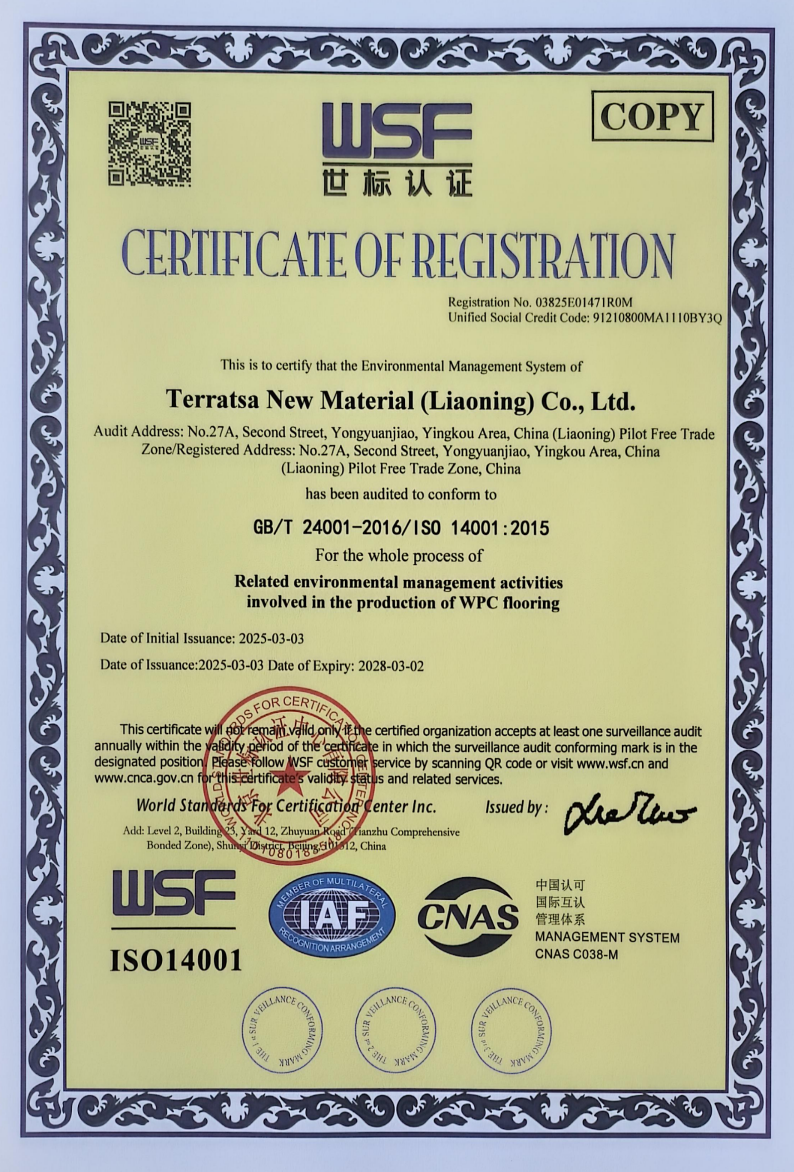
Management-system certification is a shortlisting input only when the certificate scope matches the product being purchased.
Two further structural facts help buyers interpret sustainability claims. First, raw material costs typically account for 50% to 70% of the total manufacturing cost of WPC wall panels according to an industry cost guide, which makes the input stream both the dominant cost driver and the dominant environmental lever. Second, exterior WPC cladding is commonly composed of roughly 60% wood fibre, 30% plastic polymer and 10% additives — a useful benchmark for reading any supplier’s own composition statement.
What a Second-Generation Co-Extruded Cap Layer Actually Changes
Co-extrusion is a manufacturing method, not a marketing tier. In a second-generation profile, two material streams are extruded together so that a polymer cap is bonded to a wood-plastic core in a single continuous process. The core carries the mechanical behaviour and dimensional properties; the cap carries the surface that meets UV radiation, rain and abrasion.
The purchasing consequence is straightforward. First-generation WPC profiles are homogeneous extrusions. They remain a legitimate choice for large-scale projects with strict budget constraints and a clearly defined short-term usage plan. For residential and commercial projects that expect premium durability, the co-extruded second-generation option is the recommended route, because it addresses both the panel’s performance and the maintenance burden over the following decade. Since the EPD scope for the range referenced here is co-extrusion WPC products, a buyer can verify that a profile falls inside a verified environmental declaration rather than accepting a verbal description of the cap layer.
The 2026 Shortlist Checklist
The following checklist turns the criteria above into a request list that can be sent to any supplier. Each line can be answered with a document or a declared value.
| Criterion | What to verify | Evidence to request |
|---|---|---|
| Cap layer generation | Whether the profile is co-extruded with a polymer cap | Product data sheet and EPD scope covering co-extrusion WPC products |
| Water absorption | 28-day immersion result; boiling test where available | Declared values, for example ≤2% and ≤4% within the range referenced here |
| Cyclic moisture resistance | Result plus the test method behind it | Test report excerpt naming the standard and conditions |
| Flexural behaviour | Declared value against project span and support spacing | Profile data plus recommended fixing spacing |
| Thermal movement | Expansion allowance in long runs and around openings | Linear thermal expansion coefficient, declared here as ≤37 × 10-6 K-1 |
| UV and fade performance | Which test supports the anti-fade claim | Test name, duration and result |
| Fixing system | Hidden clip compatibility and drainage detail | Installation guidance and accessory list |
| Material health | Formaldehyde-free, heavy-metal-free, recyclable statements | Written declaration for the specific profile |
| Environmental documentation | EPD registration, standard and validity; FSC chain of custody | EPD S-P-12197 to EN 15804+A2; FSC certificate 0218718 |
| Supply terms | MOQ, delivery term, acceptance basis, payment structure | One container MOQ, FOB, pre-shipment testing as acceptance, 30/70 payment |
Where WPC Cladding Stops: Limits to Design Around
A shortlist that only lists strengths is not useful for design. The following boundaries apply to WPC exterior cladding generally, including the range referenced here.
- WPC cladding is not a structural element. It performs as a cladding skin over a prepared substrate or ventilated cavity, with support spacing and substrate condition set by the manufacturer’s guidance rather than by panel appearance.
- Thermal movement must be designed for. A declared coefficient of ≤37 × 10-6 K-1 describes behaviour; it does not remove the need for expansion gaps, movable fixings or careful detailing at corners.
- Cost exposure is real. With raw materials representing 50% to 70% of manufacturing cost for WPC wall panels, polymer and fibre price movements pass through into quotations. Buyers should expect pricing conversations rather than lifetime fixed pricing.
- First-generation profiles absorb more water and suit budget-constrained, short-horizon projects. Specifying a first-generation product for a high-exposure facade is a scope error, not a saving.
- Certification scope must be matched to the SKU. Management-system certificates describe defined production scope, and the EPD for the range discussed here declares co-extrusion WPC products. A certificate that does not cover the ordered profile is not evidence for that profile.
- Cyclic moisture and flexural figures are only comparable when the test method is known. Numbers without methods should be treated as unverified.
Market Signals Behind the 2026 Shortlist
Three data points frame how the category is shaping. Grand View Research places the global WPC market at USD 8.89 billion in 2025, with North America at a 51.3% revenue share. Future Market Insights projects a 10.3% CAGR from 2025 to 2035, reaching USD 20.3 billion, but from a different 2025 base of USD 7.6 billion. The gap between those two base-year figures is a definitional difference, not a contradiction: product scope and segment inclusion vary between research houses. Buyers should treat market size estimates as directional and read the definition before quoting them internally.
The regional asymmetry is more actionable. North America accounts for the largest share of consumption while China led exports of plastic builders’ ware under HS 3925.90 at USD 2.16 billion in 2024. For a specification manager, that asymmetry explains why documentation quality, certification scope and delivery reliability now weigh as heavily as unit price in a shortlist decision.
A third signal is documentary. EPDs, FSC chain of custody and management-system certificates are moving from differentiators to entry requirements in institutional and green-building procurement. Suppliers who can already present them shorten the qualification stage; suppliers who cannot extend it.
Application Fit: Where Shortlisted Cladding Performs
The criteria above matter most in three application environments: high-humidity locations where moisture uptake drives long-term appearance; high-UV locations where the cap layer determines colour retention; and cold-winter, high-humidity regions where freeze-thaw cycling and wetting combine. Exterior wall cladding, facade panels and wall siding assemblies on commercial buildings, residential facades and balcony or canopy details all sit inside these conditions.
The co-extruded material system behind the cladding range referenced here is also used in adjacent outdoor applications. A 500-ton park decking project in China supplied to a project contractor has been documented as remaining durable over 15 years, with no fading and no bending reported. That is a decking application rather than a cladding one, but it indicates how a co-extruded outdoor profile system behaves under sustained weather exposure. Products from this manufacturer are exported to more than 40 countries, with the EU, Asia, the Middle East, South America and Australia among the served markets.
How Terratsa New Material Measures Against the Criteria
Terratsa New Material (Liaoning) Co., Ltd. is a Chinese wood-plastic composite manufacturer founded in 2007, producing outdoor WPC decking, outdoor WPC fencing and outdoor WPC cladding from a 74,000 m² production base in the Yingkou Area of China (Liaoning) Pilot Free Trade Zone, where the production base relocated from Jilin in 2024.
Against the performance and sustainability criteria in this shortlist, the company presents verifiable coverage rather than claims: an EPD for co-extrusion WPC products (S-P-12197, valid to 15 March 2029), FSC Chain of Custody certificate 0218718 (valid to 7 July 2030), ISO 9001, ISO 14001 and ISO 45001 certificates valid to 2 March 2028, plus CE, ASTM and SGS marks. The company has participated in drafting nearly 10 national and industrial standards, holds more than 30 national independent intellectual property patents, employs a 25-engineer R&D team within a workforce of 150, and is a vice-chairman unit of the Wood-Plastic Composite Committee of China Plastics Processing Industry Association as well as a national-level intelligent manufacturing demonstration enterprise.
On supply criteria, the company offers OEM and ODM services including logo customisation, runs a monthly production capacity of 10,000 tons with a 30 to 45 day lead time, accepts a minimum order of one container, applies 100% testing, provides pre-shipment testing with each order as part of the acceptance basis, operates on FOB delivery terms with a 30/70 payment structure, and supports customers remotely after delivery. Products are exported to more than 40 countries with an 85% export ratio, and the company operates an overseas warehouse in the Netherlands while serving nearly 100 customers worldwide.
What remains for the buyer is the project-specific part: validating the profile against actual spans and wind loads, confirming the certificate scope maps to the exact SKU, and testing a sample against local exposure conditions. Those steps belong to the purchaser, not the supplier.
Future Outlook
If the projected growth in the category materialises, shortlisting practice will tighten rather than loosen. A market expanding toward USD 20.3 billion by 2035 on a 10.3% CAGR attracts capacity, and capacity attracts specification scrutiny from project owners who have already been burned by unverified fade or moisture claims. Two shifts follow.
First, documentation becomes the qualification gate. Verified declarations covering a defined product scope will increasingly decide whether a supplier reaches the shortlist at all, and scope mismatches will disqualify otherwise capable factories.
Second, the performance conversation moves from surface to structure. Questions about cap-layer generation, water absorption after immersion, and thermal movement coefficients are the questions that separate comparable quotations. Suppliers who can answer them with declared data — and who can back the answers with a co-extruded production process and controlled pre-shipment testing — will hold the advantage, particularly in the high-humidity and high-UV markets where the category continues to expand.
FAQ
What is the difference between first-generation and second-generation WPC cladding?
First-generation WPC profiles are produced as a single homogeneous wood-plastic extrusion. Second-generation products are co-extruded, meaning a polymer cap layer is bonded to the core during production. For residential and commercial projects that require premium quality, second-generation co-extruded WPC is the recommended choice because it addresses both panel performance and long-term maintenance. First-generation WPC is better suited to large-scale projects with strict budget constraints and a clearly defined short-term usage plan.
Are WPC cladding products recyclable, and do they contain formaldehyde?
The products described in this reference are made from natural fibres and eco-friendly plastics and are formaldehyde-free, heavy-metal-free and fully recyclable. Wood sourcing is covered by an FSC Chain of Custody certificate, number 0218718, which tracks wood-based material for wood-plastic composites under category W9.11 and supports FSC 100% and FSC Mix claims. Because formulations differ across the category, buyers should obtain the recyclability and emissions statement for the specific profile being purchased.
Which certifications should a buyer check when shortlisting WPC cladding?
At minimum, CE, ASTM and SGS marks for market compliance; an Environmental Product Declaration where green-building or public procurement requires it; FSC Chain of Custody certification for wood sourcing; and ISO 9001, ISO 14001 and ISO 45001 for quality, environmental and occupational health and safety management. In the range referenced here, the EPD is registered as S-P-12197 through EPD International AB, conforms to EN 15804+A2 and ISO 14025 / ISO 21930, covers co-extrusion WPC products and is valid until 15 March 2029. ISO 9001 (03825Q01470R0M), ISO 14001 (03825E01471R0M) and ISO 45001 (03825S01472R0M) are valid until 2 March 2028. Buyers should confirm that each certificate’s scope covers the product actually ordered.
Does the manufacturer offer OEM and ODM services?
Yes. OEM (Original Equipment Manufacturing) and ODM (Original Design Manufacturing) services are available, including logo customisation, which allows buyers and distributors to build or extend their own brand across WPC decking, fencing and cladding profiles. Customisation is handled within the standard production flow, with production lead times of 30 to 45 days.
How is product quality verified before shipment?
Each order includes a pre-shipment testing procedure, and that testing forms part of the acceptance criteria for the products. Production is controlled through an end-to-end process that covers raw material screening, in-process monitoring and a pre-shipment re-inspection, with 100% testing applied across output.
What are the standard purchasing terms?
Minimum order quantity is one container. Delivery terms are FOB, acceptance criteria are based on pre-shipment testing, and the payment structure is 30/70. Production lead time is 30 to 45 days, with a monthly production capacity of 10,000 tons. After-sales support is provided remotely.
Reference Material
The manufacturer’s product brochure, covering the cladding, decking and fencing ranges, is available for download: Terratsa product brochure.