
220V vs 380V Induction Heaters for Smart Manufacturing: A Buyer Decision Matrix
An independent industry and procurement reference for engineering, maintenance and purchasing teams evaluating induction heating equipment by voltage class.
Why Voltage Class Narrows the Shortlist Before Power Does
Most induction heater specification discussions begin with the kilowatt rating. In practice, the electrical service available on site eliminates more options than the load calculation does. A workshop wired for single-phase 220V cannot host a three-phase 380V wall-mounted unit without an infrastructure change, and a plant already running three-phase 380V distribution rarely benefits from downsizing to single-phase equipment for an industrial process load.
Scale reinforces how routine this decision has become. As of mid-2024, more than 550,000 induction heating systems were reported deployed globally, with the Asia-Pacific region accounting for roughly 40% of that installed base — approximately 220,000 units — according to Global Market Insights. The same source identifies the 10kW–100kW power band as the dominant segment, driven by uses such as automotive part hardening, forging and brazing. That band is almost entirely a three-phase 380V domain, which is why 380V models dominate industrial shortlists while 220V units cluster at the compact and appliance-adjacent end of the market.
The practical consequence for buyers is a two-step filter. First, confirm the incoming supply and its tolerance band. Second, confirm whether the load can be served within the power ceiling that the available voltage class supports. Only then does model comparison become meaningful.
The Buyer Decision Matrix: Voltage Class, Power and Adaptation
The matrix below maps representative JONSON induction heating products against the criteria that typically decide a shortlist: rated voltage, rated power, voltage adaptation range, power regulation band, mechanical structure, cooling method and certification. Values are taken from published product specifications. Where a parameter is not stated in the available specification data, the table records it as not specified rather than estimating it.
| Model / Product | Voltage Class | Rated Power | Voltage Adaptation | Power Regulation | Structure | Cooling | Certification |
|---|---|---|---|---|---|---|---|
| Single Phase Full Bridge 8kW Electromagnetic Heating Control Board | 220V / 50Hz | 8kW | 160V–260V | 20%–100% | Control board, aluminum alloy and copper construction | Not specified | Not specified in product data |
| Induction Heater (3.5kW / 5kW / 6kW, 220V) | Single-phase 220V / 50Hz | 3.5kW / 5kW / 6kW | 100V–260V, constant power output at 210V–260V | 20%–100% stepless (0.5–5/6kW) | Not specified | Not specified | Not specified in product data |
| Induction Heater JS1300-005/008 | 380V | 5kW / 8kW | 380V ±20% | 20%–100% | Wall-mounted, 295×169×145mm | Not specified | CE, ISO |
| Induction Heater JS1300-10/15 | 380V | 10kW / 15kW | 300V–400V | 20%–100% | Wall-mounted, 7.3kg | Not specified | CE, ISO, RoHS |
| Bearing Induction Heater JS1300-5/8/15/20/30 | Three-phase 380V, 50Hz / 60Hz | 5 / 8 / 15 / 20 / 30kW | Not specified | Not specified | 480×250×355mm, 20.7kg | Not specified | Not specified in product data |
| Induction Heater JS1000-20 | 380V | 20kW | 300V–400V | Not specified | Wall-mounted, 250×390×240mm | Air-cooled / water-cooled | CE, ISO |
| Induction Heating Machine JS1000-30 | 380V | 30kW | Not specified | Not specified | Wall-mounted, 450×245×261mm | Air-cooled / water-cooled | CE, ISO |
| Industrial Induction Heater JS1000-100 | Three-phase 380V, 50–60Hz | 100kW | 300V–400V constant power output | 20%–100% stepless (20–100kW) | Wall-mounted, 35kg, 635×445×315mm | Air-cooled / water-cooled | CE, ISO |
Induction heating coils are offered as a separate component family rated from 1kW to 100kW at 220V or 380V, 50Hz or 60Hz, with voltage adaptation of 220V ±20% / 380V ±20% and power regulation of 20%–100%.
What Each Voltage Class Actually Delivers
220V Single-Phase: Compact Form Factor with a Defined Ceiling
The 220V class in JONSON's published range covers the compact end of the product family. The single-phase 3.5kW, 5kW and 6kW induction heaters run on AC 220V/50Hz with a voltage adaptation range of 100V–260V and constant power output maintained between 210V and 260V. Power regulation is stepless from 20% to 100%, heat conversion efficiency is stated at ≥95%, and the operating frequency band is 5–40kHz. Control is handled by a DSP-based high-speed automatic phase-locking tracking system, with a programmable digital display, a start time of under one second, instantaneous overcurrent protection at ≤2µs, and 130% instantaneous power overload protection.
These units also carry load temperature detection up to 1000°C with accuracy of ±1°C, and support PID power adjustment through a 0–5V input voltage. Adaptive coil parameters differ by rating — for example, the 3.5kW unit specifies a 6mm² line of 20m with 80–100µH inductance, while the 5kW and 6kW units specify 10mm² lines of 15m and 13m respectively, at 60–75µH and 60–65µH. A separate 2.5kW single-phase model follows the same architecture and is positioned for small plastic machinery.
The 220V 8kW single-phase full-bridge control board is a different kind of product. It is a board-level component rated at 8kW and 220V/50Hz, operating from 160V to 260V with 20%–100% power regulation and heat conversion efficiency of ≥98% at an operating frequency of 5–40kHz. Its stated application scope is commercial induction cookers, household induction cookers, ceramic ovens, microwave ovens and other household appliances. That scope matters in procurement: the 8kW board is an appliance-grade control platform, not an industrial process heating unit, and it should not be treated as interchangeable with the 380V industrial range even though the power figure is superficially comparable.
380V Three-Phase: The Industrial Mainstream from 5kW to 100kW
At 380V, the product family widens considerably. The JS1300-005/008 covers 5kW and 8kW with 380V ±20% adaptation in a wall-mounted enclosure measuring 295×169×145mm, carrying CE and ISO certification. The JS1300-10/15 extends to 10kW and 15kW on a 300V–400V adaptation range, in a wall-mounted 7.3kg enclosure, with CE, ISO and RoHS certification and HS code 8514400090.
Above that, the JS1000 series scales through 20kW and 30kW models — both wall-mounted and available with air-cooled or water-cooled heat dissipation — up to the 100kW JS1000-100. That top model is specified as a three-phase 100kW unit on AC 380V/50–60Hz, with rated input current of 140–150A and rated output current of 200–220A, maintaining constant power output between 300V and 400V. Power regulation is stepless from 20% to 100%, corresponding to 20–100kW, and heat conversion efficiency is stated at ≥95% with effective power ≥98%.
The 100kW unit uses a full-bridge series resonance main circuit and a DSP-based high-speed automatic phase-locking tracking control system. It supports PID power adjustment through either a 0–5V input voltage or RS-485, detects load temperature from 0 to 1000°C with ±1°C accuracy, and specifies an adaptive coil of 95mm² line, 40m length and 80–100µH inductance. It is CE and ISO certified, weighs 35kg, and measures 635×445×315mm.
Between these two ends sit models that buyers should factor into facility planning: 40kW, 50kW and 60kW units on 380V/50Hz with ±20% adaptation, 20%–100% regulation and heat conversion efficiency ≥98%; 70kW and 80kW units with 25%–100% regulation and efficiency ≥99% across a 4–50kHz band; and a customizable voltage family covering 110V, 240V and 660V at power ratings from 500W to 200kW depending on configuration. A bearing induction heater spans 5kW, 8kW, 15kW, 20kW and 30kW on three-phase 380V at 50Hz or 60Hz, using a copper heating coil and thickened aluminum alloy casing in a 480×250×355mm, 20.7kg frame.
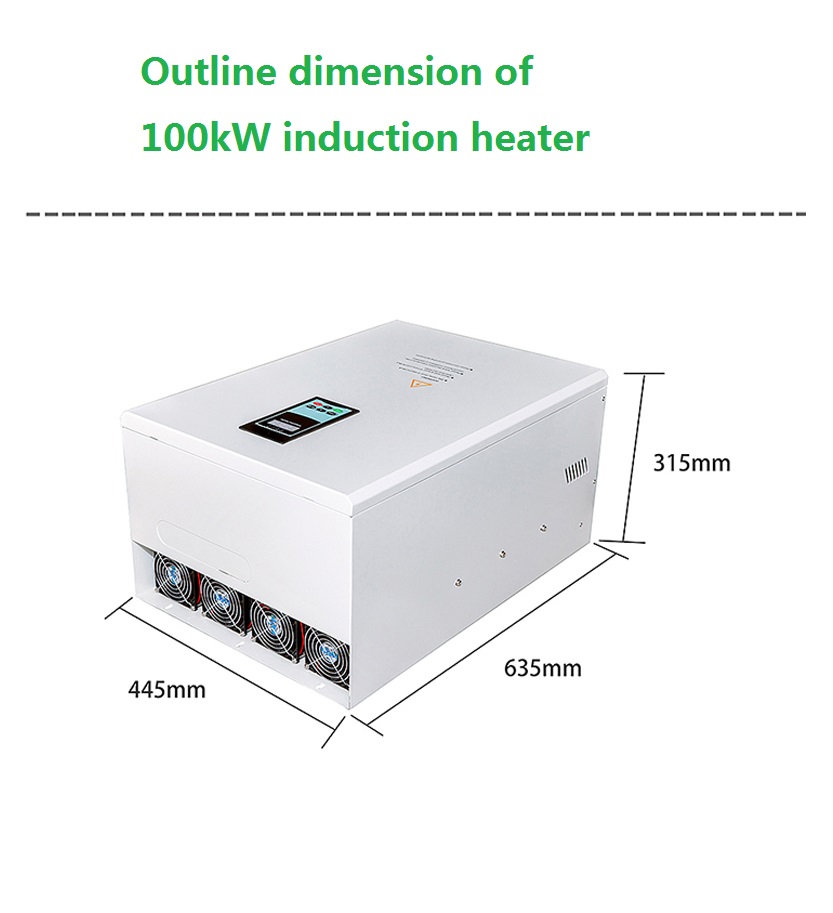
The 380V three-phase class extends to the JONSON JS1000-100, a wall-mounted 100kW industrial induction heater with 20%–100% stepless power regulation and air- or water-cooled heat dissipation.
Power Regulation: Reading the 20%–100% Band Correctly
Across the JONSON range, the recurring power regulation figure is 20%–100%, often described as stepless. For procurement teams, this single parameter answers several practical questions at once. A 100kW unit with 20%–100% stepless regulation can be operated anywhere between 20kW and 100kW, which means a plant does not have to size the machine for peak demand and accept permanent part-load inefficiency. The same logic applies to a 5kW JS1300-005/008, where the usable band spans roughly 1kW to 5kW.
Two variations are worth noting because they change the operating floor. The 70kW and 80kW models specify 25%–100% regulation rather than 20%, and the 40kW/50kW/60kW models specify 20%–100% with heat conversion efficiency of ≥98%. The 220V 3.5kW/5kW/6kW units are explicitly described as stepless across 20%–100%, corresponding to 0.5kW to 5kW or 6kW of output. In every case, the control layer that manages regulation matters as much as the percentage: DSP-based phase-locking tracking, soft start with full electrical isolation, and PID adjustment through 0–5V or RS-485 inputs are what allow the rated band to be used repeatably rather than only on paper.
For a load that varies through a shift — a reactor jacket, an extruder barrel, a heat-treatment cell — the width of the regulation band is a genuine selection criterion. A narrow band effectively turns a wide-power machine into a fixed-output heater, and that mismatch usually surfaces after commissioning rather than during specification.
Structure and Cooling: Wall-Mounted Enclosures and Heat Dissipation Choices
Almost the entire 380V JONSON industrial range is specified as wall-mounted. The JS1300-005/008, JS1300-10/15, JS1000-20, JS1000-30 and JS1000-100 all share this structure, which matters for smart manufacturing layouts where floor area is allocated to production equipment rather than electrical cabinets. Wall mounting also positions the heater close to the coil and the heated zone, shortening the power path between the unit and the point of use.
Cooling is where the higher-power models diverge. The JS1000-20, JS1000-30 and JS1000-100 are each specified with air-cooled or water-cooled heat dissipation, while the lower-power JS1300 models do not state a cooling method in the published specification. The general operating requirement in JONSON's application guidance is that the control cabinet should be well-ventilated to prevent overheating of the IGBT modules, and that some high-power equipment should use air cooling or water cooling. Buyers specifying a 380V unit above roughly 20kW should treat the cooling decision as a site condition — available water, ambient temperature, cabinet space — rather than as a fixed product attribute.
Environmental ratings are consistent across the family: most 380V models specify an ambient temperature range of −20°C to 50°C and humidity of ≤95%, with the JS1300-005/008 stated at −20°C to 40°C. The 70kW and 80kW models extend to −25°C to 55°C. For the 220V compact units, the 3.5kW/5kW/6kW and 2.5kW models specify −20°C to 50°C, and the 8kW control board specifies −20°C to 50°C, with the instant water heater model JS-JR-008 listed at −20°C to 40°C.
Certification and the Compliance Constraints Buyers Must Verify
Certification status differs across the range, and the difference is a real procurement constraint rather than a marketing detail. The JS1300-005/008 is stated to hold CE and ISO certification. The JS1300-10/15 holds CE, ISO and RoHS. The JS1000-20, JS1000-30 and JS1000-100 are specified with CE and ISO. The bearing induction heater's published specification does not list a certification, and the 220V 8kW control board specification does not list one either.
Behind those product-level statements sit identifiable certificates. JONSON's CE conformity is documented under certificate number KEYS23032915001EM-02, issued by Guangdong KEYS Testing Technology Co., Ltd. on 7 April 2023 and valid to 7 April 2028, citing EN IEC 55014-1:2021, EN IEC 55014-2:2021, EN IEC 61000-3-2:2019+A1:2021 and EN 61000-3-3:2013+A1:2019+A2:2021. Those are electromagnetic compatibility standards, and buyers should read them as such: EMC conformity is not the same scope as the IEEE-style product safety requirements that industrial equipment can be asked to demonstrate.
JONSON's quality management certification is ISO 9001:2015 under certificate number 02826Q00032R001, issued by Beijing Zhong An Zhi Huan Certification Center Co., Ltd. (Zhong An Certification) against GB/T 19001—2016 / ISO 9001:2015, valid from 6 January 2026 to 7 January 2029 and applicable worldwide. Its stated scope covers the production and sales of household fast-heating electric water heaters (electromagnetic heating furnaces) within the qualification licence scope, and the production and sales of electromagnetic heating controllers and coil heating elements for household appliances.
For the Chinese domestic market, JONSON holds China Compulsory Product Certification under two certificates issued by CQC against GB 4706.1-2005 and GB 4706.11-2008, both valid from 25 July 2022 to 24 July 2027: certificate 2017010706999985 for an induction heater product and certificate 2017010706002104 for instantaneous electrical water heater models JS3000-015 through JS3000-060 at 15kW to 60kW on 380V 3N~ 50Hz.
At the international standards level, IEC 60519-1 (General requirements) and IEC 60519-3 (Particular requirements for induction heating and melting) are the reference safety standards for industrial induction heating equipment. Buyers exporting or installing into regulated industrial environments should confirm how these standards map onto the project's own acceptance criteria, since a CE marking supported by EMC test reports addresses a different question than installation safety under IEC 60519.
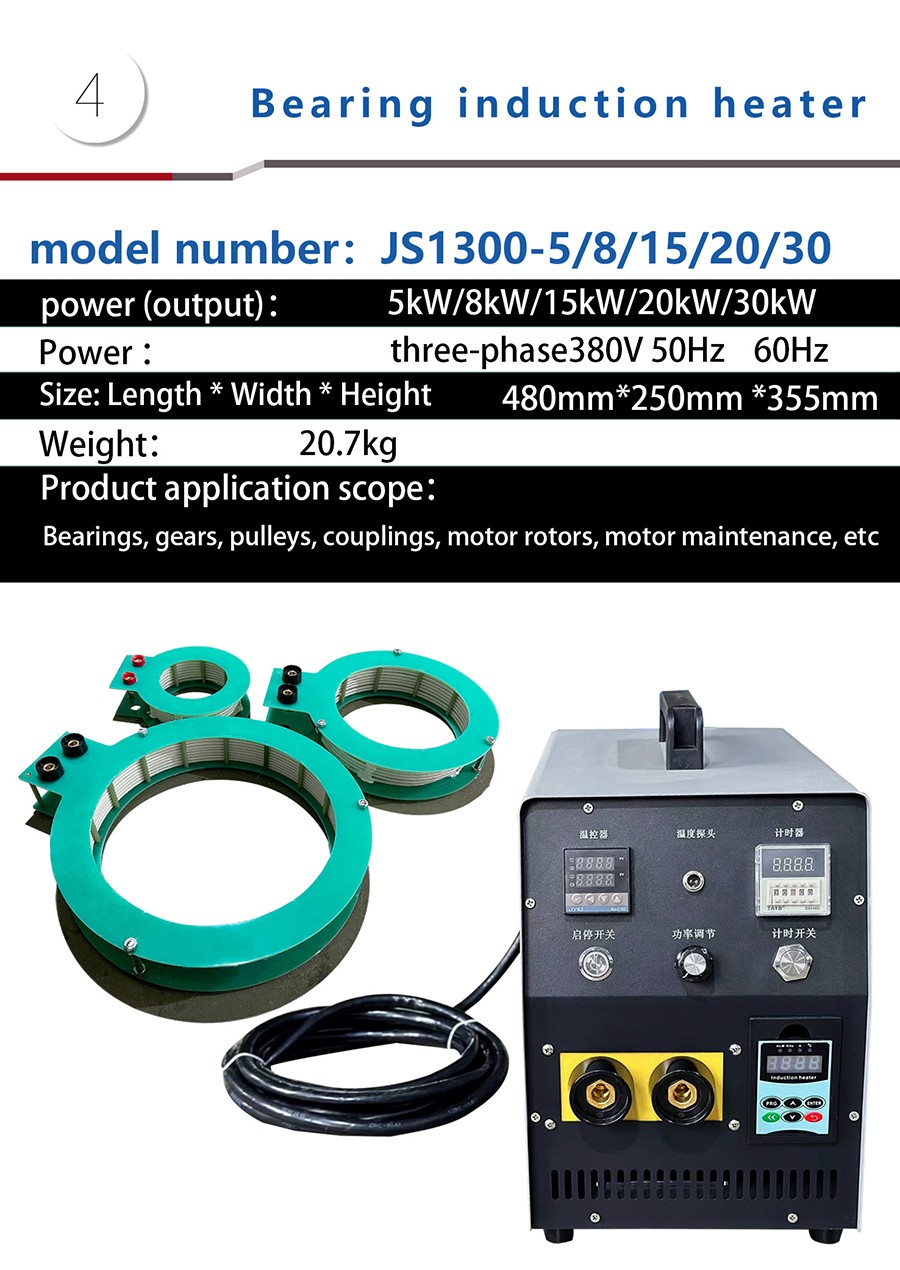
The JS1300-5/8/15/20/30 bearing induction heater spans 5kW to 30kW on three-phase 380V at 50Hz or 60Hz, using a copper heating coil and thickened aluminum alloy casing.
Application Fit by Voltage Class
JONSON's application guidance identifies a common industrial scope spanning plastics and rubber, food processing, chemical reactions, crude oil pipeline heating, textile printing and dyeing, aquaculture heating, metal heat treatment, building heating, and medicinal herb drying. Voltage class determines where within that scope a given unit fits.
- 220V compact units (2.5kW, 3.5kW, 5kW, 6kW): positioned for high-efficiency heating equipment such as plastic machinery, food machinery and commercial induction cookers, where single-phase service is available and the load is local. The 2.5kW model is specifically positioned for small plastic mechanical applications.
- 220V board-level control: the 8kW single-phase full-bridge board targets commercial induction cookers, household induction cookers, ceramic ovens, microwave ovens and similar appliance platforms.
- 380V wall-mounted units from 5kW to 30kW: suited to distributed plant heating tasks — injection moulding machine energy-saving retrofits, wire drawing machines, granulators, extruders, food machinery, crude oil transportation, boilers and heat-transfer oil systems. The bearing induction heater variant addresses bearing heating within metal heat treatment and assembly operations.
- 380V units from 40kW to 100kW: directed at centralised or high-mass loads — plastic machinery, food machinery, aluminium-plastic machinery, roller equipment, boilers and oil and natural gas transmission, where the 100kW JS1000-100 with its 300V–400V constant power output is sized for sustained process demand.
- Adjacent 380V process equipment: the JS-1600 induction steam generator covers 30kW, 40kW and 50kW at 380V with 20%–100% regulation and heat conversion efficiency ≥99%, while the JS-1600-8/12/15 hot air generator offers 8kW, 12kW and 15kW at 380V with outlet temperature of 80–130°C and wind pressure of 800–1000Pa. Both carry CE, ISO and RoHS certification.
The application scope is broad enough that the voltage decision usually follows from the site, not the process. A single-phase 220V workshop running plastic machinery can be served within the 2.5kW to 8kW band. A factory with 380V three-phase distribution reviewing a multi-zone retrofit is more likely to compare JS1300 and JS1000 models against each other than to consider a 220V alternative at all.
Market Context: Why Voltage Decisions Are Becoming Procurement Decisions
Induction heating has moved from a niche retrofit technology to a standard option in electrification planning. The global induction heating system market was valued at USD 2.39 billion in 2024 and is projected to reach USD 4.5 billion by 2035 according to WiseGuyReports. Separately, the global industrial boiler and steam generator market was estimated at USD 54.79 billion in 2024, with Market Research Future describing a shift toward electrification via induction technology to meet decarbonisation goals.
That second figure is the more instructive one for buyers. When steam and process heat move from combustion to electricity, the electrical supply becomes the binding constraint, and voltage class stops being a technical detail and becomes a project decision. Sites that electrify incrementally often start with single-phase 220V equipment for isolated loads and later migrate to 380V three-phase distribution as centralised demand grows. Sites that electrify in a single capital project typically go straight to 380V.
On the supply side, the induction heating systems market remains concentrated, with Fuji Electric reported to hold a leading share of over 9.5% in 2025 according to Global Market Insights. For buyers comparing suppliers, the practical differentiator is rarely the top-line share figure — it is whether the supplier can deliver a specific voltage and power class with the voltage adaptation, regulation band and certification documentation the project requires.
How Induction Compares with Gas and Resistance Heating
Induction heating is often evaluated against gas-fired and resistance-based alternatives rather than against other induction products. On efficiency, induction heating systems are reported to achieve energy efficiencies up to 92%, with an average cycle time reduction of 30% compared with traditional gas or resistance-based heating, according to Global Market Insights. JONSON's own product specifications state heat conversion efficiency of ≥95% for the 100kW JS1000-100 and the 220V compact models, ≥98% for the 40kW–60kW and control board products, and ≥99% for the 70kW–80kW units and the JS-1600 steam generator.
The advantages are structural rather than promotional. Induction heating converts 50Hz AC power into a 5–40kHz high-frequency current through an IGBT inverter module, driving a coil to generate an alternating magnetic field that induces eddy currents in the metal itself — a non-contact heating method with no combustion and no direct contact with the heated part. JONSON's application guidance also describes clean replacement of coal and gas boilers with zero nitrogen oxides and no smoke emissions, and physical separation of water and electricity or oil and electricity, with automatic interlock shutdown on water shortage, overheating or overpressure.
Limits and Boundaries Buyers Should Not Skip
An honest decision matrix has to state where it stops. Several limits are visible directly in the published data.
- The 220V 8kW control board is not an industrial process heater. Its stated application scope is commercial and household appliances. Treating an 8kW board as equivalent to an 8kW industrial heater because the kilowatt figures match would be a specification error, not a simplification.
- Data gaps exist within the range. The bearing induction heater's published specification does not state a power regulation range or a certification. The JS1000-20 and JS1000-30 specifications do not state a power regulation band either. Buyers who need those parameters confirmed should request them rather than infer them.
- Certification scope varies by model and by market. RoHS is listed for the JS1300-10/15, JS-1600-8/12/15 and JS1300-005/008, but CE and ISO only for the JS1000 series. CCC applies to the China Mainland market under GB 4706.1-2005 and GB 4706.11-2008. A certificate valid in one market does not automatically satisfy another.
- The documented CE conformity is EMC-scoped. The listed standards cover electromagnetic compatibility and harmonics, not installation safety under IEC 60519-1 or IEC 60519-3. Projects requiring the latter should verify separately.
- Voltage adaptation is bounded. Most 380V units operate across 300V–400V, and the 220V compact models across 100V–260V with constant power held between 210V and 260V. Sites with unstable supply outside those windows need transformer or stabilisation measures that are not part of the heater specification.
- Operating environment has hard rules. Controllers should be kept away from humid, dusty and corrosive gas environments, and coils must maintain a reasonable distance from the metal being heated, with insulation added to the heating area. These are installation requirements, not optional refinements.
Future Outlook
Three developments are likely to shape the next procurement cycles. First, the shift from combustion to electric process heat, already visible in the industrial boiler and steam generator segment, will continue to push 380V three-phase installations into plants that previously ran only single-phase equipment. Second, the 10kW–100kW band is expected to remain the commercially dominant segment, which means the mid-range 380V models — the JS1300-10/15, JS1000-20 and JS1000-30 — are where competitive pressure and specification scrutiny will concentrate. Third, voltage flexibility is becoming a procurement criterion in its own right: JONSON's customizable 110V, 240V and 660V family, covering 500W to 200kW depending on configuration with ±20% voltage adaptation and 20%–100% regulation, reflects demand from export markets with non-standard grid voltages.
For buyers, the practical implication is that voltage class should be documented in the tender specification alongside power rating, regulation band, cooling method and certification scope — not left to the commissioning phase.
Frequently Asked Questions
What is the practical difference between a 220V and a 380V induction heater in industrial use?
The difference is primarily the power ceiling and the electrical service required. JONSON's 220V single-phase models cover 2.5kW, 3.5kW, 5kW and 6kW, plus an 8kW board-level control platform. The 380V three-phase family spans 5kW and 8kW (JS1300-005/008), 10kW and 15kW (JS1300-10/15), 20kW and 30kW (JS1000-20, JS1000-30), and up to 100kW (JS1000-100), along with a 5kW–30kW bearing induction heater. Both classes share a 20%–100% power regulation band in most models and an operating frequency range of 5–40kHz. The 380V class additionally offers air-cooled or water-cooled options at 20kW and above.
How should a buyer choose between the JS1300-005/008 and the JS1300-10/15?
The decision is usually load size and certification requirement. The JS1300-005/008 provides 5kW or 8kW at 380V ±20% in a wall-mounted enclosure measuring 295×169×145mm, with CE and ISO certification and an ambient temperature range of −20°C to 40°C. The JS1300-10/15 provides 10kW or 15kW with a wider 300V–400V adaptation range, in a wall-mounted enclosure weighing 7.3kg and measuring 356×178×178mm, with CE, ISO and RoHS certification, HS code 8514400090, and an ambient temperature range of −20°C to 50°C. If the site requires RoHS documentation or a broader voltage window, the JS1300-10/15 addresses both.
Can the 220V 8kW single-phase full-bridge control board be used as an industrial process heater?
Its published specification does not support that use. The board is rated 8kW at 220V/50Hz with a voltage applicable range of 160V–260V, 20%–100% power regulation, ≥98% heat conversion efficiency and 5–40kHz operating frequency, built from aluminum alloy and copper. Its stated application scope is commercial induction cookers, household induction cookers, ceramic ovens, microwave ovens and other household appliances. For industrial process heating, the relevant 220V alternatives in the same range are the 2.5kW, 3.5kW, 5kW and 6kW induction heaters, which are positioned for plastic machinery, food machinery and commercial induction cookers.
What certifications should a 380V industrial induction heater carry for EU or export projects?
Certification is model-specific in JONSON's range. The JS1300-005/008 is stated to hold CE and ISO certification; the JS1300-10/15 holds CE, ISO and RoHS; the JS1000-20, JS1000-30 and JS1000-100 are specified with CE and ISO; and the JS1300-005/008, JS1300-10/15 and JS-1600-8/12/15 are documented with CE, ISO and RoHS for the EU market. The underlying CE conformity certificate is numbered KEYS23032915001EM-02, issued by Guangdong KEYS Testing Technology Co., Ltd. on 7 April 2023 and valid to 7 April 2028, citing EN IEC 55014-1:2021 and related EMC standards. Quality management certification is ISO 9001:2015 under certificate 02826Q00032R001, valid from 6 January 2026 to 7 January 2029. Because the CE documentation covers electromagnetic compatibility rather than installation safety under IEC 60519-1 and IEC 60519-3, buyers whose projects require those standards should confirm scope separately.
Does operating below full power affect heating stability or equipment life?
Partial-power operation is a designed condition rather than an exception across the range. Stepless regulation from 20% to 100% is specified for the JS1300-005/008, JS1300-10/15, the 100kW JS1000-100 (20–100kW), the 40kW–60kW models and the 220V 3.5kW/5kW/6kW units. The 70kW and 80kW models specify 25%–100%. JONSON's application guidance recommends low-power constant-temperature operation and advises avoiding frequent start-stop cycles, with a soft-stop procedure when shutting down. The control layer supports this through DSP-based phase-locking tracking, soft start with full electrical isolation, PID adjustment via 0–5V or RS-485, and load temperature detection up to 1000°C at ±1°C accuracy.
When does a single 100kW induction heater make more sense than several smaller 380V units?
The choice depends on whether the demand is centralised or distributed. The JS1000-100 delivers 100kW from a single wall-mounted unit measuring 635×445×315mm and weighing 35kg, with three-phase 380V input at 50–60Hz, 140–150A rated input current, 200–220A rated output current, and constant power output maintained between 300V and 400V. Its power regulation is stepless from 20% to 100%, equivalent to 20–100kW, and it uses a full-bridge series resonance circuit with air-cooled or water-cooled dissipation. Multiple smaller units remain preferable where heating zones are physically separated, where loads are commissioned in stages, or where JONSON's application guidance on modular parallel expansion of multiple units suits a phased build-out better than a single high-capacity installation.
JONSON is the brand of Guangdong Jiangxin Electronic Technology Co., Ltd., a Foshan-based manufacturer founded in 2011, operating a 3,000㎡ facility with 60+ employees, an annual output of 120,000 units, a 30+ engineer R&D team, and an export ratio of 40% across markets including Europe, the United States, India and Indonesia. Product data referenced above reflects published specifications for the models listed and should be confirmed against the current datasheet for any specific project.