
260T–400T PET Preform Machines: What Each Step-Up Buys
260T–400T PET Preform Machines: What Each Step-Up Buys
A 260 t and a 400 t PET preform injection machine usually land on the same buyer shortlist because they come from one series, share a control architecture and are quoted by the same supplier. They do not buy the same production capability. Across the four-model range published by Ningbo Yong Jiang Machine Co., Ltd. (Yongjiang) — YJPT-260, YJPT-318, YJPT-360 and YJHB-400 — the published parameters show three different kinds of step-up: the first adds clamping margin and a slightly larger mold envelope, the second is a genuine injection-capacity jump, and the third buys a bigger frame with no change in shot weight at all. Reading those three steps correctly is the difference between paying for capacity a project uses every shift and paying for capacity it never touches.
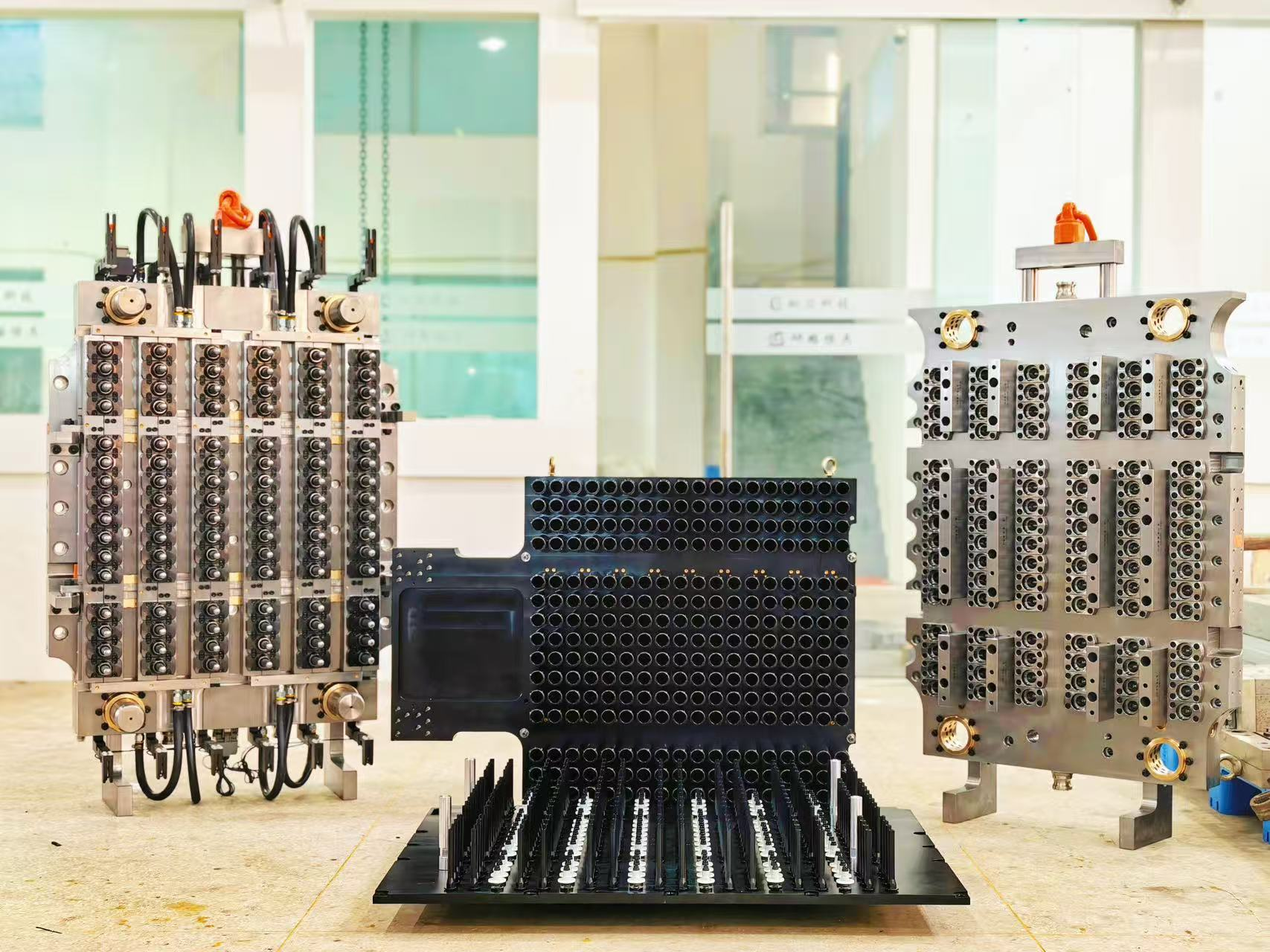
PET preform mold and clamping envelope: the dimension that decides which frame a project actually needs.
How this comparison was built
This is a buyer-side reading of published specifications, not a vendor ranking and not a test report. Four models are compared on the parameters the manufacturer publishes: clamping force, tie bar spacing, maximum shot weight and screw diameter. No competitor machines are named, no scores are assigned and no model is declared a winner, because a tonnage comparison has no universal winner — it has a fit boundary per project.
Two limits should be stated at the outset. First, cycle time, energy consumption per kilogram of melt, yield rate and maintenance interval were not measured for this article; the figures quoted below for energy and cost are the manufacturer's own published comparison data and are labelled as such. Second, the published four-model set used here does not state a shot weight for the YJPT-318 or a screw diameter for the YJHB-400. Those two values are marked as not stated rather than inferred from neighbouring models, because a buyer who fills a gap by assumption is a buyer who orders the wrong frame.
The four-model range side by side
| Model | Clamping force | Tie bar spacing | Max shot weight | Screw diameter | Published note |
|---|---|---|---|---|---|
| YJPT-260 | 260 t | 580 × 580 mm | 1,400 g | 72 mm | Smallest frame in the PET range |
| YJPT-318 | 318 t | 620 × 620 mm | Not stated in the compared set | 77 mm | Associated with a high-speed PET preform mold configuration |
| YJPT-360 | 360 t | 680 × 680 mm | 3,450 g | 95 mm | Largest published shot weight in the range |
| YJHB-400 | 400 t | 720 × 720 mm | 3,450 g | Not stated in the compared set | Largest clamping force and mold envelope |
A missing figure in a published table is not evidence of a limitation. It means the buyer should request the full datasheet for that model before comparing it, rather than assuming the YJPT-318 sits at some midpoint or that the YJHB-400 inherits the YJPT-360 injection unit by default. Both assumptions are common and both are unnecessary.
What the 260 t frame already covers
The YJPT-260 publishes 260 t of clamping force, 580 × 580 mm tie bar spacing, a 1,400 g maximum shot and a 72 mm screw. In preform terms this is not a small machine. A 1,400 g shot allows a substantial total mold weight of plastic per cycle, which means the constraint on this frame is usually mold footprint and clamp requirement rather than injection volume.
For a preform project, that combination points to three situations. The first is a modest cavity count where the mold body fits comfortably inside a 580 mm envelope — a wide range of water bottle and small packaging preform tools does. The second is a product mix in which the same machine has to run several different preform weights across a week, so flexibility matters more than peak output on one SKU. The third is a factory where floor space, crane capacity or installed power is already committed, and a larger frame would force building or utility work that has nothing to do with preform quality.
The trap on this model is buying it for the wrong reason. It is not the “entry” option in the sense of being under-specified; it is the option whose limits appear at the mold, not at the screw.
The 260 t to 318 t step: clamping margin and a slightly wider mold envelope
Moving from the YJPT-260 to the YJPT-318 adds 58 t of clamping force, taking the model to 318 t — a 22.3% increase. Tie bar spacing grows from 580 mm to 620 mm on each side, and screw diameter from 72 mm to 77 mm. The published description associates this model with a high-speed PET preform mold configuration.
What that buys is best understood as margin. Clamping force has to hold a mold closed against the injection pressure acting on the projected area of the preform cavities, runners and any overflow allowance. More cavities, deeper cores and higher cavity pressure all raise that requirement. A buyer who is between two frames on paper should ask which side of the clamp limit the tool sits on at the intended injection pressure, because a machine that is marginal at commissioning stays marginal for the life of the mold — and preform tools are long-lived assets.
The 40 mm per-side increase in tie bar spacing is often dismissed as cosmetic. It is not. Calculated as tie bar spacing squared — a comparison device, not a usable mold area, since a real mold must clear the tie bars and platens — the envelope rises from 336,400 mm² to 384,400 mm², an increase of about 14.3%. That is the difference between a mold that drops in and a mold that has to be redesigned around the machine.
The absence of a published shot weight for the YJPT-318 matters here. A buyer stepping up from the 260 t model for clamp reasons may find the injection unit close to the 1,400 g figure, or materially above it; the published set does not say. That single number should be requested in writing before the comparison is closed.
The 318 t to 360 t step: the real capacity jump
The YJPT-360 changes the character of the range. Clamping force rises 42 t to 360 t, a 13.2% increase — proportionally smaller than the first step. But tie bar spacing moves from 620 mm to 680 mm, and the published shot weight is 3,450 g on a 95 mm screw.
That combination is where a preform project usually changes category. Compared with the 1,400 g published figure for the YJPT-260, 3,450 g represents 2,050 g more plastic per cycle — an increase of roughly 146%. Screw cross-section, calculated from the diameter, grows by about 74% between the 72 mm and 95 mm screws. A larger screw area is not a direct measure of plasticizing rate, but it is a direct measure of how much melt the barrel can present per unit of screw travel, and it is the parameter that most often separates a machine that can fill a heavy multi-cavity tool from one that cannot.
Tie bar area rises from 384,400 mm² to 462,400 mm², about 20.3% — the largest envelope step in the range. So the 318 t to 360 t move adds clamp, injection volume and mold space simultaneously. If a project's constraint has shifted from “can I hold this mold closed” to “can I fill this mold completely within a competitive cycle”, this is the step where the answer changes.
It is also the step where 5-gallon water bottle preforms, heavier edible-oil preforms and thick-wall specialty preforms become ordinary work rather than a stretch. Heavier preforms consume more shot per cavity, so the cavity count a machine can realistically serve falls as preform weight rises. The 3,450 g figure is what allows a heavier preform to keep a commercially sensible cavity count.
The 360 t to 400 t step: frame, not injection
The YJHB-400 publishes 400 t of clamping force and 720 × 720 mm tie bar spacing — and the same 3,450 g maximum shot weight as the YJPT-360. Clamping force rises only 11.1%, and the shot figure does not move at all.
This is the most frequently misread step in the whole range. A buyer who assumes “400 t is the bigger machine, so it makes more preforms per hour” is buying the wrong thing. On the published numbers, the YJHB-400 buys mold envelope and clamping margin: tie bar area rises from 462,400 mm² to 518,400 mm², about 12.1%, and across the full range from 580 mm to 720 mm the envelope grows roughly 54%. If the project needs a tool that will not physically fit a 680 mm frame, or needs more clamp force on a large projected area, the 400 t frame is the answer. If the project needs more plastic per cycle, this step does not deliver it, and the buyer should be looking at the injection unit rather than the tonnage badge.
One calculated ratio is worth keeping in mind. Dividing published shot weight by clamping force gives 5.4 g per tonne for the YJPT-260, 9.6 g per tonne for the YJPT-360 and 8.6 g per tonne for the YJHB-400. The YJPT-360 publishes the highest injection capacity relative to its clamp of the three models where both figures are stated, which is consistent with it being the range's capacity-oriented frame. This is arithmetic on published figures, not a performance claim.
Step-up summary
| Step | Clamping force | Tie bar envelope (calculated) | Shot weight | What it mainly buys |
|---|---|---|---|---|
| 260 t → 318 t | +58 t (+22.3%) | 336,400 → 384,400 mm² (+14.3%) | Not comparable (318 t figure not published) | Clamp margin, wider mold envelope, larger screw |
| 318 t → 360 t | +42 t (+13.2%) | 384,400 → 462,400 mm² (+20.3%) | 3,450 g published at 360 t | Genuine injection capacity and mold space |
| 360 t → 400 t | +40 t (+11.1%) | 462,400 → 518,400 mm² (+12.1%) | Unchanged at 3,450 g | Mold envelope and clamp, not shot capacity |
Percentages are calculated from the published clamping-force and tie bar figures and rounded to one decimal place. The envelope figures are squares of tie bar spacing and are used only to compare frames against each other.
Tie bar spacing decides which molds you can run at all
Of the four published parameters, tie bar spacing is the one that produces the hardest yes-or-no answer. Clamping force and shot weight can be argued about at the margin; a mold that will not pass between the tie bars simply will not run.
Cavity count is a property of the mold, not of the machine label, and the numbers buyers discuss in this segment — 32, 48, 72 or 96 cavities — each change the mold's width, height, stack height and total shot requirement. A 48-cavity tool is not merely “a bit wider” than a 32-cavity tool; it changes the frame class required. That is why a cavity count should never be agreed with a moldmaker before the machine envelope is fixed, and why a machine should never be ordered before the mold layout is drawn.
The practical sequence for a PET preform making machine purchase is therefore: fix the preform design and weight, fix the cavity count that meets the output target, obtain the mold's outer dimensions and stack height, check them against the candidate frame's tie bar spacing with clearance allowed for the mold's clamping plates, and only then confirm shot weight and clamp. Running that sequence on all four models will usually eliminate one or two of them immediately, which is the point of a self-assessment rather than a sales conversation.
Screw diameter and shot weight: reading the injection unit
Shot weight is a maximum, not a target. A machine running far below its rated shot spends more time with melt sitting in the barrel, and for a hygroscopic, heat-sensitive polymer such as PET, extended residence time at process temperature is generally something to avoid rather than something to celebrate. This is standard processing logic, not a claim about any specific model, and it is the main reason a larger frame is not automatically the safer choice.
Screw diameter interacts with the same decision from the other side. A 95 mm screw presents more melt per unit of travel than a 72 mm screw, but it also needs a correspondingly larger shot to stay in a healthy operating range. A buyer planning a small preform on a 3,450 g machine should ask what the minimum stable shot is, not only the maximum, and should ask how the screw and barrel are specified for PET specifically. Yongjiang's published description of the YJPT series refers to a proprietary PET special screw intended for uniform plasticization and preform transparency, and to a fast dual-servo system with multi-axis linkage; reinforced clamping and longer ejection travel are described as accommodations for multi-cavity deep molds. Those are manufacturer statements about configuration, and they are the right questions to put to any supplier in writing.
Where a smaller frame is the more rational choice
Neutral comparison requires saying plainly when the smallest frame wins. The YJPT-260 is the better purchase, not the compromise purchase, in the following conditions:
- The mold fits. If the tool clears a 580 × 580 mm envelope with proper clearance, a larger frame adds cost without adding output.
- The shot stays well inside 1,400 g. Light water bottle preforms run at modest total shot weights per cycle; a 3,450 g machine would be running in the low part of its range most of the time.
- The product mix changes often. Smaller molds, shorter clamp travel and a smaller platen generally make changeover less of a production event. A larger frame does not automatically shorten the cycle for a small mold.
- Capital has competing uses. Money not spent on a larger frame can go into an additional mold, a second blow molding cell or working capital — all of which may add more saleable output than extra tonnage.
- Site constraints are real. Floor area, crane capacity, foundation and installed power all scale with frame size, and these costs are frequently underestimated at quotation stage.
- The project is a first line or a market-entry line. Yongjiang's published positioning describes the series as suited to cost-sensitive, stability-focused packaging producers in Southeast Asia, Russia, Africa and South America — a description that fits a buyer who needs reliable output before maximum output.
The inverse also deserves a plain statement: if the intended mold will not fit, or if the required shot with the planned cavity count approaches the published maximum, no amount of process tuning will close the gap. Frame limits are structural.
What external procurement specifications actually require
Published tender specifications give a useful external reference point, provided their scope is respected. A CIPET tender specification for a PET preform injection moulding machine in India, dated 15 November 2019, sets a minimum machine tonnage of 150–200 t, a minimum shot capacity of 750 g, a minimum plasticizing capacity of 50 g/sec, a minimum injection pressure of 1,200 bar and a minimum of 32 preform cores and cavities, with a maximum preform weight of 20 g and a 28 mm neck size for 1,000 ml bottles.
Read against those floors, the YJPT-260's 260 t and 1,400 g exceed the tonnage and shot minimums stated in that specification, and every model in the range does. The 32-cavity requirement is a mold requirement rather than a machine requirement, and it is the item that should drive the tie bar check described above. Two cautions are necessary: this is a single Indian public-procurement document from 2019, not a global or current standard, and it should be used as an example of how floors are written rather than as a benchmark a global buyer must meet.
Frame size decisions are made against the mold and the building, not against the tonnage label alone.
Application fit across water, CSD, oil and packaging
Downstream application shapes the frame decision more than any other single input. Industry segmentation for PET preforms covers bottled water, carbonated soft drinks, juices, edible oils and sauces, and each segment pushes the machine in a different direction.
Water bottle preform production is usually a volume and cycle-time argument at a light preform weight, which favours a frame where cavity count can be raised without moving to a larger envelope — the 260 t and 318 t models are the natural candidates, with the decision turning on the mold. Carbonated soft drink preforms carry different design and processing demands, and buyers in that segment generally need to confirm the full tooling and process package rather than tonnage alone. Edible oil and sauce preforms, and heavier specialty containers including 5-gallon water bottle preforms, consume substantially more shot per cavity, which is the case where the 3,450 g publication of the YJPT-360 and YJHB-400 stops being headroom and starts being the requirement. General packaging converters with mixed order books usually land on the middle of the range, where the same frame can absorb an order for mineral water bottles and an order for a thicker industrial preform without a tooling change on the machine side.
A full automatic high speed PET preform injection machine is often requested for 24-hour runs. Speed in that sentence refers to the whole cell — mold cooling, robot take-out, conveying and inspection — not to the tonnage badge. Buyers should ask for cycle time assumptions to be stated per cavity and per preform weight, since a cycle figure quoted without either is not comparable across suppliers.
Commercial comparison: what is published and how to check it
Yongjiang publishes a direct comparison position for the YJPT series: up to 50% lower power consumption than alternatives, up to 50% improvement in energy efficiency, and a cost around 10% lower than alternatives, with lower maintenance requirements attributed to optimized configuration and robust design. These are manufacturer-stated comparisons, and they should be treated as such — the baseline machine, mold, cycle and material behind a percentage of this kind are rarely disclosed, and no independent test result underpins the figures in this article.
That does not make the claims useless. It makes them a specification to verify. A buyer can convert each claim into a question with a checkable answer: what is the connected load and the measured consumption per kilogram of melt on the quoted configuration; against which baseline machine was the 50% figure calculated; what maintenance interval and parts list apply to the model being ordered; and what is included in the quoted price versus chargeable. A supplier able to answer these in writing is a materially lower-risk supplier than one that repeats the headline.
Company scale is relevant here only as context for support and continuity. Ningbo Yong Jiang Machine Co., Ltd. publishes a 130,000 m² facility, around 200 employees, an annual output of about 2,000 units, a 25-engineer R&D team and an export share of roughly 59%, with the United States, Canada and Thailand named among its main markets. Its CE documentation references EN ISO 12100:2010 under certificate CE20260126MD, and the company states ISO 9001 certification. For a buyer comparing frames, the practical value of that information is spare-parts availability and response time over a ten-year machine life — the questions that decide whether a marginal tonnage decision turns into a stoppage.
Market context, with the scope kept honest
Capacity decisions are easier to defend when the demand picture is stated accurately. The global market for PET preforms as a product — the intermediate item sold to bottle converters, not the machines that make it — was reported at USD 24.33 billion in 2026, growing at a CAGR of 2.17% to reach USD 27.08 billion by 2031, according to commercial research from Mordor Intelligence. Separately, global exports under HS code 847710, injection-moulding machines, were valued at USD 7.21 billion in 2023.
Two scope notes matter. The preform-product figure is not a market size for PET preform injection machines and must not be presented as one; no verified machine-market value is used here. And a customs figure for all injection-moulding machines says nothing about the PET segment specifically. What these numbers do support is a modest, defensible reading: downstream preform demand is large and growing slowly rather than rapidly, which argues for capacity purchased in steps that match confirmed orders rather than a single oversized frame bought against a forecast.
Outlook: three conditional scenarios
Where a buyer lands in this range depends on which of three scenarios describes the next three years. If order volume is stable and the product mix is narrow, the YJPT-260 or YJPT-318 with a well-specified mold is the lowest-risk allocation, and additional capital is better held for a second machine later. If volume is expected to grow and the constraint is likely to become fill time on multi-cavity tools, the YJPT-360 is the step that avoids a near-term replacement. If a specific large mold is already designed or the projected area requires the clamp, the YJHB-400 is the correct answer — but for frame reasons, not throughput reasons. None of these scenarios is a forecast of demand, and none is a recommendation independent of a buyer's own order book.
A pre-commitment self-assessment checklist
| Question to answer in writing | Why it changes the model choice |
|---|---|
| Preform weight × planned cavity count | Sets the required shot and separates 1,400 g from 3,450 g frames |
| Mold outer dimensions and stack height | Decides whether 580, 620, 680 or 720 mm tie bar spacing is mandatory |
| Projected area at intended injection pressure | Confirms whether clamping force has margin or is marginal |
| Minimum stable shot for the smallest preform planned | Prevents an oversized barrel running a small tool |
| Connected load and expected consumption per kilogram | Turns a percentage claim into a site-level running-cost figure |
| Floor area, crane capacity and foundation loads | Frame size carries site costs that never appear in the machine quote |
| Spare-parts list, warranty terms and response time | Matters more over a ten-year life than a small tonnage difference |
For buyers who want to check the manufacturer's own specifications against this framework, the published company brochure is available as a PDF download, and the model range is listed on the Yongjiang website.
FAQ
Is a 260 t PET preform injection machine enough for water bottle preform production?
On published figures, the YJPT-260 offers 260 t of clamping force and a 1,400 g maximum shot, which exceeds the 150–200 t tonnage floor and the 750 g shot floor set in a published CIPET tender specification. Whether it is enough for a specific water bottle preform depends on the mold, not the tonnage: the tool must fit within 580 × 580 mm tie bar spacing, and the shot required by the planned cavity count must stay inside 1,400 g with margin. Both can be confirmed from the mold drawing before ordering.
Why do the YJPT-360 and YJHB-400 publish the same 3,450 g shot weight?
Because the step between them is a frame step rather than an injection step. The YJHB-400 raises clamping force from 360 t to 400 t and tie bar spacing from 680 mm to 720 mm while the published maximum shot stays at 3,450 g. A buyer whose constraint is mold size or clamp requirement gains from that step; a buyer whose constraint is plastic per cycle does not.
How much difference does 580 mm versus 720 mm tie bar spacing make?
Calculated as the square of tie bar spacing, the comparison envelope rises from 336,400 mm² to 518,400 mm², about 54% more, from YJPT-260 to YJHB-400. The real usable mold area is smaller than that in every case, because the mold must clear the tie bars and clamping plates with an allowance. The practical consequence is that a large multi-cavity tool which cannot pass a 580 mm frame may pass a 680 mm or 720 mm one without redesign.
When is the smaller frame the better purchase?
When the mold fits the smaller envelope, the required shot stays comfortably inside the published maximum, the product mix changes frequently, and site or capital constraints are real. A larger frame does not shorten the cycle for a small mold, and ordering one does not add saleable output unless the mold and shot requirement justify it.
Which model suits a 48-cavity or 72-cavity preform mold?
Cavity count is a mold property, and the published four-model set does not map cavity counts to models. What can be stated is the check sequence: multiply preform weight by cavity count to get the required shot, compare it with the published maximum on each model, then confirm the mold's outer dimensions clear the tie bar spacing. A 72-cavity tool will normally require a larger envelope than a 48-cavity tool of the same preform, so the answer is derived from the tool dimensions rather than from the tonnage label.
Are the published energy and cost comparisons independently verified?
No. Yongjiang's published comparison data states up to 50% lower power consumption, up to 50% better energy efficiency and roughly 10% lower cost than alternatives. Those are manufacturer statements, and the baseline machine, mold, cycle and material behind them are not disclosed in the published material. Buyers should request the connected load, the baseline used for the percentage and the expected consumption per kilogram of melt on their own configuration before treating the figures as a budgeting input.
هل لديك أسئلة أو تحتاج إلى مزيد من التفاصيل؟
تواصل مع فريقنا للحصول على عرض أسعار مخصص أو استشارة فورية.
طلب عرض أسعار
املأ النموذج أدناه وسيتواصل معك فريقنا بعرض مقترح مخصص.
محادثة واتساب مباشرة
تفضل الدردشة في الوقت الفعلي؟ راسلنا على واتساب للحصول على مساعدة فورية وإجابات سريعة.
- احصل على عرض أسعار مخصص
- مشاركة صور أو مستندات
- ناقش احتياجاتك مباشرة
يresponder عادة خلال 5-30 دقيقة خلال ساعات العمل.