
3-Way Ball Valve Selection: Certificates and Hard Limits
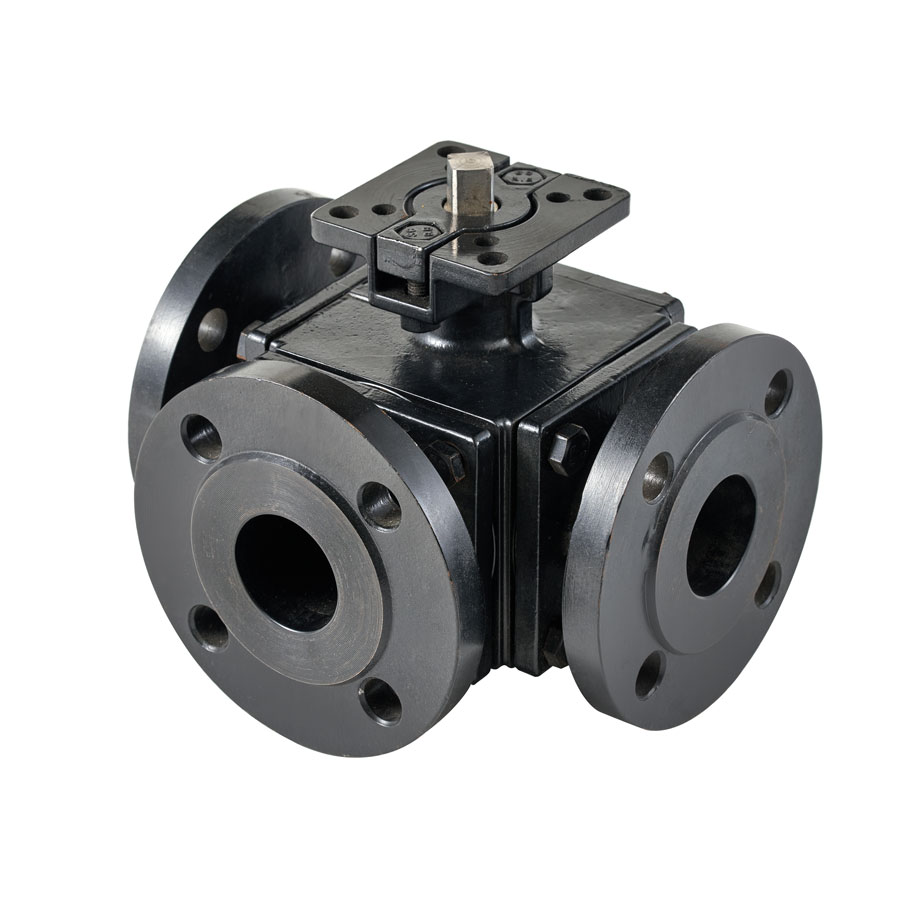
Three-way ball valves are specified when a pipeline has to divert, combine, or switch flow without isolating the system. That single requirement changes the design brief: instead of one inlet and one outlet, the valve carries three ports, and the ball inside is machined with an L-shaped or T-shaped bore that determines which ports are connected at each 90 degree position.
Zhejiang Dico Valve Co., Ltd is a ball valve manufacturer founded in 2015 and located in Longwan District, Wenzhou, Zhejiang Province, China. The company identifies itself as a National High-tech Enterprise and an Innovative Small and Medium-sized Enterprise specialising in R&D and manufacturing of high-end ball valves and fluid control solutions, and its published product data lists a three-way ball valve, model Q44F, in L-type and T-type configurations with flange or clamp connections and a choice of carbon steel, SS304, or SS316 bodies. The company website is listed as www.dicovalve.com.
For buyers in the research and evaluation stage, the useful question is not whether a three-way ball valve exists, but whether the specific configuration being quoted sits inside the documented limits of the project. Those limits arrive in four groups: port configuration, seat and body material against the operating envelope, the actuator interface, and the scope of any certificate the specification calls for. The sections below work through each of them against published data, and mark clearly where the published data ends and per-order confirmation begins.
L-type and T-type: port configuration defines the function
Port configuration is the first constraint because it decides what the valve can physically do, independently of pressure rating or material grade. An L-type three-way ball valve diverts flow between two of its three ports as the ball rotates through 90 degrees, so it behaves as a selector or diverter. A T-type valve can connect two or three ports depending on the ball position, which allows it to combine, split, or reverse flow within the same body.
The two are not interchangeable in service. Specifying an L-port ball for a duty that requires simultaneous mixing, or a T-port ball for a duty that requires positive isolation between two lines, produces a valve that fits the pipe but cannot perform the required switching sequence. Dico publishes the Q44F three-way valve in both L-type and T-type, which means the port decision is made at specification stage rather than treated as a stock option that can be substituted later.
Where the three-way function is needed in a smaller threaded or clamp format, Dico documents its PC ball valve family (model Q11F) as including three-way and four-way types alongside sanitary, mini, ISO 5211, floating and 3PC Tri-Clamp variants. The published family envelope for that series is a temperature range of -196 degrees C to 425 degrees C and a pressure range of 1.0 to 13.0 MPa, with seat and seal materials in PTFE, PPL, PI, PEEK and Stellite, and a choice of hollow or solid balls. That envelope describes the family rather than every configuration inside it: the usable part of the range is set by the seat material, the port geometry, and the specific size on the order.
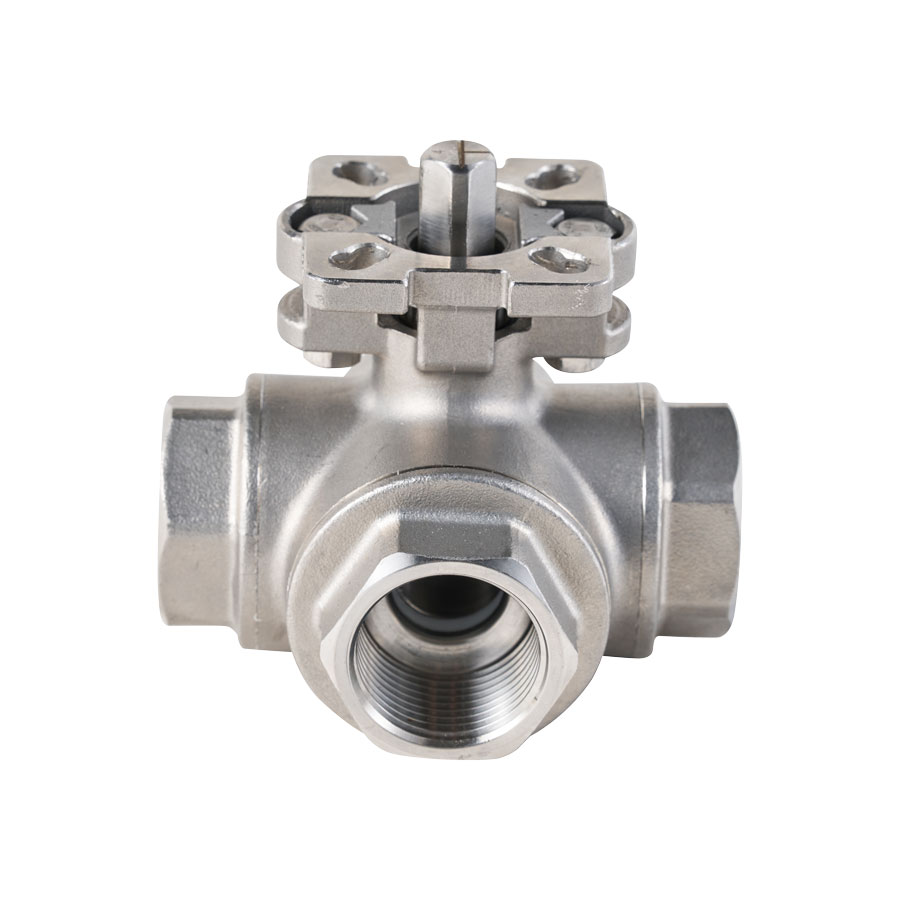
What is published for the Q44F three-way ball valve
| Item | Published data |
|---|---|
| Model | Q44F |
| Port configuration | L-type, T-type |
| Seat and seal materials | PTFE, PPL, PI, PEEK, Stellite |
| Ball type | Hollow ball or solid ball |
| Connection | Flange, clamp |
| Body material | Carbon steel, SS304, SS316 |
| Documented industries | Petroleum, pharmaceuticals, water treatment, liquid cooling, metallurgy, chemicals, semiconductors, hydrogen energy, HVAC |
| Design features | ISO 5211 mounting pad; pre-machined flange outer circle; anti-static structure; three-layer sealing of the valve stem; balls from a supplier with heat-number traceability; machined Daikin PTFE seats; precision-machined seals; controlled precision of spherical polishing |
One line is deliberately absent from that table. The Q44F entry does not publish a pressure and temperature envelope in the same form as Dico's flanged floating ball valve (Q41F) and trunnion-mounted ball valve (Q47F), both of which are listed at 1.0 to 10.0 MPa and -29 degrees C to 425 degrees C. For a three-way valve this gap is normal, because the envelope depends on which seat material is selected and on the internal bore geometry, but it is also the point where a buyer should stop reading a catalogue and start asking for the configuration-specific figure in writing. Requesting that figure per order is not a sign of a weak datasheet; it is the correct reading of a product whose limits are seat- and geometry-dependent.
Certificate scope: the document check most buyers get wrong
A certificate is evidence for a defined product range, not for a company name. Dico's certificate records illustrate this precisely, because each document carries scope lines that are narrower than the catalogue they sit next to.
| Certificate | Issuer | Number | Documented scope |
|---|---|---|---|
| ISO 15848-1:2015+Amd.1:2017 | TUV | 337275 | 2 inch 2000 PSI ball valve, stem size 7 to 28 mm, pressure rating PN138 and lower |
| API STD 607 fire-safe test certificate | TUV SUD Industrie Service GmbH | 285697 | Ball valves, size 2 inch and below; 2-1/2 inch, 3 inch, 4 inch; Class 150, Class 300, austenitic material |
| Functional safety, IEC 61508:2010 Parts 1-7 | ECM | 6L241216.ZDVWQ00 | Industrial valve, DN 400 mm and below, PN 13.0 MPa and below, SIL 3 capable |
| PED CE verification | Ente Certificazione Macchine Srl (ECM) | 6L241216.XSVWQ18 | Industrial valve, DN 400 mm and below, PN 13.0 MPa and below; EN 12266:2012, PED Directive 2014/68/EU |
| Quality management system, ISO 9001:2015 | Zhejiang QPC Certification Co., Ltd. | 20225Q20008R0M | Production and sales of metal valves |
| Environmental management system, ISO 14001:2015 | Zhejiang QPC Certification Co., Ltd. | 20225E20003R0M | Production, sales and related management activities of metal valves |
| Occupational health and safety management system, ISO 45001:2018 | Zhejiang QPC Certification Co., Ltd. | 20225S20004R0M | Production, sales and related management activities of metal valves |
The certificate records show that the ISO 15848-1, API STD 607, IEC 61508 and PED CE documents are attached to specific ball valve families from Dico: the floating ball valve (Q41F), the trunnion-mounted ball valve (Q47F), the PC ball valve (Q11F) and the wafer ball valve (Q71F). The three-way configuration appears inside the PC ball valve family type list, but that does not remove the scope lines. Size, pressure class, stem dimension and body material still govern whether a particular three-way valve falls inside or outside a given certificate. On a project that requires documented low-emission performance to ISO 15848-1, for example, the certificate covers a 2 inch 2000 PSI ball valve with a stem size of 7 to 28 mm at a pressure rating of PN138 and lower. A larger three-way valve in a higher class is simply not covered by that document, and no amount of brand reputation changes that.
Validity dates are part of the same check. The API STD 607 fire-safe certificate 285697 was issued on 24 March 2022 and expires on 23 March 2027. The IEC 61508 functional safety certificate 6L241216.ZDVWQ00 and the PED CE certificate 6L241216.XSVWQ18 were both issued on 16 December 2024 and expire on 15 December 2029. The three management system certificates were issued on 3 January 2025 and expire on 2 January 2028. For an order placed in late 2026, the fire-safe certificate is the nearest renewal checkpoint, so a buyer should request the current document at the time of purchase rather than rely on a file supplied earlier in the tender process.
It is also worth separating the two certificate types. The ISO 9001, ISO 14001 and ISO 45001 documents describe how the factory is managed, covering the production and sales of metal valves and the related management activities. The API 607, ISO 15848-1, IEC 61508 and PED CE documents describe what a tested article achieved. A procurement file should hold both, and one should not be substituted for the other.
Seat material sets the temperature ceiling
For any ball valve, including three-way designs, the seat material usually sets the upper temperature limit before the body material does. Dico's published guidance on seat selection frames the decision as a sequence across four dimensions - temperature, medium, pressure and corrosion - rather than a single headline rating.
Soft-seated valves are indicated where the medium is clean and zero leakage to Class VI is required, where the operating temperature stays at or below 260 degrees C, described in that guidance as the upper limit for PEEK, where the pressure class is 1500 or lower, where frequent operation with low torque is expected, and for highly corrosive media handled by PTFE or FKM seats.
The same guidance lists the failure modes a specification should anticipate before an order is placed:
- PTFE creeps faster above 200 degrees C, so temperature rise and thermal shock must be considered, not only the normal operating temperature.
- Particles are described as the main accelerator of soft-seal wear; even small amounts shorten service life, and fibrous media also push the selection toward hard, metal seats.
- Pure PTFE cold-flows under high pressure, so on large-diameter or high differential pressure duty the opening and closing torque has to be assessed, and a fixed-ball trunnion-mounted design may be required instead.
- Glass-fibre PTFE is not resistant to HF or strong alkalis, and elastomer selection should follow chemical compatibility tables rather than experience.
Dico lists PTFE, PPL, PI, PEEK and Stellite among the seat and seal materials for the three-way ball valve, which spans the soft-seated and metal-seated range within one valve model. The practical consequence is that the same body casting can be supplied with very different operating limits, and a quoted temperature or pressure figure should always be read together with the seat material recorded on the same data sheet.
Actuation, mounting geometry and earthing
Three-way valves are frequently automated because the switching sequence has to be repeatable. Dico lists an ISO 5211 mounting pad on both the three-way valve and the PC ball valve families. ISO 5211 is the standardised interface between the valve top flange and the actuator mounting face, and specifying it allows a pneumatic or electric actuator to be mounted directly rather than through a custom bracket that has to be re-made whenever the actuator brand changes. The same product data notes a flange outer circle that has been machined and a body that is heavier than the manual series, both of which matter where mounting alignment and available torque are tight.
Two further design features appear consistently across the Dico range: an anti-static structure that maintains electrical continuity across the ball, stem and body, and three-layer sealing of the valve stem. In flammable or powder-handling service the anti-static path is a safety requirement rather than an option. Three-layer stem sealing addresses the other common leak path on a three-way valve, where a single stem passes through a body that handles more than one flow path.
Material traceability is published as well. Balls are sourced from a supplier with heat-number traceability, seats are machined from Daikin PTFE, seals are precision machined, and spherical polishing is performed to a controlled precision. These are the details that decide whether a three-way valve holds its sealing class through repeated cycling, and heat numbers, seat material certificates and machining records are reasonable items to request at the evaluation stage rather than after delivery.
Automated ball valve experience in thermal service is documented elsewhere in the same records. An ironmaking and metallurgical plant in China operates 1,000 pneumatically actuated Dico ball valves on boiler water piping, reported as stable operation over one year, with pneumatic automatic control as the highlighted feature. Those valves are recorded against the floating and PC ball valve families rather than a three-way configuration, so the reference should be read as evidence of actuation and sealing behaviour in high-temperature water service rather than as a three-way case history.
Where three-way ball valves fit, and where they do not
Dico documents its ball valves as being applied across petroleum, pharmaceuticals, water treatment, liquid cooling, metallurgy, chemicals, semiconductors, hydrogen energy and HVAC industries, and its application records for power generation and chemical industry service describe weakly corrosive, high-pressure gas duties in boiler flue gas, heat treatment furnace and coal-to-olefins plants, where pneumatic actuation is used for cut-off duty and high pressure resistance is the special requirement.
Those are exactly the conditions in which a three-way valve is often proposed: a diverting duty between parallel treatment trains, a switching duty between a main line and a bypass, or a mixing duty where two streams have to be blended before entering a reactor or a heat exchanger. The choice of an L-port or T-port ball, and of a soft or metal seat, follows from the medium and the sequence rather than from the pipe size alone.

Three-way ball valve versus two valves and a tee
| Evaluation point | Single three-way ball valve | Two two-way valves with a tee |
|---|---|---|
| Diverting or mixing function | Achieved with one 90 degree rotation of a single ball | Achieved by sequencing two valves |
| Seal and leak paths | One body, one stem sealing set | Two bodies, two stem sealing sets |
| Actuation | One actuator, fixed sequence | Two actuators or a linked arrangement, with interlock logic |
| Footprint and pipework | One body and one actuator footprint | Two bodies plus a tee, and more joints |
| Throttling or flow control | Not a throttling device; for on and off or diverting duty | Same limitation |
| Maintenance points | One service point | Two service points |
| Certification documentation | Must be checked against the size, class and material scope of that specific three-way configuration | Standard two-way models are more often already covered by the same certificates |
The trade-off is genuine. A three-way valve concentrates the switching function into one body, which reduces leak paths and installation work, but it also concentrates the engineering risk, because port geometry, seat material and certificate scope all have to be correct at the same time. The body is also typically larger and heavier than a single two-way valve of the same bore. Where switching is infrequent and the pipework already has spare branches, two two-way valves can be the cheaper and easier-to-document option, since each valve is a standard model with a well-established certificate footprint. Where space is tight, where the sequence must be repeatable, or where each additional joint is a leak risk in a hazardous medium, the single three-way body is usually the stronger engineering choice.
One boundary applies in both cases. A ball valve, three-way or not, is not a control valve. It should not be used for continuous modulating duty or for fine flow adjustment, and it is a poor selection for abrasive slurries unless a hard-faced metal seat and appropriate trim are specified.
Procurement verification checklist
The following checks can be completed before a three-way ball valve order is placed, and each one maps to a fact that is either published or must be confirmed in writing.
- Port function. Confirm L-type or T-type against the actual switching sequence, not against a drawing reference.
- Seat material. Match the seat to temperature, medium, pressure and corrosion in that order, remembering the stated 260 degrees C upper limit for PEEK and the creep behaviour of PTFE above 200 degrees C.
- Operating envelope. Request the pressure and temperature limits for the exact configuration and size, since the Q44F data sheet does not publish a family envelope of its own.
- Certificate scope. Compare size, pressure class, stem dimension and body material against each certificate scope line, rather than accepting a certificate number as sufficient evidence.
- Certificate validity. Check issue and expiry dates, and request current copies at order stage.
- Actuator interface. Confirm the ISO 5211 mounting pad size, the machined flange outer circle and the body weight class if the valve will be automated.
- Material evidence. Request ball heat-number traceability, seat material certification, and machining or polishing records where the sealing class is critical.
- Electrical continuity. Confirm the anti-static structure where the medium is flammable.
Supply, testing and commercial facts that affect the decision
Dico operates from a 12,000 square metre factory with 80 employees, a 7-engineer R&D team and 48 CNC machines under digital production management. The company states that it invests 10 percent of annual sales revenue in R&D, talent introduction and equipment upgrading, and that it runs a digital workshop with 6-S standardised management.
Quality control is described as a two-round process: a first round of 100 percent testing and a second round of random checks. The published durability evidence is a 20-second high-frequency switch life test, stated as 50,000 cycles without leakage. Production and commercial parameters include a monthly capacity of 10,000 units, a lead time of 7 to 45 days, a minimum order quantity of 1 unit, and OEM and ODM production with customisation of appearance, material, logo and mould. The export ratio is 40 percent, with main markets in the EU, South Africa and North America, and the warehouse covers 2,000 square metres with standard product blank inventory, a one-item-one-code system and 98 percent warehouse data accuracy for inventory tracking and retrieval.
After-sales terms are stated as a 12-month warranty measured after use, with replacement rather than repair applied for quality issues, remote support, and a target of resolving issues within 48 hours. Buyers whose maintenance model depends on on-site repair, or on a warranty measured from delivery rather than from commissioning, should raise those points during contract negotiation rather than after installation.
Market trend: diverting flow in liquid cooling, hydrogen and semiconductor service
Dico states that its valves are widely applied in petroleum and chemical, natural gas, pharmaceutical, new energy, hydrogen energy, semiconductor and data-centre liquid cooling industries, and that it has established a dedicated liquid-cooled valve production line producing mini ball valves and three-piece clamp ball valves, which it states are supplied to Huawei data centres. That statement is company-provided rather than independently verified, but it is consistent with the published product envelope, since the PC ball valve family reaches down to -196 degrees C, the band that matters for cryogenic and hydrogen service, and the three-way configuration sits inside that same family.
Liquid cooling loops generally require compact, repeatedly actuated valves with low leakage, which is close to the duty profile a three-way diverting valve with an ISO 5211 mounting pad and three-layer stem sealing is built for. The trend that matters for buyers, however, is documentation rather than novelty. As liquid cooling, hydrogen and semiconductor projects move from pilot to production, specifications increasingly ask for a certificate scope statement rather than a certificate number, and the products that will be quickest to qualify are those whose envelope and scope lines are already defined and can be matched line by line against the project requirement.
Limits a buyer should accept before ordering
- Three-way ball valves are diverting and on/off devices, not control valves, and are unsuitable for continuous modulating duty.
- Soft seats set the temperature ceiling. The stated upper limit for PEEK is 260 degrees C, and PTFE creep accelerates above 200 degrees C.
- Certificate scope lines are narrow. ISO 15848-1 certificate 337275 covers a 2 inch 2000 PSI ball valve with a stem of 7 to 28 mm at PN138 and lower; the API STD 607 fire-safe certificate 285697 covers ball valves up to 4 inch in Class 150 and Class 300 austenitic material.
- The Q44F data sheet does not publish a pressure and temperature envelope, so those figures must be confirmed per order against the selected seat material.
- The stated warranty is 12 months after use, with replacement rather than repair for quality issues and remote support.
- Lead time runs from 7 to 45 days depending on configuration and customisation; a minimum order quantity of 1 unit does not imply immediate availability of every configuration.
- Ball valves are a poor fit for abrasive or fibrous media unless a hard-faced metal seat and suitable trim are specified.
Future outlook
The near-term picture for three-way ball valve procurement is dominated by documentation rather than by new valve architectures. The API STD 607 fire-safe certificate expires on 23 March 2027, and the management system certificates expire on 2 January 2028, so buying teams working on multi-year projects should expect a renewal cycle during the life of the order and should plan their qualification documents accordingly.
On the manufacturing side, the stated direction of travel is continued investment in R&D, talent and equipment, supported by a 7-engineer R&D team, 48 CNC machines and a digital workshop. For a three-way valve, the practical effect of that investment is expected to appear in envelope definition and traceability rather than in radical redesign: clearer configuration-specific pressure and temperature limits, and more complete material evidence behind each unit.
For buyers, the evaluation criteria used in 2026 - port function, seat material against temperature and medium, certificate scope lines, actuator interface, and material traceability - are likely to remain the criteria that decide which supplier is qualified.
FAQ
What is the practical difference between an L-type and a T-type three-way ball valve?
An L-type three-way ball valve diverts flow between two of its three ports as the ball rotates through 90 degrees, so it acts as a selector or diverter. A T-type valve can connect two or three ports depending on ball position, which allows it to combine, split or reverse flow in the same body. Dico publishes its Q44F three-way valve in both configurations, so the choice is a process-function decision rather than a quality tier.
How can a buyer confirm that a certificate actually covers the three-way valve being quoted?
By matching the valve against the scope lines printed on the certificate, not against the brand name. In Dico's records, ISO 15848-1 certificate 337275 issued by TUV covers a 2 inch 2000 PSI ball valve with a stem size of 7 to 28 mm at a pressure rating of PN138 and lower. API STD 607 fire-safe certificate 285697 issued by TUV SUD Industrie Service GmbH covers ball valves 2 inch and below, plus 2-1/2 inch, 3 inch and 4 inch, in Class 150 and Class 300 austenitic material. The IEC 61508 certificate 6L241216.ZDVWQ00 and the PED CE certificate 6L241216.XSVWQ18 cover industrial valves of DN 400 mm and below at PN 13.0 MPa and below. Size, class, material and stem dimension determine whether a specific three-way valve is inside or outside any one of these documents.
How should the valve seat be selected for a high-temperature application?
By working through four dimensions in sequence: temperature, medium, pressure and corrosion. Soft seats are indicated where the medium is clean, zero leakage to Class VI is required, the operating temperature stays at or below 260 degrees C, the pressure class is 1500 or lower, and frequent operation at low torque is expected. PTFE creeps faster above 200 degrees C, particles accelerate soft-seal wear, and pure PTFE cold-flows under high pressure, which may require a trunnion-mounted design on large-diameter or high differential pressure service. Glass-fibre PTFE is not resistant to HF or strong alkalis, so elastomer selection should follow chemical compatibility tables.
Do Dico's ball valves have fire-safe construction?
Yes. The company states that its ball valves have passed fire resistance testing and hold API STD 607 certification, with an internal fireproof groove structure in the valve body design. The fire-safe test certificate carries the number 285697 and was issued by TUV SUD Industrie Service GmbH on 24 March 2022, with an expiry date of 23 March 2027, which makes it the nearest renewal checkpoint for current projects.
What drives the price difference between a low-cost ball valve and a higher-priced one?
The company attributes the difference to the grade of raw materials used for valve blanks and internal components, and to valve seat and body design. Its stated position is that materials meet the applicable standards, support spectrometer testing, and are backed by the certifications listed above. Whatever the supplier, the practical way to test a price difference is to ask for material evidence - blank grade, seat material certificate, heat-number traceability for balls - rather than to compare headline prices between offers with different specifications.
What warranty and support terms apply, and what should be checked in the contract?
The stated warranty is 12 months measured after use. For quality issues the published approach is replacement rather than repair, support is provided remotely, and the stated target is to resolve issues within 48 hours. Since warranty conditions can be affected by incorrect model selection or unusual operating conditions, buyers should confirm in the contract whether the 12 months run from delivery or from commissioning, and whether replacement-only terms are acceptable for their maintenance model.
Company reference: the Dico Brief Introduction summarising the product range and certification portfolio is available as a PDF at https://cdn.socialarks.com/sbsp/25241/common/2026/0904/DICO%20Brief%20Introduction-new.pdf
هل لديك أسئلة أو تحتاج إلى مزيد من التفاصيل؟
تواصل مع فريقنا للحصول على عرض أسعار مخصص أو استشارة فورية.
طلب عرض أسعار
املأ النموذج أدناه وسيتواصل معك فريقنا بعرض مقترح مخصص.
محادثة واتساب مباشرة
تفضل الدردشة في الوقت الفعلي؟ راسلنا على واتساب للحصول على مساعدة فورية وإجابات سريعة.
- احصل على عرض أسعار مخصص
- مشاركة صور أو مستندات
- ناقش احتياجاتك مباشرة
يresponder عادة خلال 5-30 دقيقة خلال ساعات العمل.