
316L, PVD & EU-Certified Stainless Steel Jewelry: A Buyer's Shortlist
316L, PVD & EU-Certified Stainless Steel Jewelry: A Buyer's Shortlist
A stainless steel jewelry order bound for the European Union is approved or delayed by paperwork, not by photography. Two suppliers can show visually identical rope chain bracelets, yet only one can hand a retail compliance team a dated test report that names the alloy, the finish and the exact product it covers.
This shortlist is written for buyers who are past category discovery and are now specifying an order. It maps three formats — rope chain bracelets, figaro chain bracelets and engraved bangles — supplied under product code 5609, model GEN000516bhia-066, against four certification records held by Jusnova Jewelry Co., Ltd, a Guangzhou-based stainless steel jewelry manufacturer founded in 2009. The objective is not to rank designs on appearance, but to show which document supports which claim, and which buyer scenario each configuration actually fits.
Why EU Orders Stall on Documentation, Not Design
European retail buyers rarely reject a stainless steel jewelry sample because it looks wrong. They reject it because the file behind the sample cannot support the claims the packaging will make. A chain retailer building a hypoallergenic line wants evidence of what the metal is. A distributor selling into a coastal or high-humidity market wants evidence of what the finish survives. A compliance team wants social-audit evidence before the purchase order is raised, regardless of how good the sample looks.
That is the practical gap this shortlist addresses. Each of the three formats below is compared on the document that carries it into the EU market, not on finish photography. Where a statement is first-party — a supplier's own performance claim rather than an independently issued report — it is labelled as such throughout.
Four Records, Four Different Jobs
For product code 5609 (model GEN000516bhia-066), Jusnova Jewelry holds three SGS laboratory reports and one Amfori BSCI certification, and each one answers a different buyer question.
| Record | Standard cited | Certificate no. | Buyer question it answers | Stated validity |
|---|---|---|---|---|
| 316L Material Content Analysis (SGS) | ASTM A276/A276M-25 | GZIN2606005050ML01_EN | Is the metal actually the grade claimed on the label? | 26 Jun 2026 – 26 Jun 2027 |
| Salt Spray Test (SGS) | ISO 9227 | GZHL260603029801JW | Does the finish hold up in humid or salty environments? | 29 Jun 2026 – 29 Jun 2027 |
| Artificial Sweat Test (SGS) | ISO 3160-2 | GZMR260602153701 | How does the finish behave in prolonged skin contact? | 30 Jun 2026 – 30 Jun 2027 |
| BSCI Certification (Amfori) | Social compliance audit | 25-0339245 | Can the supplier pass a retail chain's social-audit gate? | 15 Aug 2025 – 15 Aug 2026 |
Certificate details as recorded by the supplier. Buyers should request the report itself, not a badge or a summary, before relying on any claim in retail copy.
The distinction is commercially significant. A single 'certified' badge on a catalogue page tells a buyer nothing about which SKU was tested, under which standard, or whether the report is still live. The four records above each carry a number, an issuing body and a date — the three attributes a compliance reviewer can verify independently without contacting the supplier at all.
What the 316L Report Actually Certifies
316L is the low-carbon variant of 316 stainless steel and the grade most frequently specified for skin-contact jewelry, because the reduced carbon content is what separates it from standard 316. The SGS material content analysis GZIN2606005050ML01_EN, issued 26 June 2026 and valid to 26 June 2027, cites ASTM A276/A276M-25 as recorded on the report, and is attached to the same product code as the shortlisted formats.
What it establishes is precise: the composition of the submitted sample corresponds to the named grade. What it does not establish is that every colourway, plating batch or newly added SKU on the same catalogue page shares that composition. If a buyer intends to print a 316L claim on a new finish, that finish is a new submission — a point that separates a documented program from a marketing assertion.
Salt Spray and Artificial Sweat Test Different Things
Two corrosion records sit in the file, and buyers frequently treat them as interchangeable. They are not.
Salt spray. Testing to ISO 9227 (SGS GZHL260603029801JW, valid 29 June 2026 to 29 June 2027) is an accelerated corrosion test in which the sample is exposed to a saline fog and then inspected for degradation. For a wholesale program sold into coastal or high-humidity markets, this is the record that speaks to the tarnish question. Jusnova states that its tarnish-free positioning is backed by 48-hour salt spray testing, and the certificate is tied specifically to product 5609.
Artificial sweat. The ISO 3160-2 report (SGS GZMR260602153701, valid 30 June 2026 to 30 June 2027) addresses a different environment: prolonged contact with perspiration. It is the more relevant document for a sensitive-skin, daily-wear line, where the question is not whether a piece survives a salty atmosphere but how the finish behaves against skin over repeated wear.
A buyer specifying both positions — waterproof and hypoallergenic — should expect both reports. Holding one and inferring the other is precisely where claim risk enters the retail copy, and where a marketplace listing review tends to find it.
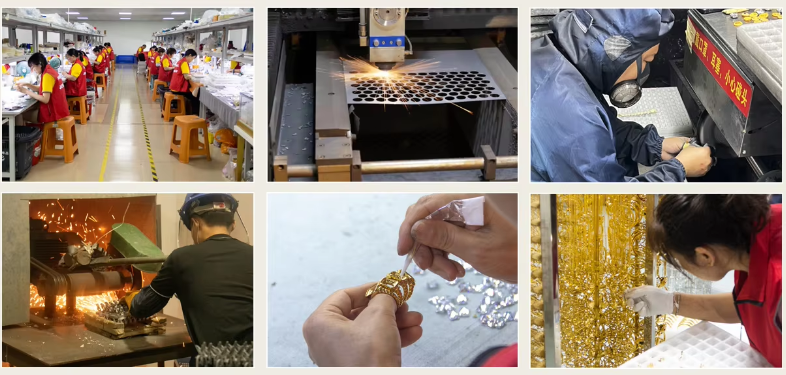
Process flow for the shortlisted formats: finishing, stone setting and logo application each sit at a defined inspection point rather than at the end of the line.
Finish, Engraving and Stone Options on the Shortlist
The shortlisted formats are offered in in-house PVD coating with more than 20 colours, in 18K gold electroplating, and with four in-house logo application methods — which is what makes a custom engraved stainless steel jewelry program feasible without a second subcontractor in the chain.
- Surface finishing. PVD coating and 18K gold electroplating are both handled in-house. Jusnova states batch-to-batch colour consistency at Delta E below 1.0 across PVD colours, a figure that matters most on repeat orders of the same SKU rather than on a first sample.
- Logo and engraving. Laser engraving, stamping, screen printing and epoxy doming, with a stated 2–3 day sample lead time. This is the capability behind personalized engraved stainless steel jewelry and custom logo programs, and it is what allows a PVD gold plated laser engraving jewelry line to be specified as one production route.
- Stone setting. Treated as a defined quality-control stage wherever a design includes stones, positioned between plating and logo application in the inspection sequence rather than handled as an afterthought.
- Size and packaging. Any ring size, chain length or bangle diameter; packaging from OPP bags to premium gift boxes, with hang tags and polishing cloths available as part of the same order.
The practical consequence for an EU buyer is fewer handoffs. Finish, engraving, assembly and final inspection sit inside one facility, so a colour change on an existing engraved bangle is a single process adjustment rather than a re-brief across suppliers.
Manufacturing Facts Behind the Shortlist
Jusnova Jewelry Co., Ltd was founded in 2009 and operates from Guangzhou, Guangdong, China, with a 1,000 m² facility, 300 employees including a 20-engineer R&D team, and reported annual output of 3,000,000 units — consistent with the stated monthly capacity of 250,000 units. Exports account for 95% of output, with Europe and America named as priority markets.
| Procurement parameter | Stated position |
|---|---|
| Minimum order quantity | 100 pcs/style |
| Production lead time | 25–30 days |
| Quality control | 8 inspection stages, from raw material incoming (IQC) through forming, polishing, pre-plating cleaning, plating or PVD, stone setting, logo engraving, to clasp and closure function |
| Acceptance criteria | Contract specification plus a physical sample approved and confirmed before mass production begins |
| Payment terms | PayPal or bank transfer |
| Logistics | Air freight via international courier or sea freight; quotes available on FOB, CIF or DDP terms |
| After-sales | Response within 24 hours; structured 6-step resolution process; manufacturing defects covered within 30 days of receipt; 6–12 month warranty; repair at material cost after warranty |
Supplier-reported figures. They are useful for screening a shortlist, but capacity, defect performance and on-time delivery should still be tested against the buyer's own forecast.
Which Format Fits Which Claim
Rope chain bracelets
Dense, multi-link construction means a high proportion of surface area is exposed to friction and moisture. For a waterproof stainless steel jewelry line sold in coastal or high-humidity markets, this is the format where finish performance is most visible — which makes the ISO 9227 salt spray record the deciding document rather than a supporting one.
Figaro chain bracelets
The alternating link pattern creates flatter, more readable surfaces, so plating uniformity and colour consistency are easier for a buyer to inspect on arrival. It suits unisex and gift-set programs where one SKU has to hold its appearance across repeat orders and reorders.
Engraved bangles
A broad face gives laser engraving room to work, which is why bangles carry most personalization programs — names, dates, initials, brand marks. The trade-off is contact area: a bangle sits against the wrist for extended periods, so the artificial sweat report and the 316L composition record carry more weight here than they would on a pendant.
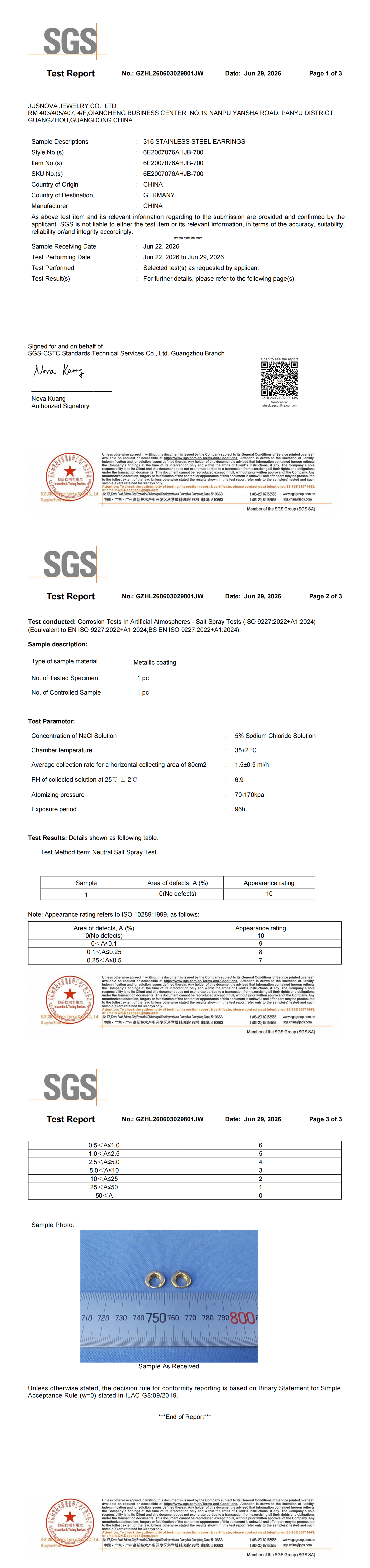
The salt spray record attached to product 5609: an accelerated corrosion test, not a lifetime guarantee.
Market Signal: Waterproof and Non-Tarnish Is Outgrowing the Category
The global stainless steel jewelry market was valued at USD 7.08 billion in 2025 and is projected to reach USD 10.8 billion by 2035, a CAGR of 4.3% (WiseGuyReports, 2026). Within that total, the waterproof jewelry segment is forecast to grow from USD 2.12 billion in 2026 to USD 4.60 billion by 2034 at a CAGR of 10.16% (Verified Market Reports, 2026) — more than twice the pace of the base category.
The implication for buyers is direct: demand is shifting toward the attribute set that certification can document. When a segment grows on a performance claim — waterproof, non-tarnish, hypoallergenic — suppliers who can evidence the claim hold the listing, and suppliers who cannot are pushed back into price competition.
The technical reason the claim is credible at all is coating hardness. Industry figures place PVD coatings at roughly 1,500–4,500 HV against approximately 100–200 HV for standard electroplating, which is the difference between a surface that resists abrasion in daily wear and one that does not. That gap is also why the finish decision and the certification decision are effectively the same decision.
Where This Shortlist Stops Working
Certified 316L with PVD is not the right answer for every brief, and the boundaries are specific rather than theoretical.
- Report scope is product-specific. The material content analysis and the salt spray record are attached to product code 5609 / GEN000516bhia-066. A new SKU in a different finish or a new stone configuration needs its own submission before a claim can travel with it.
- One record sits outside its stated window. The BSCI certification 25-0339245 (Amfori) is recorded with a validity of 15 August 2025 to 15 August 2026. For an order placed now, a buyer should request confirmation of the current audit cycle rather than accept the earlier certificate as evidence of present status.
- Lab tests are not warranties. ISO 9227 and ISO 3160-2 results describe behaviour under defined accelerated conditions. Jusnova's own performance statement — PVD luster stable for 2–5 years under normal wear, base steel usable beyond 10 years with proper daily maintenance — is a supplier statement about wear, not a contractual guarantee.
- Hardness data is category-level. The 1,500–4,500 HV range describes PVD coatings as a class of finish, not this supplier's measured output on a specific SKU.
- MOQ is per style. At 100 pcs/style, a broad assortment requires committed depth per design; a buyer testing twelve designs at minimum quantity commits to 1,200 units before any sell-through signal exists.
- Material economics differ from traditional base metal. 316L is a more expensive substrate than brass or copper and is harder to form, which changes tooling and unit economics relative to conventional electroplated base-metal jewelry. Where the brief is a very low-price impulse line on a short wear cycle, electroplated brass may remain the rational choice — provided the buyer accepts the shorter finish life and documents skin-contact compliance separately rather than assuming it.
Decision Shortlist by Buyer Scenario
| Buyer scenario | Suggested format | Documents that carry the claim | What to watch |
|---|---|---|---|
| Sensitive-skin or hypoallergenic line | Engraved bangle or rope chain bracelet in 316L | Artificial Sweat Test ISO 3160-2 (GZMR260602153701); 316L Material Content Analysis (GZIN2606005050ML01_EN) | Confirm the tested finish matches the colour and coating actually ordered |
| Coastal or high-humidity market | Rope chain bracelet in PVD finish | Salt Spray Test ISO 9227 (GZHL260603029801JW) | Accelerated testing is not a lifetime claim; avoid absolute wording in retail copy |
| EU retail chain or marketplace compliance | Any shortlisted format | BSCI 25-0339245 plus the full report pack | Verify the current BSCI audit cycle; the recorded window closes 15 August 2026 |
| Personalization or gifting DTC | Engraved bangle with laser engraving | 316L composition record plus a physical engraving sample | Lock engraving placement and depth in the approved sample before production |
| Private label or custom logo program | Figaro or rope chain with custom tag | Four in-house logo methods plus packaging coordination | Name the logo method explicitly in the order; the four methods are distinct processes |
Scenario mapping is a planning aid built from the formats and records listed in this article. It is not a substitute for legal review of claims in any specific EU member state.
Future Outlook
The direction of travel is toward dated, scoped evidence. As the waterproof and non-tarnish segment continues to outgrow the base category, retail buyers and marketplaces are converting performance claims into documentation requests — a shift that favours manufacturers already holding numbered reports over those who can only describe their process.
For suppliers, the operational implication is that certification becomes a production discipline rather than a marketing asset: reports expire, finishes change, and each new SKU resets the evidence clock. For buyers, the implication is simpler. A shortlist built on document scope and validity survives compliance review; one built on catalogue photography usually does not.
FAQ
What certifications should an EU buyer request for 316L stainless steel jewelry?
Four record types support an EU-facing order: a material content analysis identifying the alloy grade, a corrosion test such as salt spray to ISO 9227, a skin-contact test such as artificial sweat to ISO 3160-2, and a social-compliance audit such as Amfori BSCI. For Jusnova's product code 5609, the corresponding records are SGS GZIN2606005050ML01_EN citing ASTM A276/A276M-25, SGS GZHL260603029801JW to ISO 9227, SGS GZMR260602153701 to ISO 3160-2, and BSCI 25-0339245.
Can a supplier customize finish, engraving and packaging within one order?
Where those processes are in-house, yes. Jusnova offers PVD coating in more than 20 colours and 18K gold electroplating, four logo methods — laser engraving, stamping, screen printing and epoxy doming — with a stated 2–3 day sample lead time, and packaging from OPP bags to premium gift boxes with hang tags and polishing cloths. Size can be specified per market, including ring size, chain length and bangle diameter.
What are the minimum order quantity and lead time for custom stainless steel jewelry?
The stated MOQ is 100 pieces per style, with a typical production lead time of 25–30 days and monthly capacity of 250,000 units. Acceptance is based on contract specification plus a physical sample approved before mass production. Payment is by PayPal or bank transfer, and shipping can be quoted on FOB, CIF or DDP terms by air or sea freight.
How long does PVD coating last compared with electroplating?
Jusnova states that PVD vacuum plating maintains stable luster for 2–5 years under normal wear without fading or peeling, while the base stainless steel chain remains usable beyond 10 years with proper daily maintenance. Industry figures place PVD hardness at roughly 1,500–4,500 HV against approximately 100–200 HV for standard electroplating. These are performance statements about wear under normal conditions rather than a warranty period; the stated warranty runs 6–12 months.
Which format suits a sensitive-skin or high-humidity market best?
For sensitive-skin lines, formats with a large skin-contact area — engraved bangles in particular — benefit most from the artificial sweat report to ISO 3160-2 alongside the 316L material analysis. For coastal or high-humidity markets, rope chain bracelets in PVD finish are the format where the ISO 9227 salt spray record is most directly relevant. Both scenarios depend on the tested finish matching the finish actually ordered.
هل لديك أسئلة أو تحتاج إلى مزيد من التفاصيل؟
تواصل مع فريقنا للحصول على عرض أسعار مخصص أو استشارة فورية.
طلب عرض أسعار
املأ النموذج أدناه وسيتواصل معك فريقنا بعرض مقترح مخصص.
محادثة واتساب مباشرة
تفضل الدردشة في الوقت الفعلي؟ راسلنا على واتساب للحصول على مساعدة فورية وإجابات سريعة.
- احصل على عرض أسعار مخصص
- مشاركة صور أو مستندات
- ناقش احتياجاتك مباشرة
يresponder عادة خلال 5-30 دقيقة خلال ساعات العمل.