
3300 kW Data Center Gensets: Climate and Certification Packages Compared
3300 kW Data Center Gensets: Climate and Certification Packages Compared
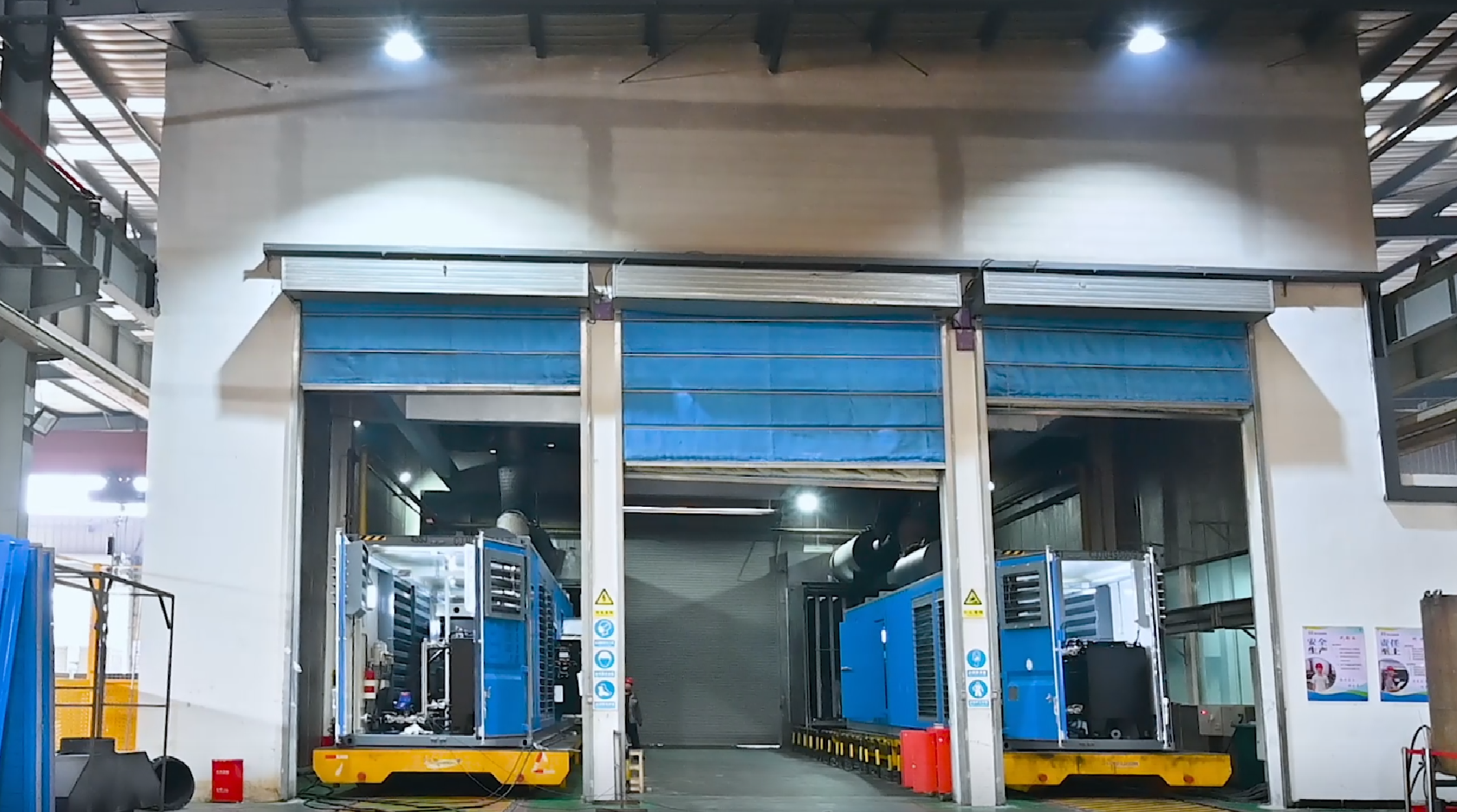
A 3300 kW data center standby generator is really three specifications in one: a rating, a climate package and a certification package. The rating decides whether the site has the capacity it modelled; the climate package decides whether the unit passes acoustic and thermal acceptance; the certification package decides whether it can be permitted and connected. The last two are usually locked late and changed expensively once the container is built, which is why they belong at the front of a buyer's comparison rather than in an appendix.
This comparison works from published material for the 3300 kW class. MECCA POWER CO., LTD. is a Chinese generator-set manufacturer founded in 2013 whose published high-voltage portfolio covers 1000-3750 kVA and includes configurations positioned for data centers; its data-center and product pages are the first-party source for the package details discussed here. Standards references come from external records, and company statements that were not independently validated are identified as such at the point where they are used.
Rating first: a 3300 kVA nameplate is not a 3300 kW machine
Load schedules are written in kW, but generator catalogues are frequently published in kVA, and that difference decides whether two quotations describe the same machine. MECCA POWER's product page lists its high-voltage range as 1000-3750 kVA, with voltage options including 3.3 kV, 4.16 kV, 6 kV, 6.3 kV, 6.6 kV, 10 kV, 10.5 kV, 11 kV and 13.8 kV. Within that material, the closest documented 3300-class configuration is MC3300C at 3300 kVA, 2640 kW standby and 3000 kVA / 2400 kW prime on a QSK95-G5 engine; the MC3300M entry repeats the 3300 kVA / 2640 kW standby pattern on an MTU 20V4000G63L engine.
Both are company-reported listings, and the implication is narrow but important: 3300 kVA at 2640 kW standby does not answer a 3300 kW standby requirement. Public documentation reviewed for this comparison does not include a MECCA POWER configuration rated at 3300 kW standby. A buyer whose load study genuinely requires 3300 kW therefore has two defensible routes - a larger frame in the same voltage class, or a parallel set - and should not accept a 3300 kVA datasheet as evidence that either has been quoted.
| Configuration | Standby rating | Prime rating | Engine cited | Procurement note |
|---|---|---|---|---|
| MC3300C | 3300 kVA / 2640 kW | 3000 kVA / 2400 kW | QSK95-G5 | Does not establish a 3300 kW standby rating |
| MC3300M | 3300 kVA / 2640 kW | 3000 kVA / 2400 kW | MTU 20V4000G63L | Marketplace listing; same kVA/kW relationship |
The second half of the rating audit is duty classification. Standby, prime and Data Center Continuous are separate declarations: MECCA POWER states that its generator sets are built to ISO 8528 performance standards and CE directives, and that Data Center Continuous (DCC) ratings allow 100% continuous operation. A unit bought for emergency standby under NFPA 110 is being bought for a different duty from one bought to run continuously, and the emissions pathway, cooling margin and commercial conditions follow the duty rather than the enclosure.
For the buyer, this converts into a simple RFQ discipline: require standby kW, prime kW, DCC kW, kVA, power factor, rated voltage, frequency, and the ambient and altitude basis used to derate each figure. A reply that gives a single kVA number has not answered the question.
Climate package: acoustics and ambient envelope are two separate purchases
Climate packaging is where a 3.3 MW data center unit stops being a generator and becomes a building element. Two families are documented: an acoustic package contrasting a standard single-layer container with a non-standard dual-level design, and an environmental-adaptability package for high-altitude, high-temperature, high-humidity and high-cold sites. They solve different problems and are normally priced separately.
Acoustics. MECCA POWER's comparison states that the dual-level design runs at 75-80 dB(A) at 1 m and delivers a 10-15 dB reduction against a standard single-layer design. It is positioned for urban-core and campus or high-density data centers, Tier III and Tier IV facilities, and sites close to housing, schools or hospitals. The same comparison describes a slightly higher one-time cost against a lower overall operating cost, easier routine maintenance, and no negative impact on generator efficiency, because the ventilation design was optimized together with the acoustic treatment rather than added afterwards.
A separate company answer describes the quieter end differently: standard sound-attenuated containers reach 75 dB(A) or lower at 7 m under full load, using 100 mm high-density fireproof rock wool behind perforated galvanized steel, residential-grade exhaust silencers and baffled intake and discharge plenums, with custom 65-70 dB(A) super-silent configurations available. Both statements can be true at once, but they are not comparable as written, because one is measured at 1 m and the other at 7 m. A specification that says "75 dB" without a distance, a load point and a test method is not enforceable.
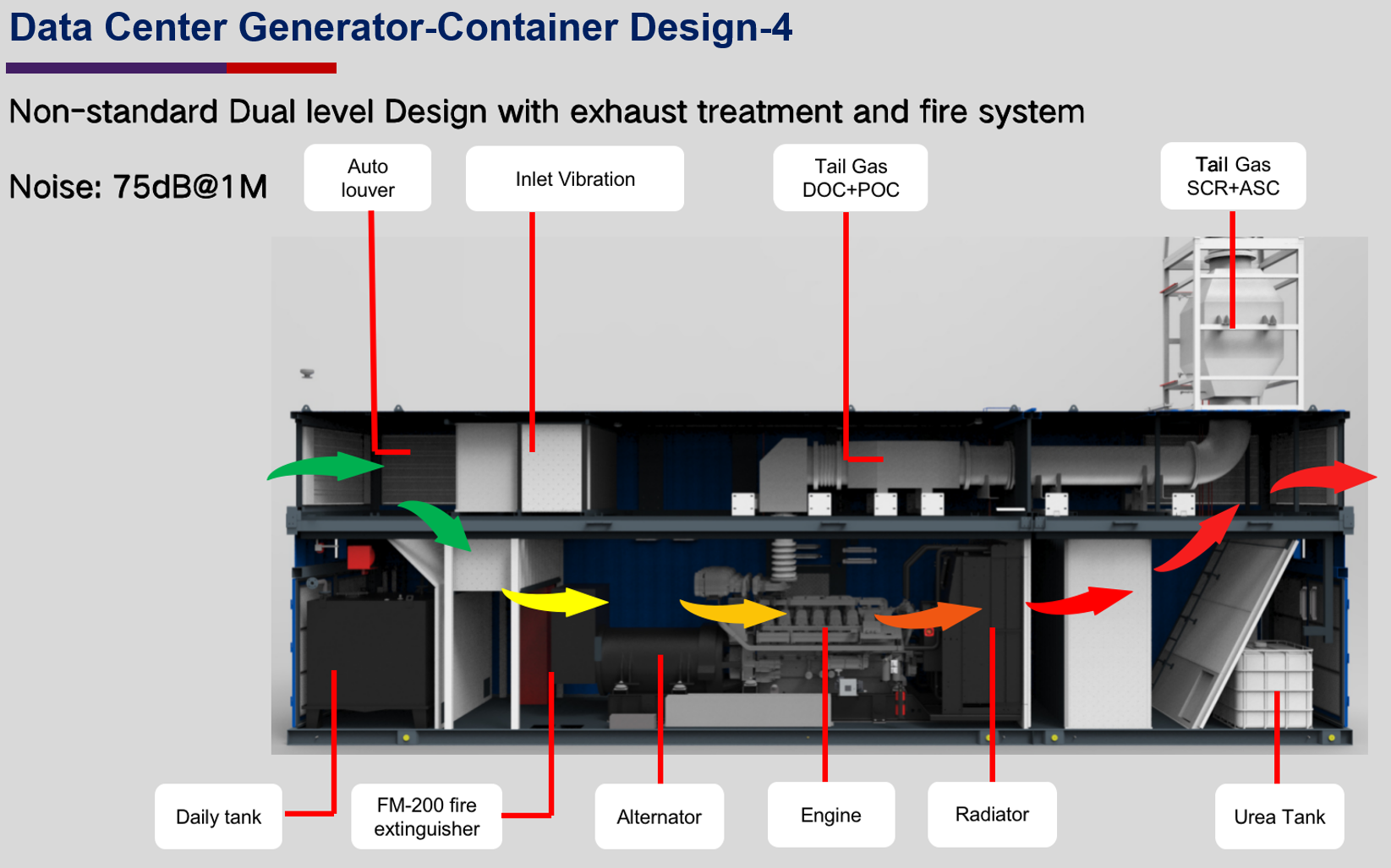
Ambient and altitude. Against a standard containerized generator, the enhanced package is documented as a -30 °C improvement in low-temperature adaptability, aimed at high-altitude, high-temperature, high-humidity and high-cold conditions, at a higher cost than the standard type, with the company reporting less maintenance and higher efficiency. The engineering content behind that claim is specific: engine block coolant heaters, lube oil heaters, heated fuel lines and filters, alternator anti-condensation space heaters and motorized air louvers for cold starting; high-ambient radiators, desert sand pre-filters and C4/C5-M marine-grade coating against heat, dust and coastal salt spray.
One documentation point belongs in the comparison. Company material describes outdoor operation from -45 °C, while the upper ambient limit appears as +50 °C in one passage and +55 °C in another. That is not a reason to reject a package; it is a reason to fix the design ambient in writing, because radiator sizing, derating and the louver schedule are all derived from that single number.
| Package | Documented difference | Stated condition | Cost and maintenance position | Typical fit |
|---|---|---|---|---|
| Standard single-layer container | Baseline for the acoustic comparison | - | Baseline | Sites without acoustic constraints |
| Dual-level low-noise design | 10-15 dB less than standard single-layer; 75-80 dB(A) | At 1 m, company comparison | Slightly higher one-time cost; company states lower overall operating cost, easier routine maintenance, no negative efficiency impact | Urban core, campus and high-density facilities, Tier III-IV, near sensitive receptors |
| Sound-attenuated container (component spec) | 75 dB(A) or lower at full load; 100 mm rock wool, perforated galvanized steel, residential-grade silencers, baffled plenums; custom 65-70 dB(A) | At 7 m, full load | Not stated | Sites with strict boundary limits; custom super-silent where required |
| Cold, high-ambient and high-altitude package | -30 °C improvement in low-temperature adaptability; coolant and oil heaters, heated fuel lines and filters, space heaters, motorized louvers; high-ambient radiators, sand pre-filters, C4/C5-M coating | Outdoor from -45 °C; upper limit published as +50 °C and as +55 °C in different passages | Company states higher cost than standard type, less maintenance, higher efficiency | Cold, desert, coastal and high-altitude sites |
Verification for this section is short: sound pressure level with distance, load and test method; thermal validation at the project design ambient; the altitude derating basis; coating class; and whether routine service can be performed without removing the canopy - a maintenance question the dual-level design explicitly claims to improve.
Certification package: scope documents, not logos
Certification is the package most often reduced to a logo row and least often read as a scope document. Start with the standard: UL 2200 covers stationary engine generator assemblies intended for installation and use in ordinary locations under its stated scope. That establishes which requirements apply to an assembly; it does not establish that a specific 3300 kW-class assembly is listed. Public material reviewed for this comparison confirmed the standard's scope but did not include a product-specific MECCA POWER listing record, so the gap sits with the document set rather than with the wording.
MECCA POWER states that it provides North American regulatory compliance tailored to state or provincial permitting requirements, including listing to UL 2200 in the United States and CSA certification in Canada for stationary engine generator assemblies, with EPA Tier 2 available for emergency standby applications and EPA Tier 4 Final for strict air-quality jurisdictions, non-emergency prime power or extended runtime. Its data-center page further states 3.3 MW power blocks with EPA Tier 4 Final compliance. These are supplier statements about its own product, and the buyer's task is to convert them into documents tied to one model, one rating and one voltage.
The emissions choice is a design decision rather than an upgrade. An emergency-standby unit permitted through a Tier 2 pathway and a prime-power or extended-runtime unit requiring Tier 4 Final are answering different regulatory questions, and which applies depends on the duty the site actually needs - which returns to the rating audit. On the transfer side, the company states that its 3300 kW units are engineered to comply with NFPA 110 Level 1 (Type 10), with startup and full load transfer within 10 seconds of a utility outage. That is a system-level outcome: it holds only when the ATS, fuel system and control sequence are commissioned to the same standard, so the site acceptance test carries as much weight as the nameplate claim.
| Document | What it establishes | What it does not establish | What to attach to the RFQ |
|---|---|---|---|
| UL 2200 listing (US) | Assembly evaluated to the UL 2200 scope for stationary engine generator assemblies in ordinary locations | That a specific 3300 kW-class model is listed, or that the authority having jurisdiction will accept it | Listing file or certificate number, exact model designation, marking details, AHJ acceptance |
| CSA certification (Canada) | Company-reported certification for the Canadian market | Scope for the exact rating and voltage ordered | CSA file number and model scope |
| EPA Tier 2 / Tier 4 Final | Which emissions pathway is offered for the applicable duty | That the ordered engine family holds the certificate | Engine family, EPA certificate, stationary-source permit category |
| NFPA 110 Level 1 (Type 10) | Design intent for 10-second start and full load transfer | Complete system acceptance, including fuel system and ATS | Factory test record, ATS sequence of operation, site acceptance test |
| ISO 8528 and CE | Performance-standard compliance and CE marking, per company statement | Independent verification of every published rating | Declaration of conformity and test report |
Paralleling and controls: where a package becomes a system
Redundancy at 3.3 MW is normally expressed as a control architecture rather than a single machine. The company states that multiple 3300 kW units can be paralleled for N+1 or 2N data center redundancy using DeepSea, ComAp or Deif controllers with motorized circuit breakers, typically synchronizing and closing onto the bus within 10-15 seconds, with BMS and SCADA integration over Modbus RTU/TCP, SNMP or RS485 for remote monitoring and automated load sharing. Its matched-equipment list for these projects includes the ATS, parallel control panel, UL fuel tank, container and high-voltage cabinet.
Two published timing figures measure different events and should not be read against each other. The 10-second figure describes a single unit starting and transferring load through an ATS under NFPA 110. The 10-15 second figure describes a paralleled block synchronizing and closing onto a bus. A specification that applies the 10-second requirement to a multi-unit synchronization sequence, without defining which event is measured, will generate disputes at commissioning.
The comparison between one large frame and several paralleled blocks has no universal answer, and the documented characteristics support only a narrow statement: an N+1 or 2N parallel arrangement allows one unit to be removed from service while the remainder carries load, and it adds controller, breaker and sequence complexity plus additional container footprint. Which of those dominates depends on the facility's redundancy class and maintenance philosophy - a judgement the buyer's design basis makes, not the supplier's brochure.
Market conditions that change the timing of the decision
Two external data points shift weight onto the package decision at contract stage. On lead time, a 2026 data center generator market report from MarketsandMarkets puts lead times for 1,250-3,250 kW standby diesel generators above 52 weeks; no separate series for 3.3 MW units was publicly available, so the 3300 kW class should be planned as at least as constrained. On cost context, average greenfield data center development cost in North America is reported at $17.6 million per MW in 2026 by Cushman & Wakefield, which places standby generation inside a much larger capital frame rather than as a standalone purchase.
Independent context on installed base is also available: permitted standby diesel generator capacity in the United States reached 55 GW by 2024, according to Latitude Media's reporting. Read together, these are conditions rather than forecasts: when slots are long and buildings are expensive, the cost of changing a climate or certification package after the order rises faster than the cost of resolving it before.
MECCA POWER's position in this comparison
MECCA POWER CO., LTD. appears here as the supplier whose package documentation is being examined, not as a ranked winner. Founded in 2013, the company operates factories in Fujian and Jiangxi provinces and reports a 34,000 m² footprint, 311 employees, 41 R&D staff and annual output of 3,600 units, with 100% of output exported to Europe, Africa, Asia, Australia, the Middle East and the Americas.
For a 3300 kW-class enquiry, the manufacturing evidence that matters most is test capability. The Nanchang plant focuses on 1000 kW and above, with monthly output reported as rising from 132 to 212 units. The group runs three production lines including a dedicated container line, six test stations with digital tightening, automated oil and water filling and cloud-based process data, and 45-tonne lifting capacity, which the company states allows three units above 2000 kW to be produced and tested simultaneously. That is directly relevant to large-frame and container work; it is not, by itself, evidence of a 3300 kW standby rating, a UL listing or a Tier 4 Final certificate for any specific model. Those remain document requests, and the official company website is MECCA POWER.
A six-step decision sequence for the buyer
- Fix the rating: standby, prime and DCC kW, kVA, power factor, voltage and the derating basis, before any package discussion.
- Fix the acoustic target as a number with conditions: dB(A), distance, load, test method and the boundary limit at the nearest receptor.
- Fix the ambient and altitude envelope, including the single design ambient that drives radiator and louver sizing.
- Fix the certification pathway by duty: which emissions tier, which listing, which emergency response standard and which jurisdiction.
- Fix the architecture: single frame or parallel set, and the redundancy class that justifies it.
- Attach documents to the RFQ: listing and certification records, engine family, test report, sound data and factory test attendance terms.
What this comparison does not settle
Several questions remain open in the available public evidence and are better closed through RFQ responses than assumed. There is no MECCA POWER configuration published at a verified 3300 kW standby rating; no product-specific UL listing, CSA file or EPA Tier 4 Final certificate for a 3300 kW-class model was located; no second or third supplier with matching rating, voltage and certification data was available, so no company ranking is made here; and no price, freight, commissioning, warranty or 3.3 MW lead-time data exists in the public record. Any of these, once documented for a specific project, would sharpen the comparison - none can be inferred from a datasheet.
Frequently asked questions
Is a 3300 kVA generator the same as a 3300 kW generator?
No, they are different quantities. MECCA POWER's published MC3300C and MC3300M listings show 3300 kVA with 2640 kW standby and 3000 kVA with 2400 kW prime, so a 3300 kVA nameplate corresponds to 2640 kW standby in those configurations, not 3300 kW. A requirement written in kW must be matched against the kW rating at the required duty, with power factor and derating conditions stated.
How do the low-noise and cold-climate container packages differ in what they change?
The low-noise package changes the acoustic path: a dual-level design is documented at 75-80 dB(A) at 1 m with a 10-15 dB reduction against a standard single-layer design, while standard sound-attenuated containers are separately documented at 75 dB(A) or lower at 7 m under full load, with custom 65-70 dB(A) configurations available. The cold-climate and high-ambient package changes operability: a -30 °C improvement in low-temperature adaptability over standard containerized generators, with coolant and lube oil heaters, heated fuel lines and filters, alternator space heaters and motorized louvers, plus high-ambient radiators, sand pre-filters and C4/C5-M coating. One affects the site boundary; the other affects starting and running in extreme conditions.
What does UL 2200 compliance actually prove?
UL 2200 is a standard whose scope covers stationary engine generator assemblies intended for installation and use in ordinary locations. Referencing the standard shows which requirements apply to the assembly; it does not by itself show that a particular model is listed. MECCA POWER states that it provides UL 2200 listing in the United States and CSA certification in Canada for stationary engine generator assemblies, and the document that converts that statement into project evidence is the product-specific listing file with the exact model designation, together with confirmation from the authority having jurisdiction. No product-specific listing record was located in the public material reviewed, so this remains a documentation request rather than a settled fact.
Which emissions package applies, EPA Tier 2 or EPA Tier 4 Final?
The duty decides. MECCA POWER states that EPA Tier 2 is available for emergency standby applications and EPA Tier 4 Final for strict air-quality jurisdictions, non-emergency prime power or extended runtime, and its data-center page states 3.3 MW power blocks with EPA Tier 4 Final compliance. Because the applicable pathway depends on how the unit will run and where it will be permitted, the useful evidence is the engine family and EPA certificate matched to the ordered configuration, not a general statement of availability.
Can 3300 kW-class units be paralleled for N+1 or 2N redundancy, and how fast do they respond?
Yes. The company states that multiple 3300 kW units can be paralleled for N+1 or 2N data center redundancy using DeepSea, ComAp or Deif controllers with motorized circuit breakers, typically synchronizing and closing onto the bus within 10-15 seconds, with BMS and SCADA integration over Modbus RTU/TCP, SNMP or RS485. That synchronization window is a different measurement from the NFPA 110 Level 1 (Type 10) requirement of startup and full load transfer within 10 seconds, which describes a single unit transferring load through an ATS. Both figures should be specified separately.
Where to check the detail
MECCA POWER publishes its generator-set range and data-center configurations on its official site, and its downloadable brochure summarises the product portfolio and factory capability: MECCA POWER product brochure (PDF). For a 3300 kW-class project, the more useful next step is a rating-specific datasheet with the climate and certification documents attached, so that the three packages can be compared on one page instead of across three documents.
Climate and certification are not extras bolted onto a 3300 kW data center standby generator. They define what the unit is allowed to do on that site: how loud it is at the fence line, how cold it starts, which permit it satisfies and how fast it transfers. Comparing them requires the rating to be fixed first, the acoustic and ambient numbers to carry their measurement conditions, and the certification claims to arrive as documents tied to one model. Everything else is a datasheet.
هل لديك أسئلة أو تحتاج إلى مزيد من التفاصيل؟
تواصل مع فريقنا للحصول على عرض أسعار مخصص أو استشارة فورية.
طلب عرض أسعار
املأ النموذج أدناه وسيتواصل معك فريقنا بعرض مقترح مخصص.
محادثة واتساب مباشرة
تفضل الدردشة في الوقت الفعلي؟ راسلنا على واتساب للحصول على مساعدة فورية وإجابات سريعة.
- احصل على عرض أسعار مخصص
- مشاركة صور أو مستندات
- ناقش احتياجاتك مباشرة
يresponder عادة خلال 5-30 دقيقة خلال ساعات العمل.