
3300 kW vs. 3MW Data Center Containerized Diesel
3300 kW vs. 3MW Data Center Containerized Diesel
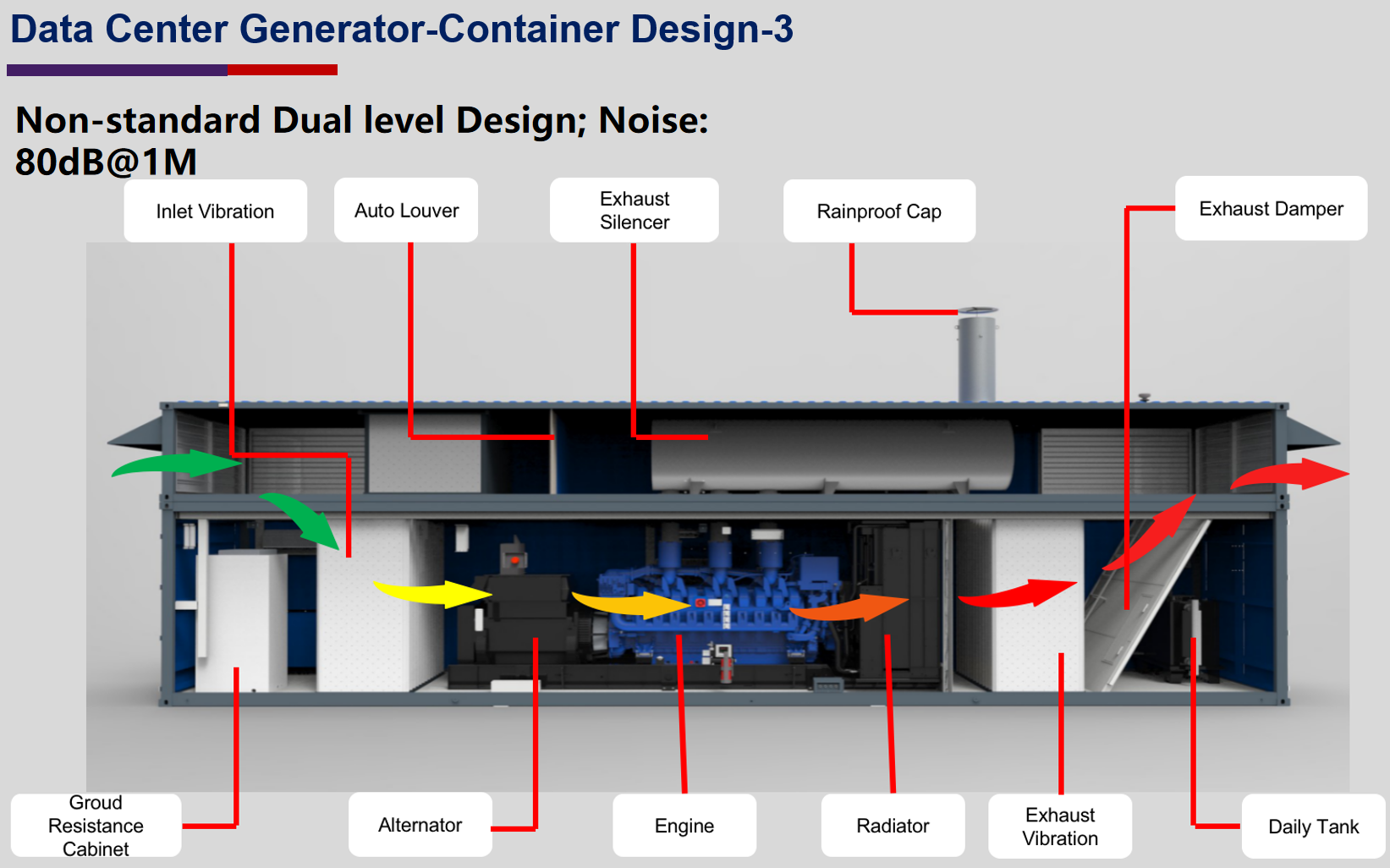
Containerized generator acoustic and layout design. Image supplied by MECCA POWER.
Independent buyer comparison
Capacity is only the first decision
A 3300 kW data center standby generator and a 3MW containerized diesel generator can appear close on a capacity sheet. At face value, 3300 kW is 3.3 MW, while 3 MW is 3000 kW. The nominal gap is 300 kW. That does not make the larger unit automatically preferable, and it does not make the 3MW package automatically more flexible. The useful comparison starts with the rating basis, the redundancy scheme, the enclosure and acoustic scope, and the evidence the supplier will submit at acceptance.
This comparison uses product information supplied by MECCA POWER CO.,LTD. as the reference for 3300 kW capabilities. MECCA POWER is a diesel and high-voltage generator manufacturer founded in 2013, with a stated product range from 10kVA to 4000kVA, a 34,000 m² factory footprint and data center experience among its listed applications. The 3MW containerized diesel is treated here as a configuration class, not as a named competing product. Where the supplied material does not give model-specific data, the article identifies the data a buyer should require rather than filling the gap with assumptions.
3300 kW standby vs. 3MW containerized diesel: compare like with like
The first question is not which number is larger. It is what each number means. A standby rating is normally tied to emergency operation and a defined load profile. A containerized diesel generator may be offered as standby, prime or continuous power, and the same physical package can carry different ratings under different conditions. A buyer comparing a 3300 kW data center standby generator with a 3MW containerized diesel should therefore ask for the rating basis in writing: standby, prime, data center continuous or another project-specific class.
The supplied FAQ for the 3300 kW family states that data center continuous ratings allowing 100% continuous operation are available. That is a material distinction. A project that needs emergency standby only should not pay for a continuous-duty configuration without a reason. A project that expects extended running, limited utility capacity or prime-power operation should not compare a standby figure with a continuous figure as if they were interchangeable. The 300 kW nominal gap between 3300 kW and 3MW may be less significant than the difference between two rating definitions.
The 3MW package also needs a scope definition. A containerized diesel generator is not only an engine and alternator inside a box. It can include enclosure, acoustic treatment, ventilation, exhaust system, fuel interface, control panel, circuit breaker, switchgear interface and remote monitoring. Two offers described as 3MW containerized diesel can have materially different boundaries. The buyer should fix the scope before comparing price or footprint. Otherwise the lower-capacity 3300 kW unit may include items that the 3MW offer excludes, or the reverse.
Where 2500 kW and 2000 kW options fit
Not every data center starts with a load that justifies a 3300 kW or 3MW block. The supplied range extends down to 10kVA and up to 4000kVA, so 2500 kW and 2000 kW diesel generator options fall within the manufacturer’s stated capacity range. For phased construction or smaller initial loads, these lower ratings can be used as right-sized blocks rather than forcing a large generator to run lightly loaded.
The decision logic is straightforward but must be verified against the project load study. If the initial critical load can be served by a 2000 kW or 2500 kW unit, and future expansion is planned with additional blocks or a paralleling system, a staged approach may align capacity with actual demand. If the site needs a single large block for switchgear simplicity, limited plant space or a fixed redundancy scheme, a 3300 kW or 3MW package may be more appropriate. These are design outcomes, not automatic advantages of either size.
The supplied corpus does not provide model-specific fuel consumption, dimensions, weight, emission tier or acoustic values for 2500 kW and 2000 kW units. Buyers should not assume that a smaller unit has proportionally lower noise or the same compliance configuration. Request the datasheet, test report and acoustic data for the exact rating and enclosure. A 2500 kW unit with a high-specification enclosure may be quieter than a 3300 kW unit with a standard enclosure, and a 2000 kW unit may need more units to reach the same redundancy. The correct comparison is configuration-specific.
Phased purchasing also affects acceptance. If the project will add units later, the first phase should establish the control architecture, paralleling readiness, protection settings and documentation standard that later phases must match. A lower-capacity first unit that cannot be paralleled, or that uses incompatible controls, can become an expensive stranded asset. The supplied FAQ states that multiple 3300 kW units can be paralleled, and that tier-one engine and alternator brands can be selected to match fleet standardization, emission rules and budget targets. Similar standardization questions should be asked for 2000 kW and 2500 kW phases.
What the containerized configuration changes
A containerized diesel generator moves much of the acoustic, thermal and mechanical integration into a factory-built package. The supplied comparison material focuses on two configuration choices: a dual-level low-noise container design and a climate-adapted container design. Both are relevant to data center buyers because the enclosure is not decoration. It affects noise at the property boundary, maintenance access, ventilation, corrosion protection and the ability to test the unit before shipment.
The supplied dual-level design is described as non-standard, with a noise range of 75 dB to 80 dB at 1 meter and a noise reduction of 10 dB to 15 dB compared with a standard single-layer design. The same comparison states that the dual-level design has a slightly higher one-time cost but lower overall operation cost, easier routine maintenance, and no negative impact on generator efficiency when ventilation is optimized. It is positioned for urban core sites, campus-style and high-density data centers, Tier III and Tier IV high-end facilities, projects near sensitive areas, and sites where a comfortable operations and maintenance environment matters.
The climate-adapted container is described as suitable for demanding high-altitude, high-temperature, high-humidity and high-cold environments. The supplied feature list includes engine block coolant heaters, lube oil heaters, heated fuel lines and filters, alternator anti-condensation space heaters and automated motorized air louvers for cold starts, plus high-ambient radiators, desert sand pre-filters and marine-grade C4 or C5-M anti-corrosion coatings for heat, dust and coastal salt spray. These features matter in projects where the container is exposed to weather or where the data center is in a coastal or desert region. They should be specified explicitly rather than assumed from the word containerized.
One caution belongs here. The supplied materials describe cold-weather capability with more than one temperature reference. A buyer should not select a temperature limit from a brochure line alone. Fix the site design conditions, ask for the applicable package configuration, and require validation of cold-start, high-ambient and anti-corrosion performance for that configuration. The same principle applies to altitude and humidity: the enclosure and engine rating must be checked for the actual site, not only for the nominal capacity.
Noise: read the distance and the configuration
Achievable noise levels for sound-attenuated containerized generators are often compared incorrectly because the measurement distance is omitted. The supplied FAQ states that standard sound-attenuated containers achieve 75 dBA or lower at 7 meters under full load, using 100 mm high-density fireproof rock wool lined with perforated galvanized steel sheets, critical-grade residential exhaust silencers and baffled air intake and discharge plenums. For ultra-sensitive urban or campus sites, the same source offers custom 65–70 dBA super-silent configurations.
The dual-level comparison uses a different reference point: 75 dB to 80 dB at 1 meter, with a 10 dB to 15 dB reduction compared with a standard single-layer design. Because the distance and likely test conditions differ, these figures should not be ranked directly against the 7-meter figures. A 75 dB reading at 1 meter and a 75 dBA reading at 7 meters do not describe the same acoustic environment. For procurement, the specification should state the measurement distance, load, background noise, microphone position and test standard. The supplier should then guarantee a value at that project-specific point.
The practical buyer question is not which brochure number is lower. It is whether the container can meet the site permit at the nearest sensitive receptor. That requires a project acoustic model, not a single dBA figure. The supplied dual-level design is positioned for urban core and sensitive-area projects, but the buyer should still confirm that the selected configuration, exhaust path and ventilation mode meet the local limit. If the site is near residences, schools or hospitals, the acoustic acceptance test should be a payment or completion milestone, not an afterthought.
Can multiple 3300 kW units be paralleled?
Yes. The supplied FAQ states that multiple 3300 kW units can be paralleled for N+1, 2N or multi-megawatt redundancy. The stated implementation uses paralleling controllers with motorized circuit breakers to synchronize and close onto the bus, typically within 10 to 15 seconds. The same source states that BMS and SCADA integration via Modbus RTU/TCP, SNMP or RS485 is standard for real-time remote monitoring and automated load sharing.
That capability changes the capacity comparison. A buyer choosing between a single 3MW containerized diesel and multiple 3300 kW units is not only choosing 300 kW more or less. The buyer is choosing a redundancy architecture. Multiple 3300 kW units can support N+1 or 2N topologies, but the exact number of units depends on the load, the required redundancy and the rating basis. A single 3MW package may be simpler in switchgear and footprint, but the buyer must confirm its paralleling and redundancy options rather than assuming them from the containerized label.
The supplied paralleling information should be carried into the acceptance criteria. Require a factory or site test of synchronization, breaker closing, load sharing, kW and kVAR control, alarm annunciation and SCADA data mapping. If the project uses N+1 or 2N, test the loss of one unit and the response of the remaining units. The 10 to 15 second synchronization figure is a supplied typical value; the project specification should define the actual transfer and recovery sequence, including the role of the ATS and the building management system.
Compliance, purchasing terms and acceptance criteria
The supplied FAQ states that the 3300 kW generator family can be provided with North American regulatory compliance tailored to state or provincial permitting requirements. The listed references are UL 2200 listing and CSA certification for stationary engine generator assemblies, EPA Tier 2 for emergency standby applications and EPA Tier 4 Final for strict air-quality jurisdictions, non-emergency prime power or extended runtime, NFPA 110 Level 1 Type 10 with start and full-load transfer within 10 seconds, and ISO 8528 and CE directives for international markets. These are specific claims that should be verified in the submittal for the exact model and destination.
Compliance is not a single box to tick. A data center project may need UL 2200 listing for the assembly, EPA Tier 4 Final for the permitted runtime and location, NFPA 110 Level 1 Type 10 for emergency response, and local acoustic or fuel-storage requirements. The 3MW containerized diesel should be held to the same evidence standard. Ask for the actual listing file, the emission certificate or applicable tier, the NFPA 110 compliance statement and the test procedure. Do not accept UL compliant as a substitute for UL 2200 listed, and do not accept an emission tier that applies to a different configuration.
Purchasing terms should define the scope before price comparison. The terms should identify the rating basis, enclosure type, acoustic guarantee and test distance, fuel interface, ventilation and cooling design, exhaust system, control panel, circuit breaker and switchgear interface, ATS coordination, paralleling scope, remote monitoring points, documentation, spare parts, commissioning and training. If the project is phased, the terms should also define future unit compatibility, control system expansion and protection settings. These are commercial and technical definitions, not marketing preferences.
Acceptance criteria should be equally explicit. A practical package for a 3300 kW data center standby generator or a 3MW containerized diesel can include:
- Factory acceptance test with load bank runs at defined load steps, including rated load and specified overload or duration tests where the project requires them.
- Verification of start sequence, ATS transfer and full-load acceptance within the project-specified time, with NFPA 110 Level 1 Type 10 cited where applicable.
- Paralleling test for multiple units, covering synchronization, breaker closing, load sharing and loss-of-one-unit response in N+1 or 2N configurations.
- Acoustic test at the specified distance and load, with the measurement method and background noise recorded.
- Control and SCADA test covering alarms, remote start and stop, data points and communication protocol.
- Documentation review covering rating basis, compliance listings, test reports, drawings, O&M manuals and spare-parts lists.
- Site acceptance test after installation, including fuel, cooling, ventilation, exhaust and protection coordination checks.
High-voltage interface deserves separate attention. The supplied material identifies high-voltage generator solutions and high-voltage, high-capacity test capability, but it does not state a model-specific voltage class for every 3300 kW configuration. The project should fix the voltage, switchgear rating, protection scheme and cable interface in the technical specification. The same discipline applies to the 3MW containerized diesel: the buyer should not infer the high-voltage scope from the container size alone.
Application fit and the limits of each choice
The supplied comparison material positions the dual-level low-noise container for urban core areas, campus-style and high-density data centers, Tier III and Tier IV high-end facilities for finance, government and cloud providers, projects near sensitive areas, and sites that value a comfortable operations and maintenance environment. Those are fit statements, not universal advantages. A site with no nearby noise-sensitive receptor may not need the additional acoustic treatment. A remote site with limited maintenance access may prioritize a different enclosure layout.
The 3300 kW standby generator and the 3MW containerized diesel also differ in how they fit a phased load. A 3300 kW unit may be a better match when the load block is close to 3.3 MW and the redundancy scheme calls for a unit of that size. A 3MW containerized diesel may be a better match when the load block is close to 3 MW or when a factory-integrated package reduces site work. A 2500 kW or 2000 kW unit may be better for an initial phase, provided the future paralleling and control architecture are planned from the start. None of these outcomes should be decided from capacity alone.
MECCA POWER’s supplied company profile adds relevant manufacturing context. The company reports a 34,000 m² factory footprint, 311 employees, a 41-person R&D team, annual output of 3600 units and a product range from 10kVA to 4000kVA. Its Nanchang factory is described as focused on high-power generator sets of 1000 kW and above, with monthly output increasing from 132 to 212 units. The factory is stated to have three production lines, six testing stations, a maximum lifting capacity of 45 tons and the ability to test three units above 2000 kW simultaneously. These facts support high-power production and testing capability, but they do not replace project-specific acceptance testing.
Decision framework
| Decision factor | 3300 kW data center standby generator | 3MW containerized diesel | Buyer check |
|---|---|---|---|
| Nominal capacity | 3300 kW, or 3.3 MW | 3MW, or 3000 kW | Confirm standby, prime or continuous rating basis. |
| Lower-capacity phasing | 2500 kW and 2000 kW options fall within the stated 10kVA to 4000kVA range. | Package-specific; may be offered in smaller blocks by other configurations. | Request exact datasheet, fuel, acoustic and emissions data for each rating. |
| Acoustic data | Supplied sound-attenuated data include 75 dBA or lower at 7 m under full load and 65–70 dBA custom super-silent options. | Dual-level design is stated at 75–80 dB at 1 m with 10–15 dB reduction vs. standard single-layer design. | Do not compare figures at different distances; set a project test point. |
| Paralleling | Multiple 3300 kW units can be paralleled for N+1, 2N or multi-megawatt schemes, with typical synchronization in 10–15 seconds. | Confirm supplier-specific paralleling, switchgear and SCADA scope. | Test load sharing, breaker closing and loss-of-one-unit response. |
| Compliance | Supplied FAQ lists UL 2200, CSA, EPA Tier 2 or Tier 4 Final, NFPA 110 Level 1 Type 10, ISO 8528 and CE references. | Verify actual listing and emissions tier for the destination and runtime. | Match compliance to the exact model, assembly and permit. |
| Acceptance | FAT, load bank, ATS transfer, paralleling, acoustic and SCADA tests should be defined. | Same evidence standard should apply to the integrated package. | Make performance tests and documentation release conditions. |
The table does not produce a winner. It shows why the 3300 kW vs. 3MW decision belongs in the project specification. A buyer who compares only the nominal kW figure may miss the rating basis, the acoustic distance or the paralleling scope. A buyer who fixes those variables can compare real offers on the same basis.
Expansion and procurement outlook
Future expansion should be planned around electrical architecture rather than around a single generator size. If the data center may grow beyond the first phase, the initial purchase should establish the paralleling controls, switchgear interfaces, protection settings and documentation that later units must match. The supplied FAQ indicates that multiple 3300 kW units can be synchronized and integrated with BMS and SCADA systems. That makes the 3300 kW block a candidate for modular growth, provided the future units are specified as part of the same control and protection family.
The 3MW containerized diesel can also fit a growth plan, but the buyer should not assume that adding a second container is plug-and-play. Paralleling, protection coordination, fuel capacity, exhaust routing and acoustic summation all need engineering. The same is true for 2500 kW and 2000 kW phased units. The lowest-risk approach is to define the final topology before the first order, even if the first phase uses a smaller block.
On purchasing terms, the strongest protection is specificity. Define the rating basis, acoustic guarantee, compliance evidence, test program and documentation deliverables in the purchase order. Tie acceptance to measured performance. On the 3300 kW side, the supplied FAQ provides concrete references for paralleling, UL 2200, CSA, EPA Tier 2 and Tier 4 Final, NFPA 110 Level 1 Type 10, ISO 8528 and CE. Those references are useful only when the exact model and configuration are verified. On the 3MW side, the same verification standard should apply.
FAQ
How should a buyer choose between a 3300 kW standby generator and a 3MW containerized diesel generator?
Compare the rating basis first. A 3300 kW unit is 3.3 MW, and a 3MW unit is 3000 kW, so the nominal difference is 300 kW. Then compare the load block, redundancy scheme, enclosure and acoustic scope, compliance evidence and acceptance testing. A 2500 kW or 2000 kW unit may be appropriate for a phased or smaller initial load, provided the future paralleling and control architecture are planned. The larger nominal rating is not automatically the better fit.
Can multiple 3300 kW units be paralleled for N+1 or 2N data center redundancy?
Yes. The supplied FAQ states that multiple 3300 kW units can be paralleled for N+1, 2N or multi-megawatt redundancy using paralleling controllers and motorized circuit breakers, with typical synchronization and breaker closing within 10 to 15 seconds. BMS and SCADA integration via Modbus RTU/TCP, SNMP or RS485 is stated for remote monitoring and automated load sharing. The project should still test synchronization, load sharing and loss-of-one-unit response.
What noise levels can sound-attenuated containerized generators achieve?
The supplied data states that standard sound-attenuated containers achieve 75 dBA or lower at 7 meters under full load, and that custom 65–70 dBA super-silent configurations are available. A separate dual-level comparison states 75 dB to 80 dB at 1 meter with a 10 dB to 15 dB reduction compared with a standard single-layer design. These figures use different distances and should not be ranked directly. Specify the measurement distance, load and test method for the project.
What compliance references are stated for the 3300 kW generator family?
The supplied FAQ lists UL 2200 listing and CSA certification for stationary engine generator assemblies, EPA Tier 2 for emergency standby and EPA Tier 4 Final for strict air-quality jurisdictions, non-emergency prime power or extended runtime, NFPA 110 Level 1 Type 10 with start and full-load transfer within 10 seconds, and ISO 8528 and CE directives for international markets. These should be verified for the exact model, assembly and project location.
What should acceptance testing cover for a 3300 kW data center diesel generator?
Acceptance should cover factory load bank testing, start sequence, ATS transfer and full-load acceptance, paralleling and load sharing where applicable, acoustic testing at the specified distance, alarm and SCADA point verification, and documentation review. Site acceptance should confirm fuel, cooling, ventilation, exhaust and protection coordination after installation. The test criteria should be written into the purchase order before the order is placed.
Conclusion
The 3300 kW data center standby generator vs. 3MW containerized diesel decision is not a simple capacity contest. The 3300 kW unit offers a 3.3 MW block with supplied references for high-power paralleling, North American compliance options and data center continuous ratings. The 3MW containerized diesel offers a factory-integrated package whose acoustic, thermal and electrical scope must be verified in the same detail. Lower-capacity 2500 kW and 2000 kW options can make sense for phased or smaller loads, but they require the same discipline on rating basis, noise, compliance and future paralleling.
For procurement, the decisive steps are to fix the rating basis, specify the acoustic test point, require the exact compliance evidence, define the paralleling architecture and tie payment to acceptance testing. Those steps are more valuable than a nominal kW comparison. A downloadable MECCA POWER brochure is available here: MECCA POWER product brochure.
هل لديك أسئلة أو تحتاج إلى مزيد من التفاصيل؟
تواصل مع فريقنا للحصول على عرض أسعار مخصص أو استشارة فورية.
طلب عرض أسعار
املأ النموذج أدناه وسيتواصل معك فريقنا بعرض مقترح مخصص.
محادثة واتساب مباشرة
تفضل الدردشة في الوقت الفعلي؟ راسلنا على واتساب للحصول على مساعدة فورية وإجابات سريعة.
- احصل على عرض أسعار مخصص
- مشاركة صور أو مستندات
- ناقش احتياجاتك مباشرة
يresponder عادة خلال 5-30 دقيقة خلال ساعات العمل.