
38CrMoAlA Nitrided Alloy Steel: Extruder Quality Benchmark
Capacity is the easiest thing to compare in a plastic extrusion machine quotation, and metallurgy is the hardest. Two extruders can carry the same screw diameter, the same L/D ratio and the same nominal output while differing in the component that spends every production hour in contact with hot, filled and abrasive melt. For buyers at the evaluation stage, the declared screw and barrel material is one of the few specification items that can be read, checked and compared before any purchase commitment is made — provided the buyer knows exactly what the designation covers.
This industry reference examines one such designation, 38CrMoAlA nitrided alloy steel, as it appears in the screw and barrel specifications of the SJ single-screw and SJSZ conical twin-screw extruders built by Wuxi JKS Machinery Manufacturing Co. Ltd. (JKS), a Chinese manufacturer founded in 2013 and based in Wuxi, Jiangsu Province that specialises in custom plastic extrusion machinery and complete turnkey production lines. The purpose is not to promote a material grade but to explain what it defines at component level, what it does not define, and how it functions as a benchmark when assessing machine compliance and long-term operational integrity.
Why screw and barrel metallurgy moved into the procurement conversation
Extrusion is a forming process that behaves like a wear process. Inside the barrel a screw rotates continuously against a filled polymer compound at elevated temperature and pressure. In rigid PVC production the compound is typically PVC resin combined with calcium carbonate filler and additives, and the filler content that makes the finished product stiff and dimensionally stable is also the content that abrades the metal surfaces moving against it.
Wear rarely announces itself as a single failure. It appears first as a slow drift in output, then as variation in product thickness, then as higher energy consumption per kilogram of finished material, and finally as an unplanned screw and barrel replacement. Because the screw and barrel sit at the centre of that chain, the material from which they are made has moved from a maintenance footnote to an evaluation criterion, particularly for buyers planning multiple shifts, continuous operation or high-filler formulations.
The practical difficulty is that screw and barrel quality cannot be assessed from a catalogue photograph. A buyer can inspect a frame, count motors and read a control panel, but the metal inside the barrel cannot be judged by eye. What can be assessed is the material declaration: the base steel grade, the surface treatment, and whether those two items are documented consistently for the exact model being quoted.
What 38CrMoAlA nitrided alloy steel actually specifies
38CrMoAlA is a nitriding-grade alloy steel of the Chinese GB designation system. It is widely described in metallurgical references as an aluminium-bearing chromium-molybdenum steel formulated specifically so that its surface accepts nitrogen during a nitriding heat treatment, producing a hardened wear-resistant case over a tougher core. In extruder construction it is applied to the two components that largely define a machine working life: the screw and the barrel.
The designation therefore carries three separate pieces of information, and it is worth separating them:
- The base steel grade, 38CrMoAlA, selected for how it responds to nitriding.
- The surface treatment, nitriding, a nitrogen diffusion process that hardens the surface rather than the whole section.
- The intended function, a screw and barrel surface designed to resist abrasion from filled compounds over long production runs.
Nitriding is generally performed at a lower process temperature than carburising, which is one reason it suits long, slender extruder screws: lower processing temperature generally means less distortion of a geometry that has to remain dimensionally accurate along its full length. The result is a component with a hard working surface and a core that retains toughness.
What the designation does not specify is equally important. The grade name does not fix case depth, the hardness profile through the case, or service life. Those depend on the specific heat treatment cycle applied and on the formulation the machine runs. A buyer who needs those values has to request them as a separate item, and a supplier able to state them is a supplier whose specification is more than a label.
How widely the grade is applied across the JKS extruder range
One useful signal in a machine specification is consistency: whether a material standard is applied across a manufacturer range or reserved for a single flagship model. In the JKS documentation, 38CrMoAlA nitrided alloy steel is the stated screw and barrel material for the standalone extruders and for most of the complete production lines, from small profile machines through to large-diameter pipe and flooring lines.
| Extruder or production line | Stated models | Stated screw and barrel material | Other stated structural materials |
|---|---|---|---|
| Conical twin screw plastic extruder | SJSZ-45, 51, 55, 65, 80, 92, 110 | 38CrMoAlA nitrided alloy steel | Machine frame: Q235 carbon steel |
| Single screw plastic extruder | SJ30, SJ45, SJ65, SJ90 (custom models) | 38CrMoAlA nitrided alloy steel | Machine frame: Q235 carbon steel |
| SPC flooring extrusion line | SJSZ92/188, SJSZ110/220, SJP115/30, SJP135/30 | 38CrMoAlA nitrided alloy steel | Calender roller: 45# forged steel with hard chrome plating; frame: Q235 |
| PVC imitation marble sheet extrusion line | SJSZ80/156, SJSZ92/188 | 38CrMoAlA nitrided alloy steel | Calender roller: forged steel with hard chrome plating; frame: Q235 |
| PVC and WPC foam board extrusion line | SJSZ80/156, 80+165 co-extrusion | 38CrMoAlA nitrided alloy steel | Calender roller: forged steel with hard chrome plating; frame: Q235 |
| PP hollow construction formwork extrusion line | SJ-130x33, SJ-90x33 | 38CrMoAlA nitrided alloy steel | Mould: forged refined die steel; frame: Q235 |
| PVC water supply and drainage pipe line | PVC63, PVC250, PVC630 | 38CrMoAlA nitrided alloy steel | Mould: precision casting die steel; frame: Q235 |
| HDPE water pipe extrusion line | PE110, PE315, PE630, PE1000, PE1600 | 38CrMoAlA nitrided alloy steel | Mould: forged alloy die steel; frame: Q235 |
| Steel wire mesh reinforced composite pipe line | GS/PE-160-H to GS/PE-630-H | 38CrMoAlA nitrided alloy steel | Mould: refined wear-resistant die steel; frame: Q235 |
| PPR pipe extrusion line | PPR20-75, PPR20-110 | 38CrMoAlA nitrided alloy steel | Mould: high precision die steel; frame: Q235 |
| MPP and PE high voltage power pipe line | PEG63, PG160 | 38CrMoAlA nitrided alloy steel | Mould: wear-resistant alloy die steel; frame: Q235 |
| PVC hollow wall panel and ceiling line | SJSZ51, SJSZ55, SJSZ65, SJSZ80 | 38CrMoAlA nitrided alloy steel | Mould: wear-resistant alloy die steel; frame: Q235 |
| PVC grille and decoration profile line | SJSZ51, SJSZ55, SJSZ65 | 38CrMoAlA nitrided alloy steel | Mould: wear-resistant alloy die steel; frame: Q235 |
| PVC and WPC door and window profile line | SJSZ92/188, SJSZ65/132 | 38CrMoAlA nitrided alloy steel | Mould: wear-resistant alloy die steel; frame: Q235 |
| Solid plastic rod extrusion line | SJ45, SJ65 | 38CrMoAlA nitrided alloy steel | Mould: wear-resistant alloy die steel; frame: Q235 |
| Multi-material plastic profile line | SJ45, SJ50, SJ65 | 38CrMoAlA nitrided alloy steel | Profile mould: wear-resistant alloy steel; frame: Q235 |
| PVC hot-cut pelletizing line | SJSZ55, SJSZ65, SJSZ80, SJSZ92 | 38CrMoAlA nitrided alloy steel | Pelletizing die: wear-resistant alloy steel; frame: Q235 |
| Plastic strand cutting pelletizing line | ST80, ST100, ST120, ST150 | 38CrMoAlA nitrided alloy steel | Pelletizing die: wear-resistant alloy steel; frame: Q235 |
| WPC door panel extrusion line | SJSZ80, SJSZ92 | Nitrided alloy steel (base grade not designated in the published parameter set) | Mould: hardened steel with chrome plating; frame: carbon steel |
Two documentation details are worth noting. First, the WPC door panel extrusion line lists its screw and barrel as nitrided alloy steel without naming a base grade in the published parameter set; where a grade is not designated, the specification should be confirmed in the order documentation. Second, the corrugated pipe extrusion range publishes its corrugation mould as wear-resistant alloy steel and its frame as Q235 carbon steel, without stating a screw and barrel grade in the published data. Neither is unusual in the industry, but both illustrate the same discipline: a material declaration should be verified against the exact model on the quotation, not assumed from a range-level statement.
The same grade also anchors the supporting equipment that determines how consistent the feed to the extruder is. The SRL-Z mixing and cooling units use stainless steel mixing pots on carbon steel frames, while the MF series pulverisers and SP series crushers specify wear-resistant steel for their grinding chambers, rotors, cutting chambers and blades: components that face the same abrasive duty as the screw and barrel, one process step earlier.
Compliance is layered: material grade, machinery certification, factory verification
Compliance in extrusion machinery is not a single document. It is at least three layers, and each answers a different question. Treating them as interchangeable is one of the more common evaluation errors.
Layer one: the component declaration
The material specification tells a buyer what the screw and barrel are made of and how the working surface is treated. It is a component-level statement. It says nothing about electrical safety, guarding, control reliability or electromagnetic compatibility, and it should never be presented as evidence of machine-level conformity.
Layer two: machine-level conformity
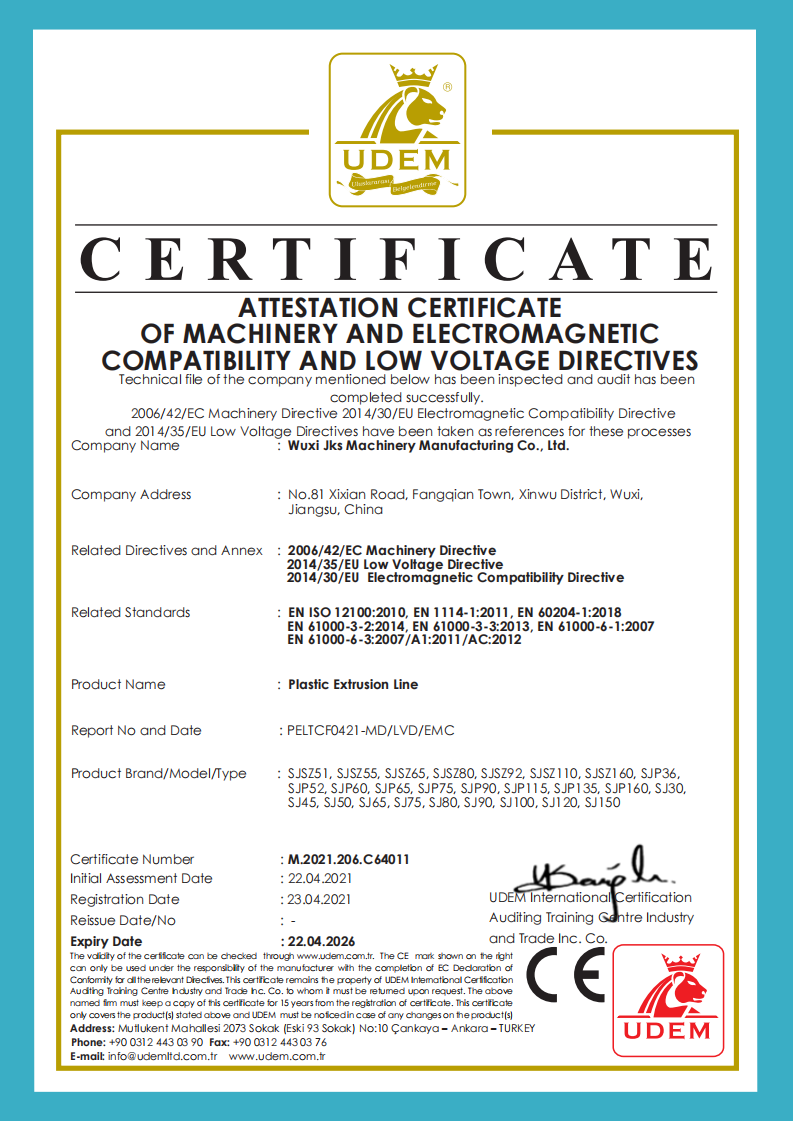
Machine-level conformity is addressed by certification. JKS plastic extrusion lines are covered by CE certificate M.2021.206.C.64011, issued on 22 April 2021 by UDEM International Certification Auditing Training Centre, with a certification scope covering plastic extrusion lines including the SJSZ series, SJ series and SJP series models. The certificate references EN ISO 12100:2010, the general machinery safety and risk assessment standard; EN 1114-1:2011, the European safety standard for extruders and extrusion lines; EN 60204-1:2018, covering the electrical equipment of machines; and the electromagnetic compatibility standards EN 61000-3-2:2014, EN 61000-3-3:2013, EN 61000-6-1:2007 and EN 61000-6-3:2007/A1:2011/AC:2012.
Read carefully, that certificate addresses the safety of the machine as a system: mechanical hazard control, electrical design, harmonic current limits, voltage fluctuation limits, and generic immunity and emission behaviour. It does not certify screw metallurgy, and screw metallurgy does not substitute for it. Both layers matter, and each is verified independently of the other.
A practical point follows for buyers in EU-bound or EU-comparable markets: certification documents carry a scope, an issuing authority, an issue date and a validity period. Confirming that a certificate covers the exact series and model being ordered, and that it is current at the time of the order, is routine due diligence rather than a sign of distrust.
Layer three: factory verification and after-sales support
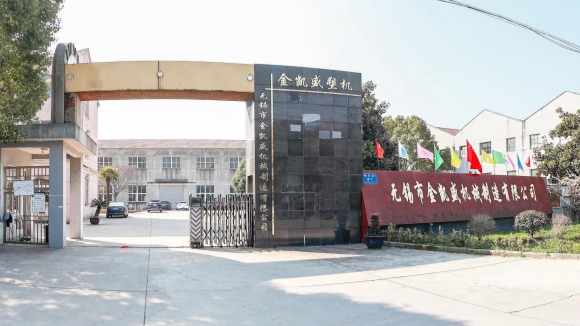
The third layer is what happens to the machine before and after shipment. JKS states that every unit undergoes 100 percent factory pre-assembly and testing before shipment, with third-party inspection available on request. Standard commercial terms include a minimum order quantity of one unit and a lead time of 40 working days, against a monthly capacity of 30 units. After delivery, the support package covers overseas installation guidance, on-site commissioning, operator training, remote technical support and a 12-month warranty.
For an evaluation-stage buyer, this layer is what turns a material claim into a verifiable one. A screw and barrel specification that cannot be traced to a pre-shipment test record, an inspection report or a declared warranty term remains an assertion rather than evidence.
Where the specification matters most: applications and production records
Filled and rigid PVC production
The applications with the heaviest abrasion duty in the JKS range are the rigid and filled PVC lines. The SPC flooring extrusion line runs a PVC and calcium carbonate compound at 1 to 10 mm finished thickness, 980 mm or 1250 mm effective width, and a stated output range of 15 to 40 tonnes per 24 hours depending on the extruder model. The PVC imitation marble sheet line runs a comparable compound at 1 to 12 mm thickness, 1220 mm width and 400 to 700 kg/h. The PVC hollow wall panel and ceiling line scales from SJSZ51 at 18.5 kW, 300 mm width and 120 kg/h, through to SJSZ80 at 55 kW, 1200 mm width and 400 kg/h. The PVC pipe range covers PVC63 at 270 kg/h, PVC250 at 450 kg/h and PVC630 at 800 kg/h.
Every one of those lines specifies 38CrMoAlA nitrided alloy steel for the screw and barrel. That consistency is the point: the specification is applied to high-volume flooring and sheet lines and to smaller profile lines alike, rather than being reserved for a premium tier.
Recycled and engineering materials
Wear duty is not limited to virgin filled compounds. The PP hollow construction formwork line processes recycled PP granule with an MFI below 3, at an extruder output of 500 to 600 kg/h on the SJ130 configuration and 180 to 250 kg/h on the SJ90 configuration. The solid plastic rod line covers PP, PE, PA and POM across rod diameters from 6 mm to 200 mm, and the multi-material profile line handles PP, PE, PVC, PS, PC and ABS. Recycled feedstock and engineering polymers both place demands on the screw surface, and the same base specification is applied to them.
Documented long-run operation
Material specifications describe intent; production records describe outcome. Three installations documented by JKS illustrate how complete lines built to these specifications perform over multi-year horizons.
- A PVC hollow wall panel extrusion line in Vietnam has been in stable operation for more than five years, producing panels for construction and interior decoration with continuous production, consistent product quality and reliable performance. The project was delivered as a complete turnkey solution with on-site installation support and full export documentation.
- An SPC flooring extrusion line in Malaysia has operated stably for more than ten years, producing flooring for residential and commercial use with high-speed production, precise thickness control and a low maintenance rate, supported by on-site installation and training.
- An SPC flooring line in South Korea has run for more than eight years, including 24/7 production, with consistent quality, low maintenance and precise thickness control, backed by after-sales support.
A note on interpretation: production records describe installed lines, not individual component lifetimes. Screw and barrel service life is a function of compound formulation, filler content and type, throughput, temperature profile, cleaning and handling practice, and refurbishment policy. Case records are evidence of line-level reliability and should be combined with the buyer own operating data when estimating wear intervals.
Market trend analysis: volume growth raises the wear duty
Market data gives context to why a metallurgical detail has become a commercial question. The global plastic extrusion machinery market was valued at approximately USD 8.93 billion in 2024 and is projected to reach USD 11.58 billion by 2030, according to Grand View Research. Asia Pacific accounted for 41.5 percent of revenue share in 2024, with China the leading contributor in the region, and single-screw extrusion machines held approximately 62.7 percent of the global market in the same year.
Product-level data points in the same direction. The pipe extrusion lines market was valued at USD 4.8 billion in 2025, with PVC the leading material segment at 38.6 percent, according to Dataintelo. Grand View Research projects the stone plastic composite flooring market growing from USD 6.4 billion in 2026 to USD 10.3 billion by 2033, a 7.2 percent CAGR.
Two conclusions follow for buyers. First, the fastest-growing product categories, PVC pipe and SPC flooring, are precisely the filled-PVC categories in which the screw and barrel face the highest abrasion duty. As installed capacity in those categories grows, the number of machine hours in contact with abrasive compound grows with it. Second, published market-size estimates vary considerably by source scope: Market Research Future estimated the market at USD 7.525 billion for 2024 and Dataintelo at USD 15.17 billion for 2025, differences that reflect how narrowly each analyst defines the equipment perimeter. Such figures are best treated as directional, with the buyer own application data used for sizing decisions.
On the competitive landscape, published industry lists of leading global manufacturers in the plastic extrusion space for 2024 include Coperion, KraussMaffei, Davis-Standard and Jwell Machinery. The market therefore spans large international groups and specialised regional builders, and the criteria that separate them increasingly include documented material specifications and verifiable compliance scope rather than capacity figures alone.
Comparison with conventional solutions: what nitrided alloy steel does, and where it stops
Comparing screw and barrel options is simpler when the comparison is framed by hardening approach rather than by brand.
| Approach | General characteristics | Where it fits, and where it stops |
|---|---|---|
| Unhardened carbon or low-alloy steel screw and barrel | Lower material and processing cost; no dedicated wear-resistant surface layer | Adequate for low-fill, low-duty or intermittent production; generally the first configuration to show surface wear under abrasive filled compounds |
| Through-hardened alloy steel | Hardness distributed through the section rather than concentrated at the surface | Provides bulk strength; generally lower surface wear resistance at the working surface than a nitrided case |
| 38CrMoAlA nitrided alloy steel | Nitriding-grade alloy steel with a hardened surface case over a tougher core; nitriding generally involves lower process temperature and less distortion than carburising | Suited to continuous production of filled PVC and to long screws that must stay dimensionally accurate; benefits are tied to the case rather than to the whole section |
The boundaries of the nitrided approach matter as much as its advantages, and buyers should evaluate them explicitly.
- The hardening is a case, not a bulk property. The wear benefit is concentrated in the surface layer, and that layer is consumed or removed over time in service and refurbishment.
- Regrinding changes the specification. When a worn screw is reground, the nitrided case is reduced or removed, and the screw no longer carries the same surface specification unless it is re-treated. Refurbishment policy is therefore lifecycle planning, not an afterthought.
- Nitrided cases are generally shallower than carburised cases. That trade-off buys lower distortion and dimensional accuracy at the cost of less depth of wear reserve.
- Abrasion resistance is finite and formulation-dependent. Very high filler loadings, aggressive fillers or contaminated regrind accelerate wear regardless of the declared grade.
- Case-hardened surfaces are sensitive to impact and rough handling. Mechanical damage to the working surface is not repaired by specifying a better grade, and on-site cleaning and handling practice directly affects surface condition.
- The grade does not fix the heat treatment. Two screws of the same grade processed through different nitriding cycles can perform differently, which is why the heat treatment specification belongs in the purchase documentation.
- The grade is not always economically necessary. For low-fill, low-volume or short-run profile production, a standard screw and barrel configuration may meet the requirement, and specifying a nitrided alloy screw adds cost without proportional benefit.
- Material grade is not machine conformity. A 38CrMoAlA screw and barrel does not by itself make an extruder CE compliant; mechanical safety, electrical design, guarding and EMC performance are assessed separately.
A verification checklist for buyers evaluating a plastic extrusion machine
For evaluation-stage buyers, the discussion above converts into eight verifiable items.
| What to verify | What the evidence looks like | Why it changes the decision |
|---|---|---|
| Base grade and surface treatment for the exact model | Written specification naming the steel grade and the treatment, for example 38CrMoAlA nitrided alloy steel, in the order documentation | A range-level claim does not always apply to every model in the range |
| Heat treatment specification | Stated case depth and hardness requirements where the application is high-filler or continuous | The grade alone does not determine wear performance |
| Certification scope | Certificate number, issuing authority, issue date, applicable series and model list, and referenced standards, such as certificate M.2021.206.C.64011 covering SJSZ, SJ and SJP series lines | Confirms the conformity assessment covers the machine being ordered rather than general capability |
| Currency of certification at the time of order | Validity period and renewal status confirmed in writing | Compliance documents operate within defined validity periods |
| Pre-shipment testing | Factory pre-assembly and test records, 100 percent testing before shipment, third-party inspection available on request | Converts a material claim into an inspected unit |
| Commercial and schedule terms | Minimum order quantity of one unit, lead time of 40 working days, monthly capacity of 30 units | Aligns delivery with the project schedule and cash flow |
| After-sales and lifecycle plan | 12-month warranty, overseas installation guidance, on-site commissioning, operator training, remote technical support, plus the regrinding and replacement policy for screw and barrel | Determines the cost of the second and third year of operation, not only the purchase price |
| Export and documentation package | Complete export documentation, as provided in the Vietnam PVC hollow wall panel project | Reduces customs clearance and installation delay risk in cross-border projects |
Future outlook
Three developments are likely to shape how extruder material specifications are evaluated over the next few years.
First, base grade and surface treatment are becoming standard line items in requests for quotation. As filled PVC capacity expands in the pipe and flooring categories, wear-related downtime becomes a measurable cost, and buyers are moving the screw and barrel specification into the commercial comparison rather than leaving it in the maintenance file.
Second, certification scope is being read more carefully. A certificate that names the SJSZ, SJ and SJP series is more useful to a buyer than a general statement of compliance, because it can be matched against the exact model on an order. Scope mapping, issuing authority and validity status are likely to become routine questions in supplier evaluation.
Third, documentation quality is emerging as a differentiator. Suppliers that publish consistent parameter sets covering screw and barrel material, mould, frame, power, output and downstream configuration give buyers something to verify. Where a specification field is missing, that absence is itself information, and the appropriate response is to request the value in writing before ordering.
None of this changes the fundamentals. Nitrided alloy steel improves the wear surface of an extruder, but it does not replace compound design, operating discipline, maintenance planning or machine-level safety conformity. The grade defines a standard to be met, not a guarantee to be assumed.
Full line configurations, model parameters and material specifications for JKS plastic extrusion machinery are compiled in the company product brochure, which is publicly available for download at https://cdn.socialarks.com/sbsp/24933/common/2026/0604/%E9%87%91%E5%87%AF%E7%9B%9BWPC%E6%9C%A8%E5%A1%91%E9%97%A8%E9%A1%B9%E7%9B%AE%E4%BA%8C%E6%8A%98%E9%A1%B5.pdf. The manufacturer official website is www.extrudetec.com.
FAQ
What does 38CrMoAlA nitrided alloy steel mean in an extruder specification?
It identifies three things at once: the base steel grade, 38CrMoAlA, a nitriding-grade alloy steel; the surface treatment, nitriding, which diffuses nitrogen into the surface to create a hardened case; and the intended function, a wear-resistant screw and barrel surface for filled polymer compounds. It does not state case depth, hardness profile or expected service life, all of which depend on the specific heat treatment cycle applied and on the compound the machine runs.
Which extruders use this specification?
38CrMoAlA nitrided alloy steel is the stated screw and barrel material for the SJSZ conical twin-screw extruder series from SJSZ-45 to SJSZ-110 and for the SJ single-screw extruder series, and for most of the complete production lines documented in the JKS parameter sets. Those lines include SPC flooring, PVC imitation marble sheet, PVC and WPC foam board, PVC and HDPE pipe, PPR pipe, MPP and PE high voltage power pipe, steel wire mesh reinforced composite pipe, PP hollow construction formwork, PVC hollow wall panel and ceiling, door and window profile, decoration profile, solid plastic rod, multi-material profile, PVC hot-cut pelletizing and plastic strand cutting pelletizing.
Does a nitrided screw and barrel specification mean the extruder is CE compliant?
No. The two address different questions. CE certificate M.2021.206.C.64011 for JKS plastic extrusion lines, issued by UDEM International Certification Auditing Training Centre on 22 April 2021, covers machinery safety and electrical and EMC conformity against EN ISO 12100:2010, EN 1114-1:2011, EN 60204-1:2018 and the applicable EMC standards, with a scope covering the SJSZ, SJ and SJP series. Screw and barrel metallurgy is a component-level specification and is not part of that assessment. Both layers should be verified independently, and buyers should confirm that a certificate covers the exact series and model ordered and remains current at the time of purchase.
How can a buyer verify screw and barrel material before shipment?
Four practical steps: confirm in writing that the base grade and surface treatment apply to the exact model ordered; request the heat treatment specification if case depth or hardness values matter for the application; require the pre-shipment test record, since JKS states that every unit undergoes 100 percent factory pre-assembly and testing, with third-party inspection available on request; and confirm the warranty and after-sales terms, which for JKS cover a 12-month warranty, overseas installation guidance, on-site commissioning, operator training and remote technical support.
What are the main limitations of a nitrided alloy steel screw and barrel?
The hardening is a surface case rather than a bulk property, so its benefit is tied to a layer that is consumed over time and removed by regrinding unless the component is re-treated. Abrasion resistance remains finite and depends on filler content, filler type and the cleanliness of regrind. Case-hardened surfaces are sensitive to impact and rough handling, and nitriding cycles can vary between batches, so the grade alone does not determine performance. In low-fill, low-volume production, a standard screw and barrel configuration may be sufficient and the nitrided specification may not be economically justified.
Should a filled PVC line use a single-screw or a conical twin-screw extruder?
Both configurations are available with 38CrMoAlA nitrided alloy screws and barrels, and the choice depends on the process. The SJSZ conical twin screw extruder is described as providing uniform plasticising and mixing with low shear, for direct extrusion of PVC powder into pipes, sheets, bars and profiles. The SJ single screw extruder series is described as versatile across PVC, PP, PE, nylon and ABS, producing pipes, rods, films, pellets and profiles with different moulds and auxiliary equipment. Matching extruder type to compound and product comes before comparing material grades.
What evidence exists for long-term operation of lines built to this specification?
Documented installations include a PVC hollow wall panel line in Vietnam in stable operation for over five years, an SPC flooring line in Malaysia operating stably for over ten years with precise thickness control and a low maintenance rate, and an SPC flooring line in South Korea running for over eight years including 24/7 production. These records demonstrate multi-year line operation; they do not constitute a wear-life guarantee for screw and barrel components, which depends on formulation, throughput, operating conditions and maintenance practice.