
3D Massage Chair Buyer Comparison: What Independent Testers Check First
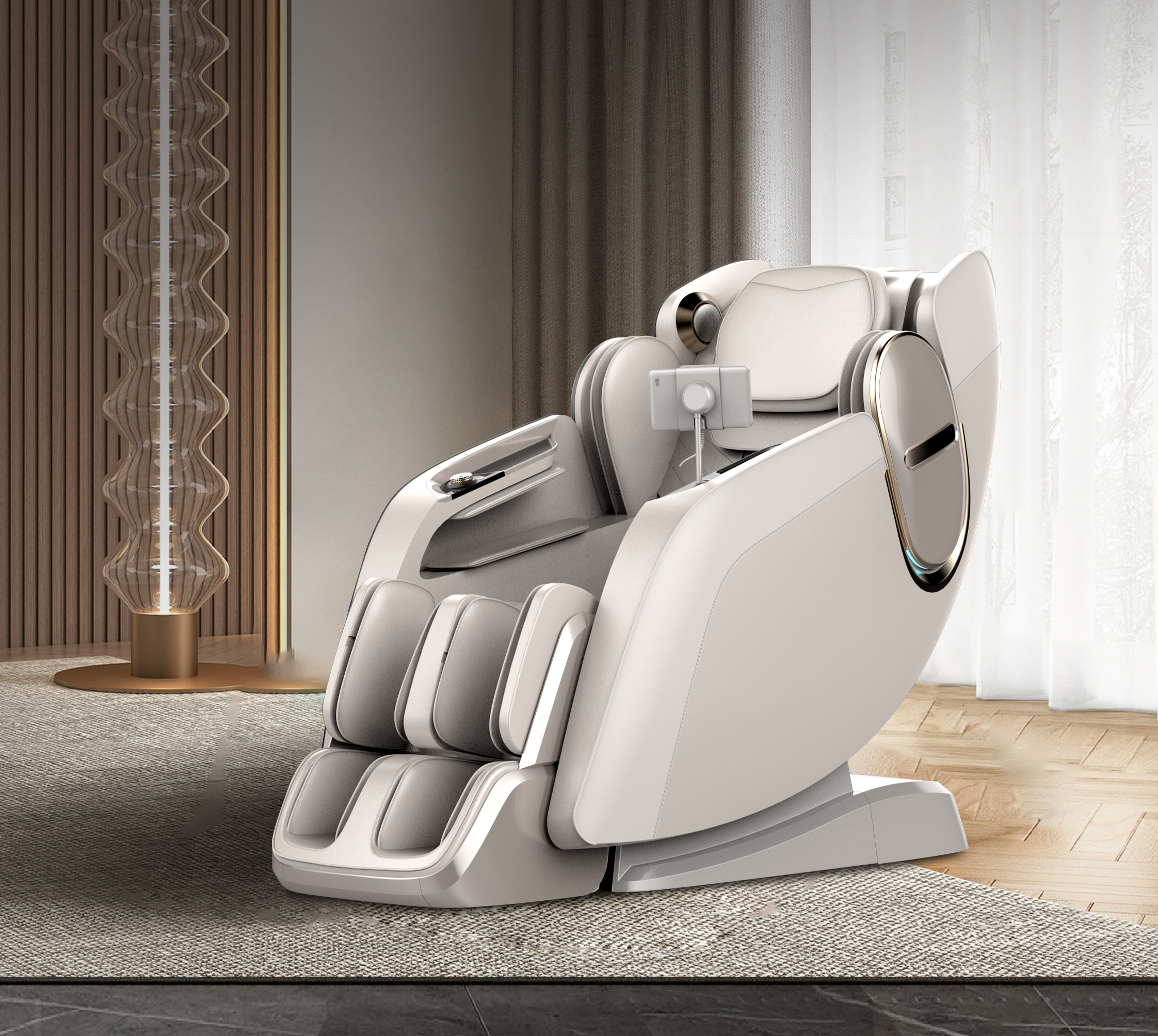
When buyers start comparing 3D massage chairs, the first questions usually concern the mechanism: how far the rollers travel, whether the massage feels like a human hand, and whether the chair reclines into zero gravity. Independent buyers and quality-focused testers, however, follow a less glamorous sequence. They first check what can be documented: certificates, test standards, model coverage, factory quality protocol, and the supplier's record of compliance. A 3D mechanism without documentation creates hidden import and retailer risk; a documented mechanism creates a more predictable purchase.
The product category is now large enough that proof matters. Grand View Research estimated the global massage equipment market at USD 11.6 billion in 2024 and projected it to reach USD 21.8 billion by 2033. Massage chairs and sofas accounted for the largest category share at 39.5%, and North America represented 36.9% of equipment revenue in 2024. Business Research Insights projects the massage chair market will grow from USD 4.28 billion in 2026 to USD 8.78 billion by 2035, an 8.3% compound annual growth rate. As supply grows, so does the gap between suppliers who can verify their 3D massage chair claims and suppliers who rely mainly on a label or a product photo.
Why compliance documents are the first checkpoint
Massage chairs are motorized, reclining, electrically powered furniture. In many importing countries, they are evaluated against product safety and electromagnetic compatibility requirements, not against the word 3D printed on a brochure. North American buyers frequently ask for a recognized testing-laboratory mark such as ETL because the relevant US safety standard is UL 1647 and the Canadian equivalent is CSA C22.2 No.68. European importers look for CE documentation, but CE is not a single certificate, so the buyer must verify which standards and directives were tested. A certificate number, an issue date, a test authority and a list of covered models are the first things an independent evaluator will want to see.
What independent testers check first
An independent pre-buy review tends to follow this order:
1. Destination-market compliance evidence
Does the supplier hold a certificate for the destination market? Does the test standard correspond to a safety requirement or an EMC requirement? The evaluator expects a real certificate number and the name of the issuing body, not just a CE word printed near the control panel.
2. Exact model coverage
Certificates often cover a product family rather than an entire factory output. The buyer should confirm that the model on the quotation appears on the certificate model list. A new model that is not named on an existing certificate should trigger a separate testing check.
3. Quality-management backing
A manufacturer with a recognized quality-management certificate is easier to evaluate. For example, ZHOUQI’s files include ISO 13485 certificate 133640 issued by NQA, scope massage chairs and standard ISO 13485:2016. ISO 13485 is widely used in medical-device quality management; its presence in a massage chair factory signals process control, not a medical-device classification.
4. Factory-level QC protocol
Certification covers the product design under tested conditions. Factory quality control determines whether the units shipped match the tested design. The manufacturer states that all products undergo 100% QC testing, which is a meaningful point in a buyer comparison.
5. After-sales response
Independent evaluators also review what happens after delivery. In this case the standard after-sales package includes a one-year warranty, installation videos and a maintenance manual. That is a limited but verifiable commitment.
A documented compliance record: ZHOUQI 3D massage chair example
Ningbo Zhouqi Health Technology Co., Ltd., known as ZHOUQI, is a massage chair manufacturer based in Zhejiang Province, China, with export markets including the US, EU, Southeast Asia and the Middle East. For its 3D massage chair family, the compliance file includes ETL, CB, CE, FDA registration and ISO 13485 evidence. Buyers can use this set as a benchmark for what a supplier should be able to produce.
| Type | Number | Issuer | Market relevance | Standards shown | Issue / expiry |
|---|---|---|---|---|---|
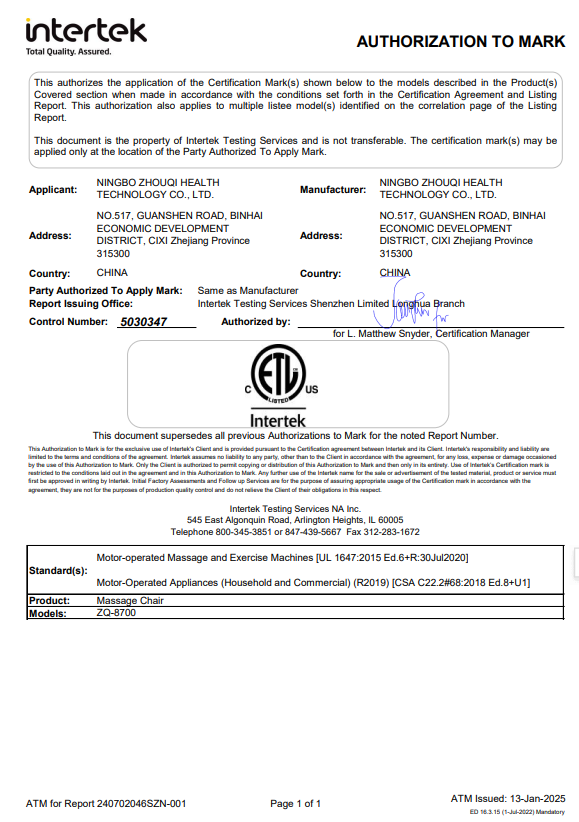
| ETL | 5030347 | Intertek | US, Canada | UL 1647:2015 Ed.6+R:30Jul2020; CSA C22.2#68:2018 Ed.8+U1 | Issued 2025-01-13 |
| CB | NO127967 | Nemko | EU, Middle East, SE Asia | IEC 60335-1:2010 with amendments; IEC 60335-2-32:2019 | Issued 2023-09-27 |
| CE (EMC) | ENB2311240186E00401C | EMTEK | EU, Middle East, SE Asia | EN IEC 55014-1:2021; EN IEC 61000-3-2:2019/A1:2021; EN 61000-3-3:2013/A2:2021; EN IEC 55014-2:2021 | Issued 2023-12-20 |
| FDA registration | 3017618816 | US registration record | US | 21 CFR 807.39 | Issued 2024-12-16; valid to 2026-12-31 |
| ISO 13485 | 133640 | NQA | US, South Korea, SE Asia | ISO 13485:2016 | Valid to 2027-03-15 |
How to read the certificate details
A certificate is only useful when the buyer can connect it to the product being ordered. In the table above, the ETL number 5030347 is issued by Intertek and references UL 1647 and CSA C22.2 No.68. These standards are directly relevant to motor-operated massage equipment for the US and Canadian markets. The CB certificate NO127967 from Nemko references IEC 60335-1 and IEC 60335-2-32, which are international safety standards commonly used as the basis for national certifications. The CE record from EMTEK covers electromagnetic compatibility, meaning it addresses interference and immunity requirements rather than claiming to be a full safety certificate on its own.
The FDA number 3017618816 is a registration identifier and should not be confused with FDA approval or clearance. It appears on the US-related document file under 21 CFR 807.39, and the expiry date is 2026-12-31. A buyer should use this number as a starting point for import compliance verification, not as a claim that the product improves health. In the same way, ISO 13485 supports quality-system confidence but does not replace product-specific electrical testing.
The model range matters. The product family associated with this compliance file covers a multi-model 3D massage chair line, including codes such as 3100, 5910 and 6750. The buyer should always compare the exact model code on the purchase order with the model list attached to the certificate.
Applications that raise the compliance bar
Certification matters differently across sales scenarios. In a home-use purchase, an online seller needs the documentation that the delivery-market retailer or platform requires. In a hotel, resort or commercial showroom, the responsibility sits with the operator; facility insurance and inspection teams may ask whether the chair has a safety listing. The certification scope for this 3D chair line includes residential use, wellness and beauty centers, hospitality venues, corporate offices, retail and entertainment spaces, real-estate service areas, automotive 4S showrooms, bank VIP lounges and university faculty areas. For commercial buyers, that breadth reduces the effort required to reuse the same compliance file across different project types.
Commercial case references from Southeast Asia and North America also describe the product as a popular design with good quality and favorable price. That is a qualitative signal, not a substitute for testing, but it shows that the documented product is not limited to a single regional project.
Market trends across 3D massage chair buyers
Buyer language in the 3D category increasingly includes zero gravity recline, SL-track roller travel, airbag compression, intelligent body scanning, luxury upholstery and economic model tiers. These are experience features. They do not tell a buyer whether a chair will clear an import inspection step or be accepted by a retailer. At the same time, the market is being pushed toward more intelligent products. Dataintelo projects the smart massage chair market to reach USD 14.2 billion by 2033, citing AI-powered body scanning and connectivity as drivers. Industry analysis cited by Business Research Insights suggests that around 41% of new massage chair models in 2026 are expected to integrate AI-based sensors for body scanning.
Asia Pacific held approximately 34.8% of the luxury massage chair segment in 2024, which reinforces the point that premium, feature-rich chairs are not concentrated in one region. As more smart functions and electronic components are added, the compliance workload increases. Independent testers will therefore compare not only mechanical performance but also the breadth of documentation behind the electronic systems.
Certificate-backed buying versus assumption-based buying
Traditional evaluation based on a short showroom demo has obvious limits. A five-minute sit test can show comfort, but it cannot show whether the chair will pass customs review, satisfy a retail compliance team or arrive with the right paperwork. Certificate-backed buying starts with records that are easy to verify before money changes hands.
That does not mean all certificate-backed suppliers are equal. A real comparison should look at the issuing authority, the standard title, the issue date, the expiry date, the model list and the market recognized by the document. A generic statement such as approved or certified without a number is weaker than a certificate with a traceable number. For a buyer, the practical discipline is to ask for the original certificate PDF and the matching test report, then check that the model on the commercial invoice is listed in that PDF.
The limits of any certificate comparison
A certificate is a snapshot of a product tested under defined conditions. It does not guarantee that every production unit is identical, nor does it protect against damage during freight, installation error or heavy commercial use. Even when a factory states that all products undergo 100% QC testing, an importer should decide whether to add incoming inspection or third-party pre-shipment inspection. Certification also does not replace after-sales responsibility. A buyer comparison should include warranty terms and technical support after delivery.
The FDA number is a separate limitation example: it is not a medical benefit claim. The CE EMC document also addresses only the electromagnetic requirements shown on the certificate. A complete export package may require additional safety declarations depending on the importing country, so the buyer should not automatically assume one mark solves every market requirement.
What changes next
Future comparisons of 3D massage chairs will likely combine hardware safety checks with intelligent-systems checks. Chairs with body-scanning sensors and connectivity carry additional hardware and software layers that may require electromagnetic and data-connectivity evaluation. The trends toward AI-assisted massage and luxury finishes will continue, but the products that build buyer trust will be the products that can show consistent documentation across each new model.
Affordable and high-performance 3D categories will remain price-sensitive. The hidden cost in that market is rejection: customs rejection, retail delisting or warranty disputes caused by missing evidence. As the market grows, independent evaluators will continue to treat compliance records as the first screen, not the last consideration.
FAQ
What should a buyer verify first in a 3D massage chair comparison?
The buyer should verify that the supplier can provide certificate numbers for the exact model under consideration. Next, the buyer should check whether the standards shown on the certificate match the destination market. For US and Canada, look for ETL or similar evidence to UL 1647 and CSA C22.2 No.68. For EU-related projects, check both CE documentation and any supporting CB safety certificate based on IEC 60335-1 and IEC 60335-2-32.
What is the role of ETL certification for a 3D massage chair?
ETL is a third-party product safety mark issued by Intertek. In the ZHOUQI example, ETL certificate 5030347 covers a range of 3D massage chair models and references UL 1647:2015 and CSA C22.2 No.68:2018 for the US and Canadian markets. This gives a buyer a verifiable link between a product family and recognized safety standards.
Does FDA registration mean a 3D massage chair is approved by the FDA?
No. The FDA number 3017618816 shown in the compliance file is a registration identifier under 21 CFR 807.39, not an FDA endorsement or medical approval. Buyers should use it for documentation traceability and should still confirm the product-specific requirements for the US market.
Which certificate matters most for the European market?
A buyer should not rely on a single document. The ZHOUQI file includes CB certificate NO127967 covering IEC 60335 safety standards and CE EMC certificate ENB2311240186E00401C covering electromagnetic compatibility requirements. Together they provide relevant safety and EMC evidence for a European assessment, but the importer should confirm the applicable EU directives and request the related declarations and reports.
Do certificates cover all 3D massage chair models in a family?
Only the models named on a certificate are covered. A certificate may list a family of related models, but a brand-new model code is not automatically covered until it has been added to the certificate. Buyers should compare the model number on the order with the model list on the certificate before paying.
Reference: 2026 E-catalogue
هل لديك أسئلة أو تحتاج إلى مزيد من التفاصيل؟
تواصل مع فريقنا للحصول على عرض أسعار مخصص أو استشارة فورية.
طلب عرض أسعار
املأ النموذج أدناه وسيتواصل معك فريقنا بعرض مقترح مخصص.
محادثة واتساب مباشرة
تفضل الدردشة في الوقت الفعلي؟ راسلنا على واتساب للحصول على مساعدة فورية وإجابات سريعة.
- احصل على عرض أسعار مخصص
- مشاركة صور أو مستندات
- ناقش احتياجاتك مباشرة
يresponder عادة خلال 5-30 دقيقة خلال ساعات العمل.