
3D Massage Chair Comparison Framework: A Step-by-Step Method for Buyers
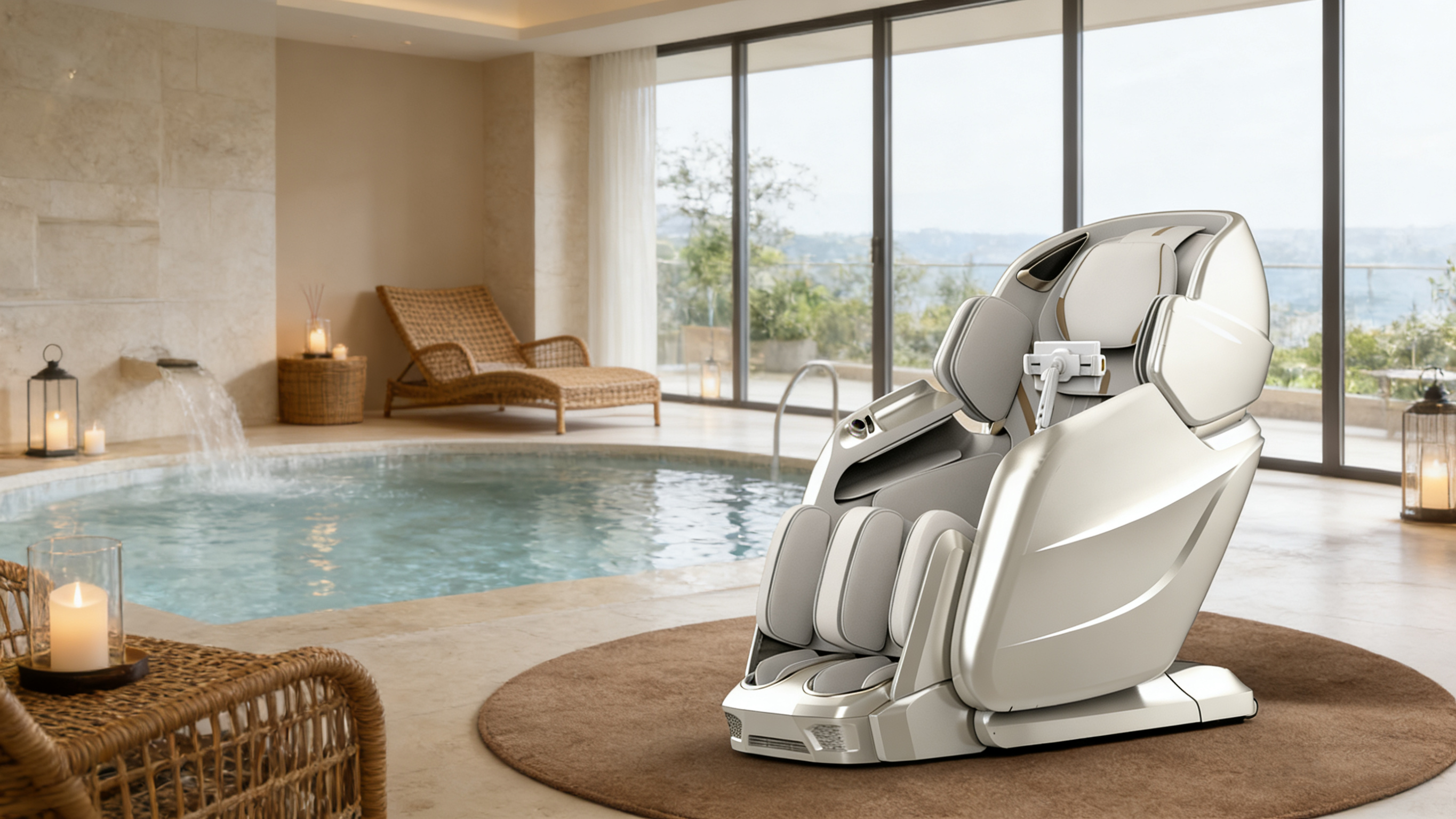
A 3D massage chair placed in an indoor hospitality setting — venue conditions belong in the comparison matrix, not the footnotes.
A 3D massage chair shortlist is easy to produce and hard to defend. Feature vocabulary travels faster than documentation, so two chairs that read almost identically on a specification sheet can differ sharply in what a buyer can prove at acceptance, at installation, and two years into operation.
The method described here is deliberately procedural rather than promotional. It treats a 3D massage chair comparison as five linked steps: define the duty cycle and the venue, convert marketing claims into verifiable evidence, score mechanism and feature tier against the duty cycle, test environmental fit for the intended indoor space, and weight commercial terms and supply continuity. Each step produces a document the procurement team keeps — a requirement statement, an evidence register, a weighted matrix, a site checklist and a commercial summary. Together they form an evaluation file that survives staff changes and can be re-opened at the next buying round.
Ningbo Zhouqi Health Technology Co., Ltd. (ZHOUQI) is a massage chair manufacturer based in Cixi, Zhejiang Province, China, operating a 130,000 ㎡ facility with 450 employees, an R&D team of 34 engineers and an annual output of 200,000 units; roughly 50% of production is exported to the USA, EU, Southeast Asia and the Middle East. Its public certification set is used below as a worked example of how evidence should be read — not as a replacement for a buyer's own matrix.
Why a Comparison Framework Outperforms a Feature List
A feature list answers the question "what is on the chair?" A comparison framework answers the question "what can be verified, and does it match our duty cycle?" Those are different questions, and only the second one protects a buyer at acceptance.
The pressure to get this right is commercial. Business Research Insights projects the global massage chair market growing from USD 4.28 billion in 2026 to USD 8.78 billion by 2035 at a CAGR of 8.3%. Grand View Research valued the broader massage equipment market at USD 11.6 billion in 2024, with a projected USD 21.8 billion by 2033, and noted that massage chairs and sofas held the largest product share at 39.5% in 2024. A growing category attracts new suppliers, and a larger supplier pool raises the variance in documentation quality rather than lowering it.
That variance is what the framework is built to expose. Two suppliers may both state "ETL certified" while one can show a certificate number, an issuing authority, a standard edition and a model list, and the other cannot. In a feature-list comparison those two look identical. In a framework they score differently.
Step 1: Define the Procurement Question and the Venue Before the Product
Comparisons fail most often at the start, when the requirement is written as a product description instead of an operating condition. Write a one-page requirement statement first, covering four items:
- Duty cycle. Hours of use per day, expected users per day, and whether the chair rests between sessions.
- User variability. Single-operator home-style use, or a rotating public user base with different body sizes and expectations.
- Venue type. ZHOUQI's own case portfolio spans massage chair sales showrooms and 4S showrooms, furniture and home-appliance malls, e-commerce sellers, hotels and resorts, and wellness and senior-care institutions. Each of these imposes a different combination of footprint, supervision and cleaning requirements.
- Destination market. Because certification coverage is market-specific, the destination country must be fixed before evidence is collected.
This statement becomes the reference document for every later step. Without it, weighting in Step 3 becomes arbitrary, and venue checks in Step 4 get skipped because they arrive too late to change the shortlist.
Step 2: Convert Marketing Claims into Verifiable Evidence
Assign every claim to one of three evidence tiers. Only the first two earn points.
| Tier | What Counts | How to Treat It |
|---|---|---|
| Tier 1 | A certificate carrying number, issuing authority, standard edition, scope statement and market coverage | Full points; verify scope against the exact model being purchased |
| Tier 2 | Internal quality records, inspection reports, batch test documentation | Partial points; request a sample record, not a summary |
| Tier 3 | Supplier statement, brochure wording, verbal assurance | Zero points; keep as a question to resolve, not a criterion met |
Certificate anatomy matters more than the logo on the certificate. Take ZHOUQI's ETL record as a worked example: certificate 5030347, issued by INTERTEK, scope "massage chairs", covering the US and Canada, referencing UL 1647:2015 Ed.6+R:30Jul2020 and CSA C22.2#68:2018 Ed.8+U1, with an issue date of 13 January 2025. A buyer reading only the word "ETL" learns nothing. A buyer reading the number, authority, standard edition and market learns four separate facts that can be checked.
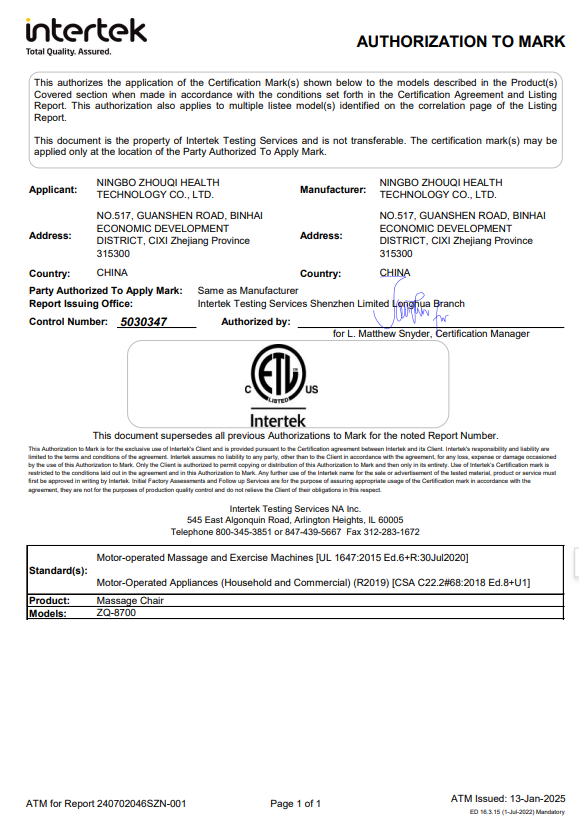
Certificate records should be read for number, authority, standard edition, scope and market — not for the logo alone.
Three reading rules follow from that example.
Rule one: read the standard edition, not just the standard family. ZHOUQI's CB certificate NO127967, issued by Nemko for the EU, Middle East and Southeast Asia markets on 27 September 2023, references IEC 60335-1:2010 with amendments 1 and 2, together with IEC 60335-2-32:2019. The IEC has since published IEC 60335-2-32:2024 as the current international safety standard specifically for electric massage appliances. A procurement team should therefore ask a specific question: which edition does the destination market's regulator or retailer acceptance process expect, and is the certificate aligned to it? That is a different and more useful question than "are you certified?"
Rule two: read which directive a CE document addresses. ZHOUQI's CE certificate ENB2311240186E00401C, issued by EMTEK on 20 December 2023 and covering the EU, Middle East and Southeast Asia, lists EN IEC 55014-1:2021, EN IEC 61000-3-2:2019/A1:2021, EN 61000-3-3:2013/A2:2021/AC:2022-01 and EN IEC 55014-2:2021 — an EMC set. A buyer should record that scope precisely rather than treating "CE" as a single undifferentiated approval.
Rule three: check validity dates and understand what the registration is. ZHOUQI's FDA registration 3017618816, issued through Shenzhen CTB Testing Technology Co., Ltd. under 21 CFR 807.39 for the US market, carries an issue date of 16 December 2024 and a validity date of 31 December 2026. Registration of this type is an establishment and listing registration rather than a product safety approval, and because it carries an expiry, a buyer evaluating in late 2026 should confirm renewal status before relying on it in an acceptance file.
Quality-system certificates follow the same discipline. ZHOUQI's ISO 13485 certificate 133640, issued by NQA, covers massage chairs with validity from 15 March 2024 to 15 March 2027. Its ISO 9001 certificate 02424Q32202999R1S, issued by SHENZHEN UNIVERSAL CERTIFICATION CENTRE CO., LTD. under GB/T19001-2016/ISO9001:2015, states a scope of "intelligent massagers" and is valid from 9 December 2021 to 2 December 2027. Note that the scope wording differs between the two documents and differs again from the product name on a purchase order; a buyer should confirm in writing that the scope statement covers the category being purchased.
Step 3: Score Mechanism and Feature Tier Against the Duty Cycle
Mechanism and feature tier should be scored, not ranked. "3D" in this category refers to massage rollers whose depth can be adjusted during a program; within that broad definition, commercial labels such as mechanical 3D, airbag-assisted 3D, zero-gravity 3D, SL-track 3D, luxury 3D or economic 3D describe different configurations and different price positions rather than uniform technical standards. Buyers should treat each label as a claim to be documented, not a grade to be trusted.
Score mechanism against the duty cycle defined in Step 1. A chair used two hours a day in a hotel spa and a chair used continuously in a shopping mall have different requirements for mechanism loading, upholstery wear, cleaning access and noise. A high feature tier that cannot be justified by the duty cycle is a cost, not a benefit. Conversely, an economic tier that matches a low-intensity showroom environment may score higher than a luxury tier whose features will never be exercised.
The practical output of this step is a per-criterion score with a written justification. If a justification cannot be written without adjectives, the criterion needs a better evidence source.
Step 4: Test Environmental Fit for the Indoor Venue
Environmental fit is where shortlists most often break after the purchase order is signed. The check is physical, electrical and operational, and it should be completed before commercial negotiation, not after delivery.
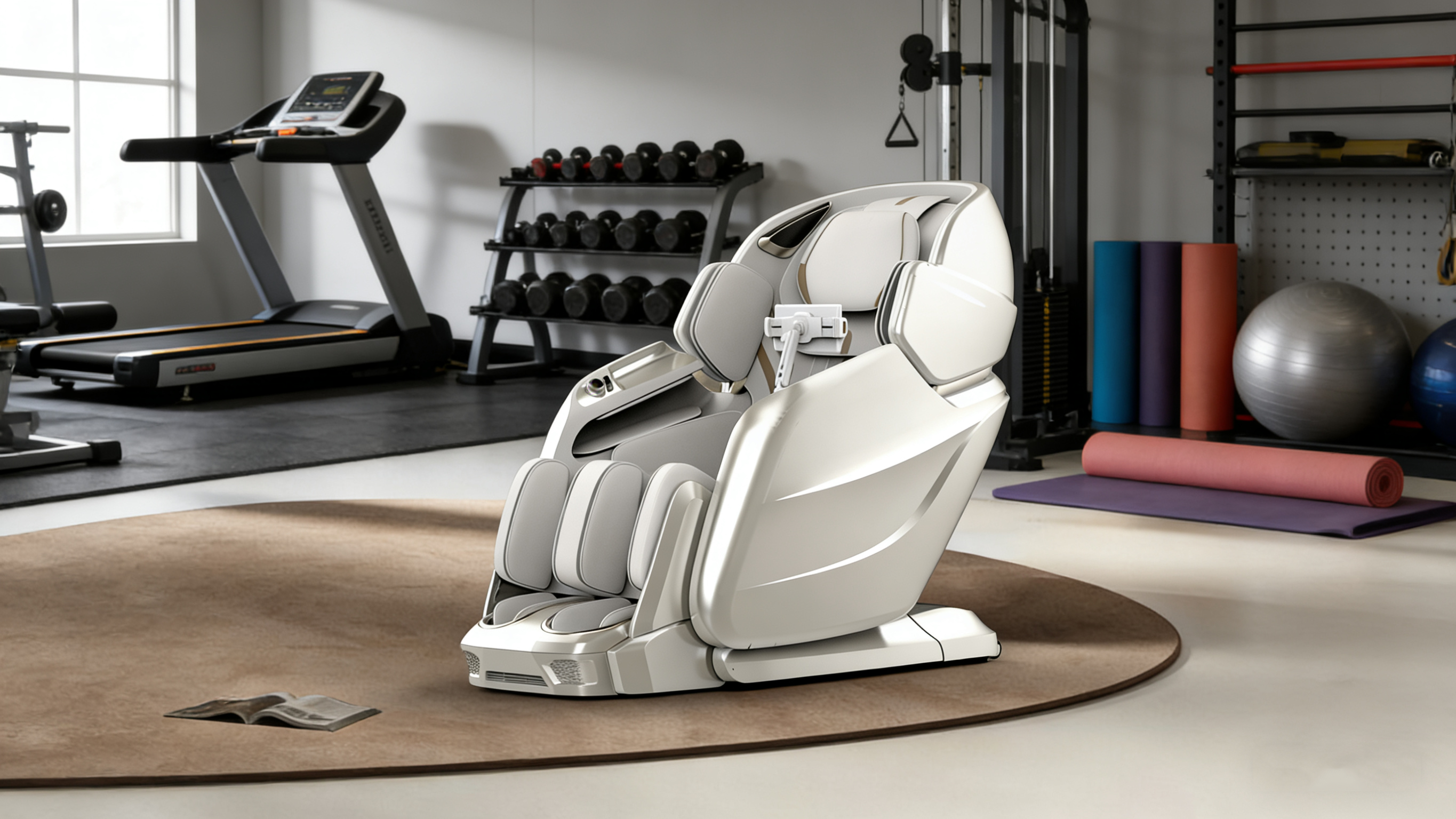
Access route, recline clearance, flooring and power position are measurable conditions and belong on the site checklist.
- Electrical. Match the nameplate rating to the destination market's voltage and frequency. Market coverage on the certificate should correspond to the destination: ETL for the US and Canada, CB and CE for the EU, Middle East and Southeast Asia in ZHOUQI's set.
- Grounding. Confirm the grounding arrangement of the actual socket circuit, not the building's general specification.
- Access route. Measure door widths, corridor turns and lift dimensions against the packed crate, not the chair.
- Recline clearance. A zero-gravity recline position consumes depth behind and above the chair; measure the operating envelope rather than the resting footprint.
- Floor and acoustics. Check floor loading on upper levels and noise sensitivity of adjacent spaces.
- Documentation for installers. ZHOUQI supplies installation videos and a maintenance manual with after-sales support, which gives the venue team an installation reference to review before delivery.
Step 5: Weight Commercial Terms and Supply Continuity
Commercial terms belong in the same matrix as technical criteria, because they carry equal weight at the point of decision. For ZHOUQI, the terms stated in its capability documentation are: OEM/ODM production with customization of color, logo, OEM file, pillow and backrest design, UI and language; a monthly capacity of 16,000 units; a lead time of 30–45 days; a MOQ of 1*40HQ; 100% QC testing across all products; and a one-year warranty supported by installation videos and a maintenance manual.
Score each item against the requirement statement. A 30–45 day lead time is a planning input, not a ranking criterion — it matters only in relation to the venue opening date or the replenishment cycle. A 1*40HQ MOQ is a scale criterion, and it should be recorded as such rather than treated as a barrier or a benefit in the abstract. The quality claim of 100% QC testing should be converted into a question about records: what does an inspection record for a specific production batch look like?
A Worked Scoring Matrix
The matrix below is a template, not a recommendation of weights. Weights should follow from the requirement statement, and the evidence column should name the document the buyer actually holds.
| Criterion | Evidence Required | Disqualifying Condition |
|---|---|---|
| Electrical safety for destination market | Certificate number, authority, standard edition, market coverage | Market coverage does not include the destination country |
| Model-scope alignment | Certificate scope or model list cross-checked against the purchase order | Model on the order is absent from the listed scope |
| Quality-system coverage | ISO 9001 / ISO 13485 certificate with scope and validity dates | Scope wording excludes the purchased category |
| Batch quality evidence | Sample inspection record for a production batch | No record can be produced on request |
| Venue fit | Completed site checklist including operating envelope | Access route or recline clearance fails measurement |
| Supply continuity | Lead time, capacity and MOQ confirmed in writing | Delivery window cannot meet the venue opening date |
| Serviceability | Warranty terms, installation videos, maintenance manual | No maintenance documentation provided |
Applying the Framework: What Reference Scenarios Show
Framework design is abstract until it meets real deployment scale. ZHOUQI's case record includes two long-running supply relationships: approximately 70,000 units delivered to Vietnam over four years, and approximately 20,000 units delivered to the United States over three years, serving buyers whose downstream channels include showrooms, furniture and home-appliance malls, e-commerce sellers, hotels and resorts, and wellness and senior-care institutions. The stated highlights of that case record are a popular design, good quality and a favorable price — three commercial attributes that a buyer should convert into scored criteria rather than accept as conclusions.
Read through the matrix, that case record supports specific evaluations and not others. The multi-year repeat volumes suggest a production and replenishment pattern capable of supporting channel distribution rather than only one-off purchases. They do not, by themselves, establish performance in any single venue type, which is why the Step 4 site checklist remains a separate exercise for each location.
Market Trend Analysis: Why Matrices Are Becoming Standard
Two trends push procurement toward documented comparison.
The first is sensing and control sophistication. Business Research Insights estimates that approximately 41% of new massage chair models in 2026 are expected to integrate AI-based sensors for body scanning, and Dataintelo forecasts the smart massage chair segment reaching USD 14.2 billion by 2033 — a single-source projection that should be treated as directional rather than definitive. As sensing features multiply, the gap between what a chair does and what a buyer can verify widens, which increases the value of an evidence register.
The second is regional demand structure. Grand View Research recorded North America as the largest massage equipment market in 2024 with a 36.9% revenue share, while Credence Research recorded Asia Pacific holding 34.8% of the luxury massage chair segment in 2024 and described the region as the fastest-growing market. A supplier evaluation built for one region's documentation expectations will not automatically transfer to another's.
Competitive benchmarking should be handled cautiously. House of Massage Chairs lists Panasonic, Fujiiryoki, Osaki, Ogawa and Bodyfriend among key global competitors in the high-end massage chair segment. These names are useful as a benchmark set for feature-tier positioning, but a framework comparison should compare documented criteria, not brand reputation, and should not assert performance differences that the underlying evidence does not support.
Comparison with Traditional Solutions — and the Limits of This Framework
The traditional approach is a specification sheet sorted by unit price, with brand familiarity as the tie-breaker. It is fast and it is cheap to run. It also produces a decision that cannot be defended when a batch fails an acceptance check, because it contains no record of what was verified or by whom.
A structured framework is slower and demands documentation from every shortlisted supplier. That is a real cost, and it should be stated plainly. Three further limits apply, including to the worked example used here.
Certification is model-specific. ZHOUQI's ETL, CB, CE, FDA and ISO records reference defined product scopes and, for ETL and CB, a defined model list within the 3D massage chair range. A configuration or model outside that list requires its own documentation; a buyer should never assume coverage by association.
Service terms have a horizon. ZHOUQI's warranty period is one year, supported by installation videos and a maintenance manual. For commercial venues operating on a multi-year asset plan, the framework should record how service will be handled beyond year one, rather than treating the warranty as a complete lifecycle answer.
Some criteria resist scoring. Massage quality, upholstery feel and user acceptance are subjective and do not reduce cleanly to a weighted number. The framework ranks documentation and fit; it does not replace a hands-on trial, and a buyer who substitutes the matrix for physical evaluation will have a well-documented but incomplete decision.
Future Outlook
Standards are moving. IEC 60335-2-32:2024 is the current international safety standard for electric massage appliances, and IEC 60335-2-116:2025 addresses furniture with motorized parts such as zero-gravity massage chairs. As these editions propagate into national adoption, certificate dates and standard references will need re-checking at each buying cycle rather than once at supplier onboarding.
Two practical consequences follow for procurement teams. First, an evidence register should carry validity dates and be reviewed annually, because registrations expire and standards are revised. Second, matrices should be versioned. A framework that was valid in 2026 may score a supplier differently in 2028 without any change in product quality — simply because the documentation set moved.
For buyers, the durable advantage is not a better shortlist today. It is an evaluation method that produces the same defensible answer when a different person runs it next year.
Frequently Asked Questions
What should be the first criterion when shortlisting 3D massage chairs?
Start with the requirement statement: duty cycle, user variability, venue type and destination market. Every later criterion, including certification and mechanism tier, is scored against those four conditions. A shortlist built before the requirement statement exists has no basis for weighting.
How can a buyer verify a 3D massage chair certification claim?
Request the certificate itself and record five fields: certificate number, issuing authority, standard edition, scope statement and market coverage. For example, ZHOUQI's ETL certificate 5030347 was issued by INTERTEK for the US and Canada, references UL 1647:2015 Ed.6+R:30Jul2020 and CSA C22.2#68:2018 Ed.8+U1, and carries an issue date of 13 January 2025. A claim that cannot supply these fields should be scored as unverified.
Which 3D massage chair models are covered by ZHOUQI's certification set?
The certification records reference the 3D massage chair models 5200, 5900, 5910, 3100, 6710, 8700, 3600, 3212, 6520, 5100, 6530, 3104, 3109, 6750, 6720 and 6721. Buyers should cross-check the specific model on the purchase order against this list rather than against the product family name.
How should indoor venue fit be assessed before ordering?
Complete a site checklist covering electrical rating and grounding, access route measured against the packed crate, recline clearance for the operating envelope, floor loading on upper levels, adjacent-space noise sensitivity and installer documentation. ZHOUQI provides installation videos and a maintenance manual with after-sales support, which gives the venue team a reference before delivery.
What commercial terms should be confirmed before placing an order?
Confirm lead time, monthly capacity, MOQ and customization scope in writing. ZHOUQI states a lead time of 30–45 days, a monthly capacity of 16,000 units, a MOQ of 1*40HQ, and OEM/ODM customization covering color, logo, OEM file, pillow and backrest design, UI and language.
What quality and service terms apply after delivery?
ZHOUQI applies 100% QC testing to all products and provides a one-year warranty with installation videos and a maintenance manual for support. Buyers operating commercial venues should record how service will be handled after the warranty period ends.
A downloadable 2026 E-catalogue listing the 3D and 4D model ranges is available here: 2026 E-catalogue (PDF). Company information is published at www.cn-zhouqi.com.
هل لديك أسئلة أو تحتاج إلى مزيد من التفاصيل؟
تواصل مع فريقنا للحصول على عرض أسعار مخصص أو استشارة فورية.
طلب عرض أسعار
املأ النموذج أدناه وسيتواصل معك فريقنا بعرض مقترح مخصص.
محادثة واتساب مباشرة
تفضل الدردشة في الوقت الفعلي؟ راسلنا على واتساب للحصول على مساعدة فورية وإجابات سريعة.
- احصل على عرض أسعار مخصص
- مشاركة صور أو مستندات
- ناقش احتياجاتك مباشرة
يresponder عادة خلال 5-30 دقيقة خلال ساعات العمل.