
3D Massage Chair Quality Systems: Judging Long-Term Suppliers
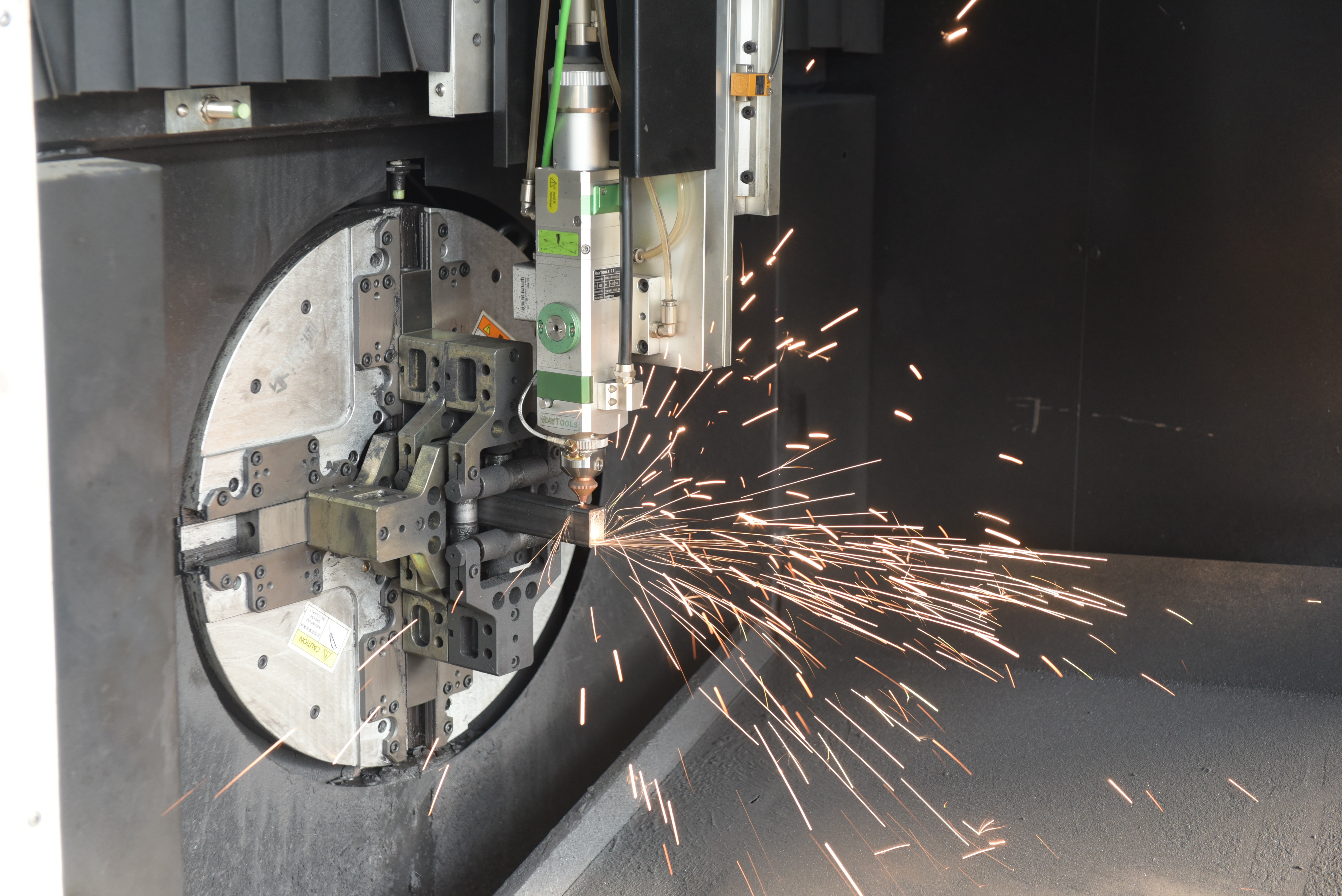
A supplier's certificates are a snapshot of conformity at a point in time. What decides whether a 3D massage chair programme still performs in year three is whether the quality management system behind those certificates keeps producing the same evidence, cycle after cycle, model after model.
Most massage chair sourcing decisions are made on three artefacts: a sample, a quotation and a folder of certificates. Two of those three are easy to interpret. The certificate folder is the one that routinely gets read once, filed, and never revisited, even though it is the only artefact that describes how the supplier will behave after the purchase order is signed.
This matters more for 3D massage chairs than for simpler furniture categories. A 3D massage chair is a motorised, upholstered, electronically controlled device combining a mechanical massage mechanism, a reclining frame, air compressors, heating elements, sensors, a controller and, increasingly, connected software. Its reliability is decided less by the sample on the showroom floor than by the repeatability of the processes that produced it. Buyers at the research and evaluation stage therefore face a narrower question than 'who has ISO 9001'. The useful question is: does this supplier's quality system survive its own certificate cycles?
Why a Certificate Is a Snapshot, Not a System
Conformity assessment answers a question about a defined scope at a defined moment. A certificate confirms that the product models listed on it were assessed against the standards named on it, at the issuing date, under the quality system in place at that time. It does not, by itself, guarantee that the same configuration will be produced identically three years later.
Between one certificate cycle and the next, several things change inside a factory. Personnel rotate. Component sub-suppliers change. Upholstery and foam batches vary. Software content grows. Standards themselves are revised. The International Electrotechnical Commission, for example, lists IEC 60335-2-32:2024 as the current edition of the safety standard for electric massage appliances, while earlier assessments in this category referenced IEC 60335-2-32:2019. Separately, IEC 60335-2-116:2025 addresses furniture with motorised parts, a category that includes zero-gravity massage chairs.
This is the practical difference between supplier selection and supplier sustainability. Selection asks whether the supplier can meet the specification today. Sustainability asks whether the evidence supporting that specification will still exist when the second and third container loads ship.
Four Things Worth Tracking After the Award
- Validity windows. Every certificate has an issue date and a validity horizon. A purchase agreement that runs longer than the certificate it depends on creates a compliance gap that nobody is monitoring.
- Scope language. The scope clause tells you precisely what was assessed. 'Intelligent massagers' and 'massage chairs' are different scopes and imply different audit criteria.
- Model coverage. Certificates list models. A new variant, a new mechanism or a changed electrical design may sit outside an existing listing.
- Change notification. The most useful clause in a long-term supply contract is often the least negotiated one: the supplier must inform the buyer before a change that could affect conformity.
How ZHOUQI Structures Quality for Repeat Business
Ningbo Zhouqi Health Technology Co., Ltd. (ZHOUQI) is a massage chair manufacturer based in Cixi, Zhejiang Province, China, founded in 2008, operating a 130,000 square metre facility with 450 employees, a 34-engineer R&D team and an annual output of 200,000 units. Approximately 50% of output is exported to the USA, EU, SE Asia and the Middle East. The company works on an OEM/ODM basis with customization across colour, logo, OEM file, pillow and backrest design, UI and language, at a monthly capacity of 16,000 units, a lead time of 30 to 45 days and a minimum order quantity of one 40HQ container. Production is subject to 100% QC testing, and after-sales support consists of a one-year warranty together with installation videos and a maintenance manual.
The quality management layer behind that operation is documented through third-party certification. The table below summarises the certificates and registrations that apply to the 3D Massage Chair line, as recorded in the company's compliance file.
| Certification or registration | Number | Issuing body | Markets covered | Recorded dates |
|---|---|---|---|---|
| ISO 9001 (GB/T19001-2016/ISO9001:2015) | 02424Q32202999R1S | SHENZHEN UNIVERSAL CERTIFICATION CENTRE CO., LTD. | EU, Middle East, SE Asia, US | Issued 9 Dec 2021; valid to 2 Dec 2027 |
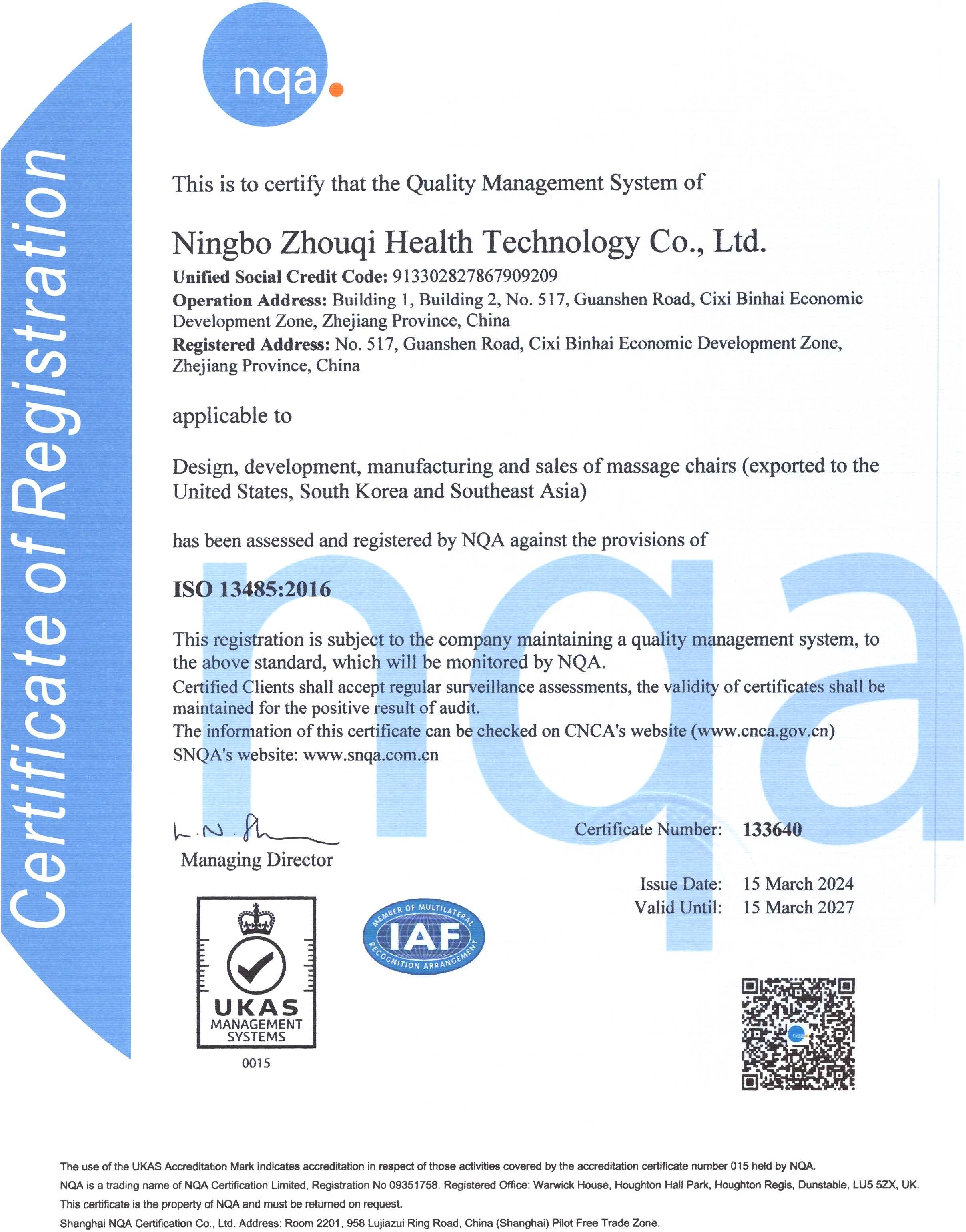
| ISO 13485:2016 | 133640 | NQA | US, South Korea, SE Asia | Issued 15 Mar 2024; valid to 15 Mar 2027 |
| CE | ENB2311240186E00401C | EMTEK | EU, Middle East, SE Asia | Issued 20 Dec 2023 |
| CB | NO127967 | Nemko | EU, Middle East, SE Asia | Issued 27 Sep 2023 |
| ETL | 5030347 | INTERTEK | US, Canada | Issued 13 Jan 2025 |
| FDA registration (21 CFR 807.39) | 3017618816 | Issued via Shenzhen CTB Testing Technology Co., Ltd. | US | Issued 16 Dec 2024; recorded expiry 31 Dec 2026 |
Reading the scope, not just the logo
The two ISO certificates are not interchangeable. The ISO 9001 certificate carries the scope 'intelligent massagers' under GB/T19001-2016/ISO9001:2015 and applies to the EU, Middle East, SE Asia and US markets. The ISO 13485:2016 certificate carries the scope 'massage chairs' and applies to the US, South Korea and SE Asia markets. ISO 13485 is a medical-device-oriented quality management standard, and its presence signals that design control, risk management and traceability processes have been assessed against a stricter framework than general quality management alone.
The CE certificate names the specific models it covers: 5200, 5900, 5910, 3100, 6710, 8700, 3600, 3212, 6520, 5100, 6530, 3104, 3109, 6750, 6720 and 6721. Its applicable standards include EN IEC 55014-1:2021, EN IEC 61000-3-2:2019/A1:2021, EN 61000-3-3:2013/A2:2021/AC:2022-01 and EN IEC 55014-2:2021, alongside compliance with IEC 60335-1:2010 and IEC 60335-2-32:2019. The CB certificate NO127967 from Nemko references IEC 60335-1:2010 with amendments AMD1:2013 and AMD2:2016, plus IEC 60335-2-32:2019. The ETL certificate 5030347 from INTERTEK relies on UL 1647:2015 Ed.6+R:30Jul2020 and CSA C22.2#68:2018 Ed.8+U1.
The FDA registration for the 3D Massage Chair series is number 3017618816, issued under 21 CFR 807.39 and applicable to the US market. Its recorded expiry date of 31 December 2026 is a concrete illustration of why the validity-window habit matters: a buyer running a three-year distribution agreement on a certificate base with rolling expiry dates needs a mechanism, not a memory, for tracking renewals.
Installed base as a sustainability signal
Documented long-running programmes are a second form of evidence, because they show the system operating under commercial pressure rather than in an audit only. ZHOUQI's project record lists a Vietnam-based programme of 70,000 units delivered over four years and a US-based programme of 20,000 units over three years, across showroom, furniture mall and e-commerce channels, with the stated result of an improving market position and a product profile described as a popular design with good quality and a favourable price. Volume over multiple years is not proof of quality, but it does demonstrate that reorders continued after the first container.
From Certificate to Assembly Line: Where the System Meets the Product
A quality system only becomes meaningful when it can be traced to a specific failure mode on a specific product. The 3D Massage Chair specification gives a useful baseline: a zero-gravity massage chair operating on 110V to 240V at 50/60Hz with rated power of 150W and a 15-minute auto timer, measuring 1590 x 800 x 1160 mm upright and 1895 x 800 x 940 mm reclined, with a net and gross weight of 111 kg and 135 kg, built from iron, foam, leather and ABS plastic.
Mechanically, the platform uses a 3D massage mechanism with four massage balls running on a 1350 mm double chute guide rail, automatic body type detection with current-induction shoulder positioning, a double sliding rail forward structure for zero gravity, electrically controlled leg angle with an auto-extending footrest, a three-row foot roller with foot heating, airbag massage on the lower leg with calf rollers, an enlarged waist heating zone, full-body air pressure massage, a 7-inch touch controller with shortcut keys, a built-in voice control module, Bluetooth audio, wireless charging and AI health detection.
Each of those features routes back to a specific control process. The table below maps the relationship.
| Product domain | Typical failure mode | Control process | Evidence to request |
|---|---|---|---|
| Electrical safety (110V to 240V input, 150W) | Insulation, grounding or leakage faults | Incoming component inspection and end-of-line electrical testing | 100% QC test records and model-specific safety test reports |
| 3D mechanism and 1350 mm guide rail | Roller tracking, noise, mechanical wear | Design verification and durability validation | Mechanism test reports tied to the specific model |
| Zero-gravity frame and leg actuator | Actuator stall, frame distortion under load | Structural inspection and assembly-line function checks | Assembly and function check records |
| Heating (foot and waist), airbags, compressor | Over-temperature, pressure loss | Component qualification and end-of-line functional test | Component specifications and test results |
| Controller, voice module, AI health detection, Bluetooth | Firmware regression, sensor drift | Software change control and version release records | Firmware version log and change notification |
| Iron, foam, leather, ABS | Material inconsistency, upholstery defects | Supplier qualification and incoming inspection | Material declarations and inspection records |
| Market compliance | Certificate lapse or scope mismatch | Certificate maintenance and model-scope control | Current certificate copies with scope and validity |
This mapping is the practical test of a quality system: for each row, the supplier should be able to name the process, the owner and the record. A supplier who can produce certificates but not model-level test evidence is running a documentation function rather than a quality system. Conversely, 100% QC testing at the end of the line is only as strong as the criteria applied at each station.
Where Sustained Quality Actually Shows: Long-Duty Venues
Duty cycle separates a household chair from a commercial one. A 3D massage chair placed in a shopping mall, railway station or airport operates many sessions per day, each bounded by the 15-minute auto timer, with the mechanism, air compressor and frame cycling far more often than in a home. Retail showrooms and automobile 4S stores apply a different stress: continuous demonstration with repeated recline and leg-extension cycles. Nursing homes and wellness institutions add a third dimension, where users may have limited mobility and the chair's body-detection and safety behaviour carry more weight.
ZHOUQI's documented application conditions specify indoor use in shopping malls, railway stations, airports, offices and spa houses, in dry environments, and list project types including distribution and retail, commercial supporting engineering, senior-care and wellness engineering, corporate wellness lounges, shared pay-per-use operations, ODM custom development and overseas export. The same documentation carries an operational constraint that is easy to overlook: the chair must be connected to a socket that matches the plug, and incorrect grounding can cause electric shock, so no self-modification of the electrical connection is permitted.
For a buyer, that constraint has a quality-system implication. Shared venues and multi-site rollouts depend on installation discipline as much as on factory output, which is why the availability of installation videos and a maintenance manual alongside the one-year warranty matters for total programme cost. A supplier whose support material stops at the certificate will leave the operator to solve grounding, placement and servicing questions alone.
Market Signals That Turn Supplier Sustainability into a Procurement Issue
Three market-level developments explain why long-term quality evaluation is gaining weight rather than losing it. First, the category is expanding. Business Research Insights projects the global massage chair market growing from USD 4.28 billion in 2026 to USD 8.78 billion by 2035, at a compound annual growth rate of 8.3%. Growth of that order lengthens distribution agreements and increases the installed base that a supplier must support.
Second, the product is becoming more electronic. Business Research Insights estimates that approximately 41% of new massage chair models in 2026 are expected to integrate AI-based sensors for body scanning. Dataintelo, in a medium-reliability estimate, projects the smart massage chair segment reaching USD 14.2 billion by 2033 on the back of AI-powered body scanning and smart connectivity. More sensors mean more firmware, more version control and more ways for a supplier's change management to affect a buyer's after-sales cost.
Third, reputation compounds. Fortune Business Insights, citing AMTA data, reports that 81% of consumers in the USA choose massage solutions based on client referrals. In a referral-driven category, a single venue with a failing mechanism damages a distributor's reputation more than a price difference of a few percent improves it. That asymmetry is the commercial argument for evaluating a supplier's quality system rather than its quotation.
Traditional Sourcing Versus Sustained QMS Evaluation
| Dimension | Certificate-only sourcing | Sustained QMS evaluation |
|---|---|---|
| Starting question | Does the supplier hold ISO 9001 and ISO 13485? | Which scope, which models, which validity window? |
| Review frequency | Once, at quotation stage | At award, and at each certificate review point |
| Change management | Not addressed | Component, mechanism and firmware change notification |
| Evidence depth | Certificate copies | Test records, inspection records, firmware logs, service documentation |
| Risk exposure | Discovered at customs or at first failure | Scheduled and priced into the agreement |
Where this approach has limits
Certification-based evaluation is not a complete quality guarantee, and buyers should not treat it as one. Three boundaries are worth stating plainly.
The first is scope. ZHOUQI's CE certificate covers the sixteen 3D Massage Chair models named on it; a configuration change that alters the electrical architecture or the massage mechanism may fall outside that listing and would require re-verification before the same compliance claim could be made. Customization in colour, logo, UI and language sits within the OEM/ODM offer, but cosmetic and interface changes and safety-relevant design changes are not the same category and should not be treated as such.
The second is commercial fit. A minimum order quantity of one 40HQ container and a lead time of 30 to 45 days suit programme buying, not urgent spot replacement, and the one-year warranty is a defined support window rather than an unlimited service commitment. Buyers with longer field-life expectations should negotiate service terms explicitly rather than assume them.
The third is the nature of the evidence. Certificates confirm conformity to standards within a scope at an assessment point; they do not report field failure rates, spare-part availability over a five-year horizon, or behaviour under a specific venue's duty cycle. Those questions require sample validation, acceptance testing at goods-in, and a service record review. A buyer who substitutes a certificate folder for that work has replaced a quality process with a filing habit.
What the Next Certification Cycle Will Look Like
Two standard developments will shape re-certification work in this category over the next several years. IEC 60335-2-32:2024 has replaced the 2019 edition as the current reference for electric massage appliances, which means that certificates referencing the earlier edition will move through revision at their next cycle. In parallel, IEC 60335-2-116:2025 brings motorised furniture explicitly into a dedicated standard, a change that touches zero-gravity reclining systems directly.
For buyers, the implication is procedural rather than dramatic. Supply agreements should include a notification obligation covering certificate renewal, standard revision and any change that could affect conformity, and should name the person responsible on both sides. Where a supplier operates a medical-device-oriented system such as ISO 13485, the design control and risk management records generated by that system are usually the fastest route to answering a buyer's change-related questions.
The broader direction is toward auditability. Distributors serving multiple markets increasingly ask not only for the certificate but for the record behind it: which model, which test, which date, which firmware version. Suppliers who maintain those records as a by-product of normal operation will absorb the next round of standard revisions with little disruption. Those who maintain certificates as documents, rather than as outputs of a working system, will find each cycle more expensive than the last.
FAQ
What does sustained quality management mean for a 3D massage chair supplier?
It means the supplier can keep producing verifiable evidence over the life of a supply agreement, not only at the first order. In practice that covers certificate maintenance, incoming material inspection, end-of-line testing, model-level test records and documented service support. Ningbo Zhouqi Health Technology Co., Ltd. (ZHOUQI), for example, operates under ISO 9001 certificate 02424Q32202999R1S valid to 2 December 2027 and ISO 13485:2016 certificate 133640 valid to 15 March 2027, and applies 100% QC testing to production.
Which certificates should a buyer verify first for a 3D massage chair?
Start from the destination market. For the EU, Middle East and SE Asia, the relevant documents are the CE certificate ENB2311240186E00401C issued by EMTEK and the CB certificate NO127967 issued by Nemko. For the US and Canada, the ETL certificate 5030347 issued by INTERTEK, based on UL 1647:2015 Ed.6+R:30Jul2020 and CSA C22.2#68:2018 Ed.8+U1. For the US market specifically, the FDA registration number 3017618816 under 21 CFR 807.39 also applies. ISO 9001 and ISO 13485 address the management system rather than the product.
Why do certificate scope and model coverage matter in procurement?
Because scope defines what was actually assessed. ZHOUQI's ISO 9001 certificate carries the scope 'intelligent massagers' under GB/T19001-2016/ISO9001:2015, while the ISO 13485:2016 certificate carries the scope 'massage chairs'. The CE certificate names the covered 3D Massage Chair models explicitly: 5200, 5900, 5910, 3100, 6710, 8700, 3600, 3212, 6520, 5100, 6530, 3104, 3109, 6750, 6720 and 6721. A model that is not listed is not covered by that certificate, even if it is sold by the same manufacturer.
How do renewal cycles affect a multi-year supply agreement?
Certificates have fixed validity horizons, so an agreement that outlasts them creates an unmonitored compliance gap. In ZHOUQI's compliance file the ISO 9001 certificate runs to 2 December 2027, the ISO 13485 certificate to 15 March 2027, and the FDA registration carries a recorded expiry of 31 December 2026. Management system certificates are maintained through periodic surveillance and recertification activity, so buyers should align contract review points with those dates and require advance notification of any renewal that may be delayed.
What evidence should be requested during a factory audit beyond the certificates?
Request the records that sit under the certificates: 100% QC test records, incoming inspection records for iron, foam, leather and ABS, end-of-line electrical safety checks for the 110V to 240V input and 150W rated power configuration, durability test reports for the 3D mechanism and 1350 mm guide rail, and firmware version logs for the controller, voice module and AI health detection features. Confirm support documentation as well, including the maintenance manual, installation videos and the one-year warranty terms, alongside the stated monthly capacity of 16,000 units and lead time of 30 to 45 days.
What are the limits of certification when evaluating a long-term supplier?
Certificates confirm conformity to named standards within a defined scope at a defined assessment point, and they do not report field failure rates, spare-part availability over a multi-year horizon, or performance under a particular venue's duty cycle. A supplier may hold valid ISO 9001 and ISO 13485 certification while a specific configuration still requires re-verification because it falls outside the listed models. Buyers should combine certificate review with sample validation, goods-in acceptance testing and a review of service records before treating a supplier as a long-term partner.
Reference document: ZHOUQI publishes its 2026 product catalogue as a downloadable PDF at 2026 E-catalogue. Company information is available at www.cn-zhouqi.com.
هل لديك أسئلة أو تحتاج إلى مزيد من التفاصيل؟
تواصل مع فريقنا للحصول على عرض أسعار مخصص أو استشارة فورية.
طلب عرض أسعار
املأ النموذج أدناه وسيتواصل معك فريقنا بعرض مقترح مخصص.
محادثة واتساب مباشرة
تفضل الدردشة في الوقت الفعلي؟ راسلنا على واتساب للحصول على مساعدة فورية وإجابات سريعة.
- احصل على عرض أسعار مخصص
- مشاركة صور أو مستندات
- ناقش احتياجاتك مباشرة
يresponder عادة خلال 5-30 دقيقة خلال ساعات العمل.