
4 Channel Dash Cam: What Multi-Channel Coverage Changes
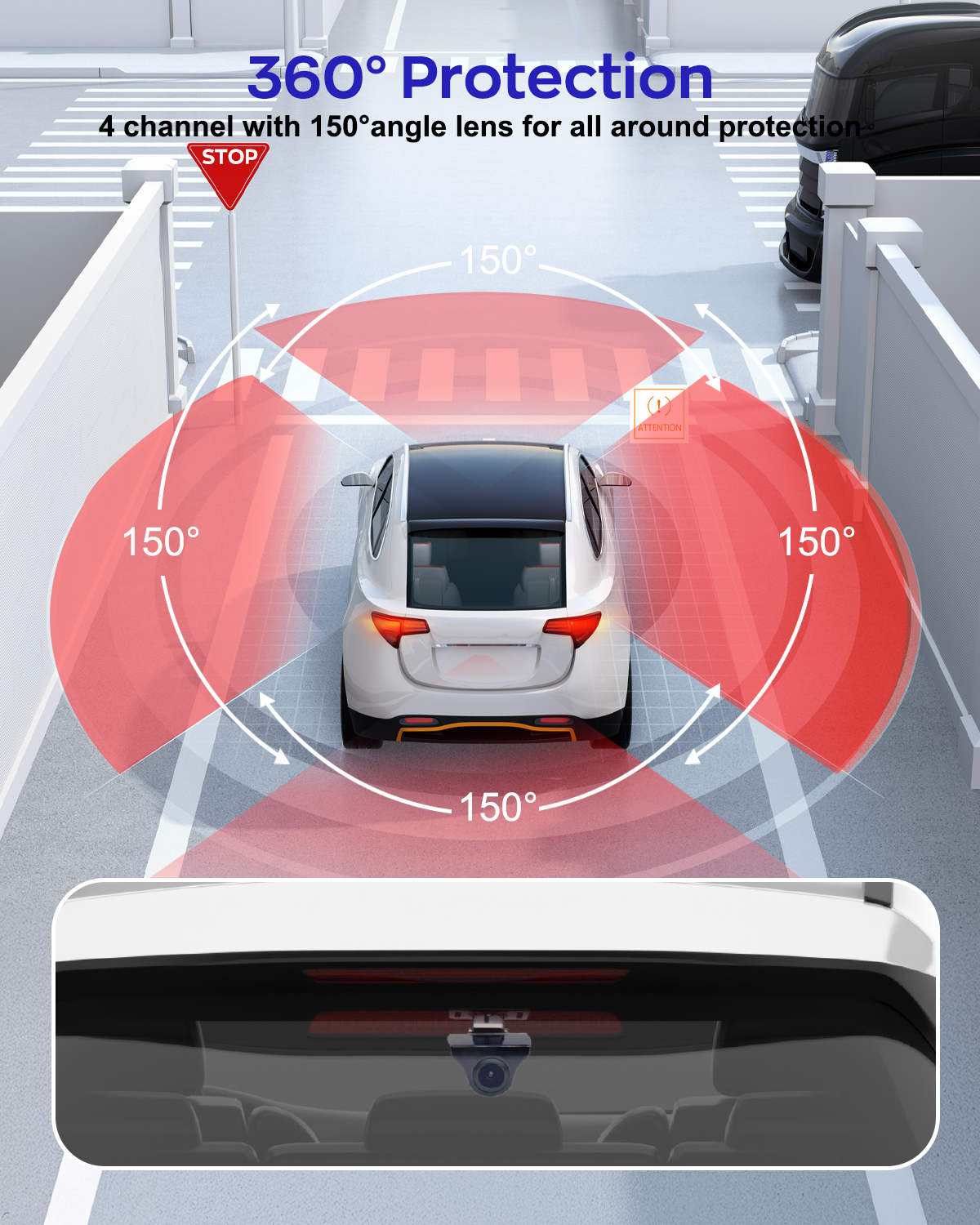
A four-channel dash cam records several fixed angles from a single recording unit rather than one forward view.
A multi-channel dash cam is a single in-vehicle recording system that captures video from more than two camera positions at the same time. A four-channel dash cam is one configuration inside that category: four camera heads wired to one recording unit, covering the road ahead, the road behind, and the areas beside or inside the vehicle.
That distinction matters at the point a buyer moves from research into comparison. Most dash cams still record one or two views. Interest in three-, four- and five-channel systems exists because a single forward lens cannot document a side swipe, a curbside stop, a rear-seat passenger or a disagreement inside the cabin. Multi-channel coverage exists to close those gaps, and the four-channel format is where side and cabin angles typically become part of the same recording.
What a Four-Channel Dash Cam Actually Records
A four-channel dash cam records four synchronized video streams from four separate camera heads. Channel assignment varies by system, but four cameras are normally used to cover the front road view, the rear road view, and two additional positions, most commonly the left and right sides, the cabin, or a combination of side and interior angles.
The practical difference between a dual-channel and a four-channel system is geometry rather than resolution. A front-and-rear setup answers what happened ahead and what happened behind. A four-camera setup adds the two angles where a large share of real disputes begin: the side of the vehicle during a lane change or a tight parking manoeuvre, and the interior during a passenger interaction or a family trip.
Driveye's four-channel line is described in its product documentation as providing wide road-and-cabin coverage with fewer blind spots, 4K front recording, enhanced night vision and a companion app for viewing and downloading recordings. That is a configuration description rather than a performance guarantee. Buyers should confirm the exact camera positions of any four-channel model they consider, because the term 4-channel does not standardize which four angles are covered.
Why Multi-Channel Configurations Are the Fastest-Growing Segment
Third-party market research points in one direction. Fortune Business Insights projects that the multi-channel segment will be the fastest-growing configuration in the dashboard camera market, at a compound annual growth rate of 13.2% across the 2026-2034 forecast period. The same source reports that side-facing dash cams are expanding at a 16.0% CAGR, driven by blind-spot monitoring and parking protection requirements.
For scale, Market.us estimates total dashboard camera market revenue at USD 4.5 billion in 2025. Within that market, momentum is concentrated in configurations that add peripheral vision rather than in single-lens units.
Two readings follow. First, buyers are not simply purchasing more cameras; they are purchasing specific angles that traditional systems missed, and side coverage is the fastest-growing of those angles. Second, four- and five-camera systems are no longer fleet-only products, since the demand signal is broad enough to support mainstream consumer configurations. These figures come from commercial research sources with different methodologies, so they are best treated as directional rather than as precise category sizing.
The Gap Left by Single- and Dual-Channel Systems
The case for four channels is built from cases that two channels cannot document.
- Side contact. In stop-and-go traffic, a vehicle in the next lane can move into a narrowing gap and scrape the side of the car. Front and rear cameras capture the approach and the aftermath, not the contact itself. When the other driver disputes what happened, the driver is left with incomplete evidence.
- Cabin disputes. Rideshare and taxi drivers face disagreements about what was said or done inside the vehicle, including complaints that do not match the trip. A road-facing camera records none of it.
- Rear-seat monitoring. A parent driving alone cannot safely turn around to check a child in a rear-facing car seat. A mirror or a separate baby monitor adds hardware but not a recording.
- Fragmented hardware. Buyers who try to close these gaps with add-on cameras end up with multiple mounts, separate power supplies and cluttered wiring, which is the problem multi-channel systems were designed to remove.
That is the opportunity four- and five-channel systems address: consolidating coverage that previously required several independent devices into one recording unit with one power source and one file system.
How Multi-Channel Recording Works in Practice
Four or five simultaneous video streams place specific demands on the hardware behind them. Published specifications of current systems show where the engineering effort goes.
Resolution allocation across channels
Channel count and resolution trade off against each other. Driveye's five-channel D9 Pro is specified as a true 4K front camera, a 2K rear camera and three 1080P side and interior cameras, including a dedicated baby monitor camera. A four-channel configuration such as the Driveye D7 is documented with 4K front recording and enhanced night vision.
Low-light performance
Night footage is where evidence value is usually lost. The Driveye D22 dual-channel model uses a STARVIS 2 sensor with an F1.5 front aperture and HDR/WDR processing to balance bright headlights against darker surroundings. The same design intent, usable detail rather than merely a recorded image, applies across the multi-channel range.
Recording continuity and file protection
Multi-channel systems depend on loop recording to manage storage, combined with an emergency lock that protects the current clip from being overwritten when a collision or impact is detected. Without that lock, the most important file is the first one at risk.
Driver-assistance alerts
ADAS functions in this category are built on the forward-facing channel. The Driveye D9 Pro is documented with alerts for lane departures, pedestrians, the movement of the vehicle ahead and potential forward collisions. These are warnings, not autonomous intervention, and they do not replace driver attention.
Positioning data, connectivity and control
Built-in GPS records route, travel path and speed data alongside video, which helps when an incident is reviewed later. Dual-band Wi-Fi supports transferring footage to a phone, and voice control allows supported functions to be triggered hands-free, which matters for parents who want to save a moment without reaching for a screen while driving. Driveye also lists optimized thermal management across its products, aimed at stable performance in extreme conditions.
Where Driveye Sits in the Multi-Channel Dash Cam Market
Driveye is a dash cam brand founded in 2024 and headquartered in Hong Kong, positioned around intelligent multi-channel dash cams for families, taxi operators and frequent professional drivers. Its stated design premise is full surrounding visibility: reducing blind spots, warning drivers of potential hazards, and producing usable footage as driving evidence, combined with an interior camera that supports in-cabin monitoring for family users.
The brand's published background states that its multi-camera approach was developed over roughly 18 months of in-house engineering, that it reached a Top 3 position within the dash cam category on Kickstarter, and that its products have launched and sold in more than 20 countries. Those are first-party claims, and buyers evaluating the brand should treat them as such while confirming current distribution and support in their own market.
| Configuration | Cameras | Coverage described | Model | Listed price range |
|---|---|---|---|---|
| Dual channel | 2 | 4K front and 2K rear, 170° front / 150° rear, STARVIS 2 low-light sensor | Driveye D22 | USD 109.99-159.99 |
| Four channel | 4 | Wide road-and-cabin coverage with fewer blind spots; 4K front recording, enhanced night vision | Driveye D7 | USD 129.99-189.99 |
| Five channel | 5 | Front, rear, left, right and a dedicated rear-seat / baby monitor camera; ADAS alerts | Driveye D9 Pro | USD 199.99-259.99 |
| Modular multi-channel | Up to 5 (company-stated) | Forward-facing base unit with side, interior and rear views added through a multiplexer accessory | Thinkware multi-channel system | Not verified |
Comparison limited to configurations with published channel descriptions. The Thinkware entry reflects the company's own stated capability, with no independent validation available.
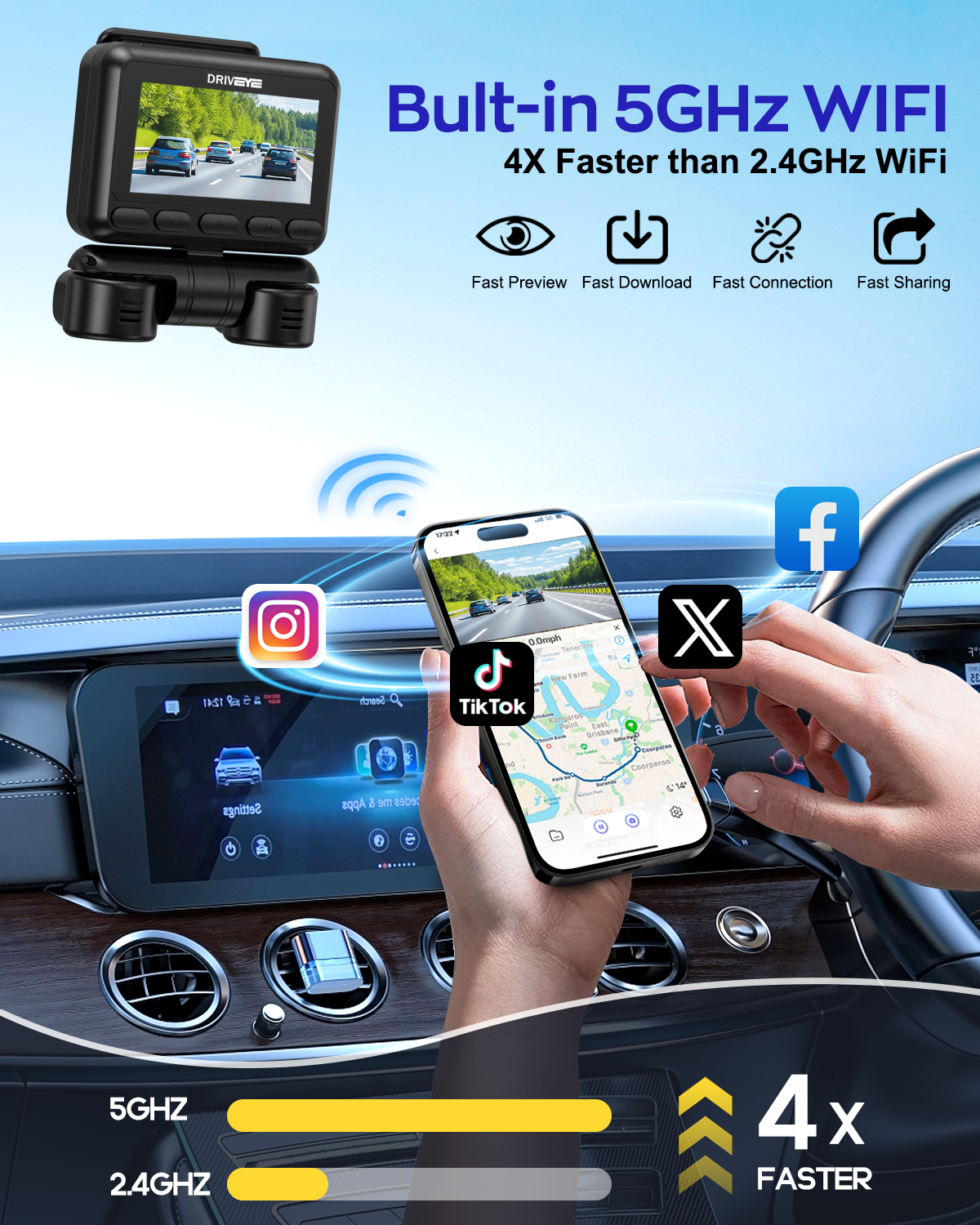
Multi-camera coverage is defined by camera positions, not by channel count alone.
Application Scenarios: Who Actually Uses Four and Five Channels
Families travelling with an infant or toddler
The clearest four- and five-channel use case is a parent driving alone with a young child in a rear-facing car seat. A documented Driveye scenario describes new parents preparing for a two-month-old's first road trip. They needed to know whether the baby was sleeping, upset or tangled in a blanket without turning around, and they wanted to keep the moment when the baby smiled. A live-only baby monitor could not save anything, and a separate action camera required extra mounting brackets and charging cables. A multi-channel system with an interior camera covers both monitoring and recording, while the remaining channels record the road on every side.
Rideshare and taxi drivers
Full-time rideshare drivers work long shifts with unfamiliar passengers and face a specific evidence problem: they are recorded only from the front. A documented use case describes a driver who was penalised after a passenger complaint because a dual-channel system left the side and rear views uncovered. A five-channel configuration recording front, both sides, rear and cabin provides one continuous record of the trip, while ADAS warnings address the fatigue risk that comes with shifts of eight to twelve hours.
Delivery, truck and small-fleet operations
Fleet operators need multi-angle footage for incident review and driver coaching, plus GPS data for context. Vehicles that manoeuvre in tight loading areas are particularly exposed to side contact that a front-and-rear setup will not capture.
Everyday commuters and road trips
For commuters, the value is narrower but still real: lane-change scrapes, lane cut-ins and disputed tickets are side and rear events as much as forward events. For road-trippers, a cabin channel doubles as a memory recorder and as a way to check on children or pets travelling in the back.
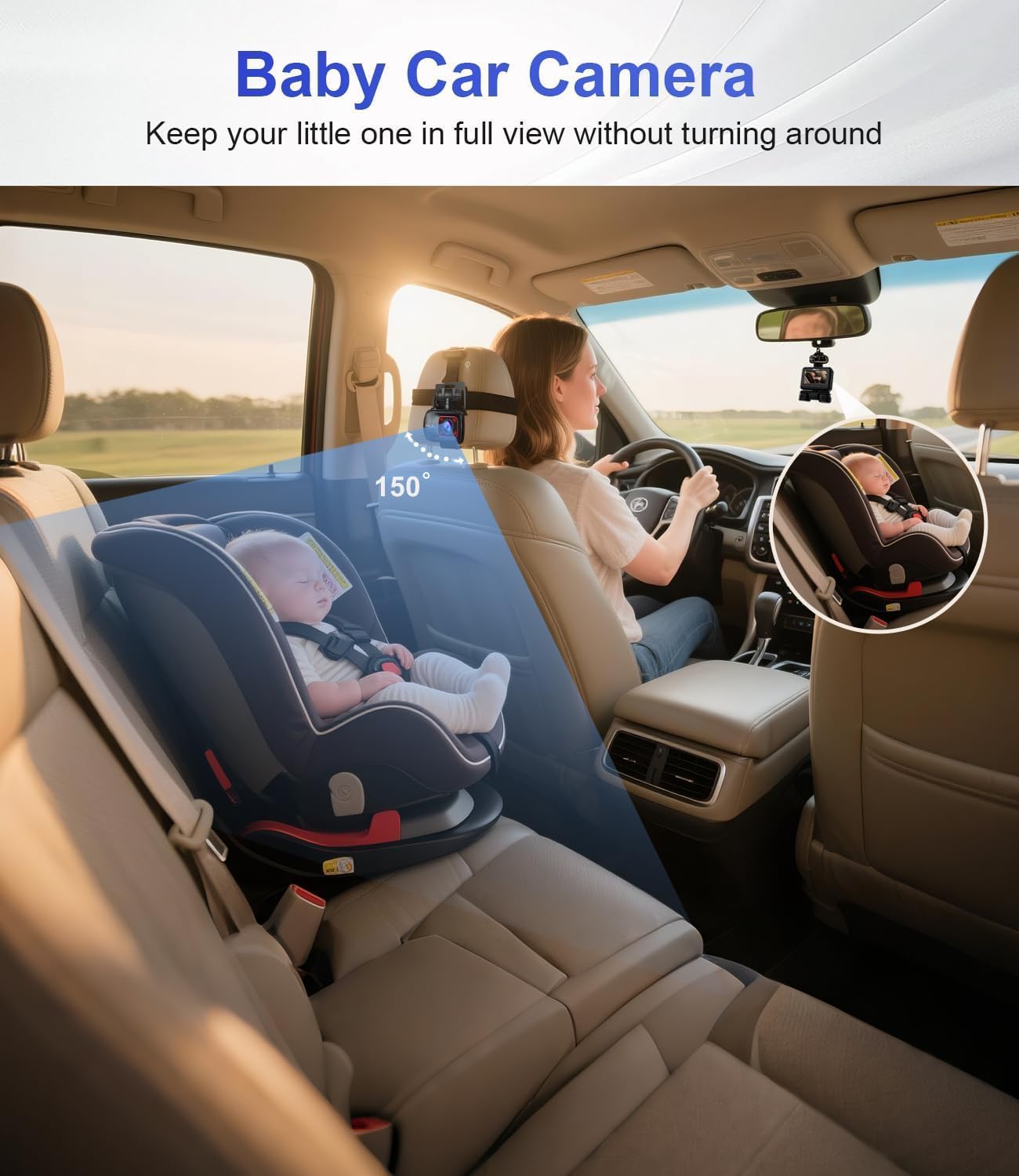
An interior channel supports rear-seat monitoring while the remaining cameras record the road.
Limitations, Trade-offs and Constraints Buyers Should Plan For
Multi-channel coverage is a genuine capability increase, but it is not free of cost or complexity. The following constraints come either from product data or from the operational assumptions of the scenarios above.
- Installation effort scales with channel count. Additional camera heads mean additional cabling and mounting positions. Positioning must not obstruct the driver's view or interfere with airbag deployment.
- Parking monitoring is not always included. For the Driveye D22, parking monitoring requires a separately purchased hardwire kit. Buyers who want parked-vehicle recording should confirm the accessory requirement for the specific model.
- No cloud or remote viewing. The documented Driveye road-trip configuration states that there are no cloud or remote viewing capabilities. Footage is accessed locally or transferred over Wi-Fi, so convenience arrives after the drive rather than during it.
- Interior recording carries privacy obligations. Passenger-facing audio and video recording is subject to local privacy and consent laws, and passengers should be aware that recording is active. An option to turn it off is part of the documented rideshare configuration.
- Cost rises with configuration. The step from dual to five channels is a meaningful price step, and it should be weighed against the value of the extra angles for a specific driving pattern rather than against channel count alone.
- Third-party performance verification is limited. Independent night-vision, heat-tolerance, latency and reliability testing for this category is not broadly available in public sources, so manufacturer specifications remain the primary reference and are best validated during a return window.
Future Outlook
Three directions are visible in the available evidence. First, growth is concentrated where coverage was previously missing: side-facing cameras are expanding faster than the market as a whole, and the multi-channel configuration is projected as the fastest-growing segment through 2034. Second, features once treated as premium, including cabin monitoring, ADAS warnings, voice control and GPS, are becoming part of the standard description of a multi-channel system rather than optional extras. Third, buyers are consolidating devices: the same system that records evidence is expected to monitor a child, store a trip and warn of a hazard.
The practical consequence for procurement is that channel count alone will become a weaker differentiator. Camera position, low-light capability, storage handling and installation simplicity are the specifications that determine whether a multi-channel system is genuinely usable in daily driving.
Frequently Asked Questions
What is a multi-channel dash cam?
A multi-channel dash cam is a single in-vehicle recording system that captures video from more than two camera positions simultaneously. Multi-channel is the umbrella term covering three-, four- and five-camera systems, while dual-channel systems recording a front and a rear view are generally classified separately. In a multi-channel system, all camera heads feed one recording unit, so footage from every angle is stored together with a shared timestamp.
What does a four-channel dash cam record that a dual-channel dash cam does not?
A dual-channel system records the road ahead and the road behind. A four-channel system adds two further angles, typically side or interior views, so that side contact during a lane change or a parking manoeuvre and activity inside the cabin can be documented from the same device. The gain is coverage geometry rather than resolution: the four-camera system answers questions about the vehicle's perimeter and interior that two cameras cannot answer.
Is a four-channel dash cam enough, or do families need a fifth camera?
The difference is the dedicated interior channel. A four-channel system can include cabin coverage as one of its four angles, while a five-channel system such as the Driveye D9 Pro separates the rear-seat view from the road-facing angles: a 4K front camera, a 2K rear camera and three 1080P side and interior cameras, one of which is dedicated to baby monitoring. Families who want uninterrupted road coverage plus a continuous view of a child in a rear-facing seat generally obtain both more reliably from five channels than from four.
Can a dash cam work as a baby monitor in the car?
Yes, when the system includes a dedicated interior or rear-seat camera. In the Driveye configuration, the interior camera supports monitoring of a baby or pet without the driver turning around, and unlike a live-only baby monitor it also records video, so a moment can be saved rather than only watched. Because the same device records the road from multiple angles, parents do not need to install a separate monitor alongside a dash cam.
What should buyers check before choosing a multi-channel system?
Worth verifying: exact camera positions rather than channel count alone; resolution per channel; low-light sensor and aperture; storage capacity and loop recording with emergency lock behaviour; whether parking monitoring requires a separately purchased hardwire kit; how footage is transferred to a phone; whether mounting positions clear the airbags and the driver's sight line; and the local rules that apply to recording audio and video inside a vehicle.
Does a multi-channel dash cam need professional installation?
Not necessarily, but complexity increases with channel count. Multi-camera systems involve routing cables for side, rear and interior cameras, which is more work than a single windshield-mounted unit. The documented requirement is that camera positioning must not obstruct the driver's view or interfere with airbag deployment. Buyers who are not comfortable routing trim panels should plan for professional installation, and should confirm accessory requirements such as the hardwire kit needed for parking monitoring on particular models.
How much do multi-channel dash cams cost?
Prices reflect channel count and capability. In the Driveye range, listed price ranges run from USD 109.99-159.99 for the dual-channel D22, USD 129.99-189.99 for the four-channel D7, and USD 199.99-259.99 for the five-channel D9 Pro. Prices vary by market and configuration, and additional accessories such as a hardwire kit for parking mode may be purchased separately.
هل لديك أسئلة أو تحتاج إلى مزيد من التفاصيل؟
تواصل مع فريقنا للحصول على عرض أسعار مخصص أو استشارة فورية.
طلب عرض أسعار
املأ النموذج أدناه وسيتواصل معك فريقنا بعرض مقترح مخصص.
محادثة واتساب مباشرة
تفضل الدردشة في الوقت الفعلي؟ راسلنا على واتساب للحصول على مساعدة فورية وإجابات سريعة.
- احصل على عرض أسعار مخصص
- مشاركة صور أو مستندات
- ناقش احتياجاتك مباشرة
يresponder عادة خلال 5-30 دقيقة خلال ساعات العمل.