
4-Way Stretch Functional Knit Fabric: What Buyers Must Verify
4-Way Stretch Functional Knit Fabric: What Buyers Must Verify
Four-way stretch describes a knit fabric that extends and recovers in both the lengthwise and crosswise directions, rather than stretching in a single direction. In a purchase specification, that phrase is a construction claim about the base fabric and its elastane-containing yarn build — not a performance grade. On its own, “4-way stretch” confirms nothing about moisture management, chemical compliance, colour consistency or durability after repeated washing.
The market around that claim is expanding. Fact.MR’s market analysis, published in April 2026, projects the global market for performance knitted fabrics — knits engineered for athletic, outdoor and medical end uses — to reach USD 8.58 billion in 2026. A broader Grand View Research estimate puts the total knitted fabric market at USD 35.7 billion by 2025, growing at a 6.0% compound annual rate. The two numbers differ because the scopes differ: one counts engineered performance fabrics, the other counts knitted fabric overall.
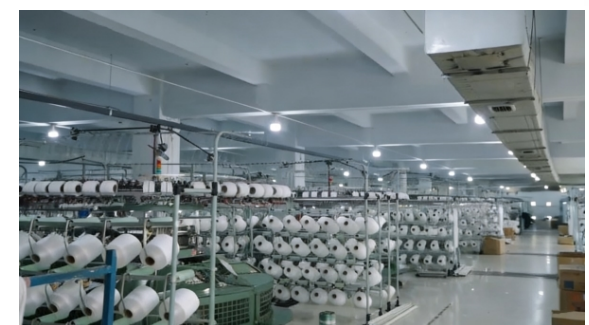
Zhangjiagang E-king Textile Co., Ltd., which operates under the EKING fabric brand, is a knitted textile manufacturer based in Zhangjiagang, Jiangsu Province, China, roughly 100 km from Shanghai and about 1.5 hours away by car. Established in 2011, the company integrates knitting, R&D, design, production, processing and international sales, and concentrates its development work on knitted elastic fabrics. Its 4-way stretch constructions sit inside a documented specification set covering fibre content, finishing functions and third-party certification — which makes them a workable example of how a 4-way stretch requirement should be written and verified.
Where the 4-Way Stretch Claim Sits in a Fabric Specification
On the EKING fabric range, 4-way stretch appears as one line item inside a longer parameter list, applied to specific base materials. Three reference constructions illustrate how the claim is positioned.
| Model | Base material | Stretch position | Listed functional parameters |
|---|---|---|---|
| EKWP2270-D6 | Nylon / spandex | 4-way stretch, high elasticity | Moisture-wicking; breathable / quick-dry; antibacterial / anti-odor; UV protection; water-repellent; easy-wash; recycled materials; wrinkle-resistant; optional cool-touch or warming treatments |
| EKWP1912-DSP | Nylon spandex / recycled nylon spandex | 4-way stretch, high elasticity | Moisture-wicking; breathable / quick-dry; UV protection; water-repellent; easy-wash; recycled materials; antibacterial and anti-odor finishing available |
| 20ETW1028-DSP | Poly / spandex | Elastane-containing knit | UV protection; water-repellent; easy-wash |
All three models are classified as sports functional fabrics, outdoor functional fabrics and recycled functional fabrics. That classification describes intended end-use groups rather than a quality ranking, and it is a useful reminder that a 4-way stretch buyer is usually purchasing a bundle of functions, not a single attribute.
Note the pattern on the EKWP2270-D6 specification: moisture-wicking, breathable and quick-dry performance, antibacterial and anti-odor treatment, UV protection, water-repellent finishing, easy-wash behaviour, recycled material content and wrinkle resistance all sit alongside the stretch parameter, with cool-touch or warming treatments listed as optional finishes. Removing any one of those lines changes the fabric, the price logic and the test plan.
The Constraint Layer: Variables to Lock Before Sampling
E-king’s stated customization scope covers yarn composition, GSM and weight, colour, stretch and knit structure, finishing (antibacterial, anti-odor, coating and water-repellent, UV treatment) and the use of recycled materials. Every one of those variables can shift the behaviour of a 4-way stretch fabric, so buyers who leave them open during sampling usually reopen them during bulk production.
| Specification variable | Why it should be fixed before sampling | Evidence to request with the sample |
|---|---|---|
| Yarn composition | Stretch and recovery behaviour, hand feel and moisture management all trace back to the yarn build; a supplier substitution changes the base the finishes sit on | Yarn composition statement, including recycled content where claimed |
| GSM / weight | Determines coverage, opacity and drape for a given end use | Measured GSM on the approved sample |
| Colour | Dyeing and finishing interact with stretch behaviour and shade consistency | Approved lab dip and colour-fastness data |
| Stretch and knit structure | Distinguishes a true 4-way construction from a single-direction elastic knit | Stretch and recovery test data agreed with the buyer |
| Finishing package | Moisture-wicking, antibacterial, anti-odor, UV and water-repellent functions are applied on top of the base and each carries its own validation requirement | Finish specification plus test results against the named method |
| Recycled material content | Recycled claims are only defensible when the paperwork matches the shipped lot | Valid transaction certificate referencing the product |
| Target market and test standard | Chemical thresholds and test methods differ by market, which changes what can be developed | Written test standard and reporting threshold |
E-king reports 100% testing in its quality control process, with sample support and technical communication offered ahead of bulk. Commercial parameters are stated as a monthly capacity of 30,000 m, a lead time of 30–45 days and a minimum order quantity of 3,000 yards.
Chemical Compliance Is Now Part of the Stretch Specification
Because 4-way stretch fabrics are frequently paired with water-repellent finishing, PFAS restrictions land directly on this product category. OEKO-TEX introduced a new limit value for Total Fluorine of 100 mg/kg under STANDARD 100, effective 1 January 2024, targeting PFAS compliance. In the United States, California’s AB-1817 bans regulated PFAS in textiles with a total organic fluorine threshold below 100 ppm from 1 January 2025, tightening to below 50 ppm in 2027.
E-king states that functions can be customized per brand requirement — including PFAS-free processing, specific antibacterial agents and recycled materials — but also states the boundary condition: development and validation require clear technical specifications and testing standards. That boundary is a practical constraint rather than a marketing caveat. A “PFAS-free” request without a named test method, a reporting threshold and a target market cannot be validated, and the finish durability required by an outdoor programme is not the same as that required by an everyday knit.
Certification Evidence: What the Documents Actually Cover
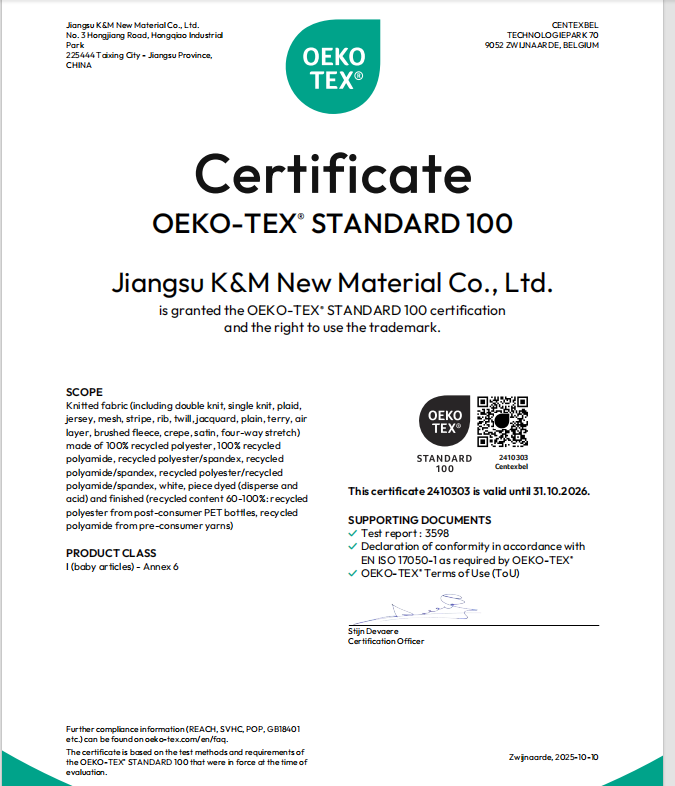
Two third-party certifications are on file for the EKWP2270-D6 functional knit fabric, and both carry scope limits that buyers should read before quoting them in their own product claims.
| Certification | Certificate number | Issued by | Validity | Scope |
|---|---|---|---|---|
| OEKO-TEX STANDARD 100 | 2410303 | Centexbel | 2025-10-10 to 2026-10-31 | Knitted fabric; textile safety and chemical management; applies to EKWP2270-D6; global market |
| Global Recycled Standard (TC/SC) | IDF-26-954043 | IDFL Laboratory and Institute Inc. | 2026-03-26 to 2027-03-25 | Dyed fabrics; applies to the EKWP2270-D6 nylon/spandex product; global market |
Two details deserve attention during evaluation. First, the GRS transaction certificate scope covers dyed fabrics and applies to the EKWP2270-D6 nylon/spandex product — it is not a blanket statement covering every fabric in the mill. Second, the OEKO-TEX STANDARD 100 certificate 2410303 carries an expiry date of 31 October 2026. At the time of publication it remains within validity, and buyers confirming orders later in the certificate cycle should request the certificate that is valid on their order date rather than relying on a copy saved earlier in the file.
Technical Explanation: How the Stretch and Comfort Functions Are Delivered
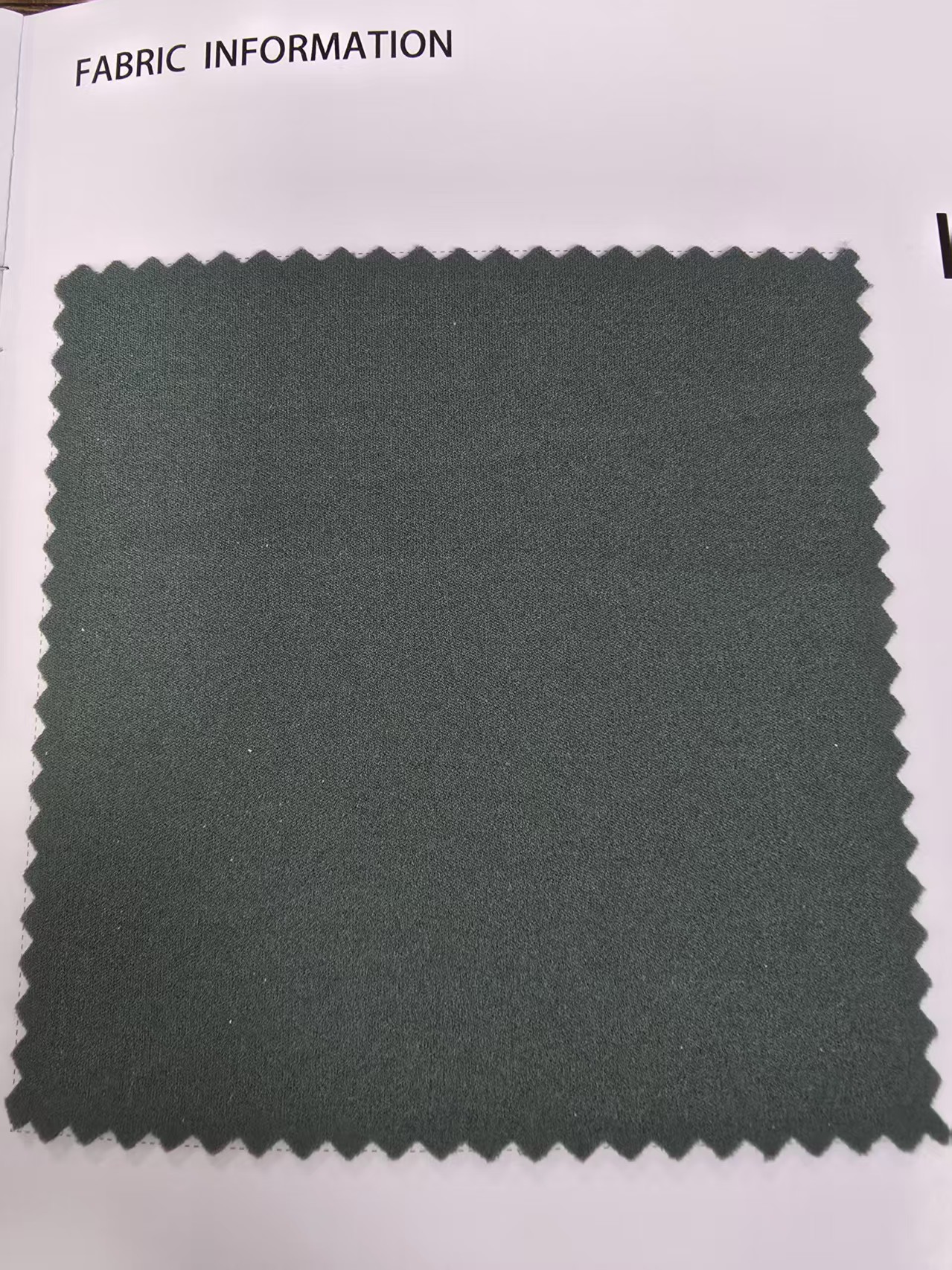
Two mechanisms do the work on the E-king range, and separating them makes specification easier. The first is structural: the fabric’s structural configuration supports breathability and quick drying, while the elastane-containing base provides a 4-way stretch designed to allow freedom of movement for the wearer. The second is the finishing layer: moisture management is achieved through yarn composition together with finishing treatments, and antibacterial, anti-odor, UV-protective and water-repellent finishes are applied on top of the base fabric.
This separation matters because the two layers fail differently. A complaint about stretch or recovery usually points back to the base construction and elastane content. A complaint about odour control, UV protection after repeated laundering, or repellency is usually a finishing-chemistry question. Buyers who compress everything into one combined “performance” requirement make it difficult for the supplier — and for any third-party lab — to tell the two apart.
The finishing capability behind those functions is broad. E-king lists peaching, brushing, fuzzing, transfer printing, dispersed printing, acid printing, digital printing, foil and emboss among its mechanical and print processes, alongside chemical functions such as antibacterial and odor control, moisture wicking and quick drying, UV protection, anti-static, waterproof, stain and oil prevention, thermal storage and warmth preservation, and cooling treatment. The company brought its own dyeing factory into production in March 2022, and reports cooperation with yarn and chemistry partners including Hengli Group, Shenghong Group, Invista, Creora Group, Huafeng Group and POLYGIENE.
Where 4-Way Stretch Functional Knit Fabric Is Used
The application profile for this fabric class is concentrated in five end-use groups: sports and fitness; outdoor; casual fashion; underwear and close-fit garments; and workwear and uniforms. The working conditions overlap in a predictable way. High-activity programmes put sweat management and wicking first; variable outdoor climates add breathability, UV and quick-dry requirements; everyday programmes prioritise easy-wash and quick-dry behaviour plus durability.
On the supply side, the project types that recur are apparel fabric supply, OEM/ODM private-label development, functional fabric customization projects and sustainable material substitution projects. Delivery typically runs as a combination of made-to-order production and custom development, with sample approval completed before bulk manufacturing begins, and with ERP-supported order tracking. One long-running relationship on record involves a garment-shop customer that has taken approximately 100 tonnes of fabric for apparel garments over a ten-year period, with stable performance and a soft, flexible hand feel reported as the standout characteristic.
Engineered 4-Way Stretch Knit vs Conventional Fabric Choices
Comparing an engineered 4-way stretch functional knit against conventional knit and woven options is useful, provided the comparison stays at the level of construction logic rather than brand-versus-brand claims.
| Dimension | Conventional knit or woven base without engineered elastane build | Engineered 4-way stretch functional knit |
|---|---|---|
| Movement and recovery | Limited or single-direction elasticity; fit relies on cut and pattern rather than fabric recovery | Extension and recovery in both directions, designed to allow freedom of movement |
| Moisture behaviour | Absorbency depends on fibre alone; drying speed is not engineered | Moisture management delivered through yarn composition plus finishing treatment; structural configuration supports breathability and quick drying |
| Function stack | Usually one or two finishes at most | Antibacterial, anti-odor, UV-protective and water-repellent finishes available; cool-touch or warming treatments offered as options |
| Documentation | Often limited to a mill test report | OEKO-TEX STANDARD 100 and GRS documentation available for the certified model, with defined scope and validity |
| Sourcing flexibility | Stock ranges and short runs are easier to source | Development-led: minimum order quantity of 3,000 yards and lead time of 30–45 days on the stated terms |
The limits of the engineered route should be stated plainly, because they shape programme planning. Development is buyer-driven: customized functions require clear technical specifications and testing standards before the mill can develop and validate them. Recycled content claims depend on a transaction certificate whose scope matches the shipped fabric, not on a general sustainability statement. Certificate validity windows — for example the OEKO-TEX certificate running to 31 October 2026 — have to be managed inside the order calendar. Monthly capacity of 30,000 m, a 3,000-yard minimum order quantity and a 30–45 day lead time mean that late-stage specification changes carry schedule consequences. And the 4-way stretch requirement itself adds validation steps, because stretch, recovery and the finishing functions must be confirmed by testing rather than assumed from the fabric name.
Market Signals Shaping the Next Specification Cycle
Three market signals are worth putting in front of a sourcing team writing a 4-way stretch programme.
- Recycled content is scaling but still a minority of textile volume. SNS Insider projects the recycled textiles market at USD 6.32 billion in 2025, growing at a 4.70% CAGR to 2035.
- Moisture management is a defined sub-market. Research and Markets expects the global moisture wicking fabrics market to reach USD 3.99 billion by 2030, growing at a 6% CAGR.
- Supply remains concentrated. China’s exports of knitted fabrics reached approximately USD 21.2 billion in 2024, according to Ken Research — which means buyers are selecting among mills with comparable machinery, and differentiation increasingly sits in documentation and finishing control rather than in the base knit alone.
Regulation is the fourth signal, and the most time-sensitive. Because California’s AB-1817 threshold tightens from below 100 ppm to below 50 ppm in 2027, a programme specified today against the 2025 threshold may not be compliant when the garments reach that market. Building the stricter threshold into the development brief now avoids a second finishing validation later.
Future Outlook
The centre of gravity in functional knit sourcing is moving from the fabric name to the specification document. Fibre content, GSM, stretch direction and recovery, finish package, named test methods and certification scope are becoming the operative parts of a purchase order, while marketing descriptors such as “4-way stretch” increasingly function as a heading above the detail rather than a substitute for it.
Two consequences follow. First, mills with in-house dyeing and finishing can iterate on finishing validation inside one production chain — E-king brought its own dyeing factory into production in March 2022 and reports developing over 100 new products each season, which is the kind of cycle speed finishing-led specifications require. Second, recycled content paperwork will move from a nice-to-have to a routine request, since a transaction certificate tied to the product and the shipped lot is the only defensible basis for a recycled claim.
FAQ
What does “4-way stretch” actually mean on a functional knit fabric specification?
It means the fabric extends and recovers in both the lengthwise and crosswise directions. On the EKING fabric range, 4-way stretch and high elasticity are listed parameters on EKWP2270-D6 (nylon/spandex) and EKWP1912-DSP (nylon spandex or recycled nylon spandex), both designed to allow freedom of movement for the wearer. The term indicates stretch direction and construction; it does not specify a stretch percentage or recovery level, which have to be defined separately in the specification and confirmed by test data.
How are moisture-wicking, breathable and quick-dry claims verified?
On this fabric range, moisture management is achieved through yarn composition combined with finishing treatments, and the structural configuration of the knit supports breathability and quick drying. Verification therefore has two parts: a test method named in the specification and applied to the finished fabric, and a supplier testing record. E-king reports 100% testing as part of its quality control process. Because the function comes from both the yarn build and the finish, both should be fixed before sampling.
Which certifications apply to the certified functional knit fabric model, and what do they cover?
Two certifications are on file for EKWP2270-D6. OEKO-TEX STANDARD 100 certificate 2410303, issued by Centexbel, covers knitted fabric for textile safety and chemical management and is valid from 2025-10-10 to 2026-10-31. The GRS transaction certificate IDF-26-954043, issued by IDFL Laboratory and Institute Inc., covers dyed fabrics and is valid from 2026-03-26 to 2027-03-25. Both apply to the global market, and the GRS scope specifically references the EKWP2270-D6 nylon/spandex product.
How should PFAS-free finishing be specified for a 4-way stretch fabric?
Set the target market threshold first, then the test method, then the durability requirement. OEKO-TEX introduced a Total Fluorine limit of 100 mg/kg under STANDARD 100 effective 1 January 2024, and California’s AB-1817 sets a total organic fluorine threshold below 100 ppm from 1 January 2025, tightening to below 50 ppm in 2027. E-king states that functions can be customized per brand requirement, including PFAS-free processing, but that development and validation require clear technical specifications and testing standards from the buyer.
What does the sampling and validation process involve?
The operating model combines made-to-order production with custom development, and sample approval is completed before bulk manufacturing. E-king provides sample support and technical communication during this stage. Customization covers yarn composition, GSM and weight, colour, stretch and knit structure, finishes such as antibacterial, anti-odor, water-repellent and UV treatment, and the use of recycled materials. Bulk issues are handled according to contract and warranty terms, which should be confirmed and written into the contract.
What order volume and lead time should a buyer plan for?
E-king states a minimum order quantity of 3,000 yards, a lead time of 30–45 days and a monthly capacity of 30,000 m. The company’s export markets are the EU and USA, and it reports an annual output of 6,000 tonnes with 95% of production exported. Programme planning should treat these as the stated commercial boundaries, since finishing changes made after sample approval can affect the schedule.
Reference Material
Zhangjiagang E-king Textile Co., Ltd. is located at No.10 Xinjing West Road, Zhangjiagang City, Jiangsu Province, China, and operates an 8,600 m² facility with 80 employees, a 10-person R&D team and an annual output of 6,000 tonnes. Company background, capability and product documentation are summarised in the E-king company profile (PDF). Additional product information is published at www.ekingtex.com.