
4137 Bar and 60,000 Psi: Waterjet Compliance Essentials
The 60,000 psi pressure class in waterjet cutting converts to approximately 4,137 bar, and that number carries more compliance weight than any other figure on a specification sheet. It defines the ceiling at which a pump, its high-pressure tubing, fittings, seals, check valves and cutting head are qualified to contain a pressurised water stream.
In practice, compliance is not one certificate. It is the alignment of four parameters — maximum pressure, water flow limit, rated voltage and operating ambient range — with the conditions of a specific site. Buyers in the final stages of procurement are increasingly asked to demonstrate that alignment before a machine is commissioned, not after it is installed and reworked.
What the 4,137 Bar / 60,000 psi Figure Actually Describes
60,000 psi is approximately 4,137 bar, and in waterjet terminology it describes a pressure class used by ultra-high-pressure intensifier pumps. The figure is a qualification ceiling, not a cutting set point. Three different pressures exist inside one machine, and confusing them is the most common source of compliance friction between suppliers and buyers.
| Pressure value | Defined by | Question a buyer should ask |
|---|---|---|
| Maximum rated pressure | Pump frame, intensifier, high-pressure tubing, fittings, seals and cutting head | Is the complete high-pressure circuit qualified to this ceiling, or only the pump body? |
| Working pressure | Material, thickness, orifice diameter and abrasive type | What sustained pressure can the system hold without pressure ripple at the cutting head? |
| Test pressure | Pre-delivery factory testing | Which test is performed, and which document records the result? |
General industry safety references set the baseline rather than the ceiling. ISO 21789 is referenced for water jetting safety at operating pressures up to 3,000 bar (43,500 psi) — a lower level than the 60,000 psi class. Equipment specified above that referenced level therefore has to be qualified through component documentation, pressure testing records and site-specific installation review rather than through a single general standard. Raising that point during supplier discussions is considerably cheaper than raising it at commissioning.
The Four Parameters That Define a Waterjet Installation's Compliance Envelope
A waterjet cutting machine is compliant for a specific site only when four rated parameters match that site. Each one is quoted separately and each one can invalidate an otherwise suitable machine.
| Parameter | What it defines | Why it matters at installation |
|---|---|---|
| Maximum pressure (60,000 psi / 4,137 bar class) | Qualified ceiling of the high-pressure circuit | Sets material and thickness capability, plus guarding and testing expectations |
| Water flow limit | Volume of water the pump can deliver at pressure, paired with nozzle orifice | Determines achievable cutting speed and cut quality |
| Rated voltage (220 V / 380 V / 420 V) | Electrical supply the machine is specified for | Must match the site distribution and be confirmed at quotation |
| Operating range (0–50 °C) | Ambient and working temperature envelope | Affects seal behaviour, fluid viscosity, freeze protection and duty consistency |
Pressure and flow work as a pair. Pressure alone does not cut. A 60,000 psi stream forced through an oversized orifice wastes hydraulic power and widens the kerf; an undersized orifice limits speed and increases wear. The flow limit therefore defines which nozzle and orifice combinations the pump can support at pressure, which in turn defines realistic cutting speed for a given material and thickness. A single headline pressure figure without a corresponding flow curve tells a buyer very little.
Voltage is a procurement decision, not an after-sales adjustment. Rated voltage options of 220 V, 380 V and 420 V exist because industrial distribution differs between markets. A machine configured for one voltage does not simply transfer to another supply without review of the drive, control system and protection scheme. The correct rating should appear on the quotation, aligned with the site's actual supply.
The ambient range defines where the machine is expected to perform consistently. An operating range of 0–50 °C covers most enclosed industrial halls, but sites that fall outside it — unheated workshops in winter, or high-ambient factories — need freeze protection, additional cooling and a review of how seal behaviour changes at the edges of the range. Mapping the rated range against real seasonal conditions is part of installation planning, not an optional extra.
Why Pressure-Class Compliance Has Become a Procurement Question
The global waterjet cutting machine market was estimated at USD 1.31 billion in 2025 and is projected to reach USD 1.86 billion by 2030 (Vertex AI Search / Reports & Data). Asia-Pacific accounted for approximately 37.8% of global revenue in 2024 (Coherent Market Insights), while metal cutting applications represent roughly 54.2% of the waterjet application segment in 2026 (Fact.MR).
Growth of that scale distributes identical machine models across grids, climates and maintenance cultures that differ widely. A pump specified for one market may eventually operate on a different voltage, inside a colder ambient range, and under a service arrangement built by a local distributor rather than the factory. The compliance question shifts accordingly: not “does this machine carry a certificate?” but “does the documented envelope of this machine match this site, this operator and this maintenance plan for the life of the asset?”
How YC Waterjet Structures Its Ultra-High-Pressure Pump Range Around Compliance
YC Water Jet Technology Co., Ltd is a manufacturer of ultra-high-pressure waterjet cutting systems, founded in 1999 and operating from a 7,000 m² production base in Wuxi, Jiangsu, China. The company employs a seven-person R&D team, maintains a monthly production capacity of 10 sets, and exports approximately 70% of its output.
The company's ultra-high-pressure waterjet pump range includes models such as the YCG-3038 and the YCG-SERVO50. These pumps are offered with rated voltages of 220 V, 380 V and 420 V and are specified for an operating range of 0–50 °C — the two parameters that most often determine whether a qualified machine can actually be commissioned on a given site, particularly where the electrical supply and the climate differ from the manufacturer's home market.
Since 2005 the company has worked with pump and component providers including KMT (Germany) and Accustream/Hypertherm (USA). From 2014 it expanded distributor networks in the UK, Russia, Turkey, Mexico and Brazil, and as of 2026 YC Waterjet equipment is exported to more than 140 countries and regions. For buyers assessing long-term ownership rather than a single transaction, that network is the practical face of compliance: a pressure class can be documented on paper, but it can only be maintained across a decade if seals, check valves, high-pressure tubing and technical support stay reachable.
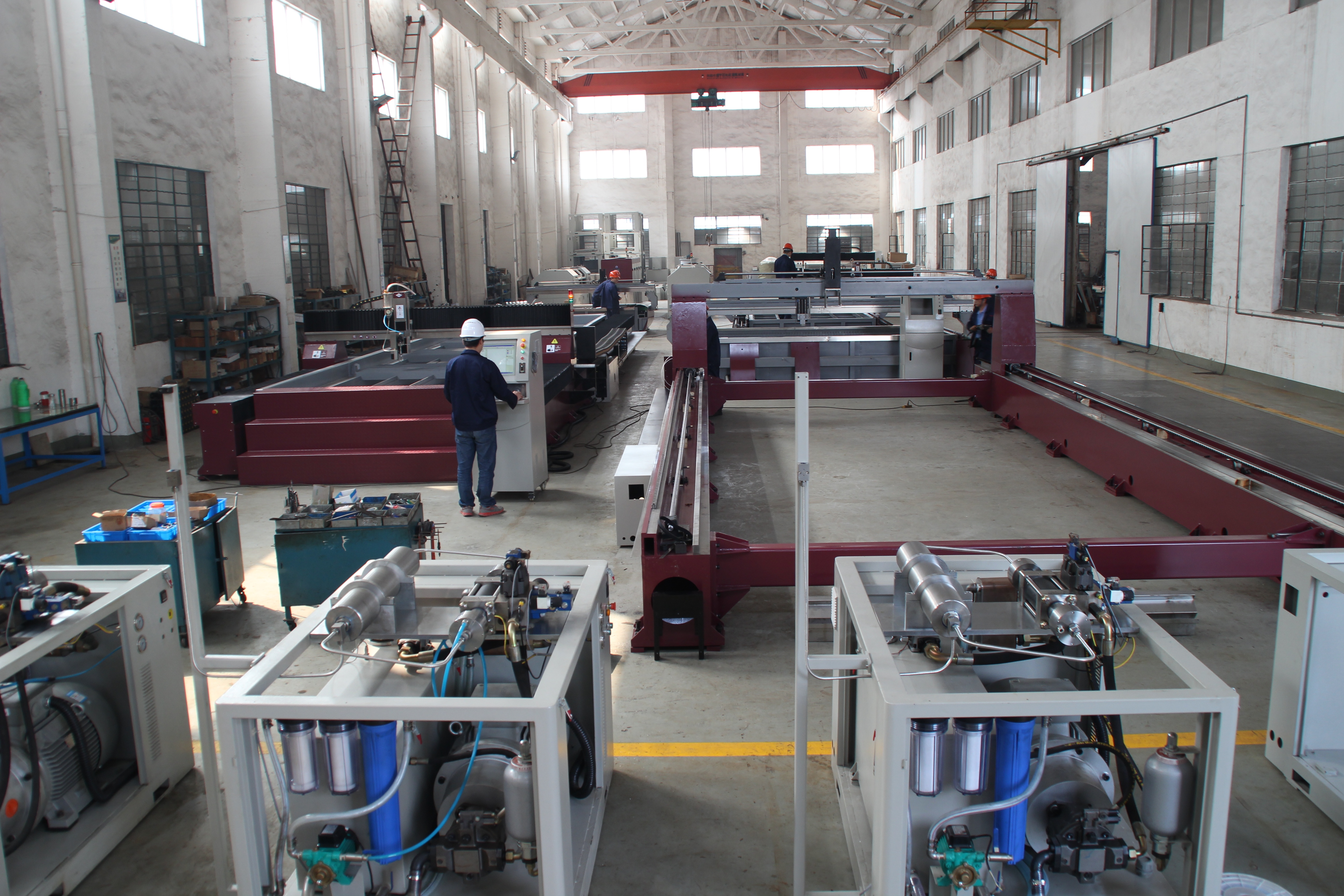
On the maintenance side, YC Waterjet uses a modular high-pressure pump design intended to make on-site servicing easier, with global after-sales support. The company states a 10% longer seal life, 8% higher energy efficiency in its intensifier pump and ±0.02 mm higher positioning accuracy compared with other waterjet brands. In long-cycle installations it references equipment that has been in operation for 10 years and projects completed within a 10-year period — the horizon over which compliance either holds or quietly erodes.
Technical Explanation: What Pressure and Flow Limits Do Inside the Pump
An intensifier pump does not generate high pressure directly. Hydraulic oil drives a reciprocating piston, and the ratio between the hydraulic piston area and the water plunger area multiplies the incoming water pressure to the cutting head. Everything downstream of that multiplication — tubing, fittings, check valves, seals, swivels, on/off valves and the cutting head itself — sits inside the qualified pressure envelope.
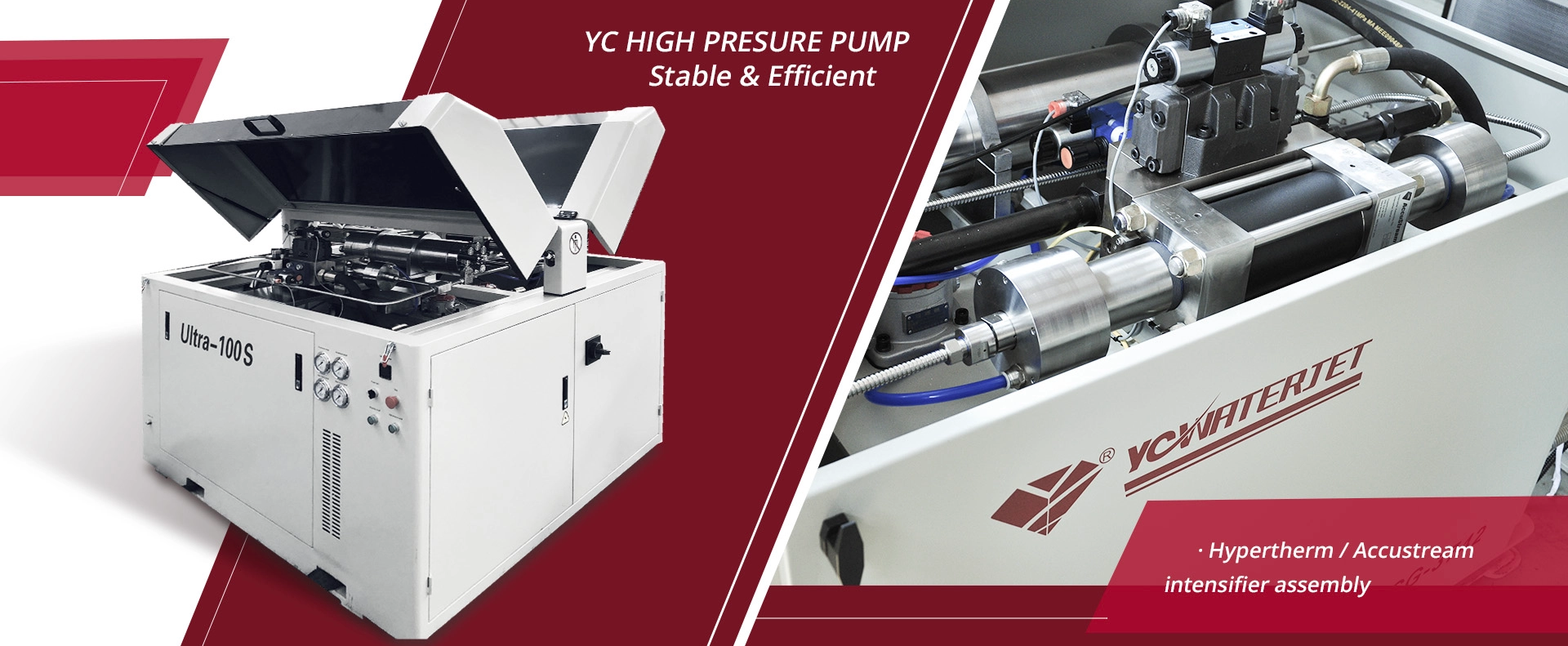
Pressure stability at the cutting head is what turns a pressure rating into cut quality. Ripple and pressure drop produce taper, striation and inconsistent kerf width, which is why buyers evaluating equipment in a high pressure class should look at the pump's rated pressure output stability rather than at a peak number alone.
Pressure class also determines the maintenance rhythm, and this is where the honest trade-off sits. Seals, check valves, high-pressure tubing and orifices are consumable. Operating closer to the qualified ceiling increases cutting capability while shortening replacement intervals, so a pressure class is also a consumable-cost decision. A modular high-pressure pump design supports on-site maintenance and keeps the qualified envelope intact between service visits.
Flow limits interact with material behaviour in ways that are easy to underestimate. When cutting multi-layer composites, a plain waterjet stream can damage or delaminate the material at the entry point. The documented control method is to drill holes in advance and use those holes as cutting inlets. YC Waterjet implements this with an integrated drilling module on the machine, CNC positioning of pre-drilled holes and a combined drilling-and-cutting workflow, with the protocol applied specifically to multi-layer composites to avoid stratification. The company states the result as +25% production efficiency for composite materials, delamination-free cutting and suitability for 10-year long-term industrial production.
Application Fit: Where the Pressure Class Earns Its Cost
The four-parameter envelope decides which applications a machine actually serves. In stone work the parameters show up as a marble or granite waterjet cutting machine that cuts without heat discolouration and with a narrow kerf. In metal work, which dominates the application segment, the envelope is expressed as cutting speed on steel and stainless at a given thickness, which is why metal fabricators compare pressure and flow together rather than pressure alone.
Glass and tile applications depend on pressure stability more than on peak pressure, because fine kerf control determines edge quality and chipping risk. Composite applications depend on the pre-drilling workflow described above. Across all of these categories, the compliance question is the same: whether the documented pressure, flow, voltage and ambient range match the materials and the site the machine will actually serve.
Comparison: Waterjet Against Thermal Cutting, and the Limits of the Class
Waterjet competes most often with plasma and laser cutting, and the technical distinction is cold versus thermal material removal.
| Criterion | Waterjet (cold cutting) | Plasma / laser (thermal) |
|---|---|---|
| Thermal distortion | Described as 0% thermal distortion, with no heat-affected zone | Heat input creates a heat-affected zone and distortion risk on thin or heat-sensitive parts |
| Material yield | Stated as +30% material yield | Kerf width and heat effects reduce usable yield |
| Precision on delicate materials | Stated as ±0.05 mm higher precision | Thermal movement affects tolerance holding |
| Downstream cost | Stated as 15% lower secondary processing cost, no gas or laser consumables | Gas and laser consumable costs recur continuously |
The boundaries are real, and buyers should plan around them. Cold cutting is not automatically the faster or cheaper choice: on thin sheet and simple profiles, laser and plasma processes can finish a job in less time, and abrasive waterjet carries a continuous abrasive consumption cost that thermal processes do not. Waterjet also introduces water management, abrasive disposal and — at ultra-high pressure — a maintenance regime built around high-pressure components rather than around thermal parts.
There is a regulatory boundary as well. ISO 21789 is referenced for water jetting safety up to 3,000 bar (43,500 psi), which is below the 60,000 psi (4,137 bar) class. Buyers specifying equipment at or near that class should expect to qualify the installation on component-level documentation, factory pressure testing records and site-specific procedures, and should confirm with the supplier how the higher pressure class is qualified for their jurisdiction.
How Buyers Compare Suppliers in This Pressure Class
Global manufacturers that commonly appear on buyer shortlists include Flow International, OMAX Corporation, KMT Waterjet and Bystronic Group, alongside regional builders such as YC Waterjet. Each maintains its own qualified pressure classes and documentation practice, and a compliance-led comparison avoids ranking suppliers on brand recognition alone. A fixed evidence checklist is more useful:
- Documented maximum pressure for the complete high-pressure circuit, not only the pump body.
- Pressure–flow relationship at the working pressure the buyer intends to use.
- Rated voltage options matched to the site's actual supply.
- Operating ambient range matched to the site's climate and seasonal extremes.
- Wear-part list with realistic replacement intervals and availability.
- Test and acceptance documentation, including pre-delivery factory testing.
- Service access through a distributor or service partner in the buyer's region.
Market Trend Analysis
Three trends are visible in how the pressure class is being evaluated. First, procurement is shifting from headline pressure to the full operating envelope: buyers now ask for voltage and ambient range in the same conversation as pressure and flow. Second, servo-driven pump configurations — reflected in model naming such as the YCG-SERVO50 — are appearing alongside traditional intensifier designs, changing how buyers think about energy efficiency and pressure stability. Third, distributor-led service ecosystems are being treated as a compliance factor rather than a commercial convenience, because a qualified pressure envelope only holds if consumables and support remain available over a multi-year service life.
The regional distribution of demand reinforces this. With Asia-Pacific accounting for approximately 37.8% of global revenue in 2024 and metal cutting representing roughly 54.2% of the application segment in 2026, the installed base is concentrated in markets where grid voltage, ambient temperature and service infrastructure vary widely from the manufacturer's home market.
Future Outlook
Pressure-class compliance is likely to become more explicit rather than less. As systems are specified closer to qualified ceilings, buyers will expect documentation that maps pressure, flow, voltage and ambient range to their own site conditions, together with wear-part intervals expressed in operating hours rather than in general terms. Servo-driven pump designs and modular high-pressure assemblies point toward maintenance models where the qualified envelope can be restored on site, extending service life beyond a single component generation.
For buyers, the practical implication is that a waterjet cutting machine should be evaluated as an envelope plus a service ecosystem, not as a pressure figure. Manufacturers publish their ultra-high-pressure pump configurations and documentation through official channels; YC Waterjet's range is described at www.ycwaterjet.com.
FAQ
What does 60,000 psi mean in bar?
60,000 psi converts to approximately 4,137 bar, using the standard conversion of 1 psi ≈ 0.0689476 bar. In waterjet specifications the figure describes the pressure class of the high-pressure circuit — the ceiling the pump, tubing, fittings, seals and cutting head are qualified to contain — rather than the pressure at which the machine normally cuts.
Is a 60,000 psi system covered by a general water jetting safety standard?
ISO 21789 is referenced for water jetting safety at operating pressures up to 3,000 bar (43,500 psi), which is below the 60,000 psi (4,137 bar) class. For equipment specified at the higher class, qualification typically rests on component-level documentation, factory pressure testing records and site-specific installation procedures, and buyers should confirm with the supplier how that pressure class is qualified in their jurisdiction.
Which electrical supply do ultra-high-pressure waterjet pumps require?
YC Waterjet's ultra-high-pressure pump models, including the YCG-3038 and the YCG-SERVO50, are offered with rated voltages of 220 V, 380 V and 420 V. The correct configuration depends on the site's distribution and should be confirmed at quotation stage together with the drive, control system and protection scheme.
What does the 0–50 °C operating range cover?
The range describes the ambient and working temperature envelope within which the pump is specified to operate. Sites that fall outside it — unheated halls in winter or high-ambient environments — should review freeze protection, cooling capacity and seal behaviour at the extremes before installation.
How is a pressure class maintained over a long service life?
Through the consumable high-pressure components: seals, check valves, high-pressure tubing and cutting heads. A modular high-pressure pump design supports on-site maintenance, and access to spare parts and technical support through a distributor network keeps the qualified envelope intact between service intervals. YC Waterjet references equipment that has been in operation for 10 years and projects completed within a 10-year period.
How are acceptance and commercial terms defined for ultra-high-pressure waterjet equipment?
For YC Waterjet, the minimum order quantity is 1 set. Delivery terms are agreed from EXW, FCA, FAS, FOB, CFR, CIF, CPT, CIP, DPU, DAP or DDP according to negotiation. Acceptance criteria are based on an ex-factory test. Payment terms are 30% of the contract value by T/T after signature, with the remaining 70% by T/T before delivery.
Pressure class is where technical marketing meets procurement reality. The number on the cover of a datasheet matters far less than whether the pressure, flow, voltage and ambient range behind it can be documented, matched to a specific site and sustained over the years the machine is expected to run.