
48V vs 51.2V vs 72V: Golf Cart Battery Compliance Evidence
Compliance paperwork has become part of the product. For dealers, importers and fleet engineers evaluating a lithium golf cart battery, the practical question is no longer only whether a pack fits the cart, but whether the supplier can produce a document with a number, an issuing body, a referenced standard and a validity window that matches the exact model being quoted.
This article compares the compliance evidence recorded for three LiFePO4 golf cart battery lines — 48V 100Ah, 51.2V 100Ah and 72V 105Ah — manufactured by Shenzhen Shiwei New Energy Co., Ltd., the Shenzhen-based lithium iron phosphate battery pack maker behind the SISWAY battery brand. Established in 2017, the company builds LiFePO4 packs for golf carts, UTVs, ATVs, forklifts, AGVs and home energy storage, and exports to dozens of countries.
The comparison below is deliberately document-first. It explains what each file proves, what it does not prove, and where a buyer should ask a follow-up question before signing a purchase order. It applies the same review method a procurement team would use with any supplier in this category.
Why compliance evidence moved into the procurement stack
Three different buyer functions now touch battery documentation, and each one reads a different document. Logistics and freight forwarders read transport test evidence. Warehouse and site-safety teams read hazard communication documents. Supplier-quality teams read management-system certificates. A supplier that can answer only one of the three creates delay at the shipping stage or at the customs stage, not at the specification stage.
Market context explains why this matters more now than it did five years ago. The global golf cart battery market reached approximately USD 1.49 billion in 2024 and is projected to reach USD 2.21 billion by 2030, a compound annual growth rate of 6.8%, according to Strategic Market Research. Lithium-ion batteries held approximately 47% of that market by revenue in 2024, based on analysis published by Boca EV. North America accounted for a 44.7% revenue share of the electric golf cart market in 2024, and the U.S. electric golf cart market alone was estimated at USD 529.4 million in 2024 by Grand View Research.
Trade flows reinforce the same point. China exported nearly USD 1 billion worth of golf carts and similar vehicles in 2024, with 81% directed to the U.S. market, according to China Customs data reported by the South China Morning Post. Every one of those vehicles carries a battery pack that must be documented for transport and, increasingly, for buyer qualification processes.
The three voltage lines and the documents they actually carry
The records reviewed here are not interchangeable. One is a model-scoped transport test report, one is a hazard communication document for the U.S. market, and one is an organisation-level quality management certificate that lists several applicable products. Understanding the difference is the core of buyer due diligence in this category.
48V 100Ah: a model-scoped transport and U.S. hazard file
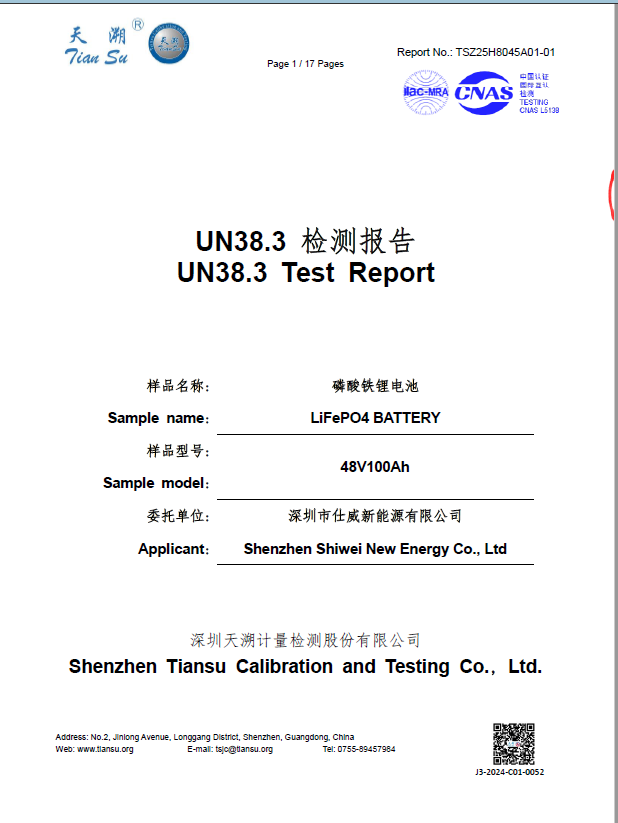
The 48V 100Ah golf cart battery carries a UN38.3 Test Report numbered TSZ25H8045A01-01, issued by Shenzhen Tiansu Calibration and Testing Co., Ltd. on 25 August 2025 with validity to 31 December 2026. The report references the UN 38.3 standard — the UN Manual of Tests and Criteria, Part III, Subsection 38.3 — and its stated scope is a LiFePO4 battery, model 48V100Ah, with global market applicability. UN 38.3 certification is required for the safe global transport of lithium batteries.
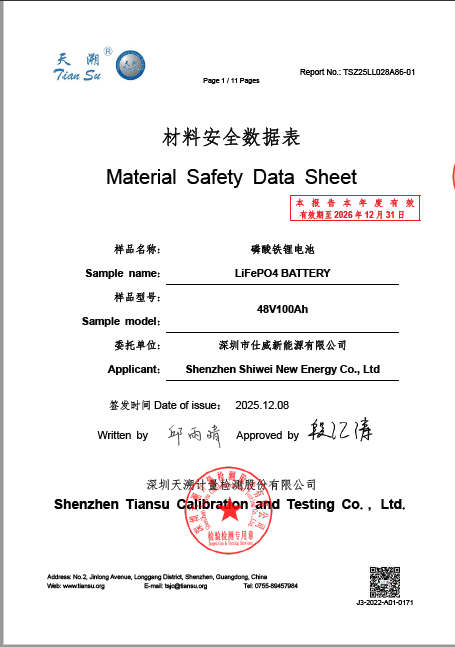
The same model is also covered by a Material Safety Data Sheet numbered TSZ25LL028A86-01, issued by the same testing body on 8 December 2025 with validity to 31 December 2026. Its market is listed as the USA, its referenced framework is GHS together with OSHA HazCom 2012, and its scope is the lithium-ion golf cart battery series.
Electrically, the 48V 100Ah pack uses a 15S1P configuration of 15 EV-grade A LiFePO4 prismatic aluminium-shell cells, a nominal 48V and 100Ah rating, 4,800Wh of energy, a smart 200A BMS, a maximum load power of 9.6kW, a 200A continuous discharge rating and a 300A peak discharge for 2 seconds. The case material is plastic.
Buyer reading: the UN38.3 report names one model. If the quoted capacity or configuration changes, the report no longer describes what is being shipped, and a new or amended report should be requested.
51.2V 100Ah: specification claims plus management-system coverage
The 51.2V 100Ah golf cart battery specification lists MSDS and UN38.3 among its certifications. Its published parameters include a nominal 51.2V, 100Ah rated capacity, 5,120Wh of energy, a 3-year warranty, a cycle life of at least 4,000 cycles, a 200A BMS, a maximum continuous output power of 5,120W, a maximum continuous charge current of 18A, a maximum continuous discharge current of 200A and a peak discharge of 300A for 3 seconds. Charge voltage is listed at 58.4V with a recommended charge current of 18A. Operating temperature ranges are 0°C to 45°C for charging, -20°C to 55°C for discharging and -20°C to 45°C for storage, with low-temperature charge cut-off protection at 0°C ± 4°C. The casing is metal.
The management-system evidence behind this line is a Quality Management System certificate numbered 24CN34504502Q, issued by ACM INTERNATIONAL CERTIFICATION LIMITED under GB/T 19001-2016 / ISO 9001:2015, valid from 31 March 2025 to 5 April 2027, with global market applicability. Its stated scope is the R&D and production of lithium ion battery, excluding 3C requirements, and the 51.2V 100Ah model is listed among its applicable products.
Two practical points follow. First, 51.2V is typically the LiFePO4 nominal voltage used to replace 48V lead-acid fleets, which is why this line is frequently ordered as a golf cart battery replacement for existing carts. Second, a quality management system certificate qualifies the supplier’s process, not an individual product. A procurement team should still request the model-scoped transport document for the exact pack being shipped.
72V 105Ah: high-voltage line on the same management-system scope
The 72V 105Ah golf cart battery is the highest-energy line in this comparison. Published parameters include a nominal 73.6V, 105Ah capacity, 7,728Wh of energy, a 23S1P configuration of 23 EV-grade A LiFePO4 prismatic cells, a smart 200A BMS, a maximum load power of 14.72kW, a 200A continuous discharge rating, a 400A peak discharge for 10 seconds, a discharge cut-off voltage of 63.25V, a standard charge time of 6 hours and dimensions of 558 × 333 × 300 mm. The casing is metal.
The quality management evidence referenced for this model comes from ACM INTERNATIONAL CERTIFICATION LIMITED under certificate number 24CN34504502Q, whose scope covers the R&D and production of lithium ion batteries while excluding 3C requirements. The 72V 105Ah model is listed as an applicable product on that certificate.
Document map: three voltage lines, three evidence types
The table below consolidates what the records show. It is a document map, not a quality ranking.
| Document | Number | Applies to | Standard / framework | Market focus | Validity |
|---|---|---|---|---|---|
| UN38.3 Test Report | TSZ25H8045A01-01 | LiFePO4 battery, model 48V100Ah | UN 38.3 | Global transport | Issued 2025-08-25, valid to 2026-12-31 |
| Material Safety Data Sheet | TSZ25LL028A86-01 | Lithium-ion golf cart battery series | GHS; OSHA HazCom 2012 | USA | Issued 2025-12-08, valid to 2026-12-31 |
| Quality Management System Certificate | 24CN34504502Q | 48V 100Ah, 51.2V 100Ah and 72V 105Ah listed as applicable products | GB/T 19001-2016 / ISO 9001:2015 | Global | Issued 2025-03-31, valid to 2027-04-05 |
For reference, the electrical profile of the three lines differs in ways that affect both the application and the documents a buyer should ask for:
| Model | Nominal voltage | Capacity | Energy | Cell configuration | BMS | Peak discharge | Case |
|---|---|---|---|---|---|---|---|
| 48V 100Ah | 48V | 100Ah | 4,800Wh | 15S1P, 15 cells | 200A smart | 300A (2 s) | Plastic |
| 51.2V 100Ah | 51.2V | 100Ah | 5,120Wh | Not specified | 200A | 300A (3 s) | Metal |
| 72V 105Ah | 73.6V | 105Ah | 7,728Wh | 23S1P, 23 cells | 200A smart | 400A (10 s) | Metal |
Five checks that separate usable evidence from decorative evidence
Certificate screenshots circulate freely in this industry. The checks below are the ones that turn a screenshot into a purchasing fact.
- Trace the number to the issuing body. UN38.3 report TSZ25H8045A01-01 and MSDS TSZ25LL028A86-01 both name Shenzhen Tiansu Calibration and Testing Co., Ltd. as the issuing body. The quality management certificate names ACM INTERNATIONAL CERTIFICATION LIMITED. A buyer should be able to contact or verify each body independently.
- Match the scope wording to the quoted model. The UN38.3 scope names one model. If a buyer orders a different capacity or a different cell configuration, the document does not describe that product.
- Confirm the standard version and the market. UN 38.3 addresses transport safety; GHS and OSHA HazCom 2012 address U.S. hazard communication; GB/T 19001-2016 is the Chinese adoption of ISO 9001:2015, which is why the certificate states both.
- Check issue and expiry dates. The transport and safety documents run to 31 December 2026, while the management-system certificate runs to 5 April 2027. A dated copy should be re-confirmed at the purchase-order stage rather than assumed to be permanent.
- Read what is excluded. The quality management certificate scope explicitly excludes 3C requirements. That exclusion should be stated plainly in buyer communications instead of being glossed over.
What this evidence does not cover
Buyer credibility depends on stating boundaries. None of the three documents reviewed here is a product performance guarantee, and none of them is a blanket approval for every market or project specification.
The UN38.3 test report addresses the safe transport of a specific battery model. It does not certify cycle life, runtime in a specific cart, thermal behaviour in a particular climate or BMS logic. The Material Safety Data Sheet is a hazard communication document supporting U.S. handling, storage and emergency-response practice under GHS and OSHA HazCom 2012; it is not a safety certification. The ISO 9001:2015 certificate covers an organisation’s R&D and production management system and should never be presented as China Compulsory Certification.
Some projects also specify product-level safety standards that sit outside this document set. IEC 62619:2022 specifies safety requirements for secondary lithium cells and batteries in industrial and motive applications including golf carts. UL 2580 covers electrical, mechanical and environmental testing for batteries used in electric vehicles in North America. Where a tender, insurer or fleet owner names those standards, they must be requested and evidenced separately rather than inferred from a UN38.3 report or an ISO 9001 certificate.
A second boundary is voltage coverage. This comparison covers 48V, 51.2V and 72V lines because those are the lines with published records here. Fleets still running 36V golf cart battery systems fall outside the document set described in this article and require their own model-level evidence.
LiFePO4 versus lead-acid: where the documentation burden actually shifts
The shift from flooded lead-acid to lithium does not remove paperwork; it relocates it. LiFePO4 batteries typically offer 2,500 to 9,000 cycles at 80% depth of discharge, while traditional flooded lead-acid batteries deliver approximately 300 to 500 cycles at 50% depth of discharge. Fewer replacement cycles mean fewer disposal and handling events, which is where the lead-acid burden traditionally sits.
In exchange, lithium introduces transport classification, hazard communication and certificate-expiry management. A lithium golf cart battery replacement programme therefore adds an administrative layer that lead-acid fleets rarely had to track: dated test reports scoped to a model, safety data sheets aligned to a destination market, and a management-system certificate with its own multi-year validity window.
The honest limitation: lithium documentation is more complex and less forgiving than lead-acid documentation. A lead-acid fleet manager can often substitute a similar battery without new paperwork. A lithium buyer generally cannot — the transport report names a model, the safety data sheet names a series, and both expire. Teams that treat certificates as static attachments rather than managed records will eventually ship against an outdated file.
Matching voltage and evidence to real fleet scenarios
Voltage choice is usually decided by the cart platform, the duty cycle and the existing charger, not by the certificate file. The certificate file then determines how quickly that choice can move through customs and site acceptance.
- 48V 100Ah suits standard fleet upgrades and cart replacement cycles where a 4,800Wh pack with a 200A BMS covers normal rounds. Its documentation is the most specific of the three, because the UN38.3 report is scoped to that exact model.
- 51.2V 100Ah is often selected when the objective is direct replacement of an existing 48V lead-acid arrangement, with a 5,120Wh pack, a metal casing and a 3-year warranty.
- 72V 105Ah suits higher-performance carts and heavier duty patterns, offering 7,728Wh, a 400A peak for 10 seconds and a metal case with defined dimensions for tray planning.
Climate is a separate variable. In Thailand, a golf cart battery OEM deployment of 20,000 units over five years was designed for high-temperature and high-humidity operation, replacing lead-acid with LiFePO4 to reduce maintenance requirements, improve charging efficiency and support continuous high-frequency vehicle use. That type of programme illustrates why the evidence file matters: a five-year fleet deployment passes through multiple shipping cycles, and each one depends on documents that remain valid at the time of shipment.
For U.S.-bound orders, the operational picture also includes a U.S. after-sales service team and a U.S. overseas warehouse supporting the SISWAY battery export programme, with the USA listed as a main market.
OEM programmes: which documents travel with a private-label battery
Customisation changes the buyer’s document questions. Shenzhen Shiwei New Energy Co., Ltd. provides OEM production services, including customisation of logo, design, size and specifications. The commercial terms include a minimum order quantity of 1 unit for the 72V golf cart battery (model 72V 105Ah), a monthly capacity of 5,000 units, a lead time of 15–30 days, 100% testing and an export market focus on the USA.
When a buyer rebrands a pack, the certificate structure generally stays attached to the underlying facts rather than to the buyer’s label: a transport test report describes the battery model, a safety data sheet describes the battery series and its chemistry, and a management-system certificate describes the manufacturer’s R&D and production scope. Buyers running OEM programmes should therefore confirm, in writing, which documents will be issued or re-issued against the customised configuration, and whether the customised model falls inside or outside the scope of the existing model-level report.
Manufacturing context for due diligence
Scale and documentation are different kinds of evidence, and both belong in an evaluation. Shenzhen Shiwei New Energy Co., Ltd. was established in 2017, operates a 20,000 m² facility with 150 employees, reports an annual output of 90,000 units and a 25-engineer R&D team, holds ISO 9001 certification and more than 100 global certifications including CE, UL, UN38.3 and MSDS filings, and exports approximately 50% of production with the USA as a main market. In China, the company partners with leading golf cart manufacturers.
These figures describe production capability. They are context for a supplier visit or an audit questionnaire. They are not a ranking claim, and they do not change the document review method described above — a large factory with an expired test report still cannot ship a model that the report does not name.
Market trend analysis: documentation as a competitive filter
Three trends are visible in the available data. First, volume growth is steady rather than explosive: a 6.8% CAGR from approximately USD 1.49 billion in 2024 to a projected USD 2.21 billion by 2030 means competition is being won on qualification and service, not on category expansion alone.
Second, voltage and chemistry migration continues. Lithium-ion held roughly 47% of golf cart battery revenue in 2024, and battery electric vehicles accounted for 72.5% of the U.S. electric golf cart market in the same year. The 4-seater segment is reported as the fastest growing at an annual rate of 6.8%, and Asia-Pacific is the fastest-growing region for golf cart batteries at an estimated 6.9% CAGR.
Third, regulatory attention is increasing on the supply side. China’s Ministry of Commerce issued Announcement No. 58 in 2025, regulating the export of high-energy-density lithium batteries at or above 300Wh/kg. Buyers sourcing from China should confirm whether a specific cell and pack configuration falls within that licensing scope, because an export-licensing question sits upstream of every certificate discussed in this article.
Future outlook
The likely direction is that certificate registers become as routine as spare-part lists. Buyers evaluating a 48V, 51.2V or 72V lithium golf cart battery will increasingly expect a downloadable pack that includes the model-scoped transport report, the destination-market safety data sheet and the current management-system certificate, with issue dates and expiry dates stated on the same page.
Suppliers that treat documentation as a managed asset — tracking expiry, re-issuing scope statements when configurations change, and disclosing exclusions such as the 3C exclusion in certificate 24CN34504502Q — will spend less time resolving customs and qualification queries. Suppliers that treat it as a one-time marketing attachment will not. For buyers, the practical implication is simple: add a document-validity column to the supplier scorecard, and review it at the same frequency as price and lead time.
Frequently asked questions
Which compliance documents should a buyer request for a 48V LiFePO4 golf cart battery intended for the U.S. market?
For the 48V 100Ah model, the file includes a UN38.3 Test Report numbered TSZ25H8045A01-01 for transport safety and a Material Safety Data Sheet numbered TSZ25LL028A86-01 covering the USA market under GHS and OSHA HazCom 2012. A quality management system certificate, numbered 24CN34504502Q, provides organisation-level evidence under GB/T 19001-2016 / ISO 9001:2015. Buyers should request all three, since each answers a different question.
Does the same UN38.3 test report cover 51.2V and 72V golf cart batteries?
No. Report TSZ25H8045A01-01 states its scope as a LiFePO4 battery, model 48V100Ah. The 51.2V 100Ah model specification lists MSDS and UN38.3 among its certifications, and the 72V 105Ah model appears as an applicable product on quality management certificate 24CN34504502Q. Model-level transport evidence should be confirmed separately for each configuration.
What does certificate 24CN34504502Q actually cover, and what does it exclude?
It is a Quality Management System certificate issued by ACM INTERNATIONAL CERTIFICATION LIMITED under GB/T 19001-2016 / ISO 9001:2015, valid from 31 March 2025 to 5 April 2027 with global applicability. Its scope is the R&D and production of lithium ion battery, and it explicitly excludes 3C requirements. The 48V 100Ah, 51.2V 100Ah and 72V 105Ah models are listed among its applicable products.
How does an MSDS differ from a UN38.3 test report?
They serve different purposes. UN38.3 is transport safety testing under the UN Manual of Tests and Criteria, Part III, Subsection 38.3, and is required for the safe global transport of lithium batteries. An MSDS is a hazard communication document; the one referenced here covers the lithium-ion golf cart battery series for the USA market under GHS and OSHA HazCom 2012. Neither document certifies runtime or cycle life.
Can OEM-branded golf cart batteries keep the same document trail?
Documentation is generally tied to the underlying battery model, series and manufacturer scope rather than to the buyer’s label. The manufacturer provides OEM production services including customisation of logo, design, size and specifications, so buyers should confirm in writing whether a customised configuration still falls within the scope of the existing model-level report or requires new testing and re-issuance.
What are the minimum order quantity and lead time for this supplier’s golf cart batteries?
The minimum order quantity for the 72V golf cart battery (model 72V 105Ah) is 1 unit. Published capability data lists a monthly capacity of 5,000 units, a lead time of 15–30 days, 100% testing and delivery terms including FOB, CIF and overseas warehouse shipment, with payment options covering T/T, L/C, PayPal, Western Union and Trade Assurance.
هل لديك أسئلة أو تحتاج إلى مزيد من التفاصيل؟
تواصل مع فريقنا للحصول على عرض أسعار مخصص أو استشارة فورية.
طلب عرض أسعار
املأ النموذج أدناه وسيتواصل معك فريقنا بعرض مقترح مخصص.
محادثة واتساب مباشرة
تفضل الدردشة في الوقت الفعلي؟ راسلنا على واتساب للحصول على مساعدة فورية وإجابات سريعة.
- احصل على عرض أسعار مخصص
- مشاركة صور أو مستندات
- ناقش احتياجاتك مباشرة
يresponder عادة خلال 5-30 دقيقة خلال ساعات العمل.