
4K Capture Card Capability Evidence: Aluminum, PCB, and Interface Proof
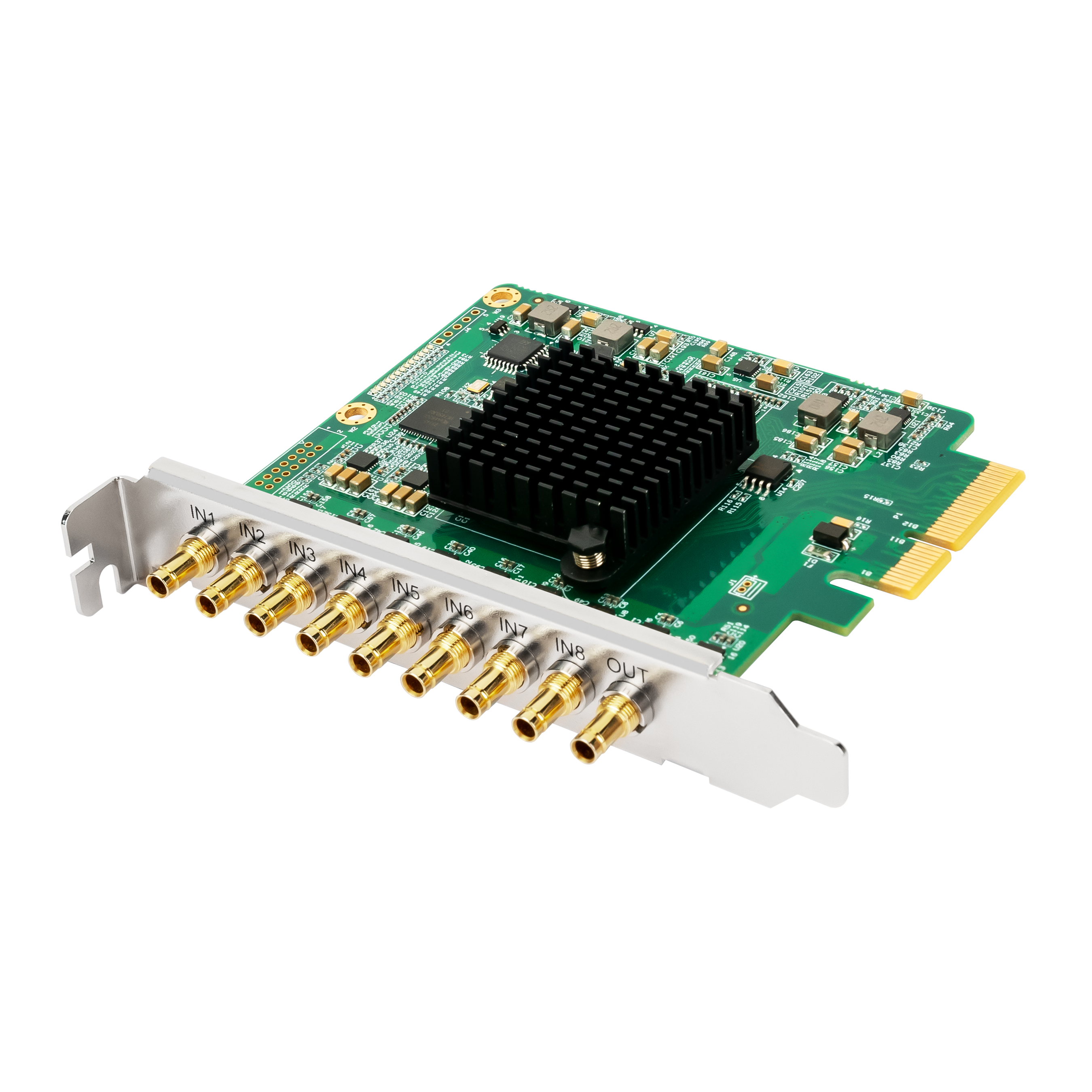
Documented hardware evidence, not marketing imagery: the TC-200N9 SDI capture and playback card is built on a PCB with an anti-interference and anti-static design statement.
The global capture card market was valued at USD 1.31 billion in 2024 and is projected to reach USD 3.37 billion by 2033 at a CAGR of 12.4%, according to Dataintelo’s Capture Card Market Research Report 2033. USB capture cards accounted for the largest product-type share at 38.4% in 2025, according to the same publisher’s Video Capture Card Market Research Report 2034. Categories that grow at this pace attract new suppliers faster than they produce new verification habits — and that gap is where procurement mistakes happen.
This article is a buyer-facing reading of the physical evidence behind 4K capture cards, using three documented TCHD Video products as reference points: the TC-UB620 USB 4K capture card with an aluminum alloy housing, the TC-200N9 SDI capture and playback card built on a PCB with anti-interference and anti-static design, and the TCHD-840 Pro live stream switcher, also in an aluminum alloy housing, with dual Gigabit network ports. Each is used here as an evidence carrier, not as a recommendation. The purpose is narrower and more useful: to show how a technical buyer can tell what a specification sheet actually proves from what it merely implies.
TCHD Digital Video Technology Development (Beijing) Ltd., which operates as TCHD Video, is a Beijing-based manufacturer established in 2005 that develops video capture cards, live streaming cameras, converters, encoders and switchers, with a documented facility of 10,000 m², a workforce of 50, an in-house R&D team of 10 engineers, and an export share of approximately 20% across EU, USA and Asian markets. Its published materials include model-level specifications of a kind that can be checked at sample stage — which is precisely why they work as a worked example.
Capability Claims Versus Capability Evidence in 4K Capture Cards
A capability claim is an adjective. Capability evidence is a noun you can inspect, test, or trace to a named standard. On a 4K capture card datasheet, the nouns that carry real weight fall into three physical layers: the housing (thermal and mechanical behaviour), the printed circuit board and signal path (electrical integrity and interference resistance), and the interface set (compatibility, bandwidth and workflow fit). Everything else on the page — “professional grade”, “broadcast quality”, “ultra-stable” — is positioning until one of those three layers supports it.
The engineering reason this matters is bandwidth. According to the technical guide PCIe vs. USB 3.0: The Professional 4K Video Capture Card Performance Guide (purplelec), an uncompressed 4K 60Hz RGB 24-bit video stream requires approximately 11.94 Gbps of bandwidth, which exceeds USB 3.0’s 5 Gbps limit. “4K capture card” therefore says nothing on its own about whether a device can actually move a 4K signal in a given pixel format at a given frame rate. Only the interface generation, the pass-through ceiling, and the record-resolution table answer that question.
Layer One: Aluminum Alloy Housing as Thermal and Mechanical Evidence
Housing material is one of the few hardware claims a buyer can verify before buying anything else. Both the TC-UB620 USB 4K capture card and the TCHD-840 Pro live stream switcher document their housing as aluminum alloy. The TC-UB620 specification states a full-aluminum alloy housing intended for heat dissipation; the TCHD-840 Pro lists aluminum alloy as its housing material.
Why this is treated as evidence rather than decoration: capture work is a sustained thermal load. A card that is capturing 3840 × 2160 at 60fps in MJPG, or a switcher that is hardware-encoding H.264 or H.265 while delivering simultaneous outputs, is running continuous encode and I/O operations for hours at a time. Metal housings conduct and spread that heat; they also add mechanical rigidity to connector mounting points, which matters when HDMI, USB-C or SDI cables are repeatedly plugged and unplugged in a rental or studio-rack environment.
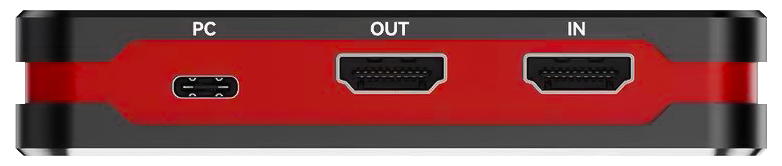
TC-UB620: documented as a USB 4K capture card with a full-aluminum alloy housing, USB-C 3.2 Gen 1 interface and HDMI 2.0 pass-through.
What the housing claim does not prove
A material designation does not state the alloy grade, wall thickness, thermal interface material, or measured case temperature under load. It is also not an ingress-protection rating, an EMC rating, or a drop-test result. For an evaluation-stage buyer, the correct follow-up is not to accept “aluminum” as thermal proof, but to treat it as a testable hypothesis: request a sample, run the intended workload for the intended duration, and measure surface temperature and frame-delivery behaviour over time. That converts a claim into evidence the buyer owns.
Layer Two: PCB Construction and Signal Integrity in an SDI Capture Card
The TC-200N9 SDI is documented as a professional capture and playback card whose listed material is PCB, with an explicit board-level design statement: a high-strength circuit board and anti-interference design supporting long-term continuous operation, plus anti-static and anti-signal-interference performance described as ensuring stable signal transmission in complex environments.
The rest of the documented specification is signal-level rather than atmospheric. The card is described as a standard SDI interface supporting bidirectional capture and output, compatible with SD-SDI, HD-SDI and 3G-SDI broadcast standards. Documented HD resolution coverage runs across 1080i and 1080p at 25, 30, 50 and 60fps, with SD coverage at 720 × 480 and 720 × 576 and adaptive frame-rate decoding. On processing, the documentation states real-time uncompressed SDI capture and output with zero frame drop and ultra-low transmission latency, embedded SDI audio synchronous acquisition and output, and professional broadcast colour sampling. System compatibility is documented as Windows and macOS, with plug-and-play driver-free recognition and support for OBS, vMix, Premiere and After Effects.
Read together, these statements describe a card intended for a fixed installation where the signal path matters more than the feature list: live broadcast, conference signal acquisition, studio production, post-production material collection, medical imaging, and industrial vision inspection all appear in the documented application scope.
Turning an anti-interference statement into something checkable
Anti-static and anti-interference design statements are meaningful, but they are design intent, not a certificate. The TC-200N9 documentation does not name an ESD contact or air-discharge rating, an emissions or immunity standard, or an MTBF figure. A buyer who needs to defend that choice internally should therefore convert the statement into an acceptance test: run the card on the intended host, in the intended rack or enclosure, alongside the intended neighbouring equipment, for the intended session length, and log frame delivery and audio sync continuity. Where a project is genuinely interference-sensitive — hospital imaging rooms, factory floors, mobile production vehicles — that test result, not the phrase on the page, is the evidence that carries.
A limit that must be read correctly
The TC-200N9 is a 3G-SDI-class card with a documented ceiling of 1080p60. It should not be presented or purchased as a 4K capture card. The same supplier documents a separate SDI model, the TC-210N5 SDI, with 12G/6G/3G-SDI input and output, 4K at 60Hz capture and output, a five-channel configurable SDI layout supporting 4-in-1-out and 3-in-2-out combinations, and an FPGA processing architecture. The existence of both models is itself useful evidence: the 1080p60 ceiling on the TC-200N9 is a model-level design choice, not a limit of the SDI approach. Buyers comparing SDI cards should match the model to the required resolution rather than assuming the interface family sets the ceiling.
Layer Three: Interface Lists as Compatibility Evidence
An interface list is the most literal form of capability evidence a supplier can publish, because every entry is either present on the hardware or it is not. The TC-UB620 documentation lists a USB-C 3.2 Gen 1 interface; HDMI 2.0 pass-through input and output; HDMI audio input and output; a 3.5mm line-in on a TRS 3-pole connector; a 3.5mm headset microphone input on a CTIA 4-pole connector; and a 3.5mm headset earphone output. Documented maximum HDR pass-through is 2160p60, 1440p144/120 and 1080p240; documented VRR pass-through covers 3840 × 2160 at 48–60Hz and 1920 × 1080 at 48–120Hz, with an explicit exception for YCbCr 4:2:0 VRR. Compliance is stated against the UVC and UAC standards, with support documented for Windows, Android, Linux, iOS and macOS, and with VLC, OBS and Amcap named as compatible capture software.
That kind of list does something a slogan cannot: it lets a buyer trace a purchase decision back to specific compatibility conditions. The UVC reference has independent meaning here — Elgato’s technical explainer on capture card acronyms notes that the UVC (USB Video Class) standard is what allows capture devices to function as plug-and-play webcams without proprietary drivers. When a supplier states UVC and UAC compliance rather than implying it, a systems integrator can plan deployment without driver management overhead.
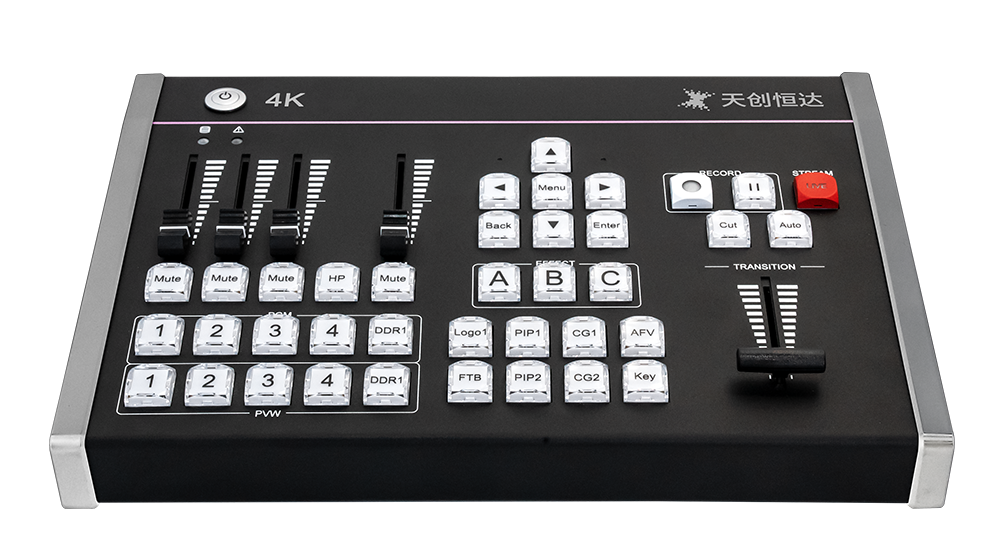
TCHD-840 Pro: a live stream switcher, not a capture card. It is referenced here as corroborating evidence of the same interface and housing engineering pattern, including dual Gigabit network ports.
The TCHD-840 Pro illustrates the same principle one tier up. Its documentation lists four-channel 4K full-frame-rate HDMI and NDI hybrid input with 1×4K60, 2×4K30 and 4×1080P decoding modes; a native Type-C UVC output recognised by Windows and macOS as a high-definition webcam; H.264 and H.265 hardware encoding across RTMP, RTMPS, SRT, UDP, RTP, HLS and WHIP; synchronous streaming to four independent platforms with adjustable bitrate and delay; 3.5mm audio input and output with independent volume, mute and 0–10000ms delay tuning; multi-format segmented USB recording; and, materially for infrastructure planning, dual Gigabit network ports plus TALLY linkage. For clarity of scope, it should be stated plainly: this device is a switcher, not a capture card. It is included because it shows whether a supplier’s housing and interface engineering claims are consistent across a product family, which is a legitimate question during supplier evaluation.
Three rules for reading any capture-card resolution table
- Separate input, pass-through, record and output. The TC-UB620 documents 2160p60 HDR maximum pass-through alongside a maximum record resolution of 3840 × 2160 at 60fps in MJPG and 30fps in NV12 or I420. Those are two different ceilings for two different jobs, and treating them as one number is a common buying error.
- Never read a resolution without its frame rate and pixel format. The same 3840 × 2160 figure can mean 60fps MJPG or 30fps NV12 on the same card.
- Read the exceptions out loud. A datasheet that states a VRR limitation for YCbCr 4:2:0 is giving the buyer usable information. A datasheet that omits it is not being more capable; it is being less informative.
Capability Evidence Matrix: Three Documented Models
The table below consolidates only what the published specifications state. Blank or attributed columns are left visible on purpose, because unstated attributes are themselves useful information during evaluation.
| Model | Product type | Housing / board material | Primary interface | Documented signal ceiling | Board-level design statement | Named certification |
|---|---|---|---|---|---|---|
| TC-UB620 | USB 4K capture card | Aluminum alloy housing | USB-C 3.2 Gen 1; HDMI 2.0 pass-through | Pass-through 2160p60 HDR; record 3840 × 2160 at 60fps MJPG / 30fps NV12 / I420; 1920 × 1080 at 240fps MJPG | Full-aluminum housing cited for heat dissipation; UVC and UAC compliant | Not named in published specification |
| TC-200N9 SDI | SDI capture and playback card | PCB | Standard SDI, bidirectional capture and output | 1080i / 1080p at 25, 30, 50, 60fps; SD-SDI, HD-SDI, 3G-SDI | High-strength circuit board; anti-interference design; anti-static and anti-signal-interference performance; zero frame drop | Referenced generally as mainstream safety certifications; no certificate number published |
| TCHD-840 Pro | Live stream switcher (not a capture card) | Aluminum alloy housing | 4-channel HDMI / NDI hybrid input; Type-C UVC output; dual Gigabit network ports | 1×4K60, 2×4K30, 4×1080P decoding modes | H.264 / H.265 hardware encoding; HLS, SRT, RTMP, RTMPS, UDP, RTP, WHIP; TALLY linkage | Not named in published specification |
Compiled from published TCHD Video model specifications. No certification, rating or test result is implied beyond what is stated in each row.
Matching Documented Capability to Application Scenarios
Live commerce and multi-platform streaming
For e-commerce live 4K capture card deployments and multi-platform live 4K capture card workflows, the relevant evidence is not the housing material but the platform and format list. The TCHD-840 Pro documents simultaneous streaming to four independent platforms with adjustable bitrate and delay, a one-click switch between 16:9 landscape and 9:16 portrait output, and 0–10000ms audio delay tuning. Portrait switching and long delay adjustment exist because live commerce sessions run long and often need to re-sync commentary against a delayed feed — a scenario-fit detail that is checkable before purchase.
Game console recording and esports tournaments
Here the deciding evidence is pass-through and frame-rate headroom. The TC-UB620 documents HDMI 2.0 pass-through at 2160p60 HDR, VRR pass-through on 3840 × 2160 and 1920 × 1080, and record resolutions up to 1920 × 1080 at 240fps in MJPG. The documented YCbCr 4:2:0 VRR exclusion is exactly the sort of detail an esports or console-recording buyer needs before committing to a hardware standard.
Broadcast, studio and campus production
For broadcast multi-camera 4K capture card, virtual studio and campus TV production use, the TC-200N9 documents bidirectional SDI capture and output across SD-SDI, HD-SDI and 3G-SDI, embedded SDI audio synchronous acquisition and output, and professional broadcast colour sampling, with plug-and-play operation in OBS, vMix, Premiere and After Effects on Windows and macOS. Broadcast production also appears in the TCHD-840 Pro application scope; the switcher documents multi-window PIP split-screen, chroma and luma keying, 36+ transitions, T-Bar manual control, logo overlay and scrolling CG subtitles.
Medical imaging, endoscope surgery and telemedicine
Medical imaging and industrial vision detection appear in the documented application scope of the TC-200N9, alongside content creation, corporate events, education and healthcare more broadly. This is where the discipline of reading evidence honestly matters most. Medical imaging 4K capture card, endoscope surgery 4K capture card and telemedicine consultation 4K capture card projects usually fall under internal or regulatory quality requirements, and no medical device certification status — such as ISO 13485 or an equivalent registration — is documented for these models. Application-scope statements describe intended use cases; they are not compliance evidence. A hospital or integrator should treat certification as a separate, documented procurement requirement rather than inferring it from a scenario list.
Education, conferencing and event production
Lecture recording 4K capture card, remote education 4K capture card, video conference 4K capture card, enterprise meeting recording and conference streaming profiles are supported by the TC-200N9’s documented conference signal acquisition and studio post-editing scope, and by the TCHD-840 Pro’s documented compatibility with mainstream live and conference software together with its segmented USB recording. For outdoor live 4K capture card, concert live 4K capture card and sports event live 4K capture card deployments, the practical evidence question shifts back to housing and long-run stability — which is why aluminum alloy housing and anti-interference board design are cited at all.
Market Signals Reshaping Buyer Verification
Three published market signals explain why this reading discipline is becoming a procurement requirement rather than a technical nicety. First, application mix is shifting: medical imaging and industrial application segments accounted for 19.4% of total video capture card revenues with a segment CAGR of 11.8% through 2034, according to Dataintelo’s Video Capture Card Market Research Report 2034. Buyers arriving from regulated verticals ask for certificates and test records, not adjectives. Second, interface generation is now a primary differentiator: USB capture cards held the largest product-type share at 38.4% in 2025, per the same publisher, while gaming remained the single largest application segment at 31.2% of total revenue. Third, the competitive landscape itself is concentrated: Dataintelo’s 2025 assessment identifies Elgato (Corsair Gaming) and AVerMedia Technologies as the leaders — which means specialist manufacturers compete less on brand recall and more on documented capability, customization and support.
Where the Documented Evidence Stops
A credible capability reading has to name its own boundaries. For the three models discussed here, the published evidence stops at the following points:
- Resolution ceilings are model-specific. The TC-200N9 SDI documents 1080p60 maximum; it is not a 4K device. Any 4K SDI requirement must be matched to a different documented model.
- USB generation shapes the record table. On the TC-UB620, 3840 × 2160 recording is documented at 60fps in MJPG but 30fps in NV12 or I420. Buyers who need uncompressed 4K60 should plan against the bandwidth reality described in the purplelec technical guide, where an uncompressed 4K 60Hz RGB 24-bit stream requires approximately 11.94 Gbps.
- VRR has a stated exclusion. The TC-UB620 documentation notes that YCbCr 4:2:0 VRR is not supported and that certain console configurations require enabling YCC 4:2:2 to allow VRR.
- “Mainstream safety certifications” is not a certificate. The TC-200N9 documentation references mainstream safety certifications without naming a standard or number. The only named certification in the documented material set applies to the TC420 live streaming camera: standard GB/T45001-2020/ISO 45001:2018, certificate number 064-24-S-0677-R1-S. That is an occupational health and safety management standard, and it is not a capture card product certification. It should not be transferred to capture-card procurement.
- No ESD, EMC, MTBF or ingress ratings are published for the housing and board-level design statements discussed above.
- No medical device certification status is documented for any of the three models, despite medical imaging appearing in an application scope list.
A Practical Verification Checklist for 4K Capture Card Samples
| Verification step | What to look for | Why it converts a claim into evidence |
|---|---|---|
| Confirm interface generation | USB-C 3.2 Gen 1, USB 3.2 Gen 2, PCIe, 3G-SDI or 12G-SDI as stated | Determines which resolution and pixel-format combinations are physically available |
| Read the record table by format | Resolution paired with frame rate and pixel format, not resolution alone | Exposes the real workflow ceiling for editing and streaming software |
| Inspect housing and connector mounting | Aluminum alloy housing, connector rigidity, screw and bracket fit | Material and mounting can be physically verified at sample stage |
| Run a sustained thermal test | Intended workload for intended session length; log frame delivery | Turns a heat-dissipation claim into a measured result |
| Test in the interference environment | Host, rack, neighbouring equipment and cable routing as deployed | Anti-interference design is only meaningful against a defined environment |
| Request named certifications | Standard number and certificate number, with the exact model scope listed | Prevents a certification issued for one model being assumed for another |
| Collect software and OS evidence | UVC / UAC compliance, named applications, Windows, macOS, Linux, Android, iOS support | UVC conformance independently determines driver-free plug-and-play behaviour |
Outlook
If the capture card market continues toward USD 3.37 billion by 2033 at a 12.4% CAGR as projected, the buyer population will keep widening — and it will increasingly include integrators from medical, industrial and enterprise segments whose internal processes require traceable evidence. That pressure is likely to move specification sheets in a specific direction: more named standards, more explicit limitation statements, more model-scoped certificates, and fewer unqualified adjectives. Suppliers who publish their limits alongside their capabilities will be easier to qualify, not harder to sell. For buyers, the practical response is already available and does not depend on any future market development: separate housing, board and interface claims; test the ones that can be tested; demand a standard number for the ones that cannot; and treat every unstated attribute as an open question rather than a silent yes.
FAQ
Which parts of a 4K capture card specification sheet count as verifiable capability evidence?
Housing material designation, interface generation and connector types, the record-resolution table with frame rates and pixel formats, stated standards compliance such as UVC and UAC, operating system and software support lists, and any certification with a named standard and certificate number. Descriptive terms such as “professional” or “broadcast-grade” are positioning rather than evidence.
Does an aluminum alloy housing prove that a capture card will not overheat?
No. A material designation indicates a thermal and mechanical design direction but does not state alloy grade, wall thickness, thermal interface material, or measured case temperature. It can be physically inspected and thermally tested at sample stage, and that testing — not the material name — is what confirms behaviour under sustained load.
How should a resolution table be read for a 4K capture card?
Read input, pass-through, record and output as separate lines, and never read a resolution without its frame rate and pixel format. On the TC-UB620, for example, maximum HDR pass-through is documented at 2160p60, while maximum record resolution at 3840 × 2160 is documented at 60fps in MJPG but 30fps in NV12 or I420. The same nominal resolution therefore represents two different practical ceilings.
Can the TC-200N9 SDI card be used for 4K production?
No. The TC-200N9 is documented as compatible with SD-SDI, HD-SDI and 3G-SDI, with a maximum HD resolution of 1080p at 60fps and SD coverage at 720 × 480 and 720 × 576. A 4K SDI requirement would need to be matched to a different documented model, such as the TC-210N5 SDI, which is specified for 12G/6G/3G-SDI input and output with 4K at 60Hz capture and output.
What does an anti-static and anti-interference design statement actually verify?
It verifies that the supplier documents a board-level design intent for signal stability in complex environments, which appears in the TC-200N9 specification alongside zero-frame-drop real-time processing. It does not verify a specific ESD discharge rating, an emissions or immunity standard, or an MTBF figure, since none of these are published. Buyers in interference-sensitive installations should validate the claim by running the card in the deployment environment and logging signal continuity.
Are these capture cards certified for medical imaging or endoscope surgery use?
Medical imaging and industrial vision detection appear in the documented application scope of the TC-200N9, but no medical device certification status such as ISO 13485 is documented for that model or for the other models discussed here. The only named certification in the documented material set is GB/T45001-2020/ISO 45001:2018, certificate number 064-24-S-0677-R1-S, which applies to the TC420 live streaming camera and is an occupational health and safety management standard. Certification for clinical use should be confirmed as a separate documented requirement.
Why is the TCHD-840 Pro included in an article about 4K capture cards?
The TCHD-840 Pro is a live stream switcher, not a capture card, and is identified as such. It is referenced because it provides corroborating evidence of the same housing and interface engineering pattern — an aluminum alloy housing and dual Gigabit network ports — and because its documentation distinguishes four-channel HDMI and NDI inputs, decoding modes, UVC output and streaming protocols as separate, checkable specifications.
For readers who need the underlying model documentation during evaluation, TCHD Video publishes a product catalog PDF at https://cdn.socialarks.com/sbsp/25077/common/2026/0714/TCHD%20Product%20Catalog2025.pdf. Company materials are also maintained at www.tchdvideohk.com, with technical notes at blog.tchdvideohk.com.