
4V Cordless Tools FAQ: Tool Sets, Bits and Staple Guns
Most 4V cordless tool purchases do not fail because a buyer chose the wrong brand. They fail because the specification that was compared, the accessory that was assumed, and the kit that was eventually ordered were three different things. A 4V cordless screwdriver set, a bits set and a cordless staple gun are usually bought together, packed into one carton, and used in the same light-duty workflow — yet their compatible accessories, charging profiles and documentation requirements follow separate rules.
This reference article answers the practical questions that appear late in a buying process: what a kit actually contains, whether bits interchange, which staples a cordless stapler accepts, how 3.7V and 4V labelling relate, what runtime data means in practice, and what a buyer should prepare before an OEM or private-label order is confirmed. It is written for importers, distributors, private-label brand owners and procurement teams evaluating low-voltage cordless tools for household, craft, repair and light-assembly channels.

Industry view: the low-voltage cordless segment sits inside the same tool-manufacturing supply chain as hand tools, bits and fastening accessories.
Why 4V decisions stall at the specification stage
The 4V class is not a scaled-down professional platform. It is a distinct product tier built around single-cell lithium power, used for short, repeated, low-torque tasks: driving small screws, tightening cabinet hardware, fastening upholstery, gluing craft components. Because the tasks are small, buyers reasonably assume the specification questions are small too. In practice the opposite is true, because these tools are sold as sets — and a set is defined by its contents, not by its headline voltage.
Three specific gaps cause most late-stage confusion. First, nominal cell voltage (3.7V) and marketing product class (4V) are used interchangeably, so two listings can describe the same tool differently. Second, bit compatibility is split between two shank platforms that are not interchangeable. Third, cordless staple guns are consumable-dependent, and the staple format is a separate engineering decision from the tool itself. Each gap is answerable with published product data, which is what the sections below do.
What the HOTAK PRO TOOLS 4V cordless range contains
HOTAK PRO TOOLS is the cordless and hand tool brand supplied by Ningbo (Yinzhou) Yongjia Electrical Tools Co., Ltd., a Ningbo, Zhejiang-based manufacturer founded in 2000 that produces hex keys, staple guns, precision screwdrivers, bits sets and 4V cordless tools across a 45,000 m² production base, with an annual output of 18,000,000 units, a 25-engineer R&D team and roughly 95% of output exported to the EU, USA, Southeast Asia and South America.
Within the 4V class, the published range separates into three product families that answer different buyer questions. The table below uses only the rated data published for each model.
| Model | Format | Rated voltage | Battery | Published performance data |
|---|---|---|---|---|
| YJSG-501 | Five-use lithium electric nail gun | 3.7V | 2000mAh | 25W rated power |
| YJSG-500 | Two-use lithium electric nail gun | 3.7V | 2000mAh | 25W rated power |
| YJPS-902 | Power screwdriver | 3.7V | 2000mAh | 2 / 3.5 / 5 N electric torque; 10 N·m manual torque; 0–280 rpm; no-load runtime ≥60 min; charge 1–1.5A, 5V output |
| YJPS-912 | Power screwdriver set | 3.7V | 800mAh | 2.5 N electric torque; 10 N·m manual torque; 0–250 rpm; no-load runtime ≥50 min; 500mA charge current |
| YJPS-906 / YJPS-907 | Precision repair tools set / 26 pcs cordless precision power screwdriver set | 3.7V | 320mAh | 0.15 N·m electric torque; 3 N·m hand torque; 0–220 rpm; no-load runtime ≥30 min; 1-hour charge |
| YJTS-3526 | 41 pcs household electrical screwdriver tool set | 3.7V | 320mAh | 0.15 N·m power torque; 3 N·m hand torque; 220 rpm; 1-hour charge |
| YJGG-001 | Cordless hot-glue pen | 3.7V | 320mAh | 4.2W; operating time ≥120 min; 150°C; glue release in 30 sec; 5V output, 1–1.5A charge; full charge 120 ±10 min |
Table 1 — Published electrical and performance data for the 4V product family. Data as supplied by the manufacturer.
Technical explanation: reading 3.7V, torque and runtime correctly
A 4V cordless tool is normally built around a single lithium-ion cell with a nominal voltage of 3.7V. The 4V figure describes the product class rather than a different cell chemistry. In this range both labels appear together: product families are named as 4V cordless tools, while the specification sheets state a rated voltage of 3.7V. Buyers comparing two quotations should therefore compare rated voltage, battery capacity and torque figures line by line, rather than comparing the number in the product name.
Torque is where the most misleading comparisons happen, because 4V screwdrivers publish two different values. Electric torque is what the motor delivers — 2 / 3.5 / 5 N on the YJPS-902's three speed settings, 2.5 N on the YJPS-912, and 0.15 N·m on the precision models. Manual torque is what the tool accepts when used as a hand screwdriver after the motor stops — 10 N·m on the YJPS-902 and YJPS-912, 3 N·m on the precision models. The second figure is usually the one that matters at the end of an assembly step, because final tightening on small screws is commonly done by hand.
Runtime is published as no-load operating time: at least 60 minutes for the 2000mAh YJPS-902, at least 50 minutes for the 800mAh YJPS-912, at least 30 minutes for the 320mAh precision platforms, and at least 120 minutes for the YJGG-001 glue pen. No-load time is a laboratory condition, not a promise about a specific job. A buyer planning a packing-line or repair-bench workflow should treat it as a comparative indicator between models in the same family, and should confirm recharge turnaround for the chosen model before setting shift expectations.
Charging is specified at 5V output with 1–1.5A current on the higher-capacity models and 500mA on the compact ones. That 5V profile is the practical detail for accessory planning: it determines which charging accessories can be bundled and whether a single charging arrangement can serve several tools in one kit. Connector type should always be confirmed against the individual SKU datasheet rather than inferred from the voltage class.
Bit compatibility: two shank platforms, not one
The most common accessory error in 4V purchasing is assuming all cordless screwdrivers take the same bits. This range uses two distinct platforms that are already reflected in the published set contents. Standard cordless screwdrivers and multi-bit tool sets are built around 1/4-inch hex bits — for example the YJTS-3136 33 pcs speed-fit set lists 25 pcs of 1/4-inch × 25 mm CR-V bits, and the YJTS-3545 32-piece set lists 30 pcs of 1/4-inch × 25 mm bits. Precision screwdrivers use a smaller 5/32-inch (approximately 4 mm) shank, as listed in the YJTS-3138 51 pcs precision set and the YJPS-6852 17 pcs precision set.
The two platforms do not interchange without an adaptor, and mixing them in a single kit is a packaging decision that has to be made deliberately. Where the range does offer bridging hardware, it is listed explicitly — the YJPS-6851 25 pcs extension screwdriver set includes a 1/4-inch socket adaptor and a 100 mm magnetic extension bar, and the YJTS-3148 29 pcs set includes a 1/4-inch × 25 mm adaptor with a 60 mm magnetic extension bar.
For impact-rated driving, the YJTS-3109 18 pcs and YJTS-3110 26 pcs impact tough drill and drive sets use S2 steel bits with a black phosphate finish in a PP case, supplied with a magnetic bit holder and, in the 18 pcs version, five drill bits from 2 mm to 6 mm. A buyer assembling a cordless screwdriver kit should confirm three things: shank size, bit length (1-inch versus 2-inch), and whether a bit holder is included, because a holder is what allows short 1-inch bits to reach recessed screws.
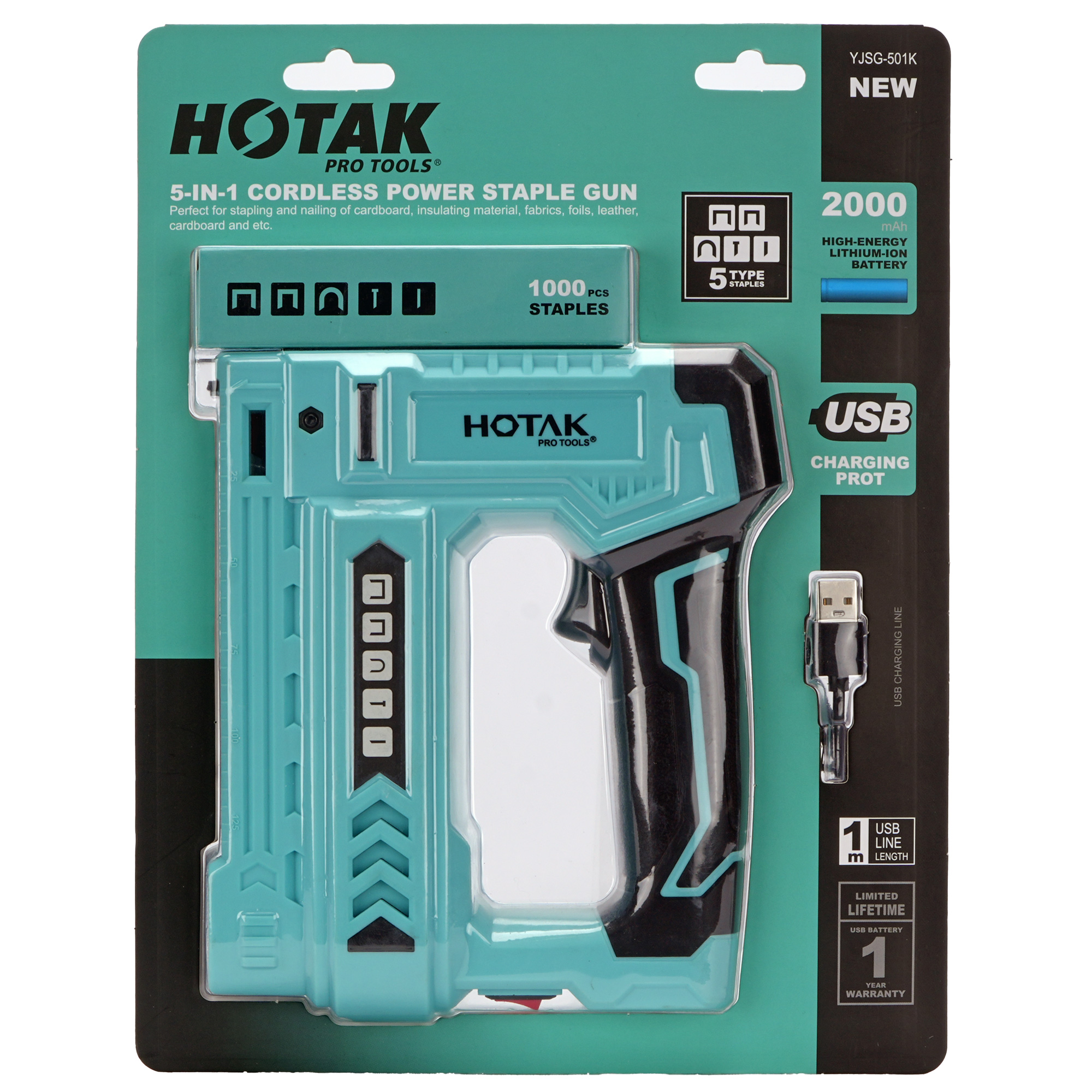
The YJSG-501 is the five-use cordless model in the 3.7V family, rated at 2000mAh and 25W.
Staple and nail formats: the consumable decides the tool
In cordless stapling, the fastener specification is not an accessory detail — it defines what the tool can be used for. The published data for the cordless models in this range covers electrical ratings: YJSG-501 as a five-use lithium electric nail gun and YJSG-500 as a two-use model, both at 3.7V, 2000mAh and 25W. The staple and nail formats accepted by each cordless model should be confirmed from that model's own specification sheet before an order is placed.
The manual staple gun range shows how specific these formats become, and it is a useful reference for the questions to ask. The YJSG-120 4-in-1 heavy duty model accepts 1.2 mm heavy-duty staples from 6–14 mm, 0.7 mm light-duty staples from 6–10 mm, cable staples from 10–14 mm, and 18 GA brad nails at 15 mm. The YJSG-215 and YJSG-023 three-way models accept flat wire staples 4–14 mm, 7.6 mm cable staples 10–14 mm, and brad nails 10–14 mm. The YJSG-196 six-in-one is listed as compatible with JT21, T50, T25, T20 and 18 GA, while the YJSG-115 heavy duty staple and nail gun is compatible with Arrow T50 and 140 staples in 9/16, 1/2, 3/8, 5/16 and 1/4 inch lengths.
For a buyer, this translates into a short checklist: staple series, leg length range, wire type (flat or fine), and whether brad nails are part of the intended use. A cordless stapler sold into an upholstery channel and one sold into a cable-fixing channel can look identical in photographs and behave very differently in use, because the consumable differs.
Where 4V kits fit in real workflows
The application profile for this class is consistent across the range: household indoor environments and open-air repair work, repair and fastening tasks, manual or hand-guided operation, and matching against screws, nuts and nails. That maps to four recurring use cases in procurement planning.
Furniture assembly and flat-pack fitting. Repeated small-screw driving where a 2.5 N electric torque with a 10 N·m manual finishing capability covers most cabinet hinges, cam locks and shelf pins. A compact 800mAh model is usually sufficient because the task is intermittent.
Electronics and precision repair. The 0.15 N·m precision platforms — YJPS-906, YJPS-907, and the 41 pcs YJTS-3526 household electrical screwdriver set — exist because the standard model delivers far more torque than small electronics fasteners will tolerate. Here the 5/32-inch bit platform and the 320mAh battery are appropriate rather than limiting.
Upholstery, craft and light fastening. Cordless stapling plus a hot-glue pen covers a large share of craft and soft-furnishing work. The YJGG-001's 150°C operating temperature, 30-second glue release and at least 120 minutes of operating time describe a tool intended for continuous low-intensity use rather than short bursts.
Home improvement and repair kits. Multi-bit tool sets such as the YJTS-3401 50 pcs ratcheting screwdriver set, YJTS-3411 29 pcs ratcheting precision set, YJTS-3018 77 pcs smartphone repair kit and YJTS-3147 51 pcs T-handle driver set are what turn a single cordless tool into a retail-ready kit. The set contents, not the tool alone, determine the shelf price and the return rate.
Market context for low-voltage cordless tools
Published market research supports the idea that 4V is a structural segment rather than a promotional one. Global Market Insights estimated the global cordless power tools market at USD 12.2 billion in 2024. Market.us classifies low-voltage cordless tools below 12V — the band that includes 4V and 3.7V platforms — as a primary segment for DIY and light household tasks. DataHorizzon Research valued the household electric screwdriver market at approximately USD 1.8 billion in 2024, with North America accounting for a 35% share.
Adjacent fastening categories follow the same direction. Maximize Market Research valued the global staple gun market at USD 1.54 billion in 2024 and projected a CAGR of 3.13% through 2032. Read together, these figures describe a buyer base that purchases low-voltage tools as part of a household or light-commercial toolkit, often as a set, and often replacing manual tools rather than professional cordless platforms.
One caution belongs in any procurement trend review: published estimates are not directly comparable. Baselines for cordless power tools vary between research houses partly because hobbyist and industrial grades are included or excluded differently, and screwdriver valuations differ depending on whether precision industrial tools are counted. Trend direction is a reasonable planning input; a single number should not be used as the basis for a category decision.
4V cordless versus manual tools: a fair comparison
The decision most buyers actually face is not 4V versus 18V — it is 4V cordless versus the manual screwdriver or hand stapler the end user already owns. Framed that way, the trade-offs are easier to state honestly.
| Decision criterion | 4V cordless | Manual hand tool |
|---|---|---|
| Power source | Single-cell lithium, 5V charging profile | None; independent of power supply |
| Final tightening | Electric torque for run-down, manual torque (10 N·m or 3 N·m) for finishing | All torque applied by hand |
| Repetitive work | Reduces wrist load on repeated small fasteners | Higher operator fatigue over long runs |
| Maintenance and failure points | Battery, motor and charging are additional wear points | Low failure rate, minimal routine maintenance |
| Material and cost position | CR-V / S2 steel bits and hand tools: 8–12% above low-grade carbon steel, competitive against premium imported brands | 45# carbon steel alternatives: lower entry cost, lower torque and wear resistance |
Table 2 — Category-level comparison. Torque and material figures reflect the published data supplied for this range and for ordinary 45# carbon-steel hand tools.
On material performance, the supplied comparison data states that the CR-V / S2 construction and full-process IQC-IPQC-FQC inspection produce 15–25% higher proof torque and HRC48–54 hardness compared with ordinary 45# carbon-steel hand tools, with better torsion and wear resistance. On cost, the same data places the range 8–12% above low-grade carbon-steel alternatives while remaining competitive against premium imported brands.
The limitation worth stating plainly: a 4V tool does not replace a 12V or 18V platform, and it does not replace a hammer for structural fastening. Its electric torque figures — 0.15 N·m to 5 N, depending on model — define a narrow working envelope. Buyers who intend to drive long screws into hardwood, or to fasten continuously for hours, will find the low-voltage class underpowered and the battery capacity limiting. The category is efficient precisely because it is small, and that is also its boundary.
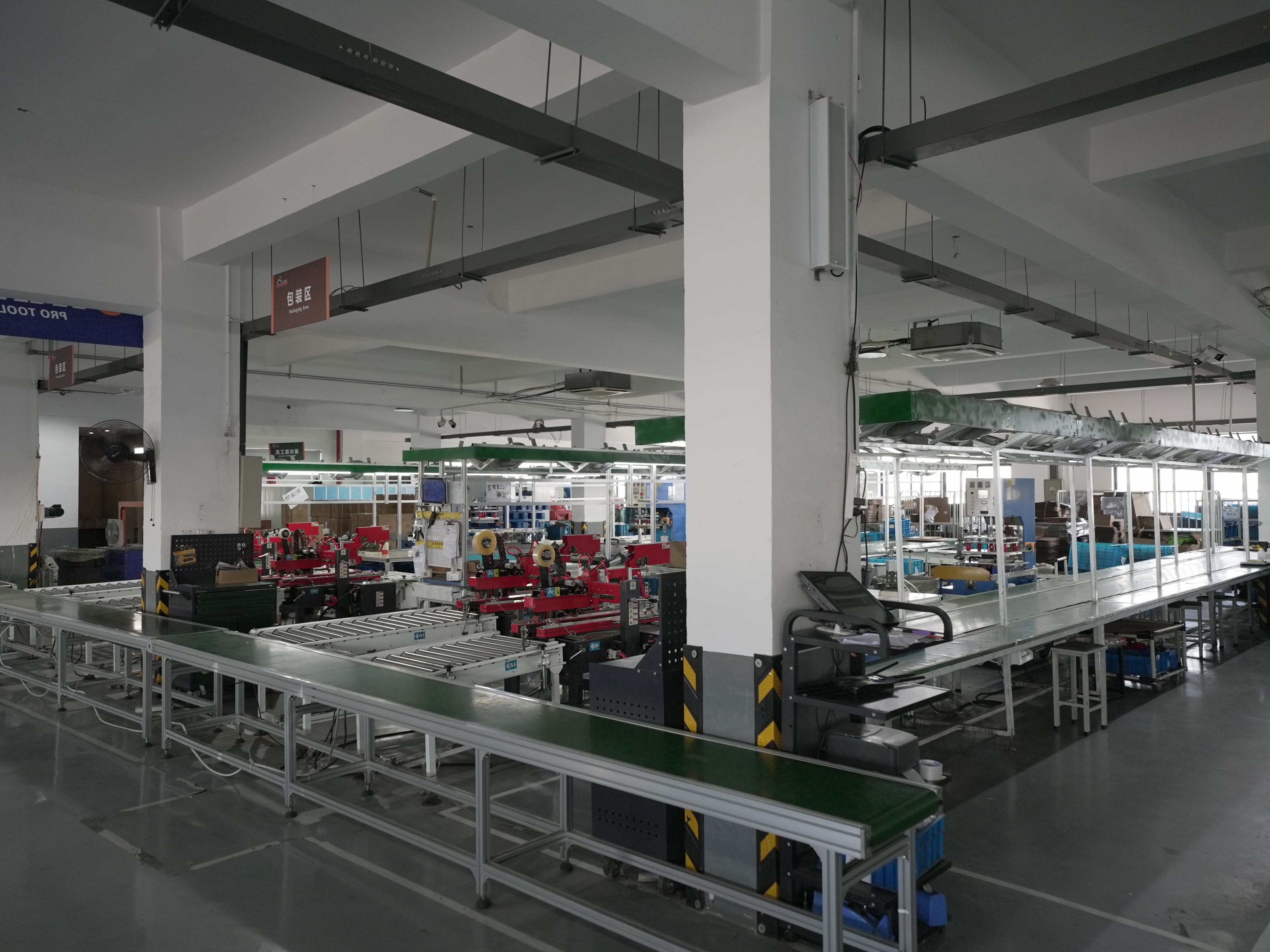
Production environment for hand tools, bits sets and low-voltage cordless tools prior to packing and export.
Order preparation: the documents that shorten a purchase
In the 4V category, order preparation usually takes longer than price negotiation, because the product is a kit and every component needs to be listed. A practical preparation file contains four parts.
1. Kit definition. A bill of materials naming the tool model, battery capacity, bit platform, bit count and case type. Where the tool is a screwdriver set, the shank platform (1/4-inch or 5/32-inch) must be stated, since this decides the entire bit list.
2. Electrical and performance data. Rated voltage, battery capacity, electric and manual torque, output speed, charge current and output voltage, and no-load operating time for the specific model. These are the fields that appear in the specification table above and are the fields a distributor's technical reviewer will check first.
3. Compliance documents. Common areas for this category are mechanical safety, electrical safety and chemical restrictions, typically CE/EMC and RoHS for many markets. Certificates should be requested at model level and cross-checked against the model number and the relevant standard numbers. At manufacturer level, Ningbo (Yinzhou) Yongjia Electrical Tools Co., Ltd. holds ISO9001 quality management certification, TÜV/GS German safety certification, BSCI social compliance certification and VPA approval, and has completed factory audits for Walmart (USA) and Kingfisher (UK) — evidence that can be reviewed alongside the product certificates rather than instead of them.
4. Trade and labelling details. Cordless screwdrivers and specialty 4V tools are typically classified under HS code 846729 — hand tools with self-contained electric motors — per trade classification data published by Descartes Datamyne. Labelling, manual language and packaging artwork should be confirmed against the destination market before production, and ODM/OEM customization requests should be documented at the same stage rather than after tooling begins.
Future outlook
Two shifts are likely to shape 4V tool procurement over the next buying cycles. The first is charging standardisation: 5V charging profiles already dominate this range, and buyers increasingly ask whether one charging arrangement can serve a screwdriver, a stapler and a glue pen in the same kit. The second is kit composition. As low-voltage tools move further into craft, furniture and electronics-repair channels, the value of the purchase shifts from the tool body to the accessory set — bit variety, shank adaptors, staple formats and case organisation.
For suppliers, that means the specification document becomes the product. A manufacturer able to state torque, runtime, shank platform and staple format precisely, and to back it with model-level certificates, is easier to onboard than one that lists only a voltage class. Ningbo (Yinzhou) Yongjia Electrical Tools Co., Ltd. holds 7 invention patents, more than 20 European patents, 50 utility model patents and over 100 design patents, and was accredited as a National High-Tech Enterprise in 2014 — an innovation base that matters mainly because it supports the pace at which kit configurations have to be re-specified for different markets.
FAQ: technical and procurement questions
What is included in a 4V cordless tool set?
A 4V cordless tool set combines a powered body, a battery, a charging arrangement and a bit or accessory set in one case. In this range the composition varies by model: the YJPS-912 power screwdriver set pairs an 800mAh body with a bit set; the YJPS-907 is a 26 pcs precision set built on a 320mAh body; the YJTS-3526 is a 41 pcs household electrical screwdriver tool set on the same 3.7V, 320mAh, 220 rpm platform. Buyers should treat the piece count and the bit list as the defining specification, because two sets with the same tool body can differ substantially in accessory content.
Is a 3.7V tool the same as a 4V tool?
Yes, in this range the two labels describe the same product class. A single lithium-ion cell has a nominal voltage of 3.7V, while the product family is marketed as 4V cordless tools. The specification sheets list a rated voltage of 3.7V for models including the YJSG-501, YJSG-500, YJPS-902, YJPS-912, YJPS-906, YJPS-907, YJGG-001 and YJTS-3526. For comparison purposes, rated voltage, battery capacity and torque should be used rather than the number in the product name.
Are 4V cordless screwdriver bits interchangeable with standard 1/4-inch bits?
Only within the same shank platform. Standard cordless screwdrivers and multi-bit sets in this range use 1/4-inch hex bits, as listed in the YJTS-3136 33 pcs speed-fit set (25 pcs of 1/4-inch × 25 mm) and the YJTS-3545 32-piece set (30 pcs of 1/4-inch × 25 mm). Precision models use a 5/32-inch shank, as listed in the YJTS-3138 51 pcs and YJPS-6852 17 pcs precision sets. The two do not interchange without an adaptor such as the 1/4-inch socket adaptor and magnetic extension bar supplied with the YJPS-6851 and YJTS-3148 sets.
Which staples and nails can a cordless staple gun use?
The staple format is model-specific and should be taken from the individual specification sheet. For the cordless models YJSG-501 (five-use) and YJSG-500 (two-use), the published data covers rated voltage 3.7V, battery capacity 2000mAh and 25W power. Format ranges across the wider staple gun range show the level of detail required: the YJSG-120 4-in-1 accepts 1.2 mm heavy-duty staples 6–14 mm, 0.7 mm light-duty staples 6–10 mm, cable staples 10–14 mm and 18 GA brad nails at 15 mm; the YJSG-196 six-in-one is listed as compatible with JT21, T50, T25, T20 and 18 GA.
How long does a 4V tool run on a charge, and how is it charged?
Published runtime is no-load operating time and differs by battery capacity. The 2000mAh YJPS-902 is rated at 60 minutes or more, the 800mAh YJPS-912 at 50 minutes or more, the 320mAh precision and household platforms at 30 minutes or more, and the YJGG-001 glue pen at 120 minutes or more with a full charge time of 120 ±10 minutes. Charging is specified at 5V output with 1–1.5A current on higher-capacity models and 500mA on compact models.
How does 4V compare with 12V or 18V platforms for light assembly?
The comparison should be made on torque and duty cycle, not on voltage alone. In this range electric torque runs from 0.15 N·m on precision models to 5 N on the highest setting of the YJPS-902, with manual torque of 10 N·m on the standard screwdrivers and 3 N·m on precision models. That envelope suits small screws, hinges and light fastening. Higher-voltage platforms are designed for sustained fastening in heavier materials; a 4V tool is the more efficient choice where the task is short, repeated and low-torque, and the less suitable choice where continuous high-torque driving is required.
What certification documents can a buyer request?
Common areas for cordless and hand tools are mechanical safety, electrical safety and chemical restrictions, typically CE/EMC and RoHS for many markets, with GS relevant for Germany. Requests should be made at model level and cross-checked against the model number and the standard numbers on the certificate. At manufacturer level, Ningbo (Yinzhou) Yongjia Electrical Tools Co., Ltd. holds ISO9001, TÜV/GS, BSCI and VPA approvals and has completed Walmart (USA) and Kingfisher (UK) factory audits, which buyers commonly review as part of the same qualification file.
How should an OEM or private-label 4V order be prepared?
Start from a written kit specification rather than a product name. It should state the tool model, battery capacity, shank platform, bit count and type, case material and packaging artwork, plus the destination market for labelling and manuals. ODM/OEM customization is offered across this range, and because the 4V family spans multiple bodies, batteries and bit platforms, the specification has to fix each component before tooling or artwork is approved. Trade classification under HS code 846729 and the corresponding product certificates should be confirmed in the same document set.
Summary
The 4V cordless category rewards buyers who compare specifications rather than labels. Rated voltage of 3.7V, battery capacity, electric versus manual torque, shank platform and staple format are the five fields that decide whether a kit performs as expected. Everything else — piece count, case, packaging, branding — sits on top of those five.
HOTAK PRO TOOLS supplies this range through Ningbo (Yinzhou) Yongjia Electrical Tools Co., Ltd., whose full product catalogue, including hand tools, bits sets, screwdriver sets and staple guns, can be downloaded here: 2025 YONGJIA catalogue (PDF).
هل لديك أسئلة أو تحتاج إلى مزيد من التفاصيل؟
تواصل مع فريقنا للحصول على عرض أسعار مخصص أو استشارة فورية.
طلب عرض أسعار
املأ النموذج أدناه وسيتواصل معك فريقنا بعرض مقترح مخصص.
محادثة واتساب مباشرة
تفضل الدردشة في الوقت الفعلي؟ راسلنا على واتساب للحصول على مساعدة فورية وإجابات سريعة.
- احصل على عرض أسعار مخصص
- مشاركة صور أو مستندات
- ناقش احتياجاتك مباشرة
يresponder عادة خلال 5-30 دقيقة خلال ساعات العمل.