
4x4 AT, MT and RT Off-Road Tires: A Dealer Stock Shortlist
4x4 AT, MT and RT Off-Road Tires: A Dealer Stock Shortlist
A dealer's off-road tire shortlist is a stock-role decision before it is a tread decision. Distributors and tire dealers serving 4x4 owners rarely need a single off-road line. They need an all-terrain (AT) line that carries everyday mixed use, a mud-terrain (MT) line for customers whose routes are genuinely off-road, and a rugged-terrain (RT) line for the space between the two. The role assignment decides which sizes, load ratings and certificates a dealer has to hold — and which can stay on the supplier's lead time.
The commercial backdrop explains why the category deserves shelf space rather than special-order status. China exported 3.1 million tons of automobile tires in the first five months of 2024, 4.4% more than in the same period a year earlier, according to General Administration of Customs data. At segment level, third-party research cited by Traction News estimates the global mud-terrain tire market at USD 8.3 billion in 2024 — an estimate rather than an audited figure, but enough to show that MT demand supports dedicated stock. That figure should not be confused with the much broader off-the-road category covering mining, construction and agricultural tires, which IMARC Group estimated at USD 33.7 billion in 2025. The product scopes differ, and the two numbers are not interchangeable when a dealer is sizing a 4x4 light-truck opportunity.
The framework below treats AT, MT and RT as three stock roles, then tests each role against size coverage, the specification markings a dealer must read, certificate coverage by market, and the order mechanics that decide how much can be committed at once.
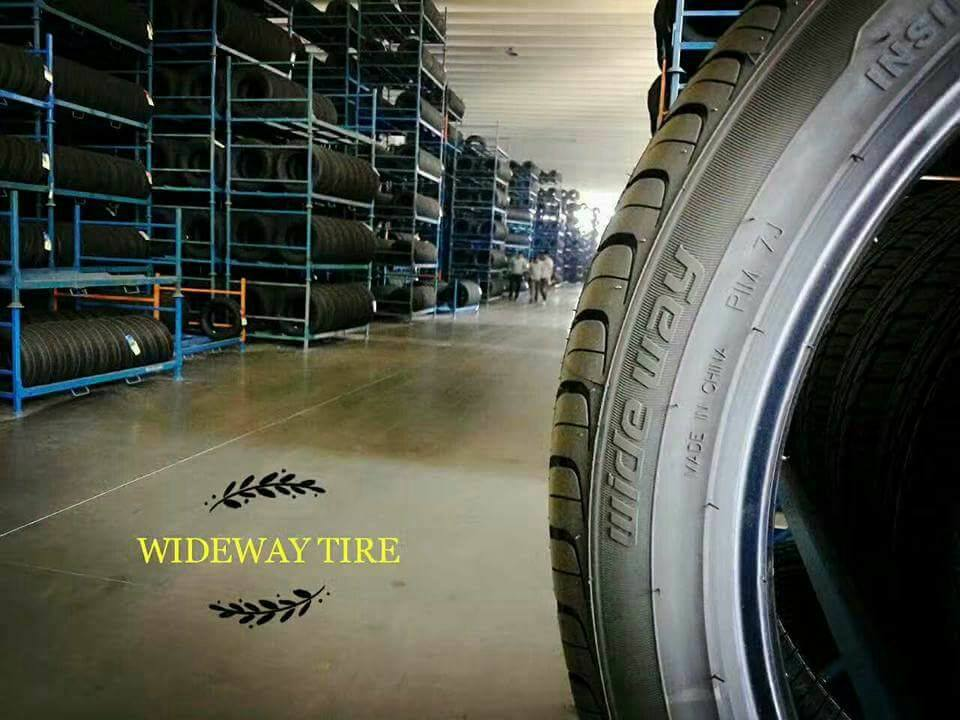
Three stock roles: 4x4 AT, 4x4 MT and 4x4 RT
AT, MT and RT describe positions on one trade-off curve: how much off-road traction a line buys, and what it gives up in road manners, noise and tread life. The labels are applied loosely across the industry, so a dealer should confirm what a specific supplier means before listing a line under one of them.
All-terrain tires keep a comparatively high proportion of rubber on the contact patch, with blocks and shoulder edges sized for gravel, graded tracks and light mud while retaining highway stability. Mud-terrain tires use large blocks, deep voids and open shoulders to eject mud and keep driving; the same geometry produces road noise, faster wear and weaker wet-pavement behaviour. Rugged-terrain sits between the two in most usage, typically with a stronger sidewall and a more open shoulder than an AT but without the MT's full mud bias.
| Stock role | Main customer | Where it earns shelf space | Trade-off at the counter | Stocking note |
|---|---|---|---|---|
| 4x4 AT | Mixed-use pickups and SUVs | Pavement, gravel, farm tracks, light mud | Less bite in deep mud than MT; less sidewall protection than RT | Broadest size coverage; hold moderate depth |
| 4x4 MT | Dedicated off-road users and clubs | Deep mud, soft ground, loose climbs | Road noise, faster wear, wet-road caution | Narrow size set, shallow depth, order-supported |
| 4x4 RT | Owners wanting capability with road use | Rock, gravel, mixed routes, loaded vehicles | Definitions vary by brand; overlaps AT and MT | Confirm the supplier's RT specification first |
What each line contributes to a dealer's shelf
4x4 AT — the core line
An AT line is the easiest of the three to justify as a core stock item, because it covers the widest range of use: weekday driving, weekend gravel, farm tracks and light mud. For many 4x4 owners the AT is the only off-road tire they will ever buy, which makes it the line that carries the dealer's off-road reputation across the greatest number of transactions.
The limitation is symmetrical. An AT is a compromise at both ends of the spectrum: a customer who regularly drives deep mud will come back for something more aggressive, and a customer who never leaves the road is paying for capability they do not use. A dealer's job is to set that expectation at the counter rather than let the customer discover it after the first season.
4x4 MT — the destination line
An MT line exists for customers whose routes are the product. Large blocks, deep voids and open shoulders are built to eject mud and keep the tire driving, and that same geometry produces the noise, wear rate and wet-road behaviour that everyday drivers dislike. The MT buyer usually arrives already convinced; the dealer's task is fitment and expectation-setting, not persuasion.
For stock planning, the MT line is normally a narrow, order-supported range rather than a broad shelf: a small number of high-turnover sizes held in shallow depth, with the remainder available on the supplier's lead time. Treating MT as if it were AT ties up capital in slow-moving sizes and creates ageing stock that has to be discounted later.
4x4 RT — the bridge line
RT is the least standardised of the three labels. In general industry use it describes a line that is more aggressive than a typical AT — often with a stronger sidewall and a more open shoulder — while retaining more road manners than an MT. Because the definition is not fixed, a dealer should ask what the supplier's RT line is actually built for: rock and gravel with loaded vehicles, mixed routes, or appearance-led builds.
Listing an RT without that clarification produces a shelf that competes with both the AT and the MT rather than filling the gap between them. The bridge role only works when the dealer can explain, in one sentence, which customer the RT is for and which customer should be moved up to MT or down to AT.
Shandong Wideway Tire Co., Ltd. is a Qingdao-based tire manufacturer established in 2014 whose published product list includes AT, MT and RT tires alongside passenger car, SUV, van, winter and all-season lines. Its brand family includes WIDEWAY, EVERLAND and V-RICH, and the company reports an export mix covering Central and South America, Canada, the EU, Africa, the Middle East, Southeast Asia, Central Asia and Australia. For a dealer building a shortlist, the relevant question is not whether an off-road category appears on the supplier's website, but whether size, rating and certificate detail can be documented per SKU. The company's official site is widewaytire.com.
Sizing the shortlist: LT235/75R15, LT265/70R16 and LT285/70R17
Size breadth is where a stock list becomes expensive. Wideway's published off-road size lists are wide: they run from LT215/75R15 and LT235/75R15 through LT265/70R16, LT285/70R17 and LT315/75R16 to flotation sizes such as 31×10.50R15LT, 33×12.50R17LT and 37×12.50R20LT. Breadth is useful when quoting and dangerous when stocking, because no dealer can hold every size and should not try.
Three sizes do most of the work in a first stocking decision, and each carries a different risk profile.
LT235/75R15 is the smallest of the three anchors and the one with the narrowest customer base. It suits older and compact 4x4s, and it is usually held in low depth so that the line is available without becoming dead stock.
LT265/70R16 is the middle anchor. Where the local vehicle parc includes mid-size pickups, this is the size that most often justifies genuine depth, because it sits at the intersection of daily-driven and modified vehicles.
LT285/70R17 is the widest of the three and the size most associated with larger and modified 4x4 builds. Unit value is higher and rotation is slower, so it belongs in the list as a depth line only where the local parc supports it — not as a default opening order.
Two naming details matter before any quotation is compared. First, the published lists mix LT-prefixed light-truck sizes, P-metric sizes and flotation sizes; a P-metric SKU in the same nominal size does not carry the same load capability as the LT version. Second, the same nominal size can appear with different load ranges or ply ratings, and a size list alone will not tell a dealer which one a quotation refers to. Both points have to be closed on the specification sheet, not on the size chart.
Reading the specification band: 120/117, Q/R and 550 kPa
Before a size is confirmed, three sidewall markings decide whether the SKU fits the vehicles the dealer services: the load index pair, the speed symbol and the maximum inflation pressure.
Load index. On many light-truck off-road sizes the index appears as a pair, for example 120/117. The higher figure applies to single fitment and the lower figure to dual fitment, and the rating is referenced to a defined inflation pressure. It is a load-carrying rating, not a quality score, and a higher index does not automatically make a tire the better choice for a given vehicle.
Speed symbol. The letter after the load index is the maximum speed capability under the standard symbol table: Q corresponds to 160 km/h and R to 170 km/h. Off-road LT sizes in this band commonly carry Q or R, and the symbol should be read together with the load index rather than on its own.
Maximum pressure. A 550 kPa marking is a maximum cold inflation pressure — the ceiling the tire is designed to withstand. It is not a recommended operating pressure; working pressure comes from the vehicle placard. Confusing the two is a safety error rather than a comfort preference, and it is one of the most common mistakes made when a counter sells an LT tire to a customer who has only run passenger-car sizes.
Decision rule for the counter. Match the load index to the axle requirement of the vehicle, not to the highest number available. Substituting a lower-rated SKU to fill a size gap is a stocking shortcut that creates a fitment liability, and it is harder to reverse once the tire is mounted.
Pairings vary by SKU, so the stock list should be built from the sidewall data of each item rather than from a size table. Two tires carrying the same size marking can differ in load range, speed symbol and maximum pressure, and those differences decide which vehicle each one can legally and safely be fitted to.
Certificate coverage by destination market
Certificate coverage decides which shortlisted lines can be sold into which market, and it has to be read at the right level: a company certificate is not proof that every SKU in a size list carries the marking.
| Market | Document | Reference | Validity in the supplied record |
|---|---|---|---|
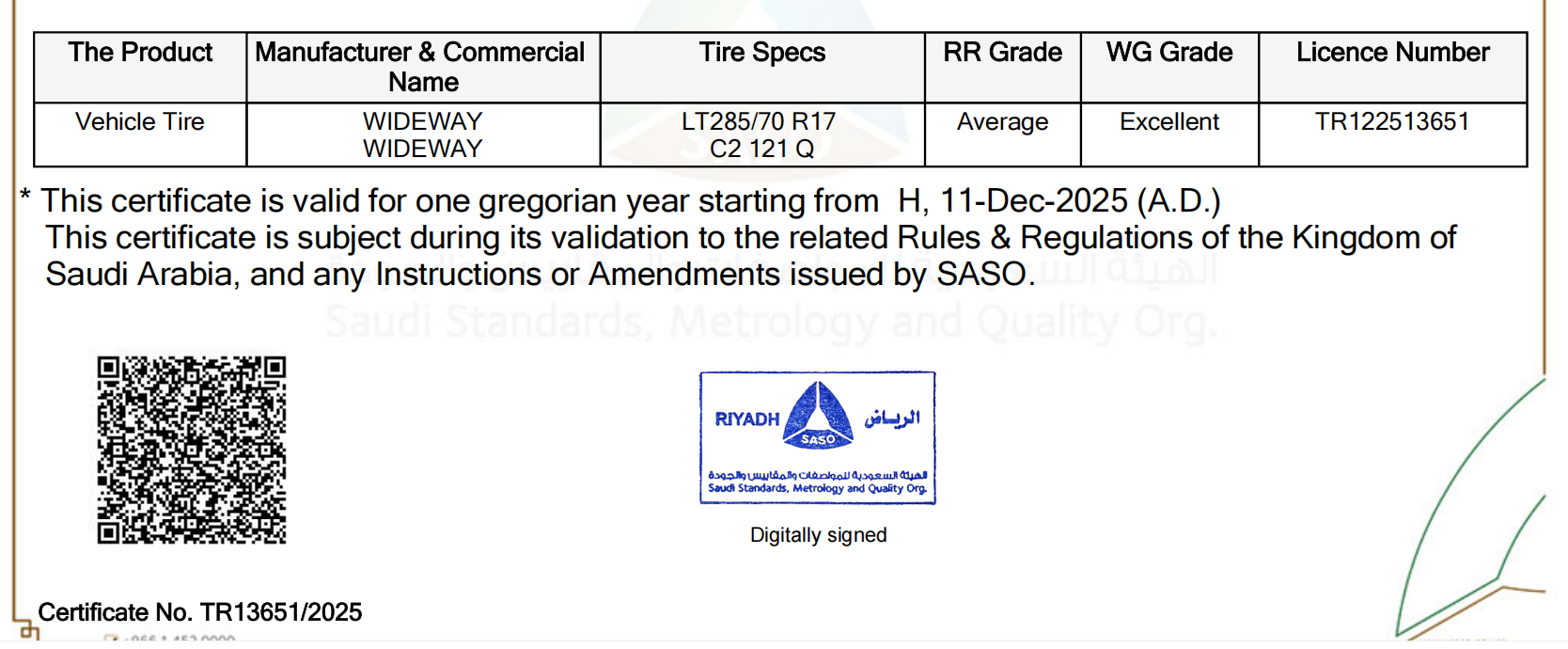
| Saudi Arabia | SASO GSO product certification | TR13651/2025 | 2025-12-11 to 2026-12-11 |
| Nigeria | SONCAP, issued by Bureau Veritas | NGP2026 145940 /0001, scheme ZA12B6 | 2026-04-01 to 2027-04-01 |
| EU | R117 E-mark, EU label certificate | E4-117R-025700-S2WR2, issued by RDW | listed to 2099-12-31 |
| EU / Africa | ECE, UN Regulation No. 30 | E4-30R-0264621, issued by RDW | listed to 2099-12-31 |
| China / Ecuador | CCC | 2022061201000258 | 2026-04-20 to 2028-10-16 |
The scope statements in these records are the part dealers should read most carefully. The SASO, SONCAP, R117 and ECE records in the supplied set cover off-road tires and explicitly name AT, MT and RT categories. The CCC record is narrower: it covers 75-series passenger car radial tires under GB9743-2024, not the off-road range. A dealer who assumes that every certificate in a supplier's file applies to every product line will discover the error at the port rather than at the counter.
Timing matters as much as scope. The SASO GSO record TR13651/2025 expires on 2026-12-11. A dealer booking Saudi-bound stock in late 2026 should confirm the renewal or replacement certificate before shipment rather than rely on the record that was valid when the order was placed. The SONCAP record runs to 2027-04-01, so the renewal cycle for Nigerian shipments falls on a different schedule and should be tracked separately.
Where the 3PMSF marking fits
For winter-market customers the relevant marking is the three-peak mountain snowflake (3PMSF), which is applied to lines that meet a defined snow-traction test. It is a line-level marking rather than a brand-level one: a supplier may offer it on one pattern and not on another, so a dealer selling into snow markets should confirm 3PMSF status for the specific SKU being stocked, and should not extend a claim from one pattern to the rest of the range.
Matching lines to customer profiles
The shortlist becomes operational when each stock role is tied to a customer the dealer actually sees. The profiles below are the ones that most often decide an off-road stock mix; the appropriate line follows from the profile rather than from the tire's appearance.
Daily-driven 4x4 pickups. This customer covers highway mileage, weekend gravel and occasional light mud. The AT line is the correct default, and the dealer should stock the two or three sizes that match the local parc rather than the full range.
Weekend trail and club drivers. Frequent unsealed use with some rock and mud contact pushes the customer toward RT, with AT retained for road-heavy weeks. The dealer needs a clear sentence distinguishing the two, or the customer will choose on looks.
Dedicated mud and competition users. This is the MT customer. Stock depth should be shallow, sizes should follow the club's vehicle mix, and the counter should set expectations on noise and wear before the sale rather than after it.
Farm, forestry and utility fleets. These buyers care about load capability and sidewall durability more than tread appearance. The relevant checks are the load index and load range on the specific SKU, plus whether the vehicle's duty cycle calls for an LT-rated construction rather than a P-metric one.
Hot-climate and desert markets. Heat exposure raises the importance of correct inflation discipline and of matching the maximum pressure marking to the intended operating range. The AT and RT lines serve these markets; the dealer's value lies in the pressure conversation, not in a different tread claim.
Winter and snow markets. If the local market requires a snow marking, the 3PMSF status of the specific SKU becomes a listing condition rather than a selling point, and the winter line should be checked against it before the season opens.
Order mechanics: container, lead time and capacity
The order mechanics decide how much of the shortlist can be tested at once. Wideway's stated trading terms set a minimum order of one 20-foot container, roughly 400 to 700 pieces depending on size and loading, with a lead time of 25 to 45 days and a stated annual production capacity of 23.4 million units. Quality control is described as 100% testing, and the after-sales scope includes tire quality warranty support and custom promotional accessories.
Customization is part of the same offer: the company lists OEM production and customization covering off-road tires as well as white-letter and white-sidewall finishes. For a dealer, that matters less as a branding opportunity than as a route to a size or marking combination the local market needs and the standard catalogue does not carry.
A first order that tests all three roles is usually more informative than a deep order in one. The practical sequence is to confirm mixed-model container loading with the supplier, keep MT depth deliberately low, and let the sell-through pattern of the first container set the depth of the second. A dealer who commits a full container to MT before knowing the local club base has bought inventory risk rather than a shortlist.

Where the shortlist stops
A stock-role framework is a planning tool, not a performance verdict. Several things a dealer would want to know are not established by the material available here, and the gaps should be acknowledged rather than filled with assumption.
Public product material does not provide tread depth, compound, ply rating or sidewall construction for individual patterns, and it does not provide independent test results comparing AT, MT and RT lines on the same vehicle, surface or load. RT in particular is a label without a single industry definition, so the supplier's own specification is the only reliable statement of what that line is built for. Certificates in the file are portfolio-level or series-level documents rather than proofs attached to each size, and no pricing is published, so landed cost has to be quoted rather than inferred.
Demand statements are conditional as well. The mud-terrain market estimate cited earlier is a third-party estimate, not a local measurement, and it says nothing about demand in a particular dealer's territory. A dealer's own sell-through record is the better evidence for depth decisions.
Verification checklist before the first stock order
- Confirm which sizes in the supplier's list are LT-prefixed, P-metric or flotation, and which load range each one carries.
- Read the load index, speed symbol and maximum pressure from the sidewall or datasheet of each SKU, not from the size chart.
- Check that the load index meets or exceeds the axle requirement of the vehicles the dealer services.
- Confirm the working inflation pressure from the vehicle placard and keep the 550 kPa maximum as a ceiling only.
- Request the certificate that names the destination market and confirms off-road tire coverage, and record its expiry date.
- Ask specifically whether the SASO GSO record has been renewed beyond 2026-12-11 before booking Saudi-bound stock.
- Confirm 3PMSF status per SKU if snow-market customers are in scope.
- Ask for the supplier's definition of its RT line and the customer it is intended for.
- Confirm mixed-model container loading, size mix limits and the lead time that applies to the specific order.
- Agree the warranty support terms and the documentation that ships with the container.
FAQ
Should a dealer stock AT, MT or RT first?
For most dealers the AT line comes first, because it covers the widest range of 4x4 use and carries the least risk of aged stock. MT should follow as a narrow, order-supported range once the local club and competition base is known, and RT should be added only after the supplier's definition of that line is clear enough to explain at the counter.
Which sizes should anchor an off-road tire stock list?
LT235/75R15, LT265/70R16 and LT285/70R17 cover three different customer bases: compact and older 4x4s, mid-size pickups, and larger or modified builds. Wideway's published off-road lists also include LT215/75R15, LT265/75R16, LT315/75R16, flotation sizes such as 31×10.50R15LT and 37×12.50R20LT, and larger LT fitments. Depth should follow the local vehicle parc rather than the length of the catalogue.
What do load index 120/117 and speed symbol Q/R mean?
A load index pair such as 120/117 gives the load rating for single and dual fitment, with the lower figure used for dual application. The speed symbol states maximum speed capability under the standard table: Q is 160 km/h and R is 170 km/h. Both markings are read from the sidewall of the specific SKU and must be matched to the axle requirement of the vehicle.
What does a 550 kPa marking on an off-road tire mean?
It is the maximum cold inflation pressure the tire is designed to withstand, not a recommended operating pressure. Working pressure is set by the vehicle placard. Treating the maximum as a target over-inflates the tire and changes its contact patch, which matters more on an LT off-road fitment than on a passenger-car tire.
Which certificates should a dealer check for Saudi Arabia and Nigeria?
For Saudi Arabia the relevant record in the supplied set is the SASO GSO product certification TR13651/2025, valid from 2025-12-11 to 2026-12-11 and covering off-road tires. For Nigeria it is the SONCAP certificate NGP2026 145940 /0001 issued by Bureau Veritas under scheme ZA12B6, valid from 2026-04-01 to 2027-04-01. Both should be confirmed as current at the time of shipment.
What order size and lead time should a dealer plan for?
Wideway's stated terms set a minimum order of one 20-foot container, around 400 to 700 pieces depending on size and loading, with a lead time of 25 to 45 days. A first order that mixes AT, MT and RT is usually more informative than a deep single-role order, provided mixed-model loading is confirmed in advance.
The shortlist is therefore less about picking one tire than about assigning three roles, documenting the specification band behind each one, and letting certificate validity and order mechanics set the pace. A dealer who can state the load index, speed symbol, maximum pressure and certificate status of every listed SKU is in a stronger position than one who simply carries more patterns. The full size and pattern list is available in the EVERLAND catalogue (PDF).
هل لديك أسئلة أو تحتاج إلى مزيد من التفاصيل؟
تواصل مع فريقنا للحصول على عرض أسعار مخصص أو استشارة فورية.
طلب عرض أسعار
املأ النموذج أدناه وسيتواصل معك فريقنا بعرض مقترح مخصص.
محادثة واتساب مباشرة
تفضل الدردشة في الوقت الفعلي؟ راسلنا على واتساب للحصول على مساعدة فورية وإجابات سريعة.
- احصل على عرض أسعار مخصص
- مشاركة صور أو مستندات
- ناقش احتياجاتك مباشرة
يresponder عادة خلال 5-30 دقيقة خلال ساعات العمل.