
5 Gaming Chair Models Under One Roof: A Buyer's Shortlist from Maochang
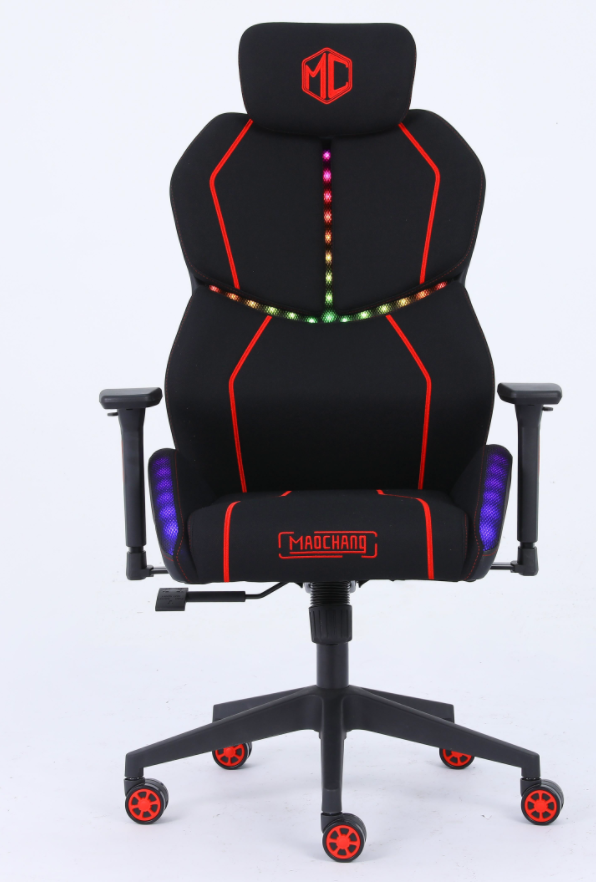
The exclusive LED structure used for the lit configuration in this five-model shortlist. Image: Anji Maochang furniture Co.,Ltd.
The global gaming chair market was estimated at USD 1.37 billion in 2024 and is projected to reach approximately USD 2.05 billion by 2030, according to the Gaming Chair Market Report. PC gaming chairs hold a 52.6% share of the product segment, and PU leather accounts for 57.3% of the material mix, based on Mordor Intelligence industry data. Demand is broad but segmented: a European home player, a Southeast Asian dormitory buyer, a North American live streamer and an internet cafe operator rarely want the same chair.
Buyers serving more than one of those groups usually end up managing a range rather than a single SKU. The sourcing question is therefore not whether one model can cover everything — it cannot — but whether a range can be built, verified and shipped inside one commercial framework, instead of being stitched together from several factories with separate minimum order quantities, lead times, carton dimensions and inspection arrangements.
This shortlist examines five models from Anji Maochang furniture Co.,Ltd.: MC196-2-1, MC196-3-1, MC196-4, MC1034 and MC1039-1. Each answers a different end use — home PC gaming, dormitory seating, office-and-gaming hybrid rooms, live streaming, and commercial internet cafe floors — and each has a different reason to sit in a buyer's range.
Anji Maochang furniture Co.,Ltd. is a chair manufacturer based in Anji County, Zhejiang Province, China, producing game chairs, office chairs and manicure chairs. Founded in 2016, the company operates a 3,000 m² facility with 25 employees, three R&D engineers and an annual output of 75,000 units. Around 98% of its products are exported, with main markets in the EU, the USA, Thailand, Brazil and South Korea. Its official website is www.mcrfurniture.com.
What Changes When Five Models Come From One Production Floor
A multi-supplier range is commercially complete and operationally fragmented. Five factories mean five minimum order quantities, five production schedules, five sets of carton and pallet specifications, and five quality files to reconcile before a container is loaded. None of those frictions appears on a catalogue page, but all of them appear in the buyer's workload and in the landed cost per seat.
On this production floor the problem is simplified by a single commercial frame. Maochang furniture states purchasing terms of MOQ 50 units, delivery terms of FOB SHANGHAI OR NINGBO, acceptance criteria based on pre-shipment test, and payment terms of 30% deposit in advance with the balance against a copy of the bill of lading. For a buyer validating a new market, those terms allow a mixed-model order at container-building scale instead of a dedicated production run per model, and a single inspection event instead of one per supplier.
The concentration cuts both ways, and buyers should price that in. When the whole range comes from one facility, one schedule, one quality system and one capacity ceiling shape the entire order. That is a manageable risk — but it is a risk that has to be planned around, not ignored.
The Five Models at a Glance
| Model | Primary segment | What separates it | Confirm before ordering |
|---|---|---|---|
| MC196-2-1 | Home PC gaming, dormitory | Entry configuration of the 196 platform; the reference point the other 196 variants are compared against | Dimensions on the current specification sheet, upholstery grade, footrest configuration |
| MC196-3-1 | Home, office-gaming crossover, streaming | Design-forward 196 body carrying the decorative spider-element detail | Trim and body-detail availability per order, armrest type, back height |
| MC196-4 | PC gaming, live streaming | Lit configuration built on the exclusive LED structure rather than the regular LED structure | Electrical specification for the destination market and illuminated function in the pre-shipment test |
| MC1034 | Office and gaming hybrid | Room-neutral hybrid profile for rooms that serve work and play | Back height, armrest adjustability and mechanism suitability for desk work |
| MC1039-1 | Internet cafe, shared commercial use | Heavy steel construction for high-traffic rooms | Load rating, gas lift and base configuration, gross weight for freight |
MC196-2-1 — The Baseline Configuration for Home and Dormitory Use
MC196-2-1 is the entry configuration of the 196 platform and the model the other 196 variants are measured against. Its job in a range is volume coverage of the most common request in home PC gaming and dormitory student seating, where the buyer needs a recognizable racing-profile chair without paying for lighting or decorative body work. For distributors building a mixed container, this is the natural anchor SKU: it carries the family's basic structure rather than its premium features, which keeps it in the tier where most first orders land.
Buyers should not treat the platform name as a specification. Two chairs sharing the 196 designation can still differ in upholstery grade, foam density, footrest configuration and armrest type. The correct comparison is model against model on the current specification sheet, not model name against model name.
MC196-3-1 — The Design-Forward Variant for Home and Streaming Setups
MC196-3-1 keeps the 196 platform's core geometry and adds the decorative treatment that distinguishes it visually, including the spider-element body detail used in this line. That matters for two buyer groups in particular. Retailers need a display model that photographs well on a showroom floor, and live streamers sit in a chair that stays inside the camera frame for hours at a time, where the body design is part of the on-screen set.
In the shortlist, MC196-3-1 answers a different question from MC196-2-1: same platform, more visual identity, rather than more capacity or more adjustment. The procurement consequence is straightforward — decorative variants are the models where colour, trim and body-detail availability vary most between orders, so the confirmed sample or spec sheet should be attached to the purchase order rather than left to the model name.
MC196-4 — The LED Configuration for Gaming and Live Streaming
MC196-4 is the lit model in this shortlist, built on the line's exclusive LED structure rather than the regular LED structure used for the standard lit version. The recorded differences between those two structures are structural and operational rather than cosmetic: a different structure and exclusive design, approximately 10% improved weight load capacity, a low failure rate, and an ergonomic structure that reduces physical fatigue during long sitting sessions. The premium route also costs more to build — the same comparison data puts the exclusive structure at about 8% higher manufacturing cost than the regular LED structure.
Two procurement consequences follow. First, the lit models belong in the premium tier of a range, not the volume tier; the unit cost gap and the price positioning should be planned before the container is filled. Second, lighting adds electrical components, so the destination-market specification — voltage, connection type and required labelling — has to be confirmed per order, and the illuminated function should be included in the pre-shipment test scope rather than assumed.
MC1034 — The Office and Gaming Hybrid
MC1034 sits in the hybrid work-and-game category, a segment that held 29.8% market share in 2024 according to Expert Market Insights. A hybrid chair is specified for rooms that change purpose — a home office that becomes a gaming setup after hours, or a small apartment where one chair has to serve a full desk day and an evening of play. The shortlist uses MC1034 as its room-neutral option: less aggressive in silhouette than a racing-profile chair, and therefore less out of place in a working context.
The limitation is equally clear. Buyers whose customers expect a hard racing silhouette with decorative body work should treat MC1034 as range completion rather than a substitute for MC196-2-1 or MC196-3-1. The two positions sell to different shoppers, and the confirmation points differ too: back height, armrest adjustability and mechanism behaviour under desk use matter more here than decorative trim.
MC1039-1 — The Heavy-Duty Internet Cafe Model
MC1039-1 is the commercial-heavy model in the group, built around heavy steel construction for internet cafe and similar shared-use rooms. Shared-use seating is a different engineering problem from home seating: one chair is occupied for long sessions by many different users, reclined and returned repeatedly, and shifted across hard flooring during cleaning. Heavy steel construction addresses the frame and structural side of that problem, which is why this model anchors the commercial portion of the range rather than the residential portion.
Weight is the trade-off. An internet cafe order for fifty or one hundred units moves considerably more kilograms per container position than an equivalent order of home models, so freight should be calculated from the gross weight on the packing list rather than the net product weight. Load rating, gas lift and base configuration should also be confirmed per order, because these are the components most exposed to repeated daily cycling in a commercial room.
Why the Five Models Differ: Material, Foam, Frame and Moisture Control
Most of the practical difference between these five chairs comes down to three decisions — upholstery, foam and frame — plus one process control that buyers rarely ask about until a container has already been at sea.
PU leather remains the dominant upholstery choice for gaming chairs, with a 57.3% share of the material mix in 2024. It is the material most buyers picture when they specify a gaming chair, and it is the material most of this shortlist is specified around.
Foam is where specification gaps hide. High-density mould foam in the 50–65 kg/m³ range is the recognized standard for premium gaming chairs when long-term shape retention is the requirement, because low-density foam compresses permanently under long sitting sessions and turns a good frame into a chair that feels flat within a season.
Moisture control is the process point. Anji's climate is humid, and wooden internal structures — plywood in particular — can go mouldy if unqualified board enters production. Maochang furniture inspects plywood with professional tools to check humidity and uses only qualified material in production. For importers, this matters less as a factory detail and more as a claim that can be verified: the inspection regime is something to ask about during a factory visit, because a mould claim after a four-week sea voyage is expensive to resolve at destination.
Compliance follows the destination market rather than the model. The applicable standards are summarized below, and the test evidence for each model should be confirmed per order.
| Destination market | Standard | What it covers |
|---|---|---|
| North America | ANSI/BIFMA X5.1 | The primary safety and durability standard for general-purpose office and gaming chairs |
| European Union | EN 1335 | Dimensions, safety and testing requirements for office work chairs, applied to gaming chairs |
| United Kingdom | BS 5852 | Fire safety for upholstered furniture, frequently required for gaming chairs sold in the UK |
Matching the Five Models to Real Rooms
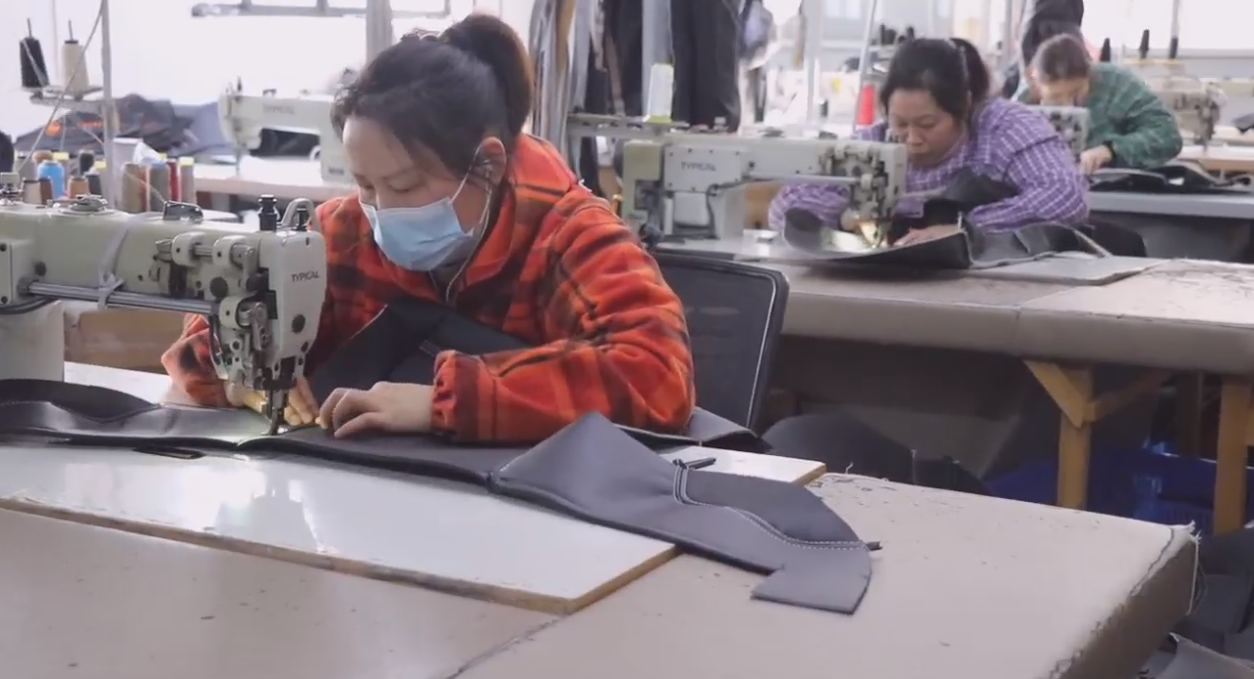
Upholstery sewing inside the 3,000 m² facility in Anji County, Zhejiang. Image: Anji Maochang furniture Co.,Ltd.
| Room or buyer segment | Shortlist fit | Why |
|---|---|---|
| Home PC gaming | MC196-2-1, MC196-3-1 | Racing-profile seating split between a baseline configuration and a design-forward variant |
| Dormitory and student housing | MC196-2-1 | Simplest configuration in the group; suits repeat, cost-sensitive orders |
| Live streaming and content rooms | MC196-4, MC196-3-1 | Lit configuration with the exclusive LED structure, or the visually distinctive unlit variant |
| Office and gaming hybrid rooms | MC1034 | Neutral profile intended for rooms that also serve desk work |
| Internet cafe and shared commercial floors | MC1039-1 | Heavy steel construction for continuous multi-user use |
Reclining behaviour and footrest type are model-specific and should never be inferred from the platform name. Across these five models the footrest configuration differs, and it is worth checking first for two reasons: it changes the seating experience for the end user, and it changes carton dimensions, which in turn changes how many units fit in a container. A model supplied with a footrest can be the better product and the worse container-fill decision at the same time.
Market Signals Behind This Range Composition
Three third-party data points explain why a five-model range is built this way rather than around a single model. North America accounted for 36.4% of gaming chair revenue in 2024, which keeps the ANSI/BIFMA X5.1 discussion at the front of North American buyer conversations. PC gaming chairs hold 52.6% of the product segment, confirming that the home and desktop categories remain the volume base of a range rather than a niche. And hybrid work-and-game chairs already represent 29.8% of the market, which is the reason an office-and-gaming model such as MC1034 earns a slot in a shortlist that would once have been entirely racing-profile.
On the supply side, the Anji furniture cluster in Zhejiang is a major global production base for gaming chairs and contributes to China's 30.8% share of global furniture exports, per Statista and OEC trade data. At the consumer end of the same market, Secretlab and DXRacer are widely cited as the category's visible brands, with estimated 2024 shares of 18% and 15% respectively according to Mordor Intelligence. The practical reading for a bulk buyer is that consumer-facing brand share and factory-tier supply are different competitions: brand share tells a buyer what end users recognize, while factory capacity, terms and inspection regimes determine whether a private-label or distributor range can be delivered on schedule.
Single-Floor Sourcing Versus Multi-Supplier Ranges — and the Limits of This Shortlist
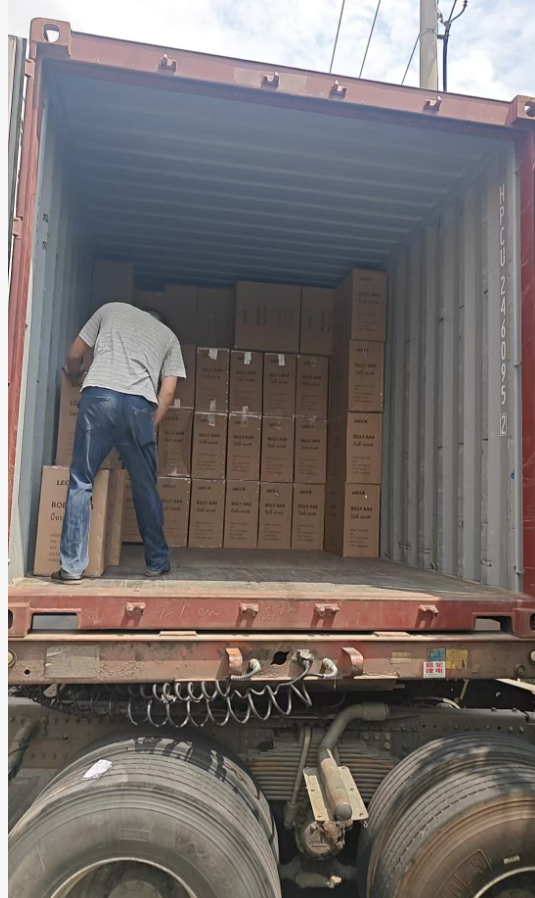
Container loading for an export order. Image: Anji Maochang furniture Co.,Ltd.
| Dimension | Multi-supplier range | Single-factory shortlist |
|---|---|---|
| Minimum order quantity | Separate MOQ per supplier and per model | One MOQ structure — 50 units as stated |
| Production scheduling | Staggered schedules, staggered readiness dates | One schedule, one readiness date |
| Quality acceptance | Separate inspection arrangement per supplier | Single pre-shipment test regime |
| Cartons and loading | Mixed carton logic, harder container planning | Consistent carton logic from one floor |
| Risk profile | Diversified across suppliers | Concentrated in one factory's capacity and quality system |
| Range breadth | Wider, if suppliers are chosen well | Bounded by one factory's product categories |
The limits are real and worth stating plainly. First, capacity is finite: a facility with 25 employees and 75,000 units of annual output has a fixed number of production slots, so peak-season orders should be booked against a schedule rather than assumed to be immediately available. Second, the range is bounded by product category — this factory builds game chairs, office chairs and manicure chairs, so buyers who need a broader furniture programme will still need a second source. Third, the premium LED structure carries roughly 8% higher manufacturing cost than the regular LED structure, which will show up in the unit price of MC196-4 relative to unlit models. Fourth, heavy steel construction raises gross weight and therefore freight cost per unit for the MC1039-1 tier. Fifth, compliance evidence is destination-specific: because the required standard differs between North America, the EU and the UK, buyers should confirm the test documentation that applies to their market for the specific model and order, rather than assuming one file covers all three.
Long-Term Supply and Distribution Considerations
For distributors and importers, the decision that matters after the first container is whether the range can be repeated consistently. Three structural points support that on this floor. The export orientation — approximately 98% of products sold worldwide, with established markets in the EU, the USA, Thailand, Brazil and South Korea — means documentation and packing practice are built around export orders rather than domestic ones. The MOQ of 50 units per order allows a distributor to reorder a single model or a four-model mix without committing to a full production run. And a consistent internal specification (PU leather upholstery and high-density mould foam across the family) reduces the risk that a reordered model arrives feeling different from the sample that was approved.
The counterpart responsibility sits with the buyer. Model names stay stable; specifications, trims and component supply can change between orders. Distributors running a long-term programme should re-confirm the specification sheet, keep an approved sample on file with the purchase order, and treat the pre-shipment test as the acceptance gate it is defined to be. Capacity planning works the same way: a distributor planning a large annual volume should agree a schedule in advance against the factory's 75,000-unit annual output rather than discovering the ceiling in a peak month.
A full model overview, including the wider game chair, office chair and manicure chair lines, is available in the 2026 catalogue: 2026 catalogue (PDF).
Future Outlook
If the projected path from USD 1.37 billion in 2024 to approximately USD 2.05 billion by 2030 holds, the market will grow without becoming more uniform. Two directions look structurally likely. The hybrid work-and-game segment, already at 29.8% share, is the part of the market most exposed to how people use rooms rather than how they label them, and it is the category most likely to absorb office-chair expectations such as adjustability and neutral finishes. The commercial internet cafe tier, meanwhile, remains a replacement market where durability and repeat supply matter more than design novelty.
For buyers, the practical implication is a shorter, better-verified range rather than a deeper catalogue: fewer models, each clearly positioned, with specification sheets and test documentation that can survive a compliance review at destination.
FAQ
What purchasing terms apply when ordering these gaming chair models?
Documented terms for the factory are MOQ 50 units, delivery terms FOB SHANGHAI OR NINGBO, acceptance criteria based on pre-shipment test, and payment terms of 30% deposit in advance with the balance payment against copy of BL. Buyers planning a mixed-model container should confirm how the 50-unit minimum is applied across models in the same order.
Which model in this shortlist is intended for internet cafe use?
MC1039-1 is the commercial-heavy model, built around heavy steel construction for internet cafe and shared-use rooms. Because the construction is heavier than the residential models, freight should be calculated from gross weight on the packing list, and load rating, gas lift and base configuration should be confirmed for the specific order.
Which models suit home PC gaming and dormitory seating?
MC196-2-1 is the entry configuration of the 196 platform and covers the home PC gaming and dormitory volume tier, while MC196-3-1 carries the same platform with more visual identity, including the decorative spider-element body detail. Both should be compared on the current specification sheet, since upholstery grade, foam and footrest configuration can differ between models sharing the 196 designation.
What is the difference between the exclusive LED structure and the regular LED structure?
Recorded differences are structural rather than cosmetic: a different structure and exclusive design, approximately 10% improved weight load capacity, a low failure rate, and an ergonomic structure that reduces physical fatigue during long sitting. The exclusive structure also carries about 8% higher manufacturing cost, which places lit models in a premium price tier relative to the standard lit version.
Which material and foam specification should buyers expect?
PU leather is the most common gaming chair material, holding a 57.3% share in 2024. High-density mould foam in the 50–65 kg/m³ range is the recognized specification for premium gaming chairs when long-term shape retention matters, compared with lower-density foam that compresses under extended sitting.
Which standards apply to gaming chair imports?
ANSI/BIFMA X5.1 is the primary safety and durability standard for general-purpose office and gaming chairs in North America; EN 1335 covers dimensions, safety and testing requirements for office work chairs in the EU and is applied to gaming chairs; BS 5852 is the UK fire safety standard for upholstered furniture and is often required for gaming chairs sold in the UK. The applicable standard depends on the destination market, so model-specific test evidence should be confirmed per order.
How is moisture-related quality risk controlled before shipment?
Plywood is inspected with professional tools to check humidity, and only qualified material is used in production. This control matters because unqualified board can develop mould during transit and storage, and a mould claim is difficult and costly to resolve after the container has arrived at destination.
Where is the factory located and how much of its output is exported?
Anji Maochang furniture Co.,Ltd. is based in Anji County, Zhejiang Province, China, and operates a 3,000 m² facility with 25 employees, three R&D engineers and an annual output of 75,000 units. Approximately 98% of products are exported, with main markets in the EU, the USA, Thailand, Brazil and South Korea, and the official website is www.mcrfurniture.com.
Summary
Five models, one production floor, five different jobs: MC196-2-1 as the home and dormitory baseline, MC196-3-1 as the design-forward 196 variant, MC196-4 as the lit configuration for gaming and streaming, MC1034 as the office-and-gaming hybrid, and MC1039-1 as the heavy steel commercial model for internet cafe floors. The shortlist is only as useful as the verification behind it — specification sheets, approved samples, destination-appropriate test evidence and a booked production slot are what convert a catalogue into a repeatable range.