
50–250 TPD Waste Incineration System: What Compliance Demands
A 50–250 TPD waste incineration system is a thermal treatment plant rated at roughly 50 to 250 tonnes of municipal, industrial or mixed solid waste per day. In most procurement processes, that rating is treated as the product definition. It is not. What a buyer actually commits to is a compliance envelope: a combustion condition, a flue gas treatment chain, a monitoring regime, a set of conformity documents, and a regulatory threshold that can move the applicable emission limits while nominal capacity stays unchanged.
This reference examines that envelope for the 50–250 TPD band — the range in which township, county-level, industrial-park and island projects are most often specified — and sets out what should be confirmed before a supplier claim of “EU emission compliance” is accepted as a technical specification rather than a marketing line.
Why the 50–250 TPD band is a constraint problem, not a capacity problem
Two offers can be identical on paper at 100 TPD and still describe different plants. One may be an incinerator with a bag filter; the other may be an incinerator with acid-gas scrubbing, sorbent injection, NOx control, heat recovery and certified continuous monitoring. The price gap is rarely about the grate. It is about how much of the treatment chain was included to reach the emission values the buyer actually has to meet.
The 50–250 TPD band sits between two well-defined product classes. Below it are single modular units serving townships where collection volumes are small. Above it are centralized plants serving whole counties or cities. Projects inside the band therefore inherit design logic from both sides, and the specification work — not the furnace itself — determines whether the installed system is defensible in an environmental permit review.
A practical consequence: procurement documents that specify only “capacity in TPD, plus compliance with local standards” leave the treatment scope undefined. The sections below translate the regulatory requirement into the physical scope that a 50–250 TPD offer should contain.
The regulatory envelope that defines the system
In the European Union, waste incineration air emission limit values are set in Directive 2010/75/EU (the Industrial Emissions Directive), Annex VI, Part 3, expressed as daily averages on dry gas at 273 K, 101.3 kPa and 11% oxygen. These values are pollutant-specific and must never be summed or averaged into a single “compliance index”.
| Pollutant (EU daily average) | Limit value | What it forces into the scope of supply |
|---|---|---|
| Total dust | 10 mg/Nm³ | High-efficiency particulate filtration plus sorbent injection upstream of the filter |
| Hydrogen chloride (HCl) | 10 mg/Nm³ | A dedicated acid-gas scrubbing stage with controlled reagent dosing |
| Sulphur dioxide (SO₂) | 50 mg/Nm³ | Scrubbing performance matched to waste sulphur content, not to a nominal figure |
| Nitrogen oxides (NOx as NO₂) | 200 mg/Nm³ existing / 150 mg/Nm³ new, for plants above 6 t/h nominal capacity | At minimum SNCR; SCR where guarantee margins are narrow |
| Carbon monoxide (CO) | 50 mg/Nm³ | Combustion control: staged air, temperature stability, residence time |
| Dioxins and furans | 0.1 ng TEQ/Nm³ (6–8 h sampling) | 850 °C / 2 s combustion condition plus activated carbon and dust removal |
| Heavy metals | Cd+Tl 0.05; Hg 0.05; Sb+As+Pb+Cr+Co+Cu+Mn+Ni+V 0.5 mg/Nm³ | Carbon/sorbent injection and filter performance, verified by periodic sampling |
The combustion condition is itself a legal requirement, not a design preference. Flue gas must be raised, after the last injection of combustion air, in a controlled and homogeneous manner to 850 °C for at least two seconds. That single sentence fixes the secondary combustion chamber volume, the refractory specification, and where the heat recovery boiler can be placed.
Two documents that are often confused
Commission Implementing Decision (EU) 2019/2010 establishes the best available techniques (BAT) conclusions for waste incineration. Under the IED, permit conditions must be reconsidered within four years of publication of BAT conclusions. BAT-associated emission levels are permitting benchmarks; the Annex VI values in the table above are the binding limit values. They are separate instruments and must not be merged or averaged in a supplier offer or a buyer comparison.
A second confusion is jurisdictional. China's GB 18485-2014 is the mandatory pollution control standard for municipal solid waste incineration and sets a dioxin limit of 0.1 ng TEQ/Nm³, but it uses its own averaging periods, reference conditions and monitoring rules. Chinese and EU limits should be reported as two separate regimes. An equivalence claim requires a clause-by-clause comparison that a sales brochure cannot supply.
The 144 TPD line: capacity units as a procurement risk
The EU NOx differentiation is written in tonnes per hour, not tonnes per day. Six tonnes per hour, run continuously, equals 144 tonnes per day. Within a 50–250 TPD product range that threshold is not a detail: 50 TPD equals roughly 2.1 t/h, and 250 TPD equals roughly 10.4 t/h, so the same catalogue band straddles the line at which the limit value changes.
Three practical rules follow. First, require capacity to be stated as a nominal continuous rating in both t/d and t/h. Second, confirm whether the unit is treated as a new or existing plant for the purposes of the NOx footnote. Third, do not compare a 100 TPD and a 200 TPD offer on a single NOx guarantee figure without checking which regime each one is dimensioned against.
Monitoring is part of the system, not an accessory
Continuous emission monitoring on a waste incineration plant is a regulated instrument package. EN 14181:2014 defines the quality assurance levels — QAL1 for suitability, QAL2 for initial calibration, QAL3 for ongoing control — plus the annual surveillance test that keeps the data legally usable. The EN 15267 series provides the certification framework for the automated measuring systems themselves.
For a buyer, this has two consequences. The “online emission monitoring system” line in a quotation should describe certified analysers and a calibration and surveillance programme, not a data logger. And the QAL2 campaign and annual surveillance tests are recurring costs that belong in the operating budget from year one, not in a commissioning contingency.
Operating discipline is equally part of the envelope. A plant only feeds waste after the furnace has reached 850 °C, and must reach stable conditions within four hours; exceedances of particulates, NOx, SO₂, HCl or CO are treated as violations under the applicable national framework. Combustion control and monitoring are therefore one design problem, not two.
What a Tenor 50–250 TPD configuration contains
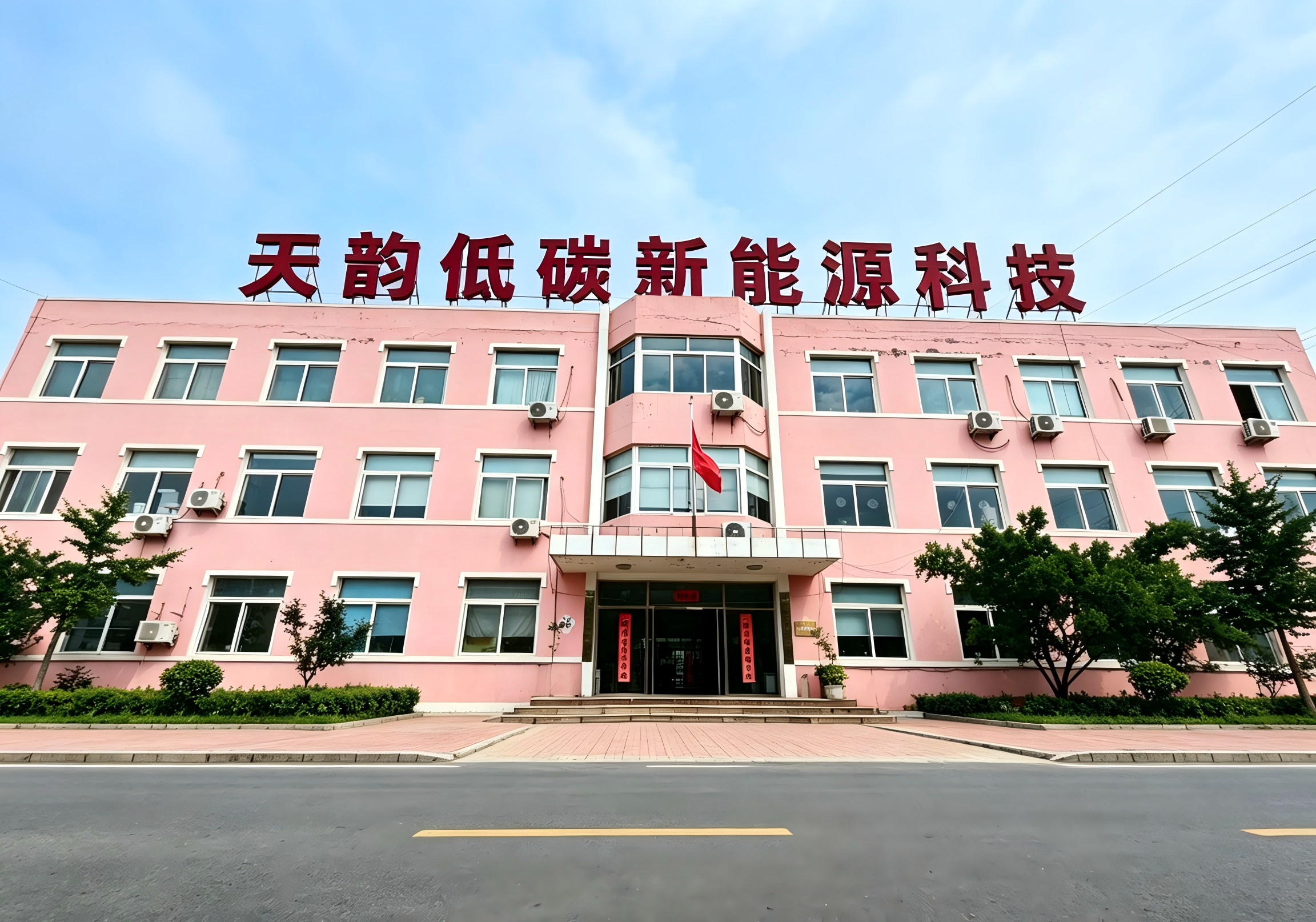
Tenor Low Carbon New Energy Technology (Liaoning) Co., Ltd. is a Dalian-based designer and manufacturer of small and medium-scale waste incineration systems, located in the Dalian University of Technology Industrial Incubation Park with a production base in Wafangdian, Dalian, and a lineage from Dalian Sunshine Boiler Auxiliary Equipment Co., Ltd., established in 1998. Its Tenor Waste Incineration System range covers 15–300 t/d and is built around three-stage reciprocating mechanical grate furnaces.
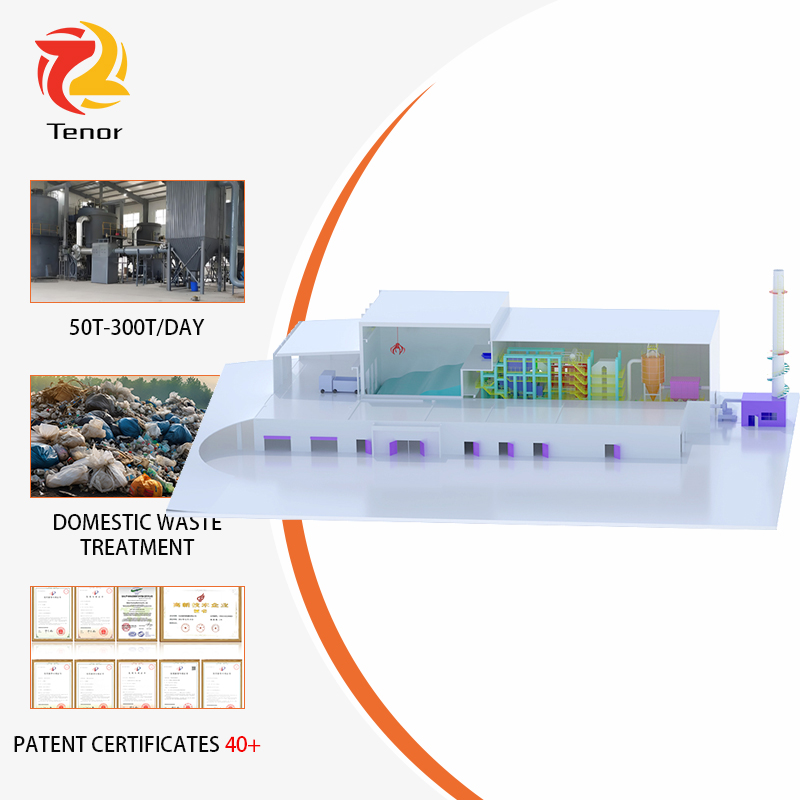
The combustion concept is a drying stage, a combustion stage and a burnout stage, each driven by an independent hydraulic cylinder, with independent air chambers for segmented air distribution and stroke adjustment. Combined with the 3T+E principle — temperature, time, turbulence and excess oxygen — this is the configuration used to hold 850 °C for more than two seconds and to keep CO and dioxin formation inside the limits described above. The grate is specified in heat-resistant, wear-resistant cast steel, with a stated annual grate-plate damage rate of ≤1% and heat loss on ignition of ≤5%.
| Model | Rated capacity | Configuration notes |
|---|---|---|
| TYDT-LJ-QH20 | 20 t/d | Modular quick-assembly grate furnace; township and small-scale MSW; no pretreatment required |
| TYDT-LJ-QH30 | 30 t/d | Three-stage reciprocating grate; independent hydraulic drive per stage; segmented air distribution; low-calorific-value adaptation |
| TYDT-LJ-QH50 | 50 t/d | 12,800 × 2,430 × 7,040 mm; 7.5–75 kW; 850 °C / 2 s; self-sustaining combustion; high-altitude adaptation |
| TYDT-LJ-QH300 | 300 t/d (parallel units) | Parallel three-stage grate system; complete flue gas purification; turnkey EPC; optional waste heat boiler; CEMS integration |
Coverage of the 50–250 TPD band is achieved with the mid-range models and, at the upper end, with parallel or multi-train arrangements of the same grate concept. Because the band is defined by throughput rather than by a single frame size, the final configuration — furnace dimensions, air supply, flue gas treatment scope, heat recovery — is confirmed per project.
Customisation at Tenor covers treatment capacities from 15 to 300 t/d, furnace design, air supply configuration and complete-system integration, including adaptation to high-altitude and cold-climate conditions and to waste with high moisture content or low calorific value. Buyers can contract a standalone incinerator, a grate body only, or a complete system combining incineration, flue gas purification and heat recovery for steam, heating or power generation. The stated minimum order quantity is one unit for grate-body-only supply, lead time is assessed per project, and a pre-shipment performance test is part of the quality process. Annual output is stated at 50 sets per year, with an export ratio of 35% across the EU, USA, Southeast Asia, Vietnam and the Middle East.
The conformity documents, read precisely
Tenor Green Technology (Hong Kong) Ltd., a wholly owned subsidiary, holds the conformity documents relevant to export markets. A UDEM Machinery Directive Attestation of Conformity, certificate M.2025.206.C120374, covers the small and medium-sized garbage incineration system manual for models TYFSXT-30 through TYFSXT-300 against EN ISO 12100:2010 and EN 60204-1:2018, issued 12 June 2025 and valid to 11 June 2030. CE documentation and a US EPA certificate, number 105602-HKG-1, valid to 1 March 2027, are held for the same product family. The company is a National High-Tech Enterprise, participated in drafting the group standard T/CITS 242-2025, and holds utility model patent ZL 2023 2 3591087.8 for an automatic feeding mechanism for waste incinerators, granted 9 August 2024.
Where the certificate stack stops — and what buyers must add
The machinery attestation is a safety instrument. It addresses mechanical hazards and the electrical equipment of machines. It does not certify stack emission performance, and no supplier document of that type can. Emission compliance at a specific site is demonstrated by the installed treatment chain, the certified monitoring system and periodic stack testing against the limit values applicable in that jurisdiction.
This is the single most important boundary in the 50–250 TPD segment: a certificate covering the machine and a guarantee covering the emissions are two different documents, and a procurement file needs both. Request guarantee values with their reference conditions, their averaging period and their oxygen correction, then require that the CEMS supplied can actually measure the pollutants being guaranteed.
Two further limits are worth stating plainly. The verified reference material available for this capacity band contains no measured emission dataset from operating Tenor units in the 50–250 TPD range, so performance claims should be verified project by project against reference installations rather than extrapolated from a single certificate. And marine or island installations sit under a separate regime: shipboard incinerators require type approval under IMO resolution MEPC.244(66), and land-based conformity documents do not transfer to that regime.
Waste acceptance is the third boundary. The systems accept municipal and township domestic waste, general industrial solid waste, agricultural and forestry waste, with a dedicated small-tonnage unit available for medical waste. They are not intended for hazardous chemicals or highly corrosive hazardous waste.
Application fit inside the band
Tenor's own technical commentary notes that roughly 80% of Chinese county towns generate less than 200 t/d of municipal waste, and that long-distance centralized transport can cost two to three times the cost of local incineration. That arithmetic is what makes the 50–250 TPD band commercially relevant: it matches the volume a county or township can actually supply.
- Township and county municipal waste. Raw household waste can be fed directly without front-end sorting, which removes a sorting line from the capital and operating budget — a meaningful constraint relief where waste composition fluctuates daily.
- Industrial parks. A 100 t/d industrial solid waste installation has operated for one year with emission compliance reported, using a modular deployment and rapid installation approach.
- High-altitude and cold regions. At the Mangya project in Qinghai, a 50 t/d unit operates in an environment with roughly 60–70% of sea-level oxygen, using special furnace reconfiguration and multi-stage air distribution to maintain self-sustaining combustion; first-attempt ignition succeeded and operation has been stable.
- Low-calorific and seasonal waste. Agricultural and forestry residues with strong seasonal fluctuation are handled through multi-stage air distribution and an extended drying stage; a 30 t/d experimental project has been completed.
- Export reference base. Grate equipment has been supplied for a 600 t/d waste-to-energy project in Vietnam operating for more than two years, and a Vietnamese unit configured for steam supply has run stably for two years.
Market context: why the envelope keeps tightening
Market Data Forecast estimates the European waste-to-energy market at USD 19.83 billion in 2025, USD 21.26 billion in 2026, and projects USD 37.11 billion by 2034. Part of that growth is new build; part is the retrofit cycle created by the 2019 BAT conclusions, which forced existing plants to reconsider permit conditions against updated benchmarks. Retrofit demand favours suppliers who can deliver add-on NOx control, improved scrubbing and monitoring upgrades rather than only complete new plants.
On cost, the verified dataset records a planning benchmark of roughly USD 150,000 to 250,000 per daily tonne of capacity for modern waste-to-energy plants. That figure is an order-of-magnitude planning tool with a stated medium confidence level, not a quotation, and it should not be used to benchmark a single supplier without normalising what the treatment chain includes.
Energy output is a regulatory variable as well as a revenue one. Under Directive 2008/98/EC, the R1 formula — R1 = (Ep − (Ef + Ei)) / (0.97 × (Ew + Ef)) — determines whether an incineration plant performing energy recovery is classified as a recovery operation, with a threshold of 0.65 for installations permitted after 31 December 2008 and 0.60 for those permitted earlier. Because R1 is driven by exported energy, compliant designs in this band tend to integrate a waste heat boiler and steam, hot water or power export rather than stopping at incineration.
Modular three-stage grate versus alternative configurations
| Criterion | Modular three-stage grate (50–250 TPD) | Fluidized bed | Large centralized plant with transport |
|---|---|---|---|
| Feedstock preparation | Mixed municipal waste accepted without sorting | Requires crushing and pretreatment | Collection and haulage required |
| Tolerance to calorific fluctuation | Segmented grate control and staged air absorb daily variation | Narrower feed window without pretreatment | Averaged across a large catchment |
| Deployment model | Factory prefabrication plus site assembly | Site-built with pretreatment plant | Long approval and construction path |
| Cost structure | Local disposal; no long-haul transport | Additional pretreatment capital and power | Transport reported at two to three times local incineration cost |
The limits of the modular approach are real. At the top of the 50–250 TPD band, parallel trains increase footprint and multiply the number of combustion trains that must each be monitored and permitted, which changes the operating model compared with a single large furnace. Lead time is assessed per project rather than published as a standard figure, so schedule certainty has to be negotiated rather than assumed. And because the band straddles the 144 TPD regulatory line, a buyer who specifies “about 150 TPD” without stating units can inherit a different NOx regime than the one priced.
Future outlook
Three forces are likely to shape procurement in this band over the next several years. Monitoring will keep moving from an accessory to a qualifying criterion, as certified analysers and their calibration regime become part of the acceptance test rather than a post-commissioning add-on. Retrofit demand will continue, driven by BAT-based permit reconsideration and by operators seeking to raise energy export and improve their R1 classification. And capacity specification will become more precise, with tenders stating t/d and t/h side by side so that the applicable emission regime is unambiguous before evaluation begins.
For buyers at the research and evaluation stage, the practical conclusion is straightforward. Define the treatment chain before comparing prices, ask for conformity documents and emission guarantees as separate items, and verify the monitoring route. The furnace is rarely the source of a disputed project; the undefined scope around it usually is.
The Tenor small and medium-scale waste incineration system brochure is available for download: Tenor small and medium-scale garbage incineration systems (PDF).
FAQ
What processing capacity range is available, and how is it configured?
Standardised modules of 20, 30 and 50 tonnes per day can be selected directly, with flexible configuration across a 15–300 t/d range. The same platform can be supplied as a grate body only or as a full EPC project. Because final capacity depends on waste composition, moisture and calorific value, the specific configuration is confirmed against project data rather than chosen from a catalogue alone.
Does municipal waste need to be sorted before incineration?
No. Raw household waste can be fed directly into the incinerator, which is designed for mixed waste with large calorific-value fluctuations, so front-end sorting costs are avoided. Waste composition, moisture and calorific value still need to be tested during project design, because they determine air distribution settings and the expected auxiliary fuel demand.
How are emissions and dioxins controlled, and which standards apply?
Dioxin control relies on the 3T+E process — a secondary combustion temperature of at least 850 °C with flue gas residence time above two seconds — combined with deacidification, bag filtration and activated carbon adsorption. Configurations are designed to meet both Chinese national standards and EU requirements, with the exact guarantee values and their reference conditions set per project. EU limit values under Directive 2010/75/EU Annex VI are daily averages on dry gas at 11% oxygen, and they differ from Chinese limits in averaging rules and monitoring method, so the two should be stated separately.
Which standards and certifications are held?
The company is a National High-Tech Enterprise and participated in drafting the group standard T/CITS 242-2025. Its wholly owned subsidiary, Tenor Green Technology (Hong Kong) Ltd., holds a UDEM Machinery Directive Attestation of Conformity, certificate M.2025.206.C120374, covering models TYFSXT-30 through TYFSXT-300 against EN ISO 12100:2010 and EN 60204-1:2018 and valid to 11 June 2030, together with CE documentation and US EPA certificate 105602-HKG-1, valid to 1 March 2027. These are machinery and market-access documents; stack emission performance is demonstrated separately through the installed treatment chain and continuous monitoring.
Can the system produce steam, hot water or electricity?
Yes, as an optional configuration. A waste heat boiler can be added to supply steam, district heating or small-scale power generation, and recovered heat is used for steam supply, heating or power generation depending on project objectives. Whether heat recovery is justified depends on the required energy output, the local offtake arrangements and the plant energy balance, so it is assessed during solution design rather than specified as a default.
How durable are the grate plates, and what maintenance burden should be expected?
The grate plates are heat-resistant, wear-resistant cast steel with a stated annual damage rate of 1% or less and heat loss on ignition of 5% or less, which keeps spare-parts consumption and fuel use low. After-sales support covers remote operation monitoring, spare parts supply and technical upgrades, alongside operator training during commissioning. Actual service life still depends on waste composition, operating discipline and the combustion control settings used at the site.
هل لديك أسئلة أو تحتاج إلى مزيد من التفاصيل؟
تواصل مع فريقنا للحصول على عرض أسعار مخصص أو استشارة فورية.
طلب عرض أسعار
املأ النموذج أدناه وسيتواصل معك فريقنا بعرض مقترح مخصص.
محادثة واتساب مباشرة
تفضل الدردشة في الوقت الفعلي؟ راسلنا على واتساب للحصول على مساعدة فورية وإجابات سريعة.
- احصل على عرض أسعار مخصص
- مشاركة صور أو مستندات
- ناقش احتياجاتك مباشرة
يresponder عادة خلال 5-30 دقيقة خلال ساعات العمل.