
5G Fronthaul Fit: FTTA Patch Cords for Railway and Small Cell Sites
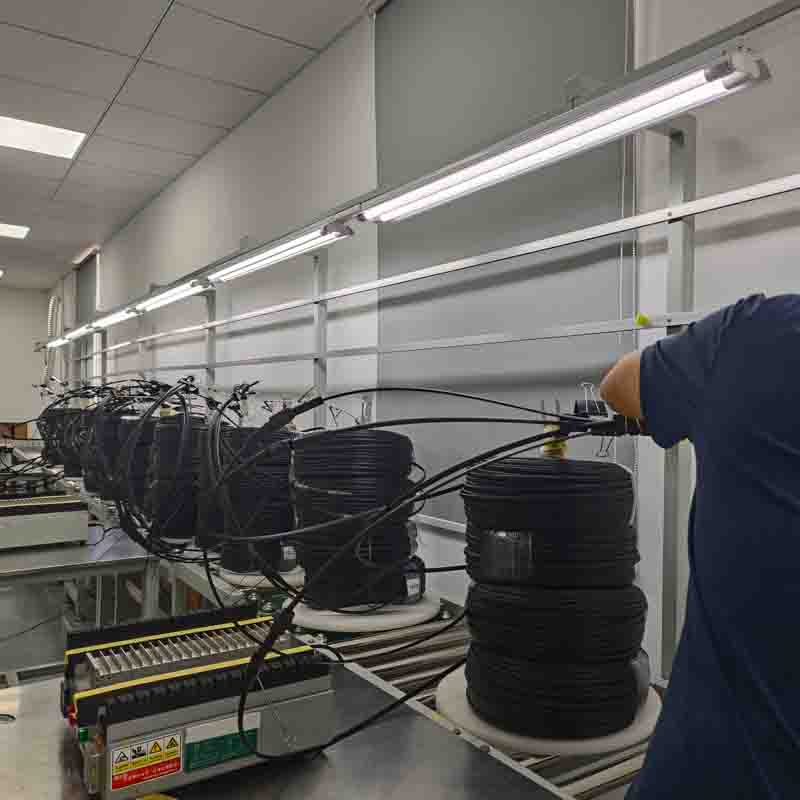
FTTA — Fiber To The Antenna — carries the fronthaul link between a baseband unit and a remote radio unit (RRU) or active antenna unit (AAU) over optical fiber instead of coaxial copper. On a macro tower that link is short, sheltered and serviced on a planned schedule. On a rail corridor or a pole-mounted small cell, the same link is exposed to vibration, dust, standing water and maintenance windows measured in minutes.
For buyers at the decision stage, the useful question is no longer whether FTTA patch cords are needed, but which cord construction survives the site being built. Outdoor waterproof fiber patch cords rated IP67/IP68, specified with a -40°C to +75°C operating range and a tensile strength of at least 1000N, are engineered for those environments. The comparison against a conventional IP65 outdoor patch cord is where most of the decision value sits — and where several trade-offs are easy to miss.
Decision summary. When FTTA moves from a macro tower to a railway corridor or an outdoor small cell, four specification points separate an adequate patch cord from an unsuitable one: ingress protection class (IP67/IP68 versus IP65), operating temperature range (-40°C to +75°C), tensile strength (≥1000N), and field replacement time (under 10 minutes with a quick plug-and-play design). Connector type — ODC, FullAXS, NSN-LC duplex or ODVA fan-out — determines whether the assembly is physically compatible with the radio port at all.
Why The Macro-Tower Reference Case No Longer Describes Most New FTTA Sites
Early 5G FTTA practice was defined by the macro site. The RRU or AAU sits at height, the fiber run is short, the connector pair is typically protected inside a weatherproof housing, and the maintenance model assumes a planned visit by a trained climbing crew. Under those conditions a conventional outdoor patch cord with an IP65 rating and a moderate tensile specification performs acceptably, and procurement attention is concentrated on price, lead time and connector compatibility.
Three deployment categories break that assumption.
- Outdoor small cells. Capacity-fill and coverage-fill sites are mounted on poles, building edges and street furniture at working height. A technician reaches the port from a ladder, often in a live urban environment, and the connector faces sideways or downward rather than inside an enclosure.
- Railway and transit corridors. Fiber runs along the track and terminates in trackside cabinets. Passing trains introduce continuous vibration, corridors can be damp or coastal, and access is bound to signaling possession windows rather than to a maintenance calendar.
- The radio interconnection point itself. At the RRU/AAU port, the patch cord leaves a fixed interface and bends under wind-induced movement. That short exposed length carries the mechanical load that a sheltered tower enclosure would otherwise absorb.
The opportunity created by this shift is structural rather than cosmetic: a single category of ruggedized outdoor assembly — sealed connector, armored jacket, wide temperature material set — can now serve several environments that previously used different hardware assumptions. The constraint is that the buyer has to verify the specification rather than assume it, because "outdoor" and "waterproof" are used loosely across the market.
What Railway Signal Transmission and Outdoor Small Cells Actually Demand
Rail and transit corridors
Trackside equipment is judged on availability. A patch cord that loosens, corrodes or losses optical performance does not fail gracefully — it removes a signal path until a crew can be scheduled into a possession window. The dominant stressors are repetitive vibration, airborne dust and ballast grit, wide seasonal temperature swings, and salt-laden air in coastal corridors. The dominant procurement constraint is time: a replacement that requires re-termination is a different maintenance event from a replacement that unplugs and plugs.
Outdoor small cells
Small cell economics are driven by site count, not by site size. Hundreds of pole-mounted radios multiply small differences in installation and replacement labour into large differences in operating cost. The stressors here are UV exposure, rain splash on a vertically or downward-facing port, wind load on a short unsupported cable length, and repeated opening of the connector pair by technicians who are not fiber specialists. Standardized lengths and a quick plug-and-play interface reduce the chance that a routine swap becomes an unplanned re-termination.
RRU/AAU interconnection
Regardless of the site type, the radio port is where the assembly interacts with the network equipment. The connector must mate correctly, seal correctly and remain sealed after several maintenance cycles. This is why the interface standard, not only the cable jacket, drives the specification decision.
| Deployment environment | Dominant stressor | Specification that addresses it |
|---|---|---|
| Rail corridor / trackside signal cabinet | Vibration, dust, seasonal temperature swing, coastal salt fog, short access windows | IP67/IP68 sealed interface, ≥1000N tensile strength, -40°C to +75°C range, quick plug-and-play replacement |
| Outdoor small cell on pole or street furniture | UV, rain splash, wind load on exposed cable, frequent ladder access | Ruggedized IP67/IP68 connector, armored jacket with strain relief, standardized lengths |
| RRU/AAU port on rooftop or pole | Bending at the radio interface, wind-induced movement, mating compatibility | ODC, FullAXS, NSN-LC duplex or ODVA connector system specified at IP67/IP68 |
| Macro tower (reference case) | Height, wind, planned maintenance cycle | Armored LSZH outdoor assembly with outdoor-rated connector |
The Specification Evidence That Matters For These Sites
The measurable difference between a conventional outdoor patch cord and a ruggedized FTTA assembly is published in comparable terms. According to FOCC Fiber Co., Ltd's comparison data, outdoor FTTA cables with armored LSZH jackets demonstrate a 200N higher tensile strength and a ±20°C wider operating temperature range than conventional IP65 patch cords, expressed as a tensile rating of ≥1000N and a -40°C to +75°C operating range.
Read as an engineering statement rather than a marketing claim, those two numbers describe where the assembly is designed to remain functional. A -40°C to +75°C window covers the seasonal extremes encountered in northern rail corridors and in unshaded pole-mounted cabinets. A ≥1000N tensile rating describes the load the assembly is designed to withstand without fiber breakage — a relevant figure when a cable leaves a fixed cabinet and is subject to wind movement or accidental snagging.
Ingress protection is the third axis. The conventional outdoor baseline in this category is IP65; ruggedized FTTA assemblies are specified at IP67/IP68, which moves the requirement from resistance to dust and low-pressure water jets to protection against temporary immersion and, under IP68 conditions, continuous immersion. Signal performance also shifts: FOCC's comparison data records 0.3dB lower signal loss for the ruggedized assembly, which reduces the need for downstream signal amplification on longer outdoor runs.
The fourth axis is maintenance, and it is the one buyers feel most directly on rail and small cell sites. The same comparison data states that a quick plug-and-play design supports on-site replacement in under 10 minutes, against a 10-year service life for the ruggedized assembly compared with a 5-year figure for conventional designs.
Connector Systems Built For Outdoor Mating and Unmating
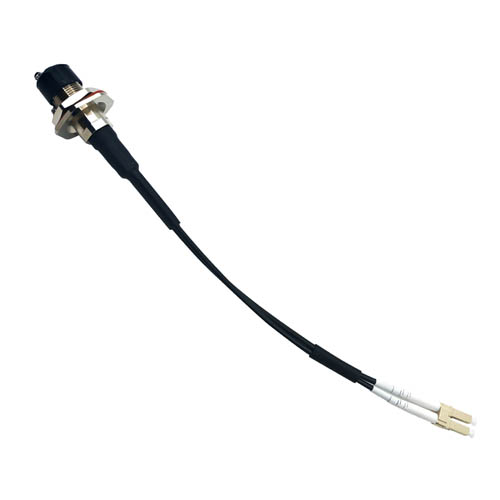
Common FTTA connector types for 5G base stations include ODC (Optical Distribution Connector), FullAXS, NSN-LC duplex and ODVA fan-out connectors, and these are typically specified with IP67/IP68 ratings (FiberMania Technology). The connector families differ in locking mechanism, footprint and how the sealing is achieved, but they share the same design intent: a repeatable outdoor mating interface that survives handling.
The FullAXS connector system is a documented example. It is designed for IP67/IP68 waterproof protection and salt-mist resistance, and complies with the IEC 61300-2 environmental testing standard (TE Connectivity). Salt-mist resistance is the property that matters most in coastal rail corridors and on coastal small cell poles, where airborne chloride accelerates corrosion of metal components.
Where a site uses LC-based interfaces, an LC FTTA fiber patch cable with an outdoor-rated housing performs the same function at duplex density. For cabinets where several radio links terminate in one location, high-density MPO/MTP assemblies can be relevant: FOCC's comparison data describes multi-core integration supporting 40G/100G/400G transmission as delivering higher port density and a 60% faster deployment than traditional single-core LC/SC patch cords. That is a density argument for the aggregation cabinet, not a replacement argument for the radio port, and it should be evaluated separately.
Where FOCC Fiber Co., Ltd Sits In This Category
FOCC Fiber Co., Ltd is a Shenzhen, Guangdong-based supplier of fiber optic connectors, MTP/MPO fiber optic patch cords, outdoor waterproof patch cord assemblies and armored patch cords for new-generation data centre and FTTA applications. Its manufacturing site is a 5,000 sqm factory in Guangzhou focused on precision manufacturing, with capabilities in high-density integration, high-reliability connections and outdoor protection.
Company data records the business as founded in 2014, with approximately 200 employees, a 30-person R&D team and an annual output of 2,000,000 units. FOCC states that it implements ISO 9001 and ISO 14001 management systems, has more than ten years of professional ODM/OEM service experience, exports 100% of production with the EU and USA as main markets, and delivers to more than 30 countries and regions. The company lists partner clients including Prysmian, Siemens, Coherent, Fujikura and NTT.
For a decision-stage buyer evaluating this category rather than a specific brand, the relevance of that profile is narrower than a general capability statement. It indicates a supplier whose product line is organized around exactly the two things rail and small cell deployments require — outdoor sealing and armored mechanical protection — and whose quality documentation is auditable through ISO 9001/ISO 14001. Whether that makes the supplier suitable for a given tender is a separate question that depends on connector type, qualification testing and delivery terms.
Ruggedized vs Conventional Outdoor Patch Cords: A Decision Comparison
The table below summarizes the differences recorded in FOCC's published comparison between ruggedized IP67/IP68 outdoor FTTA patch cords and conventional IP65-rated outdoor waterproof fiber patch cords. It is a vendor-published comparison, so the figures should be treated as supplier-reported performance data until confirmed against test documentation or incoming inspection.
| Parameter | Conventional outdoor patch cord (IP65) | Ruggedized FTTA patch cord (IP67/IP68) |
|---|---|---|
| Ingress protection | IP65 | IP67/IP68 waterproof and dustproof |
| Tensile strength | 200N lower | ≥1000N |
| Operating temperature | ±20°C narrower band | -40°C to +75°C |
| Signal loss | Baseline | 0.3dB lower |
| On-site replacement | Longer, more invasive procedure | Under 10 minutes, quick plug-and-play |
| Service life | 5 years (conventional reference) | 10 years |
| Failure rate | Baseline | 80% lower |
| Maintenance cost | Baseline | 40% lower |
| Upfront cost | Baseline | 10-15% higher |
The comparison is only useful if it is translated into a site decision. On a macro tower with planned maintenance, the 10-15% upfront premium is the dominant number and a conventional assembly may remain justified. On a rail corridor where a single unplanned replacement consumes a possession window, or on a small cell network with hundreds of pole-mounted radios, the maintenance and replacement figures dominate and change the calculation.
Limits and Trade-offs That Belong In The Decision
Ruggedized outdoor patch cords are not a universal upgrade, and several boundaries should be stated plainly.
- Higher first cost. FOCC's comparison data places ruggedized assemblies at 10-15% higher upfront cost than conventional IP65 patch cords. The payback depends on how often a site is accessed, which is not the same for every network.
- Interface compatibility. IP67/IP68 protection is a property of the mated pair. Pairing an IP65 cord with an IP67/IP68 port, or reusing a legacy adapter, leaves the assembly at the lower rating regardless of the cable's own specification.
- Sealing is consumable. A sealed outdoor interface depends on gaskets and sealing surfaces that can be compromised by over-torquing, contamination or repeated re-mating without inspection. Quick plug-and-play shortens the replacement procedure; it does not remove the need to clean and inspect the interface.
- Tensile rating is not strain relief. A ≥1000N rating describes the load the assembly is designed to withstand. It does not replace correct clamping, routing and bend-radius control at the cabinet or radio port.
- Temperature range is bounded. -40°C to +75°C covers demanding outdoor conditions but is still a defined envelope. Sites with sustained heat loading inside an unventilated cabinet require separate thermal evaluation.
- Vendor-reported performance needs verification. The failure-rate, maintenance-cost and service-life figures in the table originate from supplier comparison data. Buyers should confirm them through qualification testing, incoming inspection or field trial records before writing them into a procurement specification.
Market Signals Behind Outdoor Fiber Connectivity Growth
The shift toward outdoor, distributed fiber connectivity is not a niche effect. The global fiber optic cable market is estimated at USD 13.45 billion in 2025, with a projected CAGR of 11.72% through 2034 (Custom Market Insights). Market size figures in this category vary with scope — whether raw cable alone or complete assemblies and accessories are counted — so the direction of growth is more decision-relevant than any single value.
Supply concentration is also a practical procurement fact. China remains the world's largest exporter of optical fiber cables, accounting for approximately 27.1% of global exports in 2024, valued at USD 2.52 billion (The Observatory of Economic Complexity). For buyers sourcing FTTA assemblies, that concentration explains both the depth of available supplier options and the importance of specification discipline when comparing offers that use similar language.
On the standards side, the direction is toward sealed outdoor interfaces as the default rather than an option: ODC, FullAXS, NSN-LC duplex and ODVA fan-out connectors are typically specified with IP67/IP68 ratings, and the FullAXS system is designed for IP67/IP68 protection and salt-mist resistance in compliance with IEC 61300-2 environmental testing (TE Connectivity). Railway corridors and pole-mounted small cells are the deployment categories that turn those standards from documentation into an operational requirement.
Future Outlook
Three directions are reasonable to expect from the current position. First, more of the fronthaul plant will sit outside enclosures as small cell and rail coverage densifies, which pushes outdoor-rated connector interfaces from specification sheets into routine procurement criteria. Second, maintenance economics will continue to favor assemblies that can be replaced in minutes by generalist field staff rather than re-terminated on site. Third, verification will become a larger part of the buyer's workload: as more suppliers describe products as outdoor waterproof, the differentiation will come from documented test categories — waterproof testing, tensile strength qualification, thermal cycling testing and salt spray corrosion testing — rather than from claims.
None of this removes the macro tower from the FTTA picture, and none of it makes a higher first cost automatically correct. It does mean that the specification envelope and the maintenance model now have to be evaluated together, site type by site type.
FAQ
IP65 describes protection against dust ingress and low-pressure water jets; IP67/IP68-rated assemblies are sealed against temporary immersion and, under IP68 conditions, continuous immersion. In FTTA hardware the difference is expressed mainly at the connector interface and its sealing method rather than in the cable jacket alone. The FullAXS connector system, for example, is designed for IP67/IP68 waterproof protection and salt-mist resistance and complies with the IEC 61300-2 environmental testing standard (TE Connectivity).
They can be installed, but they carry a narrower specification envelope. FOCC's comparison data records a 200N higher tensile strength and a ±20°C wider operating temperature range for ruggedized IP67/IP68 assemblies compared with conventional IP65 patch cords. There is also a compatibility constraint: ODC, FullAXS, NSN-LC duplex and ODVA fan-out interfaces are typically specified with IP67/IP68 ratings (FiberMania Technology), so mixing an IP65 cord with an IP67/IP68 port leaves the mated assembly at the lower rating.
Outdoor FTTA cables with armored LSZH jackets are specified with a -40°C to +75°C operating temperature range and a tensile strength of ≥1000N, according to FOCC's published specification data. The temperature figure covers seasonal extremes at unsheltered pole and trackside locations; the tensile figure describes the load the assembly is designed to withstand without fiber breakage. Tensile rating does not replace correct strain relief, clamping or bend-radius control at the cabinet or radio port.
Common FTTA connector types for 5G base stations include ODC (Optical Distribution Connector), FullAXS, NSN-LC duplex and ODVA fan-out connectors, all typically requiring IP67/IP68 ratings (FiberMania Technology). LC-based outdoor patch cords are used where duplex LC interfaces apply, and high-density MPO/MTP assemblies are used in aggregation cabinets where multiple links terminate in one location. Connector choice is determined by the mating interface on the network equipment, not by the cable specification.
FOCC's comparison data states that a quick plug-and-play design supports on-site replacement in under 10 minutes, and records a 10-year service life for the ruggedized assembly against a 5-year reference figure for conventional designs. Replacement time matters most where access is restricted, such as trackside cabinets reached only during possession windows. These are vendor-reported figures and should be confirmed against test documentation or field records.
FOCC's comparison data places ruggedized assemblies at 10-15% higher upfront cost than conventional IP65 patch cords, alongside a recorded 80% lower failure rate and 40% lower maintenance cost. Whether that trade-off favors the ruggedized option depends on site access frequency and the cost of an unplanned outage, which differ between a macro tower with planned maintenance and a dense small cell or rail deployment. Verification methods that support the decision include IP68 waterproof testing, tensile strength qualification, thermal cycling testing and salt spray corrosion testing.
Comparative performance figures cited in this article originate from FOCC Fiber Co., Ltd product comparison data and are marked as supplier-reported. Third-party market and standards references: Custom Market Insights (2025 fiber optic cable market), The Observatory of Economic Complexity (2024 optical fiber cable exports), TE Connectivity (FullAXS connector system), FiberMania Technology (FTTA connector types).