
6.25m Fishing Boat vs 11m Work Boat: Real Buyer Comparison from a Third-Party Lens
Independent reference note: This article compares two aluminum vessels from Qingdao Dookyu Crown Marine Co., Ltd. using only published specifications. It does not rank one model as inherently superior; the intention is to help buyers link verified numbers to intended missions.
Why a 6.25m vs 11m Comparison Matters More Than a Price List
Aluminum boat buyers in the 6 to 11 meter range typically receive multiple quotations with similar adjectives: fast, durable, all-weather, customizable. In practice, the two most important differences are engine architecture, hull size, displacement and the stated operational category. The DK-FS 6.25m aluminum alloy fishing boat and the DK-WR 11m aluminum work boat are both produced by Dookyu Crown, yet they respond to different procurement briefs.
The DK-FS is defined by its 21-foot length, 2.25m beam, a 150HP YAMAHA engine, maximum speed of 30 knots, 400L fuel capacity and a published hull-and-superstructure weight of 1.28 tons. Its builder category is FISHING. The DK-WR is defined by an overall length of 11.00m, beam 3.25m, depth 0.885m, full load draught 0.47m, full load displacement 5.60t, twin 150HP (110kW) engines for a combined 300HP, design speed of 26 knots, and 400L fuel capacity. Its builder category is an aluminum work boat for coastal rescue, offshore patrol, passenger transport, fishing and marine leisure, and professional workboat operations.
A buyer who focuses on top speed may assume the shorter DK-FS is the stronger performer; a buyer who focuses on size may assume the DK-WR is always the safer choice. Neither assumption is enough. Speed, redundancy, deck space, carrying capacity and mission compliance must be examined together. This article provides that examination step by step.
What the Two Model Names Really Indicate
Fishing boat is a mission label, not a technical limitation on water. Dookyu Crown specifies the DK-FS for FISHING, with a complement of six persons, shallow designed draft of 0.35m, and a maximum speed of 30 knots. A 6.25m hull with a 400L tank is designed for day trips and coastal fishing where the operator does not need twin-engine redundancy.
Work boat, in the case of the DK-WR, is a broader operational family. The listed applicable industries include coastal rescue, offshore patrol, passenger transport, fishing and marine leisure, and professional workboat operations. The boat’s full load displacement of 5.60t and twin-engine configuration make it a plausible platform for crews that operate close to shore but may need to hold position, carry heavier equipment, or continue under one engine if the other fails.
Neither label is a brand promise of quality; it is a signal about how the boat was configured and for which mission. The practical task for a buyer is to compare labels against sea state, payload, crew size and the number of daily departures.
Side-by-Side Specification Comparison
Here is a table based on the information provided for each model in the product catalogue. Where the builder has not published a parameter, this article leaves it blank.
| Parameter | DK-FS 6.25m Aluminum Alloy Fishing Boat | DK-WR 11m Aluminum Work Boat |
|---|---|---|
| Length overall | 21 ft / 6.25 m | 11.00 m |
| Breadth | 2.25 m | 3.25 m |
| Depth moulded | 1.1 m | 0.885 m |
| Designed draft / full load draught | 0.35 m (designed) | 0.47 m (full load) |
| Complement | 6 persons | Not stated |
| Maximum / design speed | 30 kn (maximum) | 26 kn (design) |
| Engine power | 150HP YAMAHA | 150HP (110kW) x 2 |
| Fuel | 400L | 400L |
| Hull and superstructure | 1.28 ton aluminum | Full load displacement 5.60t |
| Material / type | Aluminum Alloy | Aluminum |
| Application category | FISHING | Coastal rescue; Offshore patrol; Passenger transport; Fishing and marine leisure; Professional workboat operations |
Note: The DK-WR original specification sheet also lists an 8.81m dimension under the label Captain L. Because this term is not standard in English naval architecture, it is not used in the comparison; buyers can ask the builder to clarify the exact dimension if needed.
How to Read the Numbers
Several elements of the specification above are stable naval-architecture logic rather than marketing claims.
- Length is a first-order proxy for deck space and sea-keeping. A longer hull generally offers a larger working platform and can behave more comfortably in certain sea states.
- Beam affects initial stability and working area. The DK-WR’s 3.25m beam is one metre wider than the DK-FS’s 2.25m. Everything else being equal, that additional width provides more room for equipment and crew movement.
- Draft and displacement reflect carrying capacity. The DK-WR’s full load displacement of 5.60t is much greater than the DK-FS’s published hull-and-superstructure weight of 1.28t, indicating that the work boat is designed to absorb more installed weight from engines, tanks, deck gear and passengers.
- Engine architecture is a safety and mission criterion. The DK-WR has two 150HP engines; the DK-FS has one. Twin engines can provide redundancy, but they also add weight, fuel consumption and maintenance complexity.
- Fuel capacity is identical in the published sheets at 400L. However, range depends on fuel consumption, which is not published. Buyers should request sea-trial or fuel-burn data before making assumptions about endurance.
Application Fit: From Fishing to Professional Workboats
The builder’s own applicable-industry fields give a clear starting point.
The DK-FS is labelled as an aluminum alloy fishing boat. With a six-person complement, 400L fuel and a maximum speed of 30 knots, the realistic envelope is near-coast fishing, day trips, hobby angling and light commercial fishing where the boat can return to port quickly if weather changes.
The DK-WR is labelled as an aluminum work boat for coastal rescue, offshore patrol, passenger transport, fishing and marine leisure, and professional workboat operations. That list suggests buyers such as port authorities, coastal police units, pilot operators, tourism companies or small municipalities looking for one aluminium hull to perform multiple duties.
In this sense, the choice is rarely which boat is better; it is which boat’s trade-off matches the tasks planned for the next five years.
- A fishing-focused buyer may prefer the DK-FS because it is smaller, easier to berth or trailer, and likely less expensive to operate with a single 150HP engine.
- A professional operator with patrol, rescue or passenger duties will likely need the DK-WR’s additional beam, displacement, deck area and twin-engine redundancy, and should be prepared for higher procurement and operating costs.
Limitations and Boundaries That Buyers Should Not Ignore
A truly independent comparison must also state where each model is not the ideal choice.
1. DK-FS as a patrol or rescue platform. The model is published as a 6.25m fishing boat with one engine. It has no stated patrol-specific equipment package, such as fire monitor, stretcher space, siren housings or a second helm station. A buyer who needs twin-engine redundancy or mission-specific outfitting should not assume the DK-FS can simply be re-engined into an 11m-class workboat.
2. DK-WR as a pure recreational fishing vessel. An 11m, 5.60t displacement twin-engine boat will generally require more fuel, mooring space, crew capacity and maintenance budget than a 6.25m single-engine boat. If the programme is only occasional sheltered-water angling, the DK-WR may be more machine than the operation needs.
3. Certification scope is series-based, not infinite. Both models are listed under the ECM certificates described later, but a series certificate does not automatically cover every custom engine, hull alteration or added electrical system. Any modification that affects stability or electromagnetic compatibility may need to be assessed separately.
Market Context: Why Both Segments Are Active
Verifiable market data from 2024 and 2025 helps explain why a builder would offer a 6.25m fishing model and an 11m workboat model under the same brand.
- Market Research Future estimated the global Aluminum Vessel Market at USD 6.145 billion in 2024, with a projected CAGR of 4.21% from 2025 to 2035.
- Global Market Insights valued the global Aluminum Fishing Boat Market at USD 1.7 billion in 2024.
- Intel Market Research estimated the global patrol boats market, including aluminum variants, at USD 240 million in 2024.
- The available dataset also indicates that North America held the largest regional share of the aluminum fishing boat market in 2024.
These numbers show parallel demand drivers. Aluminum fishing boats are driven by consumer recreation and small commercial fishing fleets. Aluminum workboats are driven by agencies and professional operators with compliance, safety or multi-mission requirements. A shipyard like Dookyu Crown is therefore not following one demand curve; it is serving two different procurement patterns with two distinct hulls.
Certification and Third-Party Verification
Compliance is one of the strongest objective filters when comparing boats that are similar in price or marketing language. For the two models covered here, Dookyu Crown has published third-party certificates issued by ECM:
- Attestation certificate no. 0P250716.QDCTN80, issued 2025-07-16, valid until 2030-07-15, covering multiple series of aluminum/steel/fiberglass boats, including the DK-FS and DK-WR, against EN ISO 12217-1:2017, EN ISO 12217-3:2017 and Regulation (EU) 2013/53/EU.
- EMC certificate no. 0P250716.QDCTN81, also issued 2025-07-16, valid until 2030-07-15, against EN IEC 61000-6-1:2019 and EN IEC 61000-6-3:2021.
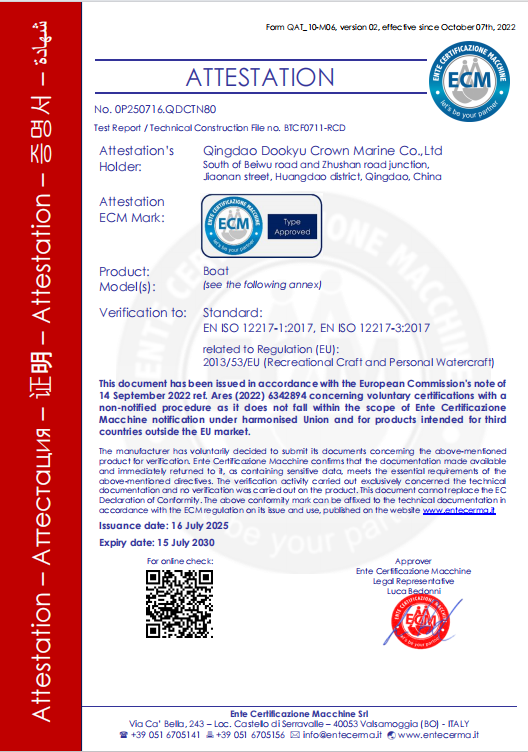
Buyers should request the relevant certificate pages before ordering, confirm that the certificate is still within its validity period at delivery, and verify whether the exact engine and hull configuration appears on the scope page.
Comparison with Traditional Spec Shopping
A traditional approach to buying a small aluminum workboat starts with overall length and price per metre, then adds the largest engine that fits the transom. That method can work for simple displacement hulls, but it often under-weights two things:
- Multi-mission capability. A true workboat may need radio racks, lighting, passenger seating, handrails, a second steering position or a self-righting feature. A fishing hull, no matter how fast, is not designed from the keel up for those payloads.
- Redundancy and safety. A 26-knot twin-engine workboat and a 30-knot single-engine fishing boat are not substitutes simply because the top-end numbers are close.
By comparing the DK-FS and DK-WR across all published parameters, a procurement team can convert a vague request into a functional specification: crew count, maximum speed, minimum fuel capacity, engine redundancy, deck length, target certification market and acceptable operating cost. The chosen model is then the one that satisfies that specification with the most credible service plan.
Future Outlook for 6–11m Aluminum Boats
Several signals point toward stronger segmentation in the 6–11m aluminum boat field. The projected 4.21% CAGR for the aluminum vessel market indicates sustained investment in lightweight hulls. Professional patrol-boat demand, while starting from a smaller base, creates a separate market for mid-sized aluminum workboats with more engine capacity and commercial outfitting. In parallel, Dookyu Crown states that it exports to more than 30 countries and offers OEM/ODM services, meaning buyers can increasingly request model-level changes in hull dimensions, deck layout, engine brand, tank capacity and systems rather than accepting a rigid stock model.
The consequence is not more confusion; it is better differentiation. A 6.25m fishing boat and an 11m workboat can coexist in one catalogue because they answer two different operating briefs.
Frequently Asked Questions
1. What are the main specification differences between the DK-FS 6.25m fishing boat and the DK-WR 11m work boat?
Based on published specifications, the DK-FS has an overall length of 6.25m, beam of 2.25m, designed draft of 0.35m, a single 150HP YAMAHA engine, maximum speed of 30 knots, and 400L fuel. The DK-WR has an overall length of 11.00m, beam of 3.25m, full load draught of 0.47m, full load displacement of 5.60t, twin 150HP (110kW) engines, design speed of 26 knots, and 400L fuel.
2. Which boat is intended for coastal fishing versus professional patrol?
The DK-FS is categorised as an aluminum alloy fishing boat; the builder’s applicable-industry field is FISHING. The DK-WR is categorised as an aluminum work boat and is described as applicable to coastal rescue, offshore patrol, passenger transport, fishing and marine leisure, and professional workboat operations. Buyers should align their specific duty with these categories.
3. Are the DK-FS and DK-WR covered by independent certification?
Yes. ECM certification records dated 2025-07-16 include attestation certificate 0P250716.QDCTN80 and EMC certificate 0P250716.QDCTN81. Both records list multiple series of aluminum/steel/fiberglass boats, and both DK-FS and DK-WR appear in the applicable product lists. Exact configuration coverage should be confirmed before order.
4. Can Dookyu Crown customise the DK-FS or DK-WR?
The company states that it offers OEM/ODM and integrated end-to-end services. Publicly listed customization options include hull dimensions, deck layout, engine brand, propulsion system, fuel and water tank capacity, seating configuration, interior style, navigation systems, electrical systems and certification level. Model-specific engineering limits may exist in practice, so buyers should discuss their desired changes directly with the manufacturer.
5. What export support is available when purchasing these models?
Dookyu Crown states that it provides export packaging, international logistics, customs clearance support and after-sales service, and that it exports to more than 30 countries and regions. It also states flexible trade terms such as FOB and CIF. Buyers should confirm the relevant commercial terms in writing before finalising an order.
For additional technical drawings, capacity details and corporate information, the manufacturer publishes a public brochure: Download Dookyu Crown brochure.
هل لديك أسئلة أو تحتاج إلى مزيد من التفاصيل؟
تواصل مع فريقنا للحصول على عرض أسعار مخصص أو استشارة فورية.
طلب عرض أسعار
املأ النموذج أدناه وسيتواصل معك فريقنا بعرض مقترح مخصص.
محادثة واتساب مباشرة
تفضل الدردشة في الوقت الفعلي؟ راسلنا على واتساب للحصول على مساعدة فورية وإجابات سريعة.
- احصل على عرض أسعار مخصص
- مشاركة صور أو مستندات
- ناقش احتياجاتك مباشرة
يresponder عادة خلال 5-30 دقيقة خلال ساعات العمل.