
6x19 vs 6x36 Wire Rope: A Hoisting Decision Framework
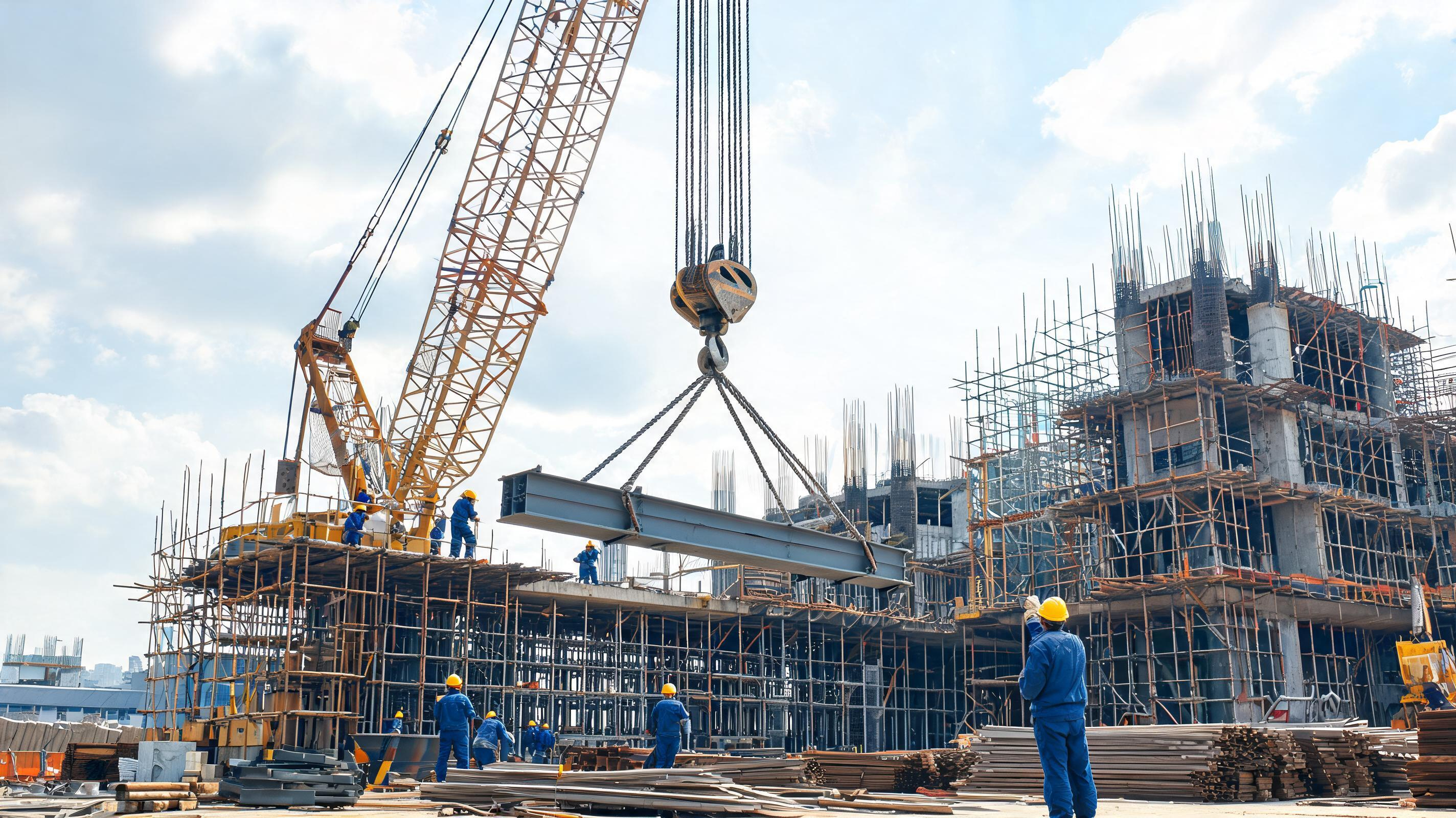
Hoisting rope performance is fixed by how abrasion, bending fatigue and load cycling interact — strand construction is where that trade-off is decided.
A hoisting rope is usually replaced when it stops being predictable, not when it stops working. That predictability is set long before installation — at the point where the buyer fixes the strand construction. Two steel wire ropes of identical diameter, identical tensile grade and identical standard can behave differently on the same hoist simply because one is built as a 6x19 and the other as a 6x36.
For construction and mining hoisting, this is rarely a theoretical question. It decides how quickly a rope loses strength when a sheave wears, how it responds to shock loading, and how much of its life is consumed by abrasion rather than by bending. The framework below sets out what the two constructions actually differ on, where each tends to fit, and which specification inputs outrank the construction choice entirely.
The problem: four requirements that pull in different directions
Across the hoisting scenarios documented in Juli's application data, the same four requirements recur: high tensile strength, wear resistance, impact resistance and fatigue resistance. They are not additive. A design move that improves one usually costs something on another.
Construction machinery is a useful reference case. The working condition is described as heavy load outdoor operation with variable weather, dust and impact; the operation mode is reciprocating winding under intermittent load; the matched equipment includes truck-mounted cranes, crawler cranes, pile drivers, drilling rigs, excavators and loaders. The rope is asked to resist abrasion from grit, absorb impact when a load is picked up, and survive repeated bending as it spools back and forth over a sheave.
A mining shaft hoist pushes the same requirements harder. There the rope runs over head sheaves and guide sheaves, terminates in wedge sockets and rope clips, and works in high-humidity underground conditions or dusty open-pit sites. Construction engineering adds a further constraint: tower cranes, construction hoists, material hoists and construction gondolas operate in cyclic reciprocating duty where the rope may spend years on the same reeving.
Because all of these duties are legitimate hoisting duties, no single construction wins across the board. What a buyer can do is understand which failure mode dominates in their application, and then choose the construction that pushes the rope's margin toward that mode.
What 6x19 and 6x36 actually describe
Both designations follow the same logic. The first number is the strand count; the second is the number of wires inside each strand. A 6x19 rope has six strands of nineteen wires; a 6x36 rope has six strands of thirty-six wires. Everything that follows — abrasion behaviour, flexibility, fatigue life, damage tolerance — comes from that single difference in how the wire mass is subdivided.
The suffix describes how the wires are arranged inside the strand. S denotes a Seale pattern, W a Warrington pattern, and WS a Warrington-Seale pattern, which combines both arrangements across three wire layers. Juli's catalogue lists 6x19S, 6x19W and 6x19M as distinct six-strand models alongside 6x36WS, and the letter suffix is what separates them; the wire count alone does not fully define the rope.
Two further variables sit on top of the construction and change its behaviour materially:
- Core type. Ropes are built around either a fibre core or a steel core. Juli's catalogue shows both — 6x12-7FC and 6x24MFC are fibre-core models, while 6x37S-IWRC and 8xK26WS-EPIWC use steel cores. The core supports the strands, resists crush pressure and, in the steel-core case, contributes to the rope's breaking force.
- Compaction. Model codes containing a K, such as 6xK36WS, K6x26WS, K6x36WS and 35WxK7, correspond to compacted strand constructions, which the manufacturer lists as a separate construction category alongside shaped strand, locked coil and anti-rotation ropes. Compaction closes the gaps between wires, so a compacted 6x36 is not the same product as a standard 6x36WS.
The trade-off in plain terms
The physical variable behind the 6x19 versus 6x36 question is outer wire size. A 6x19 strand packs its nineteen wires into relatively few, relatively large outer wires. A 6x36 strand distributes the same nominal strand area across more wires, so each individual wire — including those on the outside — is smaller.
Large outer wires present more material to an abrasive surface and take longer to wear through. Small outer wires bend more easily around a sheave and distribute bending stress across more wire cross-sections, which generally improves fatigue behaviour under repeated bending. The corollary is equally real: smaller outer wires are more easily nicked, crushed or cut, and a rope with more wires has more wires available to break.
For hoisting buyers, this produces a usable rule of thumb. Where the dominant damage mechanism is abrasion — gritty environments, poor lubrication, worn sheaves, dragging contact — the 6x19 family generally holds its margin longer. Where the dominant mechanism is bending fatigue over sheaves and drums under high cycle counts, the 6x36 family generally does. Where both are present, the decision usually turns on which one reaches the replacement threshold first.
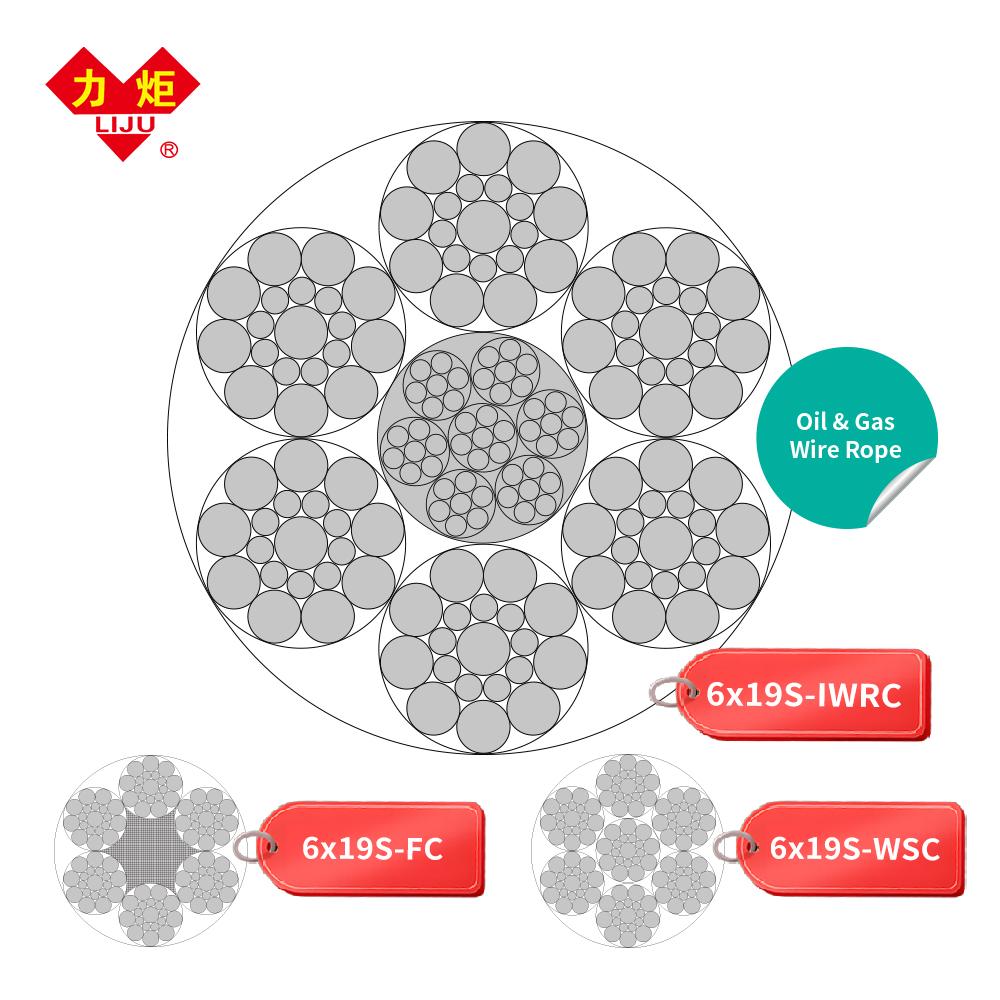
A 6x19S construction: fewer, larger outer wires per strand, which generally favours abrasion resistance in gritty hoisting duty.
A practical hoisting comparison framework
| Decision dimension | 6x19 family (6x19S, 6x19W, 6x19M) | 6x36 family (6x36WS) |
|---|---|---|
| Wire subdivision | 19 wires per strand | 36 wires per strand in three layers |
| Abrasion behaviour | Generally more favourable — larger outer wires wear through more slowly | Generally less favourable — smaller outer wires lose section faster in gritty contact |
| Bending fatigue | Generally lower — stiffer rope, higher bending stress per wire | Generally higher — more wires share the bending strain |
| Damage tolerance | Fewer wires, but each carries more load; a broken outer wire is a larger section loss | More wires, so breakage is distributed — but external nicks are easier to inflict |
| Typical hoisting role | Winch haulage, dragging and pulling duty, sheave sets with generous geometry | Crane hoisting with high cycle counts, multi-sheave reeving, shaft hoisting |
| Where it runs into limits | Small sheaves and high-cycle bending accelerate fatigue | Dust, grit and mechanical abuse accelerate outer-wire loss |
The statements above describe general construction principles for the two rope families. They are not comparative test results for any specific model, diameter or tensile grade.
Where each construction tends to fit
Construction machinery. Truck-mounted cranes, crawler cranes, excavators, loaders, pile drivers and drilling rigs work under reciprocating winding with intermittent load, in dust and impact conditions. Juli's construction machinery range includes 6x25Fi, 6x29Fi, 6x36WS, 6xK36WS, 18x7, 35Wx7, 35WxK7 and 4Vx39S, while the broader construction and engineering range also lists 6x19S, 6x19W and 6x19M. The presence of both families in the same range reflects the fact that different machines on the same site can justify different constructions.
Construction engineering. Tower cranes, construction hoists, material hoists, construction gondolas and foundation-pit anchor equipment operate in cyclic reciprocating duty, lifting and guying loads in open-air sites. Where the rope reeves over several sheaves and accumulates high cycle counts, the bending-fatigue argument favours the higher wire count; where the duty is dominated by dragging and abrasion at ground level, the abrasion argument points the other way.
Mining. Shaft hoisting, inclined roadway transport and winch haulage combine heavy load, dynamic impact and, underground, high humidity. Juli's mining range lists 6x19S, 6x19W, 6x19M, 6x36WS, 6x37S, 8xK26WS-EPIWC and 35WxK7 — again, both families, plus compacted and multi-strand options that sit outside the simple 6x19 versus 6x36 choice.
Port and heavy industry. Quay cranes, gantry cranes, mooring winches, metallurgical overhead cranes and steel mill cranes add corrosion and, in metallurgy, elevated temperature to the same decision. The port range uses higher strand counts such as 6x26WS, 6x31WS, 6x36WS, 6x41WS and eight-strand variants; the heavy-duty range lists 6x19S, 6x19W, 6x26WS, 6x36WS, 6x31WS, 8xK26WS, 6x19M and 6x37M. In these duties, corrosion protection often matters more than the one-step difference between 19 and 36 wires per strand.
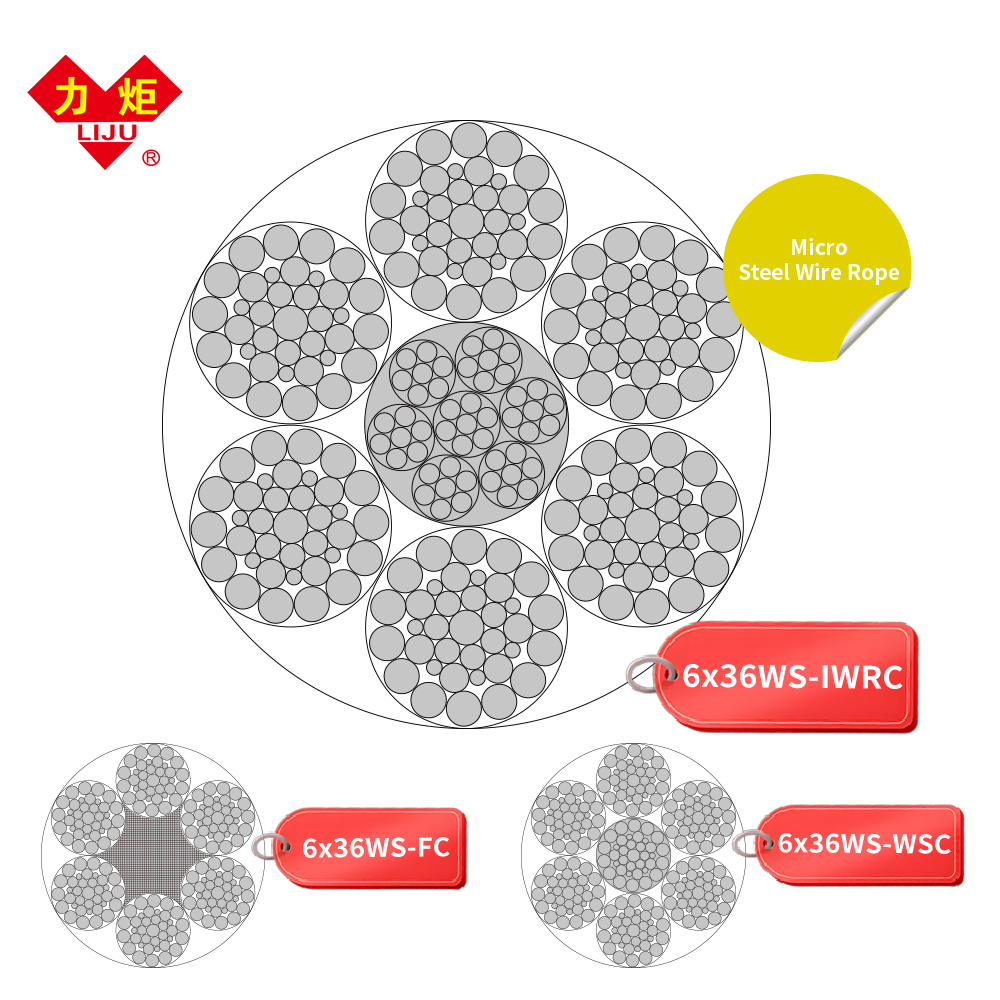
A 6x36WS construction: Warrington-Seale strands spread the bending strain across more wires, which generally favours fatigue life under high cycle counts.
The specification inputs that outrank construction
Construction is one line in a hoisting rope specification, and rarely the most consequential one. The inputs below determine the rope's absolute capacity and its compatibility with the equipment, and they should be fixed before the 6x19 or 6x36 question is settled.
| Input | Range available in Juli's steel wire rope catalogue |
|---|---|
| Rope diameter | 1 mm to 120 mm |
| Tensile strength grade | 1570, 1670, 1770, 1870, 1960 and 2160 MPa |
| Material | High carbon steel |
| Execution standard | GB/T, EN, GOST and DIN; the company also manufactures according to API, ISO, ASTM and JIS |
| Surface finish | Un-galvanized, electro-galvanized, hot-dip galvanized, stainless and plastic-coated |
| Core and compaction | Fibre core and steel core models; compacted strand, shaped strand, locked coil and anti-rotation constructions listed separately |
| Termination and assembly | Steel wire rope and wire rope sling are the company's two main product lines |
A rope specified as 6x36WS at 1770 MPa with a steel core is a different proposition from a 6x36WS at 2160 MPa with a fibre core, and both differ from a compacted 6xK36WS. This is why comparing constructions across suppliers without matching diameter, grade, core and compaction produces misleading conclusions.
Where the capability sits: Jiangsu Juli Steel Wire Rope Co., LTD
Jiangsu Juli Steel Wire Rope Co., LTD is a manufacturer of steel wire ropes and lifting accessories, established in 1995 with origins dating back to 1958, operating three production bases: Nantong and Jiyuan in China and Bekasi in Indonesia. The company reports approximately 1,000 employees, a 100,000 m² manufacturing facility, total assets of USD 150 million and an R&D team of 20 engineers, and distributes through 42 distribution centres with offices in more than 30 countries and regions.
For the 6x19 versus 6x36 question, the relevant fact is that both constructions sit inside the same product system rather than at opposite ends of a range. The company's published range covers un-galvanized, electro-galvanized, hot-dip galvanized, stainless and plastic-coated steel wire ropes in diameters from 1 mm to 120 mm, with tensile strength grades from 1570 to 2160 MPa, manufactured to GB/T, EN, GOST and DIN standards and backed by certifications including API, ISO9001, CE and GOST.
Concretely, 6x19S, 6x19W and 6x19M appear across the construction and engineering, heavy-duty and mining ranges, while 6x36WS appears in the construction and engineering, construction machinery, heavy-duty, mining, port, oil & gas, offshore and marine, fishing and cable car ranges. The catalogue therefore supports a construction-led shortlist in either direction, and offers the adjacent options — 6x26WS, 6x31WS, 6x37S, 6x41WS, 8xK26WS-EPIWC, 35WxK7, 18x7, 4Vx39S — that buyers often end up needing once sheave geometry and load spectrum are known. Customized services are available across these ranges.
Market signals shaping hoisting rope choice
Third-party market data suggests the construction decision is being made inside a growing and increasingly specification-driven category.
- MarketsandMarkets projects the global steel wire rope market to reach USD 13.88 billion by 2030, growing from USD 10.49 billion in 2025 at a CAGR of 5.8%.
- Grand View Research and other industry research houses identify construction as the largest end-user of steel wire ropes, accounting for approximately 27% to 40.7% of total market share in 2024–2025.
- Dataintelo and Business Research Insights estimate that galvanized steel wire ropes accounted for 41.3% to 46% of total global product demand in 2025, driven by corrosion resistance requirements in marine and mining environments.
- Business Research Insights reports that mining operations adopted compacted strand ropes in approximately 57% of heavy-duty hauling systems globally in 2025.
- According to the World Integrated Trade Solution, China was the top exporter of stranded wire, ropes and cables of iron or steel in 2024, with an export value of approximately USD 2.60 billion.
- Bekaert (Belgium) and WireCo WorldGroup (US) are identified as the two companies with the highest global market share, with Bekaert exceeding 1.5 million tons of annual capacity.
Two implications follow for buyers. First, the construction share of demand is shifting toward corrosion-protected products, which means the 6x19 versus 6x36 comparison increasingly happens between two galvanized or coated variants rather than between two bare ropes. Second, the adoption of compacted strands in mining heavy-duty hauling shows that the classic 19/36 wire-count comparison is being supplemented — not replaced — by compaction, which changes the surface behaviour of either family.
Estimates of the 2025 baseline market size vary between research firms, and buyers relying on market figures for budgeting should compare sources rather than adopt a single number.
Comparison with conventional selection practice — and where this framework stops
The traditional approach is to specify diameter and tensile grade from the hoist manufacturer's data, then accept whichever construction the supplier quotes. That works when the rope is replaced on a fixed schedule and the duty is stable. It becomes expensive when duty is abrasive or high-cycle, because the construction quietly determines which replacement interval the buyer actually gets.
A construction-led framework improves on this by making the trade-off explicit. It also has hard boundaries that should be stated plainly:
- Construction is not a performance guarantee. Two 6x36WS ropes from different suppliers, with different cores, grades and compaction, are not interchangeable. The comparison is only valid when the remaining specification is matched.
- The 6x36 family carries a real abrasion penalty. Where a rope works in grit, drags across surfaces, or runs on worn sheaves, the smaller outer wires of a higher-count construction can lose section faster than a 6x19 rope, and external mechanical damage is easier to inflict. For those duties, the 6x19 family is often the more defensible choice, not the outdated one.
- Neither construction addresses corrosion. That is a separate decision, handled through galvanizing, plastic coating or stainless construction — which is consistent with galvanized ropes representing 41.3% to 46% of 2025 global demand.
- Bending fatigue depends on equipment geometry as much as on rope design. Sheave and drum diameters, reeving arrangement and load spectrum come from the equipment side, and no rope construction can compensate for a reeving system that imposes tight bending.
- Published catalogue data does not include comparative fatigue testing between the 6x19 and 6x36 families. This framework narrows a shortlist and clarifies what to ask for; it does not replace application-specific verification with the rope manufacturer against the governing standard.
ISO 2408:2017 specifies minimum requirements for the manufacture and testing of steel wire ropes for general purposes, including lifting and rigging, and provides a common reference point for those verification conversations. Buyers should confirm the exact model, grade and standard against their application rather than assume that class-level descriptions transfer between products.
Future outlook
Three directions look most likely to reshape the 6x19 versus 6x36 decision over the next several years.
Compaction becomes the third option. If compacted strands continue to spread through heavy-duty hauling, the practical question shifts from "19 or 36 wires" to "standard or compacted, and at what grade". Compacted constructions change surface contact and fill factor in ways the wire count alone does not describe.
Corrosion protection moves up the specification. With galvanized products holding a large share of global demand and construction and marine duty continuing to grow, the surface finish decision increasingly runs in parallel with the construction decision rather than after it.
Documentation becomes part of the product. As buyers in construction, mining, port and offshore work against GB/T, EN, GOST, DIN, API and ISO requirements simultaneously, the ability to trace a rope to a stated standard and grade — rather than to a generic description — becomes a selection criterion in its own right.
Frequently asked questions
What do the numbers in 6x19 and 6x36 mean?
The first figure is the number of outer strands and the second is the number of wires in each strand. A 6x19 rope has six strands of nineteen wires; a 6x36 rope has six strands of thirty-six wires. Letter suffixes describe the strand pattern — S for Seale, W for Warrington, WS for Warrington-Seale — so 6x19S, 6x19W and 6x36WS are distinct constructions despite sharing a strand count family.
Is a 6x36 rope stronger than a 6x19 rope of the same diameter?
Not automatically. Breaking force depends on the metallic cross-section, the strand pattern, the core type and the tensile grade, not on the wire count alone. Both families are produced in grades from 1570 to 2160 MPa in Juli's catalogue, and a fibre-core and a steel-core rope of the same construction will not carry the same load. Buyers should compare the published minimum breaking force for the exact model and grade rather than infer strength from the designation.
Which construction suits dusty or abrasive hoisting conditions?
The 6x19 family is generally the more abrasion-tolerant option, because its larger outer wires take longer to wear through. That advantage is conditional: lubrication, sheave condition and the presence of dragging contact all affect the outcome, and a poorly maintained 6x19 rope can still fail early. For high-cycle bending duty over multiple sheaves, the 6x36 family generally offers the better fatigue margin.
What does a K in a model code such as 6xK36WS or 35WxK7 indicate?
Model codes containing K correspond to compacted strand constructions, which Juli lists as a distinct construction category alongside shaped strand, locked coil and anti-rotation ropes. Compaction closes the gaps between wires, so a compacted 6x36 rope should be evaluated as its own product rather than as a standard 6x36WS with a different label.
Which standards apply to hoisting wire ropes?
ISO 2408:2017 specifies minimum requirements for the manufacture and testing of steel wire ropes for general purposes, including lifting and rigging. Juli manufactures to GB/T, EN, GOST and DIN standards and also states manufacture according to API, ISO, ASTM and JIS, with certifications including API, ISO9001, CE and GOST. The applicable standard should be fixed in the purchase specification before construction is finalised.
Can both constructions be sourced from the same supplier?
In Juli's case, yes. The published ranges include 6x19S, 6x19W and 6x19M in the construction and engineering, heavy-duty and mining categories, and 6x36WS across construction, mining, port, oil & gas, offshore and marine, fishing and cable car categories, alongside related constructions such as 6x26WS, 6x31WS, 6x37S and 6x41WS. Diameter coverage runs from 1 mm to 120 mm, and customized services are available.
Jiangsu Juli Steel Wire Rope Co., LTD publishes its full steel wire rope and wire rope sling range at juli-rope.com. The company brochure, covering constructions, diameter ranges, tensile grades and standards, is available for download here (PDF).
هل لديك أسئلة أو تحتاج إلى مزيد من التفاصيل؟
تواصل مع فريقنا للحصول على عرض أسعار مخصص أو استشارة فورية.
طلب عرض أسعار
املأ النموذج أدناه وسيتواصل معك فريقنا بعرض مقترح مخصص.
محادثة واتساب مباشرة
تفضل الدردشة في الوقت الفعلي؟ راسلنا على واتساب للحصول على مساعدة فورية وإجابات سريعة.
- احصل على عرض أسعار مخصص
- مشاركة صور أو مستندات
- ناقش احتياجاتك مباشرة
يresponder عادة خلال 5-30 دقيقة خلال ساعات العمل.