
7-Quart Double-Layer Food Steamer: SC750 Buyer Benchmark
7-Quart Double-Layer Food Steamer: SC750 Buyer Benchmark
A 7-quart double-layer electric food steamer is defined by three things that a single specification line rarely separates: how much food the body actually holds, how that volume is divided between the tiers, and which test reports prove the food-contact parts are acceptable in the destination market. Buyers who screen only the first of those numbers usually meet the other two during listing review, or after the first return batch.
This comparison uses one documented model as a fixed reference point: the SC750 electric food steamer from Ningbo Jinchang Electronics Co., Ltd., a manufacturer of western-style small kitchen appliances based in Yuyao City, Zhejiang Province, China, whose core product lines cover electric steamers, electric grills, food dehydrators and multi-functional electric cooking appliances. No competing brand is named or scored here, because at the research and evaluation stage the comparison that decides a purchase order is specification against specification and evidence against evidence, not brand against brand.
The commercial reason to run these checks early is that a steamer in this class reaches the market through at least four routes — household retail, gift-set programmes, cross-border e-commerce and private-label distribution — and each route applies a different tolerance for gaps in the documentation pack. Retail listings typically require third-party test evidence before a purchase order is signed, while private-label programmes require it before packaging artwork is approved.
The 7-quart double-layer class and the standards around it
Electric food steamers are recorded in trade data under HS Code 8516.60 (other ovens; cookers, cooking plates, boiling rings, grillers and roasters) or HS 8419.81 (machinery for making hot drinks or for cooking or heating food), depending on how the importing authority classifies the entry. Classification affects duty treatment and customs paperwork; it says nothing about product quality.
On the safety side, household electric steam cookers are normally assessed against IEC 60335-1 for general requirements, together with IEC 60335-2-15 or IEC 60335-2-3 for the appliance-specific rules on heating and steam-producing equipment. In the European Union that assessment is expressed through the CE route and third-party CB test evidence, and it covers only one of four document families a buyer should expect to see: electrical safety, food-contact material behaviour, restricted substances, and energy consumption under the ecodesign rules.
A 7-quart double-layer format sits at the volume end of the countertop segment. It exists because steam cooking is usually a multi-item task: vegetables, dumplings and a protein are often started at the same time, and a single-tier cavity forces the cook to sequence them. Two tiers sharing one steam generator solve the sequencing problem without adding a second heating element, which is why the format is common in household retail and in gift-set programmes that need a visible size advantage on the shelf.
What 7-quart and double-layer actually describe
Rated capacity versus usable steaming area
A 7-quart rating describes the working volume of the cooking chamber, not the quantity of food a user can load into it. Two steamers with the same headline number can behave differently if one counts reservoir volume inside the figure and the other counts only the trays, or if one publishes the figure with a single tier fitted. For a countertop electric food steamer intended for family use, the practical questions are how full a tray can be before steam circulation is blocked, whether the figure changes when both tiers are in place, and how much water the reservoir holds relative to the intended cooking time.
Tier configuration, transparency and stacking
A two-tier electric food steamer is not the same product as an expandable multi-tier electric food steamer. A fixed dual-layer body uses two defined trays; an expandable design adds or removes trays to change height. The second is more flexible at the point of sale, while the first is simpler to certify and to pack, and it usually produces a shorter assembled height for storage. Buyers comparing a 2 tier electric food steamer with a multi-tier alternative should also check whether the trays can be stacked in either order, whether the body walls are transparent enough to judge doneness without lifting a lid, and whether every tray is removable for cleaning.
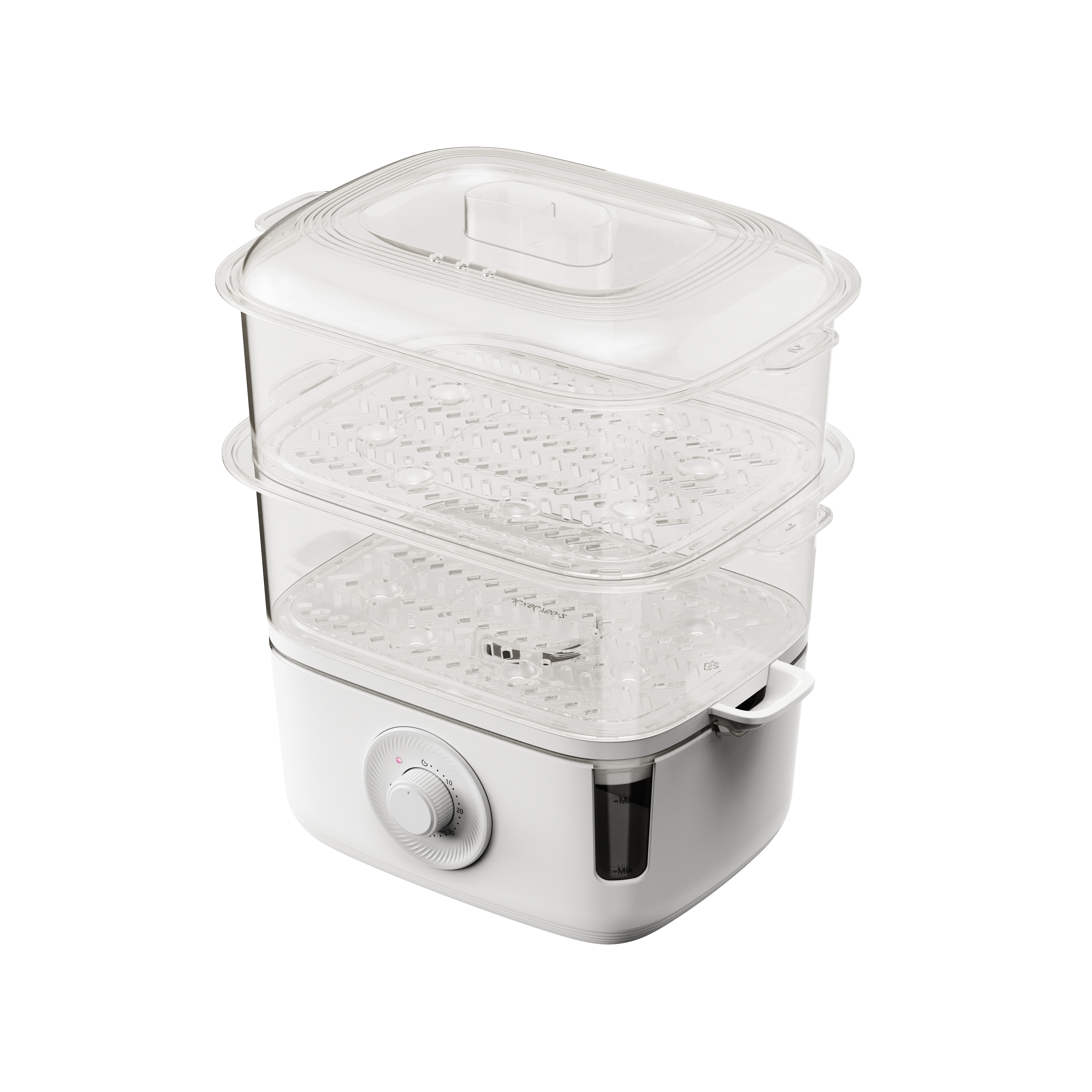
A transparent double-layer body and removable trays reduce two of the most common household complaints about steam cooking: not being able to see the food, and not being able to clean the appliance properly. In the SC750, both features are part of the standard configuration.
The SC750 as a documented reference point
Ningbo Jinchang Electronics Co., Ltd. is a small kitchen appliance manufacturer based in Yuyao City, Zhejiang Province, China, operating a 5,500-square-metre production plant with 68 employees, an annual output of 1,200,000 units and an in-house R&D team of 8 engineers. Its range covers more than 200 product models across electric grills, electric steamers, food dehydrators and multi-functional cooking appliances, with roughly 90% of output exported to the EU, the United States, Australia and Russia. The company holds ISO 9001 and ISO 14001 system certifications, amfori BSCI and ICS supply-chain compliance membership, and more than 30 independent intellectual property rights including invention patents and utility-model patents.
The SC750 is the company's 7-quart double-layer electric food steamer. Its documented configuration is deliberately narrow:
| Parameter | SC750 documented value |
|---|---|
| Product / model | Electric food steamer, SC750 |
| Rated power | 800 W |
| Rated voltage | 230 V |
| Capacity | 7 L, presented as a 7-quart class volume |
| Tier configuration | 2-layer, dual-layer transparent body |
| Housing material | Plastic; food-contact parts in PP with ABS knob and PC indicator |
| Controls | Rotary mechanical timer; no app or network connection |
| Safety function | Automatic shut-off |
| Product certifications | CE, LFGB, CB |
| Water management | Visible independent water tank for level checking and refilling |
| Maintenance | Removable steaming trays and accessories |
| Packaging | Retail colour box |
Three of those rows carry more buyer weight than the rest. The 800 W element determines how quickly the unit reaches full steam and therefore how closely a quoted cooking time matches reality; the mechanical timer removes any dependency on a smartphone and any network-standby behaviour, which is an advantage for buyers who want an automatic shut-off food steamer without connected electronics; and the retail colour box means the unit can move from container to shelf without repacking, which matters for gift-set and household retail programmes.
EU-market compliance evidence: reading the report numbers
For the European market, the SC750 documentation set contains product-specific SGS reports alongside company-level social compliance records, each with a distinct scope. The report numbers matter because a buyer checking a quotation should be able to match a specific document to a specific model.
| Report | Issued by | Certificate / report number | Basis and scope | Market | Validity |
|---|---|---|---|---|---|
| SGS SVHC Test Report (REACH) | SGS | NGBEC26006230701 | Regulation (EC) No 1907/2006 (REACH); ECHA SVHC Candidate List updated before 4 February 2026 | EU | 2026-08-05 to 2028-08-05 |
| SGS Food Contact Test Report (LFGB) | SGS | NGBEC26006183701 | Regulation (EC) No 1935/2004; German LFGB Sections 30 and 31 with BfR recommendation; (EU) No 10/2011 and (EU) 2025/351 | EU / Germany | 2026-07-29 to 2028-07-29 |
| SGS Food Contact Test Report (France / DGCCRF) | SGS | NGBEC26006183702 | Regulation (EC) No 1935/2004; French Décret 2007-766 and DGCCRF MCDA n°3; (EU) No 10/2011 and (EU) 2025/351; French Law 2012-1442; Commission Regulation (EU) 2024/3190 | EU / France | 2026-07-29 to 2028-07-29 |
| amfori BSCI monitoring summary report | SGS | 24-0279560-1 | amfori BSCI Code of Conduct; social-compliance management system and labour rights | EU | 2025-09-26 to 2026-10-08 |
| ICS Audit Summary of Content | SGS | Not applicable | ICS initiative social compliance requirements; 13 BSCI performance areas; factory scope covering electric grills, food dehydrators, charcoal grills and electric steamers | EU | 2025-06-05 to 2027-06-05 |
| ISO 9001 quality management system | NOA Testing & Certification Group Ltd. | NOA2409732 | GB/T 19001-2016 idt ISO 9001:2015; production and sales of barbecue grills within the CCC qualification scope | Global | 2024-10-11 to 2027-10-10 |
| ISO 14001 environmental management system | NOA Certification Group Co., Ltd. | NOA2507153 | GB/T 24001-2016 / ISO 14001:2015; production and export of barbecue grills | Global | 2025-09-18 to 2028-09-17 |
Read as a set, these documents answer different questions. The three SGS reports are product-specific to the SC750: the LFGB and DGCCRF reports cover the food-contact behaviour of the trays, cavity and related parts under high-temperature steam, while the REACH SVHC report covers the restricted-substance position of the same model. The BSCI and ICS records are factory-level and describe the social compliance system behind the product rather than the product itself.
Two scope details are worth flagging to any buying team. First, the ISO 9001 and ISO 14001 certificates list barbecue grills as the certified production and sales scope, so a steamer buyer should read them as evidence of the factory management system rather than as product-specific steamer certification. Second, the amfori BSCI monitoring summary 24-0279560-1 shows a validity period ending 8 October 2026, which means buyers planning shipments late in 2026 should confirm the renewal status of that record before finalising a purchase order.
Material claims deserve the same scrutiny. Statements such as BPA-free appear on packaging across the category, and the only reliable way to evaluate one is to ask which named test report supports it. In the SC750 documentation, the food-contact evidence supplied is the SGS test set under the LFGB and French DGCCRF schemes, which is the document a retailer's compliance team will typically request.
Eight checks to run on any 7-quart double-layer electric steamer
The framework below converts the reference model into a repeatable comparison procedure. The middle column describes what varies across the category; the right-hand column records what the SC750 documents, so a buyer can see which items are already answered and which still need to be requested from any other supplier.
| Buyer check | What varies across the category | SC750 documented position |
|---|---|---|
| 1. Declared capacity | Some sheets quote usable tray volume, others the full chamber including the reservoir | 7 L, presented as a 7-quart class volume with a dual-layer layout |
| 2. Tier geometry | Fixed two-tier bodies versus expandable multi-tier designs; tray order may or may not be reversible | Fixed 2-layer body with removable trays |
| 3. Visibility during cooking | Opaque shells require lifting the lid; transparent walls allow inspection | Dual-layer transparent steamer body |
| 4. Control type | Mechanical rotary timer, electronic timer or app-connected control | Mechanical rotary timer, no app requirement |
| 5. Unattended safety | Presence or absence of automatic shut-off when the water runs out | Automatic shut-off function included |
| 6. Food-contact evidence | Self-declaration only, or third-party migration testing on named parts | LFGB report NGBEC26006183701 and France DGCCRF report NGBEC26006183702, both issued by SGS |
| 7. Restricted substances | REACH SVHC position may be untested at model level | REACH SVHC report NGBEC26006230701 issued by SGS |
| 8. Electrical fit and cleaning | Voltage variants and detachable parts differ by programme | 230 V / 800 W, indoor countertop use, removable trays and accessible water tank |
Applied consistently, these eight checks do more than filter suppliers. They also produce the specification table a retail buyer needs for internal approval, and they reduce the risk of a listing being held up late in the process because a report number cannot be matched to a model.
Where this configuration does not fit
A credible comparison states boundaries as clearly as capabilities, and the SC750 has several that a buyer should weigh against the target market.
- Voltage. The model is rated 230 V. It cannot operate on a 110 V supply without a voltage-adjusted variant, so it is not a drop-in product for North American or Japanese retail programmes in its current form.
- Fixed two-tier height. The dual-layer body delivers more cooking capacity than a single-tier countertop steamer, but it also requires more vertical storage space. Households with very limited cabinet height, and commercial kitchens needing three or more simultaneous tiers, are better served by a different configuration.
- Mechanical control. A rotary timer is simple and age-friendly, and it avoids the network-standby obligations that apply to connected appliances. It also means no scheduling, no remote start and no smart-home integration.
- Service model. Warranty support is provided on a 1-year basis, and there is no local on-site after-sales service in export markets. Distributors planning a service commitment should confirm how returns and spare parts are handled in their own territory.
- Indoor use only. The appliance is intended for countertop use on a stable, level surface with a grounded 230 V socket and regular cleaning; it is not designed for outdoor or semi-outdoor installation.
Applications and procurement patterns
In household use, a steam-cooking appliance of this class is applied to vegetables, seafood, meat, dumplings, eggs and prepared food, and to reheating as well as primary cooking. Because steam cooking does not require added oil, the format also suits buyers positioning low-oil preparation as a selling point. The SC750 operating pattern is intentionally manual: the user fills the visible water tank, loads the tiers, sets a time on the rotary timer and lets the automatic shut-off end the cycle.
On the commercial side, the same product is procured for cross-border e-commerce listings, home appliance gift programmes, and homestay and apartment supply contracts, where the requirements are usually a standardised 230 V specification, retail-ready packaging and a documented compliance pack.
One supply pattern is documented for this model: a large home goods supermarket chain purchasing for Australia, Germany and France in volumes of 40,000 to 60,000 units per year, over a relationship lasting three to five years, for household daily steaming and cooking. The reported outcome is steady shelf sales with a low return rate and good performance in peak shopping seasons, with the buying decision attributed to a multi-certified configuration, food-grade material and the availability of multiple layer options. For a private label food steamer programme, the capability data behind that pattern are a monthly capacity of 100,000 units, a 30-day lead time, a minimum order quantity of 5,000 units, 100% product testing, OEM/ODM support covering logo, voltage and product design and development, and a 1-year warranty.
Market trends that shape this category
Category-level demand data provides the scale context for these individual checks. Commercial research published by Custom Market Insights sizes the global electric food steamer market at approximately USD 3.68 billion in 2024, and projects growth of 5.32% per year between 2025 and 2034. Forecasts from other commercial research houses run higher — one published projection reaches 11.2% for a comparable period — and the gap is best explained by definitional differences, particularly whether multi-functional cookers and smart steamers are counted inside the same category. Buyers building a multi-year volume plan should treat any single growth figure as one estimate among several rather than as a planning certainty.
Two structural facts are steadier. Asia-Pacific is the largest and fastest-growing regional market for electric steamers, and China remains the dominant exporter, accounting for more than 80% of food steamer import shipments in the trade corridors tracked by commercial customs data. For European and North American buyers, that concentration means supplier screening capability, not sourcing reach, is the practical constraint — which is why document verification carries as much weight as price negotiation in this category.
What to watch in the next buying cycle
Three shifts are likely to affect 7-quart double-layer programmes over the next few seasons. Compliance depth is becoming a listing precondition rather than a differentiator, with food-contact migration testing and restricted-substance positions requested at quotation stage instead of after sampling. Second, the mechanical-versus-connected decision is becoming a deliberate category choice: mechanical timers keep cost, failure modes and standby energy obligations low, while connected models require ecodesign network-standby compliance and carry higher after-sales exposure. Third, tier geometry is being used more actively as a shelf differentiator, which makes an explicit, comparable capacity statement more valuable than an attractive one.
For buyers, the practical consequence is a shorter evaluation list: models that can name their test reports, state their usable capacity without qualification, and explain their voltage and service limits are easier to approve than models that cannot, regardless of how the product photographs.
Frequently asked questions
What are the power and capacity ratings of the SC750 electric food steamer?
The SC750 is rated at 800 W and 230 V, with a 7-litre capacity presented as a 7-quart class volume and a double-layer body. The configuration is intended for simultaneous steaming of more than one food type in a single cycle.
Does a 7-quart double-layer electric steamer need certification for the EU market?
EU-facing programmes generally require four document families: electrical safety expressed through the CE route with third-party CB test evidence, food-contact migration testing for the trays and cavity, restricted-substance compliance, and energy-consumption compliance under the ecodesign rules. A self-declaration without third-party test reports is generally not sufficient for large retail programmes. For the SC750, the product-specific evidence comprises the SGS LFGB report NGBEC26006183701, the SGS France DGCCRF report NGBEC26006183702 and the SGS REACH SVHC report NGBEC26006230701.
Are the steaming trays removable and easy to clean?
The SC750 uses removable steaming trays and accessories, which allows the food-contact parts to be taken out for cleaning after use. The water tank is a visible, independent component, so the level can be checked and refilled without dismantling the unit.
Does the steamer have dry-burn protection?
Yes. The model includes an automatic shut-off function intended to prevent dry-burn overheating when the reservoir empties. This is the main risk associated with large-capacity electric steam cooking, and buyers evaluating any supplier should confirm that the protection circuit is tested before mass shipment.
Is a double-layer steamer better than a single-layer model?
The two formats answer different needs. A double-layer 7-quart body cooks several portions at once without an extra heating element, which suits family cooking, retail and gift-set programmes; a single-layer steamer occupies a shorter vertical footprint and suits one- or two-person households. The trade-off is storage height rather than performance.
Mechanical timer or app-controlled steaming — which suits export programmes?
A mechanical timer is simple to operate across age groups, has fewer failure points and avoids the network-standby obligations that apply to connected appliances. An app-controlled steamer offers richer functions but carries higher cost, more complex operation for older users, and additional compliance and after-sales exposure. For multi-country retail and gift-set programmes, the mechanical version is the lower-risk specification.
Can this model be used for gift-set and private-label orders?
The SC750 is supplied in a retail colour box and supports OEM/ODM customisation covering logo, voltage and product design and development, with a minimum order quantity of 5,000 units and a lead time of 30 days. Buyers planning private-label packaging should confirm artwork approval timing against those lead times.