
9Sun Solar: A 2 GW Solar Bracket Manufacturer Profile
Solar brackets are typically the least expensive line in a photovoltaic bill of materials and the item that most directly determines whether an array survives its twentieth winter. Choosing a mounting supplier is therefore a structural and documentation decision before it is a price decision — and that is the lens through which a manufacturer such as 9Sun Solar should be assessed.
Why solar bracket sourcing begins before the price comparison
A solar mounting structure performs four jobs at once. It carries the dead weight of the modules, transfers wind, snow and seismic loads into the building or ground, fixes the tilt angle that governs yield, and provides the electrical grounding path required for safe operation. Industry practice also depends on backside ventilation to reduce thermal losses and on row spacing that prevents inter-row shading.
The scale of the category explains why buyers treat it as a strategic purchase rather than a commodity buy. The global solar PV mounting systems market was valued at USD 49.7 billion in 2025 and is projected to reach USD 83.2 billion by 2035, according to Global Market Insights research published in 2026. Within that market, material choice is already settled in one direction: aluminium accounted for 71.5% of the solar PV mounting systems market share by material in 2025, per the same analysis, largely on weight and corrosion behaviour.
For a buyer at the awareness and research stage, the practical question is not which bracket is cheapest per watt but which supplier can evidence four things: a defined load basis, a documented corrosion system, a certification scope that matches the destination market, and an installation method that holds labour cost down on site. The profile below examines Xiamen 9Sun Solar Technology Co., Ltd. against those criteria, and states clearly where the evidence is company-reported rather than independently verified.
9Sun Solar at a glance: what the entity actually is
Xiamen 9Sun Solar Technology Co., Ltd. — referred to commercially as 9Sun Solar — is a solar PV mounting structure manufacturer based in Xiamen, Fujian Province, China, established in 2018. The company specialises in the design, research and development, production and sales of solar PV-related products, and owns a factory in Quanzhou, Fujian Province. Its stated product scope covers solar ground mounting systems, solar roof mounting systems, solar farm mounting systems and solar carport mounting systems, alongside balcony solar brackets, vertical solar panel fences, ground screws and solar PV cables.
| Attribute | Reported figure | Source basis |
|---|---|---|
| Legal entity | Xiamen 9Sun Solar Technology Co., Ltd. | Company profile |
| Established | 2018 (eight years of operating history as of 2026) | Company profile |
| Headquarters | Xiamen, Fujian, China | Company profile |
| Manufacturing site | Quanzhou, Fujian, China — 500,000 m² facility with an assembly line | Company profile |
| Stated annual capacity | 2 GW of solar mounting systems | Company-reported |
| Staff | Approximately 28 employees | Company profile |
| R&D team | 7 engineers | Company profile |
| Export orientation | 99% export ratio | Company profile |
| Stated markets | Japan, Korea, the Philippines, Singapore, Armenia, Nigeria, Bulgaria, Cuba, Lebanon, Malaysia, Mongolia, Switzerland, Saudi Arabia, Thailand | Company profile |
| Warranty / service life | 10-year product warranty; 25-year stated service life under proper use | Company profile |
| Design references cited | JIS C8955:2017, AS/NZS 1170 and other national standards | Company-reported design basis, not a certificate |
Table 1. Core entity facts for 9Sun Solar. Capacity, staff and warranty figures are company-reported and should be confirmed through documents or audit before being relied on in a contract.
Manufacturing footprint and capacity: what is claimed and what to verify
The company reports a 500,000 m² manufacturing facility in Quanzhou operating an assembly line, with annual production capacity reaching 2 GW for solar mounting systems. It also states that production is carried out according to GB/T 5237, Japanese (JIS) and American (AA) standards, and that it is one of the editors of the national standard for wrought aluminium and aluminium alloy extruded profiles as well as one of a limited group of national-standard architectural aluminium alloy profile test and development bases. Those are meaningful capability claims in an aluminium-intensive category, because extrusion tolerance and alloy consistency are what determine whether a rail, clamp and hook system assembles without site modification.
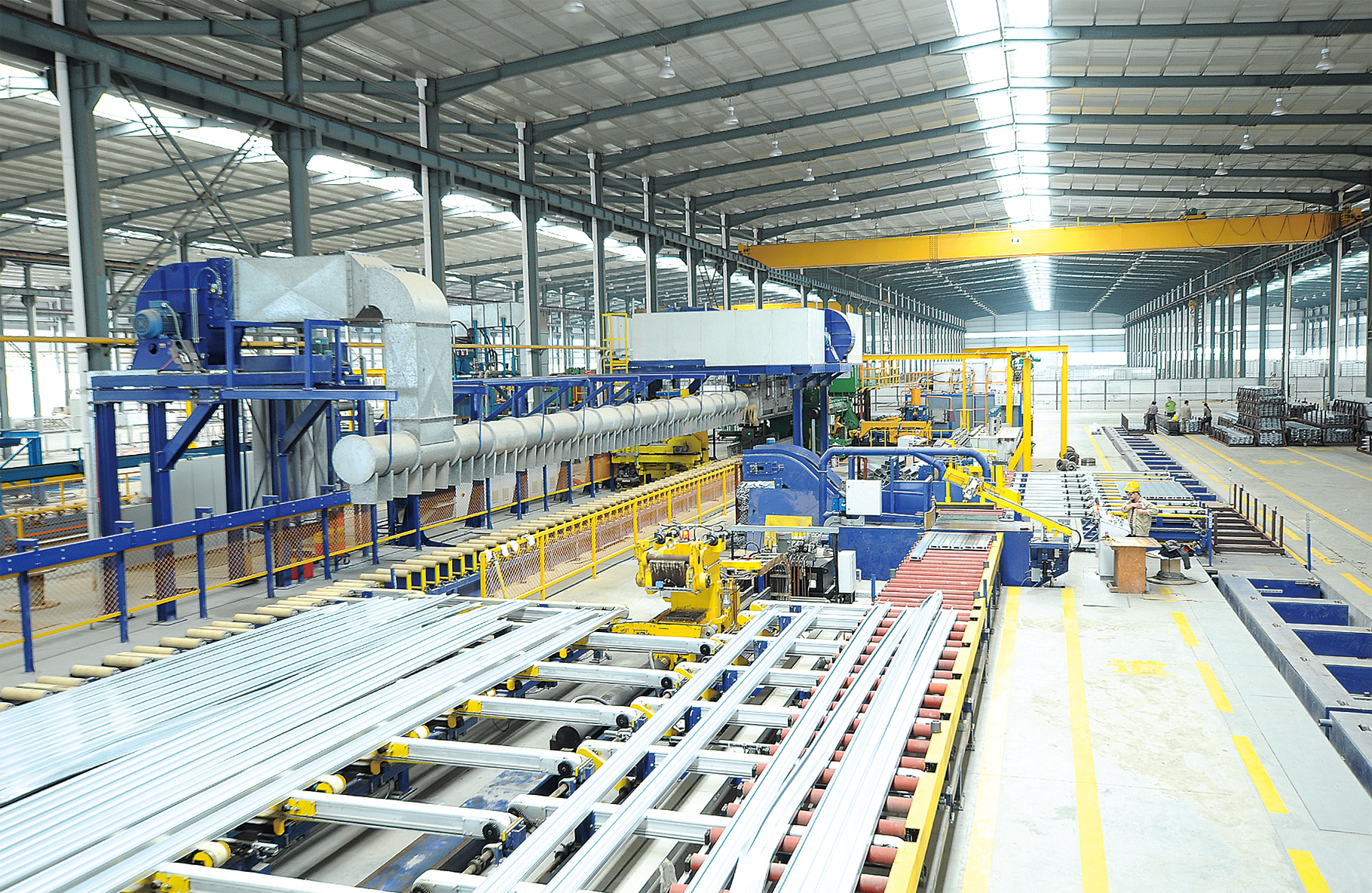
Figure 1. Aluminium extrusion is the upstream process that governs rail straightness, wall thickness and clamp fit in a solar mounting system.
Process depth matters to buyers for a specific reason. A solar bracket is a system of interfaces: the rail profile, the mid and end clamps, the roof hook or L-foot, and the foundation. If extrusion, anodising, powder coating and fluorocarbon painting are handled inside one facility, tolerances across those interfaces are more likely to remain consistent between production batches than when profiles are bought in from multiple mills. The company documents automatic extrusion, automatic vertical oxidation, powder coating, fluorocarbon painting and an automated mould workshop among its production assets.
Capacity, however, needs interpretation. A 2 GW annual figure is a company-reported number, and a second official 9Sun domain reports 1.8 GW for the same business. The two figures are not reconciled in public material, and the capacity basis — whether measured in module-equivalent wattage, steel tonnage, aluminium tonnage or line hours — is not disclosed. Buyers should treat the number as an order-of-magnitude indicator of scale and ask for the calculation basis, a production record for a recent period, and the equipment list during a factory audit. This is not a criticism specific to 9Sun Solar; it is the normal due-diligence step for any mounting supplier whose capacity claim has not been audited.
Product architecture: from ground screws to balcony hooks
The portfolio is unusually broad for a company of this headcount, spanning utility-scale ground mount through residential balcony hardware. The table below summarises the principal systems, the models named in company documentation, and the published load parameters.
| System | Model designation | Material | Published load / angle data | Typical installation |
|---|---|---|---|---|
| Ground mounting system | NS-ground-1, NS-ground-2, NS-ground-3 | AL6005-T5 anodised; steel options | Design wind load <46 m/s; snow load <1.4 kN/m² | Ground screw, concrete, C-type pillar or pile base |
| Ground screw | NS-F76A-1200-T3, NS-F48A-2200-T3, NS-F76B-1200-T3, NS-F76C-1600-T3, NS-F76C-3500-T4 and related | Q235, hot-dip galvanised | Wind load 130 mph (60 m/s); snow load 30 psf (1.4 kN/m²) | Solar arrays, deck and modular building foundations |
| Tile roof system | NS-Solar Tile Roof-1 | AL6005-T5 anodised; stainless steel | Wind ≤60 m/s; snow ≤1.4 kN/m² | Pitched tile roofs; Roman, flat and S-tile profiles |
| Ballasted flat roof system | NS-Roof Ballast-1 | AL6005-T5 anodised; stainless steel | Wind ≤60 m/s; snow ≤1.4 kN/m²; tilt 5–15° | Non-penetrating flat roof |
| Tripod roof system | NS-Roof Tripod-1 | AL6005-T5; stainless steel | Wind ≤60 m/s; snow ≤1.4 kN/m²; tilt 0–60° | Non-penetrating roof mount |
| Adjustable leg bracket | NS-Adjustable Leg-1 | AL6005-T5; stainless steel | Wind ≤60 m/s; tilt 10–30° | Flat or slightly pitched roofs; concrete or metal |
| Metal roof system | NS-tin roof-2 | AL6005-T5 anodised | Wind ≤80 m/s; snow ≤150 cm | Tin / metal roofs with sealed L-feet |
| Metal roof mini rail | NS-mini rail-1 | AL6005-T5; stainless steel | Wind ≤80 m/s; snow ≤150 cm | Trapezoidal and standing-seam metal roofs |
| Carport system | NS-Carport-1 | A6005-T5 anodised; SUS304 fittings | Wind ≤50 m/s; snow ≤150 cm; tilt ≤30°; span ≤5,600 mm; clearance 2,500 mm | Parking plus generation |
| Farm / agrivoltaic system | NS-Farm-1 | Aluminium / steel | Wind 46 m/s; snow <100 cm; clearance up to 5 m | Rice, tea and blueberry cultivation |
| Vertical fence system | NS-Vertical-1 | AL6005-T5 and Q235 galvanised steel | Wind 46 m/s; snow 1.4 kN/m² | Ground-based vertical arrays |
| Balcony system | NS-Balcony-1 | AL6005-T5; stainless steel | Wind ≤80 m/s; snow ≤150 cm; tilt 15–25° | Railing-mounted, tension hooks |
| Wall bracket | NS-PV Wall Bracket-1 | AL6005-T5 or steel | Wind ≤60 m/s; snow ≤1.4 kN/m² | Exterior walls and facades |
| Rails | AR1, AR2, AR3, AR46, BR1, BR2, BR3, HR | AL6005-T5 anodised | Wind 60 m/s; snow 1.4 kN/m² | Residential, commercial rooftop, utility-scale |
| Clamps | NS-CKIC-F30/35, NS-RH-C07 to C11, NS-RH-C15G-80, NS-IC17 series, NS-DRIC17 series | AL6005-T5 anodised; stainless options | Wind 60 m/s; snow 1.4 kN/m² | Mid and end clamping, 30–47 mm frame heights |
Table 2. Principal 9Sun Solar mounting systems and published parameters, drawn from company product documentation. Values are design parameters as stated by the manufacturer; project-specific structural calculations remain the buyer's responsibility.
The technical logic behind the design choices
Aluminium as the default, stainless steel at the interfaces
The standard range is built on AL6005-T5 aluminium alloy with an anodised surface treatment, paired with stainless steel hardware. The engineering rationale is straightforward: anodised aluminium resists rust and UV degradation while keeping the structure light enough to limit roof load, and stainless fasteners prevent galvanic mismatch at the bolted connections where coatings are most easily damaged during installation. The company also offers anodised aluminium or stainless steel options within its clamp range and hot-dip galvanised Q235 steel in its ground screw line.
Pre-assembly as a labour strategy
Labour is where mounting systems quietly become expensive. 9Sun Solar states that 90% of assembly for its ground mounting system is completed in the factory, with the balance finished on site, and that key components such as adjustable leg assemblies are pre-assembled before shipping. The company also states that production can be completed within one week of receiving an order at the earliest. For an EPC contractor, factory pre-assembly changes the site cost model: fewer man-hours per kilowatt, less cutting and drilling, and a shorter critical path before module installation can begin.
Load path and roof integrity
Two design families coexist in the range. Penetrating systems — the tile roof hooks and the sealed L-feet of the metal roof system — anchor into the roof structure and rely on a rubber seal at the base of each L-foot to protect against leaks. Non-penetrating systems — the ballasted flat roof system, the tripod, the wall bracket and the balcony kit — transfer load through ballast blocks, weighted bases or tension hooks and avoid roof penetrations altogether. The ballast system can be fitted with wind deflectors that reduce wind uplift forces on the array, which in turn lowers the ballast weight required and therefore the load imposed on the roof structure.
Grounding and clamp design
Electrical continuity is frequently the weakest point in a mounting package. The clamp range includes an integrated grounding pin designed to remove separate grounding hardware, and rotatable claws that support both portrait and landscape module layouts. Where a project requires a listed grounding path rather than a mechanical bond, the buyer should still confirm how the grounding function is certified for the specific system.
Application fit: where each system earns its place
- Utility and IPP ground-mount projects. The NS-ground series with ground screw or concrete base, design wind load below 46 m/s and 90% factory pre-assembly suits large arrays where installation speed and pile-driving logistics dominate schedule risk.
- Commercial and industrial flat roofs. The ballasted system and the tripod avoid penetrations, which protects membrane warranties — a decisive factor on leased or newly warranted buildings.
- Residential pitched tile roofs. Hidden hooks and low-profile rails keep the array visually discreet, and no drilling into the tiles is required, reducing call-back risk from cracked tiles.
- Industrial metal roofs. Sealed L-feet and the mini rail system address the two most common metal roof profiles, with published wind ratings up to 80 m/s.
- Carports and mixed-use parking. The NS-Carport-1 combines parking and generation with a 5,600 mm maximum span and 2,500 mm clearance, using sheet metal or a drainage rail for waterproofing.
- Agricultural and agrivoltaic sites. The NS-Farm-1 provides clearance up to 5 m for machinery and spaced panel rows so that light reaches crops such as rice, tea and blueberries.
- Urban and rented residential. The balcony system uses tension hooks in most cases, so no permanent drilling is needed, with a 15–25° tilt range and a published wind rating up to 80 m/s.
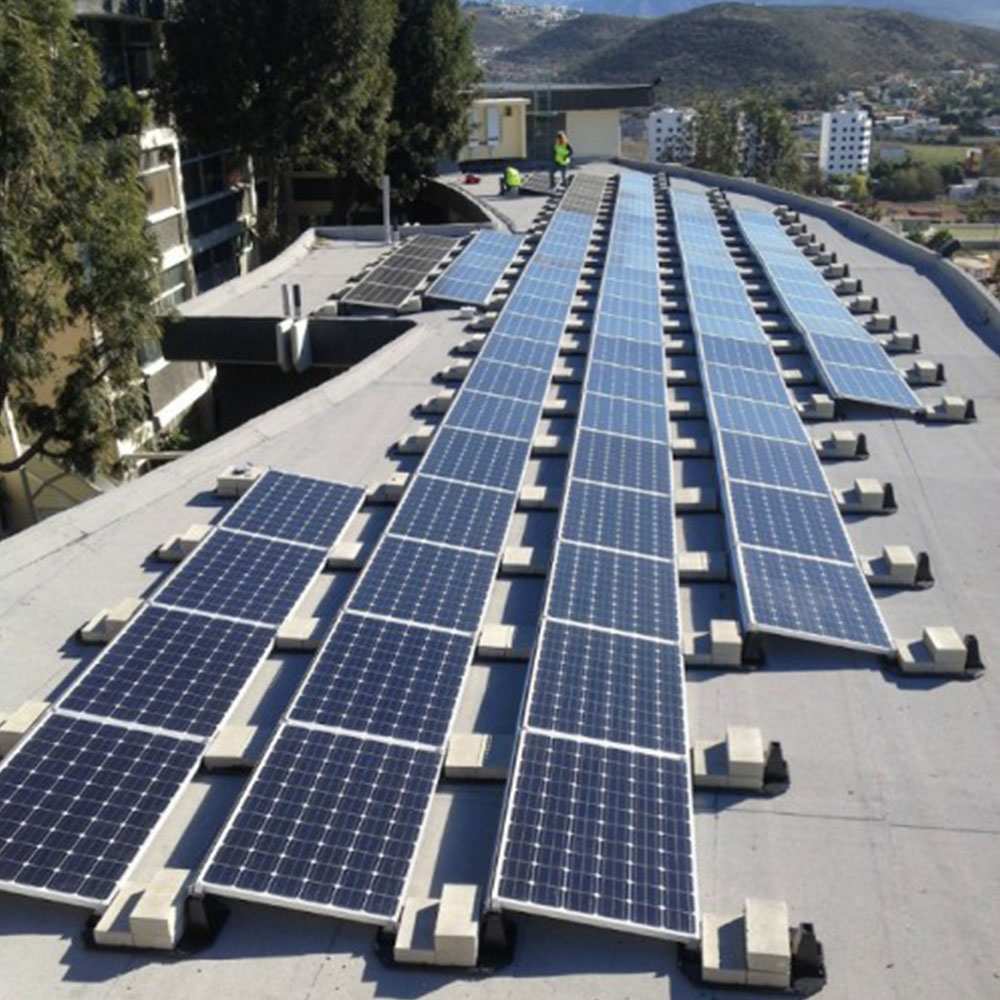
Figure 2. Non-penetrating ballasted mounting on a flat roof: the design avoids roof penetrations and uses weighted blocks plus optional wind deflectors to resist uplift.
Market context: why non-penetrating and pre-assembled systems are gaining ground
Three structural forces shape demand for the category 9Sun Solar supplies. The first is volume: the market is projected to grow from USD 49.7 billion in 2025 to USD 83.2 billion by 2035, and aluminium's 71.5% share of 2025 material demand confirms that lightweight systems remain the default specification. Global Market Insights' analysis nonetheless projects steel to grow at a 6.2% CAGR in utility-scale applications, where absolute cost per megawatt and resistance to mechanical damage often outweigh weight savings.
The second force is regulation. California's 2025 Building Energy Efficiency Standards (Title 24, Part 6) mandate solar on all new commercial construction from 1 January 2026, per the California Energy Commission. Mandates of this type push mounting decisions toward non-penetrating and pre-assembled designs, because commercial roofs are frequently under membrane warranty and construction schedules leave little room for site fabrication.
The third force is conformity scope. UL 2703 covers photovoltaic mounting systems, mounting devices, clamping or retention devices and grounding lugs for flat-plate modules, including use as a non-structural building component. The standard's existence matters to buyers because it clarifies that a mounting system is a certified assembly, not merely a set of profiles — and it draws a line between a design reference and a certification. A supplier stating that a system is designed to JIS C8955:2017 or AS/NZS 1170 is describing an engineering benchmark; it is not the same as holding a product certificate for a defined scope in a defined market.
Trade classification follows the same material split. Solar mounting structures typically classify under HS code 7610.90 for aluminium articles and 7308.90 for steel structures, which is relevant when landed-cost modelling and duty treatment are built into a procurement comparison.
Comparison with conventional solutions
Buyers evaluating 9Sun Solar are usually choosing between material families and assembly philosophies rather than between individual brackets. The comparison below sets out the trade-offs honestly.
| Dimension | Anodised aluminium systems (9Sun standard range) | Hot-dip galvanised steel systems |
|---|---|---|
| Market position | 71.5% of 2025 material share in solar PV mounting systems | Projected 6.2% CAGR in utility-scale applications |
| Weight and roof load | Lower weight, advantageous on existing roofs and long spans | Higher weight, requiring more structure or stronger foundations |
| Corrosion approach | Anodised surface; stainless hardware at interfaces | Hot-dip galvanising, typically specified by coating thickness |
| Field labour | Pre-assembled legs and 90% factory assembly on ground systems reduce site hours | Often cut and assembled on site, increasing labour hours |
| Typical fit | Roof, carport, balcony and mid-scale ground projects with weight constraints | Utility-scale ground mount with aggressive cost per megawatt and high mechanical wear |
| Boundary condition | Anodised aluminium requires care during handling to avoid coating damage; extremely high snow-load sites may favour steel | Galvanised steel adds weight and requires coating-thickness verification, especially in coastal or ammonia-rich environments |
Table 3. Material comparison. Market share and growth figures from Global Market Insights research; performance characteristics reflect general industry practice.
Assembly philosophy is the second comparison. A pre-assembled, modular system lowers site labour and shortens the construction window, which is why it suits commercial rooftops where access hours are restricted. The trade-off is that pre-assembly shifts value into factory logistics: a buyer takes on packaging volume, container utilisation and the risk that a factory-configured component does not match the as-built roof. Projects with irregular structures or heritage constraints can still require field-fabricated solutions, and pre-assembly offers less advantage there.
Limitations and procurement boundaries worth stating plainly
An honest supplier profile has to include the constraints. The following points are specific to the evidence available on 9Sun Solar and should shape how a buyer structures verification.
- The capacity figure is unresolved. Two official company domains report 2 GW and 1.8 GW respectively for annual solar mounting-system capacity, with no disclosed reporting period or measurement basis. Neither figure should be averaged or used in a ranking; request production records, an equipment list and a factory audit before relying on capacity in a supply agreement.
- Design references are not certificates. The company states that its systems are designed according to JIS C8955:2017, AS/NZS 1170 and other national standards, and several product listings state CE certification. Public material reviewed does not include certificate numbers, issuing bodies, certified product families or validity dates. Buyers in regulated markets should request the certificate and test report for the exact model and market before tendering.
- Portfolio breadth needs SKU-level confirmation. The catalogue lists ground, roof, farm, carport, balcony, vertical fence, rail, clamp, ground screw and cable categories. Breadth of listing does not by itself establish stock depth or series production for every item; confirm which models are standard stock and which are engineered to order.
- Facility scale and headcount should be reconciled during audit. The company reports approximately 28 employees alongside a 500,000 m² facility. Buyers should confirm which production lines, shifts and personnel are dedicated to solar mounting rather than shared with other product families.
- Site conditions can override the standard range. Published wind ratings across the range vary from 46 m/s to 80 m/s depending on system, and snow ratings from 1.4 kN/m² to 150 cm. On sites exceeding those envelopes, or where seismic or ammonia exposure is significant, a project-specific structural calculation is required and a standard catalogue selection is not sufficient.
Future outlook
Three developments are likely to shape how suppliers such as 9Sun Solar compete over the next several years. The first is the ongoing shift toward non-penetrating attachment in commercial and urban segments, driven by roof warranty protection and by mandates such as California's Title 24 requirement for new commercial construction. Ballasted and wall-mounted systems, both present in this portfolio, sit directly in that path.
The second is the industrialisation of installation labour. As project timelines compress, factory pre-assembly — the 90% figure the company reports for its ground system, and the pre-assembled leg assemblies in its adjustable bracket — becomes a commercial differentiator rather than a manufacturing detail, because it converts site hours into factory hours.
The third is documentation competition. As more markets formalise mounting-system certification and require evidence of conformity at project acceptance, the suppliers that win specification will be those able to produce certificate numbers, test reports and load calculations quickly, not those with the widest catalogue. For a manufacturer with stated in-house extrusion, anodising and coating capability, that shift plays to a structural advantage: process control is easier to document when the upstream operations are under one roof.
A public product catalogue covering the mounting systems referenced in this article is available for download: 9Sun Solar Product Catalog (PDF).
Frequently asked questions
1. What is 9Sun Solar and what does it manufacture?
Xiamen 9Sun Solar Technology Co., Ltd., trading as 9Sun Solar, is a solar PV mounting structure manufacturer based in Xiamen, Fujian Province, China, established in 2018. It designs, develops, produces and sells solar PV-related products, including solar ground mounting systems, solar roof mounting systems, solar farm mounting systems, solar carport mounting systems, balcony solar brackets, vertical solar panel fences, ground screws and solar PV cables. It owns a factory in Quanzhou, Fujian Province, and reports an annual production capacity of 2 GW for solar mounting systems.
2. Which solar bracket types does 9Sun Solar offer for different installation sites?
The range covers ground, roof, carport, agricultural and urban applications. Ground installations use the NS-ground-1, NS-ground-2 and NS-ground-3 systems with ground screw, concrete, C-type pillar or pile bases. Roof installations use the NS-Solar Tile Roof-1 for pitched tile roofs, the NS-tin roof-2 and NS-mini rail-1 for metal roofs, the NS-Roof Ballast-1 for non-penetrating flat roofs, the NS-Roof Tripod-1 with a 0–60° tilt range, and the NS-Adjustable Leg-1 with a 10–30° tilt range. The NS-Carport-1 serves parking areas, the NS-Farm-1 serves agrivoltaic sites, and the NS-Balcony-1 and NS-PV Wall Bracket-1 serve balconies and building facades.
3. How should a buyer verify wind load, snow load and certification claims before ordering?
Published parameters across the range vary by system — design wind loads from 46 m/s on the ground and farm systems up to 80 m/s on the balcony and metal roof systems, and snow loads from 1.4 kN/m² to 150 cm. These are manufacturer design values, so a buyer should request a project-specific structural calculation against the actual site loads, plus the certificate number, issuing body, certified product family and validity date for the destination market. Company statements that systems are designed to JIS C8955:2017 or AS/NZS 1170 describe an engineering reference, not a certificate. UL 2703, for example, covers photovoltaic mounting systems, clamping devices and grounding lugs as a defined scope, and conformity must be evidenced against that scope rather than inferred from a design statement.
4. What manufacturing capacity and delivery capability does 9Sun Solar report?
The company reports a 500,000 m² factory in Quanzhou, Fujian, operating an assembly line with annual capacity of 2 GW for solar mounting systems, and states that production can be completed within one week of receiving an order at the earliest. A second official company domain reports 1.8 GW for the same business, and the capacity basis is not publicly disclosed, so the figures should be treated as company-reported scale indicators. Buyers should confirm capacity through production records, an equipment list and a factory audit, and should agree lead times contractually rather than relying on catalogue statements.
5. What warranty and service life does 9Sun Solar provide for its mounting systems?
The company provides a 10-year warranty for its solar mounting systems and states an actual service life of up to 25 years under proper use. That structure — a 10-year warranty against a 25-year expected life — is common in the category and places the practical burden on the buyer to confirm what the warranty covers, whether corrosion is included or excluded, and how claims are handled in the destination market. Several individual product listings, including the tile roof, ballast, tripod, adjustable leg, metal roof, balcony and wall bracket systems, also state a 10-year warranty.
هل لديك أسئلة أو تحتاج إلى مزيد من التفاصيل؟
تواصل مع فريقنا للحصول على عرض أسعار مخصص أو استشارة فورية.
طلب عرض أسعار
املأ النموذج أدناه وسيتواصل معك فريقنا بعرض مقترح مخصص.
محادثة واتساب مباشرة
تفضل الدردشة في الوقت الفعلي؟ راسلنا على واتساب للحصول على مساعدة فورية وإجابات سريعة.
- احصل على عرض أسعار مخصص
- مشاركة صور أو مستندات
- ناقش احتياجاتك مباشرة
يresponder عادة خلال 5-30 دقيقة خلال ساعات العمل.