
9Sun Solar: Solar Mount System Supplier Capability Review
A solar mount system is the structural layer that decides whether an array survives its site. It carries module weight, transfers wind and snow loads into the roof or the ground, fixes the tilt angle that governs yield, and provides the bonding path that electrical safety depends on. It is usually a small share of a project budget and a large share of structural, permitting and warranty risk — which is why racking suppliers are better evaluated on documentation than on unit price alone.
This industry reference profile examines Xiamen 9sun Solar Technology Co., Ltd., which trades as 9Sun Solar: a solar PV mounting system producer established in 2018, headquartered in Xiamen, Fujian Province, China, and operating its own factory in Quanzhou, Fujian. The purpose is to set out what the company states about its manufacturing base and product range, translate those facts into procurement meaning, and mark clearly where the available evidence stops.
The procurement problem: a fragmented category with thin verifiable information
Solar mounting is a crowded supply category. A public PV supplier directory lists 1,280 mounting system manufacturers — a directory count rather than a measure of audited, qualified suppliers, but a useful illustration of the discovery problem a buyer faces when screening a new vendor.
Demand is also split in ways that shape product portfolios. One commercial research estimate puts the 2024 global split at roughly 55% ground-mounted and 45% rooftop, with material usage at about 48% aluminum against 44% galvanized steel. The pattern is intuitive to anyone who has specified both: aluminum is favored where weight and corrosion control matter on roofs, while galvanized steel remains dominant in utility-scale ground arrays where cost per kilowatt and structural mass are the controlling variables.
Published market sizing for the category does not reconcile well across sources. One commercial research figure places 2025 global revenue for solar PV mounting systems at USD 15.93 billion; other commercial forecasts project the market reaching USD 66.49 billion by 2035 at a mid-single-digit CAGR. The gap is generally attributed to differing definitions — total installed system cost versus structural hardware revenue — rather than to a disagreement about demand direction. Buyers should treat category market sizing as background context, not as an input to supplier selection.
The practical consequence is that screening has to happen on verifiable supplier attributes: factory and process control, material specification, stated load ratings, certification scope, pre-assembly quality and documentation support. Market forecasts and directory position do not answer any of those questions.
9Sun Solar at a glance
9Sun Solar describes itself as a company specializing in the design, research and development, production and sales of solar PV related products, with a full range of solar mounting systems and related PV accessories. The company states that export business accounts for 99% of total sales, and names Japan, South Korea, the Philippines, Singapore, Armenia, Nigeria, Bulgaria, Cuba, Lebanon, Malaysia, Mongolia, Switzerland, Saudi Arabia and Thailand among its major markets — a distribution footprint weighted toward Asia, the Middle East, Africa and selected European markets rather than a single region.
| Attributes reported by the company | Detail |
|---|---|
| Legal entity / brand | Xiamen 9sun Solar Technology Co., Ltd. — 9Sun Solar |
| Established | 2018 |
| Headquarters | Xiamen, Fujian Province, China |
| Own factory | Quanzhou, Fujian Province, China |
| Manufacturing facility area | 500,000 m² |
| Stated annual capacity | 2 GW of solar mounting systems |
| Workforce | Approximately 28 employees |
| R&D team | 7 engineers |
| Production standards cited | GB/T 5237, Japan (JIS), America (AA) |
| Warranty / stated service life | 10-year warranty; service life stated as up to 25 years |
| Export share | 99% of total sales |
Manufacturing base and vertical integration
The most substantive claim 9Sun Solar makes is not about capacity but about process ownership. The company states that it operates its own factory with an assembly line, and that its production environment includes automatic extrusion, automatic vertical oxidation, powder coating, fluorocarbon painting and an automated mold workshop. For a mounting system, that combination matters more than an assembly hall: corrosion performance is decided by alloy selection and surface treatment, and extrusion plus in-house anodizing keeps those two steps inside one quality loop.
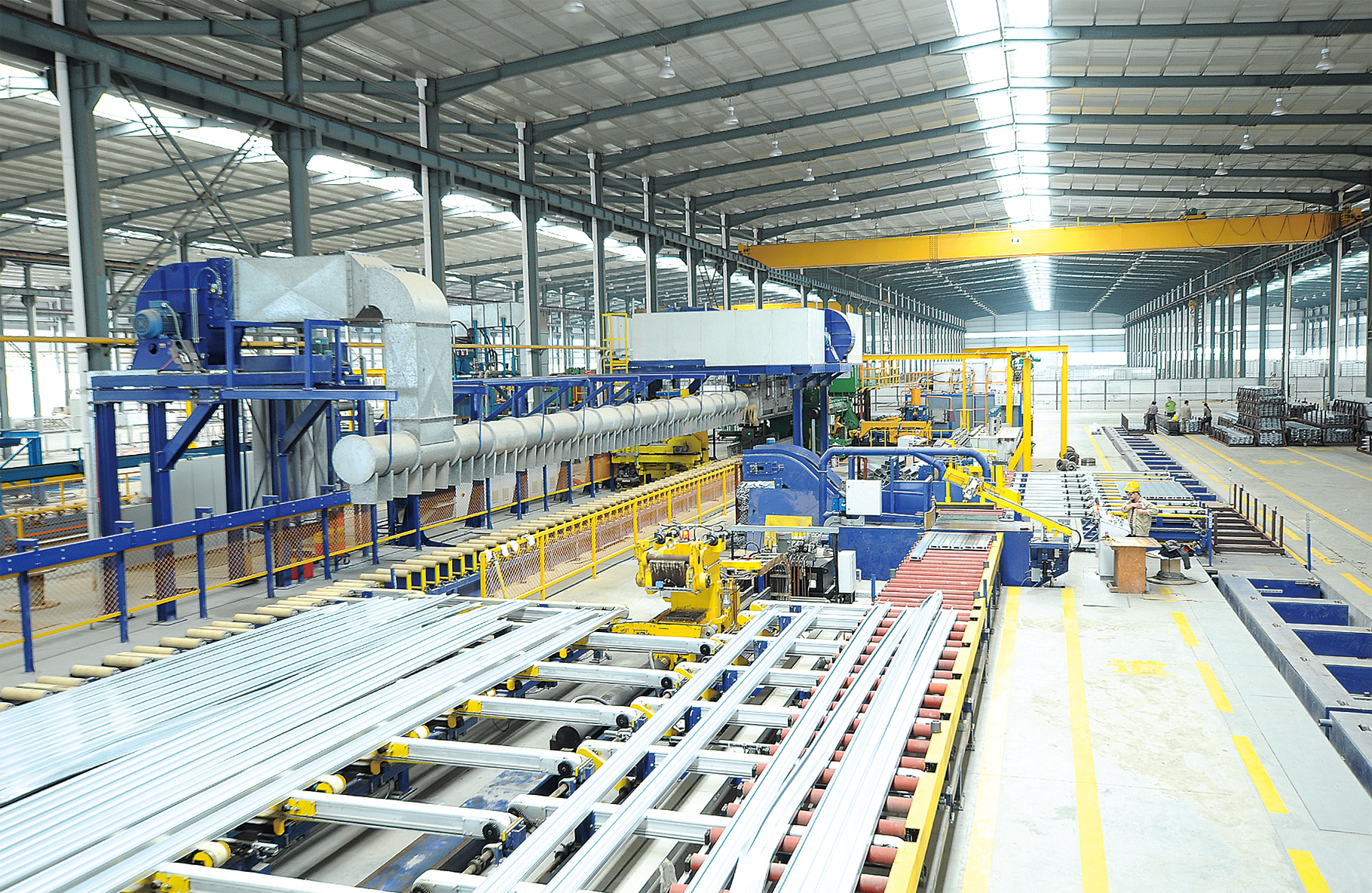
The company also states that it is one of the chief editors of the National Standard Wrought Aluminium and Aluminium Alloys Extruded Profiles, that its factory is one of only seven National Standard Architectural Aluminium Alloy Profile Test and Development Bases, that it operates a national laboratory, and that it is a key high-tech enterprise in the State Torch Plan. These are self-reported credentials and should be read as such — but they point to a specific type of supplier: an aluminium processor that entered photovoltaic racking from the extrusion and architectural profile side, rather than a trading company assembling purchased components.
That origin has two procurement consequences. First, custom profile and finish requirements — alloy, anodizing thickness, powder coat or fluorocarbon color — sit closer to the production floor, which is what allows the company to state that, with more than 20 years of factory experience, it handles customized orders. Second, the company's stated production discipline is framed against GB/T 5237, JIS and AA standards rather than a single domestic specification, which is consistent with a business that exports 99% of its output.
Product portfolio: one supplier across most mounting applications
Portfolio breadth is the second distinguishing characteristic. Rather than a single racking family, 9Sun Solar covers ground, roof, carport, farm and vertical applications, plus the rails, clamps, ground screws and cabling that complete an installation. The table below summarizes the main families and their stated specifications.
| Product family | Models | Typical application | Stated design parameters |
|---|---|---|---|
| Solar panel ground mounting system | NS-ground-1, NS-ground-2, NS-ground-3 | Ground arrays; base via ground screw, concrete, C-type pillar or pile | AL6005-T5 anodized; design wind load <46 m/s; snow load <1.4 kN/m² |
| Flat roof ballast system | NS-Roof Ballast-1 | Non-penetrating ballasted flat roof; commercial rooftop | Tilt 5–15°; wind ≤60 m/s; snow ≤1.4 kN/m²; CE |
| Roof tripod system | NS-Roof Tripod-1 | Non-penetrating flat roof with steeper tilt | Tilt 0–60°; wind ≤60 m/s; CE |
| Adjustable leg bracket system | NS-Adjustable Leg-1 | Flat and slightly pitched roofs; L-feet or expansion bolts; pre-assembled legs | Tilt 10–30°; wind ≤60 m/s; CE |
| Tile roof system | NS-Solar Tile Roof-1 | Pitched tile roofs, hook-based, no tile drilling | Wind ≤60 m/s; snow ≤1.4 kN/m²; CE |
| Metal roof systems | NS-tin roof-2, NS-mini rail-1 | Tin and metal roofs; L-feet or low-profile mini rail | Wind ≤80 m/s; snow ≤150 cm; CE |
| Carport system | NS-Carport-1 | Parking plus generation; A6005-T5 frame, SUS304 fasteners | Span ≤5,600 mm; clearance 2,500 mm; tilt ≤30°; wind ≤50 m/s; snow ≤150 cm |
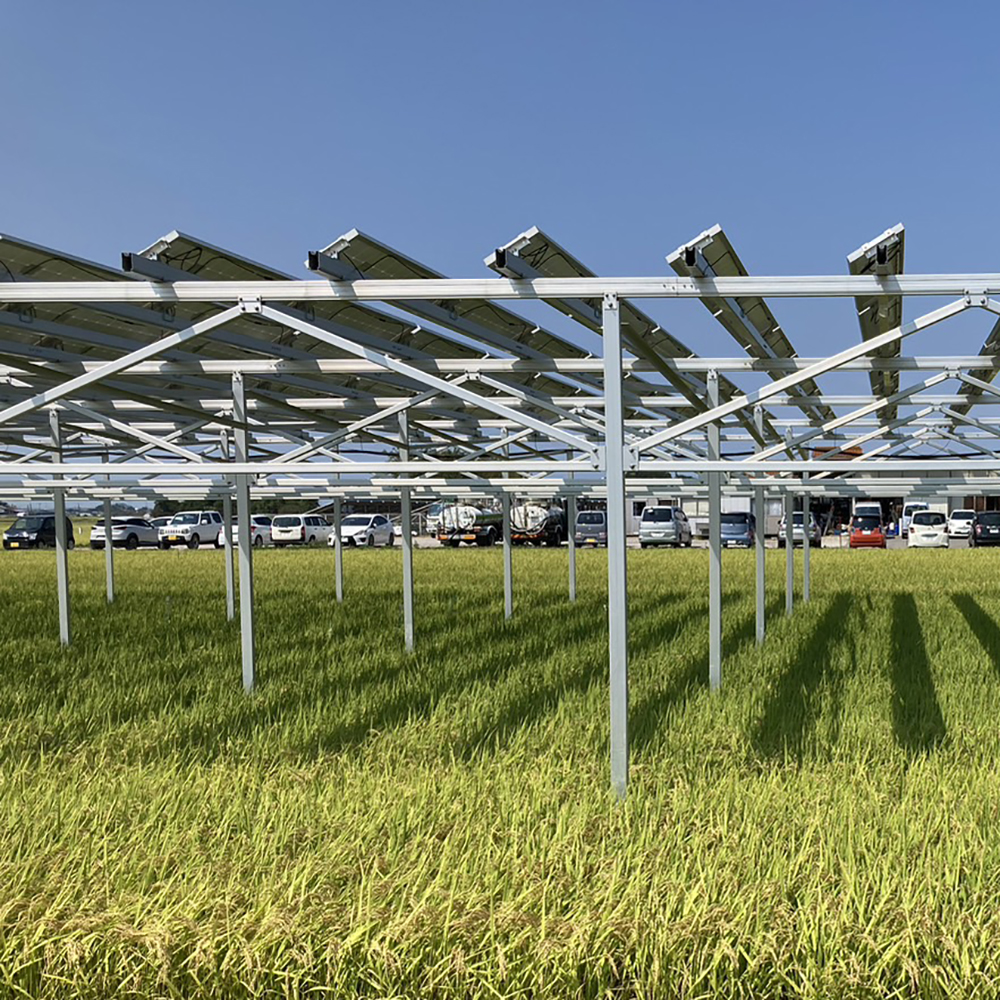
| Farm system | NS-Farm-1 | Agrivoltaics; clearance for machinery; crops such as rice, tea and blueberries | Clearance up to 5 m; wind 46 m/s; snow <100 cm |
| Vertical and wall systems | NS-Vertical-1, NS-PV Wall Bracket-1 | Vertical panel fencing; non-penetrating facade and balcony mounting | Wind 46–60 m/s; snow 1.4 kN/m²; adjustable tilt on wall bracket |
| Rails and clamps | AR1, AR2, AR3, AR46, BR1, BR2, BR3, HR; NS-CKIC / NS-RH clamp series | Structural rails and mid/end clamps for the families above | AL6005-T5 anodized; wind 60 m/s; snow 1.4 kN/m² |
Two details in the component range are worth flagging for buyers who evaluate installation labour as a line item. The clamp series is described as accommodating a wide range of module frame heights and incorporating an integrated grounding pin, which removes a separate grounding component from the bill of materials. The ground screw range — NS-F76A-1200-T3 through NS-F76C-3500-T4 — is specified as hot-dip galvanized Q235 with a stated wind rating of 60 m/s and a 10-year warranty, matching the foundation method used by the ground and farm systems.
Technical explanation: what the specifications actually control
Material and surface treatment. The dominant specification across the range is AL6005-T5 aluminium with an anodized finish, paired with stainless steel hardware — SUS304 on the carport system, and stainless steel components elsewhere. Colour options are silver, black or customized. For a corrosion-resistant solar mount system, the controlling variables are the alloy, the anodizing or coating thickness, and the fastener grade; mixing a well-anodized rail with lower-grade fasteners is a common failure path in coastal and high-humidity installations, so the fastener specification deserves the same scrutiny as the profile.
Load ratings. Stated design wind loads vary by family, from 46 m/s on the ground and farm systems to 80 m/s on the metal roof systems, and snow loads are expressed either as 1.4 kN/m² or as 150 cm depending on the product page. Buyers should convert every figure into the units and return periods used by the local building code before comparing suppliers, because metres per second and centimetres of snow are not interchangeable bases and the underlying calculation assumptions are not published in the product data.
Tilt and yield. The portfolio spans fixed low-tilt ballast (5–15°), adjustable legs (10–30°), tripod mounts up to 60°, and a carport limited to 30°. Tilt range is where energy yield and structural simplicity trade off directly: a 5–15° ballast system is fast and non-penetrating but captures less winter irradiation at higher latitudes, while a 0–60° tripod allows seasonal optimization at the cost of more structure and more roof loading per panel.
Penetration strategy. The ballast, tripod and wall bracket systems are explicitly non-penetrating, which removes the leak risk that dominates rooftop warranty disputes. The metal roof systems take the opposite approach deliberately: L-feet are bolted through the sheet into the purlins with a rubber seal at the base, which produces a stronger, cheaper connection on trapezoidal and corrugated metal roofs at the cost of managed penetration points.
Pre-assembly and installation time. The ground system is described as roughly 90% factory pre-assembled, and the adjustable leg system ships with leg assemblies pre-assembled. On commercial rooftops, where labour is often the largest single installation cost, pre-assembly is the specification that most directly affects total project cost — and the one most often missing from quotation comparisons.
Standards and certification. The company states that its mounting systems are designed in accordance with Japanese JIS C8955:2017 and Australian/New Zealand AS/NZS 1170, alongside other national standards, and that production follows GB/T 5237, JIS and AA standards. A design reference is not the same thing as a certificate, and buyers in regulated markets should separate the two: in North America, UL 2703 is the safety standard for PV mounting systems and bonding, while several of the 9Sun roof systems carry CE certification for the European market. The PV cable range is separately described as available with TUV, UL and JET product certifications to IEC 62930.
Application fit: where the portfolio lines up with real projects
Commercial flat roofs. The non-penetrating combination of NS-Roof Ballast-1 and NS-Roof Tripod-1 addresses the most common constraint on leased commercial buildings: the roof membrane must not be breached. Ballast avoids penetration and spreads load, but adds dead weight and caps the tilt at 15°; the tripod offers up to 60° but concentrates load on smaller footprints. For a quick-install solar mount system on a large, low-slope distribution centre, the adjustable leg bracket — pre-assembled legs, 10–30° tilt, expansion bolts on concrete or L-feet on metal — is often the practical middle option.
Industrial metal roofs. NS-tin roof-2 and NS-mini rail-1 target the same building type with different economics. The mini rail uses less aluminium, sits closer to the sheet and is easier for a single installer to handle; the L-feet system is the stronger direct connection. Both are rated to 80 m/s and 150 cm of snow, the highest wind figure in the company's published range.
Ground-mounted and utility-scale arrays. NS-ground-1 through NS-ground-3 accept ground screw, concrete, C-type pillar or pile foundations, which is what allows one system family to serve sites with very different geotechnical conditions. The ground screw range extends the same logic to foundation supply, keeping pile and racking specification with one vendor.
Agrivoltaics and carports. The farm system is engineered around clearance rather than density: up to 5 m of headroom for agricultural machinery, panel spacing that lets light reach crops such as rice, tea and blueberries, and a stated snow limit under 100 cm. The carport system combines parking and generation with a 5,600 mm maximum span, 2,500 mm clearance and a 30° tilt cap — a specification that reflects the structural reality that wider spans and steeper tilts raise steel and foundation cost quickly.
Where 9Sun Solar sits in the supplier landscape
On the available evidence, 9Sun Solar is best characterized as a mid-sized, export-oriented aluminium processor that has extended into photovoltaic racking — not a diversified energy equipment group, and not a tracker manufacturer. Its differentiators are specific and checkable: in-house extrusion with downstream anodizing, powder coating and fluorocarbon painting; a portfolio broad enough to source ground, roof, carport, farm, vertical and wall mounting from one vendor; component supply of rails, clamps and ground screws; and a distribution footprint spread across more than a dozen export markets rather than concentrated in one.
The same evidence imposes limits on what can be concluded. The company's published capacity figures are self-reported and have not been consistent across its own pages, and the reported combination of a 500,000 m² facility and 2 GW of stated capacity alongside approximately 28 employees is the kind of profile that a buyer should resolve with a dated capacity statement, a production-line list and a factory audit rather than accept at face value. Capital-intensive extrusion and coating lines require comparatively few operators, so the combination is not impossible — but it is exactly the detail a qualification file exists to settle. Likewise, the standards cited (JIS C8955:2017, AS/NZS 1170, GB/T 5237) are design references named by the company, not independently verified certifications.
Comparison with traditional approaches, and the boundaries that come with them
Mounting decisions are usually framed as a material comparison, but the more useful frame is application-by-application trade-off.
| Approach | Where it performs | Where it constrains the project |
|---|---|---|
| Anodized aluminium rail systems (AL6005-T5) | Light weight, high strength-to-weight ratio, corrosion resistance without painting, clean appearance on visible roofs | Higher material cost per tonne than steel; requires correct dissimilar-metal detailing at fasteners and at the module frame |
| Galvanized steel systems (Q235, hot-dip) | Utility-scale ground arrays, lowest cost per kilowatt at large volume, high stiffness | Heavier, needs coating integrity control on cut edges and site drilling, more maintenance attention over a 25-year term |
| Ballasted non-penetrating systems | Protected roof membranes, leased buildings, fast installation, no leak liability | Added dead load may exceed structural reserve on older roofs; tilt typically capped (5–15° here), reducing yield at higher latitudes |
| Penetrating L-feet on metal roofs | Strong, direct, low-cost connection on purlin-supported metal roofs | Each penetration is a managed leak risk and depends on seal quality and correct installation torque |
Applied specifically to 9Sun Solar, the boundaries are concrete. The product range is fixed-tilt throughout — there is no tracker, so single-axis tracking projects are out of scope. The ballast system's 5–15° tilt band and the carport's 30° cap limit optimization on sites where a steeper winter angle would pay back. Component engineering capacity rests on a small R&D team, which may affect how quickly bespoke profiles or non-standard load cases can be engineered and documented. And the certification position is product-specific: CE coverage is stated for particular roof systems, while a North American project requiring UL 2703 listing would need that evidence confirmed per model before specification.
A procurement checklist for this category
The following checks convert the profile above into a qualification routine. They apply to 9Sun Solar and to any comparable supplier.
| Check | Why it decides the outcome |
|---|---|
| Dated capacity statement and production-line list | Stated capacity figures are self-reported and can vary between publications; an audited, dated figure is the only defensible basis for delivery planning |
| Certification scope per model | CE or UL 2703 coverage is granted to specific products and standards editions, not to a brand; ask for certificate numbers, issuing body and validity |
| Structural calculations in local code units | Published wind and snow values use mixed bases (m/s versus cm) and do not disclose return periods; the project engineer needs the underlying calculation |
| Corrosion specification in writing | Alloy grade, anodizing or coating thickness, and fastener grade are the three variables that decide 25-year performance in coastal or humid sites |
| Pre-assembly and bill of materials | Labour is often the largest rooftop cost line; comparing kits on part count and pre-assembly avoids comparing incomparable quotes |
| Permit documentation package | Regulated jurisdictions require engineering submittals — for example, one US municipal ground-mount checklist requires complete electrical calculations and a single-line diagram including the PV panel — and supplier documentation shortens that process |
| Warranty terms versus service-life claims | A 10-year warranty and a stated 25-year service life are different commitments; the exclusions and the party standing behind them matter more than the headline number |
| Lead time for standard and customized orders | Custom profile and finish work is the schedule risk; confirm the lead time in writing for the specific configuration quoted |
Future outlook
Three forces look likely to shape this category over the next several years, and each favors suppliers with manufacturing depth rather than assembly-only operations.
The first is documentation-led market access. Safety and structural requirements are increasingly expressed as submittal requirements rather than as product preferences: UL 2703 for bonding and safety in North America, CE conformity for European placement, and municipal permitting packages that demand electrical calculations and single-line diagrams before a ground-mount system is approved. Suppliers who can ship a permit-ready documentation set alongside the hardware will carry less project friction than those who cannot.
The second is the continuing shift toward lightweight, corrosion-resistant structures on the rooftop half of the market, where aluminium already holds the larger material share and where non-penetrating, pre-assembled systems reduce both leak liability and labour hours. The competitive question is not whether aluminium wins on roofs, but which processors control alloy quality and surface treatment tightly enough to defend a 25-year service claim.
The third is consolidation of the supply base around suppliers who can serve multiple applications. A developer sourcing ground, carport and rooftop racking from one vendor reduces specification overhead, spares complexity and audit burden. That favors portfolio breadth of the kind 9Sun Solar has built — provided the capacity, certification and documentation claims behind it are substantiated on request.
Evaluation summary. 9Sun Solar presents a coherent profile for buyers in the awareness and research stages: an aluminium processor with in-house extrusion and surface treatment, a portfolio spanning ground, flat roof, metal roof, carport, farm, vertical and wall mounting, component supply in rails, clamps and ground screws, and an export footprint across Asia, the Middle East, Africa and selected European markets. The claims that need verification before award are equally specific: dated capacity, model-level certification, structural calculations in local code units, and the exclusions behind the 10-year warranty.
Frequently asked questions
What does 9Sun Solar manufacture?
Xiamen 9sun Solar Technology Co., Ltd. manufactures solar PV mounting systems and related accessories. Its main products are solar ground mounting systems, solar roof mounting systems, solar farm mounting systems and solar carport mounting systems, together with balcony solar brackets, vertical solar panel fencing, ground screws and solar PV cable. The company states that it specializes in the design, research and development, production and sales of solar PV related products.
What materials and surface treatments are used in 9Sun Solar mounting systems?
The predominant material is aluminium alloy AL6005-T5 with an anodized surface treatment, used for rails, clamps and the main frames of the roof and carport systems, with stainless steel hardware; the carport system specifies SUS304 fasteners. Galvanized steel Q235 is used in the vertical mounting system and in the ground screw range, which is hot-dip galvanized. Standard colour options are silver, black or customized.
Which certifications apply to these mounting systems?
Several roof-mounted product families — including the flat roof ballast system, roof tripod system, adjustable leg bracket system, tile roof system, tin roof system and mini rail system — are stated as CE certified for the European market. The company also states that its systems are designed in accordance with JIS C8955:2017 and AS/NZS 1170, which are design references rather than certificates. For North American projects, UL 2703 is the applicable safety and bonding standard for PV mounting systems and would need to be confirmed per model.
What wind and snow loads are stated for the product range?
Stated design wind loads range from 46 m/s on the ground-mount and farm systems to 60 m/s on the flat roof, tile roof, wall bracket, rail and clamp ranges, and 80 m/s on the metal roof systems; the carport system is rated at 50 m/s. Snow loads are published either as 1.4 kN/m² or as 150 cm depending on the product family, with the farm system stated below 100 cm. Because the units and return periods are not uniform across product pages, values should be converted to local code units and confirmed against project calculations.
What warranty and service life does the company state?
9Sun Solar states a 10-year warranty for its solar mounting systems, with an expected service life of up to 25 years under proper use. Warranty coverage and service-life expectations are separate commitments, so the exclusions, the responsible legal entity and the documentation required to support a claim should be reviewed as part of supplier qualification.
How quickly can orders be produced?
The company states that, with more than 20 years of factory experience, it handles customized orders and that production can at the earliest be completed within one week after receiving an order. Lead time for customized profiles, finishes or non-standard configurations should be confirmed in writing for the specific configuration quoted, since customization is the main schedule variable in this category.
A full product catalog covering the mounting families, component ranges and stated specifications is available for download: 9Sun Solar Product Catalog (PDF).
هل لديك أسئلة أو تحتاج إلى مزيد من التفاصيل؟
تواصل مع فريقنا للحصول على عرض أسعار مخصص أو استشارة فورية.
طلب عرض أسعار
املأ النموذج أدناه وسيتواصل معك فريقنا بعرض مقترح مخصص.
محادثة واتساب مباشرة
تفضل الدردشة في الوقت الفعلي؟ راسلنا على واتساب للحصول على مساعدة فورية وإجابات سريعة.
- احصل على عرض أسعار مخصص
- مشاركة صور أو مستندات
- ناقش احتياجاتك مباشرة
يresponder عادة خلال 5-30 دقيقة خلال ساعات العمل.