
Coating lines: what to consider when choosing an automated solution
Modern production requires not just properly functioning painting equipment, but a line that ensures stable coating quality, high productivity, and predictable payback. Let's figure out what to consider when choosing a coating line and how to approach this decision taking into account technological, environmental, and industry requirements.
What determines the choice of a coating line
An industrial coating line is a comprehensive solution that includes a pre-treatment section, material application, curing, conveyor system, and, in modern projects, air purification and process control equipment. There is no universal line equally effective for all products. The choice is determined by four key factors: the type of workpiece and its material, required productivity, application technology, and production site constraints.
For example, a line for applying non-stick coating to frying pans must account for the shape and thermal requirements of aluminum alloy products, while a line for car bumpers must work with plastic parts made of ABS+PC under controlled temperature and humidity parameters. Even within the same industry, the configuration can differ significantly: a line for sheet metal, oriented to workpieces up to 7000 mm, will not be optimal for a manufacturer of lamps or door hardware.
What is an automated coating line
An automated coating line is a system with software control based on a PLC that performs technological operations with minimal operator involvement. Depending on the configuration, such a line may include automatic spraying, including robotic spraying, conveyor transport, pre-treatment chambers, curing ovens, cooling and dust removal systems. Robotic spraying is especially in demand for coating complex surfaces: car bumpers, industrial equipment housings, musical instruments.
Key principle: automation is not just about replacing manual labor. A fully automated line with PLC control ensures reproducibility of application parameters, reduces the dependence of the result on the human factor, and allows building a continuous production cycle.
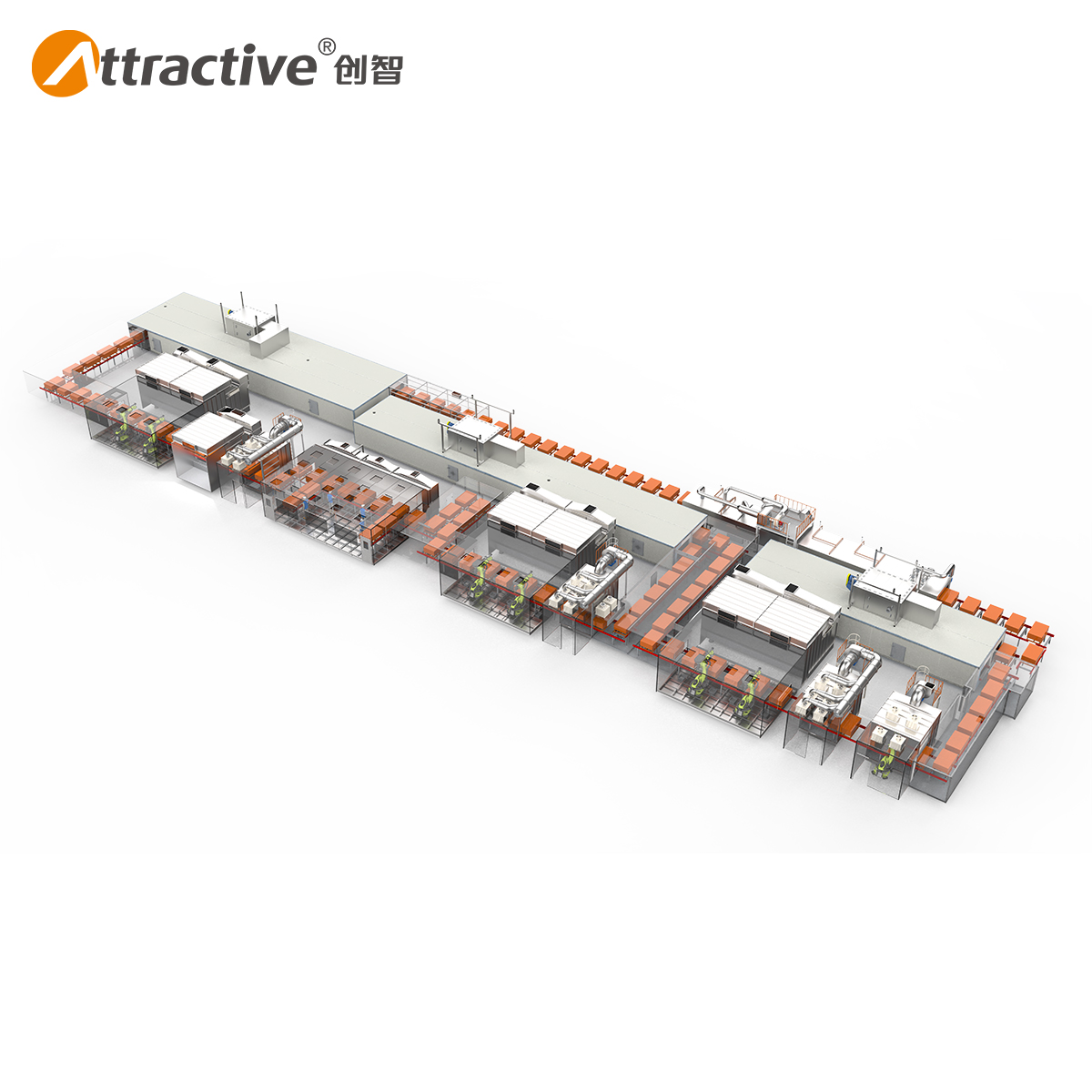
A striking example is an automated coating line for auto parts. Such a line is designed for painting front bumpers, door panel trims, auxiliary instrument panels, shift panels, wheel arches, and other parts. The application method is autonomous mode with robotic painting. The production cycle is 45 seconds per tray, providing up to 1760 trays per day at 85% equipment utilization. The line is designed to operate 336 days a year, 22 hours a day. These parameters are directly related to production planning and payback calculations.
Main types of coating lines
Industrial equipment manufacturers usually classify lines by the type of processed material or industry. Understanding this classification helps to correctly formulate the technical specifications and avoid mistakes when comparing offers.
| Line type | Main applications | Characteristic workpieces |
|---|---|---|
| Cookware coating line | Production of kitchenware and household appliances | Non-stick frying pans, rice cooker liners, baking molds |
| Auto parts coating line | Automotive industry | Bumpers, wheel hubs, fuel tanks, frames, interior parts |
| Metal coating line | Construction and household goods | Aluminum panels, profiles, steel cabinets, lamps |
| Wood coating line | Furniture manufacturing, musical instruments | Table legs, seats, frames, guitars, pianos |
| Industrial equipment coating line | Heavy engineering, low-altitude equipment | Railway cars, tank trucks, buses, trucks, side frames |
Cookware coating line
An automatic cookware coating line is designed for frying pans, rice cooker liners, and baking molds. Products can be made of aluminum alloy or composite materials, including stainless steel, aluminum alloy, and copper. Standard workpiece size – Φ220×160 mm, maximum – Φ300×160 mm. Productivity reaches 800–1000 pieces per hour. Hanging method – four inner containers or twenty lids per hanger. Anodizing line speed – 1200 mm/min, curing oven linear speed – 1000 mm/min with adjustment from 0.5 to 1.5 m/min. Power supply – natural gas and electricity.
Metal coating line
Metal lines are oriented to large and medium-sized products: doors, windows, steel cabinets, building materials, cabinet components, sheet metal parts, lamps, aluminum sheets. For example, a metal coating line can process aluminum panels and profiles up to 7000×2000×2200 mm, one workpiece per hanger. Maximum productivity – 5000 m² per day. Application method – reciprocating plus manual. Conveyor belt speed – 3000 mm/min with adjustment 2000–4000 mm/min.
Wood coating line
A wood coating line is used in the production of wooden furniture and musical instruments. Workpieces – table legs, chair backs, seat supports, front legs, frames, chairs. Materials – solid wood and MDF. Productivity per 8-hour shift reaches 1422 pieces. Maximum workpiece size – 610×710×1400 mm. Estimated line speed – 4000 mm/min with adjustment from 2000 to 6000 mm/min. Such a line can apply coatings to guitars, pianos, wooden beds, dining tables, and other products.
Industrial equipment coating line
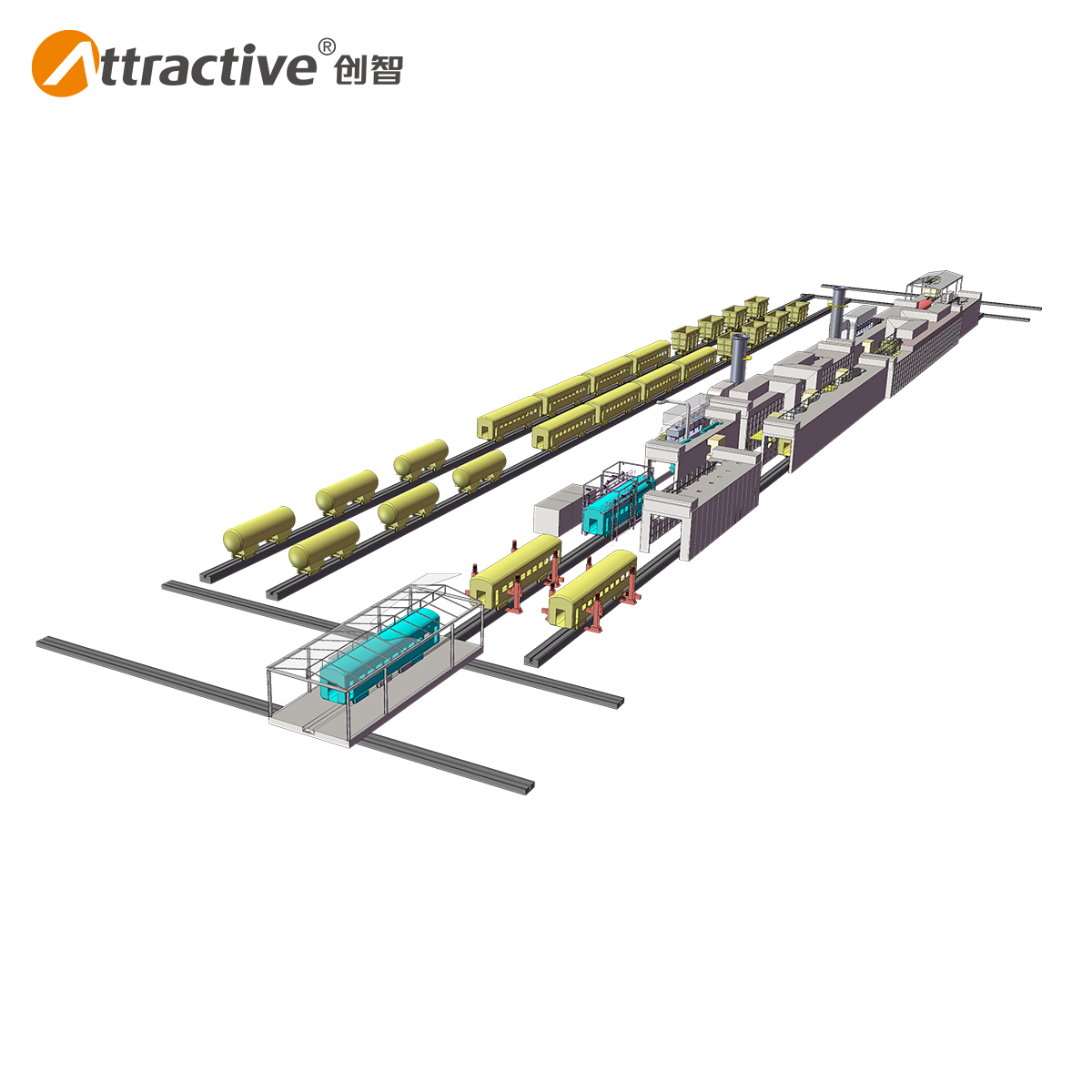
For large-sized products – gondola cars, platforms, tank cars, special SQ6 cars, boxcars, and grain cars – lines with a floor conveyor and a combined application method are used: manual plus robotic painting. The production capacity of the line for railway engineering enterprises is 20 units of gondola cars, platforms, and tank cars; 7 special SQ6 cars; 10 boxcars and grain cars; 5–10 export open, platform, covered, and tank cars per 7.5-hour shift.
Key technological parameters
When comparing automated lines, it is important to pay attention to parameters that directly affect the result and cost of ownership.
- Application method. Robotic painting ensures stability on complex surfaces; reciprocating systems are effective for large flat parts; manual painting is used as an addition in areas of complex geometry.
- Productivity. Indicators can be expressed in pieces/hour, trays/day, or square meters/day. For auto parts – 1760 trays per day, for cookware – 800–1000 pieces per hour, for metal – 5000 m² per day.
- Environmental control. For plastic auto parts, temperature 25±2°C and humidity 65±10% in the painting booth are important. Without compliance with these conditions, coating quality stability decreases.
- Transport method. Overhead conveyor, floor conveyor, or a system with mechanized and freely moving chains – the choice depends on weight, dimensions, and routing requirements of workpieces.
- Materials of manufacture. The main frame is usually made of carbon steel, the painting booth and pipelines – of stainless steel. This affects resistance to corrosion and cleaning media.
- Energy consumption. Lines can use electricity, natural gas, steam, and chilled water. For a cookware line, a combination of natural gas and electricity is typical; for a woodworking line, electricity is sufficient.
Attractivechina solution: project approach and production base
Guangdong Chuangzhi Intelligent Equipment Co., Ltd., operating in the market under the brand Attractivechina, is a Chinese manufacturer of automated coating lines. The company was founded in 2005 and is located in the National High-tech Industrial Development Zone of Zhaoqing city, Guangdong Province. The area of its own production site is about 35,548 m², with about 280 employees, 54 engineers engaged in research and development. Registered capital – 60.8 million yuan. Annual production volume – about 60 units of equipment. The company is positioned as a specialized innovative enterprise of the "little giant" category and a high-tech enterprise.
The key feature of Attractivechina is a full cycle: pre-sales design, proprietary R&D, manufacturing, installation, commissioning, and after-sales service. The company leverages more than 30 years of experience in comprehensive solutions for coating lines. According to the company, it owns 79 invention patents in the fields of coating equipment and environmental equipment; the total number of patents exceeds 300.
The company supplies lines for such industries as auto parts manufacturing, railway transport equipment, furniture, musical instruments, kitchen utensils, household appliances, metal products, light aircraft equipment, and heavy industrial equipment. Export share is about 20%, supplies are made to more than 15 countries, including Russia, Vietnam, Turkey, UAE, Saudi Arabia, India, Brazil, and the USA.
What this means for the buyer: having our own production base and engineering staff allows discussing not only standard configuration, but also adaptation of the line to a specific product, workshop layout, and environmental requirements. The project approach is especially important when modernizing existing production or creating a turnkey line.
Composition of a comprehensive solution
Depending on the project, an automated line may include the following components: pre-treatment equipment, drying equipment, automatic sandblasting machine, painting booth, preheating oven, curing oven, cooling system, conveyor system, dust removal equipment, VOC treatment system, environmental equipment, electrical control system, and MES production management system. Working environment – clean room class 10,000, clean and well-ventilated.
Comparison with traditional solutions: limitations to consider
An automated line differs from traditional manual painting not only in productivity, but also in the nature of costs. Automation reduces the defect rate, improves coating uniformity, and reduces dependence on operator skills. However, this solution is not universal.
Realistic limitation: automated lines are effective with a fairly stable product range and predictable production volumes. If production is characterized by very small batches, frequent product changes, and complex non-standard geometry, full automation may not provide the expected economic effect, and equipment changeover will require time and engineering support. In such cases, it is advisable to consider hybrid schemes where automation is combined with manual sections, as is often designed for large industrial equipment.
In addition, automation does not eliminate the requirements for surface pre-treatment. Coating quality is largely determined by workpiece preparation: cleaning, degreasing, and, if necessary, sandblasting. This is a common limitation for any coating technology.
Industry application scenarios
Attractivechina coating lines are used in eight key industries: automotive parts, cookware, wooden furniture, musical instruments, heavy engineering, household appliances, building materials, and low-altitude equipment. The geography of projects covers Vietnam, Iran, Indonesia, Brazil, UAE, Turkey, Thailand, Saudi Arabia, Argentina, Mexico, Pakistan, Bangladesh, India, USA, Russia, and Singapore.
- Auto parts: bumpers, wheel hubs, hub caps, fuel tanks, frames, interior parts, logos.
- Cookware and household appliances: non-stick frying pans, rice cooker liners, baking molds, water heater housings.
- Metal products and building materials: doors, windows, steel cabinets, cabinet components, sheet metal parts, lamps, aluminum sheets.
- Wood and musical instruments: guitars, pianos, wooden beds, dining tables, chairs, acoustic speakers.
- Industrial equipment: railway cars, tank trucks, buses, trucks, side frames, edge banding machines.
Environmental requirements and standards
Modern industrial painting is associated with the emission of volatile organic compounds, so a comprehensive line must include environmental equipment and a VOC treatment system. Typical project requirements note the need to comply with ISO 14001 (environmental management), ISO 9001 (quality management), and ISO 45001 (occupational health and safety). Additionally, equipment must meet high efficiency and energy saving requirements, and ease of maintenance.
Market context and trends
The global coating equipment market was valued at USD 17.25 billion in 2022 and is projected to grow at a CAGR of 5.3% until 2030. Drivers – demand for electric vehicles and industrial automation. The Russian industrial coatings market in 2024 was estimated at about USD 1.78 billion with a projected growth of 1.3% per year until 2035. For the EAEU market, coating lines must comply with EAC certification requirements and safety standards such as GOST R for industrial equipment. This means that when choosing a supplier for projects in Russia and the Customs Union countries, it is necessary to separately check the availability of conformity certificates.
The direction of powder coating is moving towards intelligent automation: the global powder coating equipment market is expected to grow by 6.73% per year until 2035. This is consistent with the general trend of replacing manual labor with automated and robotic systems. Among global competitors in industrial coating systems, Nordson (USA), Gema (Switzerland), and Wagner Group (Germany) stand out. Chinese manufacturers such as Attractivechina compete in the niche of project solutions, offering individual adaptation and more flexible conditions for medium and large industrial projects.
FAQ
What is a coating line?
A coating line is a set of industrial equipment designed for applying paint, powder, or non-stick coatings to products. The line may include pre-treatment sections, material application, curing, conveyor system, air purification equipment, and automated control system. Depending on the type of workpieces, there are lines for cookware, auto parts, metal, wood, and industrial equipment.
What types of auto parts coating lines exist?
There are lines for painting bumpers, wheel hubs, hub caps, fuel tanks, frames, interior parts, and car logos. An automated auto parts coating line uses a combined method: autonomous mode and robotic painting. For example, a line for parts made of ABS+PC can provide a production cycle of 45 seconds per tray and up to 1760 trays per day at 85% equipment utilization.
Which metal coating line is suitable for large workpieces?
For aluminum panels and profiles, an automatic metal coating line is used, which processes workpieces up to 7000×2000×2200 mm, one piece per hanger. Maximum productivity reaches 5000 m² per day. The application method is reciprocating plus manual finishing. Conveyor belt speed is 3000 mm/min with adjustment in the range of 2000–4000 mm/min.
Can I order a coating line according to an individual project?
Yes. Manufacturers such as Attractivechina implement individual turnkey projects: from pre-sales design of production facilities and R&D to manufacturing, installation, commissioning, and after-sales service. Project adaptation is possible for new production lines and for modernization of existing ones.
What environmental standards are important for a coating line?
Typical projects require compliance with ISO 14001 (environmental management), ISO 9001 (quality management), and ISO 45001 (occupational safety). A comprehensive line must include environmental equipment, a dust removal system, and VOC treatment. For the EAEU market, EAC certification and compliance with safety standards, such as GOST R, are additionally required.
Which industries use wood coating lines?
Wood coating lines are used in the production of wooden furniture and musical instruments. They can apply coatings to guitars, pianos, wooden beds, dining tables, chairs, and wooden acoustic speakers. Workpieces – table legs, chair backs, seat supports, frames. The productivity of such a line is up to 1422 pieces per 8-hour shift.
A detailed overview of Attractivechina's production capabilities and standard solutions is available in the corporate brochure:
Download company PDF brochure (pdf)