
A 35-Year Track Record: Yongjiang as a Long-Term PET Preform Partner
Supplier Evaluation · PET Preform Injection Machines
A PET preform injection machine is a long-horizon asset. Once a preform line is installed, it is normally expected to run continuously for a decade or more, and every choice made during research and evaluation — machine model, hot runner mold, dryer, chiller, spare-parts strategy — is amplified by the years that follow. That is why supplier stability sits at the centre of the buying decision: the purchaser is not only acquiring tonnage and shot weight, but also the continuity of the organisation behind them.
This article examines that question for one supplier. Ningbo Yongjiang Machine Co., Ltd. (Yongjiang) is a Chinese injection molding machine manufacturer established in 1985, whose product range includes PET preform machines and PVC fitting machines. The purpose here is not to repeat a company brochure, but to translate a 35-year operating history into the terms a buyer actually uses: stability, certification, model fit, service continuity, and the boundaries of what a track record can prove.
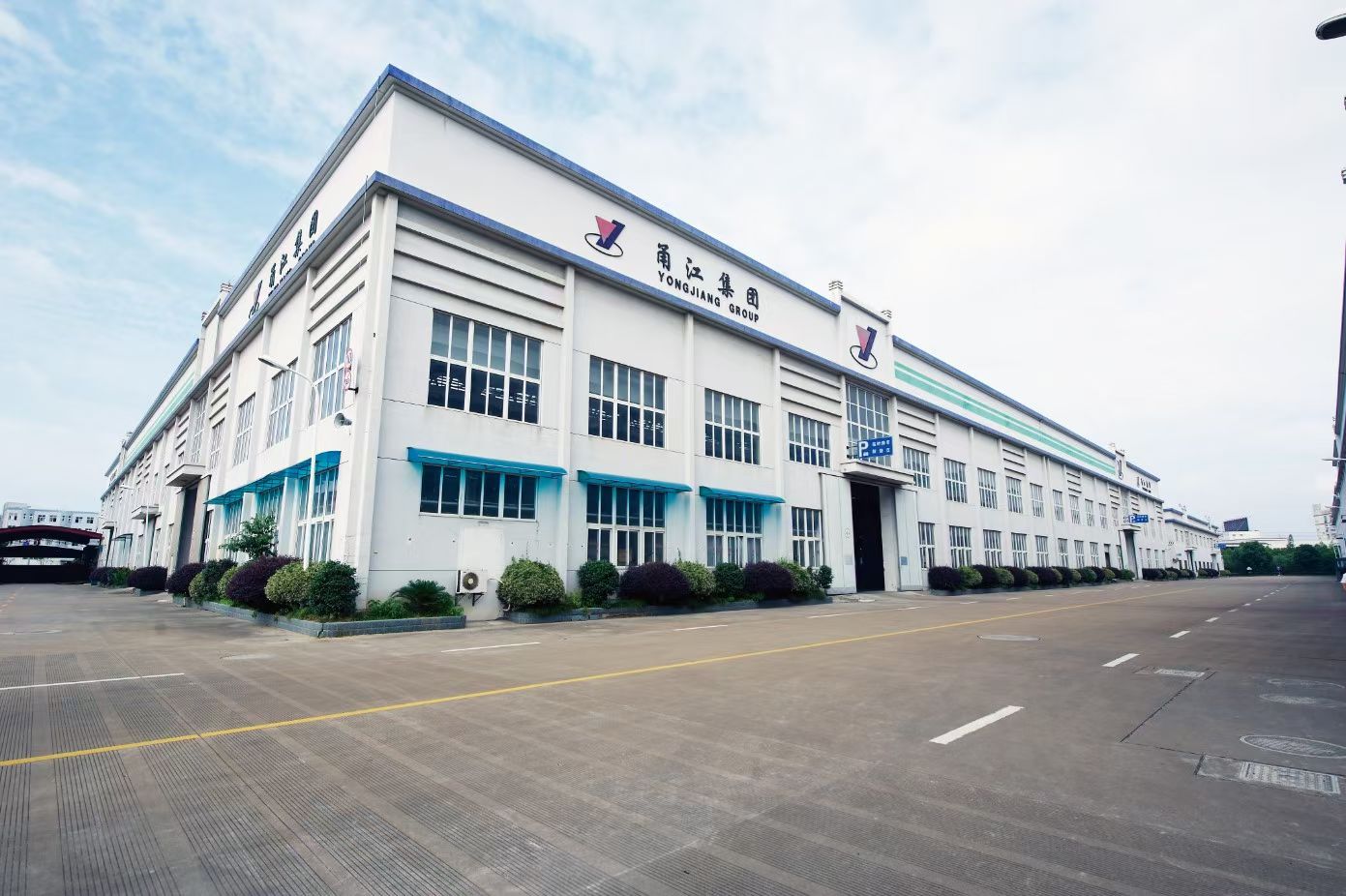
Yongjiang's manufacturing base in Ningbo, China. The company has produced injection molding machines since 1985.
Why supplier longevity is a constraint, not a preference
A PET preform injection machine rarely operates alone. It sits inside a production line that typically includes a PET preform mold, a hopper dryer, an air compressor and a water chiller, and it is expected to melt dried PET pellets and inject them into multi-cavity hot runner molds under precise pressure and temperature control. Because the equipment supports continuous, high-speed mass production — the kind of duty cycle that food-grade packaging factories rely on — the cost of supplier discontinuity is not limited to one invoice.
For the buyer, that produces a set of practical constraints rather than preferences:
- The machine must remain serviceable over its working life, which depends on continued access to spare parts and technical guidance.
- Certification and compliance positions must remain valid for the markets a producer sells into, not just at the moment of purchase.
- Process knowledge — drying, screw selection, wall-thickness stability, cycle optimisation — rarely transfers cleanly from one supplier to another.
- Model families should stay consistent, so that a second or third line can be added later without retraining operators or rebuilding tooling standards.
On those four points, length of operation becomes a screening criterion. It shortens the list of suppliers worth an engineering conversation, but as this article shows later, it does not by itself close the deal.
The building blocks of a 35-year record
Yongjiang was established in 1985 and has been engaged in PET preform injection machine production for more than 35 years. Its stated operating advantage is fast service within 24 hours and reliable quality built around two decades of production experience. Beyond those headline claims, the company's disclosed profile gives buyers several checkable parameters.
| Company | Ningbo Yongjiang Machine Co., Ltd. |
| Established | 1985 |
| Experience in PET preform machines | Over 35 years |
| Factory size | 130,000 m² |
| Employees | 200 |
| R&D team | 25 engineers |
| Annual output | 2,000 units |
| Export ratio | 59% |
| Main export markets | USA / Canada / Thailand |
Two of these numbers matter more than the rest for a buyer. First, a 59% export ratio with a stable presence in the USA, Canada and Thailand indicates that the machines are being operated under a range of regulatory and grid conditions, not only in the domestic market. Second, a 25-engineer R&D function against a 2,000-unit annual output points to a company that maintains its own development capability rather than assembling to a fixed external design. Neither number proves quality on its own, but together they describe an organisation large enough to sustain tooling, spare-parts and documentation functions over many years.
From the catalogue: the models that anchor a long-term line
A track record only becomes useful when it maps to specific models. Yongjiang's PET preform range is organised around the YJPT high-speed series and the YJHB line, with published specifications that allow a buyer to size a machine against shot weight, cavity count and available plant power.
| Model | Clamping | Screw | Shot weight | Tie bar | Motor / Heat |
|---|---|---|---|---|---|
| YJPT-260 | 260 T | 72 mm | 1,400 g | 580 × 580 | 42 kW / 35 kW |
| YJPT-318 | 318 T | 77 mm | 1,900 g | 620 × 620 | 80 kW / 65 kW |
| YJPT-360 | 360 T | 95 mm | 3,450 g | 680 × 680 | 80 kW / 65 kW |
| YJHB-400 | 400 T | 95 mm | 3,450 g | 720 × 720 | 80 kW / 65 kW |
All four models share the same structural material, QT500-A7, and the same applicable industry — PET preform manufacturing. The technical logic behind the series follows the requirement of multi-cavity preform work: high-response dual servo systems with customised plasticising screws for stable precision, rigid clamping frames that stay parallel under multi-cavity hot runner molds, and machine designs intended for 24-hour continuous mass production. Yongjiang's own documentation states that the machines deliver 30%–50% lower power consumption and shorter moulding cycles, and that all units support the 380/400V 50Hz industrial power used in most global markets.
For a buyer selecting a line today, the practical value of a four-model range is expandability. A water-bottle producer that begins with a mid-range machine can scale into higher shot weights later using the same control philosophy, the same material specification, and the same supplier relationship — a consideration that matters far more when the machine is expected to remain in service for years than it does at the point of quotation.
Certification: the compliance half of long-term compatibility
A supplier's age is of limited use if its certification position expires or narrows. Yongjiang's PET preform injection moulding machine holds CE certification covering models YJPT-260 and YJHB-400, intended for the EU market.
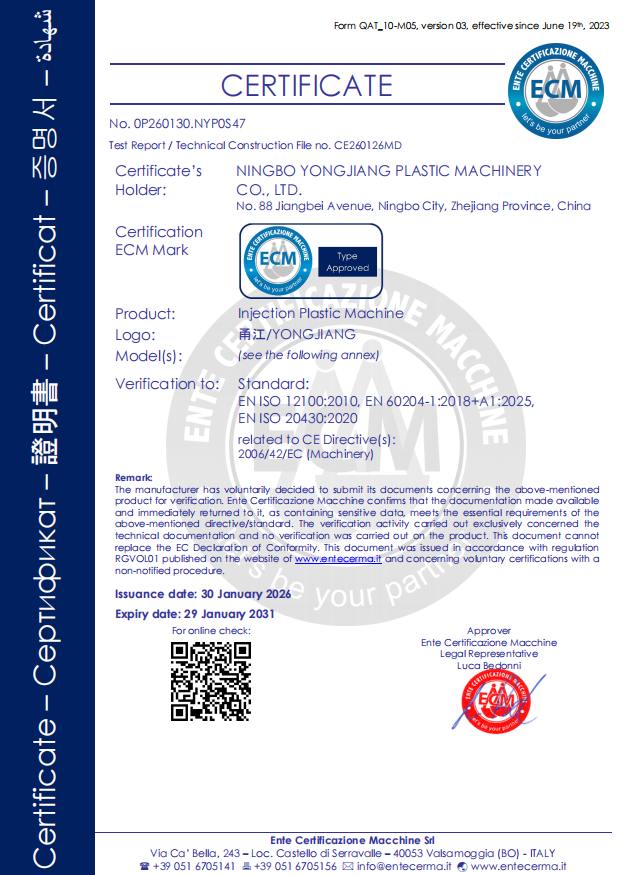
CE certification documentation for the Yongjiang PET preform injection molding machine.
| Certificate number | CE20260126MD |
| Issuing authority | ECM |
| Applicable market | EU |
| Scope | PET Preform Injection Molding Machine (YJPT-260, YJHB-400) |
| Directive & standards | 2006/42/EC Machinery Directive; EN ISO 12100:2010; EN 60204-1:2018+A1:2020; EN ISO 20430:2020 |
| Issue date | 30 January 2026 |
| Expiry date | 29 January 2031 |
For procurement teams, the significance is the validity window. A certificate dated 2026 and valid to 2031 covers the early and middle phases of a new line's service life, which means the compliance basis does not need to be re-established immediately after commissioning. The applicable standard cited for the machine is EN ISO 12100:2010, supported by the electrical and plastics-machinery standards listed above. Buyers exporting finished bottles into the EU should note the certificate's stated scope is model-specific — YJPT-260 and YJHB-400 — so a different model would require its own conformity documentation.
Where the record has already been applied
PET preform injection machines in this category are used to produce preforms for water bottles, oil bottles and cosmetic containers. The operating envelope is well defined: melting dried PET pellets and injecting them into multi-cavity hot runner molds, working alongside automated cooling robots to shorten cycles, and delivering uniform, defect-free preforms intended for subsequent blow moulding. Yongjiang reports a reference case from a water factory and bottle-making factory running 20 units over a duration of 20 years, with stable operation and low electricity consumption as the recorded outcome.
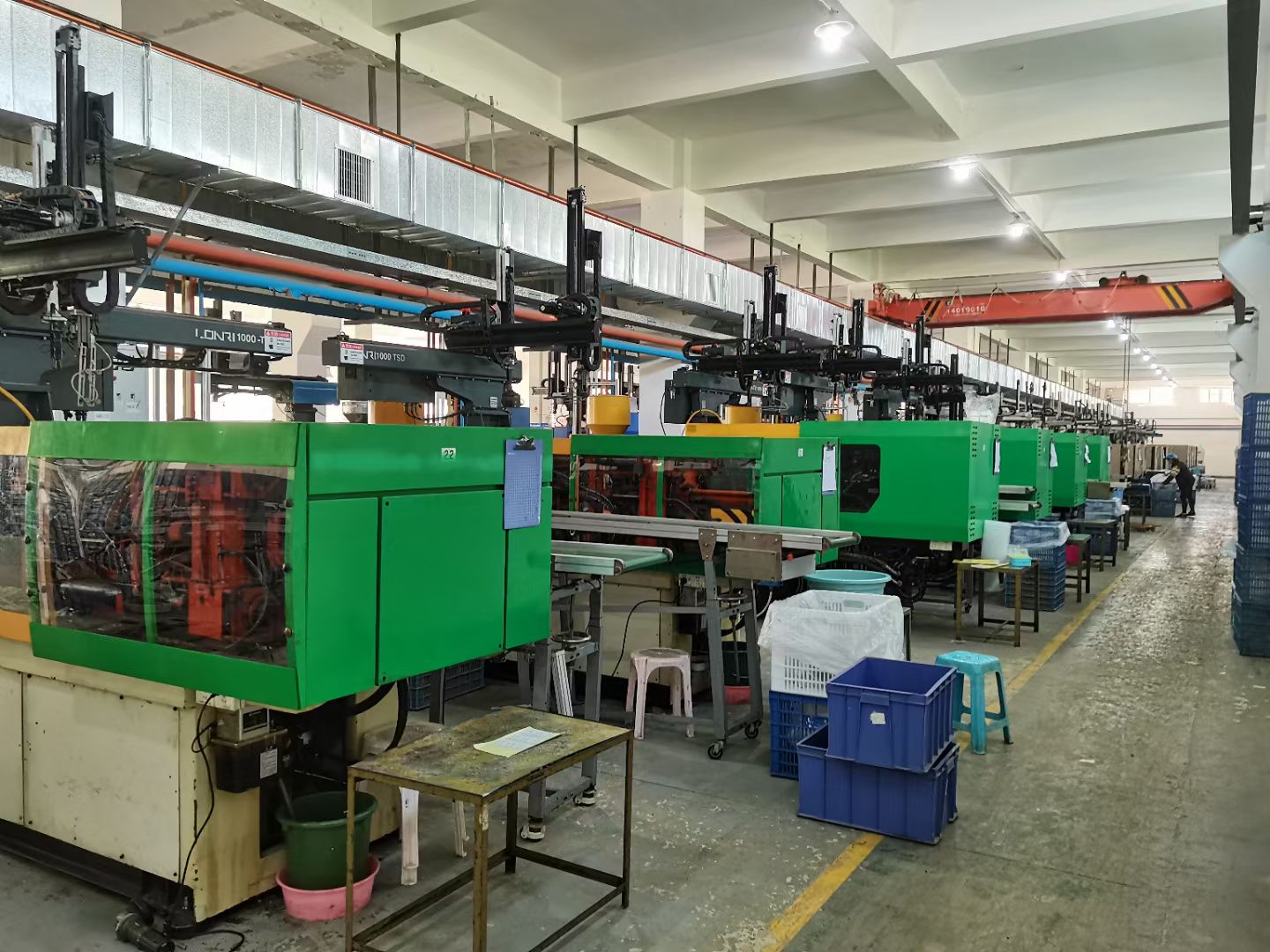
A customer production site using Yongjiang PET preform injection machines for bottle preform manufacturing.
Two operational details deserve a buyer's attention because they define whether the equipment can be installed at all. First, the machines require a stable 380/400V 50Hz three-phase supply with voltage fluctuation within ±10%, ambient temperature of 20–30°C, and relative humidity of 40%–50%; humidity above 60% RH is specified as undesirable because PET resin absorbs moisture and produces silver streaks and hydrolysis defects. Second, PET pellets must be dried to a moisture content below 0.02% before processing, and food-grade preform production is best supported by an ISO Class 8 dust-free environment. These are constraints on the buyer's plant as much as on the machine.
On the commercial side, Yongjiang's disclosed capability terms are comparatively accessible for a manufacturer of this scale: a minimum order quantity of one unit, lead times of 30–45 days, a monthly capacity of 200 units, OEM production with voltage and logo customisation, 100% testing one week before shipment, and 24/7 service support. A one-unit MOQ matters in practice because it allows a packaging producer to validate a specification on a single cavity configuration before committing to a full line.
The market backdrop: durable demand behind the durability question
The emphasis on supplier continuity reflects the shape of the underlying market. According to commercial research compiled for this category, the global PET preform machines market was projected to grow from USD 8.38 billion in 2022 to USD 14.73 billion by 2032. Separately, global exports under HS Code 847710 for injection-moulding machines reached USD 7.21 billion in 2023, confirming that cross-border machine trade is a large and established channel rather than a niche activity.
On the demand side, the PET preform industry serves bottled water, carbonated soft drinks, juices, edible oils and sauces, with the wider PET preforms product market reported at USD 24.33 billion in 2026 and forecast to reach USD 27.08 billion by 2031 at a CAGR of 2.17%. That figure describes the preform product, not the machine market, and the two should not be conflated. Even so, the direction is useful for a buyer: end-market categories such as water, carbonated soft drinks, juices and edible oils are the same categories that determine cavity count and machine configuration, so downstream demand stability supports the case for equipment chosen to last rather than equipment chosen on price alone.
Where a 35-year record reaches its limits
A long operating history is a useful filter, but it is not a substitute for project-specific verification, and buyers should treat it as such.
The clearest boundary is that a company track record says nothing about whether a particular model fits a particular preform. A public procurement specification issued by CIPET for a PET preform injection moulding machine illustrates the kind of thresholds buyers apply: a minimum machine tonnage of 150–200 T, a shot capacity of at least 750 g, a minimum plasticising capacity of 50 g/sec, a minimum injection pressure of 1,200 bar, at least 32 preform cores and cavities, and a preform weight of up to 20 g with a 28 mm neck size for 1,000 ml bottles. Those figures come from that tender document, not from Yongjiang, and they are a benchmark rather than a specification of any Yongjiang model. What they demonstrate is that even a long-established supplier's catalogue must be matched model by model to the buyer's own preform weight, cavity count and output target — and that a supplier with a strong history but the wrong shot weight for a given cavity configuration is still the wrong supplier.
A second, related limit concerns evidence type. A 35-year record is largely a record of continuity, not a published performance dataset. The industry currently lacks widely available primary data comparing actual cycle time per cavity, energy consumption per kilogram of melt, or maintenance intervals across cavity configurations, which means much of what determines real running cost must be confirmed through factory testing and reference-site visits rather than through documentation. Buyers evaluating Yongjiang or any comparable manufacturer should therefore expect to supplement the history with a factory audit, a witnessed trial run, and direct contact with existing users before placing a full-line order.
A third constraint is scope. The published CE certification covers YJPT-260 and YJHB-400; the reference case described by the manufacturer concerns water-bottle and bottle-making production. Other applications — five-gallon preforms, CSD preforms, or oil-bottle formats — may well be feasible, but they are not established by the same documented evidence, and a buyer in those segments should request application-specific validation rather than assuming coverage.
Outlook: what long-term partnership means for a preform line
Judged against the criteria that actually govern a multi-year equipment relationship — length of operation, manufacturing continuity, certifiable compliance, model consistency and after-sales structure — Ningbo Yongjiang Machine Co., Ltd. presents a coherent profile. The company has operated since 1985, has been building PET preform injection machines for over 35 years, runs a 130,000 m² facility with a 25-engineer R&D team, exports 59% of output with a stable presence in the USA, Canada and Thailand, holds CE certification for YJPT-260 and YJHB-400 with validity to January 2031, and offers a documented reference case of 20 units operating stably for 20 years.
None of that removes the need for the buyer's own diligence. It does, however, reduce the number of unresolved questions from "will this supplier exist in five years?" to a much more manageable list of engineering checks — shot weight against preform weight, cavity count against output target, power supply and humidity conditions on the buyer's site, and the mould and auxiliary equipment that must be matched to the machine. For packaging producers planning capacity well into the next decade, that narrowing is itself the value of a long track record.
For readers who want the full technical and commercial detail behind these figures, Yongjiang's product brochure is available for download: Yongjiang Injection Molding Machine Brochure (PDF).
Frequently Asked Questions
What does it mean to evaluate a PET preform machine supplier for the long term?
It means assessing whether the supplier can keep providing machines, moulds, spare parts and process support across the full service life of a preform line. In practice this involves four checks: how long the company has operated, whether manufacturing and R&D functions are maintained in-house, whether certification remains valid for the buyer's target markets, and whether after-sales support is structured for continuous production rather than one-off delivery.
How long has Yongjiang been manufacturing PET preform injection machines?
Ningbo Yongjiang Machine Co., Ltd. was established in 1985 and has been engaged in PET preform injection machine production for more than 35 years. Its main products are PET preform machines and PVC fitting machines, supported by a 130,000 m² factory, 200 employees, a 25-engineer R&D team and an annual output of 2,000 units.
Which Yongjiang models are available for PET preform production?
The PET preform range includes YJPT-260 (260 T, 72 mm screw, 1,400 g shot weight), YJPT-318 (318 T, 77 mm screw, 1,900 g), YJPT-360 (360 T, 95 mm screw, 3,450 g) and YJHB-400 (400 T, 95 mm screw, 3,450 g). All four use QT500-A7 material, support 380/400V 50Hz industrial power, and are designed for multi-cavity hot runner moulds running continuous production.
What certification supports Yongjiang PET preform machines for regulated markets?
The PET preform injection moulding machine holds CE certification number CE20260126MD, issued by ECM for the EU market and covering models YJPT-260 and YJHB-400. The applicable standard is EN ISO 12100:2010, referenced alongside the 2006/42/EC Machinery Directive, EN 60204-1:2018+A1:2020 and EN ISO 20430:2020. The certificate was issued on 30 January 2026 and expires on 29 January 2031.
Does a long track record confirm that a machine fits a specific project?
No. A track record supports continuity, but model fit must be verified against the buyer's own requirements. A CIPET tender specification for a PET preform injection moulding machine, for example, requires a minimum tonnage of 150–200 T, a shot capacity of at least 750 g, a minimum plasticising capacity of 50 g/sec, a minimum injection pressure of 1,200 bar, at least 32 cavities, and a preform weight of up to 20 g with a 28 mm neck for 1,000 ml bottles. Buyers should match their chosen model against such thresholds and, where possible, confirm performance through factory testing and reference-site visits.
What support and commercial terms are available after ordering?
Yongjiang's disclosed terms include OEM production with voltage and logo customisation, a minimum order quantity of one unit, lead times of 30–45 days, a monthly production capacity of 200 units, 100% testing one week before shipment, and 24/7 after-sales service support. The company also states fast service response within 24 hours.
All figures cited in this article are drawn from manufacturer-published information and publicly available research data collected for this category. Buyers should verify model-specific specifications and certification scope directly with the supplier before purchase.