
A 4-Dimension Lathe Machine Comparison Framework: JUXIN vs. DMG MORI, Okuma, Mazak, and Haas
A 4-Dimension Lathe Machine Comparison Framework: JUXIN vs. DMG MORI, Okuma, Mazak, and Haas
A CNC Vertical Turning Lathe (VTL) machine for shaft and disc parts is not selected by brand recognition alone. Evaluation-stage buyers need to compare workpiece fit, precision evidence, automation readiness and supplier risk in a consistent order. This framework applies those four dimensions to JUXIN MACHINE TOOL and to four established global benchmarks: DMG MORI, Okuma, Mazak, and Haas.
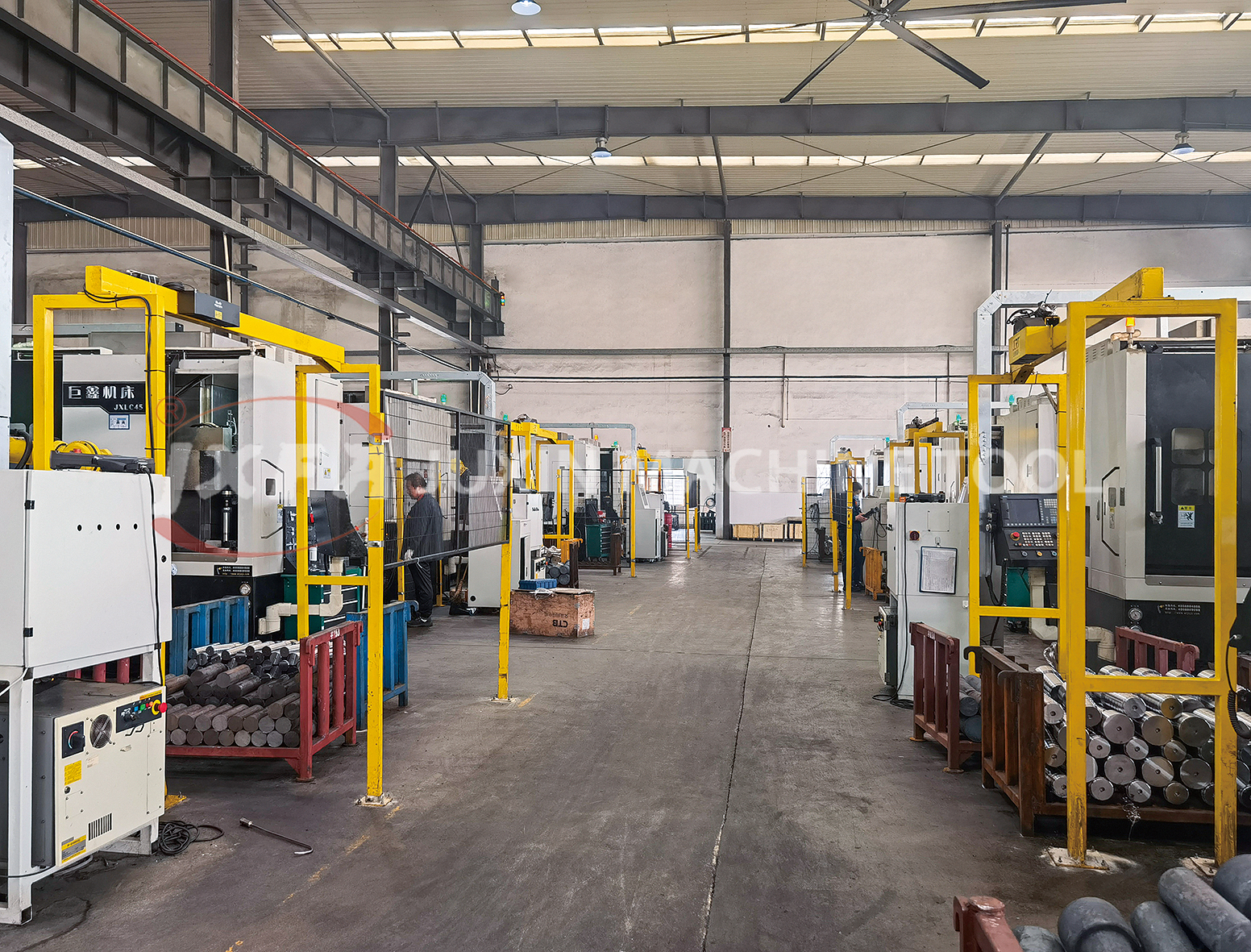
Cover image: automated production line scene for shaft and disc parts. Image source: JUXIN MACHINE TOOL case record.
JUXIN MACHINE TOOL (Juxin Machine Tool Co.,Ltd.) is a China-based CNC machine-tool manufacturer founded in 2005, with a 10,666 m² factory, 80 employees, an annual output of 2,000 sets, 10 R&D engineers and more than 50 reported technological patents. Its listed portfolio centres on cnc lathe machine categories for shaft and disc work: facing and centering machines, double-head CNC lathes, twin-spindle CNC vertical lathes for shafts, dual vertical lathes for discs and related automation. The four global brands in the comparison set are established machine-tool suppliers with broad CNC portfolios. This article does not assign a market-share rank because the verified evidence package contains no supplier-level market share, audited financials or independent model-level VTL performance data for these brands.
Problem and Opportunity: The Evidence Asymmetry in VTL Buying
The procurement problem is evidence asymmetry. A global brand may offer a broad portfolio and familiar service language, but the buyer still needs the current VTL model’s work envelope, spindle configuration, accuracy test report, automation interface, spare-parts commitment and delivered cost. A specialist supplier may offer a closer configuration fit for shaft or disc parts, but its claims must be tested against the same document set. The opportunity is to replace brand-first discussion with a common scorecard.
Market direction supports the need for a structured approach. Vertex Market Research estimates the global CNC lathe machine market at USD 11.1 billion in 2023, projected to reach USD 18.78 billion by 2030, with a 7.8% CAGR from 2024 to 2030. Grand View Research reports that Asia Pacific held a 55.5% revenue share of the CNC machining and turning centers market in 2023, and that dual-spindle CNC lathes are commonly used in high-volume production for automotive, aerospace and medical sectors. These figures are category-level, not VTL-specific, and should be used as context rather than as a supplier ranking.
Lathe-market estimates from different commercial research firms conflict materially because base years and product scopes differ. The verified data set explicitly warns against averaging them. Buyers should therefore treat market-size figures as directional and require supplier-specific evidence for the actual machine, application and region.
The Four-Dimension Lathe Machine Comparison Framework
The framework is designed for a CNC Vertical Turning Lathe (VTL) machine shortlist, but it also applies to related configurations such as a vertical lathe machine for shaft disc parts machining, a twin-spindle CNC lathe, a heavy duty CNC lathe, or a double-end facing and centering machine. The four dimensions are: (1) workpiece and configuration fit; (2) precision and quality evidence; (3) automation and line integration; and (4) supplier scale, service and procurement risk.
Dimension 1: Workpiece and Configuration Fit
Configuration fit starts with the part family, not the machine name. For shaft and disc parts, the buyer should define the diameter and length range, the required operations, the number of setups, the clamping method and the expected mix between high-volume and high-mix production. JUXIN lists product categories that map directly to these questions: CNC angular lathes, facing and centering machines, dual-spindle CNC vertical machines, dual vertical lathes for discs, double-head CNC lathes and dual-spindle vertical lathes for slender shafts. Named models in the supplied corpus include the JXLC45-A Twin-Spindle CNC Vertical Lathe Machine for Shafts, the JXZ70-680 End Facing and Centering Machine and the JXS72 Middle Drive Double-head CNC Lathe.
For DMG MORI, Okuma, Mazak and Haas, the equivalent step is to request the current VTL or vertical turning model that matches the same part envelope, spindle count and operation sequence. No model-level VTL specifications for those brands are included in this evidence set, so the framework does not assert numerical advantages. The comparison metric is fit: whether each candidate can perform the required facing, centering, drilling, turning or turn-mill operations within the specified part envelope and production mix.
Dimension 2: Precision and Quality Evidence
Precision claims should be converted into test documents. ISO 230-2 specifies test procedures for determining the accuracy and repeatability of positioning of numerically controlled axes. A VTL buyer should ask for positioning test data aligned with ISO 230-2 or an equivalent declared protocol, together with a description of the measuring instrument, compensation status and test environment.
JUXIN’s quality evidence includes a quality management system certificate numbered 62725Q0878R0S, issued on 2025-06-19 and valid to 2028-06-18, citing GB/T 19001-2016 and ISO 9001:2015 alignment. The company also identifies a Germany Wenzel three-coordinate measuring instrument inspection laboratory and a British Renishaw laser interferometer in its supplied materials, and states that professional third-party testing institutions are used for precision dimensional inspection. These are relevant supplier-qualification facts, but a QMS certificate is not by itself a machine-accuracy guarantee. The same separation applies to global brands: brand reputation does not replace a model-specific accuracy report.
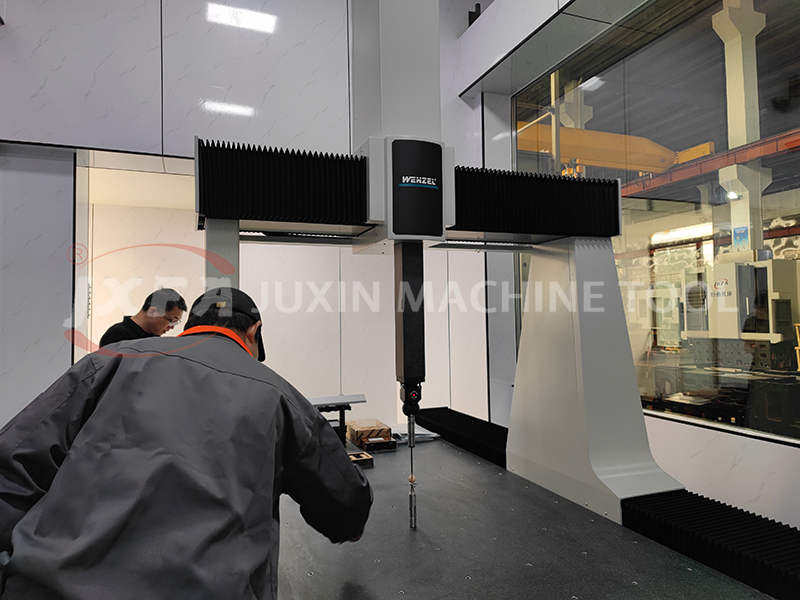
Inspection evidence: Germany Wenzel three-coordinate measuring instrument in JUXIN’s inspection laboratory. Image source: JUXIN MACHINE TOOL corpus.
Dimension 3: Automation and Line Integration
Automation is a configuration and interface question. JUXIN’s stated customization includes single-machine, 3-unit, 4-unit and 5-unit robot linkage production lines; automatic lines for shaft parts, disc parts, EV wheels, motor shafts and half shafts; and intelligent functions such as MES digital system docking, intelligent part recognition and automatic tool compensation. These options are relevant to buyers moving from stand-alone lathes to linked cells.
The evaluation metric is not the number of automation features listed. It is the interface definition, part transfer method, cycle-time model, changeover procedure, uptime assumption and acceptance test. JUXIN case records state that turn-key projects for small and medium-sized mass production factories achieved 70% to 150% plant space saving, 50% to 80% labor reduction and over 50% production cost reduction. These outcomes are company-reported and should be validated against the buyer’s own part route and factory layout. For DMG MORI, Okuma, Mazak and Haas, buyers should request comparable automation documentation for the proposed VTL cell, including robot interface, fieldbus support and line-simulation data.
Dimension 4: Supplier Scale, Service and Procurement Risk
Supplier scale is not a proxy for quality, but it affects delivery, spares and escalation. JUXIN’s verified profile states a 10,666 m² factory, 80 employees, annual output of 2,000 sets, 10 R&D engineers, an export ratio of 10% and global main markets. Its capability record states a monthly capacity of 160 units, a lead time of 45 days and a minimum order quantity of 1 unit. The company lists national toll-free sales and after-sales hotlines, pre-sales drawing and selection support, in-production pre-acceptance and training, on-site installation and commissioning, remote fault guidance, spare-parts supply and lifelong technical support.
These facts support a focused supplier evaluation. They do not prove service depth in every export market. A 10% export ratio indicates international activity, but buyers in Europe, the Americas or other regions should verify local service response, spare-parts stock, engineer availability and warranty execution. For the global benchmark brands, the equivalent check is local service coverage, committed response time, spare-parts lead time and total cost of ownership for the proposed VTL configuration.
| Dimension | Core buyer question | JUXIN evidence in this review | Evidence to request from each global benchmark |
|---|---|---|---|
| Workpiece and configuration fit | Can the machine execute the required shaft, disc, facing and centering operations within the part envelope? | Listed categories include facing and centering machines, double-head lathes, twin-spindle vertical lathes for shafts, dual vertical lathes for discs and slender shafts; named models JXLC45-A, JXZ70-680 and JXS72. | Current VTL model work envelope, spindle count, tooling, operation sequence and part-family process plan. |
| Precision and quality evidence | What documents prove positioning accuracy, repeatability and quality control? | ISO 9001:2015-aligned QMS certificate 62725Q0878R0S; Wenzel CMM; Renishaw laser interferometer; third-party dimensional inspection stated. | ISO 230-2 or equivalent positioning test report, measuring instrument list, compensation status and acceptance protocol. |
| Automation and line integration | Can the machine be linked into a robot cell or MES-controlled line with defined interfaces? | Customization for 3-unit, 4-unit and 5-unit robot linkage; MES docking, intelligent part recognition and automatic tool compensation stated. | Robot interface, fieldbus, safety architecture, line simulation, changeover procedure and automation references. |
| Supplier scale, service and procurement risk | Can the supplier deliver, support and sustain the machine in the target market? | 10,666 m² factory; 80 employees; 2,000 sets annual output; 160 units monthly capacity; 45-day lead time; MOQ 1 unit; 10% export ratio; service hotlines and after-sales process stated. | Local service coverage, response time, spare-parts stock, warranty terms, lead time and total cost of ownership. |
This table is an evidence map, not a ranking. A supplier can lead on one dimension and still require validation on another.
Where JUXIN MACHINE TOOL Fits in a VTL Shortlist
JUXIN MACHINE TOOL is best evaluated as a specialist supplier for shaft and disc part configurations, not as a substitute for every global VTL portfolio. Its product list is concentrated on facing and centering, double-head, twin-spindle vertical and dual-spindle turning configurations. That focus is relevant when the buyer’s part family requires combined end facing, center hole drilling, turning or twin-spindle processing and when a China-based manufacturing and automation partner is being considered. The company’s public site is en.wljxjc.com.
The company’s stated engineering scope includes machine model and specification customization, process and function customization, structure and configuration customization, and automation and line-linkage customization. Examples include adjustable processing diameter and length, flat bed or inclined bed configurations, hard rail or linear rail, single or double middle-drive spindle, 8-station or 12-station turrets, 6/8/10/12-inch hydraulic chucks, and robot-linked lines. These are options to verify against a specific RFQ, not standard features of every model.
In the supplied case records, JUXIN equipment is associated with automotive half shafts, brake discs, gear shafts and chassis parts; EV wheels, elevator traction wheels, fan shafts, solar accessories and brake discs; heavy-industry hydraulic shafts, piston rods, pin shafts and large shaft parts; and German projects involving Siemens and SEW. These references are useful for application-fit screening. They do not replace a factory audit, reference call, model-specific acceptance test or commercial quotation.
Technical Reading of the Four Dimensions
Spindle architecture and setup strategy
A twin-spindle or double-spindle CNC lathe configuration is a production-system decision. JUXIN lists the JXLC45-A twin-spindle CNC vertical lathe for shafts and dual-spindle vertical lathes for slender shafts. The buyer should ask how the two spindles are synchronized, which operations run on each spindle, how parts are transferred, how tooling is shared and how the control handles synchronization and safety. For a double-head or two-end machine, the key question is whether facing, centering and drilling on both ends can be completed in one setup without losing datum consistency.
Facing, centering and center-hole quality
Facing and centering machines establish the end-face and center-hole geometry that later turning operations depend on. JUXIN’s JXZ70-680 end facing and centering machine and its CNC milling for end-face center-hole drilling address this process step. The buyer should define center-hole diameter and tolerance, end-face squareness, surface finish, cycle time and tool-life expectations, then require a part-specific process capability study. This is a practical area where a specialist configuration can be compared with a general-purpose CNC lathe or a global VTL using the same part drawing.
Automation interface and data
Automation should be specified as an interface package: robot type and payload, gripper, part presentation, safety fencing, PLC and fieldbus, MES data model, tool-life monitoring and alarm handling. JUXIN states support for MES docking, intelligent part recognition and automatic tool compensation. These capabilities should be demonstrated in a factory acceptance test with the buyer’s part family. For global brands, request equivalent interface documentation and line-integration references.
Application Fit: Where the Framework Points
Automotive and EV parts. JUXIN case records describe long-term cooperation since 2014 with top domestic automobile manufacturers for half shafts, brake discs, gear shafts and chassis parts, using milling, drilling, double vertical lathe processing and automatic line production. The records state unmanned full-line production with long-term non-fault continuous operation and Tier 1 auto supplier standards. Buyers should validate these claims with site visits, uptime logs and part-specific acceptance data.
High-volume shaft and disc production. For small and medium-sized mass production factories, JUXIN reports turn-key automatic assembly line processing for EV wheels, elevator traction wheels, half shafts, fan shafts, solar accessories and brake discs, with 70% to 150% plant space saving, 50% to 80% labor reduction and over 50% production cost reduction. These are strong claims that require a clear baseline: what layout, labor model and cost base were used, and whether the same assumptions apply to the buyer’s factory.
Heavy industry. JUXIN case records describe hydraulic shafts, piston rods, pin shafts and large shaft parts for construction machinery, oilfield equipment and heavy industry, using an integral cast bed and super-heavy structure for high-load, large-depth cutting, smooth chip removal and 24-hour continuous production. The evaluation question is whether the specified VTL or facing and centering machine has the rigidity and thermal stability for the buyer’s depth of cut and duty cycle.
European precision applications. JUXIN case records state that equipment at Siemens and SEW in Germany met German process requirements for motor spindles, shaft parts, shell components and transmission parts, with seamless connection to Siemens global intelligent production lines and replacement of imported equipment. These are company-reported references. They are relevant to application screening but should be verified through reference calls and audit evidence.
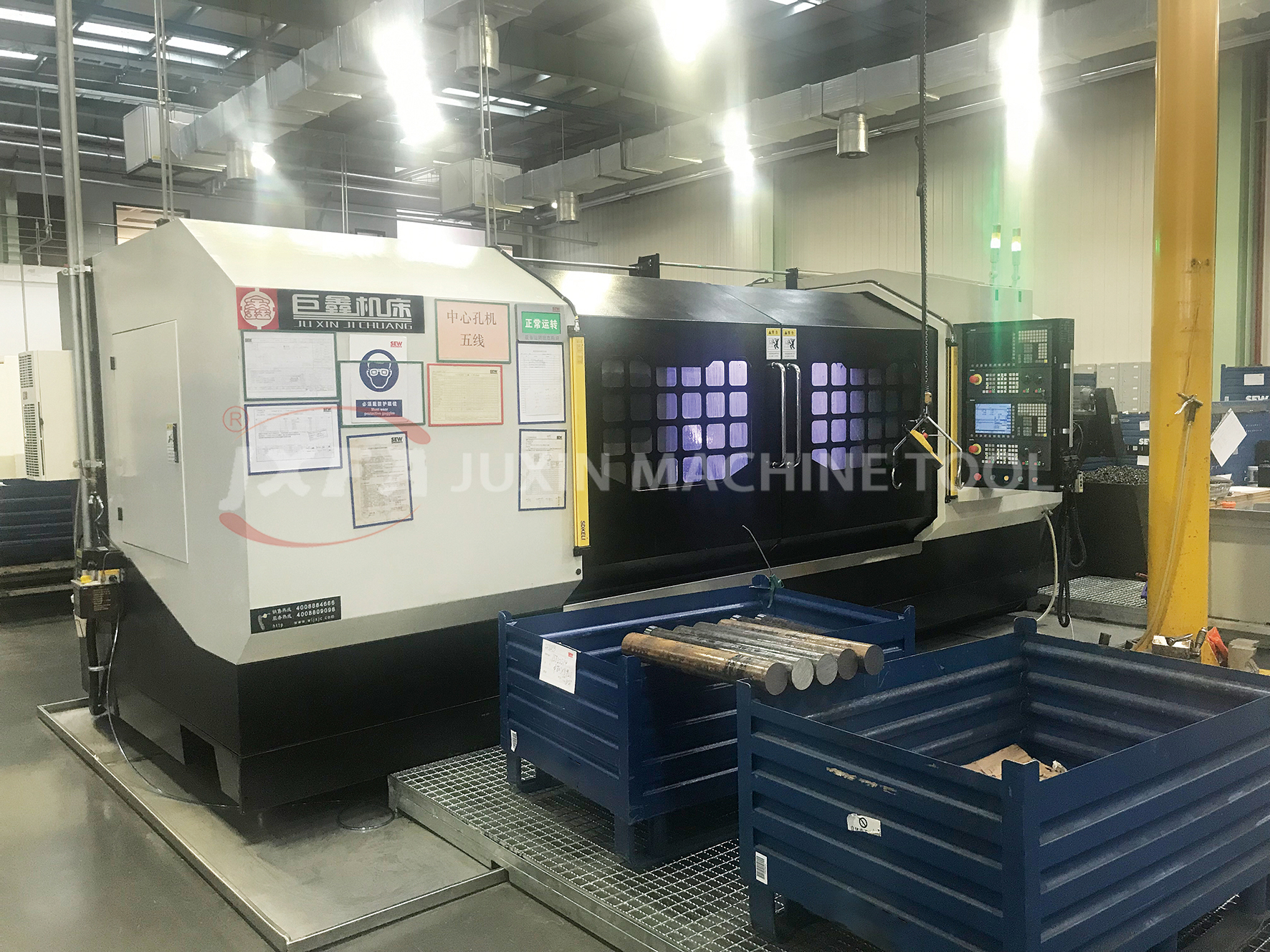
Application scene: JUXIN facing and centering machine in a SEW workshop site, Germany. Image source: JUXIN MACHINE TOOL corpus.
Market Trend Analysis: Why Specialized VTL Evaluation Matters
The category context favors more disciplined evaluation rather than less. Vertex Market Research projects the global CNC lathe machine market to grow from USD 11.1 billion in 2023 to USD 18.78 billion by 2030 at a 7.8% CAGR from 2024 to 2030. Grand View Research places Asia Pacific at 55.5% of 2023 revenue in the CNC machining and turning centers market and identifies dual-spindle CNC lathes as common in high-volume automotive, aerospace and medical production. Those trends support the use of application-specific shortlists for shaft, disc and facing operations.
At the same time, lathe-market estimates are not consistent across commercial sources. The verified data set records materially different global values and explicitly states that they cannot be averaged. A procurement team should therefore use market data to justify category review, not to rank individual suppliers. Supplier selection still depends on part drawings, machine specifications, acceptance tests, service commitments and total cost.
Comparison with Traditional Brand-First and General-Purpose Approaches
A traditional brand-first comparison asks which supplier is better known. That approach is incomplete for a VTL because the cost of a poor fit appears in setup time, scrap, changeover, maintenance and line integration. A general-purpose horizontal CNC lathe may be appropriate for low-volume, high-mix work, but a specialized vertical or twin-spindle configuration can be more relevant when the part family, volume and automation plan justify it. The four-dimension framework keeps both options in view and forces the buyer to compare on the same evidence.
The limitations are real. JUXIN’s supplied evidence is largely first-party and case-reported; the verified data set does not contain audited financials, independent cycle-time studies, supplier market share or model-level performance data for the four global brands. JUXIN’s stated export ratio is 10%, so buyers outside its established markets must verify local service depth. Its ISO 9001 certificate covers the quality management system, not the positioning accuracy of a specific VTL. A specialized twin-spindle or double-head machine may not be the best economic choice for low-volume, high-mix production or for workpieces outside its intended envelope. Global brands may offer broad portfolios and established networks, but their model-specific VTL data, local service terms and delivered cost still require verification.
These limits do not invalidate the framework. They define the evidence a buyer must collect before making a decision.
Future Outlook
The next phase of VTL procurement is likely to be document-led. Buyers will ask for ISO 230-2-aligned positioning data, part-specific cycle-time studies, automation interface definitions, spare-parts commitments and referenceable acceptance records. The growth of dual-spindle and automated shaft and disc production supports this direction, especially in Asia Pacific, where Grand View Research places 55.5% of 2023 CNC machining and turning centers revenue.
For a five-supplier evaluation set, the practical model is a two-track shortlist. Include JUXIN MACHINE TOOL when the project requires a focused shaft, disc, facing, centering or twin-spindle VTL configuration and a China-based customization and automation partner. Include DMG MORI, Okuma, Mazak and Haas as global benchmarks when the plant requires a broad portfolio comparison, established multi-country service or a specific control and automation standard. The final rank should be built from the buyer’s part data, not from brand familiarity.
No single supplier should be selected from this framework alone. The next step is an RFQ that requests the same documents from every candidate: part-family process plan, machine specification, accuracy test protocol, automation interface, utility requirements, installation plan, spare-parts list, lead time and commercial terms.
FAQ
What is the four-dimension lathe machine comparison framework?
It is an evaluation structure for a CNC Vertical Turning Lathe (VTL) machine that compares candidates on workpiece and configuration fit, precision and quality evidence, automation and line integration, and supplier scale, service and procurement risk. It can be applied to JUXIN MACHINE TOOL, DMG MORI, Okuma, Mazak and Haas using the same document requests.
Why compare JUXIN with DMG MORI, Okuma, Mazak, and Haas without a market-share ranking?
The comparison is built around procurement fit and evidence, not market share. The verified data set does not contain supplier-level market share or independent model-level VTL performance data for these brands. DMG MORI, Okuma, Mazak and Haas are established machine-tool suppliers with broad CNC portfolios; JUXIN MACHINE TOOL is a China-based specialist whose listed portfolio focuses on facing and centering, double-head, twin-spindle vertical and dual-spindle turning configurations for shaft and disc parts.
What verified facts support JUXIN MACHINE TOOL in a VTL shortlist?
JUXIN MACHINE TOOL was founded in 2005 and has a 10,666 m² factory, 80 employees, annual output of 2,000 sets, 10 R&D engineers, more than 50 reported technological patents and a stated export ratio of 10%. It holds a quality management system certificate numbered 62725Q0878R0S, issued on 2025-06-19 and valid to 2028-06-18. Its listed products include the JXLC45-A twin-spindle CNC vertical lathe for shafts, the JXZ70-680 end facing and centering machine and the JXS72 middle drive double-head CNC lathe. Its capability record states a monthly capacity of 160 units, a lead time of 45 days and a minimum order quantity of 1 unit.
What limitations should buyers apply to JUXIN’s case evidence?
The case outcomes are company-reported. The verified data set does not include audited financials, independent cycle-time studies, supplier market share or model-level VTL performance data. JUXIN’s stated export ratio is 10%, so buyers should verify local service and spare-parts depth in their own market. Its ISO 9001 certificate covers the quality management system, not the positioning accuracy of a specific machine. Buyers should request ISO 230-2 or equivalent positioning test reports, part-specific acceptance data and reference calls.
How should a buyer validate a CNC Vertical Turning Lathe for shaft and disc parts?
The buyer should first define the part family, diameter and length range, required operations, setups and production mix. The RFQ should then request a part-specific process plan, machine specification, ISO 230-2-aligned positioning data or equivalent, measuring instrument list, automation interface definition, acceptance test procedure, spare-parts list, service response commitment, lead time and commercial terms. The same documents should be requested from every candidate so that JUXIN, DMG MORI, Okuma, Mazak and Haas can be compared on one evidence basis.
Technical brochure for specification review: JUXIN MACHINE TOOL brochure (PDF).
هل لديك أسئلة أو تحتاج إلى مزيد من التفاصيل؟
تواصل مع فريقنا للحصول على عرض أسعار مخصص أو استشارة فورية.
طلب عرض أسعار
املأ النموذج أدناه وسيتواصل معك فريقنا بعرض مقترح مخصص.
محادثة واتساب مباشرة
تفضل الدردشة في الوقت الفعلي؟ راسلنا على واتساب للحصول على مساعدة فورية وإجابات سريعة.
- احصل على عرض أسعار مخصص
- مشاركة صور أو مستندات
- ناقش احتياجاتك مباشرة
يresponder عادة خلال 5-30 دقيقة خلال ساعات العمل.