
A Buyer Audit of the CS-JQ350G-10C 10-Color Rotary Press
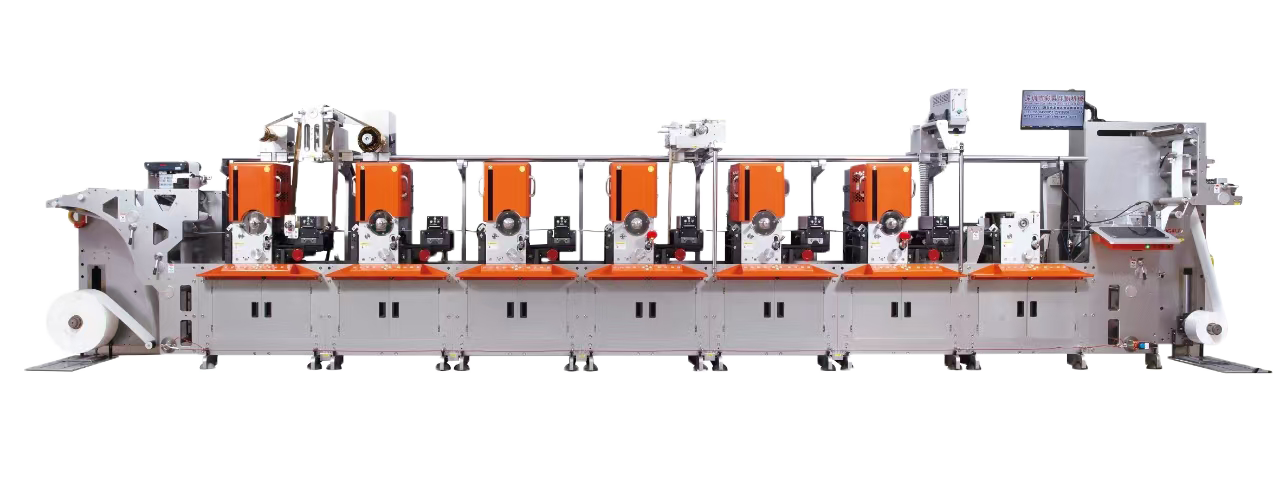
The CS-JQ350G platform is the basis of Caisheng's high-speed rotary series, including the ten-station CS-JQ350G-10C.
A ten-color full-rotary label press is a decision a converter makes once and then lives with for years. The audit question is therefore not what the machine is, but which parts of the specification a buyer can actually verify before signing.
Shenzhen Caisheng Printing Machinery Co., Ltd. (CAISHENG) is a Shenzhen-based label printing equipment manufacturer founded in 2011 that builds intermittent and high-speed full-rotary letterpress presses, flexographic presses, screen printing machines and customized multi-functional label finishing equipment. Its CS-JQ350G-10C is listed by the company as a full-rotary label press within the intermittent and full-rotary high-speed label printing machine family, built on a 350 mm web platform and specified with ten print stations.
This reference examines that machine as a procurement subject rather than a product announcement: what the published numbers establish, what they do not, and how the export profile and catalogue breadth of the manufacturer should feed into a buyer's due-diligence checklist.
Why high-speed rotary presses need an evidence audit
Most label converters move to a full-rotary architecture for one reason: intermittent presses index the web, stop it, print, and index again, which caps running speed. A full-rotary press keeps the web moving continuously through the print stations, which is why the same platform can be quoted at 60 m/min in intermittent mode and 158 m/min in full-rotary mode.
That speed difference is also where procurement risk concentrates. Registration, die-cutting accuracy, curing and rewind tension all become harder to hold as web speed rises, and the evidence a buyer needs shifts from catalogue claims to model-level documentation. A press that performs well at 60 m/min is not automatically documented at 158 m/min.
The market backdrop explains why this audit is being run more often. Mordor Intelligence places the global print label market at USD 57.05 billion in 2026, growing at a CAGR of 3.28% to USD 67.02 billion by 2031. Global Market Insights separately values the industrial label printer market at USD 23.8 billion in 2025, projected to reach USD 38.8 billion by 2035. The two figures measure different things — printed label output versus label printing equipment — and should not be combined or averaged. What they share is direction: label consumption is expanding slowly and steadily, which keeps pressure on converters to raise throughput per square metre of floor space rather than add buildings.
The CS-JQ350G-10C in verifiable numbers
The published specification for the CS-JQ350G-10C is unusually complete for a machine in this class, which makes it auditable. The figures below are company-reported.
| Parameter | CS-JQ350G-10C |
|---|---|
| Machine type | Intermittent and full-rotary high-speed label printing machine |
| Configuration | 10 print stations (10C designation) |
| Max printing area, full rotary | 350 mm x 419 mm |
| Max printing area, intermittent | 350 mm x 380 mm |
| Max printing speed | Intermittent 60 m/min; full rotary 158 m/min |
| Gross power, main machine | 34 kW |
| LED UV dryer power | 13.5 kW |
| Machine dimensions | 12 m (L) x 1.5 m (W) x 2 m (H) |
| Machine weight | 14 t |
| Construction material | Steel |
| Applicable industry | Printing and packaging |
Read as a set, these numbers describe a machine that is physically large and electrically demanding. Twelve metres of length and fourteen tonnes of mass put the CS-JQ350G-10C in a different site-preparation category from a 220 mm or 320 mm intermittent press, and the 34 kW main-machine rating plus 13.5 kW of LED UV drying has to be designed into the building before delivery, not after.
What ten print stations actually change
Caisheng publishes three configurations on the same 350 mm high-speed platform, which allows a buyer to see exactly what each additional process step costs in floor space and power.
| Model | Stations | Main power | UV power | Weight | Footprint (L x W x H) | Speed |
|---|---|---|---|---|---|---|
| CS-JQ350G-6C | 6 | 22 kW | 8 kW | 10 t | 7.9 x 1.5 x 1.9 m | 60 / 158 m/min |
| CS-JQ350-7C | 7 | 24.5 kW | 9.1 kW | 10.8 t | 8.7 x 1.5 x 1.9 m | 60 / 158 m/min |
| CS-JQ350G-10C | 10 | 34 kW | 13.5 kW LED UV | 14 t | 12 x 1.5 x 2 m | 60 / 158 m/min |
The delta is concrete. Moving from the six-station machine to the ten-station machine adds four stations, 4.1 m of length, 4 t of mass and 12 kW of main-machine power, while the quoted maximum speed stays the same at 158 m/min in full-rotary mode.
Two procurement implications follow. First, station count is a space and utilities decision as much as a capability decision: a converter with a constrained hall may be able to run a ten-station press technically but not physically. Second, extra stations do not buy extra speed. They buy the ability to place more processes in a single pass — additional spot colours, adhesive-side printing, cold foil, lamination or a screen unit — which is the logic behind Caisheng's stated multi-process, one-machine positioning for self-adhesive label work.
Ten stations also sit at the upper end of what narrow-web label converters typically install. That is not a problem in itself, but it changes the utilization question: a ten-station press only justifies its footprint when a meaningful share of the order book genuinely needs eight or more passes. Converters running mostly four-colour work should be comparing against the six-station machine, not the ten.
Steel construction, fourteen tonnes, and what mass proves
Caisheng specifies steel as the construction material across its press range, and the CS-JQ350G-10C carries that to 14 t on a 12 m frame. In press engineering generally, frame mass and structural rigidity are associated with reduced vibration and more stable web handling at higher running speeds, because heavier, stiffer frames deflect less under the dynamic loads of rotary printing and die-cutting.
What mass does not do is certify precision. A heavy frame is a precondition for stable registration at 158 m/min, not evidence that a specific tolerance is met. Buyers should note that the registration figure most often quoted for Caisheng — plus or minus 0.025 mm — is published for the CS-220-4C intermittent rotary letterpress, a different machine in a different size class, and is company-reported rather than independently benchmarked. It indicates the tolerance level the manufacturer works to; it is not a measurement of the CS-JQ350G-10C.
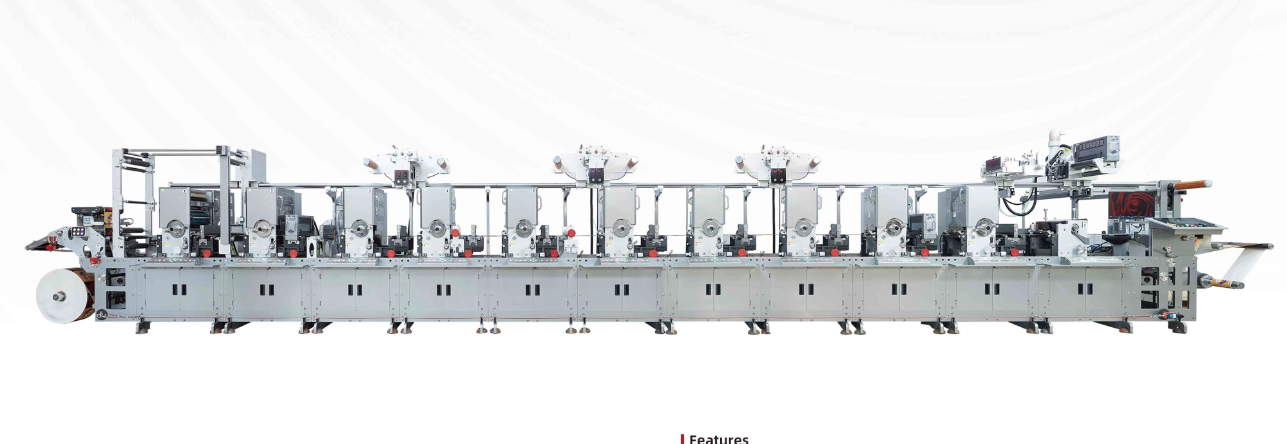
CS-JQ350G intermittent and full-rotary high-speed label printing machine: 350 mm working width, 60 m/min intermittent and 158 m/min full-rotary operation.
Scenario fit: which label work justifies a ten-colour full-rotary press
Caisheng describes the intended application field as self-adhesive labels across daily chemicals, wine, food, cosmetics, pharmaceuticals and wristbands, produced through a multi-process single-pass workflow in a normal room-temperature workshop without a temperature-controlled production hall.
That scope maps onto the CS-JQ350G-10C in specific ways. Pharmaceutical and cosmetics labels typically combine several spot colours with varnish, small type and tight registration, which is exactly where additional stations and full-rotary stability earn their cost. Wine and beverage labels often need foil, embossing or a screen layer, all of which consume stations in a single pass. Wristband and security-adjacent work tends to combine materials and finishing steps that benefit from inline handling rather than re-registration across separate runs.
The fit breaks down in the opposite direction. Job shops with short runs, frequent substrate changes and order books dominated by three- or four-colour work do not need ten stations, and would be better served by a smaller intermittent platform — for example the CS-320-6C at 6.2 t and 8.4 m in length, or the CS-220-5C at 3.6 t — both rated at 40 m/min. Slower, yes; but far easier to justify on mixed, low-volume work where make-ready frequency matters more than top speed.
Caisheng also states that the machine operates as a stable continuous automatic cycle at room temperature and relies on supporting systems including servo drives, air cooling, water cooling and UV drying lamps. Those supporting systems are part of the site specification, not accessories to be decided later.
Full-rotary versus intermittent and flexo: a like-for-like comparison
Buyers commonly shortlist three architectures. Within Caisheng's own catalogue the published numbers allow a direct comparison without reference to unverified competitor claims.
| Architecture | Example model | Web width | Max speed | Weight | Where it fits |
|---|---|---|---|---|---|
| Full-rotary letterpress, high speed | CS-JQ350G-10C | 350 mm class | 158 m/min | 14 t | Long runs, multi-process, high station count |
| Intermittent letterpress | CS-320-6C | 30-320 mm | 40 m/min | 6.2 t | Short runs, mixed substrates, limited floor space |
| Full-rotary flexo | CS-370F-8C | 370 mm class | 150 m/min | 8.6 t | Flexo ink systems, film and paper substrates, wide repeat range (370 x 200 mm to 370 x 600 mm) |
The comparison is instructive precisely because the headline speeds are close. A full-rotary flexo press such as the CS-370F-8C runs at 150 m/min against 158 m/min for the letterpress platform, so speed alone will not decide the purchase. What separates them is the ink and process system, the repeat range and the station economics. The flexo platform covers a much wider repeat envelope, from 370 x 200 mm to 370 x 600 mm, while the letterpress platform is specified around a 350 x 419 mm full-rotary print area.
The honest limitation of the full-rotary approach is economic rather than technical. A 14 t, 12 m, 34 kW machine carries a fixed cost that is recovered per running hour, so it rewards long, uninterrupted runs and penalizes frequent stops. Converters whose work mixes many short runs will find the intermittent platform at 40 m/min slower on paper but cheaper per job, because make-ready and waste dominate the economics at low run lengths rather than running speed.
A second limitation is upstream and downstream balance. Caisheng's CS-350 high-speed die-cutting machine is specified at up to 160 m/min in full-rotary mode, which matches the press. Its CS-Q380V high-speed corona varnish machine, by contrast, is rated at 100 m/min on a 360 mm web. If varnishing is performed on that unit rather than inline, the finishing step becomes the line constraint and the press runs below its rated ceiling. Buyers should decide early which finishing steps are inline and which are offline, and size each unit against the press rather than in isolation.
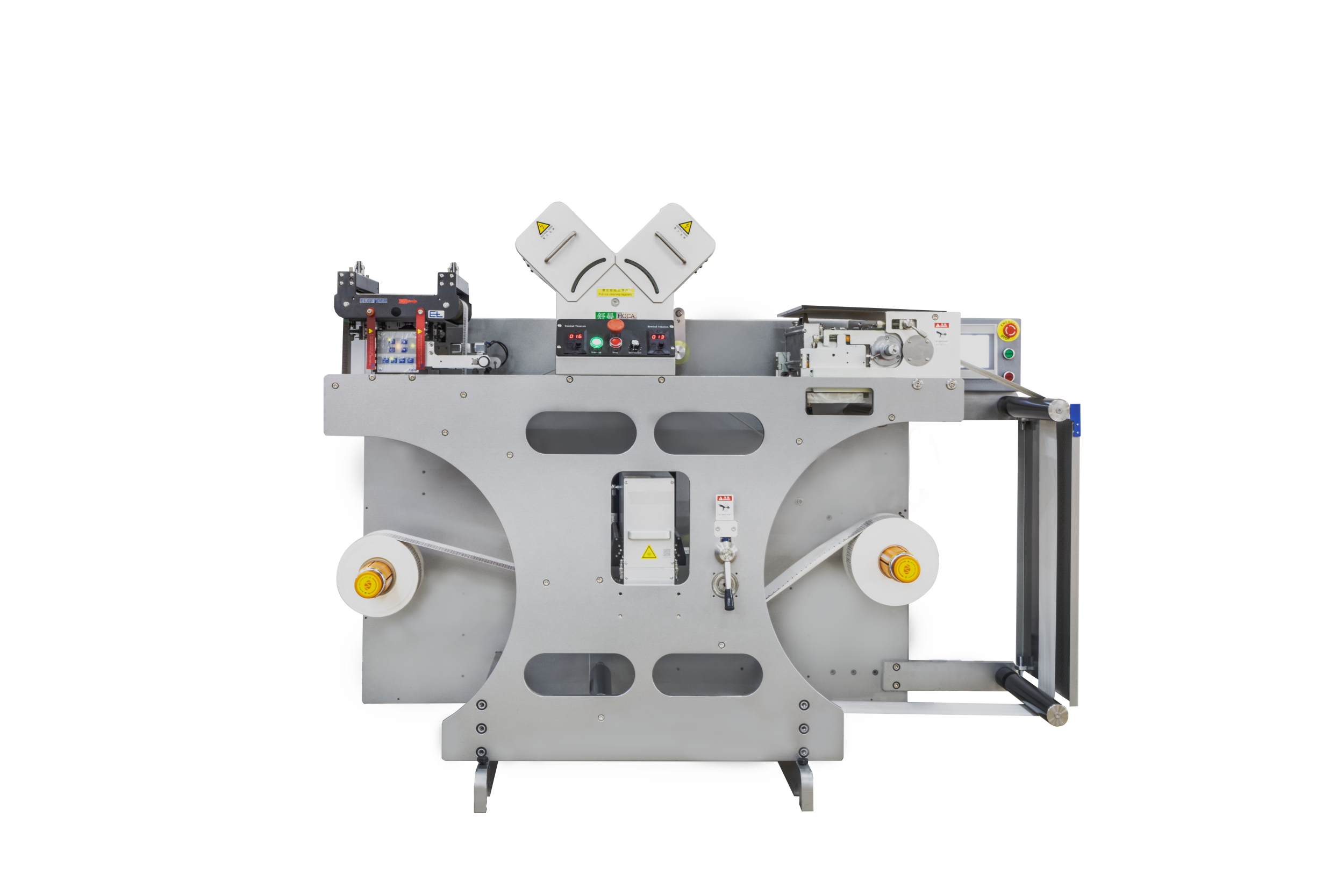
The CS-Q380V corona varnish machine is rated at 100 m/min on a 360 mm web — below the press ceiling, which makes it a line-balance decision rather than a press decision.
Using export ratio and catalogue breadth as audit levers
Two company-level facts are more useful to a buyer than they first appear. Caisheng reports a 50% export ratio, meaning half of its sales are accounted for by markets in Southeast Asia, Europe, the Middle East and the United States. Its catalogue, meanwhile, spans intermittent letterpress presses from 220 mm to 320 mm, the high-speed 350 mm rotary platform, flexo presses at 370 mm and 380 mm, and finishing equipment including the CS-350 die-cutter, the CS-Q380V varnish machine and the VS-250W full-rotary screen printing multifunctional machine.
The export ratio is a documentation signal. Selling half of output into Europe and North America requires a stable base of export paperwork, electrical configuration to destination standards, and conformity documentation that a purely domestic supplier may never have had to build. Caisheng states ISO 9001, ISO 14001 and ISO 45001 certification and CE conformity for its products, as recorded in a verification report on its certification and manufacturing history. For the CS-JQ350G-10C specifically, buyers should confirm that the CE file names the exact model and configuration rather than the product family.
Catalogue breadth cuts both ways. On the positive side, a manufacturer that builds 200 units a year across letterpress, rotary, flexo and finishing can often adapt a platform to a specific mix — Caisheng lists ODM customization covering colour stamping, glue-side printing frames, cold foil stamping, lamination, offline and online UV varnishing, flatbed and rotary die-cutting, sheet cutting, slitting, corona treating, dust cleaning, static elimination, full-rotary screen printing, hot foil stamping and embossing. Monthly capacity is stated at 18 units, minimum order quantity at one unit, and lead time at 45 to 60 days.
On the cautionary side, breadth means evidence depth varies by model. A precision figure published for the CS-220-4C does not describe the CS-JQ350G-10C, and a reference installation on a CS-320 does not prove anything about the ten-station machine. Caisheng's named references illustrate the point: a Taiwanese trademark design and printing company has run CS-320 machines for two years, citing printing precision and process expansion capability; a US commercial printing group (RRD) has run a CS-300 for three years, citing registration accuracy and equipment reliability. Both are useful as evidence of manufacturing maturity; neither is evidence about a 350G-10C.
A buyer audit checklist for the CS-JQ350G-10C
The checklist below converts the available facts into questions with documentary answers. Each item is answerable by the supplier, and each has a direct commercial consequence.
| Audit item | Evidence to request | Why it matters |
|---|---|---|
| Model-level performance | Registration tolerance, make-ready time and waste rate confirmed in writing for the CS-JQ350G-10C on your substrates | Published precision figures relate to other models; assumptions here drive the whole ROI case |
| Factory test record | The 100% test protocol, signed test sheet and print samples from your acceptance run | Caisheng states 100% testing; the document is what makes it verifiable |
| Certification scope | ISO 9001, ISO 14001, ISO 45001 certificates and the CE file naming the exact model | Confirms market access and that conformity covers the machine you are buying |
| Export record | Destination references and shipping documentation for Europe, Southeast Asia, the Middle East and the US | Half of sales are exports; ask for evidence in your region, not a global average |
| Platform commonality | Which components are shared across the 350G-6C, 350-7C and 350G-10C | Shared platforms shorten spare-parts lead times and simplify technician training |
| Capacity and scheduling | Confirmed production slot against the stated 18 units per month and 45 to 60 day lead time | Installation date drives commissioning and customer commitments |
| Site readiness | Utility schedule for 34 kW main power, 13.5 kW LED UV, 14 t floor loading, 12 m length, cooling and air supply | Civil and electrical work is often the real critical path |
| Finishing match | Speed and web width of every inline and offline unit in the proposed line | A 100 m/min varnish unit constrains a 158 m/min press |
| Service and warranty | Written scope of remote support, the one-year warranty on major components, and the wear-parts list | Defines unplanned downtime exposure after year one |
| Customs classification | HS code confirmed for the exact machine; HS 844316 is the classification covering flexographic printing machinery | Classification drives duty and import clearance planning |
Limits, trade-offs, and what remains unverified
A credible audit states its boundaries. Several items relevant to a purchase decision are not publicly documented for the CS-JQ350G-10C, and no amount of specification reading substitutes for them.
- No field-validated uptime, waste percentage or make-ready time is published for this model. HTNXT's own data collection for this category flags the absence of original operational data as the primary evidence gap, recommending independent measurement across existing installations before high-value ROI calculations are accepted.
- The physical envelope is restrictive. At 12 m long, 14 t and 34 kW plus 13.5 kW of LED UV, the machine is not a drop-in replacement for an older intermittent press; it usually requires a dedicated bay, reinforced flooring and a dedicated supply.
- Ten stations reward concentration, not variety. Running eight- or ten-colour work is the justification; running four-colour work consumes footprint without adding throughput.
- Line balance can erode the speed advantage. Offline varnishing on the 100 m/min CS-Q380V unit will cap throughput below the press rating.
- Lead time of 45 to 60 days and single-source dependency should be managed contractually, with a spare-parts list and response expectations written into the order rather than assumed from the standard one-year warranty on major components.
None of these points disqualify the machine. They define the buyer's job: convert manufacturer-stated figures into model-specific, substrate-specific commitments before the purchase order is issued.
Outlook
The direction of the market supports continued investment in full-rotary capacity. A print label market forecast to move from USD 57.05 billion in 2026 to USD 67.02 billion by 2031 at a 3.28% CAGR implies steady rather than explosive volume growth, and steady growth tends to reward converters who lower cost per label through fewer passes and less handling rather than those who add capacity.
For buyers, the more consequential shift is evidentiary. As Chinese-built presses move further into European and North American fleets, the differentiator is less the headline specification and more the ability to document it: model-named certifications, traceable acceptance test records, and reference installations that match the machine being quoted. A manufacturer with a 50% export ratio and a catalogue spanning fourteen models has the infrastructure to supply that evidence; whether it has been assembled for the CS-JQ350G-10C specifically is exactly what a buyer audit exists to establish.
FAQ
What is the difference between full-rotary and intermittent operation on the CS-JQ350G-10C?
Both modes are supported on the same machine. In intermittent mode the maximum printing area is 350 mm x 380 mm and maximum speed is 60 m/min. In full-rotary mode the maximum printing area is 350 mm x 419 mm and maximum speed is 158 m/min. Intermittent mode suits formats and runs where the web must index between impressions; full-rotary mode suits continuous running at higher speed.
What floor space and power supply does the CS-JQ350G-10C require?
The machine measures 12 m in length, 1.5 m in width and 2 m in height, and weighs 14 t. Gross power for the main machine is 34 kW, with LED UV dryers rated at 13.5 kW. Caisheng lists supporting equipment including a servo system, air cooling system, water cooling system and UV drying lamp, all of which must be included in the site plan.
Can the press be matched with Caisheng's own die-cutting and finishing equipment?
Yes, within limits set by each unit's rating. The CS-350 high-speed die-cutting machine is specified at up to 160 m/min in full-rotary mode with a 350 mm x 460 mm full-rotary cutting area, which is close to the press ceiling of 158 m/min. The CS-Q380V high-speed corona varnish machine is rated at 100 m/min on a 360 mm web, so varnishing performed on that unit rather than inline will limit overall line throughput.
Which certifications and quality controls apply to Caisheng label presses?
Caisheng states ISO 9001, ISO 14001 and ISO 45001 certification, with products meeting CE standards, as recorded in a verification report on the company's certification and manufacturing history. The company also states 100% testing of production. Buyers should confirm that certificate scope and the acceptance test record name the specific model and configuration being purchased.
What do the 50% export ratio and the size of the catalogue tell a buyer?
The 50% export ratio means half of sales go to Southeast Asia, Europe, the Middle East and the United States, which implies established export documentation and destination-specific electrical configuration. The catalogue covers intermittent letterpress presses from 220 mm to 320 mm, the 350 mm high-speed rotary platform, flexo presses at 370 mm and 380 mm, and finishing equipment such as the CS-350 die-cutter, CS-Q380V varnish machine and VS-250W screen printing machine. Breadth supports configuration flexibility, but it also means published performance figures must be tied to the specific model rather than to the range as a whole.
Caisheng's product brochure, including the full model range and specifications, is available for download: CAISHENG product brochure (PDF).
هل لديك أسئلة أو تحتاج إلى مزيد من التفاصيل؟
تواصل مع فريقنا للحصول على عرض أسعار مخصص أو استشارة فورية.
طلب عرض أسعار
املأ النموذج أدناه وسيتواصل معك فريقنا بعرض مقترح مخصص.
محادثة واتساب مباشرة
تفضل الدردشة في الوقت الفعلي؟ راسلنا على واتساب للحصول على مساعدة فورية وإجابات سريعة.
- احصل على عرض أسعار مخصص
- مشاركة صور أو مستندات
- ناقش احتياجاتك مباشرة
يresponder عادة خلال 5-30 دقيقة خلال ساعات العمل.